

Reading news that helps you learn
 |
Description
Book Introduction
The most reliable way to improve your non-fiction reading skills!
Developing study skills through reading news
Non-fiction reading comprehension is the foundation of all studies in middle and high school, and it has become even more important in the revised 2028 college entrance exam.
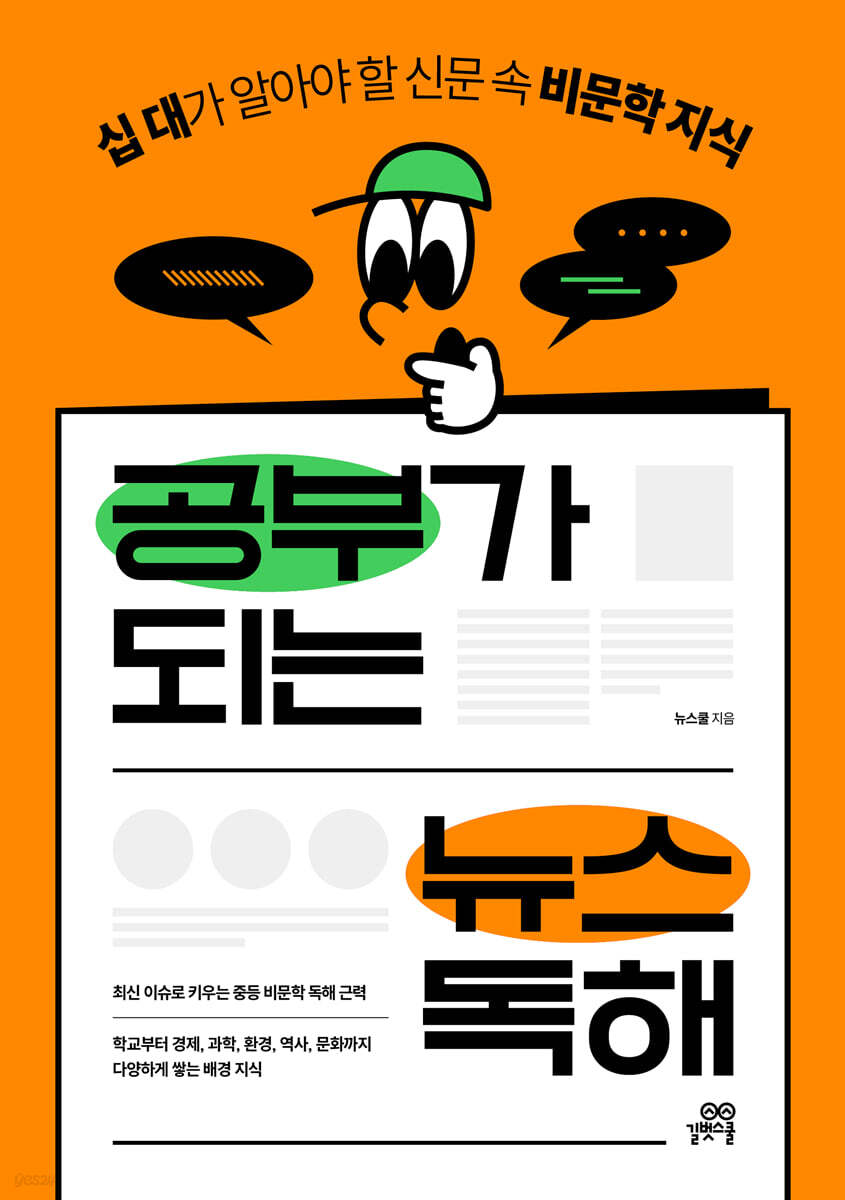
"News Reading for Study" guides teenagers through the non-literary knowledge they need to know in newspapers and helps them develop their non-literary reading skills.
New School, composed of current and former newspaper reporters and school teachers, has selected topics suitable for developing middle school reading comprehension skills, ranging from education to economics, science, politics, and the environment, and compiled books that can be read as news and thought about through discussion.
"News Reading for Study" provides background knowledge and a rich vocabulary in various fields, and develops logical reasoning and discussion skills by presenting conflicting opinions on a single topic.
Developing study skills through reading news
Non-fiction reading comprehension is the foundation of all studies in middle and high school, and it has become even more important in the revised 2028 college entrance exam.
"News Reading for Study" guides teenagers through the non-literary knowledge they need to know in newspapers and helps them develop their non-literary reading skills.
New School, composed of current and former newspaper reporters and school teachers, has selected topics suitable for developing middle school reading comprehension skills, ranging from education to economics, science, politics, and the environment, and compiled books that can be read as news and thought about through discussion.
"News Reading for Study" provides background knowledge and a rich vocabulary in various fields, and develops logical reasoning and discussion skills by presenting conflicting opinions on a single topic.
- You can preview some of the book's contents.
Preview
index
Chapter 1 Education
01 Is banning cell phone use on campus a violation of human rights?
02 Is it okay to implement justice with fists instead of the law?
03 Shouldn't young people be allowed to make declarations on current affairs?
04 Can ChatGPT do my homework for me?
05 Are you a perpetrator of school violence? We refuse your admission to our school.
06 Should the superintendent of education be elected directly?
Chapter 2 Law and Politics
01 Can a country prevent individuals from smoking?
02 Teenagers are banned from using social media?
03 Can a crime that doesn't ask be solved with the death penalty?
04 Juvenile offender, is this okay?
05 Is unification absolutely necessary?
06 At what age can someone be considered elderly?
07 Why martial law is guaranteed in the Constitution
Chapter 3 Economy
01 Is basic income a myth?
02 If the population declines, will economic growth also stop?
03 Why can't the minimum wage be raised significantly?
04 Are delivery drivers workers or self-employed?
05 Will Tariffs Help the Economy?
Chapter 4 Ethics
01 Should euthanasia be legally permitted?
02 Medicine if used well, poison if used poorly... Are genetic scissors okay?
03 A world where my body is my ID card... Is that okay?
04 Anonymity: How far should it be guaranteed?
Chapter 5 Media
01 Is it necessary to report on celebrity suicides?
02 Are the increasing number of kiosks only convenient?
03 Is game addiction a disease?
04 The right to be forgotten: to what extent should it be guaranteed?
Chapter 6 Environment
01 Is a cable car really necessary in a national park?
02 Will the dolphins that went to the sea be happy?
03 Should greenwashing also be sanctioned?
04 Can horned animals stand trial?
05 What happens when you keep buying clothes
06 Should our country also pay off its climate debt?
07 Is it okay to use pandas as a diplomatic tool?
Chapter 7 Science - Space
01 Space Debris: Who Should Be Responsible?
02 Are scientific talents banned from entering medical school?
03 Is nuclear power the savior of the AI era?
04 Can AI be used as a lethal weapon?
Chapter 8 Culture and History
01 Would you buy a banana stuck on the wall for 8.7 billion won?
02 What if you could sell the right to steal for money?
03 Snow White with dark skin, is it too much?
04 The number of No○○ zones is increasing. Is it okay?
05 Are AI-drawn drawings plagiarism or art?
06 Is it fair for transgender people to compete in the Olympics?
07 Are new words a destruction of language or a play on words?
08 When was the Republic of Korea founded?
09 The Anthropocene debate is ongoing
01 Is banning cell phone use on campus a violation of human rights?
02 Is it okay to implement justice with fists instead of the law?
03 Shouldn't young people be allowed to make declarations on current affairs?
04 Can ChatGPT do my homework for me?
05 Are you a perpetrator of school violence? We refuse your admission to our school.
06 Should the superintendent of education be elected directly?
Chapter 2 Law and Politics
01 Can a country prevent individuals from smoking?
02 Teenagers are banned from using social media?
03 Can a crime that doesn't ask be solved with the death penalty?
04 Juvenile offender, is this okay?
05 Is unification absolutely necessary?
06 At what age can someone be considered elderly?
07 Why martial law is guaranteed in the Constitution
Chapter 3 Economy
01 Is basic income a myth?
02 If the population declines, will economic growth also stop?
03 Why can't the minimum wage be raised significantly?
04 Are delivery drivers workers or self-employed?
05 Will Tariffs Help the Economy?
Chapter 4 Ethics
01 Should euthanasia be legally permitted?
02 Medicine if used well, poison if used poorly... Are genetic scissors okay?
03 A world where my body is my ID card... Is that okay?
04 Anonymity: How far should it be guaranteed?
Chapter 5 Media
01 Is it necessary to report on celebrity suicides?
02 Are the increasing number of kiosks only convenient?
03 Is game addiction a disease?
04 The right to be forgotten: to what extent should it be guaranteed?
Chapter 6 Environment
01 Is a cable car really necessary in a national park?
02 Will the dolphins that went to the sea be happy?
03 Should greenwashing also be sanctioned?
04 Can horned animals stand trial?
05 What happens when you keep buying clothes
06 Should our country also pay off its climate debt?
07 Is it okay to use pandas as a diplomatic tool?
Chapter 7 Science - Space
01 Space Debris: Who Should Be Responsible?
02 Are scientific talents banned from entering medical school?
03 Is nuclear power the savior of the AI era?
04 Can AI be used as a lethal weapon?
Chapter 8 Culture and History
01 Would you buy a banana stuck on the wall for 8.7 billion won?
02 What if you could sell the right to steal for money?
03 Snow White with dark skin, is it too much?
04 The number of No○○ zones is increasing. Is it okay?
05 Are AI-drawn drawings plagiarism or art?
06 Is it fair for transgender people to compete in the Olympics?
07 Are new words a destruction of language or a play on words?
08 When was the Republic of Korea founded?
09 The Anthropocene debate is ongoing
Detailed image

Into the book
Is banning cell phone use on campus a human rights violation?
- This opinion: It is necessary to protect the teacher's authority and the student's right to learn.
It's hard to focus on your studies when you're chatting online on messengers and playing games on your phone at school.
Additionally, many students often forget to turn off their cell phones during breaks, disrupting class.
There are many cases where teachers and students have unnecessary conflicts because of cell phones.
Without cell phones, students would ask their teachers questions instead of using their phones, and they would also develop respect for their teachers.
--- p.12
Is banning cell phone use on campus a human rights violation?
- Such opinions: violate freedom of action.
Break and lunch time are students' free time, during which they are free to do whatever they want as long as it doesn't harm others.
It's excessive control for schools to prohibit cell phone use even at this time.
--- p.13
I'll give you some background information in the news!
What is basic income?
Basic income is a system that provides a minimum living expense to all citizens.
All citizens receive the same amount of money unconditionally, regardless of whether they have a lot of wealth or not, or whether they work or not.
Most countries, including ours, operate a 'selective welfare' system that provides living expenses only to the economically disadvantaged.
However, some people argue that 'universal welfare', in which everyone benefits equally, is more helpful in reducing the gap between rich and poor and in growing the economy.
--- p.
96
What is customs duty?
A tariff is a tax imposed on imported goods, and the importer pays tariffs every time the goods cross the border.
Tariffs are used as a means to protect domestic industries, counter unfair trade practices by other countries, and to collect more taxes.
For example, to protect our country's automobile industry, we would impose taxes on automobiles imported from other countries.
If a tariff is imposed, importers have no choice but to raise the price of imported cars to avoid losses.
If imported cars become this expensive, most people will end up choosing domestic cars instead of imported cars.
Then, naturally, domestic car companies will make more money.
--- p.128
Want to know the meaning of the word?
-World Health Organization (WHO): An international organization responsible for global public health whose goal is to help people around the world achieve the highest possible level of health.
-Game addiction: A state in which excessive immersion in a game negatively affects daily life, including academics, work, and interpersonal relationships.
-Shutdown Law: A law that restricted children under the age of 16 from using online games between midnight and 6 a.m., implemented from 2011 to 2021.
Currently, a selective game time system, also known as the selective shutdown system, is in place, allowing teenagers or their guardians to voluntarily adjust their game time, but it is being evaluated as ineffective.
--- p.180
Should we think about it more deeply?
Why do teenagers use so many new words?
Among the new words that my friends and I have been using recently, there is one that is likely to become standard language in the future.
Is it there?
- This opinion: It is necessary to protect the teacher's authority and the student's right to learn.
It's hard to focus on your studies when you're chatting online on messengers and playing games on your phone at school.
Additionally, many students often forget to turn off their cell phones during breaks, disrupting class.
There are many cases where teachers and students have unnecessary conflicts because of cell phones.
Without cell phones, students would ask their teachers questions instead of using their phones, and they would also develop respect for their teachers.
--- p.12
Is banning cell phone use on campus a human rights violation?
- Such opinions: violate freedom of action.
Break and lunch time are students' free time, during which they are free to do whatever they want as long as it doesn't harm others.
It's excessive control for schools to prohibit cell phone use even at this time.
--- p.13
I'll give you some background information in the news!
What is basic income?
Basic income is a system that provides a minimum living expense to all citizens.
All citizens receive the same amount of money unconditionally, regardless of whether they have a lot of wealth or not, or whether they work or not.
Most countries, including ours, operate a 'selective welfare' system that provides living expenses only to the economically disadvantaged.
However, some people argue that 'universal welfare', in which everyone benefits equally, is more helpful in reducing the gap between rich and poor and in growing the economy.
--- p.
96
What is customs duty?
A tariff is a tax imposed on imported goods, and the importer pays tariffs every time the goods cross the border.
Tariffs are used as a means to protect domestic industries, counter unfair trade practices by other countries, and to collect more taxes.
For example, to protect our country's automobile industry, we would impose taxes on automobiles imported from other countries.
If a tariff is imposed, importers have no choice but to raise the price of imported cars to avoid losses.
If imported cars become this expensive, most people will end up choosing domestic cars instead of imported cars.
Then, naturally, domestic car companies will make more money.
--- p.128
Want to know the meaning of the word?
-World Health Organization (WHO): An international organization responsible for global public health whose goal is to help people around the world achieve the highest possible level of health.
-Game addiction: A state in which excessive immersion in a game negatively affects daily life, including academics, work, and interpersonal relationships.
-Shutdown Law: A law that restricted children under the age of 16 from using online games between midnight and 6 a.m., implemented from 2011 to 2021.
Currently, a selective game time system, also known as the selective shutdown system, is in place, allowing teenagers or their guardians to voluntarily adjust their game time, but it is being evaluated as ineffective.
--- p.180
Should we think about it more deeply?
Why do teenagers use so many new words?
Among the new words that my friends and I have been using recently, there is one that is likely to become standard language in the future.
Is it there?
--- p.310
Publisher's Review
In the age of AI, why read the news?
Non-literary knowledge from newspapers that teenagers should know
Thanks to the advancement of artificial intelligence, we have entered an era where information is readily available. However, in this era, the ability to accurately select and internalize information is especially important.
To do that, you need reading comprehension skills to read the text and understand its contents.
"News Reading for Study" gathers the latest issues from various fields in the newspaper and provides essential non-fiction knowledge for teenagers, helping them build their non-fiction reading skills.
New School, a group of authors comprised of current and former newspaper reporters and school teachers, has compiled books that can be read as news and discussed, selecting topics suitable for developing middle school reading comprehension skills, ranging from education to economics, science, politics, and the environment.
Non-fiction reading comprehension, which is becoming increasingly important in middle and high school education, is judged by the extent to which background knowledge is diverse.
"News Reading for Study" provides a broad range of background knowledge to help readers understand the topic, offering an engaging reading experience. It also helps readers grasp the flow of non-literary knowledge and grasp the core of the text.
These days, college entrance exams are a source of strength for my thoughts!
Let's create our own perspective on the world through discussion.
To prepare for the strengthened essay and descriptive section of the new 2028 college entrance exam reform plan, you'll need a keen eye for topic selection, background knowledge to support your arguments, sharpness to identify key points, and the critical thinking skills to develop and defend your own perspective.
In "News Reading for Study," you'll learn that there can be multiple opinions and thoughts on a single issue through the "What do you think?"
Just being aware that there are different thoughts and different opinions can broaden your thinking and make your thinking more flexible.
The arguments are presented based on their respective evidence, and after reading various thoughts, you can organize your own perspective.
Subjects related to the secondary school curriculum, such as social studies, science, ethics, information, and Korean language, can also help prepare for internal exams that emphasize argumentative and descriptive writing.
Any young person in middle school or above will be able to develop their newspaper reading skills and broaden their perspective on the world beyond the textbook through this book.
5 Study Skills Developed by Reading News
Non-fiction reading comprehension, the most powerful weapon in studying, is not an ability that produces results in a short period of time like memorization.
If you develop these five study skills while reading "News Reading for Study," you will be able to build a solid foundation for your studies.
First, reading comprehension improves by allowing you to grasp topics and understand the core issues by reading the latest news on unfamiliar non-literary knowledge, such as education, economics, and science.
Second, the broad background knowledge provided to deeply understand current issues fills the gaps in general knowledge in various fields and builds knowledge base.
Third, examining opposing views on a topic and reading logically structured arguments and evidence will help you develop your debating skills.
Fourth, you will learn key words that will help you understand the topic accurately and build your vocabulary that will serve as the foundation for reading comprehension.
Finally, fifthly, reading material that encourages deeper reflection will help you develop your own perspective on the issue and develop your critical thinking skills.
Target audience
- Elementary school upper grades to middle school students who want to improve their non-fiction reading skills
- Youth who want to develop literacy, critical thinking, and discussion skills at the same time
- Students who have graduated from elementary school and are looking for the next step
Non-literary knowledge from newspapers that teenagers should know
Thanks to the advancement of artificial intelligence, we have entered an era where information is readily available. However, in this era, the ability to accurately select and internalize information is especially important.
To do that, you need reading comprehension skills to read the text and understand its contents.
"News Reading for Study" gathers the latest issues from various fields in the newspaper and provides essential non-fiction knowledge for teenagers, helping them build their non-fiction reading skills.
New School, a group of authors comprised of current and former newspaper reporters and school teachers, has compiled books that can be read as news and discussed, selecting topics suitable for developing middle school reading comprehension skills, ranging from education to economics, science, politics, and the environment.
Non-fiction reading comprehension, which is becoming increasingly important in middle and high school education, is judged by the extent to which background knowledge is diverse.
"News Reading for Study" provides a broad range of background knowledge to help readers understand the topic, offering an engaging reading experience. It also helps readers grasp the flow of non-literary knowledge and grasp the core of the text.
These days, college entrance exams are a source of strength for my thoughts!
Let's create our own perspective on the world through discussion.
To prepare for the strengthened essay and descriptive section of the new 2028 college entrance exam reform plan, you'll need a keen eye for topic selection, background knowledge to support your arguments, sharpness to identify key points, and the critical thinking skills to develop and defend your own perspective.
In "News Reading for Study," you'll learn that there can be multiple opinions and thoughts on a single issue through the "What do you think?"
Just being aware that there are different thoughts and different opinions can broaden your thinking and make your thinking more flexible.
The arguments are presented based on their respective evidence, and after reading various thoughts, you can organize your own perspective.
Subjects related to the secondary school curriculum, such as social studies, science, ethics, information, and Korean language, can also help prepare for internal exams that emphasize argumentative and descriptive writing.
Any young person in middle school or above will be able to develop their newspaper reading skills and broaden their perspective on the world beyond the textbook through this book.
5 Study Skills Developed by Reading News
Non-fiction reading comprehension, the most powerful weapon in studying, is not an ability that produces results in a short period of time like memorization.
If you develop these five study skills while reading "News Reading for Study," you will be able to build a solid foundation for your studies.
First, reading comprehension improves by allowing you to grasp topics and understand the core issues by reading the latest news on unfamiliar non-literary knowledge, such as education, economics, and science.
Second, the broad background knowledge provided to deeply understand current issues fills the gaps in general knowledge in various fields and builds knowledge base.
Third, examining opposing views on a topic and reading logically structured arguments and evidence will help you develop your debating skills.
Fourth, you will learn key words that will help you understand the topic accurately and build your vocabulary that will serve as the foundation for reading comprehension.
Finally, fifthly, reading material that encourages deeper reflection will help you develop your own perspective on the issue and develop your critical thinking skills.
Target audience
- Elementary school upper grades to middle school students who want to improve their non-fiction reading skills
- Youth who want to develop literacy, critical thinking, and discussion skills at the same time
- Students who have graduated from elementary school and are looking for the next step
GOODS SPECIFICS
- Date of issue: August 8, 2025
- Page count, weight, size: 324 pages | 446g | 148*210*30mm
- ISBN13: 9791174670250
You may also like
카테고리
korean


korean

![GQ KOREA Mark (Monthly): December [2025]](http://librairie.coreenne.fr/cdn/shop/files/8ef265dbbfbf186523ed75ba7319009d.jpg?v=1765340328&width=3840)


