

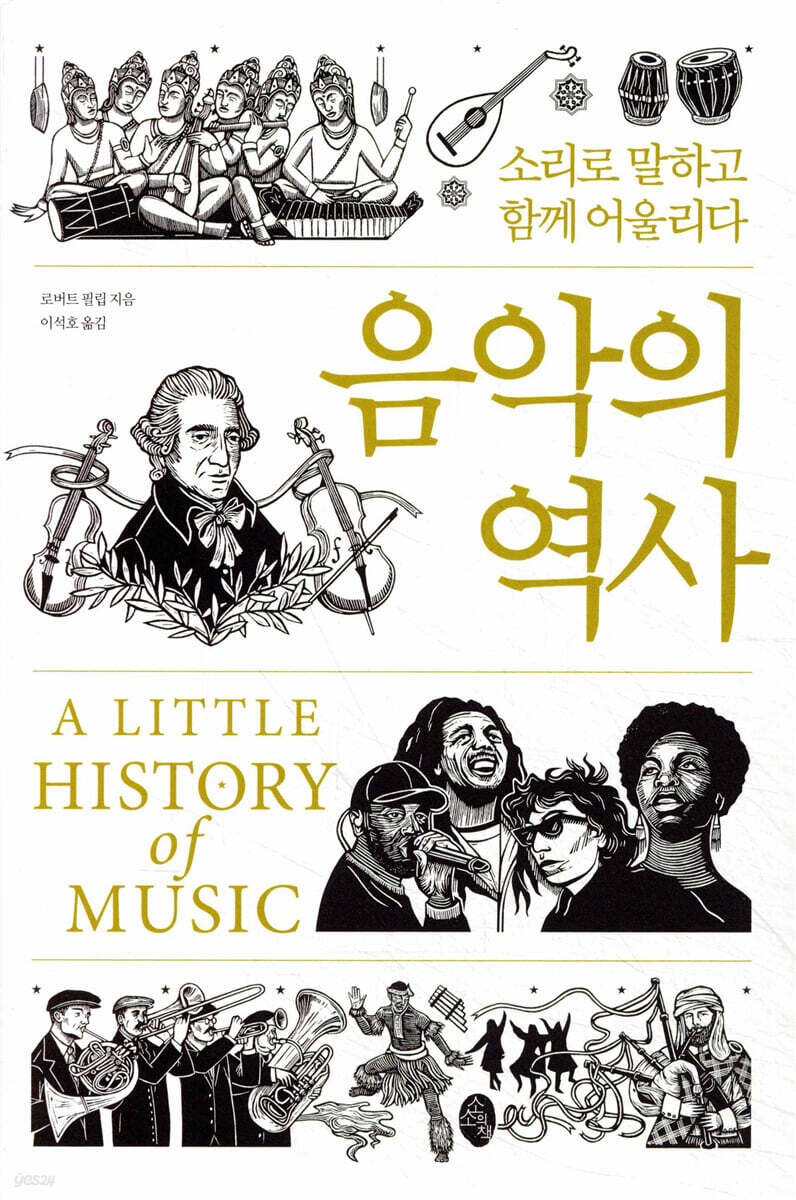
History of Music
 |
Description
Book Introduction
What is music and how has it changed?
It covers a wide range of musical genres, from ancient traditional music to modern pop music.
What does music mean to humans? What power does music possess to stimulate and move our emotions? What are the characteristics of instruments and musical traditions found in cultures around the world? And how has music evolved throughout human history? The questions surrounding the art form of music are incredibly diverse and encompass a vast scope.
Therefore, it is by no means easy to summarize the history of music and the things that readers want to know.
Nevertheless, this book concisely and clearly writes the history of music, crossing regions, people, forms, instruments, and genres.
This book provides a comprehensive overview of the overall flow of change, from traditional music in Europe, America, Asia, and Africa to medieval hymns, opera, musicals, classical music, and popular music such as jazz, rock, hip-hop, and K-pop. It analyzes and estimates how various historical events and contemporary situations have influenced the development of music, what stories are contained in the lives and works of famous composers, and how modern music genres and their future will unfold.
It covers a wide range of musical genres, from ancient traditional music to modern pop music.
What does music mean to humans? What power does music possess to stimulate and move our emotions? What are the characteristics of instruments and musical traditions found in cultures around the world? And how has music evolved throughout human history? The questions surrounding the art form of music are incredibly diverse and encompass a vast scope.
Therefore, it is by no means easy to summarize the history of music and the things that readers want to know.
Nevertheless, this book concisely and clearly writes the history of music, crossing regions, people, forms, instruments, and genres.
This book provides a comprehensive overview of the overall flow of change, from traditional music in Europe, America, Asia, and Africa to medieval hymns, opera, musicals, classical music, and popular music such as jazz, rock, hip-hop, and K-pop. It analyzes and estimates how various historical events and contemporary situations have influenced the development of music, what stories are contained in the lives and works of famous composers, and how modern music genres and their future will unfold.
index
1 The 'What' and 'Why' of Music
2 Shadows of a distant dance
3 The poet sings
4 Music that comes naturally to the sound of the lute
5 Music as Meditation
6 Eternal Gong Sound
7 Rhythm and Community
8 The spirits of our ancestors
9 Dance and Harmony
10 In the church, sing hymns, in the streets, sing songs.
11 Infer and Record
12 Old Corruption, New Ideas
13 Composers Spread Their Wings
14 Lute and Keyboard
15 Reforming the Church and Educating the People
16 Conquest and Recapture
17 Singing lyrics, talking about music
18 The charm of extreme music
19 The rise of instruments and orchestras
20 Star Singers and the Opera Market
21 The Composer's Life at Court and Church
22 Enlightenment and Revolution
23 African Slaves and European High Society
24 Storm on stage, storm in the heart
25 Becoming a 'Classic'
26 The Artist as Priest and Prophet
27 Majestic and light, sublime and witty
28 Women playing at home and abroad
29 Finding an Audience
30 The longing to find one's homeland
31 Westernization and Modernization
32 Into the Darkness
33 Hands reaching out toward the light
34 From Blues to Ragtime and Jazz
35 From Big Band to Bebop
36 Reaction to the Oppression
37 Wearing jewels or shaking them
38 From Resistance to Pop
39 Music of the 'World Village'
40 Yesterday, Today, and Tomorrow
Translator's Note
Search
2 Shadows of a distant dance
3 The poet sings
4 Music that comes naturally to the sound of the lute
5 Music as Meditation
6 Eternal Gong Sound
7 Rhythm and Community
8 The spirits of our ancestors
9 Dance and Harmony
10 In the church, sing hymns, in the streets, sing songs.
11 Infer and Record
12 Old Corruption, New Ideas
13 Composers Spread Their Wings
14 Lute and Keyboard
15 Reforming the Church and Educating the People
16 Conquest and Recapture
17 Singing lyrics, talking about music
18 The charm of extreme music
19 The rise of instruments and orchestras
20 Star Singers and the Opera Market
21 The Composer's Life at Court and Church
22 Enlightenment and Revolution
23 African Slaves and European High Society
24 Storm on stage, storm in the heart
25 Becoming a 'Classic'
26 The Artist as Priest and Prophet
27 Majestic and light, sublime and witty
28 Women playing at home and abroad
29 Finding an Audience
30 The longing to find one's homeland
31 Westernization and Modernization
32 Into the Darkness
33 Hands reaching out toward the light
34 From Blues to Ragtime and Jazz
35 From Big Band to Bebop
36 Reaction to the Oppression
37 Wearing jewels or shaking them
38 From Resistance to Pop
39 Music of the 'World Village'
40 Yesterday, Today, and Tomorrow
Translator's Note
Search
Detailed image

Into the book
Musical instruments have been around for thousands of years.
If we all have a voice, why do we need instruments? The answer is simple.
Without instruments, we wouldn't be able to produce the wide range of sounds we do today.
By borrowing the power of the instrument, we can produce high and low notes that are impossible with our voices alone, and produce loud sounds that are beyond our vocal range.
Additionally, sophisticated note patterns that cannot be achieved with human singing are possible with musical instruments.
The sound of percussion instruments has the effect of making the rhythm of the dance clear or heightening the solemnity of the liturgy.
Musical instruments are sometimes considered so important that they are offered to rulers or gods, or are considered precious objects in their own right, symbolizing the voices of ancestors.
---From "1 The 'What' and 'Why' of Music"
Although the gamelan functions much like a Western orchestra in that it resembles a complex society, the way each musician contributes to the whole is quite different.
The drummer reveals that the piece he is playing is divided into different parts by dropping and picking up the tempo.
The large gong plays a slow rhythmic cycle that repeats throughout the performance.
On top of that, small gongs and iron gongs play rhythm patterns that are two, four, or eight times faster than the rhythm patterns of the large gongs.
The slowest pattern among them carries the basic melody, while the fastest pattern decorates the melody in the highest register.
All of these patterns fit together, and in some cases, two players weave a unified pattern by alternately playing the notes of the same pattern.
All of these patterns combine in various ways to form a very complex, multi-layered spider web.
The complexity of the entire piece is heightened because each performer knows how all the parts fit together.
Although it cannot be said that an orchestra is one in which each performer has outstanding technique, it is clearly a highly technical achievement created through communication and understanding among the performers.
---From "6 Eternal Gong Sounds"
Although early operas were called operas, they placed the lyrics and music at the forefront and did not place as much importance on stage elements.
However, European countries, including Italy, have a long tradition of dramatic and spectacular stage performances for non-professional audiences.
The Medici court in Florence inserted interludes called 'intermedio' between acts of plays performed on special occasions such as weddings.
Intermedia is a dramatic genre consisting of music, dance, and complex stage settings, and is known to have even employed mechanical stage devices to express things like storms and gods descending from the sky.
Venice had a tradition of staging spectacular entertainment during the Carnival season, so it is only natural that Venice was also the city where opera, armed with a wealth of attractions, began to approach the public.
The first time an audience bought a ticket and watched an opera in a public opera house was in 1637 at a theater in Venice.
The Venetian composer Francesco Cavalli (1602–1676) achieved great success with operas for the public theater, and Cavalli's operas were soon performed in theaters throughout Italy.
---From "17 Singing Lyrics, Talking About Music"
The piano was widely accepted as a suitable instrument for young girls and young women, and there was even a view that if a woman of marriageable age had piano skills, it would be advantageous in finding a good husband.
Some women struggled through hours of rehearsals they didn't want to do, while others reached a high level of performance skills because they loved music.
Unlike the violin, which requires a twisted body and awkward arm movements, the piano can be played with a more gentle posture, which also helped to support the view that this instrument is more suitable for women.
Textbooks for guiding young musicians were sold and distributed in large quantities, and professional piano instructors emerged.
Piano teachers were not only teachers of music, but also teachers of manners and conduct to young women.
Music and etiquette, which had been consistently linked since Castiglione's [Palace Discourse] 300 years ago, spread to the middle class who had risen to a 'respectable' position in the 19th century.
---From "28 Women Playing at Home and Abroad"
Following the protest movement of the 1960s, Jamaican reggae music emerged as a leading Black Power genre in the 1970s.
Reggae was a Caribbean music genre that emerged from a blend of rhythm and blues and other African musical influences.
Bob Marley's (1945-1981) "Get Up, Stand Up" (1973) urged people to stand up for their rights.
?No Woman, No Cry? (1974) was Marley's first international hit, and contained a message of hope that everything will be alright in the end.
Reggae, which is characterized by repetitive rhythms and lyrics that sound like speech, is also the genre that gave rise to hip-hop and rap music.
Hip-hop and rap, which originated in the Bronx, New York, in the 1970s, later gained popularity in poor black neighborhoods in many American cities.
Rap music sometimes feels like a direct provocation from an angry person.
It was perhaps only natural, as the genre emerged as a means of expressing the lives of black men who had to live oppressed and trampled in neighborhoods overrun with crime.
Rap music's lyrics, directed at the white establishment and the police, were often violent and sometimes ruthlessly misogynistic.
In the 1980s, women emerged to challenge the male-dominated rap music genre.
They use hip-hop and rap to tell stories about a society that is radically different from the past and the roles men and women occupy in it.
If we all have a voice, why do we need instruments? The answer is simple.
Without instruments, we wouldn't be able to produce the wide range of sounds we do today.
By borrowing the power of the instrument, we can produce high and low notes that are impossible with our voices alone, and produce loud sounds that are beyond our vocal range.
Additionally, sophisticated note patterns that cannot be achieved with human singing are possible with musical instruments.
The sound of percussion instruments has the effect of making the rhythm of the dance clear or heightening the solemnity of the liturgy.
Musical instruments are sometimes considered so important that they are offered to rulers or gods, or are considered precious objects in their own right, symbolizing the voices of ancestors.
---From "1 The 'What' and 'Why' of Music"
Although the gamelan functions much like a Western orchestra in that it resembles a complex society, the way each musician contributes to the whole is quite different.
The drummer reveals that the piece he is playing is divided into different parts by dropping and picking up the tempo.
The large gong plays a slow rhythmic cycle that repeats throughout the performance.
On top of that, small gongs and iron gongs play rhythm patterns that are two, four, or eight times faster than the rhythm patterns of the large gongs.
The slowest pattern among them carries the basic melody, while the fastest pattern decorates the melody in the highest register.
All of these patterns fit together, and in some cases, two players weave a unified pattern by alternately playing the notes of the same pattern.
All of these patterns combine in various ways to form a very complex, multi-layered spider web.
The complexity of the entire piece is heightened because each performer knows how all the parts fit together.
Although it cannot be said that an orchestra is one in which each performer has outstanding technique, it is clearly a highly technical achievement created through communication and understanding among the performers.
---From "6 Eternal Gong Sounds"
Although early operas were called operas, they placed the lyrics and music at the forefront and did not place as much importance on stage elements.
However, European countries, including Italy, have a long tradition of dramatic and spectacular stage performances for non-professional audiences.
The Medici court in Florence inserted interludes called 'intermedio' between acts of plays performed on special occasions such as weddings.
Intermedia is a dramatic genre consisting of music, dance, and complex stage settings, and is known to have even employed mechanical stage devices to express things like storms and gods descending from the sky.
Venice had a tradition of staging spectacular entertainment during the Carnival season, so it is only natural that Venice was also the city where opera, armed with a wealth of attractions, began to approach the public.
The first time an audience bought a ticket and watched an opera in a public opera house was in 1637 at a theater in Venice.
The Venetian composer Francesco Cavalli (1602–1676) achieved great success with operas for the public theater, and Cavalli's operas were soon performed in theaters throughout Italy.
---From "17 Singing Lyrics, Talking About Music"
The piano was widely accepted as a suitable instrument for young girls and young women, and there was even a view that if a woman of marriageable age had piano skills, it would be advantageous in finding a good husband.
Some women struggled through hours of rehearsals they didn't want to do, while others reached a high level of performance skills because they loved music.
Unlike the violin, which requires a twisted body and awkward arm movements, the piano can be played with a more gentle posture, which also helped to support the view that this instrument is more suitable for women.
Textbooks for guiding young musicians were sold and distributed in large quantities, and professional piano instructors emerged.
Piano teachers were not only teachers of music, but also teachers of manners and conduct to young women.
Music and etiquette, which had been consistently linked since Castiglione's [Palace Discourse] 300 years ago, spread to the middle class who had risen to a 'respectable' position in the 19th century.
---From "28 Women Playing at Home and Abroad"
Following the protest movement of the 1960s, Jamaican reggae music emerged as a leading Black Power genre in the 1970s.
Reggae was a Caribbean music genre that emerged from a blend of rhythm and blues and other African musical influences.
Bob Marley's (1945-1981) "Get Up, Stand Up" (1973) urged people to stand up for their rights.
?No Woman, No Cry? (1974) was Marley's first international hit, and contained a message of hope that everything will be alright in the end.
Reggae, which is characterized by repetitive rhythms and lyrics that sound like speech, is also the genre that gave rise to hip-hop and rap music.
Hip-hop and rap, which originated in the Bronx, New York, in the 1970s, later gained popularity in poor black neighborhoods in many American cities.
Rap music sometimes feels like a direct provocation from an angry person.
It was perhaps only natural, as the genre emerged as a means of expressing the lives of black men who had to live oppressed and trampled in neighborhoods overrun with crime.
Rap music's lyrics, directed at the white establishment and the police, were often violent and sometimes ruthlessly misogynistic.
In the 1980s, women emerged to challenge the male-dominated rap music genre.
They use hip-hop and rap to tell stories about a society that is radically different from the past and the roles men and women occupy in it.
---From "38 Resistance to Pop"
Publisher's Review
Covers the origins of human music and major musical traditions!
A special journey that provides a glimpse into the development of music around the world.
According to one study, more than a billion young people worldwide are at risk of experiencing profound hearing loss due to loud pop music from headphones and concerts.
As these research results show, today we are constantly surrounded by music in our daily lives, whether we want it or not.
No matter where you go, including in various broadcast media, stores, coffee shops, and on the streets, you are bound to hear the sound of music.
Perhaps that is why modern people feel anxious when things are too quiet.
When I listen to soft piano music, my mind feels at ease, and when I listen to a song with a fast rhythm, my body moves without me realizing it.
That's the power of music.
Since ancient times, humans have always been close to music.
In cultures all over the world, music has been an essential part of coming together, connecting, and empathizing with one another.
This book tells the story of how such music began.
It's difficult to define music in a single word, but we are surrounded by rhythm from the moment we are born in our mother's womb until the moment we die.
The heart inside the body beats in a regular rhythm even when walking or running.
There is a recurring rhythm not only in human actions such as digging the ground, rowing, pulling ropes, and breaking rocks, but also in all natural phenomena.
Our lives are full of sources of rhythm that inspire music.
The origins of music, like those of language, can only be speculated upon based on the development of human anatomy and our knowledge of human and animal behavior.
Because there is no remaining evidence of mankind's first music.
We can only assume that music existed at the time and was related to religious rituals and funeral rites, based on instruments like flutes made thousands of years ago and depictions of people dancing on ancient ruins and artifacts.
Also, in Mesopotamia, Egypt, and ancient Greece, musical instruments, dancing, and singing were performed during religious ceremonies and banquets.
Following speculation and various claims surrounding the origins of music, this book moves to various countries around the world to cover the major living musical traditions.
What the author focuses on is the continuity and intercultural exchange that has continued uninterruptedly for centuries from the past to the present.
We examine how musical traditions from diverse cultures, such as the maqam of the Arab-Islamic world, the raga and tala of Indian music, the pian zong and qin of China, the gamelan of Indonesia, and the polyphony of Africa, have spread to and influenced other regions.
This book also examines the traditions and changing patterns of American and European music, particularly how the flow of European music changed as a result of the cultural and religious influences surrounding the Mediterranean, and the development of notation, which records musical compositions using symbols according to rules.
How has music changed in these rapidly changing times?
We explore various aspects of the music world, including the emergence of new instruments and the industrialization of music.
After Columbus's discovery of the New World, European powers continued to exert influence across the globe, creating opportunities for European hymns and African songs and dances to blend together and emerge as new cultural hybrid genres.
This later appeared as a form of abandoning the meticulousness of European music that was bound by formality and moving closer to popular music.
During this period, opera (dramatic music), in which poetry was improvised and sung to the accompaniment of instruments, grew in Italy and spread to Germany and England. As various instruments were improved and professional musicians appeared, the first ensembles worthy of being called orchestras were formed.
The 17th and early 18th centuries were a period of great change in the relationship between musicians and audiences, and in the way music was financed.
With the advent of humanism and the Renaissance, the power of the church weakened, and musicians began to seek patronage outside the church walls, including aristocratic courts.
Additionally, as the social status of the merchant and professional classes rose, the number of theaters and concert halls catering to the general public increased.
Riding the wave of these social changes, star singers emerged in the opera world and even male sopranos called castrati were trained.
This was a cruel process of castrating a boy who was good at singing when he was about to change his voice, so that he could grow into an adult while still maintaining his high-pitched voice.
The emergence and development of new instruments and the expansion of the instrumental repertoire continued through the late 18th century and into the 19th century, along with the growth of concert and home music.
There was a constant demand for orchestral music for public events, and there was also a frequent need for chamber music for private purposes.
The solo keyboard repertoire for harpsichord, clavichord, and later piano also expanded.
Among these works were some for amateurs to play at home, and others for the ever-increasing number of accomplished performers.
Additionally, as science and technology advanced day by day during the Industrial Revolution, the music industry began to take off.
Permanent opera houses and music schools emerged, and the music publishing industry also grew rapidly.
In the 20th century, the upheavals of world history, namely the two world wars, changed the course of music history.
Amidst many contradictions and hostile views, the popular music genre was conceived and differentiated by freed black slaves (African Americans).
From ragtime, which swept across America and Europe around 1900, to the blues, which conveys a sense of tenacious resistance, to jazz, which emphasizes dynamic, improvisational performance.
The music of the 20th century, represented by the Black musical tradition, served as a crucial way to give voice to the anger and grief behind resistance, the helplessness in the face of foolish human violence, and the hope for a better tomorrow.
The growth of popular music has been unstoppable over the past 50 years.
And now, anyone can enjoy the music they want anytime, anywhere, inside or outside the home, and upload their own music to streaming channels on the Internet.
Music companies with corporate values reaching billions of pounds have emerged, and a system has been established where successful recording artists can reap enormous wealth.
Not only are the musical styles diverse, but the musicians are also diverse, and the number of people who enjoy pop music is enormous.
It's no wonder that today's music scene is described as a "melting pot."
Cultures from all over the world are blending and interacting in all sorts of ways with Western classical, jazz, and pop music.
Opera houses and concert halls are being built in cities around the world, and young people from China to Venezuela are studying Western classical music.
Music festivals typically feature musicians from every continent, and it's become commonplace for musicians from various cultures to perform alongside Western musicians.
Humans have been making music for millions of years, and over the centuries we have explored ways to create music that suits the situations we find ourselves in.
Music, an essential element of our health and well-being, has never ceased to be a fundamental form of human self-expression.
No matter what happens in the future, music will always evolve with us.
This book will help us understand where we are now and how we got here.
From classical musicians to contemporary pop musicians!
The lives and works of great composers and pop music stars
This book is not only a fun read that provides a glimpse into musical traditions and their development from around the world, but it also offers fascinating stories about the lives and works of various musicians.
This book mentions the intense lives and works of countless musicians, from the German-born abbess Hildegard of Bingen, who has many hymns and folk songs set to music in manuscript form; to Henry Purcell, the greatest composer of 17th-century England as a master of sacred and stage music; to Handel, who made the most of the possibilities of new audiences and markets; to Bach, who lived almost his entire life as a church employee; to Joseph Haydn, Wolfgang Amadeus Mozart, and Ludwig van Beethoven, who lived and created new things in Vienna in the late 18th and early 19th centuries; to Schubert, known as the “King of Lieder,” to Vincenzo Bellini and Gaetano Donizetti, who were the mainstays of Italian opera; to Bob Dylan, the godfather of American folk rock; and to Aretha Franklin, the “Queen of Soul.”
Although it doesn't reveal much of their story, it clearly reveals their place in the history of music and what their achievements were.
But what role did women play in musical activities? In Australian Aboriginal groups, men performed traditional songs and instruments, while women sang lamentations.
In the 15th century, the Medici women of Florence sang and played the organ to entertain high-ranking guests.
Even wealthy merchants of the time taught their daughters to sing and dance, not only for entertainment and education, but also because music helped them find husbands.
In Europe, for many years, women's participation in public music activities was seen as a bad omen, and opinions targeting this have been used to discuss the potential dangers of music.
In the 17th century, female roles in opera were filled by castrati, male castrated singers who sang in the soprano and alto ranges.
Nevertheless, pianists from noble families such as Hélène de Mongeroux, Maria Szymanowska, who influenced Chopin, and Clara Schumann, wife of composer Robert Schumann, performed mainly in salons.
The book also illuminates the history of popular music that followed the emergence of ragtime.
We look into the activities of early jazz bands, the 'big band' sound that became popular in the 1920s, and the secrets to the success of the big bands that followed.
In addition, it tells the stories of many popular music musicians who are famous worldwide today and exude a unique charm, such as the Beatles, formed by a group of Liverpool teenagers, the Beach Boys, who popularized upbeat surf music, and Elvis Presley, who sang in a passionate and emotionally appealing way.
A special journey that provides a glimpse into the development of music around the world.
According to one study, more than a billion young people worldwide are at risk of experiencing profound hearing loss due to loud pop music from headphones and concerts.
As these research results show, today we are constantly surrounded by music in our daily lives, whether we want it or not.
No matter where you go, including in various broadcast media, stores, coffee shops, and on the streets, you are bound to hear the sound of music.
Perhaps that is why modern people feel anxious when things are too quiet.
When I listen to soft piano music, my mind feels at ease, and when I listen to a song with a fast rhythm, my body moves without me realizing it.
That's the power of music.
Since ancient times, humans have always been close to music.
In cultures all over the world, music has been an essential part of coming together, connecting, and empathizing with one another.
This book tells the story of how such music began.
It's difficult to define music in a single word, but we are surrounded by rhythm from the moment we are born in our mother's womb until the moment we die.
The heart inside the body beats in a regular rhythm even when walking or running.
There is a recurring rhythm not only in human actions such as digging the ground, rowing, pulling ropes, and breaking rocks, but also in all natural phenomena.
Our lives are full of sources of rhythm that inspire music.
The origins of music, like those of language, can only be speculated upon based on the development of human anatomy and our knowledge of human and animal behavior.
Because there is no remaining evidence of mankind's first music.
We can only assume that music existed at the time and was related to religious rituals and funeral rites, based on instruments like flutes made thousands of years ago and depictions of people dancing on ancient ruins and artifacts.
Also, in Mesopotamia, Egypt, and ancient Greece, musical instruments, dancing, and singing were performed during religious ceremonies and banquets.
Following speculation and various claims surrounding the origins of music, this book moves to various countries around the world to cover the major living musical traditions.
What the author focuses on is the continuity and intercultural exchange that has continued uninterruptedly for centuries from the past to the present.
We examine how musical traditions from diverse cultures, such as the maqam of the Arab-Islamic world, the raga and tala of Indian music, the pian zong and qin of China, the gamelan of Indonesia, and the polyphony of Africa, have spread to and influenced other regions.
This book also examines the traditions and changing patterns of American and European music, particularly how the flow of European music changed as a result of the cultural and religious influences surrounding the Mediterranean, and the development of notation, which records musical compositions using symbols according to rules.
How has music changed in these rapidly changing times?
We explore various aspects of the music world, including the emergence of new instruments and the industrialization of music.
After Columbus's discovery of the New World, European powers continued to exert influence across the globe, creating opportunities for European hymns and African songs and dances to blend together and emerge as new cultural hybrid genres.
This later appeared as a form of abandoning the meticulousness of European music that was bound by formality and moving closer to popular music.
During this period, opera (dramatic music), in which poetry was improvised and sung to the accompaniment of instruments, grew in Italy and spread to Germany and England. As various instruments were improved and professional musicians appeared, the first ensembles worthy of being called orchestras were formed.
The 17th and early 18th centuries were a period of great change in the relationship between musicians and audiences, and in the way music was financed.
With the advent of humanism and the Renaissance, the power of the church weakened, and musicians began to seek patronage outside the church walls, including aristocratic courts.
Additionally, as the social status of the merchant and professional classes rose, the number of theaters and concert halls catering to the general public increased.
Riding the wave of these social changes, star singers emerged in the opera world and even male sopranos called castrati were trained.
This was a cruel process of castrating a boy who was good at singing when he was about to change his voice, so that he could grow into an adult while still maintaining his high-pitched voice.
The emergence and development of new instruments and the expansion of the instrumental repertoire continued through the late 18th century and into the 19th century, along with the growth of concert and home music.
There was a constant demand for orchestral music for public events, and there was also a frequent need for chamber music for private purposes.
The solo keyboard repertoire for harpsichord, clavichord, and later piano also expanded.
Among these works were some for amateurs to play at home, and others for the ever-increasing number of accomplished performers.
Additionally, as science and technology advanced day by day during the Industrial Revolution, the music industry began to take off.
Permanent opera houses and music schools emerged, and the music publishing industry also grew rapidly.
In the 20th century, the upheavals of world history, namely the two world wars, changed the course of music history.
Amidst many contradictions and hostile views, the popular music genre was conceived and differentiated by freed black slaves (African Americans).
From ragtime, which swept across America and Europe around 1900, to the blues, which conveys a sense of tenacious resistance, to jazz, which emphasizes dynamic, improvisational performance.
The music of the 20th century, represented by the Black musical tradition, served as a crucial way to give voice to the anger and grief behind resistance, the helplessness in the face of foolish human violence, and the hope for a better tomorrow.
The growth of popular music has been unstoppable over the past 50 years.
And now, anyone can enjoy the music they want anytime, anywhere, inside or outside the home, and upload their own music to streaming channels on the Internet.
Music companies with corporate values reaching billions of pounds have emerged, and a system has been established where successful recording artists can reap enormous wealth.
Not only are the musical styles diverse, but the musicians are also diverse, and the number of people who enjoy pop music is enormous.
It's no wonder that today's music scene is described as a "melting pot."
Cultures from all over the world are blending and interacting in all sorts of ways with Western classical, jazz, and pop music.
Opera houses and concert halls are being built in cities around the world, and young people from China to Venezuela are studying Western classical music.
Music festivals typically feature musicians from every continent, and it's become commonplace for musicians from various cultures to perform alongside Western musicians.
Humans have been making music for millions of years, and over the centuries we have explored ways to create music that suits the situations we find ourselves in.
Music, an essential element of our health and well-being, has never ceased to be a fundamental form of human self-expression.
No matter what happens in the future, music will always evolve with us.
This book will help us understand where we are now and how we got here.
From classical musicians to contemporary pop musicians!
The lives and works of great composers and pop music stars
This book is not only a fun read that provides a glimpse into musical traditions and their development from around the world, but it also offers fascinating stories about the lives and works of various musicians.
This book mentions the intense lives and works of countless musicians, from the German-born abbess Hildegard of Bingen, who has many hymns and folk songs set to music in manuscript form; to Henry Purcell, the greatest composer of 17th-century England as a master of sacred and stage music; to Handel, who made the most of the possibilities of new audiences and markets; to Bach, who lived almost his entire life as a church employee; to Joseph Haydn, Wolfgang Amadeus Mozart, and Ludwig van Beethoven, who lived and created new things in Vienna in the late 18th and early 19th centuries; to Schubert, known as the “King of Lieder,” to Vincenzo Bellini and Gaetano Donizetti, who were the mainstays of Italian opera; to Bob Dylan, the godfather of American folk rock; and to Aretha Franklin, the “Queen of Soul.”
Although it doesn't reveal much of their story, it clearly reveals their place in the history of music and what their achievements were.
But what role did women play in musical activities? In Australian Aboriginal groups, men performed traditional songs and instruments, while women sang lamentations.
In the 15th century, the Medici women of Florence sang and played the organ to entertain high-ranking guests.
Even wealthy merchants of the time taught their daughters to sing and dance, not only for entertainment and education, but also because music helped them find husbands.
In Europe, for many years, women's participation in public music activities was seen as a bad omen, and opinions targeting this have been used to discuss the potential dangers of music.
In the 17th century, female roles in opera were filled by castrati, male castrated singers who sang in the soprano and alto ranges.
Nevertheless, pianists from noble families such as Hélène de Mongeroux, Maria Szymanowska, who influenced Chopin, and Clara Schumann, wife of composer Robert Schumann, performed mainly in salons.
The book also illuminates the history of popular music that followed the emergence of ragtime.
We look into the activities of early jazz bands, the 'big band' sound that became popular in the 1920s, and the secrets to the success of the big bands that followed.
In addition, it tells the stories of many popular music musicians who are famous worldwide today and exude a unique charm, such as the Beatles, formed by a group of Liverpool teenagers, the Beach Boys, who popularized upbeat surf music, and Elvis Presley, who sang in a passionate and emotionally appealing way.
GOODS SPECIFICS
- Date of issue: June 27, 2025
- Format: Hardcover book binding method guide
- Page count, weight, size: 412 pages | 686g | 155*222*30mm
- ISBN13: 9791171650262
- ISBN10: 1171650264
You may also like
카테고리
korean


korean

![GQ KOREA Mark (Monthly): December [2025]](http://librairie.coreenne.fr/cdn/shop/files/8ef265dbbfbf186523ed75ba7319009d.jpg?v=1765340328&width=3840)


