

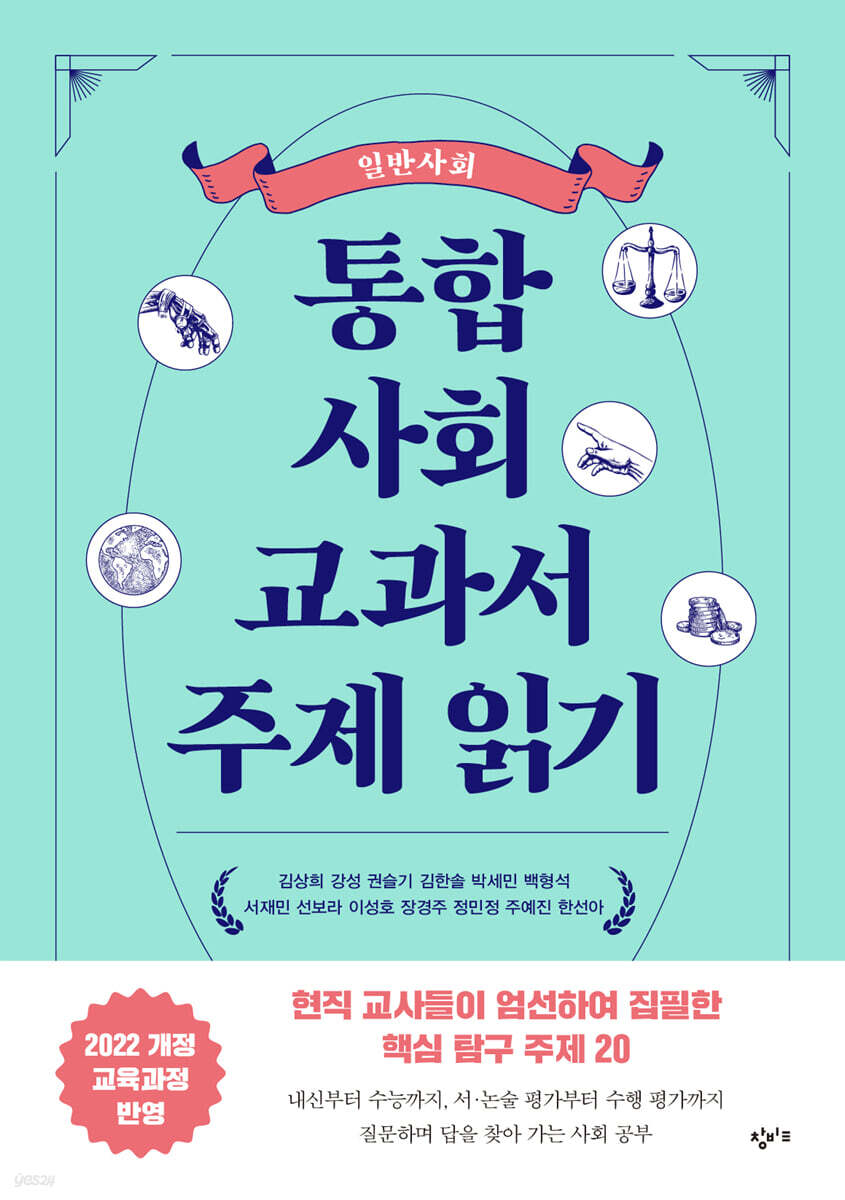
Integrated Social Studies Textbook Topic Reading: General Social Studies
 |
Description
Book Introduction
High school social studies?
Start with the core exploration topics in the integrated social studies textbook!
The "Reading Integrated Social Studies Textbook Topics" series, reflecting the 2022 revised curriculum, covers key inquiry topics drawn from the curriculum and integrated social studies textbooks.
This book was written by social studies, ethics, and geography teachers who, by leveraging their field experience and subject expertise, meticulously analyzed the curriculum and directly selected topics. They then applied the curriculum to specific life contexts to identify social problems and devise solutions.
The first book in this three-volume series, "Reading the Integrated Social Studies Textbook Topics: General Social Studies," covers the "general social studies" section of the integrated social studies textbook.
It covers a wide range of research topics in various areas of general society, from society and culture to politics, law, and economics, and also presents activities that can help readers understand and expand their thinking related to these topics.
This book is recommended for teenagers who are beginning to study social studies before entering high school, teenagers who want to preview topics that may be covered in essay and performance assessments, and teenagers who are preparing for the CSAT by reviewing integrated social studies reading materials.
Start with the core exploration topics in the integrated social studies textbook!
The "Reading Integrated Social Studies Textbook Topics" series, reflecting the 2022 revised curriculum, covers key inquiry topics drawn from the curriculum and integrated social studies textbooks.
This book was written by social studies, ethics, and geography teachers who, by leveraging their field experience and subject expertise, meticulously analyzed the curriculum and directly selected topics. They then applied the curriculum to specific life contexts to identify social problems and devise solutions.
The first book in this three-volume series, "Reading the Integrated Social Studies Textbook Topics: General Social Studies," covers the "general social studies" section of the integrated social studies textbook.
It covers a wide range of research topics in various areas of general society, from society and culture to politics, law, and economics, and also presents activities that can help readers understand and expand their thinking related to these topics.
This book is recommended for teenagers who are beginning to study social studies before entering high school, teenagers who want to preview topics that may be covered in essay and performance assessments, and teenagers who are preparing for the CSAT by reviewing integrated social studies reading materials.
- You can preview some of the book's contents.
Preview
index
Reviewing the Integrated Social Studies Textbook's Exploration Topics
Part 1: Reading topics that connect me to society
[Research Topic 01] Is rational choice selfish?
[Research Topic 02] What would happen if artificial intelligence took my place?
[Exploration Topic 03] What does it mean to enjoy freedom at school?
[Research Topic 04] Will expanding student rights lead to the collapse of classrooms?
[Research Topic 05] Should hate speech be regulated by law?
Part 2: Reading topics where we and society meet
[Research Topic 06] Is the majority rule democratic?
[Research Topic 07] Why is fake news dangerous?
[Research Topic 08] Is Inequality in Korean Society the Responsibility of a Specific Generation?
[Research Topic 09] How should we view the low birth rate phenomenon?
[Research Topic 10] Is the current resident registration system okay?
[Research Topic 11] Why is citizen participation in trials necessary?
[Research Topic 12] How can we protect working people?
[Research Topic 13] Can we acknowledge this marriage?
[Research Topic 14] What Creates Disability?
[Research Topic 15] Will the advancement of information and communication technology help citizens participate in politics?
[Research Topic 16] Should mugshots be made public?
Part 3: Reading themes that embrace the world and society
[Research Topic 17] Can Strengthening National Defense Be the Only Way to Ensure the Security of the Korean Peninsula?
[Research Topic 18] Why did Russia invade Ukraine?
[Research Topic 19] How does cultural identity affect the process of globalization?
[Research Topic 20] Should the State Take Responsibility for the Climate Crisis?
Part 1: Reading topics that connect me to society
[Research Topic 01] Is rational choice selfish?
[Research Topic 02] What would happen if artificial intelligence took my place?
[Exploration Topic 03] What does it mean to enjoy freedom at school?
[Research Topic 04] Will expanding student rights lead to the collapse of classrooms?
[Research Topic 05] Should hate speech be regulated by law?
Part 2: Reading topics where we and society meet
[Research Topic 06] Is the majority rule democratic?
[Research Topic 07] Why is fake news dangerous?
[Research Topic 08] Is Inequality in Korean Society the Responsibility of a Specific Generation?
[Research Topic 09] How should we view the low birth rate phenomenon?
[Research Topic 10] Is the current resident registration system okay?
[Research Topic 11] Why is citizen participation in trials necessary?
[Research Topic 12] How can we protect working people?
[Research Topic 13] Can we acknowledge this marriage?
[Research Topic 14] What Creates Disability?
[Research Topic 15] Will the advancement of information and communication technology help citizens participate in politics?
[Research Topic 16] Should mugshots be made public?
Part 3: Reading themes that embrace the world and society
[Research Topic 17] Can Strengthening National Defense Be the Only Way to Ensure the Security of the Korean Peninsula?
[Research Topic 18] Why did Russia invade Ukraine?
[Research Topic 19] How does cultural identity affect the process of globalization?
[Research Topic 20] Should the State Take Responsibility for the Climate Crisis?
Detailed image

Into the book
“Rational choices can vary greatly depending on how far we define ourselves as ‘me.’
It would be good to think about whether we should consider only 'me' as 'me', or expand 'me' to include 'my family', 'my neighbors', 'our people', 'world citizens', and further 'all living things on Earth', or even 'future generations' who do not yet exist but will one day live on this earth.
It would be helpful to consider whether benefits are limited to short-term gains that are immediately visible, or whether they also consider long-term benefits that will reap benefits for future generations. Furthermore, they should consider whether benefits include diverse values that are difficult to quantify in monetary terms, such as a "clean environment" or "fairness."
--- p.23 From "Is rational choice selfish?"
“Real democracy works well when its members are homogeneous.
Because majority rule can be the right decision, assuming that everyone has equal decision-making power and everyone has the same interests.
However, if the interests of the minority differ from those of the majority, majority rule can easily become an unjust method that demands sacrifice from the minority.
Therefore, examining the consequences of a decision rather than the decision-making process helps us determine whether or not a decision is democratic.
If a social decision protects and reinforces the vested interests of the majority while, conversely, infringing upon or depriving the fundamental rights of a vulnerable minority, it cannot be evaluated as democratic, regardless of the decision-making process.
Rather, it is an undemocratic decision-making method that does not conform to the well-being and progress of all members.”
--- p.90-91 From "Is the Majority Rule Democratic?"
"In our society, where diverse individual freedoms and choices coexist, how should we understand the low birth rate phenomenon and establish the direction of population policy? (Omitted) If Malthus simply viewed natural limitations and resource shortages as the essence of the population problem, we must view the population problem from a perspective centered on quality of life, individual choice, and social systems.
We need to change the direction of existing policies aimed at increasing the birth rate and create conditions that enable and encourage people to have children.
And beyond the question, ‘Should we accept the low birth rate, or should we encourage childbirth?’ we must ask, ‘What kind of society should we create?’”
--- p.134-135 From 『How should we view the low birth rate phenomenon?』
“The ‘state of fear for peace’ is not a phenomenon unique to the Korean Peninsula.
Many parts of the world are prone to physical violence and conflict, as seen in the recent Russia-Ukraine war and the Israel-Palestine conflict.
In an international society plagued by constant conflict, is the discourse of human security an idea that is out of touch with reality?
It would be good to think about whether we should consider only 'me' as 'me', or expand 'me' to include 'my family', 'my neighbors', 'our people', 'world citizens', and further 'all living things on Earth', or even 'future generations' who do not yet exist but will one day live on this earth.
It would be helpful to consider whether benefits are limited to short-term gains that are immediately visible, or whether they also consider long-term benefits that will reap benefits for future generations. Furthermore, they should consider whether benefits include diverse values that are difficult to quantify in monetary terms, such as a "clean environment" or "fairness."
--- p.23 From "Is rational choice selfish?"
“Real democracy works well when its members are homogeneous.
Because majority rule can be the right decision, assuming that everyone has equal decision-making power and everyone has the same interests.
However, if the interests of the minority differ from those of the majority, majority rule can easily become an unjust method that demands sacrifice from the minority.
Therefore, examining the consequences of a decision rather than the decision-making process helps us determine whether or not a decision is democratic.
If a social decision protects and reinforces the vested interests of the majority while, conversely, infringing upon or depriving the fundamental rights of a vulnerable minority, it cannot be evaluated as democratic, regardless of the decision-making process.
Rather, it is an undemocratic decision-making method that does not conform to the well-being and progress of all members.”
--- p.90-91 From "Is the Majority Rule Democratic?"
"In our society, where diverse individual freedoms and choices coexist, how should we understand the low birth rate phenomenon and establish the direction of population policy? (Omitted) If Malthus simply viewed natural limitations and resource shortages as the essence of the population problem, we must view the population problem from a perspective centered on quality of life, individual choice, and social systems.
We need to change the direction of existing policies aimed at increasing the birth rate and create conditions that enable and encourage people to have children.
And beyond the question, ‘Should we accept the low birth rate, or should we encourage childbirth?’ we must ask, ‘What kind of society should we create?’”
--- p.134-135 From 『How should we view the low birth rate phenomenon?』
“The ‘state of fear for peace’ is not a phenomenon unique to the Korean Peninsula.
Many parts of the world are prone to physical violence and conflict, as seen in the recent Russia-Ukraine war and the Israel-Palestine conflict.
In an international society plagued by constant conflict, is the discourse of human security an idea that is out of touch with reality?
--- p.244 From "Can Strengthening National Defense Power Be the Only Way to Guarantee the Security of the Korean Peninsula?"
Publisher's Review
Studying high school social studies? Start with the core exploration topics in the integrated social studies textbook!
From school grades to the CSAT, from essay evaluations to performance evaluations
Social studies that seek answers through questions
High school freshmen in 2025 will be learning from a new integrated social studies textbook developed in accordance with the revised 2022 curriculum, and according to the '2028 College Entrance Exam Reform Plan' confirmed and announced by the Ministry of Education, they will be required to take the CSAT as an integrated social studies subject rather than an elective.
However, the integrated social studies subject in the first year of high school is not very deep, so students have no choice but to bring in content from elective subjects learned in the second and third years of high school.
Therefore, the general opinion of teachers who teach integrated social studies is that the college entrance exam questions may become more difficult.
In addition, as eight different integrated social studies textbooks developed by various publishers are currently being used in schools, each of them covers different materials and cases, making it difficult to know what materials or cases will appear on the CSAT.
Moreover, as essay evaluations are strengthened and the importance of performance evaluations is highlighted, the burden felt by students while studying social studies in high school is increasing.
But fortunately, what the curriculum, which is the root of education, demands is the same.
It is about learning the curriculum and applying it to specific life contexts to develop the ability to identify and solve social problems.
The 'Reading the Integrated Social Studies Textbook Topics' series (3 volumes) focuses on these 'social issues', that is, 'topics of inquiry' selected through analysis of the curriculum.
"Integrated Social Studies Textbook Topic Reading: General Social Studies" is the first book in this series.
Current social studies teachers, leveraging their field experience and subject expertise, meticulously analyzed the new curriculum and textbooks to identify key social issues in the general social studies field. Based on this, they selected 20 core research topics and wrote the content themselves.
Each research topic covers all areas of general society, from society and culture to politics, law, and economics.
It is difficult to get a good grade or develop the skills required for this subject by simply memorizing the content or studying it repeatedly.
With the growing emphasis on background knowledge of key inquiry topics covered in integrated social studies textbooks and the ability to interpret and analyze related materials, this book, which focuses on the purpose and essence of the subject, will be of great help.
From 'I' to 'we' to 'the world', from 'reading' to 'understanding and expansion'
20 core inquiry topics carefully selected and written by current teachers based on the 2022 revised curriculum
『Integrated Social Studies Textbook Topic Reading: General Social Studies』 is comprised of three parts.
Part 1 explores topics that connect "me and society," such as "Is rational choice selfish?" and "Will expanding student rights lead to the collapse of the classroom?", fostering a sociological imagination.
Part 2 broadens the scope and explores topics such as "Is the majority rule democratic?" and "Is inequality in Korean society the responsibility of a specific generation?" that address the intersection of "us and society."
Part 3 explores the topic of inquiry that embraces 'the world and society', expanding our perspective to a global level.
Through research topics such as "Can strengthening national defense alone guarantee the safety of the Korean Peninsula?" and "Should the state take responsibility for the climate crisis?", young people can cultivate international awareness as members of society and develop their identities as global citizens.
After completing the reading for each topic of inquiry, various activities are provided to help readers understand and organize the topic of inquiry and expand their thinking.
In addition, you can try out various post-reading activities individually or in classes at school by utilizing the 20 activity worksheets tailored to each research topic provided free of charge through the Changbi Education website.
From school grades to the CSAT, from essay evaluations to performance evaluations
Social studies that seek answers through questions
High school freshmen in 2025 will be learning from a new integrated social studies textbook developed in accordance with the revised 2022 curriculum, and according to the '2028 College Entrance Exam Reform Plan' confirmed and announced by the Ministry of Education, they will be required to take the CSAT as an integrated social studies subject rather than an elective.
However, the integrated social studies subject in the first year of high school is not very deep, so students have no choice but to bring in content from elective subjects learned in the second and third years of high school.
Therefore, the general opinion of teachers who teach integrated social studies is that the college entrance exam questions may become more difficult.
In addition, as eight different integrated social studies textbooks developed by various publishers are currently being used in schools, each of them covers different materials and cases, making it difficult to know what materials or cases will appear on the CSAT.
Moreover, as essay evaluations are strengthened and the importance of performance evaluations is highlighted, the burden felt by students while studying social studies in high school is increasing.
But fortunately, what the curriculum, which is the root of education, demands is the same.
It is about learning the curriculum and applying it to specific life contexts to develop the ability to identify and solve social problems.
The 'Reading the Integrated Social Studies Textbook Topics' series (3 volumes) focuses on these 'social issues', that is, 'topics of inquiry' selected through analysis of the curriculum.
"Integrated Social Studies Textbook Topic Reading: General Social Studies" is the first book in this series.
Current social studies teachers, leveraging their field experience and subject expertise, meticulously analyzed the new curriculum and textbooks to identify key social issues in the general social studies field. Based on this, they selected 20 core research topics and wrote the content themselves.
Each research topic covers all areas of general society, from society and culture to politics, law, and economics.
It is difficult to get a good grade or develop the skills required for this subject by simply memorizing the content or studying it repeatedly.
With the growing emphasis on background knowledge of key inquiry topics covered in integrated social studies textbooks and the ability to interpret and analyze related materials, this book, which focuses on the purpose and essence of the subject, will be of great help.
From 'I' to 'we' to 'the world', from 'reading' to 'understanding and expansion'
20 core inquiry topics carefully selected and written by current teachers based on the 2022 revised curriculum
『Integrated Social Studies Textbook Topic Reading: General Social Studies』 is comprised of three parts.
Part 1 explores topics that connect "me and society," such as "Is rational choice selfish?" and "Will expanding student rights lead to the collapse of the classroom?", fostering a sociological imagination.
Part 2 broadens the scope and explores topics such as "Is the majority rule democratic?" and "Is inequality in Korean society the responsibility of a specific generation?" that address the intersection of "us and society."
Part 3 explores the topic of inquiry that embraces 'the world and society', expanding our perspective to a global level.
Through research topics such as "Can strengthening national defense alone guarantee the safety of the Korean Peninsula?" and "Should the state take responsibility for the climate crisis?", young people can cultivate international awareness as members of society and develop their identities as global citizens.
After completing the reading for each topic of inquiry, various activities are provided to help readers understand and organize the topic of inquiry and expand their thinking.
In addition, you can try out various post-reading activities individually or in classes at school by utilizing the 20 activity worksheets tailored to each research topic provided free of charge through the Changbi Education website.
GOODS SPECIFICS
- Date of issue: July 11, 2025
- Page count, weight, size: 304 pages | 488g | 148*210*17mm
- ISBN13: 9791165703493
- ISBN10: 1165703491
You may also like
카테고리
korean


korean

![GQ KOREA Mark (Monthly): December [2025]](http://librairie.coreenne.fr/cdn/shop/files/8ef265dbbfbf186523ed75ba7319009d.jpg?v=1765340328&width=3840)


