

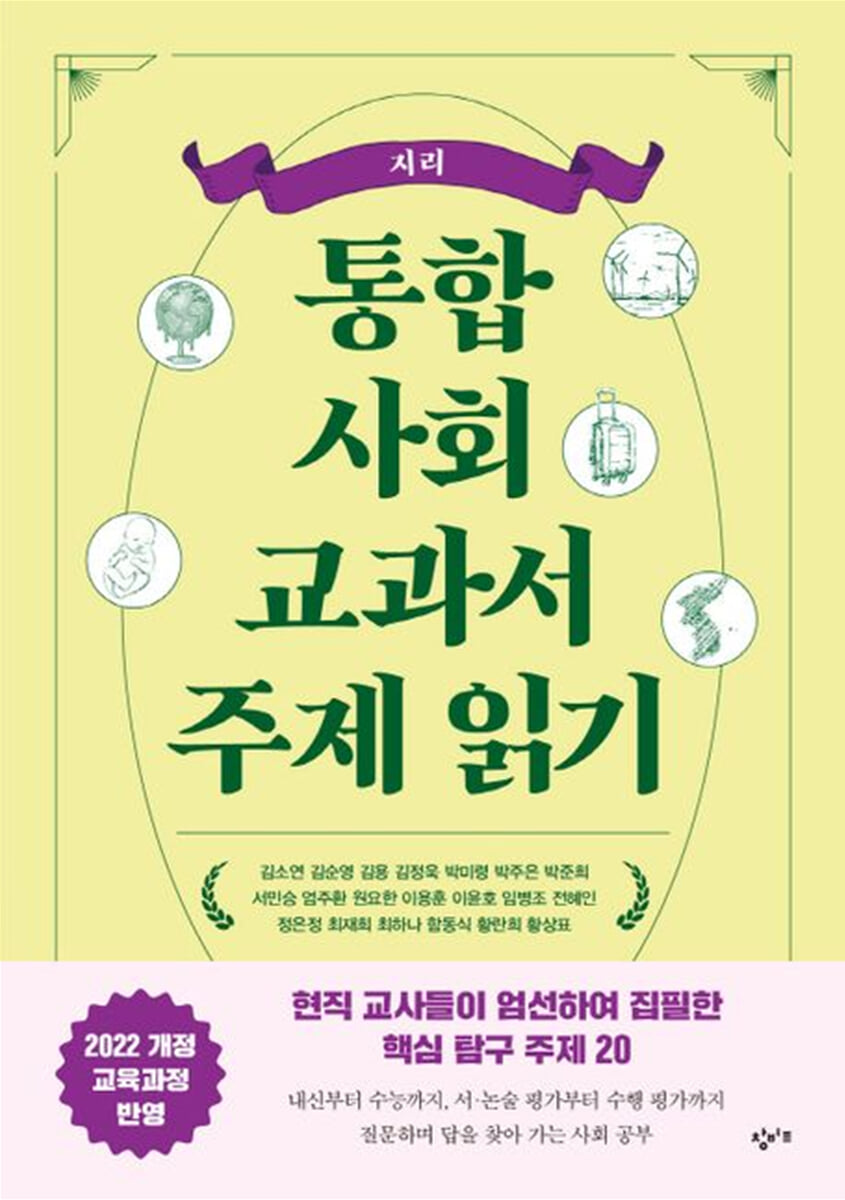
Integrated Social Studies Textbook Topic Reading: Geography
 |
Description
Book Introduction
High school social studies?
Let's start with the core research topics in the integrated social studies textbook!
The "Reading Integrated Social Studies Textbook Topics" series, reflecting the 2022 revised curriculum, covers key inquiry topics drawn from the curriculum and integrated social studies textbooks.
This book was written by social studies, ethics, and geography teachers who, by leveraging their field experience and subject expertise, meticulously analyzed the curriculum and directly selected topics. They then applied the curriculum to specific life contexts to identify social problems and devise solutions.
Following the publication of the 'General Society' section, 『Reading the Integrated Social Studies Textbook Topic: Geography』 covers the 'geography' section of the integrated social studies.
It covers a wide range of geographic topics, from the natural environment to cities, peace, population, and the future, and also offers activities to help readers understand and expand their thinking on these topics.
This book is recommended for teenagers who are beginning to study social studies before entering high school, teenagers who want to preview topics that may be covered in essay and performance assessments, and teenagers who are preparing for the CSAT by reviewing integrated social studies reading materials.
Let's start with the core research topics in the integrated social studies textbook!
The "Reading Integrated Social Studies Textbook Topics" series, reflecting the 2022 revised curriculum, covers key inquiry topics drawn from the curriculum and integrated social studies textbooks.
This book was written by social studies, ethics, and geography teachers who, by leveraging their field experience and subject expertise, meticulously analyzed the curriculum and directly selected topics. They then applied the curriculum to specific life contexts to identify social problems and devise solutions.
Following the publication of the 'General Society' section, 『Reading the Integrated Social Studies Textbook Topic: Geography』 covers the 'geography' section of the integrated social studies.
It covers a wide range of geographic topics, from the natural environment to cities, peace, population, and the future, and also offers activities to help readers understand and expand their thinking on these topics.
This book is recommended for teenagers who are beginning to study social studies before entering high school, teenagers who want to preview topics that may be covered in essay and performance assessments, and teenagers who are preparing for the CSAT by reviewing integrated social studies reading materials.
- You can preview some of the book's contents.
Preview
index
Reviewing the Integrated Social Studies Textbook's Exploration Topics
Part 1: Reading topics that connect us to the natural environment
[Research Topic 01] Is global warming really caused by human activity?
[Research Topic 02] How will our food culture change due to global warming?
[Research Topic 03] Is it possible for everyone to have a happy trip?
[Research Topic 04] What are the impacts of climate change on the Korean Peninsula's industries and what countermeasures are needed?
Part 2: Reading themes that connect us to our living spaces
[Research Topic 05] How can we overcome the crisis in rural areas and agriculture?
[Research Topic 06] Can urban problems be solved through urban design?
[Research Topic 07] Will transportation development contribute to the growth of small and medium-sized local cities?
[Research Topic 08] Can the development of the mobility industry solve the problem of transportation disadvantage?
[Research Topic 09] Why do global companies and talents gather in certain cities?
[Research Topic 10] What is a smart city?
[Research Topic 11] Are the residents of areas that have become hot places happy?
Part 3: Reading the Theme that Connects Us and the World
[Research Topic 12] How does geography influence diplomacy and military strategy?
[Research Topic 13] How should we view the refugee problem in the age of globalization?
[Research Topic 14] How have the border regions of the Korean Peninsula changed?
[Research Topic 15] If unification is achieved, what are the geopolitical benefits?
Part 4: Reading the Topics that Connect Us to the Future
[Research Topic 16] Are the government's responses to the low birth rate and aging population appropriate?
[Research Topic 17] Is regional disparity a solvable problem?
[Research Topic 18] Is renewable energy environmentally friendly?
[Exploration Topic 19] Can reducing food waste save the planet?
[Exploration Topic 20] How can UNESCO World Heritage Sites be linked to the Sustainable Development Goals?
Part 1: Reading topics that connect us to the natural environment
[Research Topic 01] Is global warming really caused by human activity?
[Research Topic 02] How will our food culture change due to global warming?
[Research Topic 03] Is it possible for everyone to have a happy trip?
[Research Topic 04] What are the impacts of climate change on the Korean Peninsula's industries and what countermeasures are needed?
Part 2: Reading themes that connect us to our living spaces
[Research Topic 05] How can we overcome the crisis in rural areas and agriculture?
[Research Topic 06] Can urban problems be solved through urban design?
[Research Topic 07] Will transportation development contribute to the growth of small and medium-sized local cities?
[Research Topic 08] Can the development of the mobility industry solve the problem of transportation disadvantage?
[Research Topic 09] Why do global companies and talents gather in certain cities?
[Research Topic 10] What is a smart city?
[Research Topic 11] Are the residents of areas that have become hot places happy?
Part 3: Reading the Theme that Connects Us and the World
[Research Topic 12] How does geography influence diplomacy and military strategy?
[Research Topic 13] How should we view the refugee problem in the age of globalization?
[Research Topic 14] How have the border regions of the Korean Peninsula changed?
[Research Topic 15] If unification is achieved, what are the geopolitical benefits?
Part 4: Reading the Topics that Connect Us to the Future
[Research Topic 16] Are the government's responses to the low birth rate and aging population appropriate?
[Research Topic 17] Is regional disparity a solvable problem?
[Research Topic 18] Is renewable energy environmentally friendly?
[Exploration Topic 19] Can reducing food waste save the planet?
[Exploration Topic 20] How can UNESCO World Heritage Sites be linked to the Sustainable Development Goals?
Detailed image

Into the book
“The first chapter of the Sixth Assessment Report of the Intergovernmental Panel on Climate Change (IPCC), an organization under the United Nations, states, “It is unequivocal that human influence has warmed the atmosphere, ocean and land.”
There is a consensus among many researchers that climate change is accelerated by human activities.
Many researchers believe that the rise in global temperatures is caused by greenhouse gases and that human activities are the cause of greenhouse gas emissions.”
--- p.11~12, from the text “Is global warming really caused by human activities?”
“If autonomous electric wheelchairs become commercially available as a means of personal transportation, it will likely increase the safety of mobility for people with disabilities and the elderly, and furthermore, urban design is likely to change to ensure their safety.
If the development of the mobility industry leads to changes in urban and social spaces for the transportation-disadvantaged, an equal society regarding 'mobility,' a fundamental human desire, can be realized."
--- p.145, from the text “Can the development of the mobility industry solve the problem of the transportation disadvantaged?”
“Geopolitics is a comprehensive study of how the element of ‘geography’ influences power relations between nations.
Geopolitics provides a framework for analyzing and interpreting a nation's foreign relations, military strategies, and political decisions based on its geographic characteristics and environmental conditions.
Geopolitics allows us to closely examine the diplomatic relations and security strategies of nations around the world through the lens of 'geography,' and cultivate a richer perspective on interpreting international politics.”
--- p.197~198, from the text “How does geography affect diplomacy and military strategy?”
“Because our country’s population, capital, industry, and culture are concentrated in the capital city of Seoul, some people refer to the Republic of Korea as the ‘Republic of Seoul.’
The National Institute of the Korean Language's open dictionary, Urimalsaem, also defines the term Seoul Republic as "a term that refers to the phenomenon in which most capabilities in all fields, including politics, economy, society, and culture, are concentrated in the Seoul Metropolitan City."
So when did the phenomenon of concentration in the metropolitan area in our country begin?
There is a consensus among many researchers that climate change is accelerated by human activities.
Many researchers believe that the rise in global temperatures is caused by greenhouse gases and that human activities are the cause of greenhouse gas emissions.”
--- p.11~12, from the text “Is global warming really caused by human activities?”
“If autonomous electric wheelchairs become commercially available as a means of personal transportation, it will likely increase the safety of mobility for people with disabilities and the elderly, and furthermore, urban design is likely to change to ensure their safety.
If the development of the mobility industry leads to changes in urban and social spaces for the transportation-disadvantaged, an equal society regarding 'mobility,' a fundamental human desire, can be realized."
--- p.145, from the text “Can the development of the mobility industry solve the problem of the transportation disadvantaged?”
“Geopolitics is a comprehensive study of how the element of ‘geography’ influences power relations between nations.
Geopolitics provides a framework for analyzing and interpreting a nation's foreign relations, military strategies, and political decisions based on its geographic characteristics and environmental conditions.
Geopolitics allows us to closely examine the diplomatic relations and security strategies of nations around the world through the lens of 'geography,' and cultivate a richer perspective on interpreting international politics.”
--- p.197~198, from the text “How does geography affect diplomacy and military strategy?”
“Because our country’s population, capital, industry, and culture are concentrated in the capital city of Seoul, some people refer to the Republic of Korea as the ‘Republic of Seoul.’
The National Institute of the Korean Language's open dictionary, Urimalsaem, also defines the term Seoul Republic as "a term that refers to the phenomenon in which most capabilities in all fields, including politics, economy, society, and culture, are concentrated in the Seoul Metropolitan City."
So when did the phenomenon of concentration in the metropolitan area in our country begin?
--- p.275, from the text “Is regional disparity a solvable problem?”
Publisher's Review
Studying high school social studies? Start with the core exploration topics in the integrated social studies textbook!
From school grades to the CSAT, from essay evaluations to performance evaluations
Social studies that seek answers through questions
High school freshmen in 2025 will be learning from a new integrated social studies textbook developed in accordance with the revised 2022 curriculum, and according to the '2028 College Entrance Exam Reform Plan' confirmed and announced by the Ministry of Education, they will be required to take the CSAT as an integrated social studies subject rather than an elective.
However, the integrated social studies subject in the first year of high school is not very deep, so students have no choice but to bring in content from elective subjects learned in the second and third years of high school.
Therefore, the general opinion of teachers who teach integrated social studies is that the college entrance exam questions may become more difficult.
In addition, as eight different integrated social studies textbooks developed by various publishers are currently being used in schools, each of them covers different materials and cases, making it difficult to know what materials or cases will appear on the CSAT.
Moreover, as essay evaluations are strengthened and the importance of performance evaluations is highlighted, the burden felt by students while studying social studies in high school is increasing.
But fortunately, what the curriculum, which is the root of education, demands is the same.
It is about learning the curriculum and applying it to specific life contexts to develop the ability to identify and solve social problems.
The 'Reading the Integrated Social Studies Textbook Topics' series (3 volumes) focuses on these 'social issues', that is, 'topics of inquiry' selected through analysis of the curriculum.
One of this series, 『Reading Integrated Social Studies Textbook Topics: Geography』, was written by 20 current geography teachers who, using their field experience and subject expertise, closely analyzed the new curriculum and textbooks to identify major social issues in the area of ethics. Based on this, they selected 20 core research topics and wrote the content themselves.
Each research topic covers a wide range of geographic topics, from the natural environment to cities, peace, population, and the future.
It is difficult to get a good grade or develop the skills required for this subject by simply memorizing the content or studying it repeatedly.
With the growing emphasis on background knowledge of key inquiry topics covered in integrated social studies textbooks and the ability to interpret and analyze related materials, this book, which focuses on the purpose and essence of the subject, will be of great help.
From nature to living space, from the world to the future
An integrated perspective and geographical thinking that provides insight into the space in which humanity lives.
20 core inquiry topics carefully selected and written by current teachers based on the 2022 revised curriculum
『Integrated Social Studies Textbook Topic Reading: Geography』 is comprised of four parts.
Part 1, "Reading themes that connect us to the natural environment," explores topics such as "Is global warming truly caused by human activity?" and "What are the impacts of climate change on Korean Peninsula industries and countermeasures?"
Through this, we examine changes in the natural environment due to climate change and examine the impact of such changes on human life through various materials.
Part 2, "Reading themes that connect us to our living spaces," explores not only traditional topics like "Can urban design solve urban problems?" and "Will transportation development contribute to the growth of small and medium-sized local cities?" but also newer topics like "Can the development of the mobility industry solve the problems of the transportation disadvantaged?" and "What kind of city is a smart city?"
These topics are examples of how cities and other living spaces can be explored through geography.
Part 3, "Reading the Topics that Connect Us to the World," examines hotly debated global issues from a geographical perspective, such as "How Does Geography Influence Diplomacy and Military Strategy?" and "How Should We View the Refugee Problem in the Age of Globalization?"
These issues provide opportunities to analyze and gain insight into globalization, refugees, and peace through a variety of sources.
Part 4, "Reading themes that connect us to the future," addresses the efforts of the current generation to solve various problems they are currently facing and how such efforts connect with future generations.
Specifically, it addresses issues arising in Korea, such as "Is regional disparity a solvable problem?" while also examining issues concerning the future of the planet, such as "Is renewable energy environmentally friendly?" and "Can reducing food waste save the planet?"
After completing the reading for each topic of inquiry, various activities are provided to help readers understand and organize the topic of inquiry and expand their thinking.
In addition, you can try out various post-reading activities individually or through classes at school by utilizing the 20 activity worksheets tailored to each research topic provided free of charge through the Changbi Education website.
From school grades to the CSAT, from essay evaluations to performance evaluations
Social studies that seek answers through questions
High school freshmen in 2025 will be learning from a new integrated social studies textbook developed in accordance with the revised 2022 curriculum, and according to the '2028 College Entrance Exam Reform Plan' confirmed and announced by the Ministry of Education, they will be required to take the CSAT as an integrated social studies subject rather than an elective.
However, the integrated social studies subject in the first year of high school is not very deep, so students have no choice but to bring in content from elective subjects learned in the second and third years of high school.
Therefore, the general opinion of teachers who teach integrated social studies is that the college entrance exam questions may become more difficult.
In addition, as eight different integrated social studies textbooks developed by various publishers are currently being used in schools, each of them covers different materials and cases, making it difficult to know what materials or cases will appear on the CSAT.
Moreover, as essay evaluations are strengthened and the importance of performance evaluations is highlighted, the burden felt by students while studying social studies in high school is increasing.
But fortunately, what the curriculum, which is the root of education, demands is the same.
It is about learning the curriculum and applying it to specific life contexts to develop the ability to identify and solve social problems.
The 'Reading the Integrated Social Studies Textbook Topics' series (3 volumes) focuses on these 'social issues', that is, 'topics of inquiry' selected through analysis of the curriculum.
One of this series, 『Reading Integrated Social Studies Textbook Topics: Geography』, was written by 20 current geography teachers who, using their field experience and subject expertise, closely analyzed the new curriculum and textbooks to identify major social issues in the area of ethics. Based on this, they selected 20 core research topics and wrote the content themselves.
Each research topic covers a wide range of geographic topics, from the natural environment to cities, peace, population, and the future.
It is difficult to get a good grade or develop the skills required for this subject by simply memorizing the content or studying it repeatedly.
With the growing emphasis on background knowledge of key inquiry topics covered in integrated social studies textbooks and the ability to interpret and analyze related materials, this book, which focuses on the purpose and essence of the subject, will be of great help.
From nature to living space, from the world to the future
An integrated perspective and geographical thinking that provides insight into the space in which humanity lives.
20 core inquiry topics carefully selected and written by current teachers based on the 2022 revised curriculum
『Integrated Social Studies Textbook Topic Reading: Geography』 is comprised of four parts.
Part 1, "Reading themes that connect us to the natural environment," explores topics such as "Is global warming truly caused by human activity?" and "What are the impacts of climate change on Korean Peninsula industries and countermeasures?"
Through this, we examine changes in the natural environment due to climate change and examine the impact of such changes on human life through various materials.
Part 2, "Reading themes that connect us to our living spaces," explores not only traditional topics like "Can urban design solve urban problems?" and "Will transportation development contribute to the growth of small and medium-sized local cities?" but also newer topics like "Can the development of the mobility industry solve the problems of the transportation disadvantaged?" and "What kind of city is a smart city?"
These topics are examples of how cities and other living spaces can be explored through geography.
Part 3, "Reading the Topics that Connect Us to the World," examines hotly debated global issues from a geographical perspective, such as "How Does Geography Influence Diplomacy and Military Strategy?" and "How Should We View the Refugee Problem in the Age of Globalization?"
These issues provide opportunities to analyze and gain insight into globalization, refugees, and peace through a variety of sources.
Part 4, "Reading themes that connect us to the future," addresses the efforts of the current generation to solve various problems they are currently facing and how such efforts connect with future generations.
Specifically, it addresses issues arising in Korea, such as "Is regional disparity a solvable problem?" while also examining issues concerning the future of the planet, such as "Is renewable energy environmentally friendly?" and "Can reducing food waste save the planet?"
After completing the reading for each topic of inquiry, various activities are provided to help readers understand and organize the topic of inquiry and expand their thinking.
In addition, you can try out various post-reading activities individually or through classes at school by utilizing the 20 activity worksheets tailored to each research topic provided free of charge through the Changbi Education website.
GOODS SPECIFICS
- Date of issue: October 24, 2025
- Page count, weight, size: 312 pages | 148*210*30mm
- ISBN13: 9791165703677
- ISBN10: 116570367X
You may also like
카테고리
korean


korean

![GQ KOREA Mark (Monthly): December [2025]](http://librairie.coreenne.fr/cdn/shop/files/8ef265dbbfbf186523ed75ba7319009d.jpg?v=1765340328&width=3840)


