

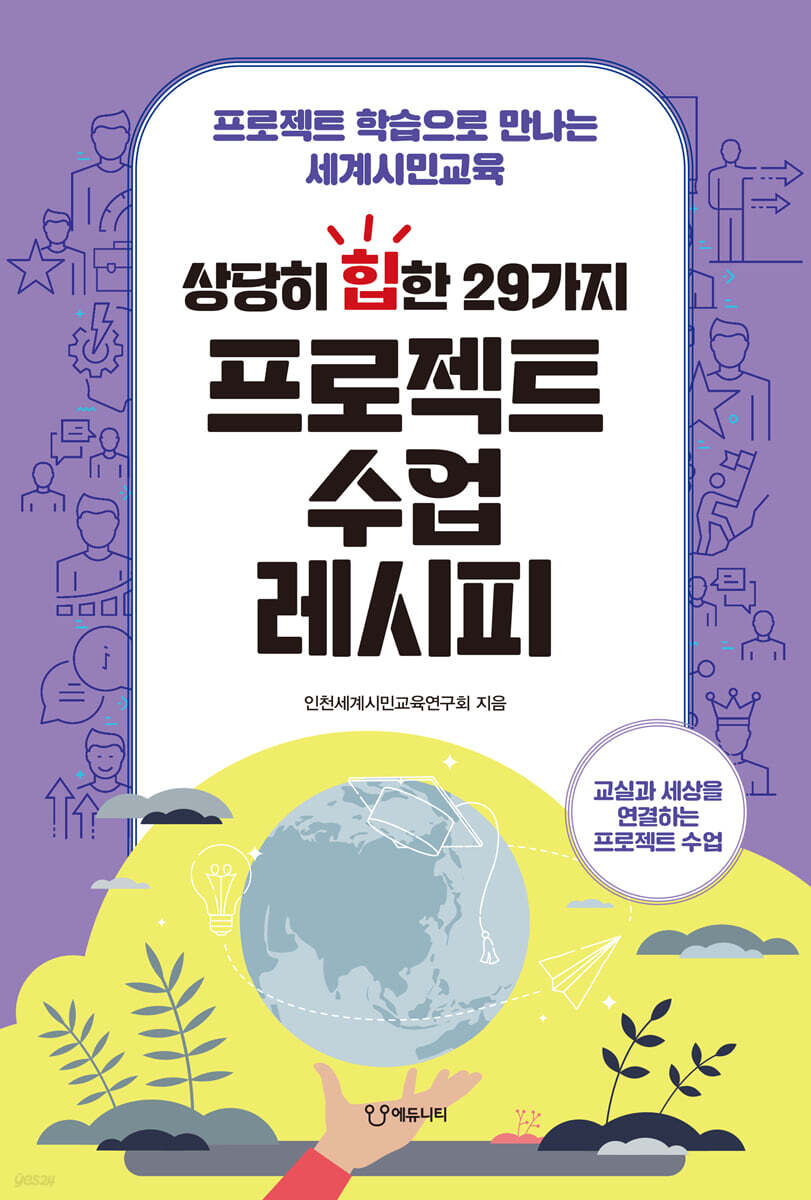
29 Hip Project Class Recipes
 |
Description
Book Introduction
Lesson plans and lesson-by-lesson explanations for 29 project classes,
It includes an evaluation plan and grading criteria, so anyone can easily use it in class.
This is a vivid example of a class practiced directly by eight teachers belonging to the Incheon World Citizen Education Research Association.
It explains the roles of teachers and students at each stage of the lesson, allowing anyone to easily apply and utilize the material in real-world classroom situations and topics. It also demonstrates how children grow through the lessons. It includes project-based lessons for global citizenship education on the topics of SDGs, cultural diversity, global community, regional connections, social participation, international exchange, and digital citizenship.
It includes an evaluation plan and grading criteria, so anyone can easily use it in class.
This is a vivid example of a class practiced directly by eight teachers belonging to the Incheon World Citizen Education Research Association.
It explains the roles of teachers and students at each stage of the lesson, allowing anyone to easily apply and utilize the material in real-world classroom situations and topics. It also demonstrates how children grow through the lessons. It includes project-based lessons for global citizenship education on the topics of SDGs, cultural diversity, global community, regional connections, social participation, international exchange, and digital citizenship.
- You can preview some of the book's contents.
Preview
index
Introduction: Why Global Citizenship Education Now? Jeong Woo-tak
Chapter 1.
The 'Growing One Inch' project as part of the Sustainable Development Goals.
Jang Eun-young
Let's give you a new perspective on the world 22
24. Identifying the world's best influencers and connecting them to the SDGs.
Good Influencer Jane Project: Becoming a Driving Force for a Sustainable World 32
39 Stories About the SDGs: A Hip Look Through Brand Activism
The Troll Dilemma: Boldly Thinking Through Global Issues 46
Chapter 2.
A cultural diversity project class that creates together but differently.
Lee Jin-sook
54 Teachers Who Love Diversity and Students Who Are Diversity Themselves
"Looking at Each Other" Project Lesson 54
We Are Cultural Envoys Project Lesson 63
Encountering Peace in History Project 75
Chapter 3.
A project class to cultivate the global community.
Kim Mi-jeong
What's the environment like? 86
Smart Gardening Project Lesson 87
"A Bowl of Healthy Food" Project Lesson 96
"Human Rights Sensitivity Through Reading" Project Lesson 103
Chapter 4.
A community-linked project class where you learn from your village and grow into a global citizen.
Yang Seung-bun
The World and Me: "I Live with Love for My Village" Project Lesson 114
"Creating a World We Live In Together, Understanding Incheon" Project Lesson 124
Think-Share-Act: Growing from Local to Global Citizens 136
Chapter 5.
Travel around the Earth Village on the Dorandoran 'Conversation Bus'.
Kim Min-jeong
Preparing for a Global Village Journey with Empathetic Dialogue 146
Connecting You and Me Through Keyword-Centric Conversations 154
A Conversation with the Guardians of Earth Village: We Are Homo Symbius 167
Chapter 6.
Adding a Spoonful of Practice to Global Citizenship Education.
Nam Seong-hyeon
Learning by doing 178
Have you heard of the "#CourageChallenge" on Instagram? 179
Create your own dream car with sunlight! 184
Local Food, Vegan, and Fair Trade Stories I Never Knew About 189
Useful tips for responsible consumption and production! 197
Chapter 7.
Social participation project classes and public good practices that lead to change for you and me.
Assistant Yang
Deepening Expression and Empathy: Seosamdok Project 206
Expanding Interests, Community Improvement Project 219
Chapter 8.
Meet the world beyond the classroom.
Seo Hyun-ah
Preparing to Meet the World - Irish Culture Day 234
International Exchange Meets Global Citizenship Education 241
Let's go to the world! Read, walk, write, and experience the world 252
Chapter 9.
A digital citizenship project class that helps build relationships and communication.
Incheon World Citizenship Education Research Association
The Digital World and Digital Citizenship 268
A closer look at the digital world, more dramatic than dramas 269
Participate as a Global Citizen with Smart Apps 277
Developing Coexistence Capabilities through Social Participation Using EdTech 291
Chapter 1.
The 'Growing One Inch' project as part of the Sustainable Development Goals.
Jang Eun-young
Let's give you a new perspective on the world 22
24. Identifying the world's best influencers and connecting them to the SDGs.
Good Influencer Jane Project: Becoming a Driving Force for a Sustainable World 32
39 Stories About the SDGs: A Hip Look Through Brand Activism
The Troll Dilemma: Boldly Thinking Through Global Issues 46
Chapter 2.
A cultural diversity project class that creates together but differently.
Lee Jin-sook
54 Teachers Who Love Diversity and Students Who Are Diversity Themselves
"Looking at Each Other" Project Lesson 54
We Are Cultural Envoys Project Lesson 63
Encountering Peace in History Project 75
Chapter 3.
A project class to cultivate the global community.
Kim Mi-jeong
What's the environment like? 86
Smart Gardening Project Lesson 87
"A Bowl of Healthy Food" Project Lesson 96
"Human Rights Sensitivity Through Reading" Project Lesson 103
Chapter 4.
A community-linked project class where you learn from your village and grow into a global citizen.
Yang Seung-bun
The World and Me: "I Live with Love for My Village" Project Lesson 114
"Creating a World We Live In Together, Understanding Incheon" Project Lesson 124
Think-Share-Act: Growing from Local to Global Citizens 136
Chapter 5.
Travel around the Earth Village on the Dorandoran 'Conversation Bus'.
Kim Min-jeong
Preparing for a Global Village Journey with Empathetic Dialogue 146
Connecting You and Me Through Keyword-Centric Conversations 154
A Conversation with the Guardians of Earth Village: We Are Homo Symbius 167
Chapter 6.
Adding a Spoonful of Practice to Global Citizenship Education.
Nam Seong-hyeon
Learning by doing 178
Have you heard of the "#CourageChallenge" on Instagram? 179
Create your own dream car with sunlight! 184
Local Food, Vegan, and Fair Trade Stories I Never Knew About 189
Useful tips for responsible consumption and production! 197
Chapter 7.
Social participation project classes and public good practices that lead to change for you and me.
Assistant Yang
Deepening Expression and Empathy: Seosamdok Project 206
Expanding Interests, Community Improvement Project 219
Chapter 8.
Meet the world beyond the classroom.
Seo Hyun-ah
Preparing to Meet the World - Irish Culture Day 234
International Exchange Meets Global Citizenship Education 241
Let's go to the world! Read, walk, write, and experience the world 252
Chapter 9.
A digital citizenship project class that helps build relationships and communication.
Incheon World Citizenship Education Research Association
The Digital World and Digital Citizenship 268
A closer look at the digital world, more dramatic than dramas 269
Participate as a Global Citizen with Smart Apps 277
Developing Coexistence Capabilities through Social Participation Using EdTech 291
Into the book
The core value pursued by global citizenship education is global citizenship awareness.
Global citizenship is also expressed as ‘cross-border citizenship,’ ‘post-nation-state citizenship,’ ‘planetary citizenship,’ and ‘cosmopolitanism.’
Global citizenship is a philosophy that respects universal human values and has a sense of belonging and solidarity with the global and human community.
Global citizenship education is an education that teaches, learns, and internalizes identity and solidarity with the Earth and humanity, as well as universal human values.
--- p.4
The main goal of the project we hope to share through this opportunity is to offer a perspective on the world through the vast prism of the Sustainable Development Goals.
And the ultimate goal of this project is to enable people, as Earthlings, to experience for themselves what valuable judgments and decisions are necessary to save the world.
Therefore, I would like to present this project in four subtopics so that teachers like me can easily apply it to their classes, and connect them sequentially to form one large project class.
--- p.23
After working with students on the 17 Sustainable Development Goals for two or three periods, they will finally understand the intention behind the rainbow-colored designs they had previously encountered without much thought.
This could also be seen as a warm-up exercise for students to willingly enter the vast ocean of SDGs.
--- p.30
To kick off the project in earnest, the teacher presents the project activity topic by 'fluently' unraveling a bundle of stories about people who have a positive influence in various areas of the world.
At this stage, it would be better if the person is socially recognized or is of a similar age to the children and can be easily accepted without much burden.
The first person I always bring up as an example is Malala Yousafzai.
--- p.33
What makes this project activity so interesting is that advertising as a medium has all the necessary elements to satisfy the learning needs of MZ learners who respond quickly to short-form content and visual materials.
As the saying goes, "If you want to see the world, look at advertisements," we can see through class activities that advertisements can be an excellent teaching tool that allows students to easily understand the true face of our society.
--- p.41
After broadening students' thinking through a philosophical exchange on the perplexing trolley dilemma, we will then engage in an exploratory activity to find points where their decisions conflict within various global issues.
There is no perfect answer.
However, in one way or another, we live in a continuum of decisions, so through this project activity, children will practice setting their own value judgments and making decisions with a clear attitude.
--- p.48
Diversity exists in any classroom.
Students of all nationalities, genders, races, religions, ages, and languages, who embody diversity, learn, work, and grow together in the classroom.
The same goes for the 4th grade classroom I teach in.
In the diverse classes where students from early immigrant backgrounds gather and study together, diversity reveals itself in sometimes pleasant and sometimes bitter ways.
--- p.55
The 'We are Cultural Envoys' project is an activity where students research and organize the cultures they have experienced and know, and have the opportunity to naturally think about cultural diversity through cultural introduction brochures created by their friends.
We carried out the project with a total of seven students: two Russian students, one Vietnamese student, two Egyptian students, and two Chinese students.
The course was conducted as a process in which students who had lived in their home countries and are currently living in Korea introduced each other to the culture of Korea and their home countries that they each selected as meaningful.
--- p.64
I thought we would finish the evaluation stage in a bright atmosphere with interest in each other's promotional work, but an unexpected situation occurred.
A female student from Egypt wrote this comment on an anti-American material in Vietnam.
“I’m sorry, but I don’t like this food.” The Vietnamese male student, upon seeing the comment, got angry and asked to return the material, saying that he too would give a bad review to the Egyptian cultural materials.
It was a moment when conflict arose due to cultural differences.
--- p.74
In this history class, I encountered difficulties and inconveniences that I had not encountered when teaching Korean history to students from non-immigrant backgrounds.
I think I tried throughout the project to look at historical events from an objective perspective, rather than a biased one.
I realized that both teachers and students, regardless of their immigration background, agree that learning history is essential for the peace of all.
It was an opportunity to once again feel the need for historical guidance from an objective and integrated perspective.
--- p.82
The 'Smart Garden Life' project class is an activity in which students of various grades plant and grow crops in the school garden in connection with the curriculum.
Garden activities are appropriately linked to school activities, morning activities, and lunchtime during the school day.
We also look at how global food resources are consumed and examine people's nutritional intake and conflict issues through the Hunger Map (https://hungermap.wfp.org/) created by the World Food Programme (WFP).
--- p.90
Students learned about human rights in a real-world context, reflected on their own lives, and naturally put it into practice.
There has been a lot of serious questioning and opinion exchange about what to use first if we were to limit electricity in our home.
When asked how much they know about disaster survival strategies and who has the right to use power first in the event of a power shortage, they answered and ranked them as hospitals, police/broadcasting stations, prisons, and the military.
--- p.108
The 'I Live with Love for My Village' project class is an activity where students look at a village map and use their knowledge of the village and their experiences living in Bupyeong to choose topics of interest such as a road with pretty flower beds, a road with family memories, an alleyway filled with scenery from the past, an alleyway filled with delicious food, and an alleyway with unique spaces, and explore the village alleyways with friends.
--- p.116
The reason I chose a village as a teaching material is because it is a small society that children can most easily access and a space for social participation that is directly connected to them.
We hope that the small communities children encounter will become meaningful connections between learning and learning in the classroom, and we created opportunities for children to become familiar with the village.
In relation to global citizenship education, we focused on exploring the problems in old downtown areas arising from regional urbanization and learning about the activities of local organizations and civic groups working toward urban regeneration.
--- p.119
The project, "Growing into Peaceful Global Citizens through Local History," expands historical facts from the local village where students live to the region and then to our country.
By naturally connecting local history to Korean history, we recognize the historical value of local cultural heritage and understand the characteristics of local culture through the lives of our ancestors.
By looking at the local community from a global perspective, you can discover the values that form the local community's identity.
--- p.129
The Noodle Road Walking Tour Project encourages children to explore the Incheon Noodle Platform and various noodle-related museums on foot, allowing them to see and experience firsthand what they've learned in the classroom.
Let's walk through Chinatown, the mecca of Jjajangmyeon, and visit 'Gonghwachun', a restaurant where the history of Jjajangmyeon in Korea began over 100 years ago.
--- p.135
Like a new semester or meeting new friends, international exchange begins with excitement and anxiety.
Children can reduce their fears of international exchange and prepare to meet new friends with a positive attitude through empathetic conversations based on their school life.
By sharing each other's experiences, we can discover the meaning of international exchange together.
--- p.146
The first step in your Earth Village journey is to find a school to participate in international exchange.
Unless the Office of Education connects you with an international exchange school or your school is already conducting international exchange, it can be a frustrating time for anyone.
Fortunately, there are several websites where you can find foreign schools that you would like to participate in international exchange programs with.
Let's take a closer look at the school information presented on each site, find the schools that best fit our school's characteristics and circumstances, and send them an email.
--- p.148
Since there is no subject called international exchange in the national curriculum, curriculum restructuring is essential when conducting international exchange.
Don't forget to obtain consent for personal information about international exchange classes from the guardians of children participating in the international exchange.
When drafting an international exchange lesson plan internally, be sure to also draft a home communication letter as an attachment and obtain the consent of the school principal and guardians before beginning the international exchange program.
--- p.152
If real-time exchange classes are available, we recommend concluding the online international exchange with a real-time class.
Even though they only met online for a short time, children form a much deeper intimacy than you might think.
Think about how it feels to not be able to say goodbye to a close friend when they transfer to a faraway school.
Although it was a short time, the children built an inner closeness regardless of the physical distance and became meaningful to each other.
Page 173
--- p.173
Technology, due to its specific nature as engineering, may seem unrelated and distant from global citizenship education. However, in reality, it is possible to integrate technology and the synergy is limitless. This chapter will discuss this.
Furthermore, I am confident that if we can gather ideas from teachers in other subjects and schools, it will become a starting point for connecting diverse subjects and global citizenship education practice classes.
--- p.178
In middle school technology classes, students learn about 'sustainable development and appropriate technology.'
There are two pictures that we always show in the first hour of this unit: one is of plastic collected in the North Pacific Gyre.
It looks like an island, so we call it 'plastic island' in class, and the shocked students are speechless for a while.
And another is the famous 'albatross carcass' photo, which shows the plastic waste left in the stomach of a dead bird.
--- p.179
Students who had thought, 'How serious can the plastic problem be?' saw the plastic problem with their own eyes and jumped into the problem situation themselves.
Finally, we conclude the activity by summarizing the entire process.
--- p.183
In the last class, all the cars are taken out to the playground.
Share who made the fastest car and who made the prettiest car, and then come back to the classroom and write down what you felt on the follow-up activity sheet.
If you are using it for performance evaluation, you can use the rubric below to evaluate it.
--- p.188
Upcycling is a combination of the words "upgrade," meaning "to improve," and "recycling," meaning "to recycle." It generally refers to a method of going beyond the simple reuse of waste materials and processing them to create new value to create new products.
For example, processing plastic bottles to create fibers and using them to make clothing, or using discarded clothes to make bags or pouches can also be considered upcycling.
--- p.200
Even if teachers don't explicitly say, "This is global citizenship education," I'm confident that if they incorporate global citizenship values into their classes, it will manifest in students' lives, whether suddenly or gradually, someday.
And the important thing here is that 'just as children are a mirror of their parents,' we, as teachers, must first live such a life.
--- p.206
Through the long-term, not short, Seosamdok Project, I hope to be able to read books of various genres without being picky, express the content of the books I read in various ways, and read and listen to the thoughts and words of other friends, expanding my area of interest and tolerance beyond myself to those around me.
Also, I hope that by reading books of my own choosing, organizing and recording my thoughts, and meeting once every two months to share my thoughts, I can cultivate self-management, commitments to myself and others, and a sense of responsibility.
--- p.209
A student left a video letter to the author of "What April 3rd Said to Me" pledging to become a global citizen who empathizes with and acts on the pain of others; a student approached the truth of the historical event and reflected on the stories of survivors and the challenges left for us; and a student wrote a video letter to the victims, taking to heart the lessons of history.
Among the "10 Drugs That Changed World History," there was a student who expressed gratitude to the scientist who discovered penicillin for his outstanding achievements and respect for life.
--- p.218
Just as my standards differ from the students', I wonder, 'Maybe the students' goals are different from what I expected?' Of course, it would be nice if they followed along well, but 'Doesn't it mean they have to follow my instructions exactly the way I thought?' In the separately run program, we don't use activities that rank students in an evaluation-based manner, so we try to give students equal opportunities for experience while allowing them autonomy and imperfection in their methods and expressions.
--- p.230
While I was working on the pre-international exchange training, I finally heard that an online meeting with Australian teachers had been scheduled.
The Queensland Department of Education in Australia sent me a consent form filled with incredibly small print.
They agreed to use the photos, videos, and artwork of students created during our online activities when publishing under the name of the Office of Education.
Unfortunately, due to the schedules of both schools, online meetings were only possible twice.
--- p.236
When I tell students that I am starting an international exchange program for the first time, they are confused, but soon they start looking forward to that time.
Even if you can't meet in person, online international exchange is a cost-effective activity that can provide students with many of the benefits of face-to-face exchange.
Naturally, the first hour of international exchange is mostly about self-introductions and school introductions.
We make videos introducing our school, show them to each other online, and ask questions.
Students are very excited about this opportunity to meet students from across the world for the first time.
--- p.241
Some countries place importance on issuing certificates of completion upon completion of an activity.
For this purpose, the issuance of a certificate of completion must be discussed in advance.
In my experience, Southeast Asian countries tend to find it quite meaningful to award certificates.
On the last day, we shared our experience of the activity and gave feedback, held a ceremony to award certificates, and shared related photos.
Since each school continued to share photos via Telegram during the activities, it was easy to see the situation at each school.
--- p.244
The easiest form of global citizenship education-based international exchange project activity would be to have each school attempt a campaign activity and then share the process and results during online international exchange activities.
This is because, without uniting, each person can practice at school in their own way and then share the results.
Although it is a simple method, the process itself can be a form of global citizenship education, allowing students to plan, produce, and implement it.
--- p.248
Surprisingly, there are overseas schools that are struggling to find a school to visit.
When students actually interact face-to-face, they easily become attached to each other in a short period of time, and they seem reluctant to part ways.
Although there is a lot to prepare for face-to-face international exchange, seeing students sad to say goodbye on the last day makes me feel proud and think, "I'm glad I tried."
--- p.252
This year, during our visit to the Thai school, we decided to hold a joint session on the topic of academic exchange related to the SDGs.
We decided to conduct a related campaign activity during lunch during our visit to the school. We conducted preliminary research on specific SDG goals and their corresponding topics, prepared academic exchange content, and planned a lunchtime campaign for students at the visiting school.
--- p.259
The article said that 'deepfake' sex crimes using artificial intelligence and AI synthesis technology are on the rise online.
Deepfake is a portmanteau of deep learning and fake, and refers to a technology that manipulates images or audio into fakes by utilizing artificial intelligence and deep learning technology.
The problem is that crimes of this nature are so easy to spread online that it is difficult to even establish government-level measures to eradicate them.
--- p.270
Among the various elements of digital citizenship, we designed a project class with 'digital ethics' as the main topic to provide middle school students with an opportunity to seriously think about digital citizenship.
The project name was decided as 'Digital Hero', which changed 'Fake' to 'Faith'.
I want to let our children know that it is they who are responsible for transforming the digital world, where fakes reign supreme, into a place of truth, a place of warmth where people share faith and trust.
--- p.271
School Nature Learning can help students learn respect for plants, insects, animals, and the environment, fostering empathy for others and helping them live as desirable global citizens.
Furthermore, by accumulating and sharing data, meaningful research on climate change and changes in the distribution of organisms can be conducted, allowing citizens, researchers, and scientists to actively participate in School Nature, and even create regional ecological maps.
--- p.281
Of course, classes are possible even without a smart device.
However, if used well, smart devices and apps can become smart learning tools that increase student engagement and effectively implement learning strategies.
Of course, concerns about smart device addiction and misuse persist.
If we can't stop the digital transformation that has deeply permeated our daily lives, why not teach people how to utilize it properly?
--- p.291
If we divide the level of digital citizenship into several stages, the final stage would be social participation.
While existing global citizenship education's social participation was limited by time and space, social participation in the digital world overcomes these limitations and enables a much broader range of social participation activities.
For example, my previous social engagement activities involved collecting signatures and holding picket lines with students near subway stations or schools to address the climate crisis. Now, by collecting digital signatures and making digital petitions, the movement can expand globally.
--- p.292
I designed my classes based on analog educational activities such as conversations between teachers and students, so that children can understand and empathize with others while moving between a virtual digital world (Wonderverse) and a fictional world (picture books).
In the process, we prioritized children's conversation and cooperation, and conducted project classes that combined edutech and digital citizenship education.
--- p.296
In global citizenship education, edtech should focus on helping children not simply use technology, but also become active and responsible citizens in the digital world.
Through this, children will practice ethical and responsible behavior in a global society, respect diverse cultures and perspectives, and develop the ability to lead social change.
Even children with low achievement and low learning engagement show high engagement in metaverse classes or course dramas.
Global citizenship is also expressed as ‘cross-border citizenship,’ ‘post-nation-state citizenship,’ ‘planetary citizenship,’ and ‘cosmopolitanism.’
Global citizenship is a philosophy that respects universal human values and has a sense of belonging and solidarity with the global and human community.
Global citizenship education is an education that teaches, learns, and internalizes identity and solidarity with the Earth and humanity, as well as universal human values.
--- p.4
The main goal of the project we hope to share through this opportunity is to offer a perspective on the world through the vast prism of the Sustainable Development Goals.
And the ultimate goal of this project is to enable people, as Earthlings, to experience for themselves what valuable judgments and decisions are necessary to save the world.
Therefore, I would like to present this project in four subtopics so that teachers like me can easily apply it to their classes, and connect them sequentially to form one large project class.
--- p.23
After working with students on the 17 Sustainable Development Goals for two or three periods, they will finally understand the intention behind the rainbow-colored designs they had previously encountered without much thought.
This could also be seen as a warm-up exercise for students to willingly enter the vast ocean of SDGs.
--- p.30
To kick off the project in earnest, the teacher presents the project activity topic by 'fluently' unraveling a bundle of stories about people who have a positive influence in various areas of the world.
At this stage, it would be better if the person is socially recognized or is of a similar age to the children and can be easily accepted without much burden.
The first person I always bring up as an example is Malala Yousafzai.
--- p.33
What makes this project activity so interesting is that advertising as a medium has all the necessary elements to satisfy the learning needs of MZ learners who respond quickly to short-form content and visual materials.
As the saying goes, "If you want to see the world, look at advertisements," we can see through class activities that advertisements can be an excellent teaching tool that allows students to easily understand the true face of our society.
--- p.41
After broadening students' thinking through a philosophical exchange on the perplexing trolley dilemma, we will then engage in an exploratory activity to find points where their decisions conflict within various global issues.
There is no perfect answer.
However, in one way or another, we live in a continuum of decisions, so through this project activity, children will practice setting their own value judgments and making decisions with a clear attitude.
--- p.48
Diversity exists in any classroom.
Students of all nationalities, genders, races, religions, ages, and languages, who embody diversity, learn, work, and grow together in the classroom.
The same goes for the 4th grade classroom I teach in.
In the diverse classes where students from early immigrant backgrounds gather and study together, diversity reveals itself in sometimes pleasant and sometimes bitter ways.
--- p.55
The 'We are Cultural Envoys' project is an activity where students research and organize the cultures they have experienced and know, and have the opportunity to naturally think about cultural diversity through cultural introduction brochures created by their friends.
We carried out the project with a total of seven students: two Russian students, one Vietnamese student, two Egyptian students, and two Chinese students.
The course was conducted as a process in which students who had lived in their home countries and are currently living in Korea introduced each other to the culture of Korea and their home countries that they each selected as meaningful.
--- p.64
I thought we would finish the evaluation stage in a bright atmosphere with interest in each other's promotional work, but an unexpected situation occurred.
A female student from Egypt wrote this comment on an anti-American material in Vietnam.
“I’m sorry, but I don’t like this food.” The Vietnamese male student, upon seeing the comment, got angry and asked to return the material, saying that he too would give a bad review to the Egyptian cultural materials.
It was a moment when conflict arose due to cultural differences.
--- p.74
In this history class, I encountered difficulties and inconveniences that I had not encountered when teaching Korean history to students from non-immigrant backgrounds.
I think I tried throughout the project to look at historical events from an objective perspective, rather than a biased one.
I realized that both teachers and students, regardless of their immigration background, agree that learning history is essential for the peace of all.
It was an opportunity to once again feel the need for historical guidance from an objective and integrated perspective.
--- p.82
The 'Smart Garden Life' project class is an activity in which students of various grades plant and grow crops in the school garden in connection with the curriculum.
Garden activities are appropriately linked to school activities, morning activities, and lunchtime during the school day.
We also look at how global food resources are consumed and examine people's nutritional intake and conflict issues through the Hunger Map (https://hungermap.wfp.org/) created by the World Food Programme (WFP).
--- p.90
Students learned about human rights in a real-world context, reflected on their own lives, and naturally put it into practice.
There has been a lot of serious questioning and opinion exchange about what to use first if we were to limit electricity in our home.
When asked how much they know about disaster survival strategies and who has the right to use power first in the event of a power shortage, they answered and ranked them as hospitals, police/broadcasting stations, prisons, and the military.
--- p.108
The 'I Live with Love for My Village' project class is an activity where students look at a village map and use their knowledge of the village and their experiences living in Bupyeong to choose topics of interest such as a road with pretty flower beds, a road with family memories, an alleyway filled with scenery from the past, an alleyway filled with delicious food, and an alleyway with unique spaces, and explore the village alleyways with friends.
--- p.116
The reason I chose a village as a teaching material is because it is a small society that children can most easily access and a space for social participation that is directly connected to them.
We hope that the small communities children encounter will become meaningful connections between learning and learning in the classroom, and we created opportunities for children to become familiar with the village.
In relation to global citizenship education, we focused on exploring the problems in old downtown areas arising from regional urbanization and learning about the activities of local organizations and civic groups working toward urban regeneration.
--- p.119
The project, "Growing into Peaceful Global Citizens through Local History," expands historical facts from the local village where students live to the region and then to our country.
By naturally connecting local history to Korean history, we recognize the historical value of local cultural heritage and understand the characteristics of local culture through the lives of our ancestors.
By looking at the local community from a global perspective, you can discover the values that form the local community's identity.
--- p.129
The Noodle Road Walking Tour Project encourages children to explore the Incheon Noodle Platform and various noodle-related museums on foot, allowing them to see and experience firsthand what they've learned in the classroom.
Let's walk through Chinatown, the mecca of Jjajangmyeon, and visit 'Gonghwachun', a restaurant where the history of Jjajangmyeon in Korea began over 100 years ago.
--- p.135
Like a new semester or meeting new friends, international exchange begins with excitement and anxiety.
Children can reduce their fears of international exchange and prepare to meet new friends with a positive attitude through empathetic conversations based on their school life.
By sharing each other's experiences, we can discover the meaning of international exchange together.
--- p.146
The first step in your Earth Village journey is to find a school to participate in international exchange.
Unless the Office of Education connects you with an international exchange school or your school is already conducting international exchange, it can be a frustrating time for anyone.
Fortunately, there are several websites where you can find foreign schools that you would like to participate in international exchange programs with.
Let's take a closer look at the school information presented on each site, find the schools that best fit our school's characteristics and circumstances, and send them an email.
--- p.148
Since there is no subject called international exchange in the national curriculum, curriculum restructuring is essential when conducting international exchange.
Don't forget to obtain consent for personal information about international exchange classes from the guardians of children participating in the international exchange.
When drafting an international exchange lesson plan internally, be sure to also draft a home communication letter as an attachment and obtain the consent of the school principal and guardians before beginning the international exchange program.
--- p.152
If real-time exchange classes are available, we recommend concluding the online international exchange with a real-time class.
Even though they only met online for a short time, children form a much deeper intimacy than you might think.
Think about how it feels to not be able to say goodbye to a close friend when they transfer to a faraway school.
Although it was a short time, the children built an inner closeness regardless of the physical distance and became meaningful to each other.
Page 173
--- p.173
Technology, due to its specific nature as engineering, may seem unrelated and distant from global citizenship education. However, in reality, it is possible to integrate technology and the synergy is limitless. This chapter will discuss this.
Furthermore, I am confident that if we can gather ideas from teachers in other subjects and schools, it will become a starting point for connecting diverse subjects and global citizenship education practice classes.
--- p.178
In middle school technology classes, students learn about 'sustainable development and appropriate technology.'
There are two pictures that we always show in the first hour of this unit: one is of plastic collected in the North Pacific Gyre.
It looks like an island, so we call it 'plastic island' in class, and the shocked students are speechless for a while.
And another is the famous 'albatross carcass' photo, which shows the plastic waste left in the stomach of a dead bird.
--- p.179
Students who had thought, 'How serious can the plastic problem be?' saw the plastic problem with their own eyes and jumped into the problem situation themselves.
Finally, we conclude the activity by summarizing the entire process.
--- p.183
In the last class, all the cars are taken out to the playground.
Share who made the fastest car and who made the prettiest car, and then come back to the classroom and write down what you felt on the follow-up activity sheet.
If you are using it for performance evaluation, you can use the rubric below to evaluate it.
--- p.188
Upcycling is a combination of the words "upgrade," meaning "to improve," and "recycling," meaning "to recycle." It generally refers to a method of going beyond the simple reuse of waste materials and processing them to create new value to create new products.
For example, processing plastic bottles to create fibers and using them to make clothing, or using discarded clothes to make bags or pouches can also be considered upcycling.
--- p.200
Even if teachers don't explicitly say, "This is global citizenship education," I'm confident that if they incorporate global citizenship values into their classes, it will manifest in students' lives, whether suddenly or gradually, someday.
And the important thing here is that 'just as children are a mirror of their parents,' we, as teachers, must first live such a life.
--- p.206
Through the long-term, not short, Seosamdok Project, I hope to be able to read books of various genres without being picky, express the content of the books I read in various ways, and read and listen to the thoughts and words of other friends, expanding my area of interest and tolerance beyond myself to those around me.
Also, I hope that by reading books of my own choosing, organizing and recording my thoughts, and meeting once every two months to share my thoughts, I can cultivate self-management, commitments to myself and others, and a sense of responsibility.
--- p.209
A student left a video letter to the author of "What April 3rd Said to Me" pledging to become a global citizen who empathizes with and acts on the pain of others; a student approached the truth of the historical event and reflected on the stories of survivors and the challenges left for us; and a student wrote a video letter to the victims, taking to heart the lessons of history.
Among the "10 Drugs That Changed World History," there was a student who expressed gratitude to the scientist who discovered penicillin for his outstanding achievements and respect for life.
--- p.218
Just as my standards differ from the students', I wonder, 'Maybe the students' goals are different from what I expected?' Of course, it would be nice if they followed along well, but 'Doesn't it mean they have to follow my instructions exactly the way I thought?' In the separately run program, we don't use activities that rank students in an evaluation-based manner, so we try to give students equal opportunities for experience while allowing them autonomy and imperfection in their methods and expressions.
--- p.230
While I was working on the pre-international exchange training, I finally heard that an online meeting with Australian teachers had been scheduled.
The Queensland Department of Education in Australia sent me a consent form filled with incredibly small print.
They agreed to use the photos, videos, and artwork of students created during our online activities when publishing under the name of the Office of Education.
Unfortunately, due to the schedules of both schools, online meetings were only possible twice.
--- p.236
When I tell students that I am starting an international exchange program for the first time, they are confused, but soon they start looking forward to that time.
Even if you can't meet in person, online international exchange is a cost-effective activity that can provide students with many of the benefits of face-to-face exchange.
Naturally, the first hour of international exchange is mostly about self-introductions and school introductions.
We make videos introducing our school, show them to each other online, and ask questions.
Students are very excited about this opportunity to meet students from across the world for the first time.
--- p.241
Some countries place importance on issuing certificates of completion upon completion of an activity.
For this purpose, the issuance of a certificate of completion must be discussed in advance.
In my experience, Southeast Asian countries tend to find it quite meaningful to award certificates.
On the last day, we shared our experience of the activity and gave feedback, held a ceremony to award certificates, and shared related photos.
Since each school continued to share photos via Telegram during the activities, it was easy to see the situation at each school.
--- p.244
The easiest form of global citizenship education-based international exchange project activity would be to have each school attempt a campaign activity and then share the process and results during online international exchange activities.
This is because, without uniting, each person can practice at school in their own way and then share the results.
Although it is a simple method, the process itself can be a form of global citizenship education, allowing students to plan, produce, and implement it.
--- p.248
Surprisingly, there are overseas schools that are struggling to find a school to visit.
When students actually interact face-to-face, they easily become attached to each other in a short period of time, and they seem reluctant to part ways.
Although there is a lot to prepare for face-to-face international exchange, seeing students sad to say goodbye on the last day makes me feel proud and think, "I'm glad I tried."
--- p.252
This year, during our visit to the Thai school, we decided to hold a joint session on the topic of academic exchange related to the SDGs.
We decided to conduct a related campaign activity during lunch during our visit to the school. We conducted preliminary research on specific SDG goals and their corresponding topics, prepared academic exchange content, and planned a lunchtime campaign for students at the visiting school.
--- p.259
The article said that 'deepfake' sex crimes using artificial intelligence and AI synthesis technology are on the rise online.
Deepfake is a portmanteau of deep learning and fake, and refers to a technology that manipulates images or audio into fakes by utilizing artificial intelligence and deep learning technology.
The problem is that crimes of this nature are so easy to spread online that it is difficult to even establish government-level measures to eradicate them.
--- p.270
Among the various elements of digital citizenship, we designed a project class with 'digital ethics' as the main topic to provide middle school students with an opportunity to seriously think about digital citizenship.
The project name was decided as 'Digital Hero', which changed 'Fake' to 'Faith'.
I want to let our children know that it is they who are responsible for transforming the digital world, where fakes reign supreme, into a place of truth, a place of warmth where people share faith and trust.
--- p.271
School Nature Learning can help students learn respect for plants, insects, animals, and the environment, fostering empathy for others and helping them live as desirable global citizens.
Furthermore, by accumulating and sharing data, meaningful research on climate change and changes in the distribution of organisms can be conducted, allowing citizens, researchers, and scientists to actively participate in School Nature, and even create regional ecological maps.
--- p.281
Of course, classes are possible even without a smart device.
However, if used well, smart devices and apps can become smart learning tools that increase student engagement and effectively implement learning strategies.
Of course, concerns about smart device addiction and misuse persist.
If we can't stop the digital transformation that has deeply permeated our daily lives, why not teach people how to utilize it properly?
--- p.291
If we divide the level of digital citizenship into several stages, the final stage would be social participation.
While existing global citizenship education's social participation was limited by time and space, social participation in the digital world overcomes these limitations and enables a much broader range of social participation activities.
For example, my previous social engagement activities involved collecting signatures and holding picket lines with students near subway stations or schools to address the climate crisis. Now, by collecting digital signatures and making digital petitions, the movement can expand globally.
--- p.292
I designed my classes based on analog educational activities such as conversations between teachers and students, so that children can understand and empathize with others while moving between a virtual digital world (Wonderverse) and a fictional world (picture books).
In the process, we prioritized children's conversation and cooperation, and conducted project classes that combined edutech and digital citizenship education.
--- p.296
In global citizenship education, edtech should focus on helping children not simply use technology, but also become active and responsible citizens in the digital world.
Through this, children will practice ethical and responsible behavior in a global society, respect diverse cultures and perspectives, and develop the ability to lead social change.
Even children with low achievement and low learning engagement show high engagement in metaverse classes or course dramas.
--- p.299
Publisher's Review
For teachers who want to be good guides,
For teachers who want to teach with impact,
The "Global Citizenship Education Project" class features nine topics and 29 case studies.
A class that begins with the students' lives, allowing them to experience making a positive impact on the lives of others, getting to know and empathize with each other, and working together to solve problems.
Preparing a project class is not an easy task for a teacher.
Nonetheless, this book is a record of the joyful and happy growth of eight elementary, middle, and high school teachers on the topic of global citizenship education.
Just as the North Star always remains in place and serves as a guide, this will serve as a good guide for teachers who hope to guide our children on their path to becoming guardians of the Earth Village.
Global citizenship education is not difficult or far away, nor is it special or new.
9 Project Lessons for Global Citizenship Education
1.
"Growing a Step" as a Sustainable Development Goal
2.
Cultural diversity, created together but differently
3.
Project to nurture the global community
4.
A local community project where people learn from their villages and grow into global citizens.
5.
Travel around the Earth Village on the Dorandoran "Conversation Bus"
6.
Adding a Spoonful of Practice to Global Citizenship Education
7.
A social participation project that leads change for you, me, and us.
8.
Meet the world beyond the classroom
9.
Digital Citizenship: Aiding Relationships and Communication
Chapter 1 explains the UN's 17 Sustainable Development Goals and includes activities to explore 'good influencer activities' and YouTube videos to use in classes via QR codes.
We also seek out various good influencers to help students consider role models that are relevant to their career paths.
Chapter 2 contains a cultural diversity project class at Incheon Hannuri School, an integrated school for children from multicultural families.
Communicating with students from diverse immigrant backgrounds and teaching with students whose native language is not Korean can be challenging, and there are often situations that cannot be resolved with just acceptance and respect.
Students become experts and serve as cultural ambassadors connecting their home countries, Korea, and their friends' countries of origin.
Chapter 3 introduces the 'Garden Life Project', 'A Bowl of Healthy Food', and 'Human Rights Sensitivity through Reading All Books' project classes utilizing the 'Hunger Map' created by the World Food Programme (WFP).
Chapter 4 introduces the 'I Live with Love for My Village' project and classes, which allow students to view the world through the local community, and the 'Knowing Incheon' and 'Think-Share-Act' project classes, which allow students to view the local community from a global citizen perspective.
Chapters 5 and 8 cover all activities, from preparing for international exchange activities with foreign schools to planning the curriculum and actually visiting the schools.
In particular, you can check everything from how to find a school, to things to check, examples of home-school correspondence, online pre-meetings with foreign schools, activities using Padlet, and sample schedules.
Chapter 6 introduces classes where students can acquire skills through projects such as the '#CourageChallenge', 'Building a Dream Car', and 'Responsible Consumption & Production', which are linked to practical training in technology subjects.
Chapter 7 introduces the long-term "Seosammok (Book Reading Three Times) Project" to learn the global citizenship attitudes needed in the community, and the "Global Leadership Project" activities linked to the local community.
Chapter 9 introduces the "Digital Hero Project: Changing Fake to Faith" to foster digital citizenship that helps with relationships and communication, and the "Project to Develop Coexistence Capabilities through the Use of Apps and EdTech" to promote social participation.
This book contains 29 elementary, middle, and high school project classes on the topic of 'global citizenship education.'
This book will serve as a valuable guide for teachers who want to provide students with a perspective on the world, teachers who want to teach classes that help students explore and view the world from a local perspective, and teachers who dream of teaching classes that help students grow into global citizens.
For teachers who want to teach with impact,
The "Global Citizenship Education Project" class features nine topics and 29 case studies.
A class that begins with the students' lives, allowing them to experience making a positive impact on the lives of others, getting to know and empathize with each other, and working together to solve problems.
Preparing a project class is not an easy task for a teacher.
Nonetheless, this book is a record of the joyful and happy growth of eight elementary, middle, and high school teachers on the topic of global citizenship education.
Just as the North Star always remains in place and serves as a guide, this will serve as a good guide for teachers who hope to guide our children on their path to becoming guardians of the Earth Village.
Global citizenship education is not difficult or far away, nor is it special or new.
9 Project Lessons for Global Citizenship Education
1.
"Growing a Step" as a Sustainable Development Goal
2.
Cultural diversity, created together but differently
3.
Project to nurture the global community
4.
A local community project where people learn from their villages and grow into global citizens.
5.
Travel around the Earth Village on the Dorandoran "Conversation Bus"
6.
Adding a Spoonful of Practice to Global Citizenship Education
7.
A social participation project that leads change for you, me, and us.
8.
Meet the world beyond the classroom
9.
Digital Citizenship: Aiding Relationships and Communication
Chapter 1 explains the UN's 17 Sustainable Development Goals and includes activities to explore 'good influencer activities' and YouTube videos to use in classes via QR codes.
We also seek out various good influencers to help students consider role models that are relevant to their career paths.
Chapter 2 contains a cultural diversity project class at Incheon Hannuri School, an integrated school for children from multicultural families.
Communicating with students from diverse immigrant backgrounds and teaching with students whose native language is not Korean can be challenging, and there are often situations that cannot be resolved with just acceptance and respect.
Students become experts and serve as cultural ambassadors connecting their home countries, Korea, and their friends' countries of origin.
Chapter 3 introduces the 'Garden Life Project', 'A Bowl of Healthy Food', and 'Human Rights Sensitivity through Reading All Books' project classes utilizing the 'Hunger Map' created by the World Food Programme (WFP).
Chapter 4 introduces the 'I Live with Love for My Village' project and classes, which allow students to view the world through the local community, and the 'Knowing Incheon' and 'Think-Share-Act' project classes, which allow students to view the local community from a global citizen perspective.
Chapters 5 and 8 cover all activities, from preparing for international exchange activities with foreign schools to planning the curriculum and actually visiting the schools.
In particular, you can check everything from how to find a school, to things to check, examples of home-school correspondence, online pre-meetings with foreign schools, activities using Padlet, and sample schedules.
Chapter 6 introduces classes where students can acquire skills through projects such as the '#CourageChallenge', 'Building a Dream Car', and 'Responsible Consumption & Production', which are linked to practical training in technology subjects.
Chapter 7 introduces the long-term "Seosammok (Book Reading Three Times) Project" to learn the global citizenship attitudes needed in the community, and the "Global Leadership Project" activities linked to the local community.
Chapter 9 introduces the "Digital Hero Project: Changing Fake to Faith" to foster digital citizenship that helps with relationships and communication, and the "Project to Develop Coexistence Capabilities through the Use of Apps and EdTech" to promote social participation.
This book contains 29 elementary, middle, and high school project classes on the topic of 'global citizenship education.'
This book will serve as a valuable guide for teachers who want to provide students with a perspective on the world, teachers who want to teach classes that help students explore and view the world from a local perspective, and teachers who dream of teaching classes that help students grow into global citizens.
GOODS SPECIFICS
- Date of issue: October 1, 2024
- Page count, weight, size: 312 pages | 152*225*18mm
- ISBN13: 9791164251667
You may also like
카테고리
korean


korean

![GQ KOREA Mark (Monthly): December [2025]](http://librairie.coreenne.fr/cdn/shop/files/8ef265dbbfbf186523ed75ba7319009d.jpg?v=1765340328&width=3840)


