

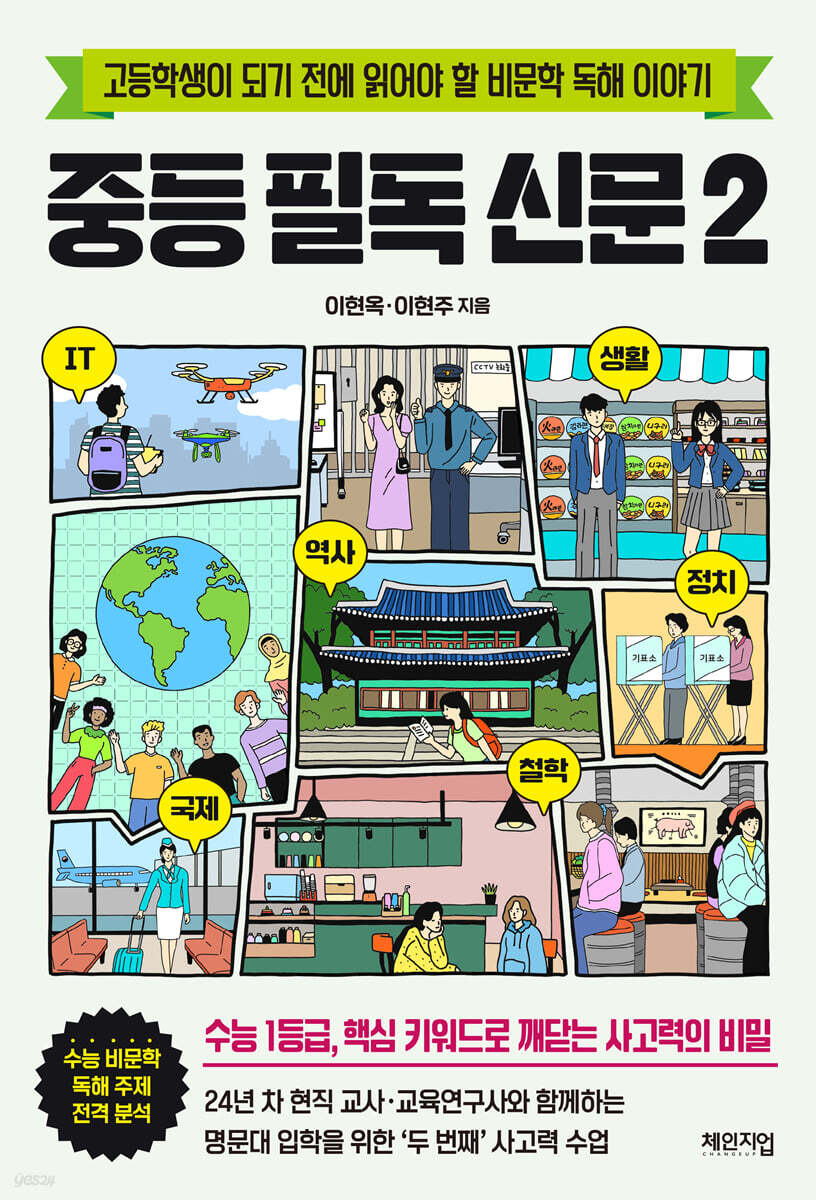
Secondary School Must-Read Newspaper 2
 |
Description
Book Introduction
High-precision analysis of articles related to secondary school curriculum! A "second" critical thinking class for the top 1% and prospective students at prestigious universities. “What would a pizza made with a 3D printer taste like?” “What if there was a refugee living next to my house?” “Is this Daiso’s sales strategy?” “This is how the Roman Empire fell!” “What did ancient Greek philosophers value?” IT, politics, life, history, international affairs, and philosophy A unique mechanism for "shifting thoughts" that has become even more powerful. 《Must-read newspaper for middle school students》 was loved by many parents and students as soon as it was published. The two authors then put their heads together again to tie up the next chapter. Unlike Part 1, which focused on education, culture, society, science, the environment, and the economy, Part 2 focuses on topics students typically struggle with, such as IT, history, and philosophy, to foster higher-level thinking. Critical judgment and discernment do not come naturally. As you read, think, and question this book, you will find yourself at the forefront of the information age with extraordinary thinking skills. While Part 1 featured newspaper articles, Part 2 covers newspaper articles, as well as 'College Scholastic Ability Test questions,' 'mock exams,' and the 'revised curriculum' that will be implemented starting in 2024. The carefully selected articles and test questions may seem a bit difficult, but if you run with the thinking skills you gained through Part 1, it is a 'track of thought' that anyone can complete. Above all, this book fosters critical thinking, the most essential skill for teenagers. It is structured so that you can read a variety of topics and information from multiple perspectives and viewpoints, helping you gain a broader perspective before entering high school. You can't miss out on the pleasure of reading the passage, answering three questions on your own, and logically developing your own arguments and opinions. As the literacy and critical thinking skills of young people are gradually declining, the ability to read long texts and discern what information to take from them and what to discard is essential for college entrance exams. Additionally, you will need to properly learn the ability to interpret data and ask questions to gain deeper knowledge. In this way, this book aims to share with everyone the power of the top 1% of students to 'correct their thinking and think independently.' Improving your thinking skills by delving into the processes of critical thinking. This is the ultimate goal of publishing “Must-read newspaper for middle school students 2.” |
- You can preview some of the book's contents.
Preview
index
Prologue: A person who thinks, questions, and acts
Chapter 1. IT
1.
Robots are used to perform surgeries on overseas patients.
2.
The Amazing Evolution of Drones
3.
3D synthetic image principles and applications
4.
In the era of big data, data is pouring in.
5.
Digital data encoding process and real-life applications
6.
ChatGPT, can we trust it?
7. AI Ethics and Regulation
8.
Create your own pizza with 3D printing
9.
How search engines determine rankings
10.
Principles of meteorological observation and accuracy of weather forecasting
Chapter 2.
politics
1.
Elections and Voting: Voter and Political Parties
2.
What if my neighbor is a refugee?
3.
The Role of Democratic Citizens
4.
Conditions for a fair trial
5.
A democratic process for resolving disputes and the positions of various political actors
6.
Interpretation and flaws of the law
7.
How are taxes used?
8.
Let's reform the media
9.
Public Choice Theory Assumptions and the Median Voter Theorem Model
10.
Policy dilemma
Chapter 3.
life
1.
Is there a Chanel alternative? The evolution of Daiso.
2.
The Impact of Advertising and Advertising in Monopolistic Competitive Markets
3.
Bet your life on a great shot
4.
Vitamin K, the guardian of blood
5.
Does More Money Make You Happy? Exploring the Psychology of the Rich
6.
The joy of communication through reading and inferential reading
7.
Is self-directed learning more effective than private education?
8.
The average annual salary of doctors is 300 million won. Is this why they flock to medical schools?
9.
Location tracking device detection feature to prevent stalking
10.
Wedding dress, can't I wear black pants?
Chapter 4.
history
1.
Lao-tzu's Tao and Han Fei-tzu's Thought
2.
A legacy that shows the times and level of knowledge
3.
Loyalty vs. Pragmatism: What is your choice?
4.
Compilation of Joseon's history books emphasizing the legitimacy of the nation's founding
5.
The Basis and Refutation of the Principle of Legality in the Joseon Dynasty
6.
The rise and fall of the Roman Empire and its influence
7.
The French Revolution and Equal Civil Society
8.
The Industrial Revolution and the Beginning of World Change
9.
World Wars I and II and the Changing International Situation
10.
The Value of India's Nonviolent Resistance Movement
Chapter 5.
International
1.
Respect for the values of other cultures and preservation of cultural diversity
2.
Free Trade Agreement
3.
Is it safe to release Fukushima contaminated water into the ocean?
4.
Monopolistic corporate profit-seeking and the Fair Trade Act
5.
International Plastics Convention to Eliminate Plastic Pollution
6.
Is Brexit the right choice for Britain?
7.
The attitude we should have as global citizens
8.
Russia's Weaponization of Energy That's Staggering the World
9. The AI tsunami threatens human jobs.
10.
Space debris reduction measures
Chapter 6.
philosophy
1.
What is happiness?
2.
moral human standards
3.
It's not just humans that are important, right?
4.
Human thought and its object exist separately.
5.
The Way of Zhangzi and Wang Chong
6.
Know Thyself: The Philosophy of Socrates
7.
Knowledge is the power of freedom: Plato's philosophy
8.
The Beginnings of Deduction and Induction: Aristotle's Philosophy
9.
I think, therefore I am: Descartes' philosophy
10.
Live according to free will: Kant's philosophy
Epilogue Now is the time to leap forward
Chapter 1. IT
1.
Robots are used to perform surgeries on overseas patients.
2.
The Amazing Evolution of Drones
3.
3D synthetic image principles and applications
4.
In the era of big data, data is pouring in.
5.
Digital data encoding process and real-life applications
6.
ChatGPT, can we trust it?
7. AI Ethics and Regulation
8.
Create your own pizza with 3D printing
9.
How search engines determine rankings
10.
Principles of meteorological observation and accuracy of weather forecasting
Chapter 2.
politics
1.
Elections and Voting: Voter and Political Parties
2.
What if my neighbor is a refugee?
3.
The Role of Democratic Citizens
4.
Conditions for a fair trial
5.
A democratic process for resolving disputes and the positions of various political actors
6.
Interpretation and flaws of the law
7.
How are taxes used?
8.
Let's reform the media
9.
Public Choice Theory Assumptions and the Median Voter Theorem Model
10.
Policy dilemma
Chapter 3.
life
1.
Is there a Chanel alternative? The evolution of Daiso.
2.
The Impact of Advertising and Advertising in Monopolistic Competitive Markets
3.
Bet your life on a great shot
4.
Vitamin K, the guardian of blood
5.
Does More Money Make You Happy? Exploring the Psychology of the Rich
6.
The joy of communication through reading and inferential reading
7.
Is self-directed learning more effective than private education?
8.
The average annual salary of doctors is 300 million won. Is this why they flock to medical schools?
9.
Location tracking device detection feature to prevent stalking
10.
Wedding dress, can't I wear black pants?
Chapter 4.
history
1.
Lao-tzu's Tao and Han Fei-tzu's Thought
2.
A legacy that shows the times and level of knowledge
3.
Loyalty vs. Pragmatism: What is your choice?
4.
Compilation of Joseon's history books emphasizing the legitimacy of the nation's founding
5.
The Basis and Refutation of the Principle of Legality in the Joseon Dynasty
6.
The rise and fall of the Roman Empire and its influence
7.
The French Revolution and Equal Civil Society
8.
The Industrial Revolution and the Beginning of World Change
9.
World Wars I and II and the Changing International Situation
10.
The Value of India's Nonviolent Resistance Movement
Chapter 5.
International
1.
Respect for the values of other cultures and preservation of cultural diversity
2.
Free Trade Agreement
3.
Is it safe to release Fukushima contaminated water into the ocean?
4.
Monopolistic corporate profit-seeking and the Fair Trade Act
5.
International Plastics Convention to Eliminate Plastic Pollution
6.
Is Brexit the right choice for Britain?
7.
The attitude we should have as global citizens
8.
Russia's Weaponization of Energy That's Staggering the World
9. The AI tsunami threatens human jobs.
10.
Space debris reduction measures
Chapter 6.
philosophy
1.
What is happiness?
2.
moral human standards
3.
It's not just humans that are important, right?
4.
Human thought and its object exist separately.
5.
The Way of Zhangzi and Wang Chong
6.
Know Thyself: The Philosophy of Socrates
7.
Knowledge is the power of freedom: Plato's philosophy
8.
The Beginnings of Deduction and Induction: Aristotle's Philosophy
9.
I think, therefore I am: Descartes' philosophy
10.
Live according to free will: Kant's philosophy
Epilogue Now is the time to leap forward
Detailed image

Into the book
As robots continue to evolve, we are now entering an era where they collaborate with people in manufacturing sites.
In the service sector, robots are taking over tasks that are difficult for people to do, and the areas in which robots are utilized are gradually expanding, including logistics, delivery, customer service, and cooking.
Why are intelligent robots, generative AI robots, growing so rapidly? The answer is simple.
Because people are precious.
As the 'productive population' available for work shrinks, robots are naturally taking their place.
Robots are expected to be widely used not only in manufacturing but also in new industries such as space, aviation, and defense, as well as in the service industry.
Of course, the scope of application can be expanded as needed.
--- p.15
ChatGPT is a useful learning tool that provides diverse learning materials in various formats, including text answers, code, mathematical formulas, tables, and examples, satisfying students' study preferences.
What's surprising is that ChatGPT is only just at the 'starting point'.
It remains to be seen how ChatGPT will provide more reliable information through natural language learning in the future.
As we update our knowledge and collect conversational patterns, personalized conversations with individuals will become possible, and our ability to analyze and understand various forms of data, such as images and videos, will become much more diverse than before.
--- p.41
Those who are elected form political parties and engage in political activities.
A political party is a group of people who share a political ideology, goal, or purpose.
A political party must have a certain number of members, and in our country, at least 1,000 party members are required in each of the five or more cities and provinces nationwide.
The party must also have a platform and policies that clearly state its basic ideology, goals, and policy direction.
A structure for the political party's decision-making process and organizational operation is also necessary.
Once the party leader is elected, he or she registers with the Central Election Management Committee and then informs the party of the party dues, rights and obligations of party members, decision-making, and financial management methods, and raises funds.
They exercise political influence by nominating candidates for elections, promoting policies, and communicating with party members and the public.
This group is called a 'political party'.
--- p.68
Public goods include police systems, environmental protection activities, scientific discoveries and research results, and even street lights, parks, public roads, and military defense systems.
Public goods are divided into 'substance theory' and 'process theory' depending on how they are understood and defined.
The entity theory, which views public goods as goods with specific properties, holds that public goods are non-rivalrous, meaning that one person's consumption does not interfere with the consumption of others, and that they are non-excludable, meaning that no one can be excluded from using them.
Examples include national defense, public roads, and parks.
The process theory emphasizes 'public choice', which is selected and provided by public institutions, and decisions made through interaction and negotiation among various stakeholders.
For example, medical services, education, and environmental protection programs are defined according to this process theory.
--- p.111
How do the wealthy spend their time? According to the 2024 South Korea Wealth Report, the average wealthy person sleeps about seven hours.
Sleep 30 minutes less than average.
They usually go to bed at 11:30 and wake up early to make good use of their morning time.
I eat a light meal like juice or Greek yogurt, and spend my mornings exercising, taking a walk, and checking my schedule.
I sometimes read the newspaper or watch the news while eating breakfast.
It was found that as the size of one's assets increased, the proportion of people who read newspapers and news also increased.
They were particularly interested in the economics section, and had relatively little interest in entertainment, sports, and society.
There was also a difference in the amount of reading.
While the average person reads about six books a year, the wealthy read more than ten.
It was revealed that wealthy people with financial assets of over 10 billion won read about 20 books.
For the rich, reading is a daily routine and a form of relaxation.
--- p.139
But in modern times, this tradition begins to waver.
In the 1920s, wedding dress designs became simpler and shorter.
The simple design that reaches to the knees has become popular.
In the 1930s and 1940s, weddings became more streamlined and dresses simpler due to the Great Depression and World War II.
In the 1950s, under the influence of Hollywood, glamorous and feminine designs became popular again, while in the 1960s and 1970s, under the influence of the hippie movement and free spirit, a more natural bohemian style emerged.
The 1980s saw the rise of voluminous sleeves and grand styles thanks to Princess Diana's dresses, and from the 2000s onwards, a variety of wedding dresses began to become popular, reflecting the bride's individuality and taste.
--- p.165
Joseon and Qing dynasties underwent various changes from the early 17th century to the late 19th century.
The Qing Dynasty was first founded by Nurhachi under the name of 'Later Jin'.
They expanded their power by winning the war against the Ming Dynasty, but at the same time they also experienced conflict with Joseon.
This is because Joseon swore allegiance to the Ming Dynasty.
In particular, when Joseon suffered the Imjin War, it received help from the Ming Dynasty, and the tributary relationship between the two countries became even stronger.
Because Joseon supported the Ming Dynasty, it was inevitable that it would be attacked by the Later Jin Dynasty, which is called the Byeongja Horan.
The Later Jin invaded Joseon and signed a peace treaty, which later became the cause of the Byeongja Horan.
--- p.181
The chaos and economic instability after the war led to the rise of Nazism in Germany and fascism in Italy.
The war put a financial strain on Europe, leading to an economic depression that ultimately led to the Great Depression in 1929.
The Great Depression created financial market turmoil and massive unemployment, and as Europe declined economically, the United States emerged as the world's economic and military power.
World War I significantly changed the course of world history and became a significant catalyst for international politics and social change in the 20th century.
In the service sector, robots are taking over tasks that are difficult for people to do, and the areas in which robots are utilized are gradually expanding, including logistics, delivery, customer service, and cooking.
Why are intelligent robots, generative AI robots, growing so rapidly? The answer is simple.
Because people are precious.
As the 'productive population' available for work shrinks, robots are naturally taking their place.
Robots are expected to be widely used not only in manufacturing but also in new industries such as space, aviation, and defense, as well as in the service industry.
Of course, the scope of application can be expanded as needed.
--- p.15
ChatGPT is a useful learning tool that provides diverse learning materials in various formats, including text answers, code, mathematical formulas, tables, and examples, satisfying students' study preferences.
What's surprising is that ChatGPT is only just at the 'starting point'.
It remains to be seen how ChatGPT will provide more reliable information through natural language learning in the future.
As we update our knowledge and collect conversational patterns, personalized conversations with individuals will become possible, and our ability to analyze and understand various forms of data, such as images and videos, will become much more diverse than before.
--- p.41
Those who are elected form political parties and engage in political activities.
A political party is a group of people who share a political ideology, goal, or purpose.
A political party must have a certain number of members, and in our country, at least 1,000 party members are required in each of the five or more cities and provinces nationwide.
The party must also have a platform and policies that clearly state its basic ideology, goals, and policy direction.
A structure for the political party's decision-making process and organizational operation is also necessary.
Once the party leader is elected, he or she registers with the Central Election Management Committee and then informs the party of the party dues, rights and obligations of party members, decision-making, and financial management methods, and raises funds.
They exercise political influence by nominating candidates for elections, promoting policies, and communicating with party members and the public.
This group is called a 'political party'.
--- p.68
Public goods include police systems, environmental protection activities, scientific discoveries and research results, and even street lights, parks, public roads, and military defense systems.
Public goods are divided into 'substance theory' and 'process theory' depending on how they are understood and defined.
The entity theory, which views public goods as goods with specific properties, holds that public goods are non-rivalrous, meaning that one person's consumption does not interfere with the consumption of others, and that they are non-excludable, meaning that no one can be excluded from using them.
Examples include national defense, public roads, and parks.
The process theory emphasizes 'public choice', which is selected and provided by public institutions, and decisions made through interaction and negotiation among various stakeholders.
For example, medical services, education, and environmental protection programs are defined according to this process theory.
--- p.111
How do the wealthy spend their time? According to the 2024 South Korea Wealth Report, the average wealthy person sleeps about seven hours.
Sleep 30 minutes less than average.
They usually go to bed at 11:30 and wake up early to make good use of their morning time.
I eat a light meal like juice or Greek yogurt, and spend my mornings exercising, taking a walk, and checking my schedule.
I sometimes read the newspaper or watch the news while eating breakfast.
It was found that as the size of one's assets increased, the proportion of people who read newspapers and news also increased.
They were particularly interested in the economics section, and had relatively little interest in entertainment, sports, and society.
There was also a difference in the amount of reading.
While the average person reads about six books a year, the wealthy read more than ten.
It was revealed that wealthy people with financial assets of over 10 billion won read about 20 books.
For the rich, reading is a daily routine and a form of relaxation.
--- p.139
But in modern times, this tradition begins to waver.
In the 1920s, wedding dress designs became simpler and shorter.
The simple design that reaches to the knees has become popular.
In the 1930s and 1940s, weddings became more streamlined and dresses simpler due to the Great Depression and World War II.
In the 1950s, under the influence of Hollywood, glamorous and feminine designs became popular again, while in the 1960s and 1970s, under the influence of the hippie movement and free spirit, a more natural bohemian style emerged.
The 1980s saw the rise of voluminous sleeves and grand styles thanks to Princess Diana's dresses, and from the 2000s onwards, a variety of wedding dresses began to become popular, reflecting the bride's individuality and taste.
--- p.165
Joseon and Qing dynasties underwent various changes from the early 17th century to the late 19th century.
The Qing Dynasty was first founded by Nurhachi under the name of 'Later Jin'.
They expanded their power by winning the war against the Ming Dynasty, but at the same time they also experienced conflict with Joseon.
This is because Joseon swore allegiance to the Ming Dynasty.
In particular, when Joseon suffered the Imjin War, it received help from the Ming Dynasty, and the tributary relationship between the two countries became even stronger.
Because Joseon supported the Ming Dynasty, it was inevitable that it would be attacked by the Later Jin Dynasty, which is called the Byeongja Horan.
The Later Jin invaded Joseon and signed a peace treaty, which later became the cause of the Byeongja Horan.
--- p.181
The chaos and economic instability after the war led to the rise of Nazism in Germany and fascism in Italy.
The war put a financial strain on Europe, leading to an economic depression that ultimately led to the Great Depression in 1929.
The Great Depression created financial market turmoil and massive unemployment, and as Europe declined economically, the United States emerged as the world's economic and military power.
World War I significantly changed the course of world history and became a significant catalyst for international politics and social change in the 20th century.
--- p.212
Publisher's Review
With the 'College Scholastic Ability Test', 'Mock Exam', and '2024 Revised Curriculum'
Experience a newer, more beneficial reading experience!
A 24-year veteran teacher and educational researcher
The second installment of the project to develop critical thinking skills
Our society is overflowing with various issues and problems these days: drones, energy weaponization, taxes, media reform, policy dilemmas, increasing medical school enrollment, Fukushima contaminated water, space debris, etc. But for some reason, I hesitate to examine them in detail.
Because I don't have that much thinking ability.
This book, which helps cultivate critical thinking skills and prepares students for prestigious universities, is therefore all the more valuable and welcome.
This book is not about simply acquiring knowledge, but rather about systematizing my thoughts on how I would think and act if the events in the issue actually happened to me.
You can practice asking yourself, "Why?" for each issue, and thinking, "What could I do?" to generate creative ideas.
I hope you'll gain background knowledge through newly emerging terms and various social issues, and experience the benefits of developing common sense in areas you might not have considered before, such as IT, politics, life, history, international affairs, and philosophy.
The Secret of Talented People Who Think, Question, and Act
A comprehensive overview of key keywords for each field that foster critical thinking skills.
An era where artificial intelligence is replacing human positions… .
What we need is to use the 'power of thought' that only humans possess to manipulate artificial intelligence usefully.
It's not just because of artificial intelligence, but the power of thought shines at any moment.
We sometimes mistakenly believe that we judge everything based on our fleeting judgments, but this is possible because we have accumulated a long history of judgment.
This is why we must cultivate the power of thought.
Just like in Part 1, let's summarize and organize the key points and ask questions as much as you want.
The habit of distinguishing between what you know and what you don't know and asking questions accordingly is more important than any study or learning.
Moreover, this format is not limited to the 60 topics covered in the book.
Remember that any issue, idea, philosophy, logic, etc. can become your own new topic.
Above all, this book will be a valuable running mate to start with.
Experience a newer, more beneficial reading experience!
A 24-year veteran teacher and educational researcher
The second installment of the project to develop critical thinking skills
Our society is overflowing with various issues and problems these days: drones, energy weaponization, taxes, media reform, policy dilemmas, increasing medical school enrollment, Fukushima contaminated water, space debris, etc. But for some reason, I hesitate to examine them in detail.
Because I don't have that much thinking ability.
This book, which helps cultivate critical thinking skills and prepares students for prestigious universities, is therefore all the more valuable and welcome.
This book is not about simply acquiring knowledge, but rather about systematizing my thoughts on how I would think and act if the events in the issue actually happened to me.
You can practice asking yourself, "Why?" for each issue, and thinking, "What could I do?" to generate creative ideas.
I hope you'll gain background knowledge through newly emerging terms and various social issues, and experience the benefits of developing common sense in areas you might not have considered before, such as IT, politics, life, history, international affairs, and philosophy.
The Secret of Talented People Who Think, Question, and Act
A comprehensive overview of key keywords for each field that foster critical thinking skills.
An era where artificial intelligence is replacing human positions… .
What we need is to use the 'power of thought' that only humans possess to manipulate artificial intelligence usefully.
It's not just because of artificial intelligence, but the power of thought shines at any moment.
We sometimes mistakenly believe that we judge everything based on our fleeting judgments, but this is possible because we have accumulated a long history of judgment.
This is why we must cultivate the power of thought.
Just like in Part 1, let's summarize and organize the key points and ask questions as much as you want.
The habit of distinguishing between what you know and what you don't know and asking questions accordingly is more important than any study or learning.
Moreover, this format is not limited to the 60 topics covered in the book.
Remember that any issue, idea, philosophy, logic, etc. can become your own new topic.
Above all, this book will be a valuable running mate to start with.
GOODS SPECIFICS
- Date of issue: September 27, 2024
- Page count, weight, size: 328 pages | 572g | 153*225*20mm
- ISBN13: 9791191378610
- ISBN10: 1191378616
You may also like
카테고리
korean


korean

![GQ KOREA Mark (Monthly): December [2025]](http://librairie.coreenne.fr/cdn/shop/files/8ef265dbbfbf186523ed75ba7319009d.jpg?v=1765340328&width=3840)


