

European Art Tour
 |
Description
Book Introduction
An invitation to a European art museum that's too good to keep to yourself.
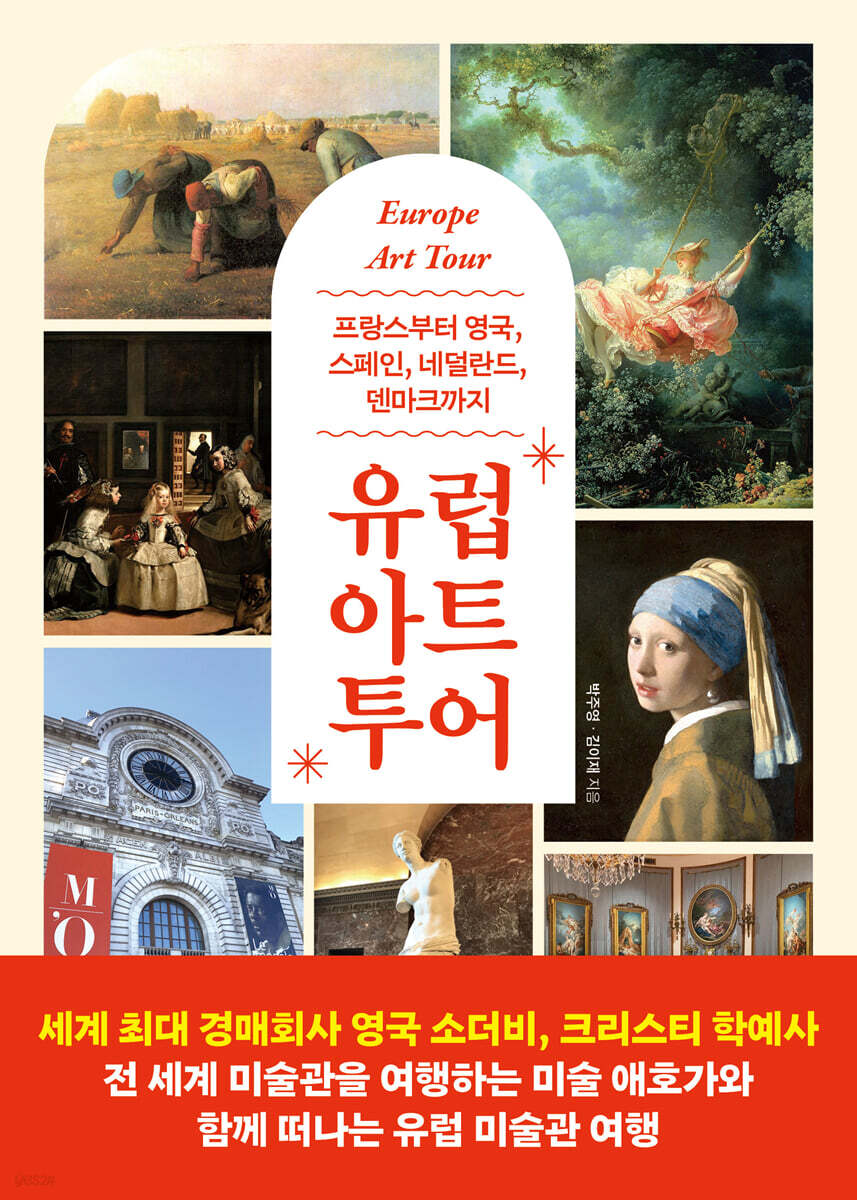
A Tour of 25 Jewel-Like Art Museums in 5 European Countries
This book was written by two authors, one of whom graduated from Goldsmiths, a prestigious art school in the UK, worked at Sotheby's Auctions, the world's largest auction house, and is currently working at Christie's. The other is an art lover who travels to art museums around the world. They wrote this book to introduce European art museums that are too good to be kept to themselves among the ones they have personally visited.
In addition to representative European art museums such as the Musée d'Orsay in France and the National Gallery in the UK, this book also includes lesser-known but highly recommended art museums in Spain, the Netherlands, and Denmark, as well as information and stories about paintings from 25 art museums in 5 European countries.
In addition to the abundant photos of art pieces that are a feast for the eyes, it also provides vivid photos of the exterior, interior, and surrounding landscapes of the museum.
Rather than simply appreciating the artwork with your eyes, the book also includes the intricate stories of the artists, collectors, and patrons behind the paintings, allowing you to enjoy the artworks on a deeper level.
This book also includes stories about art told by curators and stories about auction houses, so even beginners in art will be able to talk about art wherever they go after reading it.
The two authors are mother and daughter. In this book, author Park Joo-young, who has enjoyed and studied art for a long time, shares the know-how she gained while preparing to study abroad after her daughter, author Kim I-jae, decided to change her career path to art, a skill that is difficult to hear even at study abroad institutes.
This book details the entire process of studying art abroad, from the reasons for choosing Goldsmiths, a prestigious art school in the UK, the process of preparing to study art abroad in the UK, the undergraduate courses taken at Goldsmiths, and even the internship after graduation to joining the world's largest auction house as a curator.
I wanted this book to be a gift to parents considering sending their children to study art abroad, as well as to those preparing to do so.
Two authors who truly love art invite you to visit European art museums, and we recommend that you head to a European art museum right now.
A Tour of 25 Jewel-Like Art Museums in 5 European Countries
This book was written by two authors, one of whom graduated from Goldsmiths, a prestigious art school in the UK, worked at Sotheby's Auctions, the world's largest auction house, and is currently working at Christie's. The other is an art lover who travels to art museums around the world. They wrote this book to introduce European art museums that are too good to be kept to themselves among the ones they have personally visited.
In addition to representative European art museums such as the Musée d'Orsay in France and the National Gallery in the UK, this book also includes lesser-known but highly recommended art museums in Spain, the Netherlands, and Denmark, as well as information and stories about paintings from 25 art museums in 5 European countries.
In addition to the abundant photos of art pieces that are a feast for the eyes, it also provides vivid photos of the exterior, interior, and surrounding landscapes of the museum.
Rather than simply appreciating the artwork with your eyes, the book also includes the intricate stories of the artists, collectors, and patrons behind the paintings, allowing you to enjoy the artworks on a deeper level.
This book also includes stories about art told by curators and stories about auction houses, so even beginners in art will be able to talk about art wherever they go after reading it.
The two authors are mother and daughter. In this book, author Park Joo-young, who has enjoyed and studied art for a long time, shares the know-how she gained while preparing to study abroad after her daughter, author Kim I-jae, decided to change her career path to art, a skill that is difficult to hear even at study abroad institutes.
This book details the entire process of studying art abroad, from the reasons for choosing Goldsmiths, a prestigious art school in the UK, the process of preparing to study art abroad in the UK, the undergraduate courses taken at Goldsmiths, and even the internship after graduation to joining the world's largest auction house as a curator.
I wanted this book to be a gift to parents considering sending their children to study art abroad, as well as to those preparing to do so.
Two authors who truly love art invite you to visit European art museums, and we recommend that you head to a European art museum right now.
- You can preview some of the book's contents.
Preview
index
Prologue: An invitation to a European art museum too good to keep to yourself.
Part 1 France
Orsay Museum | Orangerie Museum | Louvre Museum | Rodin Museum
Part 2 England
Apsley House | Sir John Soane Museum | Kenwood House | Wallace Collection | Courtauld Gallery | National Gallery
Part 3 Spain
Prado Museum | Reina Sofia National Art Center | Thyssen-Bornemisza National Museum
Part 4 Amsterdam, Netherlands
Rijksmuseum | Stedelijk Museum | Kröller-Müller Museum
Part 5 The Hague, Netherlands
Mauritshuis | Kunstmuseum The Hague | Kunstmuseum Vorlinden | Mesdag Panorama Museum | Royal Delft Museum
Part 6 Denmark
National Gallery of Denmark | New Carlsberg Glyptothek | Arken Museum of Modern Art | Louisiana Museum of Modern Art
Epilogue 1: Sending My Daughter, a Fine Arts Major, to Study Abroad
Epilogue 2 How to get a job at the world's best auction house?
Part 1 France
Orsay Museum | Orangerie Museum | Louvre Museum | Rodin Museum
Part 2 England
Apsley House | Sir John Soane Museum | Kenwood House | Wallace Collection | Courtauld Gallery | National Gallery
Part 3 Spain
Prado Museum | Reina Sofia National Art Center | Thyssen-Bornemisza National Museum
Part 4 Amsterdam, Netherlands
Rijksmuseum | Stedelijk Museum | Kröller-Müller Museum
Part 5 The Hague, Netherlands
Mauritshuis | Kunstmuseum The Hague | Kunstmuseum Vorlinden | Mesdag Panorama Museum | Royal Delft Museum
Part 6 Denmark
National Gallery of Denmark | New Carlsberg Glyptothek | Arken Museum of Modern Art | Louisiana Museum of Modern Art
Epilogue 1: Sending My Daughter, a Fine Arts Major, to Study Abroad
Epilogue 2 How to get a job at the world's best auction house?
Detailed image

Into the book
To delve into the inner workings of a work, one must study the historical background and understand the author's environment and the people around him.
The author's situation is reflected in the work.
After exploring the writer's surroundings, I looked for someone who could help the writer work without worrying about making a living.
In the past, most writers were poor.
If you were lucky, you might have been recognized for your abilities early on and found a lucrative position, but without a sponsor, it would have been difficult to continue your work due to financial difficulties.
As the author's works began to pour out, there were those who recognized the true value of the work and purchased it.
It had to catch the eye of the greatest collectors of the time, not just the kind-hearted rich who might buy one or two pieces.
In this way, the works could be passed down through generations and stored in mansions or art galleries.
---From "Prologue - An Invitation to European Art Museums Too Good to Keep to Yourself"
The moment you enter the Musée d'Orsay, your heart races.
There are so many works that it can be overwhelming to decide where to start, but I'll share some tips I've learned along the way to help you see them more efficiently.
If you arrive in the morning in top condition, you should definitely go up to the 5th floor and take a picture in front of the Orsay's iconic wall clock.
After taking a leisurely commemorative photo in the morning when there are no crowds, I start looking at the impressionist paintings gathered on the 5th floor.
---From "Part 1 - France"
Around this time, European countries were nationalizing their royal collections and making them available to the public.
In the case of the Bavarian Royal Collection, the Medici Collection, and the French Royal Collection, the highest level of collections collected by the royal family were donated to the National Gallery.
Unlike many European countries where the royal collection was donated to the state, the British royal collection was classified as a private (royal) collection and there was no such thing as a national collection.
The British monarchy did not bequeath its royal collection to public art museums, and the government took a very conservative approach to establishing art museums for the public.
As a result, the British government has missed several opportunities to collect excellent works.
---From "Part 2 - England"
The most bizarre of these is Saturn Devouring His Son.
I was really impressed when I first saw it a few years ago.
However, it is said that Goya painted this painting on the kitchen wall and looked at it while eating.
The fact that Goya expressed the myth of Saturn devouring his son in the most gruesome way possible seems to show that he was unable to escape from anxiety, fear, and despair.
Compared to the pretty paintings he made in his smooth youth, it is hard to believe that these are the paintings of one person.
It's amazing how a person's temperament can change from one extreme to the next. If I give in to the environment that surrounds me, I'm doomed to fall into the abyss.
Still, Goya lived until the day God allowed him, expressing his stress and anger in this way. Wasn't that the best thing for him?
---From "Part 3 - Spain"
If the end of the world were imminent and I had the chance to visit only one place, what would it be? I would visit the Kröller-Müller Museum.
It is an art museum in the forest, filled with beautiful nature and masterpieces.
There are still many places I haven't been to, and many I've been to, but this place is the best I've ever been to.
It seems like a nice place to visit in any season.
Even the quiet winter days with few visitors were perfect.
The time my daughter and I rode our bikes through the forest to the art museum was definitely a scene from a movie.
---From "Part 4 - Amsterdam, Netherlands"
What is unique about Mondrian's paintings is that they are divided only by horizontal and vertical lines.
Mondrian and Theo van Doesburg, who had created De Stijl together, had differences of opinion and the reasons for their conflict were astonishing.
Because Theo van Doesburg insisted on allowing the use of diagonal lines in De Stijl paintings, and Mondrian was adamant that diagonal lines could never be allowed.
If we compare the paintings of these two artists, we can see that although the basic concept is the same, Theo van Doesburg's painting uses diagonal lines, while Mondrian's painting does not use any diagonal lines at all.
Come to think of it, Mondrian's paintings feel stiff and stubborn, while Theo van Doesburg's paintings feel a bit soft.
---From "Part 5 - The Hague, Netherlands"
The landscape paintings from the Danish Golden Age that continue to this day are dazzlingly beautiful.
The sky was bright and clear and painted very ideally.
The contrast between Denmark's ever-changing weather and the darkness of its long winters made it seem like a fantasy.
The seascape is also unrealistically calm and beautiful.
It seems to be peaceful, unrelated to the reality of Denmark, which had a powerful navy and was constantly involved in naval wars.
The portraits are simple and modest, and there are also nationalistic paintings featuring the Danish flag.
Did he want to turn away from the miserable human condition in this bleak reality?
It seems that internal conflicts such as anxiety about the future are hidden and wrapped up in dreams of an ideal reality.
---From "Part 6 - Denmark"
At first, I was thinking about art school in New York, but as I was preparing for art school, my direction changed to London.
Even within the same major, portfolios had to be prepared differently depending on which country and which school one was going to.
Since I had only visited schools in New York, I naturally thought about going to New York, but as my husband advised me to consider London as well, I visited London and looked around at all the schools famous for their art.
As a result, I changed my mind and decided to go to London.
The biggest deciding factor was that I felt that London had a more comfortable and safer living environment, and above all, I thought that I would be able to study art while looking out over all of Europe from London.
---From "Epilogue 1 - Sending My Daughter, a Art Major, to Study Abroad"
While visiting various auction houses and galleries during my master's program, I never expected that I would be able to work here.
I especially lost confidence when I saw the question on my job application asking if I knew anyone within the company.
It is true that, as someone from the East, I felt small compared to the Europeans, given the country's deep traditions and history.
In terms of language, I should be able to speak at least German or French, but I was lacking in many ways.
But luckily, I ended up joining Sotheby's, where I learned and gained more experience than in all my time in London combined.
The author's situation is reflected in the work.
After exploring the writer's surroundings, I looked for someone who could help the writer work without worrying about making a living.
In the past, most writers were poor.
If you were lucky, you might have been recognized for your abilities early on and found a lucrative position, but without a sponsor, it would have been difficult to continue your work due to financial difficulties.
As the author's works began to pour out, there were those who recognized the true value of the work and purchased it.
It had to catch the eye of the greatest collectors of the time, not just the kind-hearted rich who might buy one or two pieces.
In this way, the works could be passed down through generations and stored in mansions or art galleries.
---From "Prologue - An Invitation to European Art Museums Too Good to Keep to Yourself"
The moment you enter the Musée d'Orsay, your heart races.
There are so many works that it can be overwhelming to decide where to start, but I'll share some tips I've learned along the way to help you see them more efficiently.
If you arrive in the morning in top condition, you should definitely go up to the 5th floor and take a picture in front of the Orsay's iconic wall clock.
After taking a leisurely commemorative photo in the morning when there are no crowds, I start looking at the impressionist paintings gathered on the 5th floor.
---From "Part 1 - France"
Around this time, European countries were nationalizing their royal collections and making them available to the public.
In the case of the Bavarian Royal Collection, the Medici Collection, and the French Royal Collection, the highest level of collections collected by the royal family were donated to the National Gallery.
Unlike many European countries where the royal collection was donated to the state, the British royal collection was classified as a private (royal) collection and there was no such thing as a national collection.
The British monarchy did not bequeath its royal collection to public art museums, and the government took a very conservative approach to establishing art museums for the public.
As a result, the British government has missed several opportunities to collect excellent works.
---From "Part 2 - England"
The most bizarre of these is Saturn Devouring His Son.
I was really impressed when I first saw it a few years ago.
However, it is said that Goya painted this painting on the kitchen wall and looked at it while eating.
The fact that Goya expressed the myth of Saturn devouring his son in the most gruesome way possible seems to show that he was unable to escape from anxiety, fear, and despair.
Compared to the pretty paintings he made in his smooth youth, it is hard to believe that these are the paintings of one person.
It's amazing how a person's temperament can change from one extreme to the next. If I give in to the environment that surrounds me, I'm doomed to fall into the abyss.
Still, Goya lived until the day God allowed him, expressing his stress and anger in this way. Wasn't that the best thing for him?
---From "Part 3 - Spain"
If the end of the world were imminent and I had the chance to visit only one place, what would it be? I would visit the Kröller-Müller Museum.
It is an art museum in the forest, filled with beautiful nature and masterpieces.
There are still many places I haven't been to, and many I've been to, but this place is the best I've ever been to.
It seems like a nice place to visit in any season.
Even the quiet winter days with few visitors were perfect.
The time my daughter and I rode our bikes through the forest to the art museum was definitely a scene from a movie.
---From "Part 4 - Amsterdam, Netherlands"
What is unique about Mondrian's paintings is that they are divided only by horizontal and vertical lines.
Mondrian and Theo van Doesburg, who had created De Stijl together, had differences of opinion and the reasons for their conflict were astonishing.
Because Theo van Doesburg insisted on allowing the use of diagonal lines in De Stijl paintings, and Mondrian was adamant that diagonal lines could never be allowed.
If we compare the paintings of these two artists, we can see that although the basic concept is the same, Theo van Doesburg's painting uses diagonal lines, while Mondrian's painting does not use any diagonal lines at all.
Come to think of it, Mondrian's paintings feel stiff and stubborn, while Theo van Doesburg's paintings feel a bit soft.
---From "Part 5 - The Hague, Netherlands"
The landscape paintings from the Danish Golden Age that continue to this day are dazzlingly beautiful.
The sky was bright and clear and painted very ideally.
The contrast between Denmark's ever-changing weather and the darkness of its long winters made it seem like a fantasy.
The seascape is also unrealistically calm and beautiful.
It seems to be peaceful, unrelated to the reality of Denmark, which had a powerful navy and was constantly involved in naval wars.
The portraits are simple and modest, and there are also nationalistic paintings featuring the Danish flag.
Did he want to turn away from the miserable human condition in this bleak reality?
It seems that internal conflicts such as anxiety about the future are hidden and wrapped up in dreams of an ideal reality.
---From "Part 6 - Denmark"
At first, I was thinking about art school in New York, but as I was preparing for art school, my direction changed to London.
Even within the same major, portfolios had to be prepared differently depending on which country and which school one was going to.
Since I had only visited schools in New York, I naturally thought about going to New York, but as my husband advised me to consider London as well, I visited London and looked around at all the schools famous for their art.
As a result, I changed my mind and decided to go to London.
The biggest deciding factor was that I felt that London had a more comfortable and safer living environment, and above all, I thought that I would be able to study art while looking out over all of Europe from London.
---From "Epilogue 1 - Sending My Daughter, a Art Major, to Study Abroad"
While visiting various auction houses and galleries during my master's program, I never expected that I would be able to work here.
I especially lost confidence when I saw the question on my job application asking if I knew anyone within the company.
It is true that, as someone from the East, I felt small compared to the Europeans, given the country's deep traditions and history.
In terms of language, I should be able to speak at least German or French, but I was lacking in many ways.
But luckily, I ended up joining Sotheby's, where I learned and gained more experience than in all my time in London combined.
---From "Epilogue 2 - Joining the World's Best Auction House"
Publisher's Review
From France to England, Spain, the Netherlands and Denmark
An art tour to 25 art museums across 5 European countries!
The book features 25 must-visit gems of art museums from five European countries—France, England, Spain, the Netherlands, and Denmark—that the two authors, who love art and museums, have personally visited.
Author Park Joo-young studied the historical background and explored the author's environment and surroundings to delve into the inner workings of the work.
I started writing because I wanted to share the interesting stories I learned with more people.
Author Kim Lee-jae developed a love for art through trips to art museums with her mother since childhood. She majored in art and worked as a curator, and she decided to write this book to share the diverse knowledge she gained about art.
The two authors have carefully selected and introduced European art museums, divided by country, so you can visit them as if you were going on a trip.
You can read the book in order, but it would also be fun to choose a country you would like to visit for an art museum tour and read that section first.
The Netherlands in particular is worth noting as it is divided into Amsterdam and The Hague sections and covered in more detail.
It would be a good idea to choose an art gallery you've always been curious about and read about it first.
Part 1, "France," introduces the Orsay Museum, which preserves the Paris of the Belle Époque era, the Orangerie Museum at the end of the Tuileries Garden, the Louvre Museum, which would take over 100 days to see all the works, and the Rodin Museum, where you can see Rodin's works and those collected by Rodin.
Part 2, "Britain," introduces Apsley House, once known as London's number one house; the Sir John Soane Museum, also known as the Little British Museum; the beautiful Kenwood House, which was also used as a filming location; the Wallace Collection, which exhibits the collected heritage of British aristocratic families; the Courtauld Gallery, which houses the LVMH Great Room, London's oldest exhibition space; and the National Gallery, Britain's representative art museum.
Part 3, "Spain," introduces the Prado Museum, which houses the Spanish royal collection dating back to the 12th century, as well as European art from Italy, Flanders, and other countries; the Reina Sofia National Art Center, which houses a large collection of modern art; and the Thyssen-Bornemisza National Museum, with its impressive salmon-colored exhibition hall.
Part 4, "Amsterdam, Netherlands" introduces the Rijksmuseum, which houses the works of the Dutch representative artist Vermeer, the Amsterdam Stedelijk Museum, which welcomes you with a bathtub-shaped canopy, and the Kröller-Müller Museum, built within a national park and blending in with nature.
Part 5 "The Hague, Netherlands" introduces the Mauritshuis Museum where you can see tronie works and [The Goldfinch], the Kunstmuseum The Hague which has the largest collection of Mondrian's works, the Vorlinden Museum with a swimming pool inside the museum, the Mesdag Panorama Museum where you can appreciate works with a 360-degree panoramic view, and the Royal Delft Museum where you can see and even experience the ceramics manufacturing process.
Part 6, "Denmark," introduces the National Gallery of Denmark, which offers a detailed gallery text for each piece; the New Carlsberg Glyptothek, a museum with a garden where time seems to stand still; the Arken Museum of Modern Art, filled with fresh contemporary art pieces; and the Louisiana Museum of Modern Art, one of the most beautiful art museums in the world.
The World of Art as Told by Sotheby's and Christie's Curators
Even stories about studying art in the UK that you can't hear even at study abroad centers
This book contains stories about art related to art museums and artworks told by Kim Lee-jae, a current art curator, throughout the text.
You can take a step further into the world of art through stories that enrich your appreciation of art that you cannot find by just looking at the works in a museum, such as an internship at Artlos Register, an art database company; the process of discovering that a table commissioned by a client had belonged to Napoleon; the Wallace Collection's 'Open Furniture Month' event where you can look inside furniture made by 18th-century Parisian furniture craftsmen such as Regener, Ouven, and Leleux; and the reason why Manet's [Execution of Emperor Maximilian] was broken into pieces.
In the epilogue, I share in detail the process of changing my major to art and deciding to study art abroad in London within a limited amount of time.
This book contains the secrets of how Kim Lee-jae, who did not graduate from an arts middle school or high school, was able to pass the Goldsmiths entrance exam while standing shoulder to shoulder with students who had studied art for a long time.
After beating the odds and getting accepted, we also share tips on how to use your preparation time wisely and not waste it before you enroll.
This book covers not only art but also art study abroad and the process of landing a job at the world's top auction house. It is packed with helpful information that will be helpful not only to art lovers, but also to art majors and those preparing to study art abroad.
An art tour to 25 art museums across 5 European countries!
The book features 25 must-visit gems of art museums from five European countries—France, England, Spain, the Netherlands, and Denmark—that the two authors, who love art and museums, have personally visited.
Author Park Joo-young studied the historical background and explored the author's environment and surroundings to delve into the inner workings of the work.
I started writing because I wanted to share the interesting stories I learned with more people.
Author Kim Lee-jae developed a love for art through trips to art museums with her mother since childhood. She majored in art and worked as a curator, and she decided to write this book to share the diverse knowledge she gained about art.
The two authors have carefully selected and introduced European art museums, divided by country, so you can visit them as if you were going on a trip.
You can read the book in order, but it would also be fun to choose a country you would like to visit for an art museum tour and read that section first.
The Netherlands in particular is worth noting as it is divided into Amsterdam and The Hague sections and covered in more detail.
It would be a good idea to choose an art gallery you've always been curious about and read about it first.
Part 1, "France," introduces the Orsay Museum, which preserves the Paris of the Belle Époque era, the Orangerie Museum at the end of the Tuileries Garden, the Louvre Museum, which would take over 100 days to see all the works, and the Rodin Museum, where you can see Rodin's works and those collected by Rodin.
Part 2, "Britain," introduces Apsley House, once known as London's number one house; the Sir John Soane Museum, also known as the Little British Museum; the beautiful Kenwood House, which was also used as a filming location; the Wallace Collection, which exhibits the collected heritage of British aristocratic families; the Courtauld Gallery, which houses the LVMH Great Room, London's oldest exhibition space; and the National Gallery, Britain's representative art museum.
Part 3, "Spain," introduces the Prado Museum, which houses the Spanish royal collection dating back to the 12th century, as well as European art from Italy, Flanders, and other countries; the Reina Sofia National Art Center, which houses a large collection of modern art; and the Thyssen-Bornemisza National Museum, with its impressive salmon-colored exhibition hall.
Part 4, "Amsterdam, Netherlands" introduces the Rijksmuseum, which houses the works of the Dutch representative artist Vermeer, the Amsterdam Stedelijk Museum, which welcomes you with a bathtub-shaped canopy, and the Kröller-Müller Museum, built within a national park and blending in with nature.
Part 5 "The Hague, Netherlands" introduces the Mauritshuis Museum where you can see tronie works and [The Goldfinch], the Kunstmuseum The Hague which has the largest collection of Mondrian's works, the Vorlinden Museum with a swimming pool inside the museum, the Mesdag Panorama Museum where you can appreciate works with a 360-degree panoramic view, and the Royal Delft Museum where you can see and even experience the ceramics manufacturing process.
Part 6, "Denmark," introduces the National Gallery of Denmark, which offers a detailed gallery text for each piece; the New Carlsberg Glyptothek, a museum with a garden where time seems to stand still; the Arken Museum of Modern Art, filled with fresh contemporary art pieces; and the Louisiana Museum of Modern Art, one of the most beautiful art museums in the world.
The World of Art as Told by Sotheby's and Christie's Curators
Even stories about studying art in the UK that you can't hear even at study abroad centers
This book contains stories about art related to art museums and artworks told by Kim Lee-jae, a current art curator, throughout the text.
You can take a step further into the world of art through stories that enrich your appreciation of art that you cannot find by just looking at the works in a museum, such as an internship at Artlos Register, an art database company; the process of discovering that a table commissioned by a client had belonged to Napoleon; the Wallace Collection's 'Open Furniture Month' event where you can look inside furniture made by 18th-century Parisian furniture craftsmen such as Regener, Ouven, and Leleux; and the reason why Manet's [Execution of Emperor Maximilian] was broken into pieces.
In the epilogue, I share in detail the process of changing my major to art and deciding to study art abroad in London within a limited amount of time.
This book contains the secrets of how Kim Lee-jae, who did not graduate from an arts middle school or high school, was able to pass the Goldsmiths entrance exam while standing shoulder to shoulder with students who had studied art for a long time.
After beating the odds and getting accepted, we also share tips on how to use your preparation time wisely and not waste it before you enroll.
This book covers not only art but also art study abroad and the process of landing a job at the world's top auction house. It is packed with helpful information that will be helpful not only to art lovers, but also to art majors and those preparing to study art abroad.
GOODS SPECIFICS
- Date of issue: September 19, 2024
- Page count, weight, size: 380 pages | 150*210*30mm
- ISBN13: 9791161508894
- ISBN10: 1161508899
You may also like
카테고리
korean


korean

![GQ KOREA Mark (Monthly): December [2025]](http://librairie.coreenne.fr/cdn/shop/files/8ef265dbbfbf186523ed75ba7319009d.jpg?v=1765340328&width=3840)


