

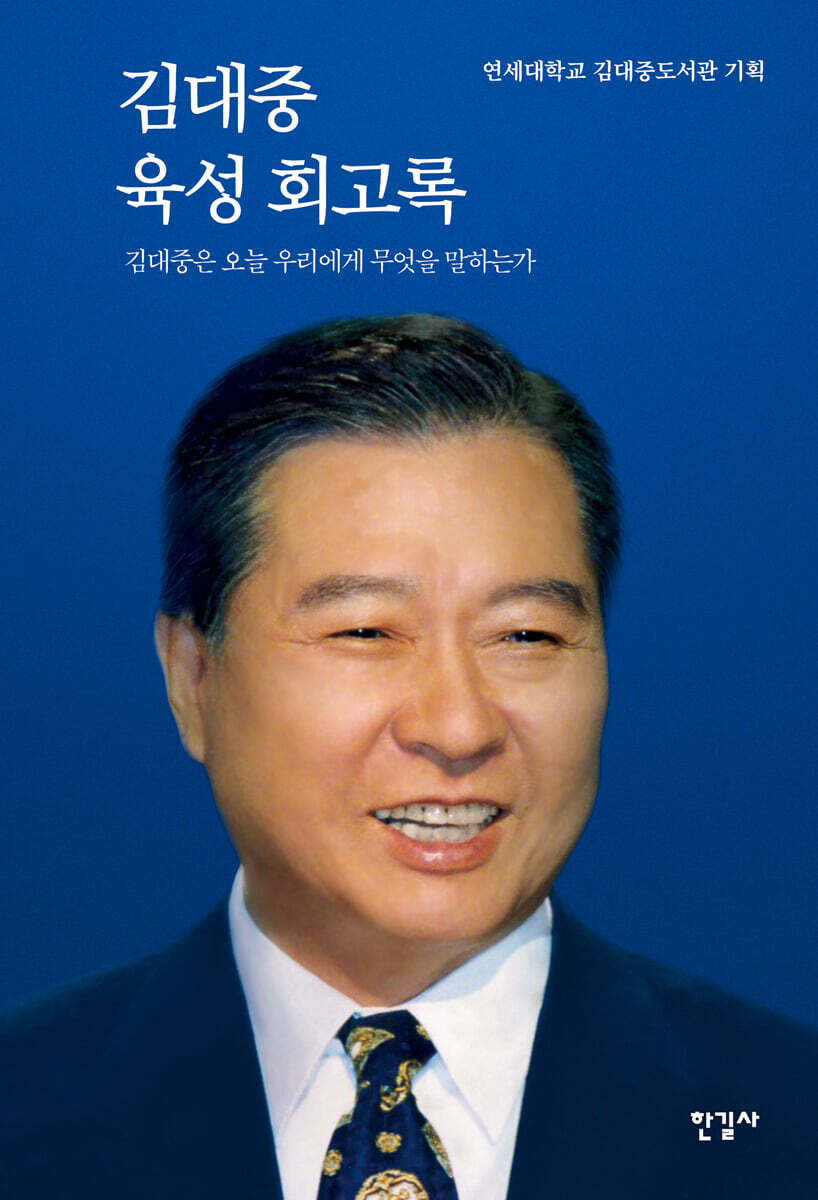
Kim Dae-jung's Memoirs
 |
Description
Book Introduction
To mark the 100th anniversary of President Kim Dae-jung's birth and the 15th anniversary of his death, we are publishing his final autobiography, "Kim Dae-jung's Voice Memoir," written in his own voice.
From his birth in 1924 on Haeui Island in Sinan until his death in 2009, you can hear the life and thoughts of President Kim Dae-jung in vivid voice.
Kim Dae-jung, a great politician and political thinker who left behind the last diary entry that said, “Life is beautiful and history progresses,” overcame the regression of history with his whole body.
Through the memoirs of Kim Dae-jung, who experienced and led the Japanese colonial period, the division of North and South Korea, the Korean War, military dictatorship, the democratization movement, and national prosperity, we can vividly experience the turbulent modern history of Korea—a truly harsh yet brilliant scene—through this book.
"Kim Dae-jung's Memoirs" is the only autobiographical reflection and record in the form of interviews with Kim Dae-jung experts.
President Kim Dae-jung conducted 41 oral interviews totaling 42 hours and 26 minutes with researchers at the Kim Dae-jung Library at Yonsei University from July 2006 to October 2007, and the result is “Kim Dae-jung’s Voice Memoir.”
This book contains the remarkable human history of President Kim Dae-jung, a testimony that only he can give, and the historical landscape experienced by an outstanding political leader.
It covers how his thoughts and beliefs regarding the times and society were formed during his childhood and adolescence, before and after liberation, and the Korean War.
He entered politics during the dictatorship of the Liberal Party and Syngman Rhee, and experienced the April 19 Revolution. He overcame death during the Park Chung-hee coup and the declaration of Yushin to devote himself to the democratization movement.
In the midst of the rise of the new military regime of Chun Doo-hwan and the suffering of the people, the path of the great politician Kim Dae-jung, who never gave up and stood up with indignation, is truly astonishing.
However, through imprisonment and exile, Kim Dae-jung's political ideology grew brilliantly.
His extensive reading in prison, his exchanges and discussions with world-class intellectuals through exile and study abroad, helped him become a world-class political leader.
Through five near-death experiences, six years of imprisonment, three years in exile, and long-term house arrest, he was armed with firm theories and ideologies on world peace and human rights.
You will learn how to achieve peace on the Korean Peninsula and in the world.
Kim Dae-jung lived a truly difficult life.
This book contains many unknown stories.
Kim Dae-jung's life, walking the path of democracy and justice, is truly amazing.
His life, theories, and reflections are enough to serve as a textbook on democracy for people around the world.
It contains 64 historical photos, including about 10 previously unreleased photos from the Kim Dae-jung Library, including photos taken when he was a neighbor with Stephen Hawking during his study abroad days.
Another great advantage of this book is that you can listen to President Kim Dae-jung's voice at any time by inserting a QR code containing his voice.
"Kim Dae-jung's Memoirs" allows us to read the strategies and ideology of a leader who led an era with a "scholarly awareness of problems" and a "merchant's sense of reality," along with the sense of calling of a great politician who thoroughly prepared.
His political journey, which unfolded while steadfastly resisting injustice, was a source of inspiration and celebration for his contemporaries living in the same era.
He resists all temptations from the new military regime that sentences him to death.
Never betray the people who support you.
The peace strategy and spirit of peace for the unification of the divided country have inspired international sentiment.
Ultimately, the world's conscience awarded him the Nobel Peace Prize.
As part of the strategy to achieve peace on the Korean Peninsula, we will hold the first-ever inter-Korean summit.
"Kim Dae-jung's Memoirs" is especially worthy of being a "textbook on implementing democracy" for the youth of this land living in a divided era.
In today's turbulent political climate in Korea, "Kim Dae-jung's Memoirs" can serve as a compass and navigational chart for developing new politics.
In "Kim Dae-jung's Memoirs," Kim Dae-jung's political leadership, peace policy, human rights policy, and welfare policy are alive and breathing.
His political wisdom, strategic tactics, and philosophy and practice of state administration that can be gained through this will serve as a guide to overcome today's dark political reality.
From his birth in 1924 on Haeui Island in Sinan until his death in 2009, you can hear the life and thoughts of President Kim Dae-jung in vivid voice.
Kim Dae-jung, a great politician and political thinker who left behind the last diary entry that said, “Life is beautiful and history progresses,” overcame the regression of history with his whole body.
Through the memoirs of Kim Dae-jung, who experienced and led the Japanese colonial period, the division of North and South Korea, the Korean War, military dictatorship, the democratization movement, and national prosperity, we can vividly experience the turbulent modern history of Korea—a truly harsh yet brilliant scene—through this book.
"Kim Dae-jung's Memoirs" is the only autobiographical reflection and record in the form of interviews with Kim Dae-jung experts.
President Kim Dae-jung conducted 41 oral interviews totaling 42 hours and 26 minutes with researchers at the Kim Dae-jung Library at Yonsei University from July 2006 to October 2007, and the result is “Kim Dae-jung’s Voice Memoir.”
This book contains the remarkable human history of President Kim Dae-jung, a testimony that only he can give, and the historical landscape experienced by an outstanding political leader.
It covers how his thoughts and beliefs regarding the times and society were formed during his childhood and adolescence, before and after liberation, and the Korean War.
He entered politics during the dictatorship of the Liberal Party and Syngman Rhee, and experienced the April 19 Revolution. He overcame death during the Park Chung-hee coup and the declaration of Yushin to devote himself to the democratization movement.
In the midst of the rise of the new military regime of Chun Doo-hwan and the suffering of the people, the path of the great politician Kim Dae-jung, who never gave up and stood up with indignation, is truly astonishing.
However, through imprisonment and exile, Kim Dae-jung's political ideology grew brilliantly.
His extensive reading in prison, his exchanges and discussions with world-class intellectuals through exile and study abroad, helped him become a world-class political leader.
Through five near-death experiences, six years of imprisonment, three years in exile, and long-term house arrest, he was armed with firm theories and ideologies on world peace and human rights.
You will learn how to achieve peace on the Korean Peninsula and in the world.
Kim Dae-jung lived a truly difficult life.
This book contains many unknown stories.
Kim Dae-jung's life, walking the path of democracy and justice, is truly amazing.
His life, theories, and reflections are enough to serve as a textbook on democracy for people around the world.
It contains 64 historical photos, including about 10 previously unreleased photos from the Kim Dae-jung Library, including photos taken when he was a neighbor with Stephen Hawking during his study abroad days.
Another great advantage of this book is that you can listen to President Kim Dae-jung's voice at any time by inserting a QR code containing his voice.
"Kim Dae-jung's Memoirs" allows us to read the strategies and ideology of a leader who led an era with a "scholarly awareness of problems" and a "merchant's sense of reality," along with the sense of calling of a great politician who thoroughly prepared.
His political journey, which unfolded while steadfastly resisting injustice, was a source of inspiration and celebration for his contemporaries living in the same era.
He resists all temptations from the new military regime that sentences him to death.
Never betray the people who support you.
The peace strategy and spirit of peace for the unification of the divided country have inspired international sentiment.
Ultimately, the world's conscience awarded him the Nobel Peace Prize.
As part of the strategy to achieve peace on the Korean Peninsula, we will hold the first-ever inter-Korean summit.
"Kim Dae-jung's Memoirs" is especially worthy of being a "textbook on implementing democracy" for the youth of this land living in a divided era.
In today's turbulent political climate in Korea, "Kim Dae-jung's Memoirs" can serve as a compass and navigational chart for developing new politics.
In "Kim Dae-jung's Memoirs," Kim Dae-jung's political leadership, peace policy, human rights policy, and welfare policy are alive and breathing.
His political wisdom, strategic tactics, and philosophy and practice of state administration that can be gained through this will serve as a guide to overcome today's dark political reality.
- You can preview some of the book's contents.
Preview
index
A living, breathing record sought by future generations | Publishing Kim Dae-jung's voiced memoirs
1.
My hometown, Hayido and Mokpo
2.
Times of chaos and adversity
3.
Legislative activities that blossomed amidst trials
4.
Emerging as a leader of the democratic forces
5.
Fighting against the Yushin dictatorship
6.
From Spring in Seoul to the 13th Presidential Election
7.
From the 13th National Assembly to the 15th President
8.
Overcoming the Korean economy's crisis and taking a new leap forward
9.
President of Democracy and Human Rights
10.
The Beginning of the Korean Peninsula Peace Process
11.
The First Inter-Korean Summit and Korean Peninsula Diplomacy
12.
A word to junior politicians
Acknowledgments | Kim Hong-eop and Kim Seong-jae
The Compass and Navigational Chart of Korean Politics | Ryu Sang-young, Jang Shin-ki, and Park Myung-rim
Chronology of President Kim Dae-jung
List of QR codes for President Kim Dae-jung's speeches
1.
My hometown, Hayido and Mokpo
2.
Times of chaos and adversity
3.
Legislative activities that blossomed amidst trials
4.
Emerging as a leader of the democratic forces
5.
Fighting against the Yushin dictatorship
6.
From Spring in Seoul to the 13th Presidential Election
7.
From the 13th National Assembly to the 15th President
8.
Overcoming the Korean economy's crisis and taking a new leap forward
9.
President of Democracy and Human Rights
10.
The Beginning of the Korean Peninsula Peace Process
11.
The First Inter-Korean Summit and Korean Peninsula Diplomacy
12.
A word to junior politicians
Acknowledgments | Kim Hong-eop and Kim Seong-jae
The Compass and Navigational Chart of Korean Politics | Ryu Sang-young, Jang Shin-ki, and Park Myung-rim
Chronology of President Kim Dae-jung
List of QR codes for President Kim Dae-jung's speeches
Detailed image

Publisher's Review
From the Japanese colonial period to liberation,
Mental assets gained from Hayido and Mokpo
“This will be the last time I talk about my past.
So, when I received the questionnaire, I carefully reviewed it and prepared thoroughly in advance to refresh my memory.”
"Kim Dae-jung's Memoirs" contains detailed testimony from President Kim Dae-jung about his childhood and youth, starting from the time he was born on Hayido Island.
At the time that President Kim Dae-jung was born, most of the farmland in Ha-ui Island had been transferred to the Japanese due to the greed of existing landowners, and farmers were initiating a tenant dispute, claiming ownership.
In an area with a spirit of resistance, President Kim Dae-jung's father was the village headman.
Thanks to this, the Maeil Shinbo was delivered to his home, and President Kim Dae-jung spent his childhood reading the political section diligently.
President Kim Dae-jung, who attended elementary school in Hayido, moved to Mokpo to study.
During the Japanese colonial period, Mokpo was a large port city, ranked among the seven largest cities.
President Kim Dae-jung, who entered Mokpo Public Commercial School as the top student, showed talent for public speaking.
The second-grade homeroom teacher, Mr. Mukumoto, praised Kim Dae-jung, saying, “Kim Dae-jung’s eloquence is no less than that of a Japanese representative in the National Assembly.”
After graduation, he worked at Mokpo Jeonnam Steamship and then entered the shipping business.
In a commercial city where economic activity was brisk, President Kim Dae-jung learned about the flow of the economy while managing a shipping company and the Mokpo Ilbo, and acquired various economic knowledge, including accounting.
This experience served as a foundation for policy formulation and budget review after becoming a member of the National Assembly.
There are various anecdotes from his youth, such as posting signs on the streets immediately after liberation saying, "The Emperor of Japan has surrendered," going to Mokpo Public Commercial School in a fire truck to mediate a clash between Japanese soldiers and students before their withdrawal, and being detained on false charges by a political rival in Mokpo during the Daegu October 1st Incident in 1946.
It cannot be left out that the Korean War broke out while I was going up to Seoul to receive business funds.
After crossing the Han River, President Kim Dae-jung walked all the way to Mokpo, overcoming several near-death experiences.
President Kim Dae-jung, who had been continuing his business after returning to Korea, decided to increase his interest in politics and awareness of its problems after witnessing the Busan political upheaval in 1952.
President Kim Dae-jung, who ran as an independent candidate in the third general election, came to Seoul to devote himself to politics in earnest, joined the Democratic Party, and worked as a junior politician.
Human rights, equality, and democracy for the people
In “Kim Dae-jung’s Memoirs,” President Kim Dae-jung recalls the beliefs that guided his actions at every crucial moment.
The image of President Kim Dae-jung seen in this book is that of an extremely liberal democrat.
His life was dedicated to freedom, peaceful unification, democracy, and human rights, and he suffered harsh oppression.
President Kim Dae-jung had his candidacy illegally cancelled in the 1958 general election after joining the Democratic Party, and three days after being first elected to the National Assembly in 1961, the May 16 coup occurred and he was stripped of his seat before even taking the oath.
He grew into a leader while resisting the dictatorship of the Park Chung-hee regime, and in 1969, he joined civil society forces in a struggle to block the third constitutional amendment.
The speech given at Hyochang Stadium at the time received “a very great response, with applause coming nearly 20 times during the 15-minute speech.”
“Because the fruits of economic development were monopolized by a small number of people, workers and farmers were sacrificed and the middle class was not properly formed.
If this continues, it will be difficult for democracy to develop properly.”
President Kim Dae-jung, who became a member of the 6th National Assembly in 1963, dealt a blow to the Park Chung-hee regime through his active legislative activities.
He sparked controversy by revealing that “the joining of the Republican Party by Park Chung-hee, the Acting President and Chairman of the Supreme Council for National Reconstruction, is unconstitutional and violates the National Assembly Act, so even if he is elected President, it will be invalid.”
President Kim Dae-jung recalls that from that time on, he began to be under full-scale surveillance by the Park Chung-hee regime.
President Kim Dae-jung, while serving as spokesperson and head of the propaganda department, criticized economic development through dictatorship and argued that democracy was necessary for true economic development.
Furthermore, the construction of the Gyeongbu Expressway, which is recognized as an achievement of President Park Chung-hee, is evaluated as “a result of the various problems that are appearing in our country today due to the unbalanced development at that time.”
From this time on, what President Kim Dae-jung advocated was local autonomy.
He insisted that local elections were absolutely necessary to prevent election fraud, raise the democratic awareness of the people, and strengthen the opposition party's organizational power, and in 1990, he went on a 13-day hunger strike to push for the implementation of local autonomy.
“If you look at history over a long period of time, there has never been a case where someone who devoted themselves to the people was defeated.
“We may be temporarily defeated, but history will always move in the right direction.”
Whenever a threat to South Korea's democracy arose, President Kim Dae-jung devoted himself to the fight.
He went into exile twice and spent about six years in prison.
His first exile began in October 1972, when he was recovering from a leg injury in Japan after the declaration of the Yushin Constitution. He heard news from home and decided not to return home but to remain in Japan and fight.
The goal was to “form public opinion in the United States and Japan on Korean democratization” and “awaken democratic forces overseas.”
『Kim Dae-jung's Memoirs』 vividly contains testimony about the time he was kidnapped and almost murdered by the Korean Central Intelligence Agency in Japan.
Even after narrowly returning to the country, President Kim Dae-jung did not stop his struggle.
In order to revive the stagnant struggle against the Yushin dictatorship, he announced the March 1st Declaration of Democracy and National Salvation, “prepared to go to prison.”
He was imprisoned in Jinju Prison for this.
As this incident became an international issue, the Yushin regime, feeling burdened, transferred President Kim Dae-jung to the Seoul National University prison ward under the pretext of providing treatment. However, according to his memoirs, he “experienced hell” there, “with all the windows closed so I couldn’t see outside or get any sunlight.”
Even during the Chun Doo-hwan regime, President Kim Dae-jung's struggle continued.
The new military government, along with the expansion of martial law on May 17, fabricated a conspiracy to commit sedition and arrested Kim Dae-jung.
At that time, Kim Dae-jung was so shocked by the news that over 100 Gwangju citizens had died in the Gwangju Democratization Movement that he collapsed.
When the Chun Doo-hwan regime threatened to spare his life if he did not cooperate, he “decided to die” because he “could not betray the countless citizens who died in Gwangju just because he was afraid of death” and was sentenced to death, but his life was saved by an international rescue movement.
After that, he was imprisoned in Cheongju Prison.
The second exile was to the United States in 1982 after receiving a stay of execution through an international rescue campaign.
Even at this time, the goal was to make the United States “criticize and restrain Korea’s dictatorship and human rights violations.”
He met with and persuaded even American conservatives, and received great attention from members of the U.S. House of Representatives and Senate.
Then, ahead of the February 12, 1985 general election, he risked his life by returning to Korea to actively fight to further pressure the Chun Doo-hwan regime.
“I believe that the goal of the democratization movement was a society in which freedom, human rights, and peace take root and spread.
In that sense, human rights are an essential element and value for the development of democracy.”
President Kim Dae-jung recognized “democracy with human rights” as the essence of democratization.
This book reveals the struggle to change Korean society, which values material values over human rights.
In particular, efforts to advance women's rights have been successful since the 13th National Assembly.
As the leader of the Democratic Party, I took responsibility and put all my efforts into revising the Family Law in 1989.
Although it was an issue that even the male members of the party were not happy about, they managed to pass the bill by persuading other party leaders and even President Roh Tae-woo.
After becoming president, he continued his efforts by establishing the Special Committee on Women under the President and enacting the Anti-Discrimination Act.
He launched the National Human Rights Commission, abolished the ideological conversion system, and released prisoners of conscience, leading to South Korea being evaluated as a democratic and human rights country.
Korea's best international public good
Kim Dae-jung's peace diplomacy
“War destroys even the most basic human dignity and takes away countless precious lives.
That is why I have a firm belief that we must prevent war and achieve peaceful unification of the Korean Peninsula.”
President Kim Dae-jung's actions, including being imprisoned, kidnapped, and going into exile while fighting for democracy, attracted the world's attention.
Moreover, the world watched in awe as he simultaneously developed democracy and a market economy, overcoming the crisis at a rapid pace and emerging as a global powerhouse of knowledge, information, and culture, even when the country was on the verge of national bankruptcy after being elected president.
Through President Kim Dae-jung, Korea's national prestige was elevated and diplomacy became more active, as he achieved reconciliation with North Korea and Japan, developed future-oriented relations, and became the first Korean to win the Nobel Peace Prize.
President Kim Dae-jung's peace diplomacy took three forms.
First, there is the ‘4-power security guarantee theory’ that has been a campaign promise since the 7th presidential election in 1971.
“Considering the geopolitical characteristics of the Korean Peninsula, diplomacy with the four surrounding powers (the U.S., Japan, China, and the Soviet Union) is very important in resolving the national issue between North and South Korea.”
They established the principle of 'cooperative autonomy' to ensure that they adopt the most cooperative policies possible, at least to avoid hindering peaceful unification.
So, when President Kim Dae-jung held summit meetings with U.S. Presidents Clinton and Bush, Japanese Prime Minister Keizo Obuchi, Chinese President Jiang Zemin, and Russian President Boris Yeltsin, he tried to obtain their cooperation in overcoming the economic crisis and support for the Sunshine Policy toward North Korea, and he succeeded.
“It is of profound historical significance that our people, who have long been at odds and in conflict, have taken action to resolve their problems and achieved positive results.”
Second, President Kim Dae-jung developed inter-Korean relations in accordance with the “three-stage unification theory.”
President Kim Dae-jung has argued since 1971 that a step-by-step approach, rather than immediate unification, is necessary because the prolonged division has created a sense of alienation between the two Koreas.
Accordingly, the goal during the presidential term was to achieve the first of three stages, the formation of a South-North alliance.
Since the core of the North-South unification was various dialogues and mutual agreements, they tried to reach an agreement through the North-South summit.
"Kim Dae-jung's Memoirs" vividly reveals the previously unknown process leading up to the first inter-Korean summit since the division and the announcement of the June 15 Joint Declaration.
Third, President Kim Dae-jung envisioned an East Asian community encompassing Southeast Asia and Northeast Asia.
In 1983, he formed the Asian Democratic Front with Philippine opposition leader Benigno Aquino to launch a joint struggle for democracy and anti-dictatorship in the Asian region, but the plan was not carried out due to Aquino's assassination.
In 1998, President Kim Dae-jung attended the ASEAN+3 Summit and proposed the creation of the 'East Asia Vision Group.'
Starting with this, the discourse on the East Asian community was steadily developed, leading to the East Asia Summit (EAS).
A president who prepared for the future
“The first thing you need to do to become a great political leader is to study various policies.
“You have to become a politician who studies to advance to the next level.”
President Kim Dae-jung was a president prepared through long study and training and answered the call of the times.
Looking at the 『Kim Dae-jung Memoirs』, we can see that the reason he was used to the best of his ability at the most appropriate time was because he prepared for the future from an early age.
His insight into and preparation for the future of society, including international relations, economy, advanced technology, and culture, was unparalleled at the time.
He emphasizes that a quality that a political leader must possess is “having the knowledge to communicate with experts, even if he or she is not the best expert in a specific field.”
First, President Kim Dae-jung recognized globalization as an inevitable trend and prepared for the problem of foreign capital.
“Because we have limited natural resources and a small domestic market, we must survive in competition in the global market,” he concluded.
So, by liberalizing foreign investment, we solved the foreign exchange problem and at the same time taught advanced management skills and financial institutions also learned advanced financial techniques.
President Kim Dae-jung evaluated that these efforts helped repay the IMF loan three years earlier than originally planned and laid the foundation for a new economic leap forward.
“I judged that the world at the time was in a period of great transition, rapidly changing from a conventional industrial society to a knowledge-information society.”
Second, President Kim Dae-jung, in preparation for the knowledge-based information society, consistently sent out the message, “Industrialization may be late, but let’s take the lead in knowledge-based information.”
President Kim Dae-jung, who had judged that economic development was no longer possible through the mass production of existing low-priced goods since the 1970s, recognized the importance of the knowledge industry while reading books such as Alvin Toffler's "The Third Wave."
So, from the beginning of his term, he set knowledge informatization as a key national task and devoted all his efforts to building information and communications infrastructure.
We achieved an information society by popularizing computers, installing high-speed information and communication networks, establishing e-government, and supporting small and medium-sized venture companies with technological capabilities.
To develop necessary science and technology, the President established the National Science and Technology Commission, chaired by the President. To cultivate talent suited to the knowledge-based information society, the goals of education policy were changed, and educational informatization projects were promoted, such as providing PCs to all schools.
“Cultural capacity, along with military and economic power, is a key factor in determining the rise and fall of a nation and people.”
Third, what President Kim Dae-jung prepared was the development of culture and tourism.
President Kim Dae-jung predicted that as globalization progresses and information and communication technology develops, productivity will increase, working hours will decrease, and demand for cultural and tourism products to enjoy during leisure time will increase.
President Kim Dae-jung believed that if cultural content was developed well, it would not only contribute to the economy through enormous profits, but also enhance our country's cultural capabilities.
For that reason, in 2001, we opened the era of 1 trillion won in the cultural sector budget, and allocated a significant portion of the budget to the cultural content sector to lay the foundation for the development of the cultural industry.
This book also introduces the fact that he received the Chunsa Na Woon-kyu Film Festival Merit Award in 2003 in recognition of his great contribution to the development of Korean cinema by protecting the screen quota.
“I have stated that the purpose of the mass economy that I advocate is to realize a welfare society.
“I have been interested in economic and social policies related to welfare for a long time.”
Lastly, what President Kim Dae-jung had been preparing for for a long time was welfare policy.
Welfare, which I had been interested in since my days as a current affairs commentator in the 1950s, appeared as a campaign promise in the 1971 presidential election.
President Kim Dae-jung's knowledge of the latest policies and debates on welfare in Western societies through his exile in the United States and his study abroad in the United Kingdom was also a great asset in formulating Korea's welfare policy.
After taking office, President Kim Dae-jung pursued "productive welfare" to help people with the ability to work become self-sufficient.
In addition, the National Basic Livelihood Security System was implemented to guarantee a minimum standard of living regardless of work ability.
By expanding the scope of application and benefit levels of the four major social insurances—health insurance, national pension, employment insurance, and industrial accident compensation insurance—South Korea was elevated to the ranks of a welfare state.
The first president to practice solidarity and unity
“I thought I could eradicate the dark remnants of resentment and hatred in the hearts of our people.”
President Kim Dae-jung's political philosophy was solidarity and integration.
Kim Dae-jung's politics was a coalition politics that transcended ideology, factions, and regions.
As soon as he entered politics immediately after liberation, President Kim Dae-jung supported the left-right cooperation line.
We sought ways to avoid permanent division with the primary goal in mind.
When the conservative grand coalition was formed through the merger of three parties, President Kim Dae-jung's New Democratic Party formed a grand democratic coalition with the Democratic Party led by Lee Ki-taek and Roh Moo-hyun.
At the time, the New Democratic Party was strong, but President Kim Dae-jung adopted a joint representative system and appointed Democratic Party members to key party positions to demonstrate his sincerity for unification.
Also, during the 1997 presidential election, the DJP coalition formed an alliance with the conservative camp, demonstrating a solidarity of values and politics to solve the challenges of the times, moving away from the "either you're with me or you're against me" mindset.
President Kim Dae-jung's mission was to resolve the problems of regionalism and regional sentiment.
Because he himself has been a big victim of regionalism since the 1971 presidential election.
In "Kim Dae-jung's Memoirs," we see President Kim Dae-jung's efforts to ensure that the Honam region, which had suffered discrimination for decades, was treated equally with other regions.
Additionally, we tried not to provide a cause for regional conflict by not giving special privileges to any region.
“Because we've never before seen such a great era of integration, I felt a sense of mission to do it.”
The Kim Dae-jung administration was the first to officially embrace victims of state violence and victims of national defense, regardless of political affiliation.
President Kim Dae-jung united the victims from the perspective of the people.
We also held a public signing ceremony to enact a law to uncover the truth and restore the honor of victims of the Jeju April 3 Incident, the democratization movement, and suspicious deaths, and to emphasize its historical significance.
President Kim Dae-jung was subjected to harsh oppression by the dictatorship during the democratization movement.
However, after his term in office, he provided national support for the construction of the President Park Chung-hee Memorial Hall.
The reason, he said, was that President Kim Dae-jung himself “considered himself the most suitable person to break the vicious cycle of political retaliation and open an era of reconciliation and unification, as he was a victim who had suffered tremendously.”
“The principle I emphasized most during the restructuring process was fairness.
“If fairness is shaken and undermined, trust in government policies will be shaken, and a backlash will immediately follow, making it difficult to push for reform.”
President Kim Dae-jung's politics of unification shone brightly during the national bankruptcy crisis.
President Kim Dae-jung recalls that immediately after winning the 15th presidential election, he devoted all his energy to overcoming the economic crisis without a single day of rest.
To secure dollars and extend the repayment period for short-term foreign debt, it was necessary to gain the trust of the international community.
At that time, President Kim Dae-jung presented a vision for structural reform of the Korean economy and practically promoted a grand compromise between labor, management, and government.
Instead of pressuring the labor sector as under authoritarian regimes, the government successfully negotiated comprehensively, explaining domestic and international conditions and accepting the labor sector's long-held desires.
Furthermore, the gold collection campaign, which received nationwide support, greatly contributed to paying off foreign debt and creating a positive image of Korea in the international community.
The politics of the coalition permeated Kim Dae-jung's entire politics.
“Politicians must seek the truth for the future within reality. They must not cling to the truth and ignore reality.”
If we trace President Kim Dae-jung's entire life in "Kim Dae-jung's Memoirs," we can see that he was an "idealistic realist."
He was a responsible politician who practiced politics with conviction while not neglecting the needs of the people.
This is why we are recalling President Kim Dae-jung in this era when politics is becoming disconnected from the lives of the people and its productivity is declining.
Mental assets gained from Hayido and Mokpo
“This will be the last time I talk about my past.
So, when I received the questionnaire, I carefully reviewed it and prepared thoroughly in advance to refresh my memory.”
"Kim Dae-jung's Memoirs" contains detailed testimony from President Kim Dae-jung about his childhood and youth, starting from the time he was born on Hayido Island.
At the time that President Kim Dae-jung was born, most of the farmland in Ha-ui Island had been transferred to the Japanese due to the greed of existing landowners, and farmers were initiating a tenant dispute, claiming ownership.
In an area with a spirit of resistance, President Kim Dae-jung's father was the village headman.
Thanks to this, the Maeil Shinbo was delivered to his home, and President Kim Dae-jung spent his childhood reading the political section diligently.
President Kim Dae-jung, who attended elementary school in Hayido, moved to Mokpo to study.
During the Japanese colonial period, Mokpo was a large port city, ranked among the seven largest cities.
President Kim Dae-jung, who entered Mokpo Public Commercial School as the top student, showed talent for public speaking.
The second-grade homeroom teacher, Mr. Mukumoto, praised Kim Dae-jung, saying, “Kim Dae-jung’s eloquence is no less than that of a Japanese representative in the National Assembly.”
After graduation, he worked at Mokpo Jeonnam Steamship and then entered the shipping business.
In a commercial city where economic activity was brisk, President Kim Dae-jung learned about the flow of the economy while managing a shipping company and the Mokpo Ilbo, and acquired various economic knowledge, including accounting.
This experience served as a foundation for policy formulation and budget review after becoming a member of the National Assembly.
There are various anecdotes from his youth, such as posting signs on the streets immediately after liberation saying, "The Emperor of Japan has surrendered," going to Mokpo Public Commercial School in a fire truck to mediate a clash between Japanese soldiers and students before their withdrawal, and being detained on false charges by a political rival in Mokpo during the Daegu October 1st Incident in 1946.
It cannot be left out that the Korean War broke out while I was going up to Seoul to receive business funds.
After crossing the Han River, President Kim Dae-jung walked all the way to Mokpo, overcoming several near-death experiences.
President Kim Dae-jung, who had been continuing his business after returning to Korea, decided to increase his interest in politics and awareness of its problems after witnessing the Busan political upheaval in 1952.
President Kim Dae-jung, who ran as an independent candidate in the third general election, came to Seoul to devote himself to politics in earnest, joined the Democratic Party, and worked as a junior politician.
Human rights, equality, and democracy for the people
In “Kim Dae-jung’s Memoirs,” President Kim Dae-jung recalls the beliefs that guided his actions at every crucial moment.
The image of President Kim Dae-jung seen in this book is that of an extremely liberal democrat.
His life was dedicated to freedom, peaceful unification, democracy, and human rights, and he suffered harsh oppression.
President Kim Dae-jung had his candidacy illegally cancelled in the 1958 general election after joining the Democratic Party, and three days after being first elected to the National Assembly in 1961, the May 16 coup occurred and he was stripped of his seat before even taking the oath.
He grew into a leader while resisting the dictatorship of the Park Chung-hee regime, and in 1969, he joined civil society forces in a struggle to block the third constitutional amendment.
The speech given at Hyochang Stadium at the time received “a very great response, with applause coming nearly 20 times during the 15-minute speech.”
“Because the fruits of economic development were monopolized by a small number of people, workers and farmers were sacrificed and the middle class was not properly formed.
If this continues, it will be difficult for democracy to develop properly.”
President Kim Dae-jung, who became a member of the 6th National Assembly in 1963, dealt a blow to the Park Chung-hee regime through his active legislative activities.
He sparked controversy by revealing that “the joining of the Republican Party by Park Chung-hee, the Acting President and Chairman of the Supreme Council for National Reconstruction, is unconstitutional and violates the National Assembly Act, so even if he is elected President, it will be invalid.”
President Kim Dae-jung recalls that from that time on, he began to be under full-scale surveillance by the Park Chung-hee regime.
President Kim Dae-jung, while serving as spokesperson and head of the propaganda department, criticized economic development through dictatorship and argued that democracy was necessary for true economic development.
Furthermore, the construction of the Gyeongbu Expressway, which is recognized as an achievement of President Park Chung-hee, is evaluated as “a result of the various problems that are appearing in our country today due to the unbalanced development at that time.”
From this time on, what President Kim Dae-jung advocated was local autonomy.
He insisted that local elections were absolutely necessary to prevent election fraud, raise the democratic awareness of the people, and strengthen the opposition party's organizational power, and in 1990, he went on a 13-day hunger strike to push for the implementation of local autonomy.
“If you look at history over a long period of time, there has never been a case where someone who devoted themselves to the people was defeated.
“We may be temporarily defeated, but history will always move in the right direction.”
Whenever a threat to South Korea's democracy arose, President Kim Dae-jung devoted himself to the fight.
He went into exile twice and spent about six years in prison.
His first exile began in October 1972, when he was recovering from a leg injury in Japan after the declaration of the Yushin Constitution. He heard news from home and decided not to return home but to remain in Japan and fight.
The goal was to “form public opinion in the United States and Japan on Korean democratization” and “awaken democratic forces overseas.”
『Kim Dae-jung's Memoirs』 vividly contains testimony about the time he was kidnapped and almost murdered by the Korean Central Intelligence Agency in Japan.
Even after narrowly returning to the country, President Kim Dae-jung did not stop his struggle.
In order to revive the stagnant struggle against the Yushin dictatorship, he announced the March 1st Declaration of Democracy and National Salvation, “prepared to go to prison.”
He was imprisoned in Jinju Prison for this.
As this incident became an international issue, the Yushin regime, feeling burdened, transferred President Kim Dae-jung to the Seoul National University prison ward under the pretext of providing treatment. However, according to his memoirs, he “experienced hell” there, “with all the windows closed so I couldn’t see outside or get any sunlight.”
Even during the Chun Doo-hwan regime, President Kim Dae-jung's struggle continued.
The new military government, along with the expansion of martial law on May 17, fabricated a conspiracy to commit sedition and arrested Kim Dae-jung.
At that time, Kim Dae-jung was so shocked by the news that over 100 Gwangju citizens had died in the Gwangju Democratization Movement that he collapsed.
When the Chun Doo-hwan regime threatened to spare his life if he did not cooperate, he “decided to die” because he “could not betray the countless citizens who died in Gwangju just because he was afraid of death” and was sentenced to death, but his life was saved by an international rescue movement.
After that, he was imprisoned in Cheongju Prison.
The second exile was to the United States in 1982 after receiving a stay of execution through an international rescue campaign.
Even at this time, the goal was to make the United States “criticize and restrain Korea’s dictatorship and human rights violations.”
He met with and persuaded even American conservatives, and received great attention from members of the U.S. House of Representatives and Senate.
Then, ahead of the February 12, 1985 general election, he risked his life by returning to Korea to actively fight to further pressure the Chun Doo-hwan regime.
“I believe that the goal of the democratization movement was a society in which freedom, human rights, and peace take root and spread.
In that sense, human rights are an essential element and value for the development of democracy.”
President Kim Dae-jung recognized “democracy with human rights” as the essence of democratization.
This book reveals the struggle to change Korean society, which values material values over human rights.
In particular, efforts to advance women's rights have been successful since the 13th National Assembly.
As the leader of the Democratic Party, I took responsibility and put all my efforts into revising the Family Law in 1989.
Although it was an issue that even the male members of the party were not happy about, they managed to pass the bill by persuading other party leaders and even President Roh Tae-woo.
After becoming president, he continued his efforts by establishing the Special Committee on Women under the President and enacting the Anti-Discrimination Act.
He launched the National Human Rights Commission, abolished the ideological conversion system, and released prisoners of conscience, leading to South Korea being evaluated as a democratic and human rights country.
Korea's best international public good
Kim Dae-jung's peace diplomacy
“War destroys even the most basic human dignity and takes away countless precious lives.
That is why I have a firm belief that we must prevent war and achieve peaceful unification of the Korean Peninsula.”
President Kim Dae-jung's actions, including being imprisoned, kidnapped, and going into exile while fighting for democracy, attracted the world's attention.
Moreover, the world watched in awe as he simultaneously developed democracy and a market economy, overcoming the crisis at a rapid pace and emerging as a global powerhouse of knowledge, information, and culture, even when the country was on the verge of national bankruptcy after being elected president.
Through President Kim Dae-jung, Korea's national prestige was elevated and diplomacy became more active, as he achieved reconciliation with North Korea and Japan, developed future-oriented relations, and became the first Korean to win the Nobel Peace Prize.
President Kim Dae-jung's peace diplomacy took three forms.
First, there is the ‘4-power security guarantee theory’ that has been a campaign promise since the 7th presidential election in 1971.
“Considering the geopolitical characteristics of the Korean Peninsula, diplomacy with the four surrounding powers (the U.S., Japan, China, and the Soviet Union) is very important in resolving the national issue between North and South Korea.”
They established the principle of 'cooperative autonomy' to ensure that they adopt the most cooperative policies possible, at least to avoid hindering peaceful unification.
So, when President Kim Dae-jung held summit meetings with U.S. Presidents Clinton and Bush, Japanese Prime Minister Keizo Obuchi, Chinese President Jiang Zemin, and Russian President Boris Yeltsin, he tried to obtain their cooperation in overcoming the economic crisis and support for the Sunshine Policy toward North Korea, and he succeeded.
“It is of profound historical significance that our people, who have long been at odds and in conflict, have taken action to resolve their problems and achieved positive results.”
Second, President Kim Dae-jung developed inter-Korean relations in accordance with the “three-stage unification theory.”
President Kim Dae-jung has argued since 1971 that a step-by-step approach, rather than immediate unification, is necessary because the prolonged division has created a sense of alienation between the two Koreas.
Accordingly, the goal during the presidential term was to achieve the first of three stages, the formation of a South-North alliance.
Since the core of the North-South unification was various dialogues and mutual agreements, they tried to reach an agreement through the North-South summit.
"Kim Dae-jung's Memoirs" vividly reveals the previously unknown process leading up to the first inter-Korean summit since the division and the announcement of the June 15 Joint Declaration.
Third, President Kim Dae-jung envisioned an East Asian community encompassing Southeast Asia and Northeast Asia.
In 1983, he formed the Asian Democratic Front with Philippine opposition leader Benigno Aquino to launch a joint struggle for democracy and anti-dictatorship in the Asian region, but the plan was not carried out due to Aquino's assassination.
In 1998, President Kim Dae-jung attended the ASEAN+3 Summit and proposed the creation of the 'East Asia Vision Group.'
Starting with this, the discourse on the East Asian community was steadily developed, leading to the East Asia Summit (EAS).
A president who prepared for the future
“The first thing you need to do to become a great political leader is to study various policies.
“You have to become a politician who studies to advance to the next level.”
President Kim Dae-jung was a president prepared through long study and training and answered the call of the times.
Looking at the 『Kim Dae-jung Memoirs』, we can see that the reason he was used to the best of his ability at the most appropriate time was because he prepared for the future from an early age.
His insight into and preparation for the future of society, including international relations, economy, advanced technology, and culture, was unparalleled at the time.
He emphasizes that a quality that a political leader must possess is “having the knowledge to communicate with experts, even if he or she is not the best expert in a specific field.”
First, President Kim Dae-jung recognized globalization as an inevitable trend and prepared for the problem of foreign capital.
“Because we have limited natural resources and a small domestic market, we must survive in competition in the global market,” he concluded.
So, by liberalizing foreign investment, we solved the foreign exchange problem and at the same time taught advanced management skills and financial institutions also learned advanced financial techniques.
President Kim Dae-jung evaluated that these efforts helped repay the IMF loan three years earlier than originally planned and laid the foundation for a new economic leap forward.
“I judged that the world at the time was in a period of great transition, rapidly changing from a conventional industrial society to a knowledge-information society.”
Second, President Kim Dae-jung, in preparation for the knowledge-based information society, consistently sent out the message, “Industrialization may be late, but let’s take the lead in knowledge-based information.”
President Kim Dae-jung, who had judged that economic development was no longer possible through the mass production of existing low-priced goods since the 1970s, recognized the importance of the knowledge industry while reading books such as Alvin Toffler's "The Third Wave."
So, from the beginning of his term, he set knowledge informatization as a key national task and devoted all his efforts to building information and communications infrastructure.
We achieved an information society by popularizing computers, installing high-speed information and communication networks, establishing e-government, and supporting small and medium-sized venture companies with technological capabilities.
To develop necessary science and technology, the President established the National Science and Technology Commission, chaired by the President. To cultivate talent suited to the knowledge-based information society, the goals of education policy were changed, and educational informatization projects were promoted, such as providing PCs to all schools.
“Cultural capacity, along with military and economic power, is a key factor in determining the rise and fall of a nation and people.”
Third, what President Kim Dae-jung prepared was the development of culture and tourism.
President Kim Dae-jung predicted that as globalization progresses and information and communication technology develops, productivity will increase, working hours will decrease, and demand for cultural and tourism products to enjoy during leisure time will increase.
President Kim Dae-jung believed that if cultural content was developed well, it would not only contribute to the economy through enormous profits, but also enhance our country's cultural capabilities.
For that reason, in 2001, we opened the era of 1 trillion won in the cultural sector budget, and allocated a significant portion of the budget to the cultural content sector to lay the foundation for the development of the cultural industry.
This book also introduces the fact that he received the Chunsa Na Woon-kyu Film Festival Merit Award in 2003 in recognition of his great contribution to the development of Korean cinema by protecting the screen quota.
“I have stated that the purpose of the mass economy that I advocate is to realize a welfare society.
“I have been interested in economic and social policies related to welfare for a long time.”
Lastly, what President Kim Dae-jung had been preparing for for a long time was welfare policy.
Welfare, which I had been interested in since my days as a current affairs commentator in the 1950s, appeared as a campaign promise in the 1971 presidential election.
President Kim Dae-jung's knowledge of the latest policies and debates on welfare in Western societies through his exile in the United States and his study abroad in the United Kingdom was also a great asset in formulating Korea's welfare policy.
After taking office, President Kim Dae-jung pursued "productive welfare" to help people with the ability to work become self-sufficient.
In addition, the National Basic Livelihood Security System was implemented to guarantee a minimum standard of living regardless of work ability.
By expanding the scope of application and benefit levels of the four major social insurances—health insurance, national pension, employment insurance, and industrial accident compensation insurance—South Korea was elevated to the ranks of a welfare state.
The first president to practice solidarity and unity
“I thought I could eradicate the dark remnants of resentment and hatred in the hearts of our people.”
President Kim Dae-jung's political philosophy was solidarity and integration.
Kim Dae-jung's politics was a coalition politics that transcended ideology, factions, and regions.
As soon as he entered politics immediately after liberation, President Kim Dae-jung supported the left-right cooperation line.
We sought ways to avoid permanent division with the primary goal in mind.
When the conservative grand coalition was formed through the merger of three parties, President Kim Dae-jung's New Democratic Party formed a grand democratic coalition with the Democratic Party led by Lee Ki-taek and Roh Moo-hyun.
At the time, the New Democratic Party was strong, but President Kim Dae-jung adopted a joint representative system and appointed Democratic Party members to key party positions to demonstrate his sincerity for unification.
Also, during the 1997 presidential election, the DJP coalition formed an alliance with the conservative camp, demonstrating a solidarity of values and politics to solve the challenges of the times, moving away from the "either you're with me or you're against me" mindset.
President Kim Dae-jung's mission was to resolve the problems of regionalism and regional sentiment.
Because he himself has been a big victim of regionalism since the 1971 presidential election.
In "Kim Dae-jung's Memoirs," we see President Kim Dae-jung's efforts to ensure that the Honam region, which had suffered discrimination for decades, was treated equally with other regions.
Additionally, we tried not to provide a cause for regional conflict by not giving special privileges to any region.
“Because we've never before seen such a great era of integration, I felt a sense of mission to do it.”
The Kim Dae-jung administration was the first to officially embrace victims of state violence and victims of national defense, regardless of political affiliation.
President Kim Dae-jung united the victims from the perspective of the people.
We also held a public signing ceremony to enact a law to uncover the truth and restore the honor of victims of the Jeju April 3 Incident, the democratization movement, and suspicious deaths, and to emphasize its historical significance.
President Kim Dae-jung was subjected to harsh oppression by the dictatorship during the democratization movement.
However, after his term in office, he provided national support for the construction of the President Park Chung-hee Memorial Hall.
The reason, he said, was that President Kim Dae-jung himself “considered himself the most suitable person to break the vicious cycle of political retaliation and open an era of reconciliation and unification, as he was a victim who had suffered tremendously.”
“The principle I emphasized most during the restructuring process was fairness.
“If fairness is shaken and undermined, trust in government policies will be shaken, and a backlash will immediately follow, making it difficult to push for reform.”
President Kim Dae-jung's politics of unification shone brightly during the national bankruptcy crisis.
President Kim Dae-jung recalls that immediately after winning the 15th presidential election, he devoted all his energy to overcoming the economic crisis without a single day of rest.
To secure dollars and extend the repayment period for short-term foreign debt, it was necessary to gain the trust of the international community.
At that time, President Kim Dae-jung presented a vision for structural reform of the Korean economy and practically promoted a grand compromise between labor, management, and government.
Instead of pressuring the labor sector as under authoritarian regimes, the government successfully negotiated comprehensively, explaining domestic and international conditions and accepting the labor sector's long-held desires.
Furthermore, the gold collection campaign, which received nationwide support, greatly contributed to paying off foreign debt and creating a positive image of Korea in the international community.
The politics of the coalition permeated Kim Dae-jung's entire politics.
“Politicians must seek the truth for the future within reality. They must not cling to the truth and ignore reality.”
If we trace President Kim Dae-jung's entire life in "Kim Dae-jung's Memoirs," we can see that he was an "idealistic realist."
He was a responsible politician who practiced politics with conviction while not neglecting the needs of the people.
This is why we are recalling President Kim Dae-jung in this era when politics is becoming disconnected from the lives of the people and its productivity is declining.
GOODS SPECIFICS
- Date of issue: August 12, 2024
- Format: Hardcover book binding method guide
- Page count, weight, size: 784 pages | 128*188*40mm
- ISBN13: 9788935678808
- ISBN10: 8935678805
You may also like
카테고리
korean


korean

![GQ KOREA Mark (Monthly): December [2025]](http://librairie.coreenne.fr/cdn/shop/files/8ef265dbbfbf186523ed75ba7319009d.jpg?v=1765340328&width=3840)


