

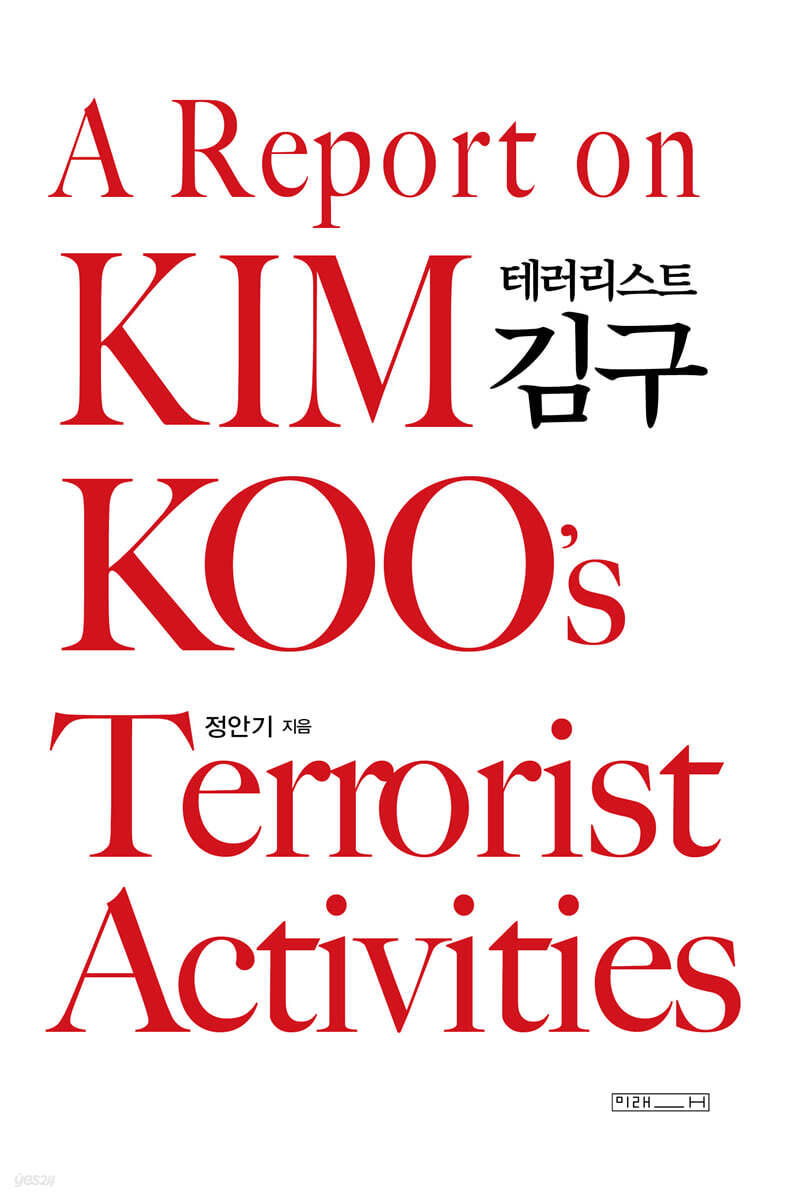
Terrorist Kim Gu
 |
Description
Book Introduction
Challenge the demythologization of the great myth called 'Baekbeom Kim Gu'!
A statue standing majestically on the slopes of Namsan Mountain in Seoul.
A massive marble memorial located in the heart of the city.
The grand tomb of Hyochang Park, reminiscent of a royal tomb.
Baekbeom Kim Gu (1876-1949) is a great man who has long been admired and revered by Koreans as a great leader of the nation, a giant of anti-Japanese independence, and the father of the Republic of Korea.
Throughout modern and contemporary Korean history, there is no historical figure of comparable grandeur or inviolable sacredness to Kim Gu.
Kim Gu has another face.
Terrorist.
Kim Gu was a world-renowned political assassin who committed dozens of brutal terrorist attacks throughout his life.
However, Kim Gu never denied or felt ashamed of the criticism and ridicule of his contemporaries who called him a “global terrorist” or “chief culprit of terrorism.”
Rather, he considered it a 'medal of honor' symbolizing his revolutionary past fighting against the unjust Japanese imperialist system, and he took pride in being a 'national crusader.'
So, was Kim Gu a true terrorist? This book empirically analyzes Kim Gu's terrorist activities, distinguishing between "terror with terrorism" and "terror without terrorism," and elucidating the structure, characteristics, and logic of terrorism.
In short, this is a critical reflection on the fantastical dissonance between a global terrorist and the father of the Republic of Korea, and a full-fledged academic study that challenges the demythologization of the grand myth of "Baekbeom Kim Gu."
A statue standing majestically on the slopes of Namsan Mountain in Seoul.
A massive marble memorial located in the heart of the city.
The grand tomb of Hyochang Park, reminiscent of a royal tomb.
Baekbeom Kim Gu (1876-1949) is a great man who has long been admired and revered by Koreans as a great leader of the nation, a giant of anti-Japanese independence, and the father of the Republic of Korea.
Throughout modern and contemporary Korean history, there is no historical figure of comparable grandeur or inviolable sacredness to Kim Gu.
Kim Gu has another face.
Terrorist.
Kim Gu was a world-renowned political assassin who committed dozens of brutal terrorist attacks throughout his life.
However, Kim Gu never denied or felt ashamed of the criticism and ridicule of his contemporaries who called him a “global terrorist” or “chief culprit of terrorism.”
Rather, he considered it a 'medal of honor' symbolizing his revolutionary past fighting against the unjust Japanese imperialist system, and he took pride in being a 'national crusader.'
So, was Kim Gu a true terrorist? This book empirically analyzes Kim Gu's terrorist activities, distinguishing between "terror with terrorism" and "terror without terrorism," and elucidating the structure, characteristics, and logic of terrorism.
In short, this is a critical reflection on the fantastical dissonance between a global terrorist and the father of the Republic of Korea, and a full-fledged academic study that challenges the demythologization of the grand myth of "Baekbeom Kim Gu."
index
At the beginning of the book
prolog
Terrorism, terrorism, new terrorism
Is Kim Gu a terrorist?
The Inconvenient Truth of the Historical Academic Community
Research subject, perspective, and method
Part 1: Anti-Japanese Terrorism
1.
Josuke Tsuchida, the herbalist of Chihapo
Memories of Murder
Arrest and interrogation of Haejubu
Jangyeon Sanposu Incident
Transfer and interrogation at Incheon Superintendent's Office
Judgment, Disposition, and Compensation
Truth and Issues
Galmuri
2.
Lee Bong-chang, the debaucher terrorist
Memories of Terror
Who is Lee Bong-chang?
Baek Jeong-seon of Shanghai
Mission Impossible
Arrest, interrogation, and trial
The shock and ripple effects of terrorism
Truth and Issues
Galmuri
3.
Yun Bong-gil, the unwavering independence fighter of love
Memories of the bombing
Who is Yun Bong-gil?
Shanghai's Salgaji
The bombing of the century
Arrest, interrogation, and judgment
Global shock and repercussions
Division, conflict, and infighting within the Korean community
Truth and Issues
Galmuri
Part 2: Secret Agent Terror
4.
Kim Lip, socialist anti-Japanese revolutionary
Memories of Assassination
Who is Kim Lip?
The Korean Socialist Party's revolutionary diplomacy
Moscow's red money
The shooters of the magic bullet
The Secret of Moscow's Gold
Truth and Issues
Galmuri
5.
The spy who was created, Ok Kwan-bin
Memories of a Murder
Who is Ok Kwan-bin?
Korean merchants in Shanghai
The shock of Dosan Ahn Chang-ho's death
The truth behind Ok Kwan-bin's assassination
Is Ok Kwan-bin really a spy?
The shock and ripple effects of the assassination
Truth and Issues
Galmuri
6.
An Gong-geun, Ahn Jung-geun's youngest brother
Memories of Cheonggye-dong
Who is An Gong-geun?
Master of slander and intrigue
Troublesome copycat
The truth behind the 'Nammokcheong incident'
Traces and Testimony of the Assassination
Truth and Issues
Galmuri
Part 3 Static Terror
7.
Song Jin-woo, the founding father of democracy
Memories of Assassination
Who is Song Jin-woo?
Cooperation between the Provisional Government and the Military Government
The aftermath of the anti-trusteeship struggle
Arrest, interrogation, and trial
The shock and ripple effects of the assassination
Truth and Issues
Galmuri
8.
Yeo Woon-hyung, a superficial communist
Memories of the Four Pillars
Who is Yeo Woon-hyung?
I will devote myself to the communist revolution!
Master of theater politics
Othello at Hyehwa-dong Rotary
Arrest, interrogation, and trial
Truth and Issues
Galmuri
9.
The Faceless Father of the Nation, Jang Deok-su
Tears of regret
Jang Deok-su, who is he?
The Great Race toward Nation-building
The collapsed tower of faith
Those thirsty for blood
Kim Gu in court
Truth and Issues
Galmuri
Epilogue
The Structure of Terrorism
Characteristics of terrorist activity
The logic of terrorist activity
annotation
References
Biographical Index
prolog
Terrorism, terrorism, new terrorism
Is Kim Gu a terrorist?
The Inconvenient Truth of the Historical Academic Community
Research subject, perspective, and method
Part 1: Anti-Japanese Terrorism
1.
Josuke Tsuchida, the herbalist of Chihapo
Memories of Murder
Arrest and interrogation of Haejubu
Jangyeon Sanposu Incident
Transfer and interrogation at Incheon Superintendent's Office
Judgment, Disposition, and Compensation
Truth and Issues
Galmuri
2.
Lee Bong-chang, the debaucher terrorist
Memories of Terror
Who is Lee Bong-chang?
Baek Jeong-seon of Shanghai
Mission Impossible
Arrest, interrogation, and trial
The shock and ripple effects of terrorism
Truth and Issues
Galmuri
3.
Yun Bong-gil, the unwavering independence fighter of love
Memories of the bombing
Who is Yun Bong-gil?
Shanghai's Salgaji
The bombing of the century
Arrest, interrogation, and judgment
Global shock and repercussions
Division, conflict, and infighting within the Korean community
Truth and Issues
Galmuri
Part 2: Secret Agent Terror
4.
Kim Lip, socialist anti-Japanese revolutionary
Memories of Assassination
Who is Kim Lip?
The Korean Socialist Party's revolutionary diplomacy
Moscow's red money
The shooters of the magic bullet
The Secret of Moscow's Gold
Truth and Issues
Galmuri
5.
The spy who was created, Ok Kwan-bin
Memories of a Murder
Who is Ok Kwan-bin?
Korean merchants in Shanghai
The shock of Dosan Ahn Chang-ho's death
The truth behind Ok Kwan-bin's assassination
Is Ok Kwan-bin really a spy?
The shock and ripple effects of the assassination
Truth and Issues
Galmuri
6.
An Gong-geun, Ahn Jung-geun's youngest brother
Memories of Cheonggye-dong
Who is An Gong-geun?
Master of slander and intrigue
Troublesome copycat
The truth behind the 'Nammokcheong incident'
Traces and Testimony of the Assassination
Truth and Issues
Galmuri
Part 3 Static Terror
7.
Song Jin-woo, the founding father of democracy
Memories of Assassination
Who is Song Jin-woo?
Cooperation between the Provisional Government and the Military Government
The aftermath of the anti-trusteeship struggle
Arrest, interrogation, and trial
The shock and ripple effects of the assassination
Truth and Issues
Galmuri
8.
Yeo Woon-hyung, a superficial communist
Memories of the Four Pillars
Who is Yeo Woon-hyung?
I will devote myself to the communist revolution!
Master of theater politics
Othello at Hyehwa-dong Rotary
Arrest, interrogation, and trial
Truth and Issues
Galmuri
9.
The Faceless Father of the Nation, Jang Deok-su
Tears of regret
Jang Deok-su, who is he?
The Great Race toward Nation-building
The collapsed tower of faith
Those thirsty for blood
Kim Gu in court
Truth and Issues
Galmuri
Epilogue
The Structure of Terrorism
Characteristics of terrorist activity
The logic of terrorist activity
annotation
References
Biographical Index
Detailed image

Into the book
The publication of this book was made possible by the bold decision and groundbreaking planning of Editor-in-Chief Jeong Gyu-jae, a leading commentator and icon of free press in our time.
Since October 2020, I have been broadcasting live on the 'Kim Gu Myth' with Editor-in-Chief Jeong Gyu-jae for about 20 times.
It required extraordinary courage, guts, and a calling to use the dark history of Kim Gu, a figure who had long been held sacred and inviolable, even though it was not allowed to be discussed officially or critically, as a topic for discussion.
I was shocked and angry at the 'true nature of Kim Gu's murder' and the 'shamelessness of Baekbeom Ilji' that were revealed as the episodes continued.
From then on, guided solely by my scholarly conscience, I followed the narrative whispered by the historical materials and the arrows pointing to them, targeting Kim Gu's terrorism and terrorism.
I had to lose sleep at night due to the shock, fear, and confusion of facing the cruel truth, and I had to tremble at the shocking hypocrisy and atrocities of the pseudo-historians who built the Tower of Babel of lies called the "Kim Gu myth."
The writing process, which lasted approximately three years, was a painful and arduous process of asking myself and answering the questions, "Who is Kim Gu?" and "Why do I study Kim Gu?"
But looking back, it was a precious time filled with academic tension and joy.
In that way, Kim Gu became my destiny.
I was able to endure this heavy workload thanks to the encouragement of my eternal teacher, Masahiro Shimotani of Kyoto University, who became a star in heaven two years ago, and Professor Emeritus Dae-geun Lee of Sungkyunkwan University, whom I respect.
In particular, this professor often said that he would only organize his life in this world after reading this work.
I had to swallow hot tears at those heartbreaking words, and that made me even more committed to this research, as if I were jumping for joy with a knife in my mouth.
I sincerely hope that you will continue to stay healthy and continue to watch over my follow-up research.
--- p.7
So when and how did the “historical obsession” that “Kim Gu is not a terrorist” or “he should not be a terrorist” come to be?
“9/11 was a terrorist attack that killed innocent civilians, but Mr. Kim Gu had a goal of independence.
“Terrorism targeting innocent civilians and the independence movement must be clearly distinguished.” Koreans’ perception of history is no different from the argument that the 9/11 terrorist attacks were an indiscriminate massacre of innocent civilians, but Kim Gu’s actions were not considered terrorism because he committed patriotic violence for independence.
But this is nothing more than a gross value bias and arbitrary interpretation of terrorism.
Behind this 'historical obsession' or 'historical confirmation bias' of Koreans lies an inconvenient truth about the field of historical studies.
--- p.25
Kim Gu was imprisoned in Seodaemun Prison from 1911 to 1914.
Meanwhile, he met Kim Jin-sa, a gangster who had been caught committing robberies in the Samnam area and was sentenced to five years in prison.
Through him, I learned about the existence of bandits called Chusul, Mokdanseol, and Bukdae, as well as their organization and training methods.
When he was the chief of the police department in the 1920s, Kim Gu had his bodyguards practice the methods of punishing traitors that he had learned from Jinsa Kim, and applied them to punishing spies.
As Min Pil-ho testified, “Whenever a Korean spy who was acting as a lackey for the Japanese consulate in Shanghai came near the French Concession, Kim Gu would secretly arrest them, take them to a pre-arranged location, and execute them.” Kim Gu’s terrorist activities were a copy of the tactics of bandits.
--- p.413
Kim Gu is a dark cloud that brings death to modern and contemporary Korean history, and represents a historical figure whose fabricated fiction has been disguised as a magnificent history.
This is a historical illusion created by the pro-North Korea faction of Kim Gu, which Koreans fantasize about today.
In the mid-1980s, the pro-North Korean faction began to promote Kim Gu as a countermeasure to the disparagement of Syngman Rhee, based on the “battle history” perception that the root of all social evils lies in the failure to liquidate pro-Japanese collaborators.
(…) In order to emphasize the legitimacy of North Korea, Kim Gu’s words, “We must not establish a separate government, even if we have to cut down the 38th parallel.” The historical manipulation of “promoting Kim Gu and belittling Syngman Rhee,” which is remembered as the most successful project in the history of the pro-North Korea faction, was reconstructed into a false frame of “Kim Gu, the embodiment of unification, Syngman Rhee, the culprit of division,” and brainwashed the Korean people.
To fantasize about and sanctify Kim Gu as the ‘savior of the nation’ or the ‘messiah of freedom and unification’ is a terrible schizophrenia and a terrible hypocrisy.
In short, Kim Gu was a "terrorist without terrorism" who threatened and committed violence against his own people while wielding a provisional government signboard in one hand and a long sword in the other, and a lugal who most powerfully perfected "provisional government extremism" and rose to a position that will never be forgotten.
This is the true face of Kim Gu, and the cruel truth behind the so-called 'independence movement'.
Kim Gu is nothing more than a historical fiction created by the pro-North Korean faction and an idol that mocks the ignorance and superficiality of Koreans.
Koreans must quickly wake up from the anachronistic idolatry of Kim Gu and the absurd fantasy.
We can no longer ignore and neglect the 'Kim Gu golden age'.
Since October 2020, I have been broadcasting live on the 'Kim Gu Myth' with Editor-in-Chief Jeong Gyu-jae for about 20 times.
It required extraordinary courage, guts, and a calling to use the dark history of Kim Gu, a figure who had long been held sacred and inviolable, even though it was not allowed to be discussed officially or critically, as a topic for discussion.
I was shocked and angry at the 'true nature of Kim Gu's murder' and the 'shamelessness of Baekbeom Ilji' that were revealed as the episodes continued.
From then on, guided solely by my scholarly conscience, I followed the narrative whispered by the historical materials and the arrows pointing to them, targeting Kim Gu's terrorism and terrorism.
I had to lose sleep at night due to the shock, fear, and confusion of facing the cruel truth, and I had to tremble at the shocking hypocrisy and atrocities of the pseudo-historians who built the Tower of Babel of lies called the "Kim Gu myth."
The writing process, which lasted approximately three years, was a painful and arduous process of asking myself and answering the questions, "Who is Kim Gu?" and "Why do I study Kim Gu?"
But looking back, it was a precious time filled with academic tension and joy.
In that way, Kim Gu became my destiny.
I was able to endure this heavy workload thanks to the encouragement of my eternal teacher, Masahiro Shimotani of Kyoto University, who became a star in heaven two years ago, and Professor Emeritus Dae-geun Lee of Sungkyunkwan University, whom I respect.
In particular, this professor often said that he would only organize his life in this world after reading this work.
I had to swallow hot tears at those heartbreaking words, and that made me even more committed to this research, as if I were jumping for joy with a knife in my mouth.
I sincerely hope that you will continue to stay healthy and continue to watch over my follow-up research.
--- p.7
So when and how did the “historical obsession” that “Kim Gu is not a terrorist” or “he should not be a terrorist” come to be?
“9/11 was a terrorist attack that killed innocent civilians, but Mr. Kim Gu had a goal of independence.
“Terrorism targeting innocent civilians and the independence movement must be clearly distinguished.” Koreans’ perception of history is no different from the argument that the 9/11 terrorist attacks were an indiscriminate massacre of innocent civilians, but Kim Gu’s actions were not considered terrorism because he committed patriotic violence for independence.
But this is nothing more than a gross value bias and arbitrary interpretation of terrorism.
Behind this 'historical obsession' or 'historical confirmation bias' of Koreans lies an inconvenient truth about the field of historical studies.
--- p.25
Kim Gu was imprisoned in Seodaemun Prison from 1911 to 1914.
Meanwhile, he met Kim Jin-sa, a gangster who had been caught committing robberies in the Samnam area and was sentenced to five years in prison.
Through him, I learned about the existence of bandits called Chusul, Mokdanseol, and Bukdae, as well as their organization and training methods.
When he was the chief of the police department in the 1920s, Kim Gu had his bodyguards practice the methods of punishing traitors that he had learned from Jinsa Kim, and applied them to punishing spies.
As Min Pil-ho testified, “Whenever a Korean spy who was acting as a lackey for the Japanese consulate in Shanghai came near the French Concession, Kim Gu would secretly arrest them, take them to a pre-arranged location, and execute them.” Kim Gu’s terrorist activities were a copy of the tactics of bandits.
--- p.413
Kim Gu is a dark cloud that brings death to modern and contemporary Korean history, and represents a historical figure whose fabricated fiction has been disguised as a magnificent history.
This is a historical illusion created by the pro-North Korea faction of Kim Gu, which Koreans fantasize about today.
In the mid-1980s, the pro-North Korean faction began to promote Kim Gu as a countermeasure to the disparagement of Syngman Rhee, based on the “battle history” perception that the root of all social evils lies in the failure to liquidate pro-Japanese collaborators.
(…) In order to emphasize the legitimacy of North Korea, Kim Gu’s words, “We must not establish a separate government, even if we have to cut down the 38th parallel.” The historical manipulation of “promoting Kim Gu and belittling Syngman Rhee,” which is remembered as the most successful project in the history of the pro-North Korea faction, was reconstructed into a false frame of “Kim Gu, the embodiment of unification, Syngman Rhee, the culprit of division,” and brainwashed the Korean people.
To fantasize about and sanctify Kim Gu as the ‘savior of the nation’ or the ‘messiah of freedom and unification’ is a terrible schizophrenia and a terrible hypocrisy.
In short, Kim Gu was a "terrorist without terrorism" who threatened and committed violence against his own people while wielding a provisional government signboard in one hand and a long sword in the other, and a lugal who most powerfully perfected "provisional government extremism" and rose to a position that will never be forgotten.
This is the true face of Kim Gu, and the cruel truth behind the so-called 'independence movement'.
Kim Gu is nothing more than a historical fiction created by the pro-North Korean faction and an idol that mocks the ignorance and superficiality of Koreans.
Koreans must quickly wake up from the anachronistic idolatry of Kim Gu and the absurd fantasy.
We can no longer ignore and neglect the 'Kim Gu golden age'.
--- p.428
Publisher's Review
Aiming for 'terrorist Kim Gu'!
A controversial work that touches on the taboos of the times!
A critical report on the fantastical incongruity between 'terrorist' and 'national treasurer'!
Kim Gu, did he have terrorism?
Are 'terrorists without terrorism' really terrorists?
A majestic statue standing tall on the slopes of Namsan Mountain.
A massive marble memorial hall located in the heart of Seoul.
The grand tomb of Hyochang Park, reminiscent of a royal tomb.
This is the trace left by Kim Gu (1876-1949), the great leader of the nation, a giant of independence against Japanese colonial rule, the father of the Republic of Korea, and a man who is admired and revered.
Kim Gu is sacred.
Throughout modern and contemporary Korean history, there is no historical figure of comparable grandeur or inviolable sacredness to Kim Gu.
But Kim Gu has another face.
Terrorist.
Kim Gu is a world-renowned political assassin who committed dozens of terrorist attacks and killed numerous people throughout his life.
However, he has never tried to deny or feel ashamed of the criticism and ridicule of contemporary historians who label him a 'global terrorist' or 'chief terrorist'.
Rather, he thought of it as a 'medal of honor' symbolizing his revolutionary past fighting against the unjust Japanese imperialist system.
He was a 'national crusader'.
So, was Kim Gu truly a terrorist? Or rather, what exactly is a terrorist? Unfortunately, no academic research has directly addressed and analyzed Kim Gu's terrorist activities or terrorism.
This is because leftist historians, who used to apply harsh standards to countless patriotic leaders for even the slightest trace of pro-Japanese activities, left only 'Kim Gu' as a sanctuary.
Accordingly, the author delved into the dark side of Kim Gu that Koreans tend to avoid looking at, namely, 'Kim Gu the terrorist.'
This book is the result of a full-fledged academic study that challenges the demythologization of the grand myth of "Baekbeom Kim Gu," along with a critical reflection on the "fantastic dissonance" between "global terrorist" and "father of the Republic of Korea."
The author, along with editor-in-chief Jeong Gyu-jae, conducted a live discussion broadcast covering the 'dark history of Kim Gu' over approximately 20 episodes.
As the meeting progressed, I was shocked and enraged by the revelation of ‘Kim Gu’s true nature as a murderer’ and ‘the lies of Baekbeom Ilji’, and I took aim at Kim Gu’s terrorism and terrorism, using only my scholarly conscience as a guide.
It was a series of heart-wrenching days filled with the shock, fear, and complexity of facing the brutal truth, and the author had to tremble at the shocking hypocrisy of the pseudo-historians who built the false Tower of Babel called the "Kim Gu myth."
Before embarking on a full-scale discussion, the author first defines ‘terrorism’ and ‘terrorist.’
Terrorism is distinguished from personal grudges and revenge in that its purpose is to be acted upon, from war in that its targets are unarmed civilians, and from accidental crimes in that it is meticulously planned in advance.
Terrorism is the righteous violent resistance of the weak against the strong.
Lee Bong-chang and Yun Bong-gil's bombings and Kim Gu, who planned them, were renowned throughout the Far East as the most fearsome terrorists of their time, but to us, they were also fierce independence fighters of love.
However, they also did not necessarily deny that they were 'terrorists'.
For them, being a terrorist was a 'medal of honor' and a 'symbol of pride' for revolutionaries who attacked and overthrew the unjust Japanese imperialist system.
The author raises his voice, saying that despite these historical facts, historians are abusing the terms "righteous man" or "martial artist" by saying "Kim Gu is not a terrorist" due to confirmation bias or obsession in only believing the facts they want to believe.
The author argues that “reflecting pre-modern Confucian values and glorifying the meta-historical terrorism that permeates modern and contemporary history as righteousness or uprising, and mythologizing or sanctifying violence, is clearly anti-civilization, anti-human rights, and anti-intellectual.”
The argument is that the righteous struggle is an asymmetric tactic of the colonial liberation struggle against imperialism and has no distinction whatsoever from 'traditional terrorism'.
“However, the history community’s allergy to terrorism is merely a result of the association of Kim Gu with Osama bin Laden and the resulting rejection, following the shockwave of the 9/11 terrorist attacks.
This is nothing but the true face of a pseudo-historical study and a vicious case of "if my side does it, it's righteousness, if the other side does it, it's terrorism."
This inconvenient truth in the field of historical scholarship lies at the root of today's Koreans' "historical obsession" or "invisible abstraction" that "Kim Gu was not a terrorist."
The author divided Kim Gu's terrorist activities into three categories: anti-Japanese, spy, and political enemy, and attempted to distinguish between "terrorism with terrorism" and "terrorism without terrorism," and to elucidate their structure, characteristics, and logic.
Since terrorism is a neutral academic concept that involves factual judgments rather than value judgments of good and evil, we empirically analyzed Kim Gu's terrorist activities based solely on factual judgments, leaving moral value judgments in parentheses.
Specifically, Kim Gu's terrorist activities were reconstructed into five factors: victim, target, means, motive, and intention.
Anti-Japanese terrorism covers the Chihapo murders in March 1896, which were particularly violent attacks on Japanese people, and the bombings of Lee Bong-chang in January 1932 and Yun Bong-gil in April 1932.
The Chihapo Incident is known as the incident in which the young Kim Gu killed a Japanese army lieutenant in the name of protecting the mother of the nation.
The January 1932 bombing of Lee Bong-chang was a terrorist attack that attempted to blow up the Japanese Emperor as he was returning to the palace after attending an army parade in Tokyo, Japan, but failed.
The Yun Bong-gil bombing attack in April 1932 was a terrorist incident in which a bomb was detonated at the Tianzhong Day commemoration ceremony in Shanghai's Hongkou Park, killing General Yoshinori Shirakawa and others.
Kim Gu gained fame as a world-class terrorist by carrying out the bombing attack on Yun Bong-gil.
The Secret Agents' Terrorism deals with the assassinations of Kim Lip in February 1922, Ok Kwan-bin in August 1933, and Ahn Gong-geun in May 1939, which were special acts of violence against Korean spies who obstructed and hindered the anti-Japanese movement.
The assassination of Kim Lip in February 1922 was an incident in which Kim Gu had his elementary school students Oh Myeon-jik and No Jong-gyun assassinate Kim Lip, the Secretary General of the Provisional Government, on the grounds that he was a national traitor.
The assassination of Ok Gwan-bin, which occurred in August 1933, was an incident in which Jeong Hwa-am of the Namhwa Korean Youth League instigated the assassination of Ok Gwan-bin, a Korean merchant in Shanghai, by accusing him of being a spy.
The assassination of Ahn Gong-geun in May 1939 was also a terrorist incident in which Jeong Hwa-am instigated the assassination of Ahn Gong-geun, Ahn Jung-geun's youngest brother.
Static Terrorism deals with the assassination of Song Jin-woo in December 1945, Yeo Un-hyeong in July 1947, and Jang Deok-su in December 1947, which were special acts of violence committed against political opponents with different political views during the process of establishing the nation after the return to power in November 1945.
The assassination of Song Jin-woo was an incident in which the then-chief secretary of the Korean Democratic Party, Song Jin-woo, was assassinated by the nationalist fanatic Han Hyeon-woo, accusing him of being a pro-North Korea supporter.
The assassination of Yeo Un-hyeong was an incident in which Han Hyeon-u, who was imprisoned in Mapo Prison, instigated the assassination of Yeo Un-hyeong, the leader of the Workers' Party, by accusing him of being a traitor to the nation.
The assassination of Jang Deok-su was a terrorist incident in which Kim Seok-hwang, the head of the Korean Patriotic Volunteer Corps under the Korean Independence Party, and his group were mobilized to assassinate Jang Deok-su, the political director of the then Korean Democratic Party.
Among the nine terrorist attacks by Kim Gu covered in this book, only one, the assassination of Yun Bong-gil, was a "terrorist attack with political purpose."
The rest were all “terrorism without terrorism,” as in the claim that “the opposition was consistently purged through terrorism,” and that terrorism was used as a means of personal greed, revenge, and eliminating political enemies.
For Kim Gu, terrorism was not a sacred means of fighting against Japanese injustice, but rather a despicable means of implementing “wild justice.”
Contrary to what Koreans today fantasize about, he was a self-proclaimed "terrorist without terrorism."
However, they were not 'new terrorists' who committed indiscriminate violence against an unspecified number of people like the 9/11 terrorists, but 'traditional terrorists' who committed discriminatory violence.
In concluding this book, the author concludes:
“Kim Gu is a dark cloud that brings death to modern and contemporary Korean history, and he represents a historical figure whose fabricated fiction has been disguised as a magnificent history.
The Kim Gu that Koreans fantasize about today is nothing more than a historical illusion created by the pro-North Korean faction.
To fantasize about and sanctify Kim Gu as the ‘savior of the nation’ or the ‘messiah of freedom and unification’ is a terrible schizophrenia and a terrible hypocrisy.
Koreans must quickly wake up from the anachronistic idolatry and absurd fantasy of Kim Gu.”
A controversial work that touches on the taboos of the times!
A critical report on the fantastical incongruity between 'terrorist' and 'national treasurer'!
Kim Gu, did he have terrorism?
Are 'terrorists without terrorism' really terrorists?
A majestic statue standing tall on the slopes of Namsan Mountain.
A massive marble memorial hall located in the heart of Seoul.
The grand tomb of Hyochang Park, reminiscent of a royal tomb.
This is the trace left by Kim Gu (1876-1949), the great leader of the nation, a giant of independence against Japanese colonial rule, the father of the Republic of Korea, and a man who is admired and revered.
Kim Gu is sacred.
Throughout modern and contemporary Korean history, there is no historical figure of comparable grandeur or inviolable sacredness to Kim Gu.
But Kim Gu has another face.
Terrorist.
Kim Gu is a world-renowned political assassin who committed dozens of terrorist attacks and killed numerous people throughout his life.
However, he has never tried to deny or feel ashamed of the criticism and ridicule of contemporary historians who label him a 'global terrorist' or 'chief terrorist'.
Rather, he thought of it as a 'medal of honor' symbolizing his revolutionary past fighting against the unjust Japanese imperialist system.
He was a 'national crusader'.
So, was Kim Gu truly a terrorist? Or rather, what exactly is a terrorist? Unfortunately, no academic research has directly addressed and analyzed Kim Gu's terrorist activities or terrorism.
This is because leftist historians, who used to apply harsh standards to countless patriotic leaders for even the slightest trace of pro-Japanese activities, left only 'Kim Gu' as a sanctuary.
Accordingly, the author delved into the dark side of Kim Gu that Koreans tend to avoid looking at, namely, 'Kim Gu the terrorist.'
This book is the result of a full-fledged academic study that challenges the demythologization of the grand myth of "Baekbeom Kim Gu," along with a critical reflection on the "fantastic dissonance" between "global terrorist" and "father of the Republic of Korea."
The author, along with editor-in-chief Jeong Gyu-jae, conducted a live discussion broadcast covering the 'dark history of Kim Gu' over approximately 20 episodes.
As the meeting progressed, I was shocked and enraged by the revelation of ‘Kim Gu’s true nature as a murderer’ and ‘the lies of Baekbeom Ilji’, and I took aim at Kim Gu’s terrorism and terrorism, using only my scholarly conscience as a guide.
It was a series of heart-wrenching days filled with the shock, fear, and complexity of facing the brutal truth, and the author had to tremble at the shocking hypocrisy of the pseudo-historians who built the false Tower of Babel called the "Kim Gu myth."
Before embarking on a full-scale discussion, the author first defines ‘terrorism’ and ‘terrorist.’
Terrorism is distinguished from personal grudges and revenge in that its purpose is to be acted upon, from war in that its targets are unarmed civilians, and from accidental crimes in that it is meticulously planned in advance.
Terrorism is the righteous violent resistance of the weak against the strong.
Lee Bong-chang and Yun Bong-gil's bombings and Kim Gu, who planned them, were renowned throughout the Far East as the most fearsome terrorists of their time, but to us, they were also fierce independence fighters of love.
However, they also did not necessarily deny that they were 'terrorists'.
For them, being a terrorist was a 'medal of honor' and a 'symbol of pride' for revolutionaries who attacked and overthrew the unjust Japanese imperialist system.
The author raises his voice, saying that despite these historical facts, historians are abusing the terms "righteous man" or "martial artist" by saying "Kim Gu is not a terrorist" due to confirmation bias or obsession in only believing the facts they want to believe.
The author argues that “reflecting pre-modern Confucian values and glorifying the meta-historical terrorism that permeates modern and contemporary history as righteousness or uprising, and mythologizing or sanctifying violence, is clearly anti-civilization, anti-human rights, and anti-intellectual.”
The argument is that the righteous struggle is an asymmetric tactic of the colonial liberation struggle against imperialism and has no distinction whatsoever from 'traditional terrorism'.
“However, the history community’s allergy to terrorism is merely a result of the association of Kim Gu with Osama bin Laden and the resulting rejection, following the shockwave of the 9/11 terrorist attacks.
This is nothing but the true face of a pseudo-historical study and a vicious case of "if my side does it, it's righteousness, if the other side does it, it's terrorism."
This inconvenient truth in the field of historical scholarship lies at the root of today's Koreans' "historical obsession" or "invisible abstraction" that "Kim Gu was not a terrorist."
The author divided Kim Gu's terrorist activities into three categories: anti-Japanese, spy, and political enemy, and attempted to distinguish between "terrorism with terrorism" and "terrorism without terrorism," and to elucidate their structure, characteristics, and logic.
Since terrorism is a neutral academic concept that involves factual judgments rather than value judgments of good and evil, we empirically analyzed Kim Gu's terrorist activities based solely on factual judgments, leaving moral value judgments in parentheses.
Specifically, Kim Gu's terrorist activities were reconstructed into five factors: victim, target, means, motive, and intention.
Anti-Japanese terrorism covers the Chihapo murders in March 1896, which were particularly violent attacks on Japanese people, and the bombings of Lee Bong-chang in January 1932 and Yun Bong-gil in April 1932.
The Chihapo Incident is known as the incident in which the young Kim Gu killed a Japanese army lieutenant in the name of protecting the mother of the nation.
The January 1932 bombing of Lee Bong-chang was a terrorist attack that attempted to blow up the Japanese Emperor as he was returning to the palace after attending an army parade in Tokyo, Japan, but failed.
The Yun Bong-gil bombing attack in April 1932 was a terrorist incident in which a bomb was detonated at the Tianzhong Day commemoration ceremony in Shanghai's Hongkou Park, killing General Yoshinori Shirakawa and others.
Kim Gu gained fame as a world-class terrorist by carrying out the bombing attack on Yun Bong-gil.
The Secret Agents' Terrorism deals with the assassinations of Kim Lip in February 1922, Ok Kwan-bin in August 1933, and Ahn Gong-geun in May 1939, which were special acts of violence against Korean spies who obstructed and hindered the anti-Japanese movement.
The assassination of Kim Lip in February 1922 was an incident in which Kim Gu had his elementary school students Oh Myeon-jik and No Jong-gyun assassinate Kim Lip, the Secretary General of the Provisional Government, on the grounds that he was a national traitor.
The assassination of Ok Gwan-bin, which occurred in August 1933, was an incident in which Jeong Hwa-am of the Namhwa Korean Youth League instigated the assassination of Ok Gwan-bin, a Korean merchant in Shanghai, by accusing him of being a spy.
The assassination of Ahn Gong-geun in May 1939 was also a terrorist incident in which Jeong Hwa-am instigated the assassination of Ahn Gong-geun, Ahn Jung-geun's youngest brother.
Static Terrorism deals with the assassination of Song Jin-woo in December 1945, Yeo Un-hyeong in July 1947, and Jang Deok-su in December 1947, which were special acts of violence committed against political opponents with different political views during the process of establishing the nation after the return to power in November 1945.
The assassination of Song Jin-woo was an incident in which the then-chief secretary of the Korean Democratic Party, Song Jin-woo, was assassinated by the nationalist fanatic Han Hyeon-woo, accusing him of being a pro-North Korea supporter.
The assassination of Yeo Un-hyeong was an incident in which Han Hyeon-u, who was imprisoned in Mapo Prison, instigated the assassination of Yeo Un-hyeong, the leader of the Workers' Party, by accusing him of being a traitor to the nation.
The assassination of Jang Deok-su was a terrorist incident in which Kim Seok-hwang, the head of the Korean Patriotic Volunteer Corps under the Korean Independence Party, and his group were mobilized to assassinate Jang Deok-su, the political director of the then Korean Democratic Party.
Among the nine terrorist attacks by Kim Gu covered in this book, only one, the assassination of Yun Bong-gil, was a "terrorist attack with political purpose."
The rest were all “terrorism without terrorism,” as in the claim that “the opposition was consistently purged through terrorism,” and that terrorism was used as a means of personal greed, revenge, and eliminating political enemies.
For Kim Gu, terrorism was not a sacred means of fighting against Japanese injustice, but rather a despicable means of implementing “wild justice.”
Contrary to what Koreans today fantasize about, he was a self-proclaimed "terrorist without terrorism."
However, they were not 'new terrorists' who committed indiscriminate violence against an unspecified number of people like the 9/11 terrorists, but 'traditional terrorists' who committed discriminatory violence.
In concluding this book, the author concludes:
“Kim Gu is a dark cloud that brings death to modern and contemporary Korean history, and he represents a historical figure whose fabricated fiction has been disguised as a magnificent history.
The Kim Gu that Koreans fantasize about today is nothing more than a historical illusion created by the pro-North Korean faction.
To fantasize about and sanctify Kim Gu as the ‘savior of the nation’ or the ‘messiah of freedom and unification’ is a terrible schizophrenia and a terrible hypocrisy.
Koreans must quickly wake up from the anachronistic idolatry and absurd fantasy of Kim Gu.”
GOODS SPECIFICS
- Date of issue: August 15, 2024
- Page count, weight, size: 616 pages | 152*223*35mm
- ISBN13: 9788970871554
- ISBN10: 8970871551
You may also like
카테고리
korean


korean

![GQ KOREA Mark (Monthly): December [2025]](http://librairie.coreenne.fr/cdn/shop/files/8ef265dbbfbf186523ed75ba7319009d.jpg?v=1765340328&width=3840)


