

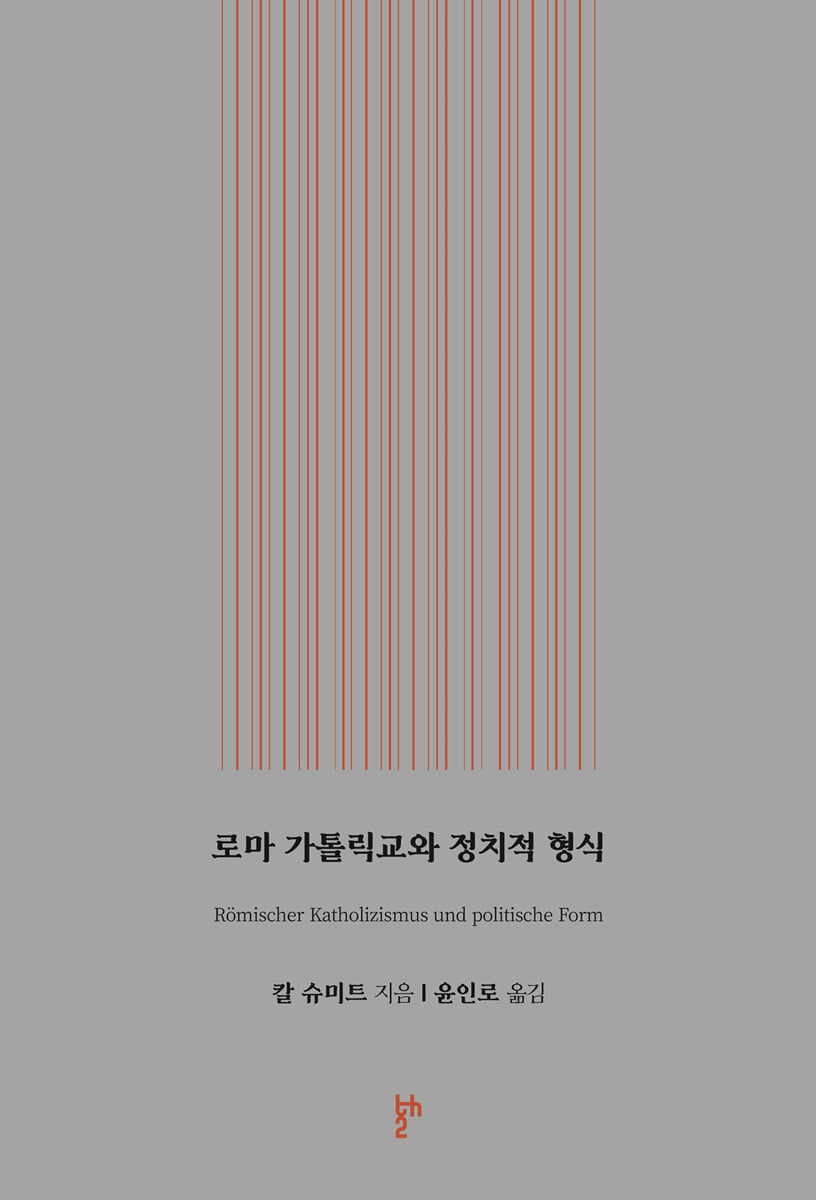
Roman Catholicism and its political forms
 |
Description
Book Introduction
A link to the thought of Carl Schmitt, a controversial 20th-century thinker
The form of ‘representative’ capacity possessed by Catholicism VS.
Economic-technical thinking
『Roman Catholicism and Political Form』, first published in Germany in 1923, is an early work by the infamous German public law scholar and political thinker Carl Schmitt, who has been highlighted as a thinker who must be confronted again in modern times, despite the stigma attached to Nazism, for his fundamental definition of sovereignty and law and his unique theoretical development of land and sea.
Starting with 『Political Romanticism』(1919), Schmitt began to show his true colors as a thinker. He clearly showed his Catholic conservative side by criticizing the political romantics of 19th century Germany and Europe, and through this, he developed a unique theory that led to 『Political Theology』(1922). The work that allows us to understand the origin of his theological explanation method is 『Roman Catholicism and Political Form』.
This book illuminates the meaning and form of representation in Catholicism, while raising awareness of the confusion of values that Schmitt seeks to confront, which deviates from the ideology of representation, namely economic-technical thinking.
The form of ‘representative’ capacity possessed by Catholicism VS.
Economic-technical thinking
『Roman Catholicism and Political Form』, first published in Germany in 1923, is an early work by the infamous German public law scholar and political thinker Carl Schmitt, who has been highlighted as a thinker who must be confronted again in modern times, despite the stigma attached to Nazism, for his fundamental definition of sovereignty and law and his unique theoretical development of land and sea.
Starting with 『Political Romanticism』(1919), Schmitt began to show his true colors as a thinker. He clearly showed his Catholic conservative side by criticizing the political romantics of 19th century Germany and Europe, and through this, he developed a unique theory that led to 『Political Theology』(1922). The work that allows us to understand the origin of his theological explanation method is 『Roman Catholicism and Political Form』.
This book illuminates the meaning and form of representation in Catholicism, while raising awareness of the confusion of values that Schmitt seeks to confront, which deviates from the ideology of representation, namely economic-technical thinking.
- You can preview some of the book's contents.
Preview
index
Roman Catholicism and Political Forms 9
Americas 73
Translator's Note 105
Introduction of people 120
Americas 73
Translator's Note 105
Introduction of people 120
Into the book
From the perspective of Catholic political ideology, the essence of the Roman Catholic connection between these conflicting things lies in a unique formal superiority in relation to the materiality of human life, which no empire has ever known.
At that point, the real form of historical and social reality was achieved, and Catholicism, despite its formal character, continued as a concrete presence, that is, as an overflowingly vibrant and, indeed, extremely rational presence.
Such formal uniqueness of Roman Catholicism is based on the strict enforcement of the principle of representation.
The specificity of such principles becomes very clear when contrasted with the economic and technological thinking that dominates today.
--- p.19
Major social conflicts cannot be resolved economically.
When managers say to workers: “I am feeding you,” the workers respond: “We are feeding you.” This situation arises not from a struggle over production and consumption, but from something entirely different from economics, from the various pathos of moral or legal convictions.
This has to do with the moral or legal responsibility for modern wealth as to who is its original producer and creator, and consequently who is its owner.
As soon as production becomes completely anonymous, as soon as the veil that covers joint-stock companies and other “legal” persons makes it impossible to hold concrete human beings accountable, the private property of the nothing-capitalist must be relegated to the background as an inexplicable ornament [Appendix].
--- p.35~36
One of the sociological mysteries of the Church is its capacity for legal form.
However, the reason the church can have power over all forms is because the church has power over representatives.
It represents civitas humana [civic human/humanity], captures every moment of the historical connection between Christ's incarnation and his sacrifice on the cross, and personally represents Christ himself as God made human within historical reality.
In such representation lies the superiority of the church, which transcends the era of economic and technological thinking.
--- p.37
One can observe how, with the spread of economic thinking, the understanding of representation of all kinds is declining.
Even so, today's parliamentarism contains at least a minimal ideological and theoretical basis for the thinking of representatives.
Moreover, it is based on what is technically called the “principle of representation.”
As long as the principle does nothing other than designate a proxy, that is, an individual who votes, it does not signify any of its own characteristics.
At that point, the real form of historical and social reality was achieved, and Catholicism, despite its formal character, continued as a concrete presence, that is, as an overflowingly vibrant and, indeed, extremely rational presence.
Such formal uniqueness of Roman Catholicism is based on the strict enforcement of the principle of representation.
The specificity of such principles becomes very clear when contrasted with the economic and technological thinking that dominates today.
--- p.19
Major social conflicts cannot be resolved economically.
When managers say to workers: “I am feeding you,” the workers respond: “We are feeding you.” This situation arises not from a struggle over production and consumption, but from something entirely different from economics, from the various pathos of moral or legal convictions.
This has to do with the moral or legal responsibility for modern wealth as to who is its original producer and creator, and consequently who is its owner.
As soon as production becomes completely anonymous, as soon as the veil that covers joint-stock companies and other “legal” persons makes it impossible to hold concrete human beings accountable, the private property of the nothing-capitalist must be relegated to the background as an inexplicable ornament [Appendix].
--- p.35~36
One of the sociological mysteries of the Church is its capacity for legal form.
However, the reason the church can have power over all forms is because the church has power over representatives.
It represents civitas humana [civic human/humanity], captures every moment of the historical connection between Christ's incarnation and his sacrifice on the cross, and personally represents Christ himself as God made human within historical reality.
In such representation lies the superiority of the church, which transcends the era of economic and technological thinking.
--- p.37
One can observe how, with the spread of economic thinking, the understanding of representation of all kinds is declining.
Even so, today's parliamentarism contains at least a minimal ideological and theoretical basis for the thinking of representatives.
Moreover, it is based on what is technically called the “principle of representation.”
As long as the principle does nothing other than designate a proxy, that is, an individual who votes, it does not signify any of its own characteristics.
--- p.48~49
Publisher's Review
Translator Yoon In-ro's afterword, "The 'Representative' Called Catholicism: Its Forms of Power, Its Enemies," states that this book defends the power of Catholic conservatism by showing the chaotic contemporary reality in the context of the representative system of the Weimar Republic, which failed to live up to the ideology of representation, and the rejection of it, through the threefold form of Catholicism: "the aesthetic form in art, the legal form in law, and the power form in world history overflowing with the light of glory."
From the perspective of these Catholic political forms, the lawless and formless capitalist mode of production is shaped only as “a form of technical precision” that can only serve demand.
Schmitt thus criticizes the apolitical tendencies of modern capitalism and the disorderliness of Masonic secret societies, while concisely conveying the visibility and representative power of Catholicism, which can be explained as a “connected union of conflicting elements.”
Furthermore, he points out that the confrontation between the bourgeoisie and the Bolsheviks is also a false antagonism, while revealing that economic-technical thinking is in fact the basis of a false antagonism, and that their common utopia did not go further than Lenin's ideal of an "electrically supplied Earth."
In opposing this false salvation through economic thinking, he argues that the ideal of a “perfect society” pursued by Catholicism has “special rationality” and is guaranteed in a threefold form, that is, by the authority of legal and political ideology.
This translation meticulously preserves the paragraph divisions, sentence structure, use of symbols, and foreign language notation of the original 1925 edition, and, by referring to the English, Japanese, and Spanish editions, endeavors to present Schmitt's logic and argumentation as rigorously as possible.
In this short book, readers will be able to get a glimpse of Carl Schmitt's conservative Catholicism and his views on the Weimar political forces of his time, as well as the Bolsheviks and anarchists.
Readers will find the concise text helpful through biographical introductions of key figures such as Tocqueville, Burke, Hello, Sorel, de Maistre, Dostoevsky, Marx, Donoso Cortés, Bakunin, and Lenin, as well as elaborate translator's notes and footnotes.
From the perspective of these Catholic political forms, the lawless and formless capitalist mode of production is shaped only as “a form of technical precision” that can only serve demand.
Schmitt thus criticizes the apolitical tendencies of modern capitalism and the disorderliness of Masonic secret societies, while concisely conveying the visibility and representative power of Catholicism, which can be explained as a “connected union of conflicting elements.”
Furthermore, he points out that the confrontation between the bourgeoisie and the Bolsheviks is also a false antagonism, while revealing that economic-technical thinking is in fact the basis of a false antagonism, and that their common utopia did not go further than Lenin's ideal of an "electrically supplied Earth."
In opposing this false salvation through economic thinking, he argues that the ideal of a “perfect society” pursued by Catholicism has “special rationality” and is guaranteed in a threefold form, that is, by the authority of legal and political ideology.
This translation meticulously preserves the paragraph divisions, sentence structure, use of symbols, and foreign language notation of the original 1925 edition, and, by referring to the English, Japanese, and Spanish editions, endeavors to present Schmitt's logic and argumentation as rigorously as possible.
In this short book, readers will be able to get a glimpse of Carl Schmitt's conservative Catholicism and his views on the Weimar political forces of his time, as well as the Bolsheviks and anarchists.
Readers will find the concise text helpful through biographical introductions of key figures such as Tocqueville, Burke, Hello, Sorel, de Maistre, Dostoevsky, Marx, Donoso Cortés, Bakunin, and Lenin, as well as elaborate translator's notes and footnotes.
GOODS SPECIFICS
- Date of issue: July 25, 2024
- Page count, weight, size: 124 pages | 128*188*20mm
- ISBN13: 9791190186407
- ISBN10: 1190186403
You may also like
카테고리
korean


korean

![GQ KOREA Mark (Monthly): December [2025]](http://librairie.coreenne.fr/cdn/shop/files/8ef265dbbfbf186523ed75ba7319009d.jpg?v=1765340328&width=3840)


