

Constitutional Moment
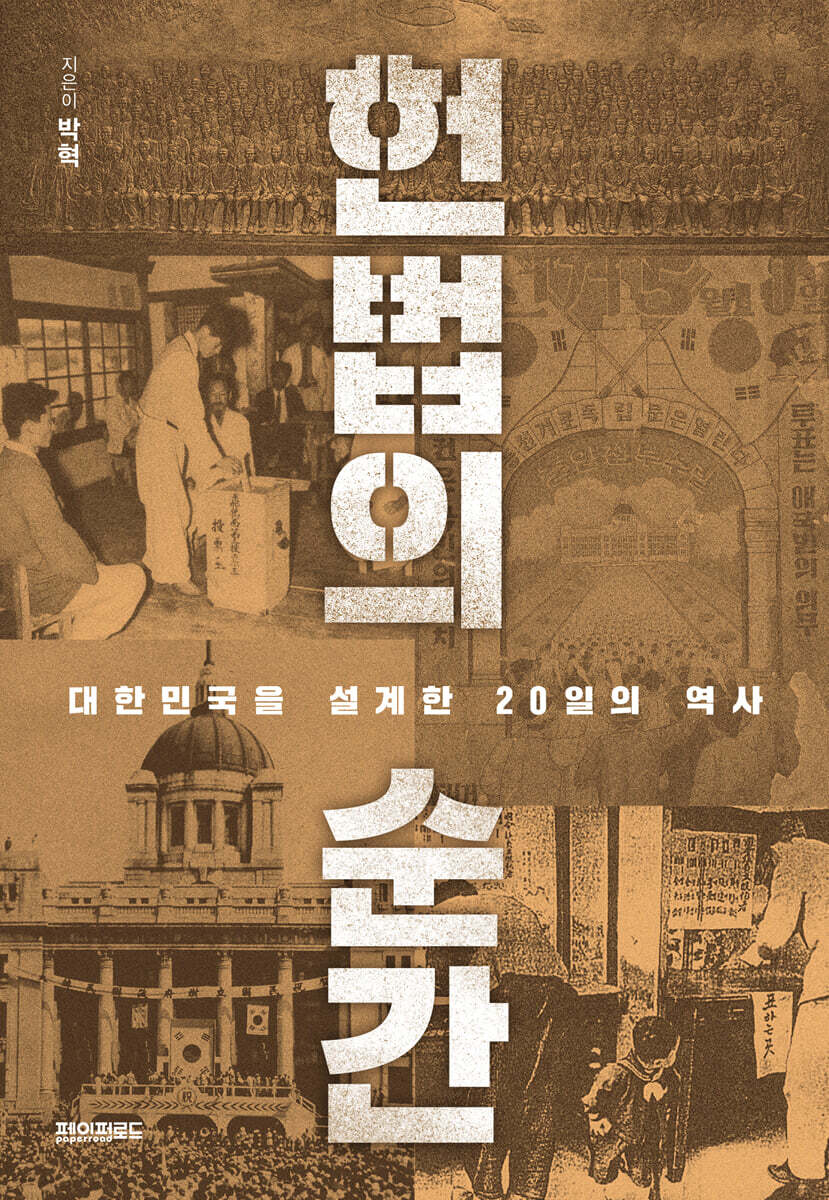 |
Description
Book Introduction
The moment the Constitution was enacted
The moment Korea was founded
From June 23 to July 12, 1948
A Feast of Politics in the Minutes of the Constitutional Assembly
In the 20 days of history that designed the Republic of Korea
Finding the Future of the Democratic Republic
May 10, 1948.
The old order of power bestowed by heaven was overturned, and the people drew sticks to elect their own officials.
With approximately 7.48 million voters and a voter turnout of 95.5%, 198 members of the first National Assembly were elected.
Immediately after the opening ceremony, a crowd of people gathered in front of Seoul City Hall and along Taepyeong-ro and Sejong-ro to support the Constitutional Assembly and march to celebrate independence.
The moment when the "Democratic Republic," a nation where all people are equal, a long-awaited dream since the establishment of the Provisional Government of the Republic of Korea, was born was grand and splendid, like the curtain call of liberation after a long period of oppression.
However, liberation was not an end, but a new beginning.
It took only 20 days for the Constitution of the Republic of Korea to be created.
After the draft constitution was presented to the plenary session of the Constitutional Assembly on June 23, 1948, it was not until July 12 that all 10 chapters and 103 articles of the constitution were passed.
The 20 days of history that shaped the Republic of Korea are recorded in their entirety in the minutes of the Constitutional Assembly, and the content contained in those records is qualitatively different from today's constitutional amendment debate, which is mired in issues such as "presidential system or cabinet system."
The 20-day record, meticulously written by a stenographer, provides a detailed account of the mindset of the 198 members of the Constitutional Assembly as they embarked on drafting the Constitution.
The minutes are filled with a sense of mission that a good constitution can create a good country, a sense of responsibility to quickly enact a constitution and establish a government, regret that better provisions could not be created due to the burden of reality, and a fervor to make the people's lives better.
Therefore, the 'feast of politics' that the members of the Constitutional Assembly unfolded with their tongues is the driving force that designed today's Republic of Korea, and a source of imagination that provides endless inspiration to those who dream of a new Republic of Korea.
A constitution is a promise embodying the values a nation pursues, a minimal fence protecting the lives of the vulnerable, and a milestone illuminating the future of a community.
As time passes, politics and the people become more and more distant, and hope is lost.
For those who dream of breaking through the era of despair and creating a new republic, "The Moment of the Constitution," which covers the process of creating the Constitution by the Constituent Assembly in 1948, was published.
This book returns to the starting point of the Republic of Korea and explores the identity of the democratic republic and the future of the community contained in that moment.
The moment Korea was founded
From June 23 to July 12, 1948
A Feast of Politics in the Minutes of the Constitutional Assembly
In the 20 days of history that designed the Republic of Korea
Finding the Future of the Democratic Republic
May 10, 1948.
The old order of power bestowed by heaven was overturned, and the people drew sticks to elect their own officials.
With approximately 7.48 million voters and a voter turnout of 95.5%, 198 members of the first National Assembly were elected.
Immediately after the opening ceremony, a crowd of people gathered in front of Seoul City Hall and along Taepyeong-ro and Sejong-ro to support the Constitutional Assembly and march to celebrate independence.
The moment when the "Democratic Republic," a nation where all people are equal, a long-awaited dream since the establishment of the Provisional Government of the Republic of Korea, was born was grand and splendid, like the curtain call of liberation after a long period of oppression.
However, liberation was not an end, but a new beginning.
It took only 20 days for the Constitution of the Republic of Korea to be created.
After the draft constitution was presented to the plenary session of the Constitutional Assembly on June 23, 1948, it was not until July 12 that all 10 chapters and 103 articles of the constitution were passed.
The 20 days of history that shaped the Republic of Korea are recorded in their entirety in the minutes of the Constitutional Assembly, and the content contained in those records is qualitatively different from today's constitutional amendment debate, which is mired in issues such as "presidential system or cabinet system."
The 20-day record, meticulously written by a stenographer, provides a detailed account of the mindset of the 198 members of the Constitutional Assembly as they embarked on drafting the Constitution.
The minutes are filled with a sense of mission that a good constitution can create a good country, a sense of responsibility to quickly enact a constitution and establish a government, regret that better provisions could not be created due to the burden of reality, and a fervor to make the people's lives better.
Therefore, the 'feast of politics' that the members of the Constitutional Assembly unfolded with their tongues is the driving force that designed today's Republic of Korea, and a source of imagination that provides endless inspiration to those who dream of a new Republic of Korea.
A constitution is a promise embodying the values a nation pursues, a minimal fence protecting the lives of the vulnerable, and a milestone illuminating the future of a community.
As time passes, politics and the people become more and more distant, and hope is lost.
For those who dream of breaking through the era of despair and creating a new republic, "The Moment of the Constitution," which covers the process of creating the Constitution by the Constituent Assembly in 1948, was published.
This book returns to the starting point of the Republic of Korea and explores the identity of the democratic republic and the future of the community contained in that moment.
- You can preview some of the book's contents.
Preview
index
Composition of the National Assembly at the time of the enactment of the Constitution… 7
Recommendation… 8
Preface: Waiting for the Constitutional Moment… 12
Chapter 1: The Korean People, As Korea - Why We Named Our Country the Republic of Korea… 25
Chapter 2: The Stolen Word: Citizens or People? The Debate on Who Should Be the Subject of Fundamental Rights… 47
Chapter 3: My Beloved Korean Peninsula - The Debate Surrounding Territorial Clauses… 71
Chapter 4: The Lost Revolution - Between the March 1st Revolution and the March 1st Movement... 91
Chapter 5: Even the Hen Should Crow - Abolishing Concubinedom, the First Step toward Equal Rights for Men and Women... 111
Chapter 6: The Power of "At Least" - Implement Compulsory and Free Education... 131
Chapter 7: As the Conscience of the Nation - Article 101: The Will to Purge Pro-Japanese Collaborators… 149
Chapter 8: Treating People Like People - Physical Freedom, the Right to Freedom from Torture… 171
Chapter 9: Politics is Politics, Religion is Religion - Prohibition of State Religion and Separation of Church and State… 199
Chapter 10: True Liberation: Economic Democratization - Workers' Right to Participate in Management and Profit Sharing... 223
Chapter 11: Stew Pots and Appetizers - The Story of the Unicameral System Adopted in Reservation of the Bicameral System… 253
Chapter 12: For One Person Only - Why the Change from a Cabinet System to a Presidential System… 277
Chapter 13: The Prime Minister and the Prime Minister's Role: Support or Check? 307
Chapter 14: The Unfamiliar Name, Shim Gye-won - The Role of Auditing Agencies... 327
Conclusion: Again, waiting for the moment of constitutional law… 342
References … 352
Recommendation… 8
Preface: Waiting for the Constitutional Moment… 12
Chapter 1: The Korean People, As Korea - Why We Named Our Country the Republic of Korea… 25
Chapter 2: The Stolen Word: Citizens or People? The Debate on Who Should Be the Subject of Fundamental Rights… 47
Chapter 3: My Beloved Korean Peninsula - The Debate Surrounding Territorial Clauses… 71
Chapter 4: The Lost Revolution - Between the March 1st Revolution and the March 1st Movement... 91
Chapter 5: Even the Hen Should Crow - Abolishing Concubinedom, the First Step toward Equal Rights for Men and Women... 111
Chapter 6: The Power of "At Least" - Implement Compulsory and Free Education... 131
Chapter 7: As the Conscience of the Nation - Article 101: The Will to Purge Pro-Japanese Collaborators… 149
Chapter 8: Treating People Like People - Physical Freedom, the Right to Freedom from Torture… 171
Chapter 9: Politics is Politics, Religion is Religion - Prohibition of State Religion and Separation of Church and State… 199
Chapter 10: True Liberation: Economic Democratization - Workers' Right to Participate in Management and Profit Sharing... 223
Chapter 11: Stew Pots and Appetizers - The Story of the Unicameral System Adopted in Reservation of the Bicameral System… 253
Chapter 12: For One Person Only - Why the Change from a Cabinet System to a Presidential System… 277
Chapter 13: The Prime Minister and the Prime Minister's Role: Support or Check? 307
Chapter 14: The Unfamiliar Name, Shim Gye-won - The Role of Auditing Agencies... 327
Conclusion: Again, waiting for the moment of constitutional law… 342
References … 352
Detailed image
.jpg)
Into the book
I have to be honest and confess.
I have so far ignored the members of the Constitutional Assembly, who were elected through general elections held only in South Korea.
It was regrettable and disappointing that an election was held that would lead to the permanent division of North and South Korea.
Let alone the Constitution they created.
I never thought of it as a proper constitution.
I considered it a hastily drafted constitution, like roasting beans in a flash, to be trivial.
It was dismissed as an outdated document.
It was looked down upon as a copycat constitution patched together from other countries' constitutions.
I happened to come across a constitutional moment.
At that time, I had the opportunity to carefully look at the National Assembly minutes.
I can't forget the feelings I had at that time.
We met the vivid voices and thoughts of the members of the Constitutional Assembly.
At that moment, how earnest and vibrant they were! The sight of their earnest devotion and determination struck my heart.
The rhetoric and logic used to persuade and refute the opponent were also not easy.
That moment is literally a 'feast of politics'.
The feast made my heart beat faster and broke the prejudices in my heart.
---From the "Preface"
On March 1, 1919, the entire nation resisted the 'Korea Genocide' perpetrated by Japan.
In every corner of the country, in broad daylight, they shout, “Long live Korean independence!”
The name Daehan itself meant independence, and shouting Daehan itself was anti-Japanese.
‘Reclaiming Korea’ is liberation.
With the spirit of independence and anti-Japanese sentiment continuing, the Provisional Government decided to name the country the Republic of Korea.
We protect the national name of Korea, which Japan tried to eradicate, and raise the spirit of independence.
This historical context provides strong grounds for the argument that the national name should be set as Daehan.
---From "Chapter 1, The Korean People, To Korea"
What did you think of the debate over whether the people are the subjects of fundamental rights? What do you think of the argument that the people should be the subjects of fundamental rights? That argument captures the image of Korea we aspire to.
I hope that the Republic of Korea will be a country that faithfully guarantees freedom and equality to each and every one of its members, that the universal human rights guaranteed by the Constitution will not be a privilege granted only to the citizens who are members of the state, and that it will be a country different from the modern nation-state that guarantees rights only to the sovereign citizens and does not allow any rights to foreigners.
In 1948, a small, independent nation on the periphery aspired to become a model nation for the world, contributing to lasting world peace and the common prosperity of humanity.
I wanted to include in the Constitution the precious values that were created from the experience of losing my country and living abroad as a stateless person for a long time.
In that sense, it seems that changing the people to citizens was not just a matter of losing a single word.
Perhaps, amidst division and ideological conflict, we have lost our great aspirations and even our precious values?
---From "Chapter 2: Good Words Stolen"
The preamble to the current Constitution states that “peaceful unification” is the mission of the Korean people.
Article 4 of the current Constitution states, “The Republic of Korea shall seek unification and shall establish and promote a peaceful unification policy based on the principles of liberal democracy.”
Article 66 of the current Constitution stipulates that the “peaceful unification of the country” is an important responsibility of the President.
Since the 1987 constitutional amendment, the territorial clause has served as the basis for regarding North Korea as a partner with whom we must engage in dialogue and cooperation for peaceful reunification.
The future goal of Korea is to unite the entire Korean Peninsula through dialogue and cooperation.
Perhaps that was the true spirit the Constitution sought to capture in its territorial clause. The territorial clause is a promise toward a peaceful nation, refraining from reclaiming or expanding territory through war.
It is also a pledge to protect our territory.
Because protecting territory is protecting sovereignty.
---From "Chapter 3, My Love, the Korean Peninsula"
Even before the Constitution, the March 1st Revolution was commonly referred to as an independence movement.
The problem is that the constitutional moment was a process of re-evaluating and redefining the historical nature and national significance of the March 1st Revolution.
The preamble to the Constitution declares that a democratic republic will be established by inheriting the spirit of the March 1st Movement.
They say the March 1st Movement is the root of the Republic of Korea.
At a moment when a name worthy of that assessment was needed, a movement was chosen over a revolution.
Was that really the right choice?
After the Constitution, the term March 1st Revolution became unfamiliar.
Of course, attempts to call it a revolution have not completely disappeared.
After the establishment of the government, when creating the law regarding national holidays, there were some who called for March 1st to be called 'Revolution Day', but it did not receive a favorable response.
Since the debate surrounding the name has already been settled, the proposal to call it Revolution Day is treated as a trumpet call after the procession is over.
I need to think about it now.
Is it really unfair to call it the March 1st Revolution?
---From Chapter 4, The Lost Revolution
At the moment of constitutional change, the members of the Constituent Assembly agree that 'gender equality' is an important task of the times.
In a situation where there were almost no changes to the provisions of the constitutional draft submitted by the Constitutional Drafting Committee, Article 20 was newly created.
This is because the issue of gender discrimination was a serious social problem.
Commissioner Yoo Jin-oh also expressed his pride in his memoir, saying, “The establishment of Article 20 was the greatest achievement of the second reading.”
But in 1962, the Park Chung-hee regime changed Article 20 of the Constitution.
Has the world changed much since gender equality was achieved? The details are unknown, but the phrase "Marriage is based on equal rights for men and women" from the original Constitution was deleted.
Instead, the purpose of Article 20 of the Constitution is lost by stating, “All citizens shall be protected by the State with regard to marital chastity and health.”
Fortunately, the current Constitution moved Article 20 of the Constitution to Article 36, which stipulates that “Marriage and family life must be established and maintained on the basis of individual dignity and gender equality, and the State shall guarantee this.”
Although the wording has changed slightly, the spirit of Article 20 of the Constitution, which states that women should not be unfairly discriminated against in family and marriage, has been maintained.
Article 20, born at the moment of the Constitution, presents the goal of a community where men and women live together without discrimination and with mutual respect.
---From Chapter 5, "The Time When Even a Hen Should Crow"
At the moment of the Constitution, the three letters "at least" in Article 16 were born like this.
That one word captures the spirit of the Constitution.
It is a promise to provide free compulsory education for at least six years of elementary education and to gradually expand the scope of free education to secondary education as the national economy improves.
The single word “at least” makes it possible to keep the promise to expand the scope of compulsory and free education at any time without amending the Constitution.
---From "The Great Power Contained in 'At Least'" in Chapter 6
Representative Shin Hyun-don's claims deserve careful consideration.
Because it contains all the main arguments against punishing anti-nationalists.
First, let us examine the argument that a law punishing anti-nationalists would be a law of exile.
If the Anti-National Act is enacted, it will cause fear by saying, “Everyone, including the mayor of the town, district, neighborhood, and class, can be arrested, and the entire nation will be trapped in a net.”
Second, the issue of liquidating pro-Japanese collaborators is being pushed into an ideological conflict.
Incitement like “Congressmen who advocate for the liquidation of pro-Japanese collaborators are communists” is rampant.
It doesn't end with just incitement.
They are branding the young lawmakers who led the enactment of the anti-people law according to the Constitution as spies.
They fabricate the National Assembly spy incident by lying that they were acting under the support and orders of North Korea, and put them in prison.
Third, they argue that pro-Japanese collaborators should be eliminated after the government is established.
The logic is that if we punish all pro-Japanese collaborators in a situation where human resources are insufficient, there will be no one to run the country.
Fourth, there is the argument that the country will be thrown into chaos, like burning down an entire house to catch a flea.
Now that everyone has forgotten the past and is living a normal life, why are you making a fuss?
Fifth, the theory of putting people's livelihood first.
They ask why we are leisurely talking about liquidating pro-Japanese collaborators when it is difficult to even make a living.
It is said that when you go out on the streets, there are people who say they are hungry and cannot live and ask for food and clothes, but no one says that they cannot live because of pro-Japanese collaborators and that we should liquidate them.
These logics have been a strong breakwater protecting pro-Japanese collaborators since then.
---From Chapter 7, “As the Conscience of the Nation”
The conflict between human rights and public safety that arose at the Constitutional Court is, in fact, a difficult issue to reconcile.
For communities to survive and individuals to live freely, security must be ensured.
Who wouldn't be unaware of this fact? The reason we couldn't shake off anxiety during the Constitutional Moment was because human rights were routinely suppressed in the name of public safety.
Moreover, the police officers' misdeeds are the same before and after liberation.
How miserable must the reality have been when King Noh Deok-sul, the torturer who had brutally treated independence activists during the Japanese colonial period, was running wild again as a security technician?
Looking at history, dictatorships always rise to power by suppressing freedom under the pretext of safety and human rights under the pretext of public order.
They ask if freedom or human rights will feed you.
Freedom and human rights are also threatened as being possible only on the basis of strong safety and security.
In doing so, freedom and human rights are pushed to the back burner.
In Korea, too, the logic of such barbaric dictatorship has held sway for a long time.
In the face of that logic, the freedom of the body provided for in the Constitution is utterly powerless.
The democratization of Korean society, achieved through the combined efforts of all citizens, is a process that has brought to life and vibrant freedom and human rights that had been stuffed and crouched within the Constitution.
In the process, citizens reach a social consensus that freedom and human rights are just as important as safety.
---From Chapter 8, Treat People as People
The spirit of the Constitution engraved in the Constitutional Moment is clear.
I hope for a democratic republic where people of various religions, including atheists, coexist peacefully, respecting each other without discrimination.
A democratic republic lives and breathes diversity.
The religiousization of politics or the politicization of religion, in which the state favors a particular religion and religion cooperates with a particular political group, destroys diversity.
It is not uncommon for politicians to cling to a specific religion in order to gain the votes of religious people, or for religious leaders to use votes as a weapon to manipulate political power.
The state must strictly maintain religious neutrality, and religion must not be swayed by or colluded with state power.
That is the spirit of the Constitution.
Political leaders should also refrain from favoring a particular religion or making religiously biased remarks in public settings.
Because such remarks can cause conflict between religions.
I hope that politics and religion will faithfully implement the spirit of the Constitution and develop into a peaceful, multi-religious nation, unprecedented in the world.
---From Chapter 9, “Politics is Politics, Religion is Religion”
The workers' right to participate in management will be omitted, and only the workers' right to equal share of profits will be included in the Constitution.
What does this result mean? It represents a compromise, guaranteeing entrepreneurs' management freedom while protecting workers' right to survive.
The strategy of the opposition to the amendment, which turned the issue into an ideological issue by claiming that workers' participation in management was a violation of private property rights under the communist system, has been successful.
---From Chapter 10, “True Liberation is Economic Democratization”
Commissioner Yoo Jin-oh emphasizes that the bicameral system he designed is different from the British bicameral system.
They propose forming a lower house with representatives directly elected by the people, and forming an upper house with regional and professional representatives elected separately.
They also emphasize the advantage of electing different members of the two houses and having them act differently, which allows them to look at the same issues from different perspectives.
With different perspectives, you can make decisions more carefully and calmly.
Going through the two levels of the House and the Senate is like taking a small sip of stew from a boiling pot instead of eating it straight away.
The idea is to not eat it while it's still hot, but to let it cool down before eating.
---From "Chapter 11 Stew Pot and Appetizer Plate"
There is a particularly attractive part in Rep. Kang Wook-joong's speech.
This is a passage that positively interprets the frequent political changes (coups) that occur under the cabinet system.
He criticizes Representative Lee Won-hong's view that the presidential system is much more stable than the parliamentary system because there is no political change, as being extremely narrow-minded.
The brilliant counterargument is that a coup resulting from the National Assembly's vote of no confidence in the government and the government's dissolution of the National Assembly actually makes politics more vibrant and allows for reform of reality.
There are also claims that a coup d'état that occurs under a cabinet system is actually beneficial because it can prevent extreme changes such as rebellions or coups that occur under a presidential system.
---From Chapter 12, “For Just One Person”
At the moment of constitutional change, the expectations the Constituent Assembly had for the Prime Minister are clear.
It was intended to prevent the president from monopolizing state affairs or dictating personnel decisions.
We wanted to prevent the government from becoming a presidential love room.
I expected the administration and the National Assembly to play a major role in cooperating.
How about now? The president never shares power with the prime minister.
Nor does it use the Prime Minister as a mediator to lead cooperation with the National Assembly.
Appoint as Prime Minister someone who can go to the National Assembly and fight against the National Assembly members on your behalf.
Even the Prime Minister does not try to exercise his powers according to the Constitution.
The Prime Minister's right to nominate State Council members, which is so difficult to enshrine in the Constitution, is nothing more than a power that exists only on paper.
I just endure the ridicule of being called 'Prime Minister, Plant Prime Minister'.
---From "Chapter 13: The Prime Minister and the Prime Minister"
Even at the constitutional moment, the audit of public accounting emerged as an important topic.
As a country that has just been liberated, the national financial situation is not good.
By October 1948, the country's deficit was approximately 8.5 billion won.
The annual budget for the same year was approximately 19.4 billion, so the deficit compared to the budget is enormous.
The money going out is much more than the money coming in.
The national debt continues to grow.
We have no choice but to manage our national affairs more meticulously and frugally.
We must prevent the misuse or waste of national funds.
To this end, a provision for the establishment of an accounting audit agency is included in the Constitution.
Article 94 of the Draft Constitution (Constitutional Draft) states, “The State’s revenue and expenditures shall be audited annually by the Audit Office,” and establishes an accounting audit agency called the Audit Office.
---From "Chapter 14: The Unfamiliar Name, Sim Gye-won"
A lot of time has passed.
Since the moment of the Constitution, the Constitution has been changed several times.
As that change continues, it reveals how deep and solid the roots of the Constitutional Moment are.
Despite various upheavals, the spirit of the Constitution, engraved in the Constitutional moment, continues to endure.
As we have seen, realizing political and economic democracy, creating a free, equal, and prosperous nation—this is the spirit that the Constituent Assembly members hoped would endure for eternity.
This constitutional spirit has become the foundation upon which the Republic of Korea has grown into a model nation for the world.
I have so far ignored the members of the Constitutional Assembly, who were elected through general elections held only in South Korea.
It was regrettable and disappointing that an election was held that would lead to the permanent division of North and South Korea.
Let alone the Constitution they created.
I never thought of it as a proper constitution.
I considered it a hastily drafted constitution, like roasting beans in a flash, to be trivial.
It was dismissed as an outdated document.
It was looked down upon as a copycat constitution patched together from other countries' constitutions.
I happened to come across a constitutional moment.
At that time, I had the opportunity to carefully look at the National Assembly minutes.
I can't forget the feelings I had at that time.
We met the vivid voices and thoughts of the members of the Constitutional Assembly.
At that moment, how earnest and vibrant they were! The sight of their earnest devotion and determination struck my heart.
The rhetoric and logic used to persuade and refute the opponent were also not easy.
That moment is literally a 'feast of politics'.
The feast made my heart beat faster and broke the prejudices in my heart.
---From the "Preface"
On March 1, 1919, the entire nation resisted the 'Korea Genocide' perpetrated by Japan.
In every corner of the country, in broad daylight, they shout, “Long live Korean independence!”
The name Daehan itself meant independence, and shouting Daehan itself was anti-Japanese.
‘Reclaiming Korea’ is liberation.
With the spirit of independence and anti-Japanese sentiment continuing, the Provisional Government decided to name the country the Republic of Korea.
We protect the national name of Korea, which Japan tried to eradicate, and raise the spirit of independence.
This historical context provides strong grounds for the argument that the national name should be set as Daehan.
---From "Chapter 1, The Korean People, To Korea"
What did you think of the debate over whether the people are the subjects of fundamental rights? What do you think of the argument that the people should be the subjects of fundamental rights? That argument captures the image of Korea we aspire to.
I hope that the Republic of Korea will be a country that faithfully guarantees freedom and equality to each and every one of its members, that the universal human rights guaranteed by the Constitution will not be a privilege granted only to the citizens who are members of the state, and that it will be a country different from the modern nation-state that guarantees rights only to the sovereign citizens and does not allow any rights to foreigners.
In 1948, a small, independent nation on the periphery aspired to become a model nation for the world, contributing to lasting world peace and the common prosperity of humanity.
I wanted to include in the Constitution the precious values that were created from the experience of losing my country and living abroad as a stateless person for a long time.
In that sense, it seems that changing the people to citizens was not just a matter of losing a single word.
Perhaps, amidst division and ideological conflict, we have lost our great aspirations and even our precious values?
---From "Chapter 2: Good Words Stolen"
The preamble to the current Constitution states that “peaceful unification” is the mission of the Korean people.
Article 4 of the current Constitution states, “The Republic of Korea shall seek unification and shall establish and promote a peaceful unification policy based on the principles of liberal democracy.”
Article 66 of the current Constitution stipulates that the “peaceful unification of the country” is an important responsibility of the President.
Since the 1987 constitutional amendment, the territorial clause has served as the basis for regarding North Korea as a partner with whom we must engage in dialogue and cooperation for peaceful reunification.
The future goal of Korea is to unite the entire Korean Peninsula through dialogue and cooperation.
Perhaps that was the true spirit the Constitution sought to capture in its territorial clause. The territorial clause is a promise toward a peaceful nation, refraining from reclaiming or expanding territory through war.
It is also a pledge to protect our territory.
Because protecting territory is protecting sovereignty.
---From "Chapter 3, My Love, the Korean Peninsula"
Even before the Constitution, the March 1st Revolution was commonly referred to as an independence movement.
The problem is that the constitutional moment was a process of re-evaluating and redefining the historical nature and national significance of the March 1st Revolution.
The preamble to the Constitution declares that a democratic republic will be established by inheriting the spirit of the March 1st Movement.
They say the March 1st Movement is the root of the Republic of Korea.
At a moment when a name worthy of that assessment was needed, a movement was chosen over a revolution.
Was that really the right choice?
After the Constitution, the term March 1st Revolution became unfamiliar.
Of course, attempts to call it a revolution have not completely disappeared.
After the establishment of the government, when creating the law regarding national holidays, there were some who called for March 1st to be called 'Revolution Day', but it did not receive a favorable response.
Since the debate surrounding the name has already been settled, the proposal to call it Revolution Day is treated as a trumpet call after the procession is over.
I need to think about it now.
Is it really unfair to call it the March 1st Revolution?
---From Chapter 4, The Lost Revolution
At the moment of constitutional change, the members of the Constituent Assembly agree that 'gender equality' is an important task of the times.
In a situation where there were almost no changes to the provisions of the constitutional draft submitted by the Constitutional Drafting Committee, Article 20 was newly created.
This is because the issue of gender discrimination was a serious social problem.
Commissioner Yoo Jin-oh also expressed his pride in his memoir, saying, “The establishment of Article 20 was the greatest achievement of the second reading.”
But in 1962, the Park Chung-hee regime changed Article 20 of the Constitution.
Has the world changed much since gender equality was achieved? The details are unknown, but the phrase "Marriage is based on equal rights for men and women" from the original Constitution was deleted.
Instead, the purpose of Article 20 of the Constitution is lost by stating, “All citizens shall be protected by the State with regard to marital chastity and health.”
Fortunately, the current Constitution moved Article 20 of the Constitution to Article 36, which stipulates that “Marriage and family life must be established and maintained on the basis of individual dignity and gender equality, and the State shall guarantee this.”
Although the wording has changed slightly, the spirit of Article 20 of the Constitution, which states that women should not be unfairly discriminated against in family and marriage, has been maintained.
Article 20, born at the moment of the Constitution, presents the goal of a community where men and women live together without discrimination and with mutual respect.
---From Chapter 5, "The Time When Even a Hen Should Crow"
At the moment of the Constitution, the three letters "at least" in Article 16 were born like this.
That one word captures the spirit of the Constitution.
It is a promise to provide free compulsory education for at least six years of elementary education and to gradually expand the scope of free education to secondary education as the national economy improves.
The single word “at least” makes it possible to keep the promise to expand the scope of compulsory and free education at any time without amending the Constitution.
---From "The Great Power Contained in 'At Least'" in Chapter 6
Representative Shin Hyun-don's claims deserve careful consideration.
Because it contains all the main arguments against punishing anti-nationalists.
First, let us examine the argument that a law punishing anti-nationalists would be a law of exile.
If the Anti-National Act is enacted, it will cause fear by saying, “Everyone, including the mayor of the town, district, neighborhood, and class, can be arrested, and the entire nation will be trapped in a net.”
Second, the issue of liquidating pro-Japanese collaborators is being pushed into an ideological conflict.
Incitement like “Congressmen who advocate for the liquidation of pro-Japanese collaborators are communists” is rampant.
It doesn't end with just incitement.
They are branding the young lawmakers who led the enactment of the anti-people law according to the Constitution as spies.
They fabricate the National Assembly spy incident by lying that they were acting under the support and orders of North Korea, and put them in prison.
Third, they argue that pro-Japanese collaborators should be eliminated after the government is established.
The logic is that if we punish all pro-Japanese collaborators in a situation where human resources are insufficient, there will be no one to run the country.
Fourth, there is the argument that the country will be thrown into chaos, like burning down an entire house to catch a flea.
Now that everyone has forgotten the past and is living a normal life, why are you making a fuss?
Fifth, the theory of putting people's livelihood first.
They ask why we are leisurely talking about liquidating pro-Japanese collaborators when it is difficult to even make a living.
It is said that when you go out on the streets, there are people who say they are hungry and cannot live and ask for food and clothes, but no one says that they cannot live because of pro-Japanese collaborators and that we should liquidate them.
These logics have been a strong breakwater protecting pro-Japanese collaborators since then.
---From Chapter 7, “As the Conscience of the Nation”
The conflict between human rights and public safety that arose at the Constitutional Court is, in fact, a difficult issue to reconcile.
For communities to survive and individuals to live freely, security must be ensured.
Who wouldn't be unaware of this fact? The reason we couldn't shake off anxiety during the Constitutional Moment was because human rights were routinely suppressed in the name of public safety.
Moreover, the police officers' misdeeds are the same before and after liberation.
How miserable must the reality have been when King Noh Deok-sul, the torturer who had brutally treated independence activists during the Japanese colonial period, was running wild again as a security technician?
Looking at history, dictatorships always rise to power by suppressing freedom under the pretext of safety and human rights under the pretext of public order.
They ask if freedom or human rights will feed you.
Freedom and human rights are also threatened as being possible only on the basis of strong safety and security.
In doing so, freedom and human rights are pushed to the back burner.
In Korea, too, the logic of such barbaric dictatorship has held sway for a long time.
In the face of that logic, the freedom of the body provided for in the Constitution is utterly powerless.
The democratization of Korean society, achieved through the combined efforts of all citizens, is a process that has brought to life and vibrant freedom and human rights that had been stuffed and crouched within the Constitution.
In the process, citizens reach a social consensus that freedom and human rights are just as important as safety.
---From Chapter 8, Treat People as People
The spirit of the Constitution engraved in the Constitutional Moment is clear.
I hope for a democratic republic where people of various religions, including atheists, coexist peacefully, respecting each other without discrimination.
A democratic republic lives and breathes diversity.
The religiousization of politics or the politicization of religion, in which the state favors a particular religion and religion cooperates with a particular political group, destroys diversity.
It is not uncommon for politicians to cling to a specific religion in order to gain the votes of religious people, or for religious leaders to use votes as a weapon to manipulate political power.
The state must strictly maintain religious neutrality, and religion must not be swayed by or colluded with state power.
That is the spirit of the Constitution.
Political leaders should also refrain from favoring a particular religion or making religiously biased remarks in public settings.
Because such remarks can cause conflict between religions.
I hope that politics and religion will faithfully implement the spirit of the Constitution and develop into a peaceful, multi-religious nation, unprecedented in the world.
---From Chapter 9, “Politics is Politics, Religion is Religion”
The workers' right to participate in management will be omitted, and only the workers' right to equal share of profits will be included in the Constitution.
What does this result mean? It represents a compromise, guaranteeing entrepreneurs' management freedom while protecting workers' right to survive.
The strategy of the opposition to the amendment, which turned the issue into an ideological issue by claiming that workers' participation in management was a violation of private property rights under the communist system, has been successful.
---From Chapter 10, “True Liberation is Economic Democratization”
Commissioner Yoo Jin-oh emphasizes that the bicameral system he designed is different from the British bicameral system.
They propose forming a lower house with representatives directly elected by the people, and forming an upper house with regional and professional representatives elected separately.
They also emphasize the advantage of electing different members of the two houses and having them act differently, which allows them to look at the same issues from different perspectives.
With different perspectives, you can make decisions more carefully and calmly.
Going through the two levels of the House and the Senate is like taking a small sip of stew from a boiling pot instead of eating it straight away.
The idea is to not eat it while it's still hot, but to let it cool down before eating.
---From "Chapter 11 Stew Pot and Appetizer Plate"
There is a particularly attractive part in Rep. Kang Wook-joong's speech.
This is a passage that positively interprets the frequent political changes (coups) that occur under the cabinet system.
He criticizes Representative Lee Won-hong's view that the presidential system is much more stable than the parliamentary system because there is no political change, as being extremely narrow-minded.
The brilliant counterargument is that a coup resulting from the National Assembly's vote of no confidence in the government and the government's dissolution of the National Assembly actually makes politics more vibrant and allows for reform of reality.
There are also claims that a coup d'état that occurs under a cabinet system is actually beneficial because it can prevent extreme changes such as rebellions or coups that occur under a presidential system.
---From Chapter 12, “For Just One Person”
At the moment of constitutional change, the expectations the Constituent Assembly had for the Prime Minister are clear.
It was intended to prevent the president from monopolizing state affairs or dictating personnel decisions.
We wanted to prevent the government from becoming a presidential love room.
I expected the administration and the National Assembly to play a major role in cooperating.
How about now? The president never shares power with the prime minister.
Nor does it use the Prime Minister as a mediator to lead cooperation with the National Assembly.
Appoint as Prime Minister someone who can go to the National Assembly and fight against the National Assembly members on your behalf.
Even the Prime Minister does not try to exercise his powers according to the Constitution.
The Prime Minister's right to nominate State Council members, which is so difficult to enshrine in the Constitution, is nothing more than a power that exists only on paper.
I just endure the ridicule of being called 'Prime Minister, Plant Prime Minister'.
---From "Chapter 13: The Prime Minister and the Prime Minister"
Even at the constitutional moment, the audit of public accounting emerged as an important topic.
As a country that has just been liberated, the national financial situation is not good.
By October 1948, the country's deficit was approximately 8.5 billion won.
The annual budget for the same year was approximately 19.4 billion, so the deficit compared to the budget is enormous.
The money going out is much more than the money coming in.
The national debt continues to grow.
We have no choice but to manage our national affairs more meticulously and frugally.
We must prevent the misuse or waste of national funds.
To this end, a provision for the establishment of an accounting audit agency is included in the Constitution.
Article 94 of the Draft Constitution (Constitutional Draft) states, “The State’s revenue and expenditures shall be audited annually by the Audit Office,” and establishes an accounting audit agency called the Audit Office.
---From "Chapter 14: The Unfamiliar Name, Sim Gye-won"
A lot of time has passed.
Since the moment of the Constitution, the Constitution has been changed several times.
As that change continues, it reveals how deep and solid the roots of the Constitutional Moment are.
Despite various upheavals, the spirit of the Constitution, engraved in the Constitutional moment, continues to endure.
As we have seen, realizing political and economic democracy, creating a free, equal, and prosperous nation—this is the spirit that the Constituent Assembly members hoped would endure for eternity.
This constitutional spirit has become the foundation upon which the Republic of Korea has grown into a model nation for the world.
---From the “Conclusion”
Publisher's Review
14 Debates Surrounding the 1948 Constitutional Assembly
The first National Assembly, established in 1948, was surrounded by numerous crises.
Concerned that a separate election in South Korea would result in the division of North and South Korea, left-wing forces and prominent figures from the provisional government boycotted the election.
Those who participated in the election also clashed and clashed with each other according to their own goals and political party interests.
The moment the Constitution of the Republic of Korea was enacted was a fierce ideological battle filled with the differing views of 198 people, and it was also a prelude to a power struggle to secure future political leadership.
In “The Moment of the Constitution,” author Park Hyuk carefully selects 14 debates that shook the Constitutional Assembly and introduces them one by one in each chapter.
The moment of the fierce debate, which was so intense that it was breathtaking, was described in such detail that it could rival a novel, and with such vividness that it was like a drama.
So, there are three main points to note in this book.
First, the Constitutional Assembly at the time tried to establish the history of the independence movement as a national identity.
The independence movement was both a physical struggle to drive out the Japanese Empire and an ideological resistance to build a new world.
As proof of this, Chapter 1, “The Korean People, to Korea,” introduces the process by which the national name was decided as the Republic of Korea.
Immediately after Japan robbed the Korean people of their sovereignty, it erased the name "Daehan," which symbolized a unified Korea, and revived "Joseon," which symbolized a ruined nation.
In other words, the revolution of March 1, 1919 was a struggle to restore the name and meaning of Daehan.
In this historical context, the national name 'Republic of Korea' includes the meaning of succeeding the provisional government established with the spirit of independence and anti-Japanese sentiment.
Likewise, in Chapter 3, “My Love Korean Peninsula,” the name for the country, “Korean Peninsula,” was also considered a word that had been taken away and then reclaimed, and was included in the Constitution.
The work to establish the independence movement as the origin of the Republic of Korea was not smooth.
In Chapter 4, “The Lost Revolution,” several lawmakers, including Syngman Rhee, changed the name of the March 1st Revolution to the March 1st Movement, downgrading its significance.
In Chapter 7, “As the Conscience of the Nation,” let’s examine the conflict surrounding the passage of Article 101, which stipulates the liquidation of pro-Japanese collaborators.
Conservative forces, including the Democratic Party of Korea, persistently obstructed the creation of a clause to liquidate pro-Japanese collaborators.
Just as the Special Committee on Anti-Japanese Collaborators was later brutally suppressed without even being able to carry out its activities, attempts to establish justice within the community were repeatedly met with resistance from pro-Japanese forces.
Second, the Constitution is full of alternative imaginations to overcome the Japanese colonial period.
The Constituent Assembly delved into what values should be most important in the Constitution of the Democratic Republic.
It is a universal human right.
Chapter 2, “Good Words Stolen,” Chapter 8, “Treat People as People,” Chapter 9, “Politics is Politics, Religion is Religion,” and Chapter 10, “True Liberation is Economic Democratization,” are all centered around the message that we must overcome the absurdities of the past.
Chapter 2 shows the process of debating whether 'citizens' or 'people' should be the subjects who should be guaranteed basic rights.
Contrary to the prejudice that everyone would naturally be considered a "citizen" given that the law is a promise between the state and its members, there were several members of the 1948 Constitutional Assembly who argued that the term "people" should be used from the perspective that the universal rights of all human beings should be guaranteed.
Even examining the debate surrounding “personal liberty” and “the right to be free from torture” in Chapter 8 reveals how sensitive the Constitutional Assembly was to universal human rights.
Chapter 9 introduces the process of prohibiting state religion and separating church and state to ensure freedom of thought, religion, and conscience.
In Chapter 10, numerous lawmakers proposed amendments and fought against conservative forces, arguing that workers' rights must be protected to achieve "economic democracy."
In other words, the members of the Constitutional Assembly personally experienced the importance of human rights, freedom of body and conscience, and economic equality through 36 years of colonial rule, and they worked tirelessly to incorporate these values into the Constitution so that the country could become a model nation for the world.
Furthermore, the Constitution also shows traces of efforts to overcome contemporary social problems.
Chapter 5, “The Time When Even a Hen Should Crow,” explains the evils of concubinage that were prevalent at the time and the movement to overcome them.
Although women's suffrage was introduced and women candidates ran for office, the Constitutional Assembly became a quintessential "widowers' assembly."
Outside the National Assembly, high-ranking officials openly kept concubines, oppressed their wives, and contributed to the breakdown of their families.
In such a situation, the establishment of Article 20 of the Constitution, which was not even included in the draft, was truly a memorable event.
Article 20, which states that “Marriage is based on the equality of men and women, and marital chastity and family health are under the special protection of the State,” can be highly regarded as evidence of the efforts of the Constitutional Assembly to eliminate the discrimination against women under the patriarchal system and create a more equal society.
In Chapter 6, “The Great Power of ‘At Least’,” we can confirm the will of the Constituent Assembly members to expand the scope of free compulsory education.
At a time when the country was struggling financially, everyone was disappointed by the provision that only elementary education was guaranteed as free and compulsory education.
Additionally, according to the 'Minor Labor Protection Act' that has been in effect since 1947, children who have completed only elementary education and have not advanced to secondary school are placed in a situation where they cannot work or receive an education.
To address this issue, the members of the Constitutional Assembly tentatively agreed to insert the word "at least" into the clause to prepare for the future.
Article 16 of the Constitution: “All citizens have the right to equal education.
In “At least elementary education shall be compulsory and free,” the word “at least” provided a basis for expanding the scope of free compulsory education in the future.
The inside story of the birth of the Korean presidential system
If the first two are closely related to the ideological battle over the direction of the Republic of Korea, the last is closely related to the preliminary battle of political strife to secure leadership in the future political situation.
Third, Korea's unique political system, the "Korean presidential system," is the result of the constitutional draft being overturned at the moment of constitutional change.
At the time the Constitution of the Republic of Korea was being established, there were actually quite a few members of the National Assembly who were in favor of a political system consisting of a bicameral system and a parliamentary cabinet system.
In Chapter 12, “For One Person Only,” the Constitutional Drafting Committee, which produced the draft constitution, designed a constitution based on a parliamentary cabinet system (cabinet responsibility system).
This was because, in a presidential system, there was no proper way to hold the government and the National Assembly accountable, and no way to resolve the conflict between the government and the National Assembly.
In fact, Dr. Yoo Jin-oh, who made a great contribution to the design of the Constitution, coincidentally predicted the problems of the so-called 'imperial presidency' on that day in 1948.
In a presidential system, no matter how incompetent or problematic the president or government may be, no one can be voted out of confidence.
Likewise, no matter what tyranny the National Assembly commits, there is no way to dissolve it until the next election.
Unless they violate the Constitution or commit a grave illegal act, there is no way to hold the government or the National Assembly accountable or check them under a presidential system.
Readers who have been feeling disillusioned with the current president's excessive use of his veto power and the conflict between the government and the main opposition party will find the debates of the members of the Constitutional Assembly, introduced in "The Moment of the Constitution," to be truly exquisite.
Of course, there is also a context in which the parliamentary cabinet system was adopted based on realistic calculations.
The Constitutional Drafting Committee was led by members of the conservative Democratic Party of Korea and independent lawmakers, and they did not have a prestigious figure like Syngman Rhee to nominate for president.
They had no way of securing future leadership without a cabinet system.
In the end, all members of the Constitution Drafting Committee unanimously agreed to include the parliamentary cabinet system in the draft constitution.
However, someone strongly advocated for a presidential system and demanded that the contents of the draft constitution be changed.
It was Syngman Rhee, who was the interim Speaker of the National Assembly at the time.
He, who enjoyed overwhelming public support as a potential presidential candidate, pressured the Constitutional Drafting Committee by threatening not to participate in the government under a parliamentary cabinet system.
In a situation where people from the provisional government did not participate in the general election, if the soon-to-be-formed government did not even include Syngman Rhee, it would be difficult for that government to gain the trust of the people.
In the end, the draft constitution was changed to a presidential system for 'only one person'.
There was much debate about this, but in the end, the presidential system was adopted due to the prevailing political opinion that “social stability and strong governance are necessary.”
Just as the parliamentary system was changed to a presidential system overnight, many of the contents of the draft constitution were overturned according to the political interests of various political factions and the political situation surrounding the Republic of Korea.
In Chapter 11, “The Stew Pot and the Appetizer Plate,” we can also learn about the reasons why the bicameral system was postponed and the unicameral system was adopted in order to quickly stabilize society, despite the many advantages of the bicameral system.
Additionally, with the sudden change to a presidential system, the Constitution included content that the original Constitution Drafting Committee had not intended.
For example, Chapter 13, “The Prime Minister and the Prime Minister,” and Chapter 14, “The Unfamiliar Name, Shim Gye-won,” show how the draft constitution changed after the parliamentary system was changed to a presidential system.
This is because, although the appointment of the Prime Minister requires National Assembly approval, the Prime Minister is not guaranteed the right to recommend members of the State Council, and the government only reports the previous year's budget and settlement to the National Assembly without having it reviewed.
Some people describe this as a 'Korean-style presidential system' with elements of a cabinet system.
However, as Rep. Kang Wook-joong pointed out at the time, this is more like the result of the constitution being suddenly changed and becoming a 'hodgepodge'.
In other words, the Korean-style presidential system stipulated in the Constitution of the Republic of Korea is not an intentional compromise between the presidential system and the parliamentary cabinet system, but rather a product of chance born from the debates and conflicts that took place in the Constitutional Assembly.
The long-standing future of the democratic republic found in the Constitution
The author of “The Moment of the Constitution” said this in the preface about the process by which the Constituent Assembly enacted the Constitution:
“I hope that (the readers) can freely imagine the moment of the Constitution, like a legacy left behind without a will.” Here, we must pay attention to the word ‘legacy.’
The Constitution of the Republic of Korea, enacted by the Constituent Assembly, is not simply a constitution for that day, but a constitution for the future.
The political feast presented by the Constitutional Assembly is not a debate for that day, but a discussion for the future.
As the author mentions once again in his concluding remarks, the future of the Republic of Korea is contained in their debates, discussions, and struggles recorded in the minutes of the Constitutional Assembly.
Nearly 40 years have passed since the current constitution was revised.
Constitutional revision is gradually becoming a hot topic, and more and more people are mentioning the '7th Republic'.
In this situation, citizens interested in constitutional amendments would naturally be interested in how to improve the current presidential system.
However, what this book talks about does not end with simply reforming the presidential system or political system.
The Constitution is a promise between the nation and its people and a milestone indicating the direction in which the community should move forward.
The Republic of Korea has amended its constitution a total of nine times since its establishment in 1948.
But most of them were constitutional amendments for a minority or for just one person.
In other words, in modern Korean history, constitutional amendments were implemented only as a means to justify abnormal political turmoil, to the point where the meaning of the constitution was rendered meaningless.
In that respect, today's discussion on constitutional amendment, which is focused solely on changes in the political system, is very concerning.
This is because it is not fundamentally different from the constitutional amendments made during the past dictatorships, in that it is not discussed to improve the lives of the general public.
Therefore, the new constitutional amendment story to come must be different from the past, and in that sense, "The Constitutional Moment" will qualitatively change the discussion surrounding constitutional amendment.
This book traces the process of establishing the Constitution.
Through this, it speaks to the values that the Republic of Korea should pursue and the future that the Republic of Korea should pursue.
The Constitutional Assembly was not only mired in debates over the form of government.
At that time, the members of the Constitutional Assembly fought over important values such as guaranteeing labor rights (the right to equal distribution of profits), expanding women's rights (equal marriage rights between men and women and abolition of concubinage), realizing justice in the community (liquidating pro-Japanese collaborators), guaranteeing universal human rights (freedom of the body and the right to be free from torture), and the necessity of free compulsory education.
If we look closely at the debates of that time, we realize that the future that the people of that time dreamed of is the dream we live in today.
Most of the issues we grapple with today were discussed from the moment the Constitution was enacted, and the members of the Constituent Assembly debated fiercely and clearly pointed out the direction in which the community should move forward.
Therefore, this book has the significance of unearthing an old future that has been forgotten.
I confidently recommend this book to citizens of a democratic republic who are imagining a new community.
The first National Assembly, established in 1948, was surrounded by numerous crises.
Concerned that a separate election in South Korea would result in the division of North and South Korea, left-wing forces and prominent figures from the provisional government boycotted the election.
Those who participated in the election also clashed and clashed with each other according to their own goals and political party interests.
The moment the Constitution of the Republic of Korea was enacted was a fierce ideological battle filled with the differing views of 198 people, and it was also a prelude to a power struggle to secure future political leadership.
In “The Moment of the Constitution,” author Park Hyuk carefully selects 14 debates that shook the Constitutional Assembly and introduces them one by one in each chapter.
The moment of the fierce debate, which was so intense that it was breathtaking, was described in such detail that it could rival a novel, and with such vividness that it was like a drama.
So, there are three main points to note in this book.
First, the Constitutional Assembly at the time tried to establish the history of the independence movement as a national identity.
The independence movement was both a physical struggle to drive out the Japanese Empire and an ideological resistance to build a new world.
As proof of this, Chapter 1, “The Korean People, to Korea,” introduces the process by which the national name was decided as the Republic of Korea.
Immediately after Japan robbed the Korean people of their sovereignty, it erased the name "Daehan," which symbolized a unified Korea, and revived "Joseon," which symbolized a ruined nation.
In other words, the revolution of March 1, 1919 was a struggle to restore the name and meaning of Daehan.
In this historical context, the national name 'Republic of Korea' includes the meaning of succeeding the provisional government established with the spirit of independence and anti-Japanese sentiment.
Likewise, in Chapter 3, “My Love Korean Peninsula,” the name for the country, “Korean Peninsula,” was also considered a word that had been taken away and then reclaimed, and was included in the Constitution.
The work to establish the independence movement as the origin of the Republic of Korea was not smooth.
In Chapter 4, “The Lost Revolution,” several lawmakers, including Syngman Rhee, changed the name of the March 1st Revolution to the March 1st Movement, downgrading its significance.
In Chapter 7, “As the Conscience of the Nation,” let’s examine the conflict surrounding the passage of Article 101, which stipulates the liquidation of pro-Japanese collaborators.
Conservative forces, including the Democratic Party of Korea, persistently obstructed the creation of a clause to liquidate pro-Japanese collaborators.
Just as the Special Committee on Anti-Japanese Collaborators was later brutally suppressed without even being able to carry out its activities, attempts to establish justice within the community were repeatedly met with resistance from pro-Japanese forces.
Second, the Constitution is full of alternative imaginations to overcome the Japanese colonial period.
The Constituent Assembly delved into what values should be most important in the Constitution of the Democratic Republic.
It is a universal human right.
Chapter 2, “Good Words Stolen,” Chapter 8, “Treat People as People,” Chapter 9, “Politics is Politics, Religion is Religion,” and Chapter 10, “True Liberation is Economic Democratization,” are all centered around the message that we must overcome the absurdities of the past.
Chapter 2 shows the process of debating whether 'citizens' or 'people' should be the subjects who should be guaranteed basic rights.
Contrary to the prejudice that everyone would naturally be considered a "citizen" given that the law is a promise between the state and its members, there were several members of the 1948 Constitutional Assembly who argued that the term "people" should be used from the perspective that the universal rights of all human beings should be guaranteed.
Even examining the debate surrounding “personal liberty” and “the right to be free from torture” in Chapter 8 reveals how sensitive the Constitutional Assembly was to universal human rights.
Chapter 9 introduces the process of prohibiting state religion and separating church and state to ensure freedom of thought, religion, and conscience.
In Chapter 10, numerous lawmakers proposed amendments and fought against conservative forces, arguing that workers' rights must be protected to achieve "economic democracy."
In other words, the members of the Constitutional Assembly personally experienced the importance of human rights, freedom of body and conscience, and economic equality through 36 years of colonial rule, and they worked tirelessly to incorporate these values into the Constitution so that the country could become a model nation for the world.
Furthermore, the Constitution also shows traces of efforts to overcome contemporary social problems.
Chapter 5, “The Time When Even a Hen Should Crow,” explains the evils of concubinage that were prevalent at the time and the movement to overcome them.
Although women's suffrage was introduced and women candidates ran for office, the Constitutional Assembly became a quintessential "widowers' assembly."
Outside the National Assembly, high-ranking officials openly kept concubines, oppressed their wives, and contributed to the breakdown of their families.
In such a situation, the establishment of Article 20 of the Constitution, which was not even included in the draft, was truly a memorable event.
Article 20, which states that “Marriage is based on the equality of men and women, and marital chastity and family health are under the special protection of the State,” can be highly regarded as evidence of the efforts of the Constitutional Assembly to eliminate the discrimination against women under the patriarchal system and create a more equal society.
In Chapter 6, “The Great Power of ‘At Least’,” we can confirm the will of the Constituent Assembly members to expand the scope of free compulsory education.
At a time when the country was struggling financially, everyone was disappointed by the provision that only elementary education was guaranteed as free and compulsory education.
Additionally, according to the 'Minor Labor Protection Act' that has been in effect since 1947, children who have completed only elementary education and have not advanced to secondary school are placed in a situation where they cannot work or receive an education.
To address this issue, the members of the Constitutional Assembly tentatively agreed to insert the word "at least" into the clause to prepare for the future.
Article 16 of the Constitution: “All citizens have the right to equal education.
In “At least elementary education shall be compulsory and free,” the word “at least” provided a basis for expanding the scope of free compulsory education in the future.
The inside story of the birth of the Korean presidential system
If the first two are closely related to the ideological battle over the direction of the Republic of Korea, the last is closely related to the preliminary battle of political strife to secure leadership in the future political situation.
Third, Korea's unique political system, the "Korean presidential system," is the result of the constitutional draft being overturned at the moment of constitutional change.
At the time the Constitution of the Republic of Korea was being established, there were actually quite a few members of the National Assembly who were in favor of a political system consisting of a bicameral system and a parliamentary cabinet system.
In Chapter 12, “For One Person Only,” the Constitutional Drafting Committee, which produced the draft constitution, designed a constitution based on a parliamentary cabinet system (cabinet responsibility system).
This was because, in a presidential system, there was no proper way to hold the government and the National Assembly accountable, and no way to resolve the conflict between the government and the National Assembly.
In fact, Dr. Yoo Jin-oh, who made a great contribution to the design of the Constitution, coincidentally predicted the problems of the so-called 'imperial presidency' on that day in 1948.
In a presidential system, no matter how incompetent or problematic the president or government may be, no one can be voted out of confidence.
Likewise, no matter what tyranny the National Assembly commits, there is no way to dissolve it until the next election.
Unless they violate the Constitution or commit a grave illegal act, there is no way to hold the government or the National Assembly accountable or check them under a presidential system.
Readers who have been feeling disillusioned with the current president's excessive use of his veto power and the conflict between the government and the main opposition party will find the debates of the members of the Constitutional Assembly, introduced in "The Moment of the Constitution," to be truly exquisite.
Of course, there is also a context in which the parliamentary cabinet system was adopted based on realistic calculations.
The Constitutional Drafting Committee was led by members of the conservative Democratic Party of Korea and independent lawmakers, and they did not have a prestigious figure like Syngman Rhee to nominate for president.
They had no way of securing future leadership without a cabinet system.
In the end, all members of the Constitution Drafting Committee unanimously agreed to include the parliamentary cabinet system in the draft constitution.
However, someone strongly advocated for a presidential system and demanded that the contents of the draft constitution be changed.
It was Syngman Rhee, who was the interim Speaker of the National Assembly at the time.
He, who enjoyed overwhelming public support as a potential presidential candidate, pressured the Constitutional Drafting Committee by threatening not to participate in the government under a parliamentary cabinet system.
In a situation where people from the provisional government did not participate in the general election, if the soon-to-be-formed government did not even include Syngman Rhee, it would be difficult for that government to gain the trust of the people.
In the end, the draft constitution was changed to a presidential system for 'only one person'.
There was much debate about this, but in the end, the presidential system was adopted due to the prevailing political opinion that “social stability and strong governance are necessary.”
Just as the parliamentary system was changed to a presidential system overnight, many of the contents of the draft constitution were overturned according to the political interests of various political factions and the political situation surrounding the Republic of Korea.
In Chapter 11, “The Stew Pot and the Appetizer Plate,” we can also learn about the reasons why the bicameral system was postponed and the unicameral system was adopted in order to quickly stabilize society, despite the many advantages of the bicameral system.
Additionally, with the sudden change to a presidential system, the Constitution included content that the original Constitution Drafting Committee had not intended.
For example, Chapter 13, “The Prime Minister and the Prime Minister,” and Chapter 14, “The Unfamiliar Name, Shim Gye-won,” show how the draft constitution changed after the parliamentary system was changed to a presidential system.
This is because, although the appointment of the Prime Minister requires National Assembly approval, the Prime Minister is not guaranteed the right to recommend members of the State Council, and the government only reports the previous year's budget and settlement to the National Assembly without having it reviewed.
Some people describe this as a 'Korean-style presidential system' with elements of a cabinet system.
However, as Rep. Kang Wook-joong pointed out at the time, this is more like the result of the constitution being suddenly changed and becoming a 'hodgepodge'.
In other words, the Korean-style presidential system stipulated in the Constitution of the Republic of Korea is not an intentional compromise between the presidential system and the parliamentary cabinet system, but rather a product of chance born from the debates and conflicts that took place in the Constitutional Assembly.
The long-standing future of the democratic republic found in the Constitution
The author of “The Moment of the Constitution” said this in the preface about the process by which the Constituent Assembly enacted the Constitution:
“I hope that (the readers) can freely imagine the moment of the Constitution, like a legacy left behind without a will.” Here, we must pay attention to the word ‘legacy.’
The Constitution of the Republic of Korea, enacted by the Constituent Assembly, is not simply a constitution for that day, but a constitution for the future.
The political feast presented by the Constitutional Assembly is not a debate for that day, but a discussion for the future.
As the author mentions once again in his concluding remarks, the future of the Republic of Korea is contained in their debates, discussions, and struggles recorded in the minutes of the Constitutional Assembly.
Nearly 40 years have passed since the current constitution was revised.
Constitutional revision is gradually becoming a hot topic, and more and more people are mentioning the '7th Republic'.
In this situation, citizens interested in constitutional amendments would naturally be interested in how to improve the current presidential system.
However, what this book talks about does not end with simply reforming the presidential system or political system.
The Constitution is a promise between the nation and its people and a milestone indicating the direction in which the community should move forward.
The Republic of Korea has amended its constitution a total of nine times since its establishment in 1948.
But most of them were constitutional amendments for a minority or for just one person.
In other words, in modern Korean history, constitutional amendments were implemented only as a means to justify abnormal political turmoil, to the point where the meaning of the constitution was rendered meaningless.
In that respect, today's discussion on constitutional amendment, which is focused solely on changes in the political system, is very concerning.
This is because it is not fundamentally different from the constitutional amendments made during the past dictatorships, in that it is not discussed to improve the lives of the general public.
Therefore, the new constitutional amendment story to come must be different from the past, and in that sense, "The Constitutional Moment" will qualitatively change the discussion surrounding constitutional amendment.
This book traces the process of establishing the Constitution.
Through this, it speaks to the values that the Republic of Korea should pursue and the future that the Republic of Korea should pursue.
The Constitutional Assembly was not only mired in debates over the form of government.
At that time, the members of the Constitutional Assembly fought over important values such as guaranteeing labor rights (the right to equal distribution of profits), expanding women's rights (equal marriage rights between men and women and abolition of concubinage), realizing justice in the community (liquidating pro-Japanese collaborators), guaranteeing universal human rights (freedom of the body and the right to be free from torture), and the necessity of free compulsory education.
If we look closely at the debates of that time, we realize that the future that the people of that time dreamed of is the dream we live in today.
Most of the issues we grapple with today were discussed from the moment the Constitution was enacted, and the members of the Constituent Assembly debated fiercely and clearly pointed out the direction in which the community should move forward.
Therefore, this book has the significance of unearthing an old future that has been forgotten.
I confidently recommend this book to citizens of a democratic republic who are imagining a new community.
GOODS SPECIFICS
- Date of issue: July 31, 2024
- Page count, weight, size: 356 pages | 490g | 147*210*21mm
- ISBN13: 9791192376424
- ISBN10: 1192376420
You may also like
카테고리
korean


korean

![GQ KOREA Mark (Monthly): December [2025]](http://librairie.coreenne.fr/cdn/shop/files/8ef265dbbfbf186523ed75ba7319009d.jpg?v=1765340328&width=3840)


