

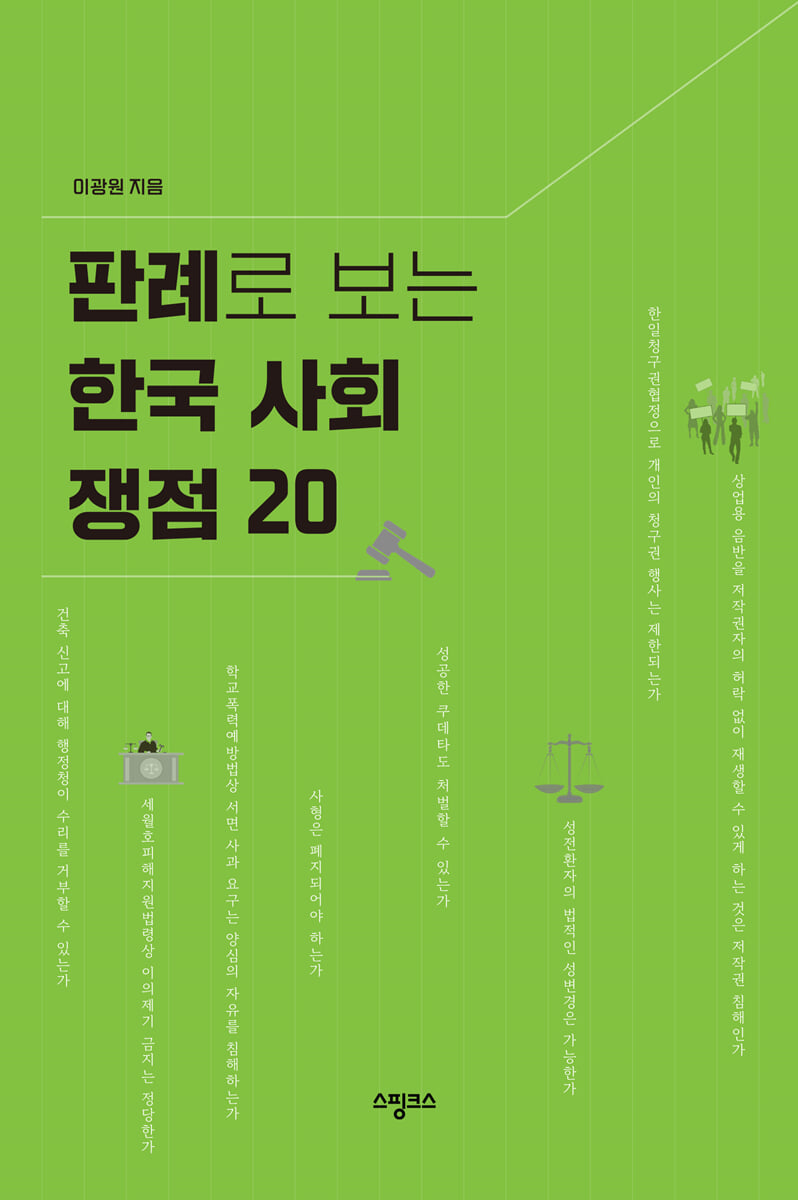
20 Korean Social Issues Seen Through Case Law
 |
Description
Book Introduction
South Korea, still a hotly debated country
In each case, the Supreme Court and the Constitutional Court
How did you decide?
This book introduces case law related to controversial topics in our society.
For example, the case of the 12/12 military coup, ‘Can a successful coup be punished?’ (Supreme Court, April 17, 1997)
96 degrees 3376 total)', and 'Is it customary constitution that the capital is Seoul?' (Constitutional Court 2004.10.21.) on the issue of relocation of the capital to Seoul.
Twenty cases, ten each from the Supreme Court and the Constitutional Court, were selected, including ‘2004 Heonma 554’, and background explanations, commentaries, and majority and dissenting opinions of the judges were included.
Precedent means 'an example decided by a court', and the Supreme Court and the Constitutional Court are institutions that deal with very important disputes in our society.
Therefore, not only legal issues but also political, social and cultural issues are addressed.
If we look at case law, we can see that most controversial issues in our society have been decided by the judiciary.
On the positive side, it can be seen as the realization of the rule of law in that social disputes are ultimately resolved according to the law. On the negative side, it can be seen as a reflection of the divisions in our society in that social issues are not resolved through autonomous discussion and compromise within civil society, but are forcibly resolved through the judiciary.
Among the rulings, the precedents produced by the Supreme Court and the Constitutional Court, the highest courts in our country, show with dignity and refinement the process by which the best intellectuals fiercely contemplate, debate, and argue on the issues that are controversial in our society.
The development of the text is very logical, so it cannot be denied that it has an educational effect in terms of current affairs and writing.
I hope this book will serve as a welcome gesture, providing an opportunity for us to organize our thoughts and reflect more calmly on ourselves in our society, which is still a hotly debated topic.
In each case, the Supreme Court and the Constitutional Court
How did you decide?
This book introduces case law related to controversial topics in our society.
For example, the case of the 12/12 military coup, ‘Can a successful coup be punished?’ (Supreme Court, April 17, 1997)
96 degrees 3376 total)', and 'Is it customary constitution that the capital is Seoul?' (Constitutional Court 2004.10.21.) on the issue of relocation of the capital to Seoul.
Twenty cases, ten each from the Supreme Court and the Constitutional Court, were selected, including ‘2004 Heonma 554’, and background explanations, commentaries, and majority and dissenting opinions of the judges were included.
Precedent means 'an example decided by a court', and the Supreme Court and the Constitutional Court are institutions that deal with very important disputes in our society.
Therefore, not only legal issues but also political, social and cultural issues are addressed.
If we look at case law, we can see that most controversial issues in our society have been decided by the judiciary.
On the positive side, it can be seen as the realization of the rule of law in that social disputes are ultimately resolved according to the law. On the negative side, it can be seen as a reflection of the divisions in our society in that social issues are not resolved through autonomous discussion and compromise within civil society, but are forcibly resolved through the judiciary.
Among the rulings, the precedents produced by the Supreme Court and the Constitutional Court, the highest courts in our country, show with dignity and refinement the process by which the best intellectuals fiercely contemplate, debate, and argue on the issues that are controversial in our society.
The development of the text is very logical, so it cannot be denied that it has an educational effect in terms of current affairs and writing.
I hope this book will serve as a welcome gesture, providing an opportunity for us to organize our thoughts and reflect more calmly on ourselves in our society, which is still a hotly debated topic.
index
At the beginning of the book
Chapter 1: What is Precedent?
1.
Democracy and Separation of Powers
2.
Legal Disputes and the Judiciary
3.
Significance of precedent
Chapter 2 Supreme Court Case Law
1.
Can a successful coup be punished?
2.
Is legal gender change possible for transgender people?
3.
Can the administrative agency refuse to repair a building upon a building report?
4.
Can parents also be kidnappers?
5.
Does the Korea-Japan Claims Settlement Agreement restrict individuals' right to exercise their claims?
6.
Should it be permitted to refuse military service for reasons of conscience?
7.
Can posting a link also be considered copyright infringement?
8.
Can a grandfather adopt his grandchild?
9.
Are statutory ground rents still valid under customary law?
10.
If all of the testator's children renounce their inheritance, does the spouse become the sole heir?
Chapter 3 Constitutional Court Case Law
1.
Does the pledge of obedience to the law violate freedom of conscience?
2.
Is it customary constitutional law that the capital is Seoul?
3.
Should the death penalty be abolished?
4.
Is it right for only men to go to the military?
5.
Is the prohibition on raising objections under the Sewol Ferry Disaster Relief Act justified?
6.
Does the police filming of protesters violate the freedom of assembly?
7.
Is it copyright infringement to allow the reproduction of commercial recordings without the copyright holder's permission?
8.
Does the requirement for a written apology under the School Violence Prevention Act violate freedom of conscience?
9.
Does setting a specific day of the week for the exam violate religious freedom?
10.
Does banning the distribution of leaflets to North Korea violate freedom of expression?
In closing
Chapter 1: What is Precedent?
1.
Democracy and Separation of Powers
2.
Legal Disputes and the Judiciary
3.
Significance of precedent
Chapter 2 Supreme Court Case Law
1.
Can a successful coup be punished?
2.
Is legal gender change possible for transgender people?
3.
Can the administrative agency refuse to repair a building upon a building report?
4.
Can parents also be kidnappers?
5.
Does the Korea-Japan Claims Settlement Agreement restrict individuals' right to exercise their claims?
6.
Should it be permitted to refuse military service for reasons of conscience?
7.
Can posting a link also be considered copyright infringement?
8.
Can a grandfather adopt his grandchild?
9.
Are statutory ground rents still valid under customary law?
10.
If all of the testator's children renounce their inheritance, does the spouse become the sole heir?
Chapter 3 Constitutional Court Case Law
1.
Does the pledge of obedience to the law violate freedom of conscience?
2.
Is it customary constitutional law that the capital is Seoul?
3.
Should the death penalty be abolished?
4.
Is it right for only men to go to the military?
5.
Is the prohibition on raising objections under the Sewol Ferry Disaster Relief Act justified?
6.
Does the police filming of protesters violate the freedom of assembly?
7.
Is it copyright infringement to allow the reproduction of commercial recordings without the copyright holder's permission?
8.
Does the requirement for a written apology under the School Violence Prevention Act violate freedom of conscience?
9.
Does setting a specific day of the week for the exam violate religious freedom?
10.
Does banning the distribution of leaflets to North Korea violate freedom of expression?
In closing
Into the book
The film "Spring in Seoul," released on November 22, 2023, is about the December 12 military coup and was a huge box office success, attracting over 10 million viewers.
This film is based on the incident on December 12, 1979, when the new military government, led by the military's secret organization, Hanahoe, including Chun Doo-hwan and Roh Tae-woo, illegally arrested Army Chief of Staff Jeong Seung-hwa, the martial law commander.
The movie ends with the new military junta led by Chun Doo-hwan succeeding in the coup, but the historical record ends with the coup's main perpetrators, including Chun Doo-hwan and Roh Tae-woo, being punished for treason by the judiciary.
This case is a ruling that punished the new military junta, including Chun Doo-hwan and Roh Tae-woo, who staged the December 12 military coup, for treason.
---From "Can a successful coup be punished?"
In this case, the question arose as to whether legal surnames could be changed through the family register correction procedure stipulated in Article 120 of the Family Register Act, in a situation where there is no system in place to allow legal surnames determined by biological sex to be changed in accordance with subsequent changes in social surnames.
The majority opinion of the Supreme Court was that a change of surname could be permitted through the family register correction procedure under Article 120 of the Family Register Act, while the dissenting opinion of two justices took the position that it could not be permitted.
---From "Is it possible for a transgender person to legally change their gender?"
Recently, as the number of multicultural families has increased, there have been frequent cases of children born between Korean men and foreign women being taken to their own homes or to their parents' homes by foreign women, and this has become a social issue.
Whether this act constitutes kidnapping will depend on whether the intent of the perpetrator is considered, whether it is viewed from the perspective of the rights of the party whose custody rights are excluded, or whether it is viewed from the perspective of the child's education or other welfare.
This precedent is a ruling in a criminal appeal case handed down by the Supreme Court on June 20, 2013.
The facts of this case are as follows.
---From "Can Parents Be Kidnappers?"
The right of individual citizens of the Republic of Korea (then Joseon) who suffered damages due to forced mobilization (or forced labor) during the Japanese colonial period to claim compensation remains a long-standing issue in Korea-Japan relations.
1945.
8. 15.
The 48 Allied nations and Japan in 1951.
9. 8.
In order to resolve the issue of postwar compensation, the San Francisco Peace Treaty (hereinafter referred to as the "San Francisco Treaty") was signed, and the treaty was signed in 1952.
4. 28.
It has been fermented.
Article 4(a) of the Treaty of San Francisco stipulates that the property claims and debts between the municipal authorities and their nationals in the areas separating from Japanese rule and Japan and its nationals shall be handled by special agreements between the said authorities and Japan, and Article 4(b) stipulates that Japan recognizes as valid the disposal of property of Japan and its nationals by the USAMGIK authorities in the said areas.
This film is based on the incident on December 12, 1979, when the new military government, led by the military's secret organization, Hanahoe, including Chun Doo-hwan and Roh Tae-woo, illegally arrested Army Chief of Staff Jeong Seung-hwa, the martial law commander.
The movie ends with the new military junta led by Chun Doo-hwan succeeding in the coup, but the historical record ends with the coup's main perpetrators, including Chun Doo-hwan and Roh Tae-woo, being punished for treason by the judiciary.
This case is a ruling that punished the new military junta, including Chun Doo-hwan and Roh Tae-woo, who staged the December 12 military coup, for treason.
---From "Can a successful coup be punished?"
In this case, the question arose as to whether legal surnames could be changed through the family register correction procedure stipulated in Article 120 of the Family Register Act, in a situation where there is no system in place to allow legal surnames determined by biological sex to be changed in accordance with subsequent changes in social surnames.
The majority opinion of the Supreme Court was that a change of surname could be permitted through the family register correction procedure under Article 120 of the Family Register Act, while the dissenting opinion of two justices took the position that it could not be permitted.
---From "Is it possible for a transgender person to legally change their gender?"
Recently, as the number of multicultural families has increased, there have been frequent cases of children born between Korean men and foreign women being taken to their own homes or to their parents' homes by foreign women, and this has become a social issue.
Whether this act constitutes kidnapping will depend on whether the intent of the perpetrator is considered, whether it is viewed from the perspective of the rights of the party whose custody rights are excluded, or whether it is viewed from the perspective of the child's education or other welfare.
This precedent is a ruling in a criminal appeal case handed down by the Supreme Court on June 20, 2013.
The facts of this case are as follows.
---From "Can Parents Be Kidnappers?"
The right of individual citizens of the Republic of Korea (then Joseon) who suffered damages due to forced mobilization (or forced labor) during the Japanese colonial period to claim compensation remains a long-standing issue in Korea-Japan relations.
1945.
8. 15.
The 48 Allied nations and Japan in 1951.
9. 8.
In order to resolve the issue of postwar compensation, the San Francisco Peace Treaty (hereinafter referred to as the "San Francisco Treaty") was signed, and the treaty was signed in 1952.
4. 28.
It has been fermented.
Article 4(a) of the Treaty of San Francisco stipulates that the property claims and debts between the municipal authorities and their nationals in the areas separating from Japanese rule and Japan and its nationals shall be handled by special agreements between the said authorities and Japan, and Article 4(b) stipulates that Japan recognizes as valid the disposal of property of Japan and its nationals by the USAMGIK authorities in the said areas.
---From "Is the Korea-Japan Claims Settlement Agreement Restricting Individual Claims?"
GOODS SPECIFICS
- Date of issue: June 27, 2024
- Page count, weight, size: 240 pages | 618g | 140*210*15mm
- ISBN13: 9791190966108
- ISBN10: 1190966107
You may also like
카테고리
korean


korean

![GQ KOREA Mark (Monthly): December [2025]](http://librairie.coreenne.fr/cdn/shop/files/8ef265dbbfbf186523ed75ba7319009d.jpg?v=1765340328&width=3840)


