

Hacking the CSAT
 |
Description
Book Introduction
The college entrance exam has been reduced to a puzzle
The deformedly evolved technicians of private education
Moving the 'college entrance exam' in Korea
The formula for hacking the CSAT is revealed in detail!
The killer question issue, the medical school quota issue, the controversy over repeat students... Is there any topic that heats up and shakes our society as much as the CSAT?
Because it is an exam that determines a person's entire life, including their lifetime income and interpersonal relationships, it seems that society's obsession with the CSAT will not subside easily in the future.
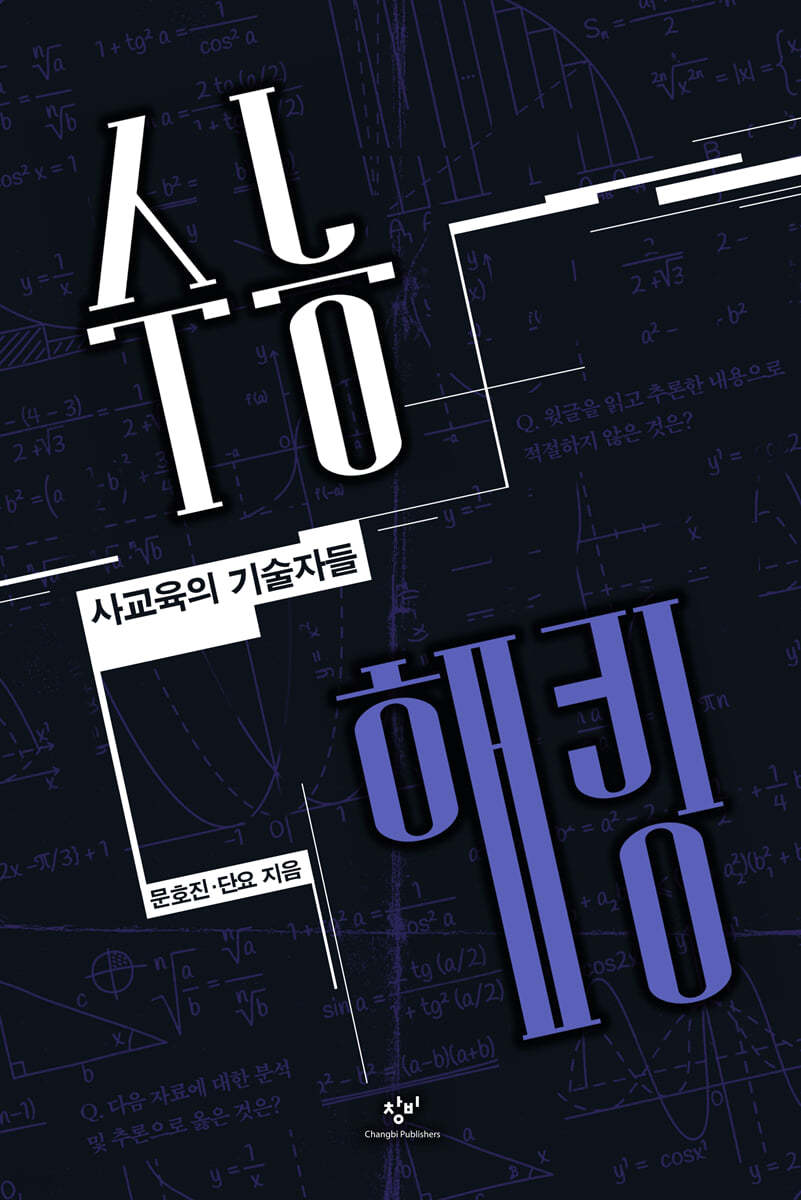
The book "Hacking the College Scholastic Ability Test: The Technicians of Private Education" has been published, dispelling the demonization and "over-immersion" attached to this test and revealing the true nature of the college entrance exam situation in 2024.
This impressive book, which contains extensive interviews and data from numerous students, teachers, and current and former private education workers, carefully examines the bizarre and seriously distorted nature of the current CSAT, based on the vivid experiences and reporting of Moon Ho-jin, a practicing doctor and activist, and novelist Dan Yo, who have observed and witnessed the private education field.
This book is simply shocking, as it reveals, one by one, that today's test-takers live in a world completely different from what the older generation assumed, and persistently "hacks" into what is happening in the so-called "college entrance exam world."
The authors point out that the turmoil in the CSAT is connected to problems throughout Korean society, and emphasize that education, and by extension, our society and its future, depend more than anything on what we must do to change the CSAT.
The deformedly evolved technicians of private education
Moving the 'college entrance exam' in Korea
The formula for hacking the CSAT is revealed in detail!
The killer question issue, the medical school quota issue, the controversy over repeat students... Is there any topic that heats up and shakes our society as much as the CSAT?
Because it is an exam that determines a person's entire life, including their lifetime income and interpersonal relationships, it seems that society's obsession with the CSAT will not subside easily in the future.
The book "Hacking the College Scholastic Ability Test: The Technicians of Private Education" has been published, dispelling the demonization and "over-immersion" attached to this test and revealing the true nature of the college entrance exam situation in 2024.
This impressive book, which contains extensive interviews and data from numerous students, teachers, and current and former private education workers, carefully examines the bizarre and seriously distorted nature of the current CSAT, based on the vivid experiences and reporting of Moon Ho-jin, a practicing doctor and activist, and novelist Dan Yo, who have observed and witnessed the private education field.
This book is simply shocking, as it reveals, one by one, that today's test-takers live in a world completely different from what the older generation assumed, and persistently "hacks" into what is happening in the so-called "college entrance exam world."
The authors point out that the turmoil in the CSAT is connected to problems throughout Korean society, and emphasize that education, and by extension, our society and its future, depend more than anything on what we must do to change the CSAT.
index
introduction
Part 1: Hacking the CSAT: The CSAT Has Become an Anti-Educational Test
Chapter 1: The College Scholastic Ability Test
Chapter 2: The Puzzle of the College Scholastic Ability Test
Chapter 3: The Black Comedy of the College Scholastic Ability Test
Chapter 4: There is no easy way
interlude
Part 2: The Perceptual Shift in Private Education: The Emergence of Test-Taker Communities and the Coevolution of Private Education
Chapter 1: The Dichotomy of Author and Instructor
Chapter 2: Play Culture and Perceptual Change
Part 3: A Tectonic Shift in the Entrance Exam Landscape: The Consequences of the Universalization of Online Lectures and the Expansion of Rolling Admissions
Chapter 1: The Illusion That Online Lectures Resolved the Gap
Chapter 2: "Monkey Shoes" and the Red Queen
Chapter 3: Who is responsible?
Part 4: The Emotions of Private Education: Desire and Anger
Chapter 1: The Problem of Calculation and Aspiration
Chapter 2: A Community of Desire and Anger
Chapter 3 To break the chain
Part 5: Hacking the College Entrance Exam: Compromise in Public Education and the Self-Centeredness of Universities
Chapter 1: Don't Run Away from School
Chapter 2: University Autonomy and Cost Passing
Part 6: Finally, Education Again: The Tie-Up and the Remaining Words
In closing the book
Part 1: Hacking the CSAT: The CSAT Has Become an Anti-Educational Test
Chapter 1: The College Scholastic Ability Test
Chapter 2: The Puzzle of the College Scholastic Ability Test
Chapter 3: The Black Comedy of the College Scholastic Ability Test
Chapter 4: There is no easy way
interlude
Part 2: The Perceptual Shift in Private Education: The Emergence of Test-Taker Communities and the Coevolution of Private Education
Chapter 1: The Dichotomy of Author and Instructor
Chapter 2: Play Culture and Perceptual Change
Part 3: A Tectonic Shift in the Entrance Exam Landscape: The Consequences of the Universalization of Online Lectures and the Expansion of Rolling Admissions
Chapter 1: The Illusion That Online Lectures Resolved the Gap
Chapter 2: "Monkey Shoes" and the Red Queen
Chapter 3: Who is responsible?
Part 4: The Emotions of Private Education: Desire and Anger
Chapter 1: The Problem of Calculation and Aspiration
Chapter 2: A Community of Desire and Anger
Chapter 3 To break the chain
Part 5: Hacking the College Entrance Exam: Compromise in Public Education and the Self-Centeredness of Universities
Chapter 1: Don't Run Away from School
Chapter 2: University Autonomy and Cost Passing
Part 6: Finally, Education Again: The Tie-Up and the Remaining Words
In closing the book
Detailed image

Into the book
To solve education problems, we need to look into how the private education market operates, how private education interacts with public education, and what influence it has had on education policy and the College Scholastic Ability Test (CSAT).
(…) This book attempts to escape the errors of demonization and mystification and to capture the reality of private education, and furthermore, the reality of the college entrance exam.
(…) It closely describes the operating principles of the College Scholastic Ability Test and private education, and illuminates the ways in which private education, public education, and the system interact.
It also argues how and to what extent the current college entrance exam has been distorted.
And through this, we draw the total picture of Korean education and society.
---From the "Preface"
The medications used to treat ADHD naturally induce a state of high concentration, which is why they are often sold secretly as "study drugs."
The number of ADHD medication prescriptions in Songpa-gu and Gangnam-gu has increased by about 2.5 times in the past five years.
Looking at it on a yearly basis, it starts to increase from September and then decreases again in late November.
This is a meaningful pattern considering that the CSAT is administered in early to mid-November every year.
Meanwhile, we often hear stories about medical school information sessions for children, or about fortune telling services that teach students how to answer science inquiry questions.
The reason we can't just dismiss it as a ghost story or a joke is because we really do live in a world where that could happen.
--- p.6
Contrary to popular belief, solving this problem does not require any special intellectual ability or background knowledge.
You don't even need to know the philosophical meaning of absolute spirit or thesis, antithesis, and synthesis.
Even if you don't understand the fingerprint itself, you can solve the problem if you can just discern the shape of the letters.
--- p.12
In the end, the CSAT is just a tool.
It is a tool that can be helpful if used well, and detrimental if used poorly.
It's time to put aside the illusions and look at reality.
--- p.35
Ultimately, this type of test not only lacks education, but also has no ability to verify abilities, and in some ways, it is even harmful.
--- p.99
1) When (3523.3/x)*327.4+552=2059.88, find the value of x without a calculator.
2) Hume argued that inductive reasoning about the future is circular and therefore cannot be logically justified.
At this time, infer what premises are implied in inductive reasoning about the future, and explain why it is a circular argument.
The above two problems are tricky.
But it's not exactly tricky in the same way.
Question 1 asks about knowledge within the elementary school curriculum, but its format would likely annoy even a math professor.
On the other hand, question 2 asks about the philosophy of science at the undergraduate level, but if you have knowledge in the field, you can finish the explanation in three sentences.
(…) Then, what branch does the current CSAT fall into?
As we have seen repeatedly in Chapters 2 and 3, it is the former.
--- p.113
The evaluation agency uses complex puzzle-style questions as a tool to control the score distribution.
If you only focus on the grade cutoff line, it may seem like the CSAT is somewhere between "weakly difficult" and "moderately difficult." However, if you take away the puzzle and look at the knowledge and logic behind it, it turns out to be an incredibly easy CSAT.
In other words, the current college entrance exam may be an ‘impossible college entrance exam,’ but it cannot be a ‘difficult college entrance exam.’
--- p.113~14
Just as iron filings align according to the magnetic field when a magnet is applied, the national academy district has been reorganized based on the influence of Daechi-dong.
--- p.204
When we synthesize these data, it becomes clear that attempts to explain Gangnam's hegemony with crude genetic theories like "Gangnam parents are professionals, so their children are good at studying" are based on preconceived notions and are faulty storytelling.
(Even taking into account the population outflow due to the concentration of population in Seoul) it is unlikely that the population composition of each region would have changed so drastically in just 10 years.
The key differences lie in the level of regional educational infrastructure, the presence or absence of an entrance exam information community, and the extent to which private education has become more sophisticated.
--- p.211~12
In rural areas, there are no academies that prepare students for the regular admissions exam, no local communities that share know-how on the regular admissions exam, and no awareness of the content of the CSAT.
--- p.215
Therefore, when discussing the incompetence of public education, we should not hold individual teachers accountable.
Even if there are indeed negligent teachers, extending that case to the entire class does nothing to improve the situation.
However, it is worth noting that this apathy not only leads public education to chaos, but also decisively strengthens students' reliance on private education.
--- p.229
At this point, where the line between consumer and provider blurs, academies and communities function as two-way platforms, consuming all participants except themselves.
--- p.285
The new community of test-takers is fundamentally closely related to the culturalization of studying.
(…) Most of them have never experienced a life outside of studying, and they are all crushed by competitive pressure and stress.
There is also a great deal of anxiety about failure.
Because they are anxious, they forget all other options besides studying, and the more anxious they are, the more they trust and follow private tutors.
(…) Ultimately, a culture dominated by simple, peripheral emotions, centered around anxiety and anger, dominates the student community, which is also another aspect of aspiration.
--- p.334~37
The collective desire for academic achievement is imbued with fear.
It is a fear of survival, that if you do not obtain sufficient education, you will be pushed to the margins of this society and die.
This feeling is not only a reality of the 2020s, but also deeply rooted in Korea's modern and contemporary history.
--- p.460
While Korea has undoubtedly come this far through the power of fear and anxiety, it is also true that the internal contradictions of that driving force are what are ultimately destroying Korea.
The total birth rate, which has fallen to 0.7, and the percentage of repeat college entrance exam takers approaching 40% are representative evidence of the record-high private education spending.
It is time to comprehensively reexamine who we teach, for what purpose, and how we teach, and to establish concrete alternatives.
(…) This book attempts to escape the errors of demonization and mystification and to capture the reality of private education, and furthermore, the reality of the college entrance exam.
(…) It closely describes the operating principles of the College Scholastic Ability Test and private education, and illuminates the ways in which private education, public education, and the system interact.
It also argues how and to what extent the current college entrance exam has been distorted.
And through this, we draw the total picture of Korean education and society.
---From the "Preface"
The medications used to treat ADHD naturally induce a state of high concentration, which is why they are often sold secretly as "study drugs."
The number of ADHD medication prescriptions in Songpa-gu and Gangnam-gu has increased by about 2.5 times in the past five years.
Looking at it on a yearly basis, it starts to increase from September and then decreases again in late November.
This is a meaningful pattern considering that the CSAT is administered in early to mid-November every year.
Meanwhile, we often hear stories about medical school information sessions for children, or about fortune telling services that teach students how to answer science inquiry questions.
The reason we can't just dismiss it as a ghost story or a joke is because we really do live in a world where that could happen.
--- p.6
Contrary to popular belief, solving this problem does not require any special intellectual ability or background knowledge.
You don't even need to know the philosophical meaning of absolute spirit or thesis, antithesis, and synthesis.
Even if you don't understand the fingerprint itself, you can solve the problem if you can just discern the shape of the letters.
--- p.12
In the end, the CSAT is just a tool.
It is a tool that can be helpful if used well, and detrimental if used poorly.
It's time to put aside the illusions and look at reality.
--- p.35
Ultimately, this type of test not only lacks education, but also has no ability to verify abilities, and in some ways, it is even harmful.
--- p.99
1) When (3523.3/x)*327.4+552=2059.88, find the value of x without a calculator.
2) Hume argued that inductive reasoning about the future is circular and therefore cannot be logically justified.
At this time, infer what premises are implied in inductive reasoning about the future, and explain why it is a circular argument.
The above two problems are tricky.
But it's not exactly tricky in the same way.
Question 1 asks about knowledge within the elementary school curriculum, but its format would likely annoy even a math professor.
On the other hand, question 2 asks about the philosophy of science at the undergraduate level, but if you have knowledge in the field, you can finish the explanation in three sentences.
(…) Then, what branch does the current CSAT fall into?
As we have seen repeatedly in Chapters 2 and 3, it is the former.
--- p.113
The evaluation agency uses complex puzzle-style questions as a tool to control the score distribution.
If you only focus on the grade cutoff line, it may seem like the CSAT is somewhere between "weakly difficult" and "moderately difficult." However, if you take away the puzzle and look at the knowledge and logic behind it, it turns out to be an incredibly easy CSAT.
In other words, the current college entrance exam may be an ‘impossible college entrance exam,’ but it cannot be a ‘difficult college entrance exam.’
--- p.113~14
Just as iron filings align according to the magnetic field when a magnet is applied, the national academy district has been reorganized based on the influence of Daechi-dong.
--- p.204
When we synthesize these data, it becomes clear that attempts to explain Gangnam's hegemony with crude genetic theories like "Gangnam parents are professionals, so their children are good at studying" are based on preconceived notions and are faulty storytelling.
(Even taking into account the population outflow due to the concentration of population in Seoul) it is unlikely that the population composition of each region would have changed so drastically in just 10 years.
The key differences lie in the level of regional educational infrastructure, the presence or absence of an entrance exam information community, and the extent to which private education has become more sophisticated.
--- p.211~12
In rural areas, there are no academies that prepare students for the regular admissions exam, no local communities that share know-how on the regular admissions exam, and no awareness of the content of the CSAT.
--- p.215
Therefore, when discussing the incompetence of public education, we should not hold individual teachers accountable.
Even if there are indeed negligent teachers, extending that case to the entire class does nothing to improve the situation.
However, it is worth noting that this apathy not only leads public education to chaos, but also decisively strengthens students' reliance on private education.
--- p.229
At this point, where the line between consumer and provider blurs, academies and communities function as two-way platforms, consuming all participants except themselves.
--- p.285
The new community of test-takers is fundamentally closely related to the culturalization of studying.
(…) Most of them have never experienced a life outside of studying, and they are all crushed by competitive pressure and stress.
There is also a great deal of anxiety about failure.
Because they are anxious, they forget all other options besides studying, and the more anxious they are, the more they trust and follow private tutors.
(…) Ultimately, a culture dominated by simple, peripheral emotions, centered around anxiety and anger, dominates the student community, which is also another aspect of aspiration.
--- p.334~37
The collective desire for academic achievement is imbued with fear.
It is a fear of survival, that if you do not obtain sufficient education, you will be pushed to the margins of this society and die.
This feeling is not only a reality of the 2020s, but also deeply rooted in Korea's modern and contemporary history.
--- p.460
While Korea has undoubtedly come this far through the power of fear and anxiety, it is also true that the internal contradictions of that driving force are what are ultimately destroying Korea.
The total birth rate, which has fallen to 0.7, and the percentage of repeat college entrance exam takers approaching 40% are representative evidence of the record-high private education spending.
It is time to comprehensively reexamine who we teach, for what purpose, and how we teach, and to establish concrete alternatives.
--- p.496~97
Publisher's Review
The current college entrance exam is anti-educational!
Puzzle-style solving and outsourcing of thinking
Few people would strongly disagree with the two authors who call the CSAT a “black comedy.”
This is because they are aware of the harmful effects of the CSAT, which is a test for lining up students for college entrance exams, far removed from true education, with its standardized patterns, rote memorization knowledge, and special techniques solely for problem solving.
But how much do we really know about the gravity of this situation? Through the interplay between the evaluation institute and the private education market, the CSAT has been distorted in a far more bizarre and distorted way than in the past.
To avoid nationwide criticism for failing to adjust the level of difficulty, the evaluation institute's exam questions became increasingly difficult and, at the same time, failed to avoid becoming entrenched. Private education took advantage of this gap and began mass-producing various techniques, such as so-called "puzzle thinking" and "outsourcing of thinking."
As a result, no matter how much you study, it is impossible to get a high score on the CSAT without receiving private tutoring, and the minimum learning ability verification that the CSAT used to perform has long since become meaningless.
For example, the correct answer rate for the 2022 College Scholastic Ability Test Korean language passage titled "Hegel's Aesthetics," which was reported in the media several times for being so difficult that even majors expressed difficulty, surprisingly reached 45%, nearly half of the test takers.
Even if you don't know the 'absolute spirit' or the 'philosophical meaning of thesis, antithesis, and synthesis', or even understand the text itself, you can solve the problem by properly exercising your trained skills.
The process of explaining in detail the process of solving actual past exam questions and proving it right before your eyes is shocking, beyond surprising.
The authors point out that the technology for hacking the CSAT has advanced by leaps and bounds over the past decade, leading to a sharp increase in students' reliance on private tutoring.
The reality that you can't do well on exams without learning this useless skill is problematic, but even if you score high on the current CSAT and get into a popular university, you'll just end up being a student who "asks the professor for the answer sheet."
This is why the authors assert that the CSAT has degenerated into an anti-educational test.
The educational privileged class, shrouded in aspiration and anger
The result of endless N-study and private education
Kim Dong-chun, author of “Testing Ability,” said in his recommendation of the book that it is “more vivid and concrete than any other book that has so far criticized Korean education,” and that it reminds us that “current test takers and students are living in a completely different world from the one that the general public, education scholars, and policy makers know about.”
As the mechanics of the CSAT became impossible to understand without the hacking techniques of private education, the CSAT became a sort of "cult" and became a major culture among test-takers.
The central roles within it are played by the test-taker community and large entrance exam prep schools, including a specific academy in Gangnam.
Students who are unable to achieve high grades without private education are influenced by communities that promote medical school preference and retaking the exam multiple times, so they easily decide to retake the exam multiple times, shouting "one more time" and ultimately becoming unable to escape the CSAT and the private education market.
The analysis in "Hacking the College Scholastic Ability Test" shows that the degree of "over-immersion" in the exam is on a different level than in the past, and that rather than considering the college entrance exam as a stage in life, the college entrance exam itself has become one's identity.
The actual number of repeat test takers has been increasing, reaching 35.2% of test takers in 2024.
The worsening educational gap is also pointed out as a problem.
According to the results of the survey on the ratio of student grades by city and province, officially announced by the Evaluation Institute every year, the ratio of Seoul/non-Seoul students who received the highest grade in math on the College Scholastic Ability Test (CSAT) reached 3:1, and the ratio of Seoul/non-Seoul students who received the highest grade in Korean, where the theory of "uselessness of private education" was dominant in the past, also exceeded 2:1.
Considering that nearly 50% of recent medical school admissions are from a specific academy in Gangnam, the gap becomes even wider for students with extremely high CSAT scores.
This gap, which has become noticeably wider since the mid-to-late 2010s, as the CSAT exam questions became increasingly difficult and the private education market was reorganized and sophisticated, suggests that private CSAT education is a benefit only available to those in certain regional and socioeconomic positions.
The authors say they cannot easily hide their concerns about the human race created by the current college entrance exam and the private education industry.
It is difficult to be optimistic about whether those who have been focusing on the CSAT and honing their hacking skills within their own world, centered around those who can afford private education, will be able to play a healthy role in society.
"Hacking the College Scholastic Ability Test" meticulously argues that the recent evolution of the College Scholastic Ability Test (CSAT) is not only inherently harmful, but also a problematic phenomenon that has a fatal negative impact on the private education and public education systems, and even the future of our society.
The first full-scale exploration of the 'CSAT'
Accurate and clear diagnosis from a doctor and novelist
Author Moon Ho-jin, a practicing physician who also co-authored a mock college entrance exam, said he began to notice the negative impact of the absurdity and inequality created by the college entrance exam on other areas of society, and that he became concerned about the phenomenon of medical school entrance exams becoming a channel for the inheritance of wealth and the reproduction of class.
Danyo, a science fiction novelist who keenly captures aspects of reality through fictional stories with a bizarre imagination, also participated in this reportage project, drawing on his experience in the field of creating numerous non-literature questions for the Korean language private mock exam and his interest in social functioning and the distribution of power and resources.
The two authors' expertise is reflected in extensive and vivid interviews and meticulous analysis with current and former private education professionals, including test-takers, repeat test takers, academy instructors, and teaching assistants.
Above all, no other book has examined the entire Korean education system so thoroughly, starting with the single keyword of the College Scholastic Ability Test (CSAT).
"Hacking the College Scholastic Ability Test" meticulously examines the corruption of the College Scholastic Ability Test (CSAT), the private education technology that has followed suit, and the reality of public education that has helplessly neglected it. It raises questions about the CSAT and the education system, and then seriously considers solutions.
The two authors argue that the education system can only function properly when resources are distributed fairly, illusions are dispelled, and transparency and democracy are guaranteed. They believe that change can begin in all processes, above all else, by incorporating voices from the field and reorganizing public institutions and systems to transform the CSAT from its current state.
With private education costs reaching record highs and the number of repeat exam repeaters soaring, it's time to consider new study methods that will take charge of our society's future, starting with "Hacking the College Scholastic Ability Test" before it's too late.
Puzzle-style solving and outsourcing of thinking
Few people would strongly disagree with the two authors who call the CSAT a “black comedy.”
This is because they are aware of the harmful effects of the CSAT, which is a test for lining up students for college entrance exams, far removed from true education, with its standardized patterns, rote memorization knowledge, and special techniques solely for problem solving.
But how much do we really know about the gravity of this situation? Through the interplay between the evaluation institute and the private education market, the CSAT has been distorted in a far more bizarre and distorted way than in the past.
To avoid nationwide criticism for failing to adjust the level of difficulty, the evaluation institute's exam questions became increasingly difficult and, at the same time, failed to avoid becoming entrenched. Private education took advantage of this gap and began mass-producing various techniques, such as so-called "puzzle thinking" and "outsourcing of thinking."
As a result, no matter how much you study, it is impossible to get a high score on the CSAT without receiving private tutoring, and the minimum learning ability verification that the CSAT used to perform has long since become meaningless.
For example, the correct answer rate for the 2022 College Scholastic Ability Test Korean language passage titled "Hegel's Aesthetics," which was reported in the media several times for being so difficult that even majors expressed difficulty, surprisingly reached 45%, nearly half of the test takers.
Even if you don't know the 'absolute spirit' or the 'philosophical meaning of thesis, antithesis, and synthesis', or even understand the text itself, you can solve the problem by properly exercising your trained skills.
The process of explaining in detail the process of solving actual past exam questions and proving it right before your eyes is shocking, beyond surprising.
The authors point out that the technology for hacking the CSAT has advanced by leaps and bounds over the past decade, leading to a sharp increase in students' reliance on private tutoring.
The reality that you can't do well on exams without learning this useless skill is problematic, but even if you score high on the current CSAT and get into a popular university, you'll just end up being a student who "asks the professor for the answer sheet."
This is why the authors assert that the CSAT has degenerated into an anti-educational test.
The educational privileged class, shrouded in aspiration and anger
The result of endless N-study and private education
Kim Dong-chun, author of “Testing Ability,” said in his recommendation of the book that it is “more vivid and concrete than any other book that has so far criticized Korean education,” and that it reminds us that “current test takers and students are living in a completely different world from the one that the general public, education scholars, and policy makers know about.”
As the mechanics of the CSAT became impossible to understand without the hacking techniques of private education, the CSAT became a sort of "cult" and became a major culture among test-takers.
The central roles within it are played by the test-taker community and large entrance exam prep schools, including a specific academy in Gangnam.
Students who are unable to achieve high grades without private education are influenced by communities that promote medical school preference and retaking the exam multiple times, so they easily decide to retake the exam multiple times, shouting "one more time" and ultimately becoming unable to escape the CSAT and the private education market.
The analysis in "Hacking the College Scholastic Ability Test" shows that the degree of "over-immersion" in the exam is on a different level than in the past, and that rather than considering the college entrance exam as a stage in life, the college entrance exam itself has become one's identity.
The actual number of repeat test takers has been increasing, reaching 35.2% of test takers in 2024.
The worsening educational gap is also pointed out as a problem.
According to the results of the survey on the ratio of student grades by city and province, officially announced by the Evaluation Institute every year, the ratio of Seoul/non-Seoul students who received the highest grade in math on the College Scholastic Ability Test (CSAT) reached 3:1, and the ratio of Seoul/non-Seoul students who received the highest grade in Korean, where the theory of "uselessness of private education" was dominant in the past, also exceeded 2:1.
Considering that nearly 50% of recent medical school admissions are from a specific academy in Gangnam, the gap becomes even wider for students with extremely high CSAT scores.
This gap, which has become noticeably wider since the mid-to-late 2010s, as the CSAT exam questions became increasingly difficult and the private education market was reorganized and sophisticated, suggests that private CSAT education is a benefit only available to those in certain regional and socioeconomic positions.
The authors say they cannot easily hide their concerns about the human race created by the current college entrance exam and the private education industry.
It is difficult to be optimistic about whether those who have been focusing on the CSAT and honing their hacking skills within their own world, centered around those who can afford private education, will be able to play a healthy role in society.
"Hacking the College Scholastic Ability Test" meticulously argues that the recent evolution of the College Scholastic Ability Test (CSAT) is not only inherently harmful, but also a problematic phenomenon that has a fatal negative impact on the private education and public education systems, and even the future of our society.
The first full-scale exploration of the 'CSAT'
Accurate and clear diagnosis from a doctor and novelist
Author Moon Ho-jin, a practicing physician who also co-authored a mock college entrance exam, said he began to notice the negative impact of the absurdity and inequality created by the college entrance exam on other areas of society, and that he became concerned about the phenomenon of medical school entrance exams becoming a channel for the inheritance of wealth and the reproduction of class.
Danyo, a science fiction novelist who keenly captures aspects of reality through fictional stories with a bizarre imagination, also participated in this reportage project, drawing on his experience in the field of creating numerous non-literature questions for the Korean language private mock exam and his interest in social functioning and the distribution of power and resources.
The two authors' expertise is reflected in extensive and vivid interviews and meticulous analysis with current and former private education professionals, including test-takers, repeat test takers, academy instructors, and teaching assistants.
Above all, no other book has examined the entire Korean education system so thoroughly, starting with the single keyword of the College Scholastic Ability Test (CSAT).
"Hacking the College Scholastic Ability Test" meticulously examines the corruption of the College Scholastic Ability Test (CSAT), the private education technology that has followed suit, and the reality of public education that has helplessly neglected it. It raises questions about the CSAT and the education system, and then seriously considers solutions.
The two authors argue that the education system can only function properly when resources are distributed fairly, illusions are dispelled, and transparency and democracy are guaranteed. They believe that change can begin in all processes, above all else, by incorporating voices from the field and reorganizing public institutions and systems to transform the CSAT from its current state.
With private education costs reaching record highs and the number of repeat exam repeaters soaring, it's time to consider new study methods that will take charge of our society's future, starting with "Hacking the College Scholastic Ability Test" before it's too late.
GOODS SPECIFICS
- Date of issue: June 24, 2024
- Page count, weight, size: 504 pages | 628g | 140*210*24mm
- ISBN13: 9788936480240
- ISBN10: 8936480243
You may also like
카테고리
korean


korean

![GQ KOREA Mark (Monthly): December [2025]](http://librairie.coreenne.fr/cdn/shop/files/8ef265dbbfbf186523ed75ba7319009d.jpg?v=1765340328&width=3840)


