

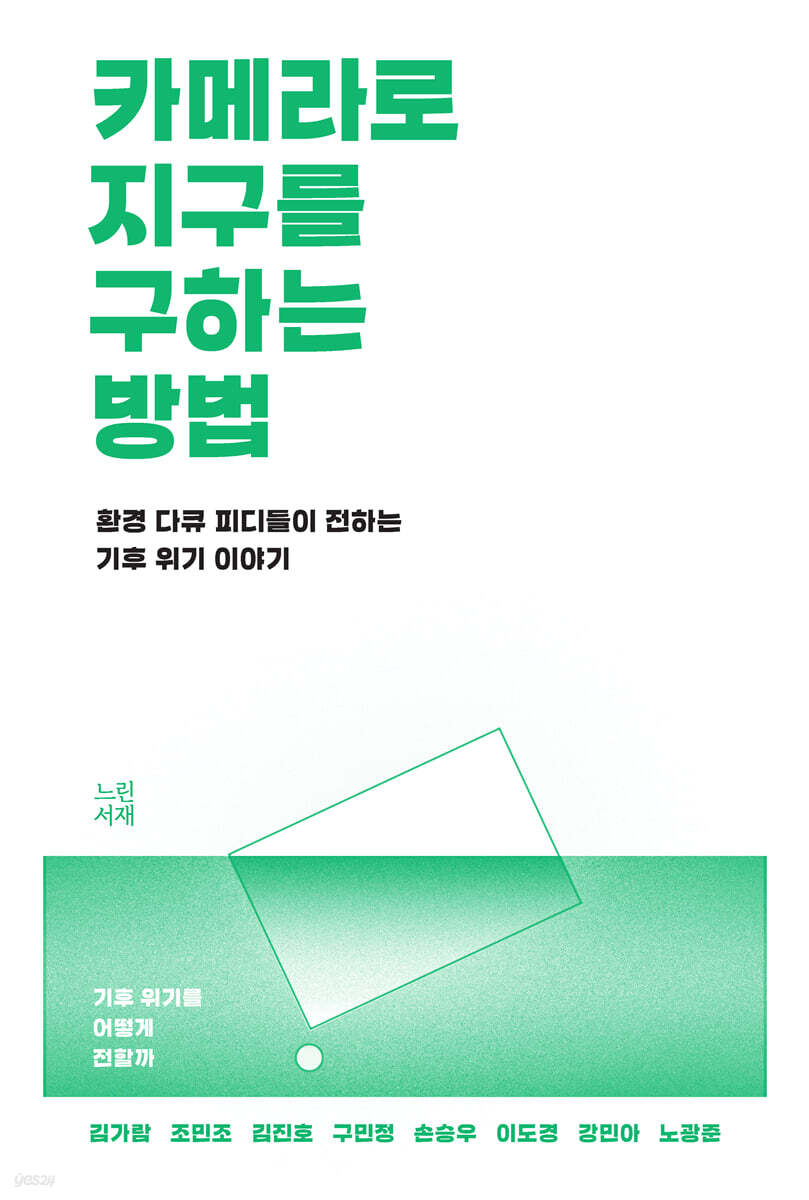
How to Save the Earth with a Camera
 |
Description
Book Introduction
We are facing a 'hot planet' like we've never experienced before.
They say the era of global warming is over.
They say we are now in the era of global warming.
The Earth is very hot.
Warning signals are sounding everywhere.
They say that if we continue to emit carbon in this way, something really big could happen, and that we could face an irreversible tragedy.
Not natural disasters, but human-created ones - record-breaking heat waves, animal extinctions, destruction of the Amazon rainforest, food shortages, the onslaught of microplastics...
In 2019, forests in Australia burned for six months.
About 500 million animals died in the fires.
The forest itself was dry, and there was no rain.
Experts say these wildfires are growing out of control because of global warming.
On one side, there are forest fires, on the other side, heavy snowfall, in our country, many places are suffering from a recycling crisis, and in Antarctica, the glaciers are melting, forcing polar bears to swim for food.
Even starvation occurs.
The unprecedented time we are experiencing, the 'Anthropocene', is driving many animals to extinction.
Moreover, the city and the people living in it are also facing a threat to their survival.
But it's strange.
The Earth is hot, some countries are on the verge of drowning, and we treat this problem as if it's none of our business.
I'm not even that interested.
Really... is it okay to be this indifferent?
If the climate crisis doesn't really affect me, is it okay to just live like this and pretend not to know?
They say the era of global warming is over.
They say we are now in the era of global warming.
The Earth is very hot.
Warning signals are sounding everywhere.
They say that if we continue to emit carbon in this way, something really big could happen, and that we could face an irreversible tragedy.
Not natural disasters, but human-created ones - record-breaking heat waves, animal extinctions, destruction of the Amazon rainforest, food shortages, the onslaught of microplastics...
In 2019, forests in Australia burned for six months.
About 500 million animals died in the fires.
The forest itself was dry, and there was no rain.
Experts say these wildfires are growing out of control because of global warming.
On one side, there are forest fires, on the other side, heavy snowfall, in our country, many places are suffering from a recycling crisis, and in Antarctica, the glaciers are melting, forcing polar bears to swim for food.
Even starvation occurs.
The unprecedented time we are experiencing, the 'Anthropocene', is driving many animals to extinction.
Moreover, the city and the people living in it are also facing a threat to their survival.
But it's strange.
The Earth is hot, some countries are on the verge of drowning, and we treat this problem as if it's none of our business.
I'm not even that interested.
Really... is it okay to be this indifferent?
If the climate crisis doesn't really affect me, is it okay to just live like this and pretend not to know?
- You can preview some of the book's contents.
Preview
index
· Beginning the story, "Edward Scissorhands" and the camera, Kim Jin-ho ·· ······07
Where Do All These Clothes Go? / Kim Garam ·· ······14
· Local PD Opens a Store to Save the Earth / Jo Min-jo ·· ······48
· What on earth have you been doing all this time? / Kim Jin-ho ·· ······82
· Selling the Climate Crisis / Gu Min-jeong ·· ······122
Connecting with the Ignored in Nature / Seungwoo Son ·· ······150
If We Live Simply and Wisely / Lee Do-kyung ·· ······180
· I hope it wasn't a storm in a teacup / Kang Min-ah ·· ······208
· Production Log for "Today's Climate," a drumbeat that resonates with the listener / Noh Gwang-jun … 230
· Concluding the Story: Why I Spread the Environmental Nagging / Kim Garam ······268
Where Do All These Clothes Go? / Kim Garam ·· ······14
· Local PD Opens a Store to Save the Earth / Jo Min-jo ·· ······48
· What on earth have you been doing all this time? / Kim Jin-ho ·· ······82
· Selling the Climate Crisis / Gu Min-jeong ·· ······122
Connecting with the Ignored in Nature / Seungwoo Son ·· ······150
If We Live Simply and Wisely / Lee Do-kyung ·· ······180
· I hope it wasn't a storm in a teacup / Kang Min-ah ·· ······208
· Production Log for "Today's Climate," a drumbeat that resonates with the listener / Noh Gwang-jun … 230
· Concluding the Story: Why I Spread the Environmental Nagging / Kim Garam ······268
Detailed image
Into the book
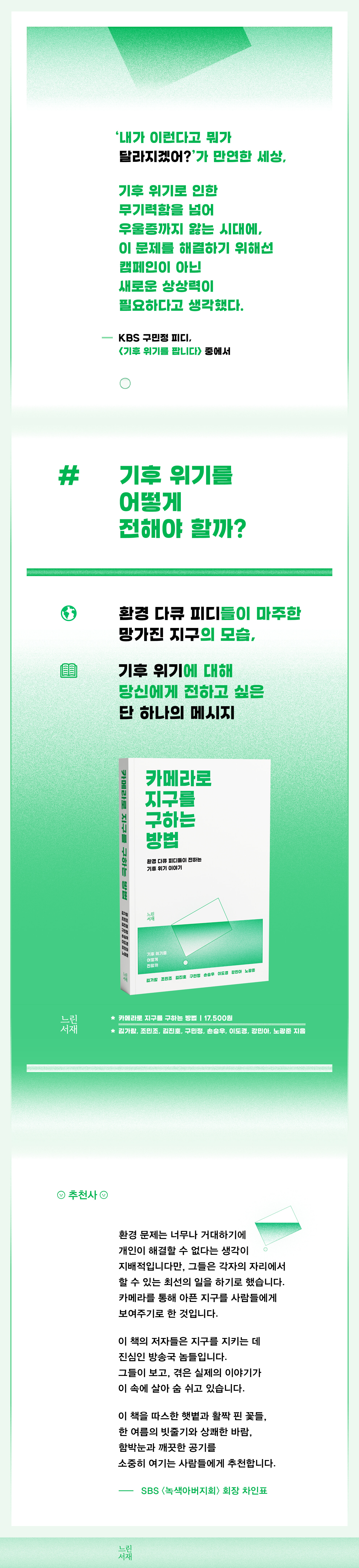
It was absurd to teach children to protect nature while dismissing the abundance achieved by squeezing people and nature to an unsustainable degree as “economic activity” and “common sense.”
As a consumer with the freedom to buy, and as a member of the planet with the freedom to think, I wanted to share my questions with more people.
---From "Where Do All These Clothes Go?"
"Do you know what's the most frustrating reality about trash? We think it's okay because once you throw it out, it's gone from your sight the next day.
“It becomes something that is not of interest, thinking, ‘It must be being handled well somewhere.’”
---From "Local PD Opens a Store to Save the Earth"
Climate refugees are people who are forced to leave their hometowns and emigrate to other countries due to the loss of glaciers and rising sea levels caused by global warming.
Even at this very moment, about 41 people are becoming climate refugees every minute.
According to the World Bank's report, "Global Climate Refugee Preparation Process," there will be 143 million climate refugees worldwide in 2050.
Additionally, the UN Refugee Agency estimates that if we do not take appropriate measures to address climate change, more than 200 million people will be forcibly displaced by 2050.
The main culprits for melting the Antarctic glaciers are developed countries, including South Korea, but the damage is being suffered by island nations in the South Pacific.
---From "What on earth have you been doing all this time?"
The same is true even within the same country.
Heat waves, floods, and forest fires in other regions may be unfortunate and concerning, but it is difficult to empathize beyond that for someone who has not experienced them.
In that sense, the 2050 version of the Pacific island nation Marshall Islands, the 'Four Seasons Performance', had a big impact.
A situation where the conductor and the musicians are all present, but no instrument makes a sound.
The Marshall Islands in 2050 are at risk of losing their islands due to rising sea levels.
I'm convinced that if music can help people feel and empathize with the climate disasters each region is experiencing, as I felt from this project, it will have a much greater power than simply conveying facts to viewers.
---From "I hope it wasn't a storm in a teacup"
Because I believe that the louder the voices of people like me become, the easier it will be for me to live the way I have lived.
It is for the same reason that I continue to produce environmental programs and am willing to participate in writing them.
I don't want to experience the price of houses and seasonal vegetables in neighborhoods that won't be flooded when the global temperature rises by 3 degrees, so I'm spreading environmental complaints to the world today.
The more difficult it is to make a living, the better it is for one's later years to take the time to be sensitive to environmental policies.
As a consumer with the freedom to buy, and as a member of the planet with the freedom to think, I wanted to share my questions with more people.
---From "Where Do All These Clothes Go?"
"Do you know what's the most frustrating reality about trash? We think it's okay because once you throw it out, it's gone from your sight the next day.
“It becomes something that is not of interest, thinking, ‘It must be being handled well somewhere.’”
---From "Local PD Opens a Store to Save the Earth"
Climate refugees are people who are forced to leave their hometowns and emigrate to other countries due to the loss of glaciers and rising sea levels caused by global warming.
Even at this very moment, about 41 people are becoming climate refugees every minute.
According to the World Bank's report, "Global Climate Refugee Preparation Process," there will be 143 million climate refugees worldwide in 2050.
Additionally, the UN Refugee Agency estimates that if we do not take appropriate measures to address climate change, more than 200 million people will be forcibly displaced by 2050.
The main culprits for melting the Antarctic glaciers are developed countries, including South Korea, but the damage is being suffered by island nations in the South Pacific.
---From "What on earth have you been doing all this time?"
The same is true even within the same country.
Heat waves, floods, and forest fires in other regions may be unfortunate and concerning, but it is difficult to empathize beyond that for someone who has not experienced them.
In that sense, the 2050 version of the Pacific island nation Marshall Islands, the 'Four Seasons Performance', had a big impact.
A situation where the conductor and the musicians are all present, but no instrument makes a sound.
The Marshall Islands in 2050 are at risk of losing their islands due to rising sea levels.
I'm convinced that if music can help people feel and empathize with the climate disasters each region is experiencing, as I felt from this project, it will have a much greater power than simply conveying facts to viewers.
---From "I hope it wasn't a storm in a teacup"
Because I believe that the louder the voices of people like me become, the easier it will be for me to live the way I have lived.
It is for the same reason that I continue to produce environmental programs and am willing to participate in writing them.
I don't want to experience the price of houses and seasonal vegetables in neighborhoods that won't be flooded when the global temperature rises by 3 degrees, so I'm spreading environmental complaints to the world today.
The more difficult it is to make a living, the better it is for one's later years to take the time to be sensitive to environmental policies.
---From "Why I Spread the Words About the Environment"
Publisher's Review
How to Communicate the Climate Crisis
PDs who have filmed documentaries related to the Earth and the environment say:
They also say that they were not interested in the climate crisis from the beginning.
They say that their thoughts completely changed because of a single photo, a rumor, or a person they met out of curiosity, either by chance or by chance.
Producer Kim Ga-ram, who directed “No Earth for Clothes,” began planning the documentary after seeing a photo of goats eating fibers from a mountain of clothes piled high.
Producer Jo Min-jo, who was thinking about creating a zero-waste shop and environmental activities that could be done in the local area, opened the “Good Family Earth” shop in Ulsan and took on the responsibility of filming and running the shop.
While filming a variety show in the jungle, PD Kim Jin-ho began to wonder what he could do to save the Earth through his camera while watching animals on the verge of extinction.
What a producer can do is to take a camera and film all over the world, so I reached out to my fellow producers with the hope that they could convey the climate crisis we face in a more accessible and clearer way to readers.
Let's think together about how to tell the story of the climate crisis that we see, hear, and experience through the camera.
Elephants in Myanmar who are dying of intestinal obstruction after eating food waste and plastic discarded by humans due to loss of habitat caused by human logging, plastic waste exported by developed countries to keep their rivers clean - and Indonesia importing that plastic to use as fuel instead, environmental activists receiving death threats, explorers who went to explore the North Pole but had to swim because there was no ice, a sad and despairing concert where the musicians who gathered to play the 'Four Seasons' of 2050 told us that the music they were going to give us was 'silence', staff who were wondering if they could play items about the climate crisis on the radio every day...
The reality faced by producers who were concerned about whether the 'climate crisis' would become an item was miserable and horrific.
The producers, who were worried about how to best convey the images of the Earth being devastated to the point of speechlessness and the people who have become climate refugees and are leaving their homes, collected the things they had experienced one by one.
I hope this story doesn't sound like nagging.
I hope this story isn't too late
The climate crisis is not a problem that scientists can scientifically solve, nor is it something that polar bears have no business dealing with.
This is the problem that will arise right in front of me tomorrow, and next month.
So I made this book in the hope that this story wouldn't arrive too late.
The shift of apple production from Daegu to Gangwon Province, the disappearance of bees ruining fruit crops, the ever-longer summer days, and the unbearable torrential rains each year are all related to the climate crisis.
Rather than thinking there's nothing we can do for the planet that changes every day, why not try finding something small we can do today?
That small thing could be watching a documentary made by the producers who wrote this book, or it could be spreading the word about the story in this book.
Instead of using non-biodegradable plastic, how about carrying your own water bottle and using a bamboo toothbrush?
This book also attempted to reduce the burden on the environment by using soybean ink printing and chlorine-free recycled pulp.
I think that doing each and every little thing that you can is better than doing nothing.
May the stories contained herein bring about change in you!
PDs who have filmed documentaries related to the Earth and the environment say:
They also say that they were not interested in the climate crisis from the beginning.
They say that their thoughts completely changed because of a single photo, a rumor, or a person they met out of curiosity, either by chance or by chance.
Producer Kim Ga-ram, who directed “No Earth for Clothes,” began planning the documentary after seeing a photo of goats eating fibers from a mountain of clothes piled high.
Producer Jo Min-jo, who was thinking about creating a zero-waste shop and environmental activities that could be done in the local area, opened the “Good Family Earth” shop in Ulsan and took on the responsibility of filming and running the shop.
While filming a variety show in the jungle, PD Kim Jin-ho began to wonder what he could do to save the Earth through his camera while watching animals on the verge of extinction.
What a producer can do is to take a camera and film all over the world, so I reached out to my fellow producers with the hope that they could convey the climate crisis we face in a more accessible and clearer way to readers.
Let's think together about how to tell the story of the climate crisis that we see, hear, and experience through the camera.
Elephants in Myanmar who are dying of intestinal obstruction after eating food waste and plastic discarded by humans due to loss of habitat caused by human logging, plastic waste exported by developed countries to keep their rivers clean - and Indonesia importing that plastic to use as fuel instead, environmental activists receiving death threats, explorers who went to explore the North Pole but had to swim because there was no ice, a sad and despairing concert where the musicians who gathered to play the 'Four Seasons' of 2050 told us that the music they were going to give us was 'silence', staff who were wondering if they could play items about the climate crisis on the radio every day...
The reality faced by producers who were concerned about whether the 'climate crisis' would become an item was miserable and horrific.
The producers, who were worried about how to best convey the images of the Earth being devastated to the point of speechlessness and the people who have become climate refugees and are leaving their homes, collected the things they had experienced one by one.
I hope this story doesn't sound like nagging.
I hope this story isn't too late
The climate crisis is not a problem that scientists can scientifically solve, nor is it something that polar bears have no business dealing with.
This is the problem that will arise right in front of me tomorrow, and next month.
So I made this book in the hope that this story wouldn't arrive too late.
The shift of apple production from Daegu to Gangwon Province, the disappearance of bees ruining fruit crops, the ever-longer summer days, and the unbearable torrential rains each year are all related to the climate crisis.
Rather than thinking there's nothing we can do for the planet that changes every day, why not try finding something small we can do today?
That small thing could be watching a documentary made by the producers who wrote this book, or it could be spreading the word about the story in this book.
Instead of using non-biodegradable plastic, how about carrying your own water bottle and using a bamboo toothbrush?
This book also attempted to reduce the burden on the environment by using soybean ink printing and chlorine-free recycled pulp.
I think that doing each and every little thing that you can is better than doing nothing.
May the stories contained herein bring about change in you!
GOODS SPECIFICS
- Date of issue: May 24, 2024
- Page count, weight, size: 272 pages | 330g | 135*200*17mm
- ISBN13: 9791193749036
- ISBN10: 1193749034
You may also like
카테고리
korean


korean

![GQ KOREA Mark (Monthly): December [2025]](http://librairie.coreenne.fr/cdn/shop/files/8ef265dbbfbf186523ed75ba7319009d.jpg?v=1765340328&width=3840)


