

Five-body prostration
 |
Description
Book Introduction
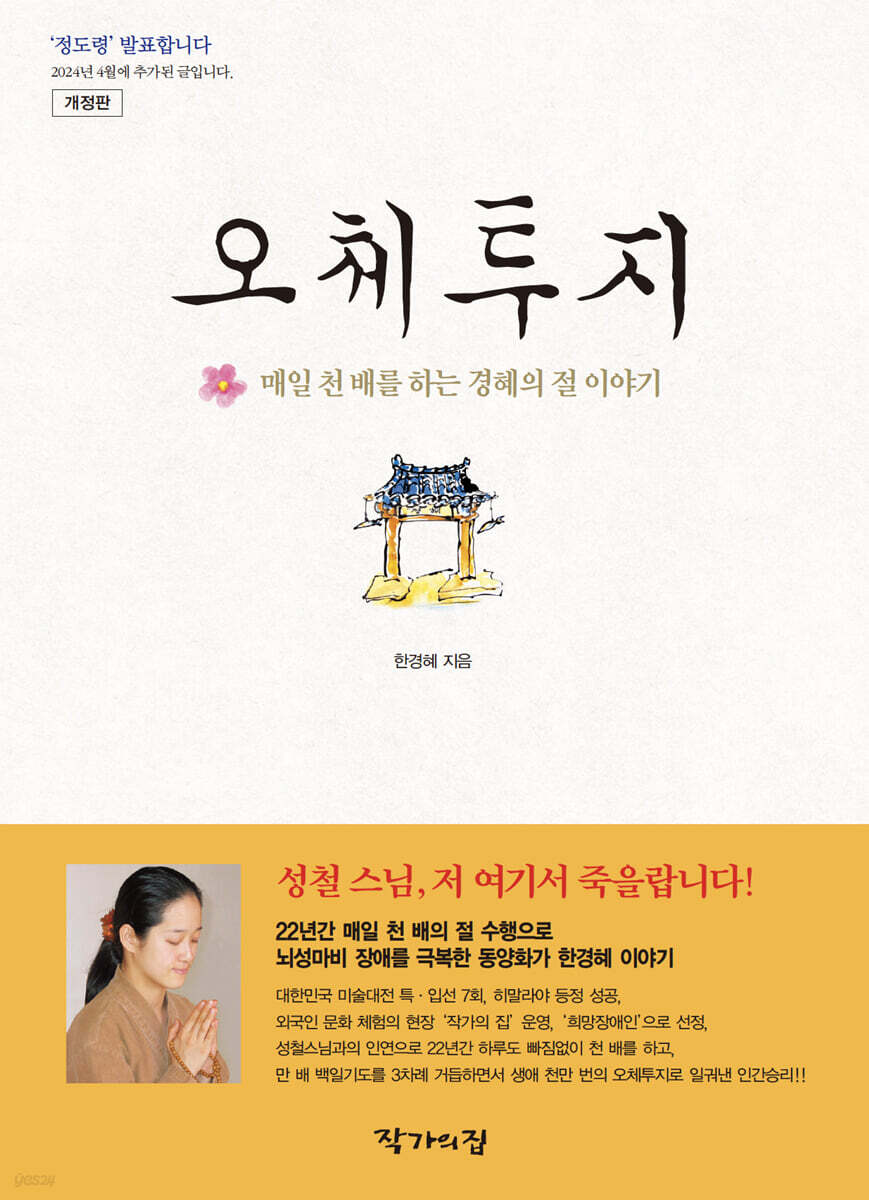
The story of Han Kyung-hye, an Oriental painter who overcame cerebral palsy through daily prostrations. The author has been doing a thousand prostrations every day without fail for 42 years. Born prematurely, weighing 1.6 kg, she suffered from cerebral palsy when she was just over a year old. By the time she was seven, her limbs were acting independently like wooden dolls and she could not even swallow a sip of water, let alone food. She was declared dead at the hospital, and her mother, desperate to find a way out, took her to Monk Seongcheol. In order to see Monk Seongcheol, who refused to meet her even when the minister came, my mother did 3,000 bows. Despite her poor health, she did 3,000 bows over three days. In the midst of a life-threatening Zen question-and-answer session, she heard the words of life-giving Dharma. After the conversation with the monk, he gave me homework to do a thousand bows every day. As I practiced prostration every day, my crooked body gradually straightened, my intelligence improved, and my hand strength improved, allowing me to hold a brush. And through the ‘10,000-day prayer’ three times in his life, he achieved the miracle of overcoming his disability. I think I have done enough bowing to change the karmic body of this life. I hated my body that moved on its own regardless of my will, so I decided to choose death, but the temple I chose ended up being the turning point that changed my life. This book is a story of a Buddhist monk's practice of meditation, and it is a book that calmly describes human reflection through self-overcoming. The part added in this revised edition is Jeong Do-ryeong. Her mother, her assistant and teacher, announced the end of the law. Mother and Monk Seongcheol speak in Zen language, but ordinary people cannot understand. When I was young, I could feel at that time that the language of the dead was a language of truly frightening silence. Seon-eo is a short, powerful language that contains the future. Now that I think about it, it seems like there was a story about announcing Jeong Do-ryeong here. The reason for issuing the Jeongdo-ryeong was because of the wish for all people to live in peace and safety. In the Gyeokam Yurok, 'Jeong Do-ryeong' is also mentioned, but this is not a person, but a guidebook that can change one's life and consciousness structure. Its significance lies in its inclusion and integration of all religions, enabling each person to practice and create the life they desire. |
- You can preview some of the book's contents.
Preview
index
prolog
Chapter 1: Dreams and Temples
Dream
A challenge with life on the line
Ten thousand times the hundred-day prayer, the procession of life and death
A child who can't walk
Monk Seongcheol, I will die here.
I just want to let go
Living with the strength to die
A new life consciousness, a meeting with mother
Chapter 2: The Lotus Blooming in the Mud
The child who became a lotus flower
Saturday is the day to meet the great monk
The great monk's last intense gaze
My younger sister Kyung-ah
Mom, Mom, our Mom!
Chapter 3 Like a salmon swimming against the current
A new reconciliation with the world
The path I chose
Preparing for a new destiny
Travel, the teacher of life
Second Manbae Baekil Prayer, I want to end reincarnation.
Burning pain and koan
The highest level, Gyeonggak
Disability is also a blessing
Third Ten Thousand-Day Prayer
Chapter 4: The Protagonist of My Life
For a new life
Himalayan trekking
Writer's House
Children's exhibition
A life of constant challenge
Epilogue
Jeong Do-ryeong announces.
Chapter 1: Dreams and Temples
Dream
A challenge with life on the line
Ten thousand times the hundred-day prayer, the procession of life and death
A child who can't walk
Monk Seongcheol, I will die here.
I just want to let go
Living with the strength to die
A new life consciousness, a meeting with mother
Chapter 2: The Lotus Blooming in the Mud
The child who became a lotus flower
Saturday is the day to meet the great monk
The great monk's last intense gaze
My younger sister Kyung-ah
Mom, Mom, our Mom!
Chapter 3 Like a salmon swimming against the current
A new reconciliation with the world
The path I chose
Preparing for a new destiny
Travel, the teacher of life
Second Manbae Baekil Prayer, I want to end reincarnation.
Burning pain and koan
The highest level, Gyeonggak
Disability is also a blessing
Third Ten Thousand-Day Prayer
Chapter 4: The Protagonist of My Life
For a new life
Himalayan trekking
Writer's House
Children's exhibition
A life of constant challenge
Epilogue
Jeong Do-ryeong announces.
Into the book
The destiny given by heaven through human power
If only I could change it, if only I could change it...
I wanted to change it.
As I wish
The life I want
So I will do it as long as I can, even if I die doing it.
I would rather choose death,
I wanted to live the life I wanted, by my own will.
If only I could change it, if only I could change it...
I wanted to change it.
As I wish
The life I want
So I will do it as long as I can, even if I die doing it.
I would rather choose death,
I wanted to live the life I wanted, by my own will.
--- From the text
Publisher's Review
The story of Han Kyung-hye, an Oriental painter who overcame cerebral palsy by performing a thousand prostrations daily for 23 years.
- Prostration.
It refers to a bow in which one lowers oneself infinitely, so that five parts of the body, including both knees, elbows, and forehead, touch the ground.
Han Kyung-hye.
For her, prostration is like life itself.
She has been doing a thousand prostrations every day without fail for 42 years.
And through the ‘10,000-day prayer’ three times in his life, he achieved the miracle of overcoming his disability.
This book is a story of a Buddhist monk's practice in a temple, where he was reborn with a divine mind and a strong body.
In her, who overcame the obstacles of cerebral palsy and stood tall, we see an example of human triumph.
- If you go to Jinyeong, Gyeongnam, there is a fairytale-like house with a red roof along the shallow hillside along the Junam Reservoir.
The colorful house, just like the candy house in Hansel and Gretel, is the 'Writer's House'.
Han Kyung-hye, a Korean painter, lives there.
He is a talented artist in the art world who won awards seven times at the Korea National Art Exhibition and later graduated from the master's and doctoral programs at Hongik University's Graduate School of Fine Arts.
Here, she teaches painting to children, and as the place became known to foreigners visiting Korea, she developed it into a space where they could experience traditional Korean culture, such as painting oriental paintings, making pottery, making kimchi, wearing hanbok, and tea ceremonies.
Kyung-hye was born with a congenital disability called cerebral palsy.
At the age of seven, when the shadow of death was hanging over me like a final sentence telling me to give up on life in the hospital, I vaguely went to see Monk Seongcheol, led by my mother's hand, with the intention of grabbing at straws.
The young boy threw his twisted body on the floor for two days and nights, and after completing three thousand prostrations, he met the monk, but all he got was a piece of rice paper with a circle drawn on it.
Because of this connection with Monk Seongcheol, Gyeonghye has been bowing a thousand times every day without fail for 42 years, hanging up the Ilwon statue.
The temple training, which began as homework based on a promise with Monk Seongcheol, gradually brought about changes in her body as the years went by.
My gait became more balanced and my speech became clearer.
The temple was producing a miracle where people were reborn as normal people.
As her story of overcoming her disability and her transformation in life became known to the world, she became the main character of the MBC Special documentary [A Journey - We Are Now Going to the Himalayas], and as if testing the miracle of her body, she embarks on a journey to overcome the limitations of her disability.
No one said it was impossible.
However, she stood tall on the summit of Kalapathar, the 5,545-meter-high Himalayan mountain known as the "black stone," by performing 108 prostrations every day during the arduous 15-night and 16-day journey.
It was a drama that conveyed a moving message of courage and hope to all the disabled people in this land.
Since then, she has been selected as a 'Hopeful Disabled Person' and has been giving hope and challenge to 1.5 million disabled people.
Her challenge continues even now.
At that time, she held an exhibition of the skills of the children she was teaching at the writer's house.
The exhibition of paintings, pottery, and handkerchief dyes, which captured the natural colors seen through the eyes of rural children, also sent a small ripple through the art world.
- Three ten thousand prostrations, one hundred days of prayer, and one thousand prostrations repeated daily for 42 years.
Through ten million prostrations throughout her life, she now appears in the world with a healthy body and an evolved soul, with no signs of disability.
She is now perfectly healthy and well.
Through the temple, she saw the highest realm of enlightenment in life, the realm of the gaze.
It was a message of enlightenment that asked oneself the endless question, 'Who am I here, right now?' with restrained laughter and purified gestures.
For many people living with physical and mental disabilities, the story of Kyung-hye's temple leaves a deep impression of reflection, courage, and hope that makes us look back.
The book contains interesting anecdotes about Monk Seongcheol, who loved children at Baekryeonam at the time, as well as a travelogue of the Silk Road, a Himalayan trek, the meaning of the 10,000-day prayer and daily bowing, and stories about works that won awards at the Republic of Korea Art Exhibition, all of which bring unique interest and emotion.
The book's significance is enhanced by the inclusion of ink wash-style illustrations and award-winning works that highlight the author's unique style as an artist on each page.
Although physically disabled, the wisdom and acceptance of a mother who raised her child to be a strong child who could stand on her own two feet, not a mentally disabled child, also gives us a much-needed awakening.
This book is a record of the harsh 30-year life of a female oriental painter who overcame her disability of cerebral palsy through Buddhist practice.
Her story of transforming a congenital disability into a blessing reminds us, in these times of loss, of what true challenge and courage are.
Ten million prostrations began with a connection to Monk Seongcheol.
A 30-year record of a grueling life that transformed disability into a blessing.
- A girl with cerebral palsy who couldn't walk until she was five years old.
A child whose words murmured in his mouth, whose face turned at will, and whose limbs flailed about in isolation.
The temple was the catalyst that allowed the child, who had been thrown out of the world, to begin a new life.
The child who had been shaking his head even at the hospital began to come back to life little by little by doing a thousand prostrations every day without fail, as if it were homework, thanks to his connection with Monk Seongcheol.
It was a means of practice that forged one's own destiny rather than overcoming obstacles.
It wasn't easy to keep up with schoolwork, but I never slacked off in my efforts to bow.
After graduating from middle school, I passed the college entrance exam in just three months and knocked on the door of university.
However, because he was disabled, he was repeatedly rejected from his goal of attending art school.
However, even though I changed my major, I did not put down my brush, and eventually, in 1995, I was able to enter the path of becoming a painter by winning an award at the [Republic of Korea Art Exhibition] for the first time.
Although I have won two special awards and five honorable mentions at national art exhibitions and have held numerous exhibitions, I have never been able to give up my dream of studying art formally.
The bowing may have been another source of energy that helped me focus and focus on my studies.
I graduated from Hongik University's Graduate School of Fine Arts with new hopes and challenges.
Now the child is proud of himself and loves himself.
After working as a painter with cerebral palsy and successfully climbing the Himalayas, which is not easy even for a normal person, the child was selected as a ‘hopeful disabled person’ at the National Disabled Sports Festival and performed paragliding at the opening ceremony, spreading a message of courage and hope to 1.5 million disabled people in this country.
The boy accidentally discovers his distorted image in a video taken with his companions while traveling the Silk Road during his college years, and this leads to a new chapter in his ascetic practice.
As if testing the inner strength he gained from doing a thousand bows every day without fail, the child takes on a new challenge that puts his life on the line.
Ten Thousand Times Hundred Day Prayer
On the path of training that cannot be completed without God's permission, he had to overcome several crises that brought him face to face with death.
Since it was a self-chosen asceticism, there could be no delusion.
For the child, it was like a new life, a life that would break the cycle of disability in this life.
At the age of twenty-two and twenty-three, the child was conceiving a new life by overcoming cerebral palsy, which was like a curse, through three rounds of ten thousand prostrations and one hundred-day prayers.
Ah, the ultimate and complete realization of life!
That's right.
The child saw the view through the temple.
For the child, the bow was a means of enlightenment to overcome his disability.
It was the result of prostrating one thousand times every day for 42 years without fail, repeating the ten thousand prostrations and the hundred-day prayer three times, and prostrating oneself ten million times in his life.
Now, the child is reborn as a spiritually and physically more mature woman and is looking at the world.
He built [The Writer's House] in Jinyeong, Gyeongnam, and once gave hope to children and people with disabilities.
He taught painting to children with disabilities with his mother, who was both a master and a disciple of the monk, and also introduced Korean culture to foreigners by providing an experiential platform to introduce Korean traditional culture.
We see in her a true human triumph, a miracle accomplished through sacrifice.
- Prostration.
It refers to a bow in which one lowers oneself infinitely, so that five parts of the body, including both knees, elbows, and forehead, touch the ground.
Han Kyung-hye.
For her, prostration is like life itself.
She has been doing a thousand prostrations every day without fail for 42 years.
And through the ‘10,000-day prayer’ three times in his life, he achieved the miracle of overcoming his disability.
This book is a story of a Buddhist monk's practice in a temple, where he was reborn with a divine mind and a strong body.
In her, who overcame the obstacles of cerebral palsy and stood tall, we see an example of human triumph.
- If you go to Jinyeong, Gyeongnam, there is a fairytale-like house with a red roof along the shallow hillside along the Junam Reservoir.
The colorful house, just like the candy house in Hansel and Gretel, is the 'Writer's House'.
Han Kyung-hye, a Korean painter, lives there.
He is a talented artist in the art world who won awards seven times at the Korea National Art Exhibition and later graduated from the master's and doctoral programs at Hongik University's Graduate School of Fine Arts.
Here, she teaches painting to children, and as the place became known to foreigners visiting Korea, she developed it into a space where they could experience traditional Korean culture, such as painting oriental paintings, making pottery, making kimchi, wearing hanbok, and tea ceremonies.
Kyung-hye was born with a congenital disability called cerebral palsy.
At the age of seven, when the shadow of death was hanging over me like a final sentence telling me to give up on life in the hospital, I vaguely went to see Monk Seongcheol, led by my mother's hand, with the intention of grabbing at straws.
The young boy threw his twisted body on the floor for two days and nights, and after completing three thousand prostrations, he met the monk, but all he got was a piece of rice paper with a circle drawn on it.
Because of this connection with Monk Seongcheol, Gyeonghye has been bowing a thousand times every day without fail for 42 years, hanging up the Ilwon statue.
The temple training, which began as homework based on a promise with Monk Seongcheol, gradually brought about changes in her body as the years went by.
My gait became more balanced and my speech became clearer.
The temple was producing a miracle where people were reborn as normal people.
As her story of overcoming her disability and her transformation in life became known to the world, she became the main character of the MBC Special documentary [A Journey - We Are Now Going to the Himalayas], and as if testing the miracle of her body, she embarks on a journey to overcome the limitations of her disability.
No one said it was impossible.
However, she stood tall on the summit of Kalapathar, the 5,545-meter-high Himalayan mountain known as the "black stone," by performing 108 prostrations every day during the arduous 15-night and 16-day journey.
It was a drama that conveyed a moving message of courage and hope to all the disabled people in this land.
Since then, she has been selected as a 'Hopeful Disabled Person' and has been giving hope and challenge to 1.5 million disabled people.
Her challenge continues even now.
At that time, she held an exhibition of the skills of the children she was teaching at the writer's house.
The exhibition of paintings, pottery, and handkerchief dyes, which captured the natural colors seen through the eyes of rural children, also sent a small ripple through the art world.
- Three ten thousand prostrations, one hundred days of prayer, and one thousand prostrations repeated daily for 42 years.
Through ten million prostrations throughout her life, she now appears in the world with a healthy body and an evolved soul, with no signs of disability.
She is now perfectly healthy and well.
Through the temple, she saw the highest realm of enlightenment in life, the realm of the gaze.
It was a message of enlightenment that asked oneself the endless question, 'Who am I here, right now?' with restrained laughter and purified gestures.
For many people living with physical and mental disabilities, the story of Kyung-hye's temple leaves a deep impression of reflection, courage, and hope that makes us look back.
The book contains interesting anecdotes about Monk Seongcheol, who loved children at Baekryeonam at the time, as well as a travelogue of the Silk Road, a Himalayan trek, the meaning of the 10,000-day prayer and daily bowing, and stories about works that won awards at the Republic of Korea Art Exhibition, all of which bring unique interest and emotion.
The book's significance is enhanced by the inclusion of ink wash-style illustrations and award-winning works that highlight the author's unique style as an artist on each page.
Although physically disabled, the wisdom and acceptance of a mother who raised her child to be a strong child who could stand on her own two feet, not a mentally disabled child, also gives us a much-needed awakening.
This book is a record of the harsh 30-year life of a female oriental painter who overcame her disability of cerebral palsy through Buddhist practice.
Her story of transforming a congenital disability into a blessing reminds us, in these times of loss, of what true challenge and courage are.
Ten million prostrations began with a connection to Monk Seongcheol.
A 30-year record of a grueling life that transformed disability into a blessing.
- A girl with cerebral palsy who couldn't walk until she was five years old.
A child whose words murmured in his mouth, whose face turned at will, and whose limbs flailed about in isolation.
The temple was the catalyst that allowed the child, who had been thrown out of the world, to begin a new life.
The child who had been shaking his head even at the hospital began to come back to life little by little by doing a thousand prostrations every day without fail, as if it were homework, thanks to his connection with Monk Seongcheol.
It was a means of practice that forged one's own destiny rather than overcoming obstacles.
It wasn't easy to keep up with schoolwork, but I never slacked off in my efforts to bow.
After graduating from middle school, I passed the college entrance exam in just three months and knocked on the door of university.
However, because he was disabled, he was repeatedly rejected from his goal of attending art school.
However, even though I changed my major, I did not put down my brush, and eventually, in 1995, I was able to enter the path of becoming a painter by winning an award at the [Republic of Korea Art Exhibition] for the first time.
Although I have won two special awards and five honorable mentions at national art exhibitions and have held numerous exhibitions, I have never been able to give up my dream of studying art formally.
The bowing may have been another source of energy that helped me focus and focus on my studies.
I graduated from Hongik University's Graduate School of Fine Arts with new hopes and challenges.
Now the child is proud of himself and loves himself.
After working as a painter with cerebral palsy and successfully climbing the Himalayas, which is not easy even for a normal person, the child was selected as a ‘hopeful disabled person’ at the National Disabled Sports Festival and performed paragliding at the opening ceremony, spreading a message of courage and hope to 1.5 million disabled people in this country.
The boy accidentally discovers his distorted image in a video taken with his companions while traveling the Silk Road during his college years, and this leads to a new chapter in his ascetic practice.
As if testing the inner strength he gained from doing a thousand bows every day without fail, the child takes on a new challenge that puts his life on the line.
Ten Thousand Times Hundred Day Prayer
On the path of training that cannot be completed without God's permission, he had to overcome several crises that brought him face to face with death.
Since it was a self-chosen asceticism, there could be no delusion.
For the child, it was like a new life, a life that would break the cycle of disability in this life.
At the age of twenty-two and twenty-three, the child was conceiving a new life by overcoming cerebral palsy, which was like a curse, through three rounds of ten thousand prostrations and one hundred-day prayers.
Ah, the ultimate and complete realization of life!
That's right.
The child saw the view through the temple.
For the child, the bow was a means of enlightenment to overcome his disability.
It was the result of prostrating one thousand times every day for 42 years without fail, repeating the ten thousand prostrations and the hundred-day prayer three times, and prostrating oneself ten million times in his life.
Now, the child is reborn as a spiritually and physically more mature woman and is looking at the world.
He built [The Writer's House] in Jinyeong, Gyeongnam, and once gave hope to children and people with disabilities.
He taught painting to children with disabilities with his mother, who was both a master and a disciple of the monk, and also introduced Korean culture to foreigners by providing an experiential platform to introduce Korean traditional culture.
We see in her a true human triumph, a miracle accomplished through sacrifice.
GOODS SPECIFICS
- Date of issue: April 30, 2024
- Page count, weight, size: 244 pages | 426g | 150*210*20mm
- ISBN13: 9788995736432
- ISBN 10: 8995736437
You may also like
카테고리
korean


korean

![ELLE 엘르 스페셜 에디션 A형 : 12월 [2025]](http://librairie.coreenne.fr/cdn/shop/files/b8e27a3de6c9538896439686c6b0e8fb.jpg?v=1766436872&width=3840)


