

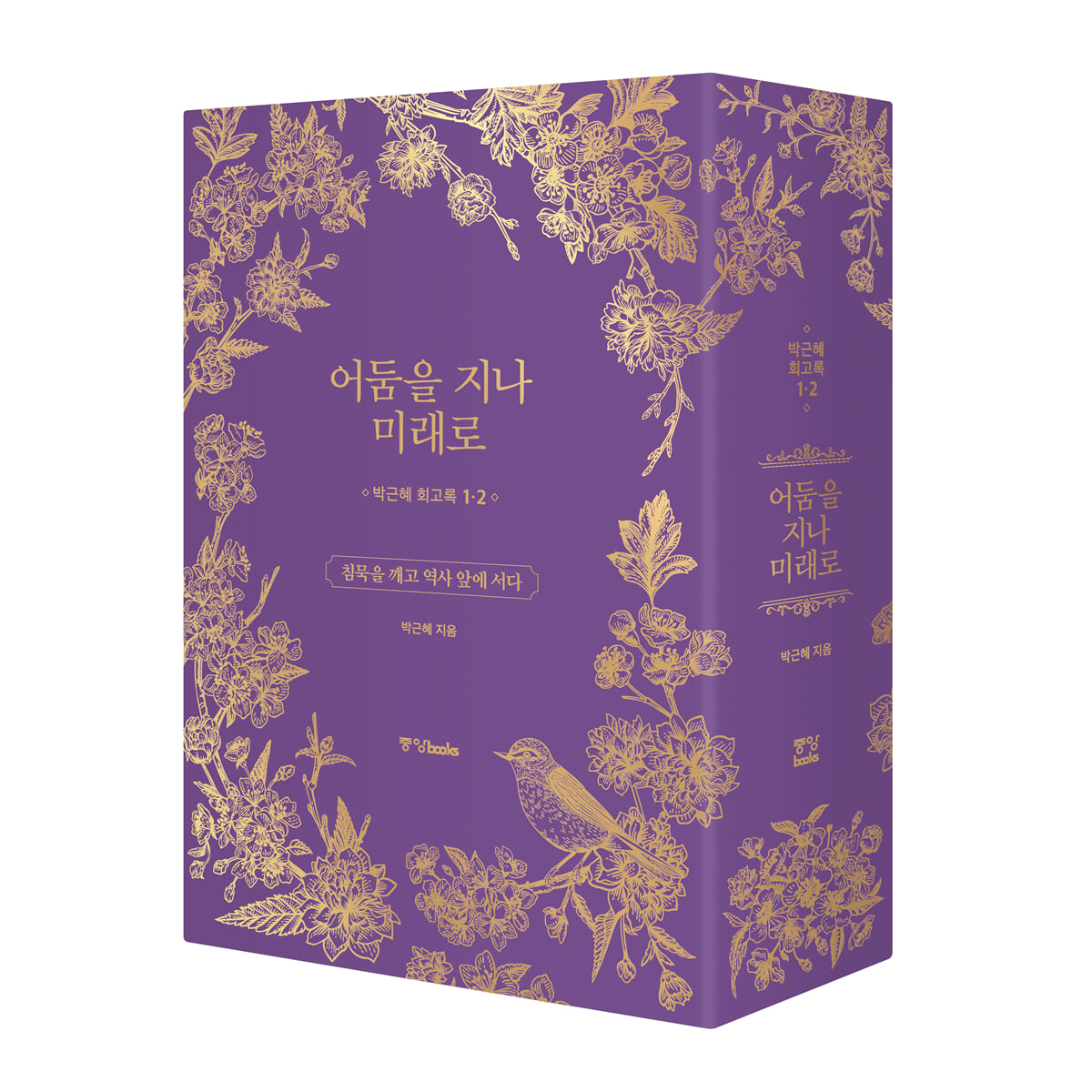
Park Geun-hye's Memoirs: Beyond Darkness to the Future (Part 1 and Part 2) Box Set
 |
Description
Book Introduction
Park Geun-hye's Memoirs, Volumes 1 and 2
Through the darkness into the future
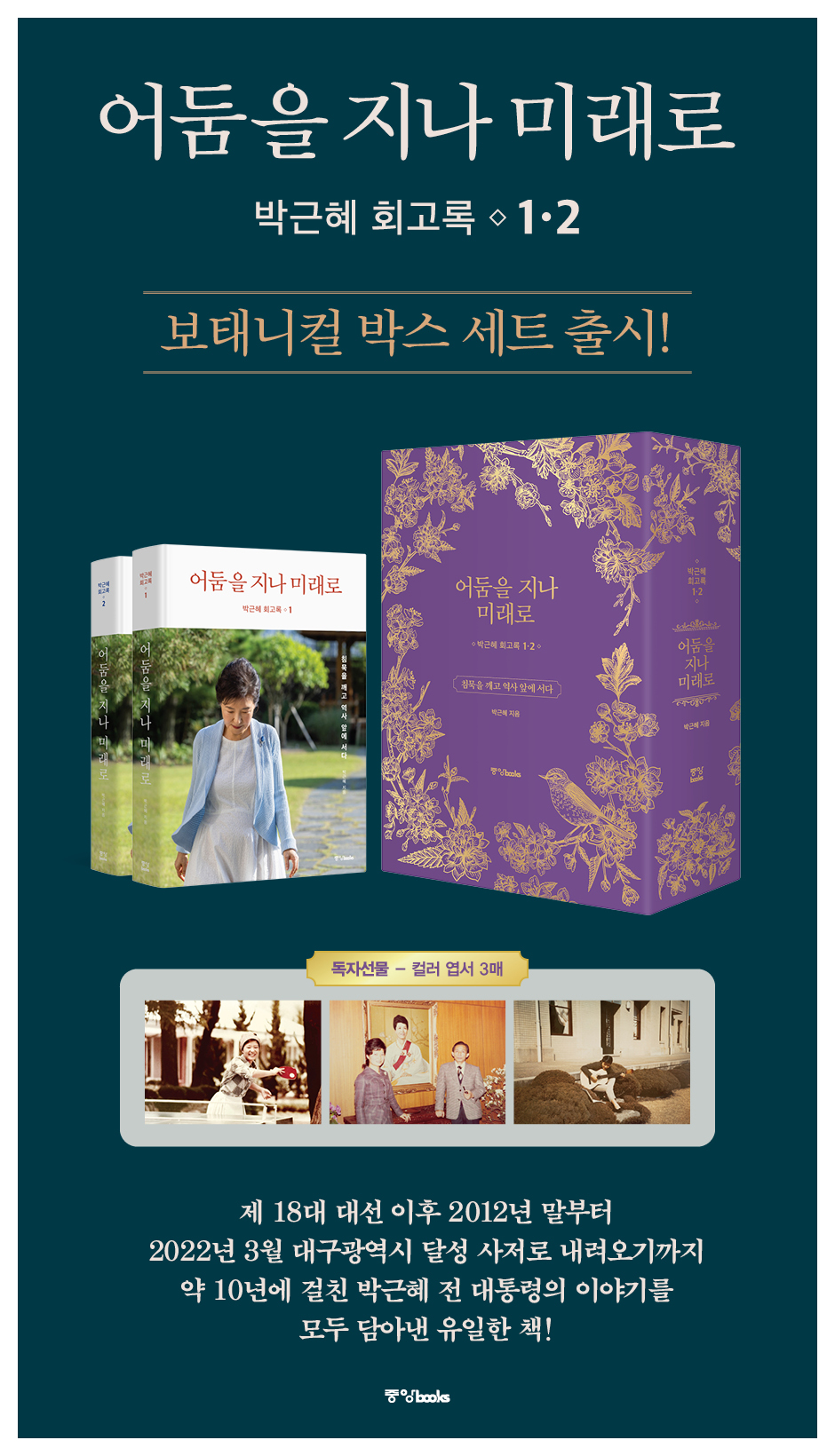
Former President Park Geun-hye's memoirs box set published!
From the end of 2012, after the 18th presidential election
Until March 2022, when I moved to Dalseong, Daegu.
The only book that contains the entire story of former President Park Geun-hye over the past 10 years!
A box set of the book, "Park Geun-hye's Memoir: From Darkness to the Future 1·2," which contains the political life of former President Park Geun-hye, has been published.
It was produced with a special design utilizing botanical patterns that are full of the feeling of nature that former President Park Geun-hye loved, and readers who purchase this box set will also be able to see three special color photo postcards featuring former President Park Geun-hye.
This book offers a comprehensive look at President Park Geun-hye's political history, from her 1998 political entry to her diplomatic and security policies and various domestic policies implemented after her election, to her impeachment and special pardon in 2017. It also holds significant value as a historical resource.
Through the darkness into the future
Former President Park Geun-hye's memoirs box set published!
From the end of 2012, after the 18th presidential election
Until March 2022, when I moved to Dalseong, Daegu.
The only book that contains the entire story of former President Park Geun-hye over the past 10 years!
A box set of the book, "Park Geun-hye's Memoir: From Darkness to the Future 1·2," which contains the political life of former President Park Geun-hye, has been published.
It was produced with a special design utilizing botanical patterns that are full of the feeling of nature that former President Park Geun-hye loved, and readers who purchase this box set will also be able to see three special color photo postcards featuring former President Park Geun-hye.
This book offers a comprehensive look at President Park Geun-hye's political history, from her 1998 political entry to her diplomatic and security policies and various domestic policies implemented after her election, to her impeachment and special pardon in 2017. It also holds significant value as a historical resource.
index
Volume 1
Chapter 1 Politics
I ate kimbap in the car every day... I felt dizzy when I sat down at the table.
Lee Jeong-hee: "I'm out to bring down Park Geun-hye."
Kim Jong-in accused me of being lobbied by the business community.
The first cabinet reshuffle: "He cried in front of me."
The heartbreaking story of the Prime Minister's brutality
The Prosecutor General's extramarital affair scandal
Moon Jae-in opposed the dissolution of the Unified Progressive Party.
“He wasn’t the Jinyeong I usually knew.”
The absurd rumors of the 'Sewol 7 Hours'
The reason Choi Seo-won entered the Blue House on the day of the Sewol Ferry disaster
The Truth Behind the Minister of Education's "Emperor Ramen"
Jeong Yoon-hoe, who manipulates the secretaries of the Blue House?
Park Gwan-cheon's false documents, like private information papers
The regrettable civil servant pension reform
Yoo Seung-min's contact was cut off
2016 was such a sad year
Chosun Ilbo and Woo Byung-woo
Chapter 2 Diplomacy and Security
closure of the Kaesong Industrial Complex
Kim Yang-geon grabbed his arm, asking, "What kind of breakup is this?"
"Make a Wish" resonates throughout the North
THAAD
Thae Yong-ho's defection and Jang Song-thaek's purge
Cadiz Boramae Project
GSOMIA, the final decision as president
Britain, France, Russia, Iran, and Africa
Appendix Old Photos
Volume 2
Yoon Mi-hyang was shocked when she heard, "I never heard an explanation about the comfort women agreement."
Knife terrorism and Abe's beef
Regrets of my first visit to the US
Obama put pressure on Abe
China panics over "FTAs won't work this way"
China's Victory Day and the North Korean delegation pushed to the corner
Chapter 3 Policy
creative economy
Regulatory reform
New airport in Yeongnam region
MERS: A single photo sparks a ghost story
Why I Decided on National Textbooks
Jeongsu Scholarship Association
Chapter 4: Through the Darkness into the Future
Choi Seo-won, who asked, "Mr. President, what is a bidet?" believed her.
“Is this why you became president?”
Lawmakers who voted for impeachment
The investigation was interrupted by the question, “Why are you trying to make a dirty person?”
Choi Seo-won, who still hasn't told the truth
“You didn’t tell the truth about one thing.”
Four trials a week, a time of savagery
False propaganda claiming that "Choi Seo-won made all the greetings"
I put everything down and endured it
He also refused to visit his younger brother.
Back to normal, but...
Former President Park Geun-hye as Seen by Attorney Yoo Young-ha
Former President Park Geun-hye's Key Dates
Appendix Old Photos
Chapter 1 Politics
I ate kimbap in the car every day... I felt dizzy when I sat down at the table.
Lee Jeong-hee: "I'm out to bring down Park Geun-hye."
Kim Jong-in accused me of being lobbied by the business community.
The first cabinet reshuffle: "He cried in front of me."
The heartbreaking story of the Prime Minister's brutality
The Prosecutor General's extramarital affair scandal
Moon Jae-in opposed the dissolution of the Unified Progressive Party.
“He wasn’t the Jinyeong I usually knew.”
The absurd rumors of the 'Sewol 7 Hours'
The reason Choi Seo-won entered the Blue House on the day of the Sewol Ferry disaster
The Truth Behind the Minister of Education's "Emperor Ramen"
Jeong Yoon-hoe, who manipulates the secretaries of the Blue House?
Park Gwan-cheon's false documents, like private information papers
The regrettable civil servant pension reform
Yoo Seung-min's contact was cut off
2016 was such a sad year
Chosun Ilbo and Woo Byung-woo
Chapter 2 Diplomacy and Security
closure of the Kaesong Industrial Complex
Kim Yang-geon grabbed his arm, asking, "What kind of breakup is this?"
"Make a Wish" resonates throughout the North
THAAD
Thae Yong-ho's defection and Jang Song-thaek's purge
Cadiz Boramae Project
GSOMIA, the final decision as president
Britain, France, Russia, Iran, and Africa
Appendix Old Photos
Volume 2
Yoon Mi-hyang was shocked when she heard, "I never heard an explanation about the comfort women agreement."
Knife terrorism and Abe's beef
Regrets of my first visit to the US
Obama put pressure on Abe
China panics over "FTAs won't work this way"
China's Victory Day and the North Korean delegation pushed to the corner
Chapter 3 Policy
creative economy
Regulatory reform
New airport in Yeongnam region
MERS: A single photo sparks a ghost story
Why I Decided on National Textbooks
Jeongsu Scholarship Association
Chapter 4: Through the Darkness into the Future
Choi Seo-won, who asked, "Mr. President, what is a bidet?" believed her.
“Is this why you became president?”
Lawmakers who voted for impeachment
The investigation was interrupted by the question, “Why are you trying to make a dirty person?”
Choi Seo-won, who still hasn't told the truth
“You didn’t tell the truth about one thing.”
Four trials a week, a time of savagery
False propaganda claiming that "Choi Seo-won made all the greetings"
I put everything down and endured it
He also refused to visit his younger brother.
Back to normal, but...
Former President Park Geun-hye as Seen by Attorney Yoo Young-ha
Former President Park Geun-hye's Key Dates
Appendix Old Photos
Detailed image
Into the book
The Saenuri Party's struggle to be reborn created a miracle in the 19th general election.
All election experts predicted that the ruling party would have a majority in the National Assembly, but when the ballot boxes were opened on the night of April 11, the ruling party secured a majority with 152 seats for the Saenuri Party, 127 seats for the Democratic United Party, 13 seats for the Unified Progressive Party, 5 seats for the Liberty Forward Party, and 5 seats for independents.
I actually didn't expect such a dramatic victory.
However, at the end of the campaign, when I was shaking hands with voters, I kept getting the feeling that the air was good.
I could feel that the people had high expectations for changes in our party.
My right hand hurt from shaking hands a lot, so I would often apply ice to it. Word got out, and thankfully, some people said, “I won’t hold your hand because it hurts.”
Later, he started to wear a bandage on his right hand, and the term 'bandage fighting spirit' appeared in the media.
---From "Chapter 1 - Politics"
North Korea's sudden resumption of nuclear provocations, which had been quiet for three years since January 2013, was shocking and heightened the sense of crisis.
We do not have nuclear weapons, but it has been revealed that North Korea has been continuously developing nuclear weapons behind the scenes even in an atmosphere of dialogue.
To be honest, I never gave up any hope for North Korea until then.
However, watching the fourth nuclear test, deep skepticism has arisen about whether meaningful dialogue with the Kim Jong-un regime is even possible.
North Korea expressed regret over the serious injuries suffered by South Korean soldiers due to landmines during the August 25th Agreement just four months ago, and proposed that authorities hold talks in Seoul or Pyongyang at an early date to improve inter-Korean relations and that dialogue and negotiations be held in various fields in the future.
Then, a sudden nuclear test wiped it out.
---From "Chapter 2 - Foreign Affairs and Security"
Immediately after the MERS outbreak began to subside, I focused all my efforts on drastically reforming the national quarantine system.
In the event of an epidemic of this scale, we have created a manual to enable a government-wide response, while also establishing a legal foundation to support it.
It was at this time that information was made mandatory for card companies and telecommunications companies to be able to trace the movements of confirmed cases and their contacts, as it would be impossible to conduct a rapid epidemiological investigation or respond if information on suspected infected persons was not quickly obtained.
Thanks to this, during the COVID-19 outbreak, we were able to trace infected people and their contacts more quickly than any other country in the world and prevent the spread, so it is truly a blessing in disguise.
---From "Chapter 3 - Policy"
When reports came out in mid-October that Director Choi had established a company called Videk Sports in Germany and received money from Samsung, I felt compelled to check the facts.
So I called her and asked, “Do you know about the company called Bidek that is currently being reported in the media?” Director Choi asked me back, “Mr. President, what is Bidek?”
He said he had no idea.
I believed her when she said that.
I never thought she would lie to me.
This was my last phone call with Director Choi.
All election experts predicted that the ruling party would have a majority in the National Assembly, but when the ballot boxes were opened on the night of April 11, the ruling party secured a majority with 152 seats for the Saenuri Party, 127 seats for the Democratic United Party, 13 seats for the Unified Progressive Party, 5 seats for the Liberty Forward Party, and 5 seats for independents.
I actually didn't expect such a dramatic victory.
However, at the end of the campaign, when I was shaking hands with voters, I kept getting the feeling that the air was good.
I could feel that the people had high expectations for changes in our party.
My right hand hurt from shaking hands a lot, so I would often apply ice to it. Word got out, and thankfully, some people said, “I won’t hold your hand because it hurts.”
Later, he started to wear a bandage on his right hand, and the term 'bandage fighting spirit' appeared in the media.
---From "Chapter 1 - Politics"
North Korea's sudden resumption of nuclear provocations, which had been quiet for three years since January 2013, was shocking and heightened the sense of crisis.
We do not have nuclear weapons, but it has been revealed that North Korea has been continuously developing nuclear weapons behind the scenes even in an atmosphere of dialogue.
To be honest, I never gave up any hope for North Korea until then.
However, watching the fourth nuclear test, deep skepticism has arisen about whether meaningful dialogue with the Kim Jong-un regime is even possible.
North Korea expressed regret over the serious injuries suffered by South Korean soldiers due to landmines during the August 25th Agreement just four months ago, and proposed that authorities hold talks in Seoul or Pyongyang at an early date to improve inter-Korean relations and that dialogue and negotiations be held in various fields in the future.
Then, a sudden nuclear test wiped it out.
---From "Chapter 2 - Foreign Affairs and Security"
Immediately after the MERS outbreak began to subside, I focused all my efforts on drastically reforming the national quarantine system.
In the event of an epidemic of this scale, we have created a manual to enable a government-wide response, while also establishing a legal foundation to support it.
It was at this time that information was made mandatory for card companies and telecommunications companies to be able to trace the movements of confirmed cases and their contacts, as it would be impossible to conduct a rapid epidemiological investigation or respond if information on suspected infected persons was not quickly obtained.
Thanks to this, during the COVID-19 outbreak, we were able to trace infected people and their contacts more quickly than any other country in the world and prevent the spread, so it is truly a blessing in disguise.
---From "Chapter 3 - Policy"
When reports came out in mid-October that Director Choi had established a company called Videk Sports in Germany and received money from Samsung, I felt compelled to check the facts.
So I called her and asked, “Do you know about the company called Bidek that is currently being reported in the media?” Director Choi asked me back, “Mr. President, what is Bidek?”
He said he had no idea.
I believed her when she said that.
I never thought she would lie to me.
This was my last phone call with Director Choi.
---From "Chapter 4 - Beyond the Darkness to the Future"
Publisher's Review
The Korea-Japan comfort women agreement, the closure of the Kaesong Industrial Complex, the THAAD deployment, the signing of the GSOMIA, and civil servant pension reform...
The only book that comprehensively examines the policies, foreign affairs, and security of the Park Geun-hye administration!
This book contains the story of former President Park Geun-hye spanning approximately 10 years from the end of 2012, when the 18th presidential election ended, until she moved down to her private residence in Dalseong, Daegu Metropolitan City in March 2022.
After being elected president, he had no choice but to make lonely decisions that defied public opinion, such as the Korea-Japan comfort women agreement, the closure of the Kaesong Industrial Complex, the deployment of THAAD, the signing of the GSOMIA, and civil servant pension reform. He also candidly tells the story of the cabinet members and staff who supported the president's decisions, as well as the impeachment due to the misconduct of a close friend and the extreme days he endured in a detention center for 4 years and 9 months while veiled.
Former President Park Geun-hye explained in the preface why she decided to write this memoir, saying, “I am the only president in constitutional history to have left office due to impeachment, but I thought it was my duty to the people to tell the story of my time in office and the story afterward as it was, beyond judgment of right or wrong.” She explained that the main reason was her sense of duty as a former president.
This book consists of four chapters: Chapter 1, ‘Politics,’ Chapter 2, ‘Foreign Affairs and Security,’ Chapter 3, ‘Policy,’ and Chapter 4, ‘Beyond the Darkness and Into the Future.’ The table of contents is integrated as a series where the stories of Volumes 1 and 2 continue.
This is the only book that vividly presents the various achievements made after the inauguration of the Park Geun-hye administration through the perspective of former President Park Geun-hye, allowing readers to recall the urgent situation and circumstances of the time.
Chapter 1 details the story of how he successfully ran the 19th general election as the emergency committee chairman of the Grand National Party in 2011.
He steered the party into crisis four months before the general elections, when the party was defeated in the Seoul mayoral by-election and Chairman Hong Joon-pyo resigned in the aftermath of the DDoS attack. In the 2012 general elections, when defeat was likely, he overturned expectations and secured 152 seats, more than half, laying the foundation for regaining power.
Chapter 2, which deals with foreign affairs and security, unfolds with a tense story about former President Park Geun-hye, who decided to completely shut down the Kaesong Industrial Complex as a special measure against the Kim Jong-un regime, which carried out its fourth nuclear test in January 2013.
In particular, when withdrawing from the Kaesong Industrial Complex, the safety of South Korean citizens, including businesspeople, was a top priority, so this book also details the plan to gradually reduce the number of people staying at the Kaesong Industrial Complex through entry and exit restrictions in two stages.
Chapter 3, which mainly deals with policy, explains the controversy over the national textbooks that were scrapped just three days after the MERS outbreak and the impeachment of former President Park, and the controversy over the Jeongsu Scholarship Foundation, which was repeatedly attacked by candidate Moon Jae-in during the height of the 2012 presidential campaign.
The final four chapters reminisce about the painful yet calm daily life and regrets of former President Park, who was eventually impeached and sentenced to a long prison term due to her close associate Choi Seo-won (formerly Choi Soon-sil).
Unpublished handwritten notes written in prison during his imprisonment are revealed for the first time in a book.
Former President Park Geun-hye spent 4 years and 9 months in detention, the longest imprisonment of any president.
It was longer than the term of office of the president, and even longer than the combined prison terms of former presidents Chun Doo-hwan and Roh Tae-woo.
There has been a lot of speculation in the world that former President Park Geun-hye received numerous special privileges while in prison, but through this book, she candidly confesses for the first time about her deteriorating health during her imprisonment and the severe back pain she suffered, such as using a large Korean dictionary as a chair because there was no proper chair.
It is also said that it was the letters of comfort from the public that kept him from mentally collapsing as he contemplated his long sentence until 2039, until a special pardon was granted.
It is said that he had no means of contact with the outside world other than letters, and he rarely watched TV or newspapers.
Occasionally, politicians or high-ranking officials with whom he had a past connection would request a visit, but he refused all visits to prevent the stories he shared with others from being exaggerated and spread outside.
He even refused to allow his family, including his younger brother Park Ji-man, to visit him.
Then, in late fall of 2021, former President Park Geun-hye, driven mad by the thought that "if I take on all of this, won't it be resolved?", sent a note containing this to attorney Yoo Young-ha.
This memo is a handwritten memo by former President Park Geun-hye that was not made public during her long imprisonment, and is being made public for the first time through this book.
Below is the full text of the memo.
I will clear up the lies and misunderstandings about me and the public officials I worked with.
Because I wanted to reveal that businessmen worked for the country and its people.
We silently followed the procedures set forth in the Constitution and the law.
However, on October 16, 2017, an additional arrest warrant was issued for me.
After issuance, further trial proceedings are deemed meaningless.
Instead of taking on all the historical burden and responsibility, I will take on the public officials and
I have asked for your tolerance towards businessmen.
After that, while serving as president, I did everything I could.
Public officials who were branded as corrupt and faithfully performed their duties
Watching him being arrested was an unbearable pain for me.
And, even those who have been with me since I first started politics
As I watched the luggage being handed to me, I felt the transience of life.
But, I will accept that this is all a predetermined fate.
As the President of the Republic of Korea, I am aware of the dark forces that are endangering this country.
We have maintained our security from the powers that be and have made our lives a little better.
The time I spent working hard to give to the people was worthwhile.
My life after the 2006 terrorist attacks was a bonus for the country.
I thought it was dedicated, so I didn't know anything about myself.
There is no such thing as foolishness.
Now, I will bury all the yoke.
No one to blame or resent
doesn't exist.
I hope that we can create a better Republic of Korea by supporting each other.
Park Geun-hye
Some have criticized his long imprisonment as politically harsh, but former President Park Geun-hye argues in her book that it is right to leave this to the judgment of history.
This book was planned by JoongAng Ilbo and published by reorganizing articles serialized in The JoongAng Plus by the JoongAng Ilbo special reporting team.
As an appendix to the book, Volume 1 contains special private photos of former President Park Geun-hye that have never been released to the media, such as those from her childhood and days as First Lady. Volume 2 includes previously unreleased photos from after she entered politics and major diaries of former President Park Geun-hye from after the launch of the Presidential Transition Committee on January 16, 2013, allowing readers to take a detailed look at her political life.
The only book that comprehensively examines the policies, foreign affairs, and security of the Park Geun-hye administration!
This book contains the story of former President Park Geun-hye spanning approximately 10 years from the end of 2012, when the 18th presidential election ended, until she moved down to her private residence in Dalseong, Daegu Metropolitan City in March 2022.
After being elected president, he had no choice but to make lonely decisions that defied public opinion, such as the Korea-Japan comfort women agreement, the closure of the Kaesong Industrial Complex, the deployment of THAAD, the signing of the GSOMIA, and civil servant pension reform. He also candidly tells the story of the cabinet members and staff who supported the president's decisions, as well as the impeachment due to the misconduct of a close friend and the extreme days he endured in a detention center for 4 years and 9 months while veiled.
Former President Park Geun-hye explained in the preface why she decided to write this memoir, saying, “I am the only president in constitutional history to have left office due to impeachment, but I thought it was my duty to the people to tell the story of my time in office and the story afterward as it was, beyond judgment of right or wrong.” She explained that the main reason was her sense of duty as a former president.
This book consists of four chapters: Chapter 1, ‘Politics,’ Chapter 2, ‘Foreign Affairs and Security,’ Chapter 3, ‘Policy,’ and Chapter 4, ‘Beyond the Darkness and Into the Future.’ The table of contents is integrated as a series where the stories of Volumes 1 and 2 continue.
This is the only book that vividly presents the various achievements made after the inauguration of the Park Geun-hye administration through the perspective of former President Park Geun-hye, allowing readers to recall the urgent situation and circumstances of the time.
Chapter 1 details the story of how he successfully ran the 19th general election as the emergency committee chairman of the Grand National Party in 2011.
He steered the party into crisis four months before the general elections, when the party was defeated in the Seoul mayoral by-election and Chairman Hong Joon-pyo resigned in the aftermath of the DDoS attack. In the 2012 general elections, when defeat was likely, he overturned expectations and secured 152 seats, more than half, laying the foundation for regaining power.
Chapter 2, which deals with foreign affairs and security, unfolds with a tense story about former President Park Geun-hye, who decided to completely shut down the Kaesong Industrial Complex as a special measure against the Kim Jong-un regime, which carried out its fourth nuclear test in January 2013.
In particular, when withdrawing from the Kaesong Industrial Complex, the safety of South Korean citizens, including businesspeople, was a top priority, so this book also details the plan to gradually reduce the number of people staying at the Kaesong Industrial Complex through entry and exit restrictions in two stages.
Chapter 3, which mainly deals with policy, explains the controversy over the national textbooks that were scrapped just three days after the MERS outbreak and the impeachment of former President Park, and the controversy over the Jeongsu Scholarship Foundation, which was repeatedly attacked by candidate Moon Jae-in during the height of the 2012 presidential campaign.
The final four chapters reminisce about the painful yet calm daily life and regrets of former President Park, who was eventually impeached and sentenced to a long prison term due to her close associate Choi Seo-won (formerly Choi Soon-sil).
Unpublished handwritten notes written in prison during his imprisonment are revealed for the first time in a book.
Former President Park Geun-hye spent 4 years and 9 months in detention, the longest imprisonment of any president.
It was longer than the term of office of the president, and even longer than the combined prison terms of former presidents Chun Doo-hwan and Roh Tae-woo.
There has been a lot of speculation in the world that former President Park Geun-hye received numerous special privileges while in prison, but through this book, she candidly confesses for the first time about her deteriorating health during her imprisonment and the severe back pain she suffered, such as using a large Korean dictionary as a chair because there was no proper chair.
It is also said that it was the letters of comfort from the public that kept him from mentally collapsing as he contemplated his long sentence until 2039, until a special pardon was granted.
It is said that he had no means of contact with the outside world other than letters, and he rarely watched TV or newspapers.
Occasionally, politicians or high-ranking officials with whom he had a past connection would request a visit, but he refused all visits to prevent the stories he shared with others from being exaggerated and spread outside.
He even refused to allow his family, including his younger brother Park Ji-man, to visit him.
Then, in late fall of 2021, former President Park Geun-hye, driven mad by the thought that "if I take on all of this, won't it be resolved?", sent a note containing this to attorney Yoo Young-ha.
This memo is a handwritten memo by former President Park Geun-hye that was not made public during her long imprisonment, and is being made public for the first time through this book.
Below is the full text of the memo.
I will clear up the lies and misunderstandings about me and the public officials I worked with.
Because I wanted to reveal that businessmen worked for the country and its people.
We silently followed the procedures set forth in the Constitution and the law.
However, on October 16, 2017, an additional arrest warrant was issued for me.
After issuance, further trial proceedings are deemed meaningless.
Instead of taking on all the historical burden and responsibility, I will take on the public officials and
I have asked for your tolerance towards businessmen.
After that, while serving as president, I did everything I could.
Public officials who were branded as corrupt and faithfully performed their duties
Watching him being arrested was an unbearable pain for me.
And, even those who have been with me since I first started politics
As I watched the luggage being handed to me, I felt the transience of life.
But, I will accept that this is all a predetermined fate.
As the President of the Republic of Korea, I am aware of the dark forces that are endangering this country.
We have maintained our security from the powers that be and have made our lives a little better.
The time I spent working hard to give to the people was worthwhile.
My life after the 2006 terrorist attacks was a bonus for the country.
I thought it was dedicated, so I didn't know anything about myself.
There is no such thing as foolishness.
Now, I will bury all the yoke.
No one to blame or resent
doesn't exist.
I hope that we can create a better Republic of Korea by supporting each other.
Park Geun-hye
Some have criticized his long imprisonment as politically harsh, but former President Park Geun-hye argues in her book that it is right to leave this to the judgment of history.
This book was planned by JoongAng Ilbo and published by reorganizing articles serialized in The JoongAng Plus by the JoongAng Ilbo special reporting team.
As an appendix to the book, Volume 1 contains special private photos of former President Park Geun-hye that have never been released to the media, such as those from her childhood and days as First Lady. Volume 2 includes previously unreleased photos from after she entered politics and major diaries of former President Park Geun-hye from after the launch of the Presidential Transition Committee on January 16, 2013, allowing readers to take a detailed look at her political life.
GOODS SPECIFICS
- Date of issue: April 30, 2024
- Format: Hardcover book binding method guide
- Page count, weight, size: Checking page count | 148*218*30mm
- ISBN13: 9788927813170
- ISBN10: 8927813170
You may also like
카테고리
korean


korean

![GQ KOREA Mark (Monthly): December [2025]](http://librairie.coreenne.fr/cdn/shop/files/8ef265dbbfbf186523ed75ba7319009d.jpg?v=1765340328&width=3840)


