

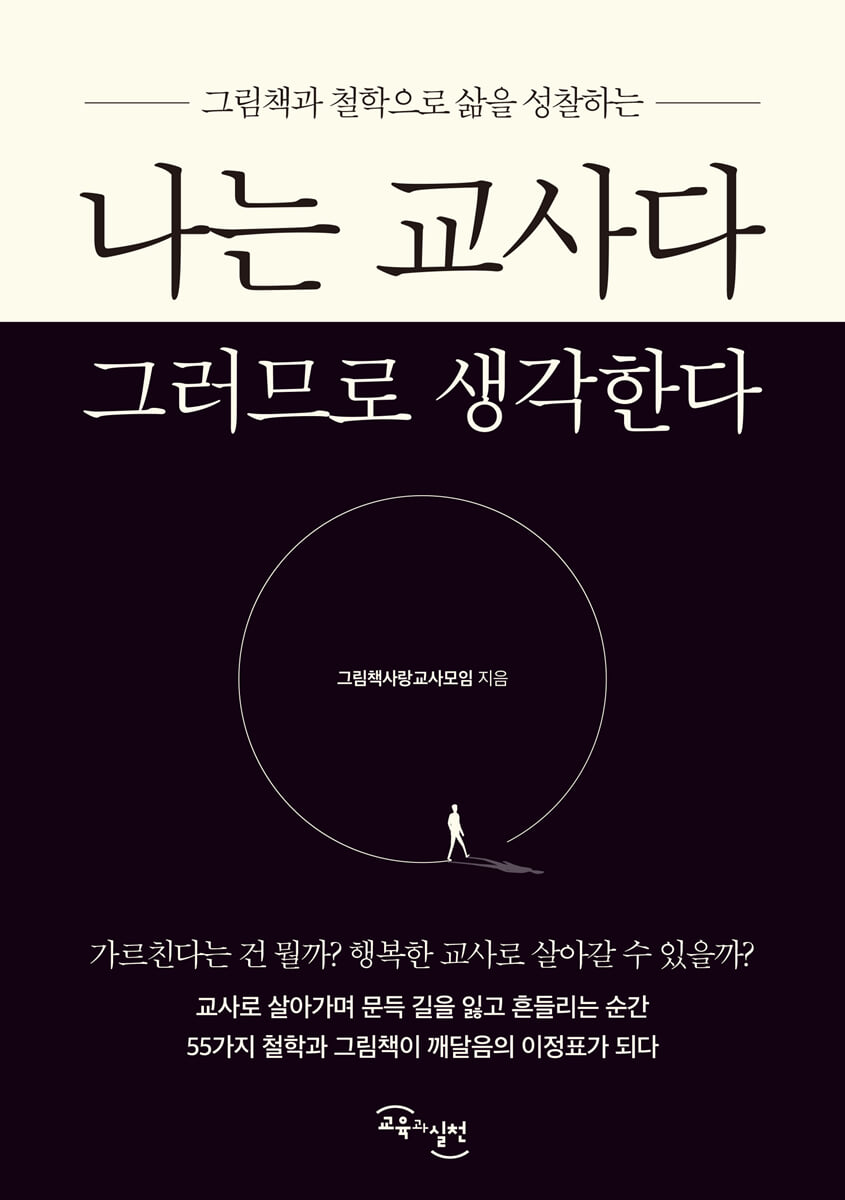
I am a teacher, therefore I think
 |
Description
Book Introduction
A teacher's life, with its daily questions and exclamation points!
To answer the question that I will inevitably face at some point while living as a teacher.
Swim in the sea of thought through 55 picture books and philosophy
I invite my fellow teachers to the bright lighthouse I finally found.
“A teacher must always ask questions about life.
As a teacher, you must ask yourself how you should meet and teach children, and whether you are living properly as a teacher, and find the answers yourself.
Anyone who spends their days just going around in circles will eventually come to a dead end.”_From ‘Introduction’
Every life is different, but a teacher's life is particularly fraught with question marks.
Not only is the weight of education immense, but the countless people and institutions involved in the teaching-learning relationship constantly ask questions and demand answers and action.
This is why teachers need more reason.
"I am a teacher who reflects on life through picture books and philosophy, therefore I think" contains thoughts and reflections on the questions encountered while living as a teacher.
Facing 43 questions about the essence of education, the profession of teaching, and the classroom and school as educational settings, we approach answers one step at a time by summoning 55 philosophical ideas and picture books.
As you read, you'll discover that philosophy is a vital companion for a teacher's life, one that's constantly vacillating and moving forward, and that picture books are a medium that conveys messages more clearly and kindly.
When I wonder if I'm doing a good job as a teacher, when I feel like I've lost the strength that has sustained me, let's open "I am a teacher who reflects on life through picture books and philosophy, so I think."
The vivid experiences and reflections of fellow teachers who have reached dead ends and reached the abyss of thought while living as teachers are enough to shed a small exclamation point before big questions.
To answer the question that I will inevitably face at some point while living as a teacher.
Swim in the sea of thought through 55 picture books and philosophy
I invite my fellow teachers to the bright lighthouse I finally found.
“A teacher must always ask questions about life.
As a teacher, you must ask yourself how you should meet and teach children, and whether you are living properly as a teacher, and find the answers yourself.
Anyone who spends their days just going around in circles will eventually come to a dead end.”_From ‘Introduction’
Every life is different, but a teacher's life is particularly fraught with question marks.
Not only is the weight of education immense, but the countless people and institutions involved in the teaching-learning relationship constantly ask questions and demand answers and action.
This is why teachers need more reason.
"I am a teacher who reflects on life through picture books and philosophy, therefore I think" contains thoughts and reflections on the questions encountered while living as a teacher.
Facing 43 questions about the essence of education, the profession of teaching, and the classroom and school as educational settings, we approach answers one step at a time by summoning 55 philosophical ideas and picture books.
As you read, you'll discover that philosophy is a vital companion for a teacher's life, one that's constantly vacillating and moving forward, and that picture books are a medium that conveys messages more clearly and kindly.
When I wonder if I'm doing a good job as a teacher, when I feel like I've lost the strength that has sustained me, let's open "I am a teacher who reflects on life through picture books and philosophy, so I think."
The vivid experiences and reflections of fellow teachers who have reached dead ends and reached the abyss of thought while living as teachers are enough to shed a small exclamation point before big questions.
- You can preview some of the book's contents.
Preview
index
Recommendation / Introduction
Part 1.
Reflecting on Learning and Teaching_On the Essence of Education
1 What is the role of a teacher? Plato and the Red Wall
2 What does it mean to learn? ... Socrates and "What does it mean to learn?"
3. What Kind of Teacher Should I Be? ··· Buddhism and "I Am the Subway"
4. What does a kind teacher look like? Confucius and "Kind Behavior"
5 How Should We Love Children? Mozi and "What About Us?"
6 Will a teacher's love change children? ··· Jesus and "Shine the Light"
7. Want to connect with your children? ··· Wonhyo and "Making Up Your Mind"
8. What if we look at children with preconceived notions? ... Bacon and "Who Came to the Lion's Room?"
9 How to Love a Child Just as He Is? ... Deleuze and "The Many, Many Greens of the World"
10. How can a shared conversation be meaningful? ··· Lipman and "Beautiful: Tell Me the Beauty You've Found"
11 How Do Children Grow? ... Hegel and "One Fine Day"
12 What Makes a Good Educational Environment for a Child's Growth? ··· Dewey and "The Road to Grandma's House"
13 Why is anxiety necessary for growth? Kierkegaard and "My Little Doll Box"
14 Can Children Find Their True Dreams? ··· Lacan and "My True Wish"
15 What kind of seeds do children have? ··· Pico and "What kind of seed are you?"
16 Are Children Conscientious Beings? Kant and The Red Cicada
17 How Should Student Life Education Be Done? ··· Bentham and Hedgehog X
18 What is a school community? ··· Confucius and "To You Who Came to Earth"
19 What kind of experiences should schools provide children? ··· Locke and "Afiya's White Dress"
Part 2.
Living as a Happy Teacher_About the Teaching Profession and the Education Field
1. How to win the hearts of children? ... Hobbes and "Mr. Nelson Has Disappeared!"
2. What is the appropriate distance between children and themselves? ··· Schopenhauer and The Hedgehog's Thorns
3 What is true forgiveness? ... Derrida and "The Lion Has Grow Smaller!"
4. Who is the more honest child? Kant and "John the Evangelist"
5. Struggling with communication issues with children? ... Wittgenstein and "The Land of Word Factories"
6. If you want to instill courage in children...? Tillich and "The Picnic"
7. Want to teach autonomy and responsibility? ··· Rousseau and "The Happiness Cook"
8. Is there a way to live as a happy teacher? ··· Sartre and The Priest with the Oars
9 Repetitive Lessons: How to Avoid Falling into Mannerism? ··· Nietzsche and "At the Door"
10. When your confidence as a teacher falters? Mencius and "Jump, Grasshopper"
11 How to Deal with Conflicts with Teachers? ··· Habermas and the Ping-Pong Club
12 Can I Follow My Own Path Without Comparing Myself to Other Teachers? ··· Zhuangzi and The Road No One Has Taken
13. When you feel emotionally drained when comparing yourself to friends in other professions? ··· Mencius and "The Journey of the Heart"
14 What if the balance between a teacher's life and their personal life is lost? Aristotle and "Equilibrium"
15. When Material Desires Make Me Worried? - Epicurus and "The Best Tea"
16. What if we're engaging in educational activities without sufficient reflection? ··· Arendt and "Let No One Pass!"
What kind of leadership is needed for a head teacher? ··· Lao Tzu, "When the Bear Went Down the River"
18 Will teachers be replaced by artificial intelligence in the future? Levinas and "I Really Curious!"
Part 3.
Back to Basics: Philosophical Concepts Teachers Need to Know
1 What does it mean to know? - About 'knowledge'... Plato and 'Is This Really an Apple?', Gettier and 'Did You Hear That?', Confucius and 'Follow the Moonlight Home'
2 Is this really me? - About the 'self'... Descartes and 'What can 'thought' do?', Hume and 'Is this really me?', Kant and 'Should I be good?'
3 What does it mean to be free-spirited? - On 'freedom'... The Stoics and 'The Fool', Mill and 'As I Will', Berlin and 'Perfect'
4 What is true beauty? - On 'beauty'... Plato and 'True Beauty', Benjamin and 'Schumann's Special Shoes', Dewey and 'The Sixth Violin'
5 Where is happiness? - About 'happiness'... Smith and 'The Deer Garden', Schopenhauer and 'I Envy You', Buddha and 'Do You Want It Too?'
6 Are Life and Death Separate? - About 'Death'... Zhuangzi and 'When the Wind Stops', Buddhism and 'The Wire Elephant', Heidegger and 'I'll Be With You'
Part 1.
Reflecting on Learning and Teaching_On the Essence of Education
1 What is the role of a teacher? Plato and the Red Wall
2 What does it mean to learn? ... Socrates and "What does it mean to learn?"
3. What Kind of Teacher Should I Be? ··· Buddhism and "I Am the Subway"
4. What does a kind teacher look like? Confucius and "Kind Behavior"
5 How Should We Love Children? Mozi and "What About Us?"
6 Will a teacher's love change children? ··· Jesus and "Shine the Light"
7. Want to connect with your children? ··· Wonhyo and "Making Up Your Mind"
8. What if we look at children with preconceived notions? ... Bacon and "Who Came to the Lion's Room?"
9 How to Love a Child Just as He Is? ... Deleuze and "The Many, Many Greens of the World"
10. How can a shared conversation be meaningful? ··· Lipman and "Beautiful: Tell Me the Beauty You've Found"
11 How Do Children Grow? ... Hegel and "One Fine Day"
12 What Makes a Good Educational Environment for a Child's Growth? ··· Dewey and "The Road to Grandma's House"
13 Why is anxiety necessary for growth? Kierkegaard and "My Little Doll Box"
14 Can Children Find Their True Dreams? ··· Lacan and "My True Wish"
15 What kind of seeds do children have? ··· Pico and "What kind of seed are you?"
16 Are Children Conscientious Beings? Kant and The Red Cicada
17 How Should Student Life Education Be Done? ··· Bentham and Hedgehog X
18 What is a school community? ··· Confucius and "To You Who Came to Earth"
19 What kind of experiences should schools provide children? ··· Locke and "Afiya's White Dress"
Part 2.
Living as a Happy Teacher_About the Teaching Profession and the Education Field
1. How to win the hearts of children? ... Hobbes and "Mr. Nelson Has Disappeared!"
2. What is the appropriate distance between children and themselves? ··· Schopenhauer and The Hedgehog's Thorns
3 What is true forgiveness? ... Derrida and "The Lion Has Grow Smaller!"
4. Who is the more honest child? Kant and "John the Evangelist"
5. Struggling with communication issues with children? ... Wittgenstein and "The Land of Word Factories"
6. If you want to instill courage in children...? Tillich and "The Picnic"
7. Want to teach autonomy and responsibility? ··· Rousseau and "The Happiness Cook"
8. Is there a way to live as a happy teacher? ··· Sartre and The Priest with the Oars
9 Repetitive Lessons: How to Avoid Falling into Mannerism? ··· Nietzsche and "At the Door"
10. When your confidence as a teacher falters? Mencius and "Jump, Grasshopper"
11 How to Deal with Conflicts with Teachers? ··· Habermas and the Ping-Pong Club
12 Can I Follow My Own Path Without Comparing Myself to Other Teachers? ··· Zhuangzi and The Road No One Has Taken
13. When you feel emotionally drained when comparing yourself to friends in other professions? ··· Mencius and "The Journey of the Heart"
14 What if the balance between a teacher's life and their personal life is lost? Aristotle and "Equilibrium"
15. When Material Desires Make Me Worried? - Epicurus and "The Best Tea"
16. What if we're engaging in educational activities without sufficient reflection? ··· Arendt and "Let No One Pass!"
What kind of leadership is needed for a head teacher? ··· Lao Tzu, "When the Bear Went Down the River"
18 Will teachers be replaced by artificial intelligence in the future? Levinas and "I Really Curious!"
Part 3.
Back to Basics: Philosophical Concepts Teachers Need to Know
1 What does it mean to know? - About 'knowledge'... Plato and 'Is This Really an Apple?', Gettier and 'Did You Hear That?', Confucius and 'Follow the Moonlight Home'
2 Is this really me? - About the 'self'... Descartes and 'What can 'thought' do?', Hume and 'Is this really me?', Kant and 'Should I be good?'
3 What does it mean to be free-spirited? - On 'freedom'... The Stoics and 'The Fool', Mill and 'As I Will', Berlin and 'Perfect'
4 What is true beauty? - On 'beauty'... Plato and 'True Beauty', Benjamin and 'Schumann's Special Shoes', Dewey and 'The Sixth Violin'
5 Where is happiness? - About 'happiness'... Smith and 'The Deer Garden', Schopenhauer and 'I Envy You', Buddha and 'Do You Want It Too?'
6 Are Life and Death Separate? - About 'Death'... Zhuangzi and 'When the Wind Stops', Buddhism and 'The Wire Elephant', Heidegger and 'I'll Be With You'
Into the book
-For John Dewey, knowledge is a useful tool that helps solve problem situations.
According to him, the solution to the problem is formed through the experience of each learner, and it evolves and changes with the times.
Ultimately, life is a process of problem solving, and that is growth.
Therefore, a good educational environment should be able to encourage learners to reconstruct their experiences.
-The picture book “The Way to Grandma’s House” depicts a child’s journey to find his grandmother’s house alone.
The child takes the wrong path and has an independent experience that is distinct from the experience of the path made and walked by adults.
(Omitted) The child thinks about giving up and turning back, but he gathers his courage and takes one step at a time.
Solve problems solely from the child's perspective, without relying on existing stereotypes or cognitive frameworks.
-The grammar of life of the parental generation is no longer valid.
The future demands the ability to create new ways to drive change.
Creativity and originality flourish in a permissive and democratic atmosphere that allows for self-direction.
That's why it's even more important to give children time to think things through on their own in problem situations, to try things out on their own, and to experience both success and failure.
---「Part 1 12.
"What is a good educational environment that helps children grow?" ··· From Dewey and "The Road to Grandmother's House"
-Friedrich Wilhelm Nietzsche, while presupposing that life is meaningless and painful, says that we should live as if we were playing, assuming that 'living is an eternal repetition of the same thing.'
It tells us to love our lives and make them even more lovable, even if the same present repeats itself forever.
Nietzsche believed that humans were not so weak as they were, and that if they could realize their own strength and properly utilize their will to power, they could live their lives with autonomy.
-The three sisters in the picture book “At the Door” show the human race facing a boringly repetitive life.
When doors keep appearing no matter how many times he opens them, the first one gives up and turns into a tree, escaping the pain and boredom.
The second one runs away saying he'll find the key, like an evasive person who ignores the harsh reality.
Third, it opens doors thousands and tens of thousands of times and finally brings about change.
In him, we can find the figure of the 'Ubermensch' (superman) who, as Nietzsche said, does not succumb to pain and boredom, but bravely faces them and creates his own destiny.
Is teaching a repetitive "skill" or a creative "art"? Should teachers strive to achieve that of a "master" or a "craftsman"? Each encounter with a new, living being, experiencing change and growth together, is a creative process.
Therefore, teachers must pour their heart and soul into each and every work of art, called a class, with the same mind as a craftsman creating a work of art.
According to him, the solution to the problem is formed through the experience of each learner, and it evolves and changes with the times.
Ultimately, life is a process of problem solving, and that is growth.
Therefore, a good educational environment should be able to encourage learners to reconstruct their experiences.
-The picture book “The Way to Grandma’s House” depicts a child’s journey to find his grandmother’s house alone.
The child takes the wrong path and has an independent experience that is distinct from the experience of the path made and walked by adults.
(Omitted) The child thinks about giving up and turning back, but he gathers his courage and takes one step at a time.
Solve problems solely from the child's perspective, without relying on existing stereotypes or cognitive frameworks.
-The grammar of life of the parental generation is no longer valid.
The future demands the ability to create new ways to drive change.
Creativity and originality flourish in a permissive and democratic atmosphere that allows for self-direction.
That's why it's even more important to give children time to think things through on their own in problem situations, to try things out on their own, and to experience both success and failure.
---「Part 1 12.
"What is a good educational environment that helps children grow?" ··· From Dewey and "The Road to Grandmother's House"
-Friedrich Wilhelm Nietzsche, while presupposing that life is meaningless and painful, says that we should live as if we were playing, assuming that 'living is an eternal repetition of the same thing.'
It tells us to love our lives and make them even more lovable, even if the same present repeats itself forever.
Nietzsche believed that humans were not so weak as they were, and that if they could realize their own strength and properly utilize their will to power, they could live their lives with autonomy.
-The three sisters in the picture book “At the Door” show the human race facing a boringly repetitive life.
When doors keep appearing no matter how many times he opens them, the first one gives up and turns into a tree, escaping the pain and boredom.
The second one runs away saying he'll find the key, like an evasive person who ignores the harsh reality.
Third, it opens doors thousands and tens of thousands of times and finally brings about change.
In him, we can find the figure of the 'Ubermensch' (superman) who, as Nietzsche said, does not succumb to pain and boredom, but bravely faces them and creates his own destiny.
Is teaching a repetitive "skill" or a creative "art"? Should teachers strive to achieve that of a "master" or a "craftsman"? Each encounter with a new, living being, experiencing change and growth together, is a creative process.
Therefore, teachers must pour their heart and soul into each and every work of art, called a class, with the same mind as a craftsman creating a work of art.
---「Part 2, Chapter 8.
"How to avoid falling into repetitive lessons and mannerism?" - From Nietzsche and "At the Door"
"How to avoid falling into repetitive lessons and mannerism?" - From Nietzsche and "At the Door"
Publisher's Review
[Book Structure]
- Part 1, ‘Contemplating Learning and Teaching’, reflects on the essence of education.
We ask and seek answers to questions such as what the role of a teacher is, what kind of teacher they should be, how to love children, and what kind of educational environment should be created to support their proper growth.
- Part 2, 'Living as a Happy Teacher', looks back on the profession of teaching and ponders answers to questions raised by the classroom and educational community.
When you lose the balance between your teaching life and your personal life, when you envy friends in other professions, when you fall into a rut due to repetitive classes, or when you experience conflict with a fellow teacher, let's think together about how to overcome crises and live as a happy teacher.
-Part 3, 'Back to Basics,' organizes the philosophical concepts that underlie all of the thinking in this book, suggesting a starting point and direction for thinking.
It leads us to reconsider how we should view knowledge, self, freedom, beauty, happiness, and death, and how we should integrate them into our lives.
[Book Features]
Illuminating Thoughts and Reflections from 55 Philosophies and Picture Books
Isn't philosophy a difficult subject? Why do teachers need it? The authors argue that both philosophy and picture books are grounded in our lives.
Philosophy makes us ask fundamental questions about life, and picture books make us think about how we should live in the world.
Philosophy is about cultivating the 'power to think for oneself' and 'enable one to ask good questions' in a world where there are no set answers, and picture books allow one to reflect on one's own life by reading them while projecting the context of one's current life.
This book poses 43 questions and seeks answers by borrowing 55 philosophers' thoughts and 55 picture books tailored to each topic.
However, just as philosophy as a discipline does not claim to have a single correct answer, and just as there are different ways to interpret picture books, this book does not force the teacher to answer questions by saying, “This is the correct path, so go this way.”
However, by leaning on the ideas of great philosophers who transcend time and find a direction for your thoughts, and by reflecting on yourself while responding to free and inclusive picture books, you will find yourself one step closer to the enlightenment of life that shines like a jewel.
- Part 1, ‘Contemplating Learning and Teaching’, reflects on the essence of education.
We ask and seek answers to questions such as what the role of a teacher is, what kind of teacher they should be, how to love children, and what kind of educational environment should be created to support their proper growth.
- Part 2, 'Living as a Happy Teacher', looks back on the profession of teaching and ponders answers to questions raised by the classroom and educational community.
When you lose the balance between your teaching life and your personal life, when you envy friends in other professions, when you fall into a rut due to repetitive classes, or when you experience conflict with a fellow teacher, let's think together about how to overcome crises and live as a happy teacher.
-Part 3, 'Back to Basics,' organizes the philosophical concepts that underlie all of the thinking in this book, suggesting a starting point and direction for thinking.
It leads us to reconsider how we should view knowledge, self, freedom, beauty, happiness, and death, and how we should integrate them into our lives.
[Book Features]
Illuminating Thoughts and Reflections from 55 Philosophies and Picture Books
Isn't philosophy a difficult subject? Why do teachers need it? The authors argue that both philosophy and picture books are grounded in our lives.
Philosophy makes us ask fundamental questions about life, and picture books make us think about how we should live in the world.
Philosophy is about cultivating the 'power to think for oneself' and 'enable one to ask good questions' in a world where there are no set answers, and picture books allow one to reflect on one's own life by reading them while projecting the context of one's current life.
This book poses 43 questions and seeks answers by borrowing 55 philosophers' thoughts and 55 picture books tailored to each topic.
However, just as philosophy as a discipline does not claim to have a single correct answer, and just as there are different ways to interpret picture books, this book does not force the teacher to answer questions by saying, “This is the correct path, so go this way.”
However, by leaning on the ideas of great philosophers who transcend time and find a direction for your thoughts, and by reflecting on yourself while responding to free and inclusive picture books, you will find yourself one step closer to the enlightenment of life that shines like a jewel.
GOODS SPECIFICS
- Date of issue: May 17, 2024
- Page count, weight, size: 332 pages | 446g | 148*210*20mm
- ISBN13: 9791191724547
- ISBN10: 1191724549
You may also like
카테고리
korean


korean

![GQ KOREA Mark (Monthly): December [2025]](http://librairie.coreenne.fr/cdn/shop/files/8ef265dbbfbf186523ed75ba7319009d.jpg?v=1765340328&width=3840)


