

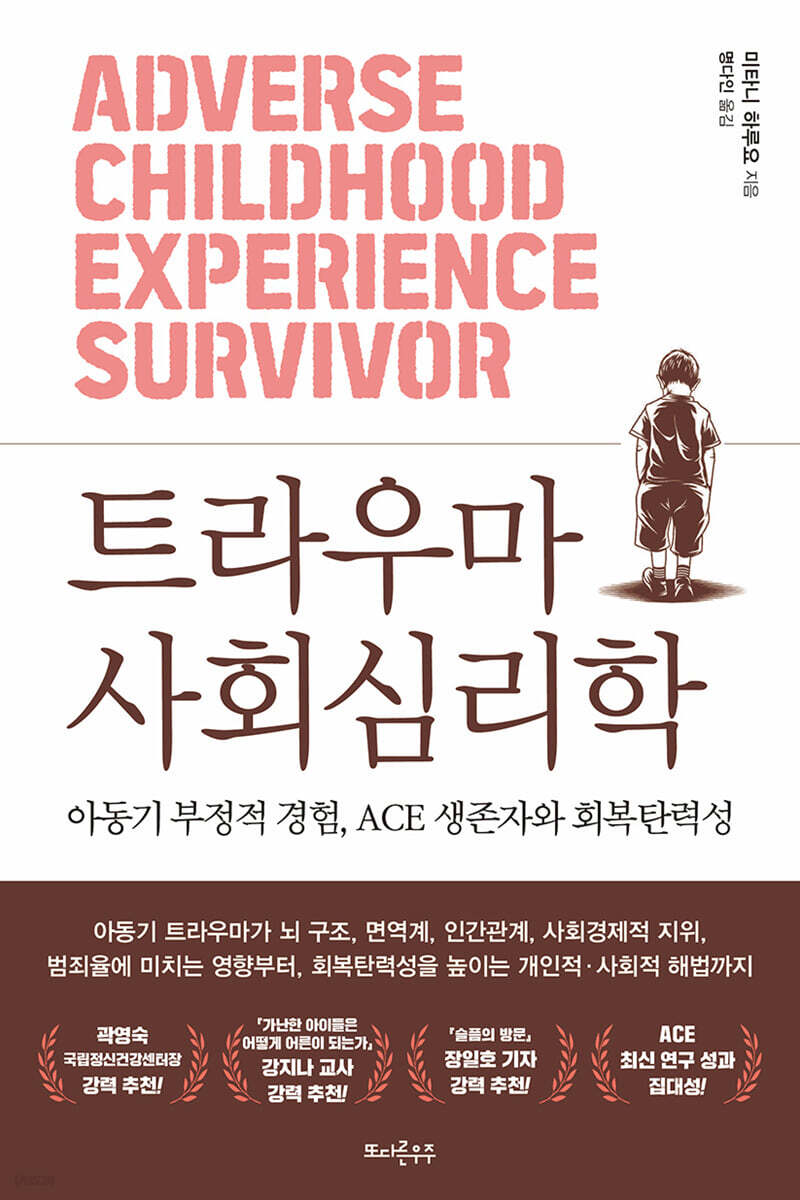
Trauma Social Psychology
 |
Description
Book Introduction
Childhood trauma affects brain structure, the immune system, relationships, socioeconomic status,
From the impact on crime rates to personal and social solutions that increase resilience.
A masterpiece that compiles the latest research findings on Adverse Childhood Experiences (ACEs)!
Adverse childhood experiences (ACEs), such as child abuse and neglect, family suicide, and parental alcoholism or mental illness, often make for sensational news, but academic research on them began in earnest in the 1990s.
Over the past several decades, a vast body of research has accumulated on how ACEs affect mental and physical health, socioeconomic status, and interpersonal relationships in adulthood. However, most of the relevant data is in English-language papers and is therefore not widely available to the general public.
Those who experienced four or more adverse childhood experiences were 2.2 times more likely to develop heart disease, 2.4 times more likely to develop stroke, 3.9 times more likely to develop chronic lung disease, 7.4 times more likely to develop alcohol dependence, 4.6 times more likely to develop depression, 3.2 times more likely to have had sex with more than 50 people, and 12.2 times more likely to attempt suicide. ACE survivors experience a lifetime of suffering as these negative experiences accumulate.
The gap in living environment of the family that is born by chance leads to multifaceted gaps throughout life.
Haruyo Mitani, an authority on welfare sociology and family sociology, describes the suffering of ACE survivors, which is not visible on the surface due to factors such as ethnicity or disability, as “the problem of a minority in a blind spot.”
The author wrote this book to compile and easily understand the academic achievements of the ACE Research, which studies the impact of childhood trauma on a child's entire lifespan. This book aims to provide the foundational knowledge for establishing prevention systems and social support systems to create a world where no one becomes a victim or perpetrator of ACEs and where ACE survivors can recover and live well.
ACE expert Kwak Young-sook, former president of the Korean Academy of Child and Adolescent Psychiatry and current director of the National Center for Mental Health; youth policy researcher and teacher Kang Ji-na, author of “How Poor Children Become Adults,” and SisaIN reporter Jang Il-ho, author of the essay “A Visit of Sadness” as an ACE survivor, all strongly recommended this book as a book that is absolutely necessary for Korean society today.
From the impact on crime rates to personal and social solutions that increase resilience.
A masterpiece that compiles the latest research findings on Adverse Childhood Experiences (ACEs)!
Adverse childhood experiences (ACEs), such as child abuse and neglect, family suicide, and parental alcoholism or mental illness, often make for sensational news, but academic research on them began in earnest in the 1990s.
Over the past several decades, a vast body of research has accumulated on how ACEs affect mental and physical health, socioeconomic status, and interpersonal relationships in adulthood. However, most of the relevant data is in English-language papers and is therefore not widely available to the general public.
Those who experienced four or more adverse childhood experiences were 2.2 times more likely to develop heart disease, 2.4 times more likely to develop stroke, 3.9 times more likely to develop chronic lung disease, 7.4 times more likely to develop alcohol dependence, 4.6 times more likely to develop depression, 3.2 times more likely to have had sex with more than 50 people, and 12.2 times more likely to attempt suicide. ACE survivors experience a lifetime of suffering as these negative experiences accumulate.
The gap in living environment of the family that is born by chance leads to multifaceted gaps throughout life.
Haruyo Mitani, an authority on welfare sociology and family sociology, describes the suffering of ACE survivors, which is not visible on the surface due to factors such as ethnicity or disability, as “the problem of a minority in a blind spot.”
The author wrote this book to compile and easily understand the academic achievements of the ACE Research, which studies the impact of childhood trauma on a child's entire lifespan. This book aims to provide the foundational knowledge for establishing prevention systems and social support systems to create a world where no one becomes a victim or perpetrator of ACEs and where ACE survivors can recover and live well.
ACE expert Kwak Young-sook, former president of the Korean Academy of Child and Adolescent Psychiatry and current director of the National Center for Mental Health; youth policy researcher and teacher Kang Ji-na, author of “How Poor Children Become Adults,” and SisaIN reporter Jang Il-ho, author of the essay “A Visit of Sadness” as an ACE survivor, all strongly recommended this book as a book that is absolutely necessary for Korean society today.
- You can preview some of the book's contents.
Preview
index
Entering
Chapter 1: ACE Research and the Problems of the Modern Family
Adverse Childhood Experiences│The Current State of Child Abuse and Domestic Violence│Family: A Hotbed of Conflict│Facing the Reality of Blind Spots
Chapter 2: Changes in Body and Mind
[The Beginning of the ACE Study] What a Doctor Discovered│The First ACE Study with 17,337 Participants│The Impact on Health in Adulthood
[ACE-induced diseases] ACE-induced mental and physical illnesses│Japanese ACE research
[The mechanism by which ACE causes disease] ACE pyramid│Mechanism 1.
Changes in stress response│Mechanism 2.
Changes in the brain itself│Mechanism 3.
epigenetic changes
[Boron 1] The Link Between ACE and Crime
[Boron 2] Significance and Challenges of ACE Research
Chapter 3: Impact on Socioeconomic Status
[Effects on Education, Employment, and Income] Low Education, Unemployment, and Poverty│Why ACEs Affect Socioeconomic Status
[Japan's 'Life Science Web Survey'] ACE Status: A Look at Data from 20,000 People Nationwide | ACE Score Distribution | The Relationship Between ACE and Health Indicators
[ACE Survivors' Socioeconomic Status] Education, Employment, and Income by ACE Score│Is It the Influence of Social Class or ACE?
Chapter 4: Impact on Human Relationships
[Interpersonal Difficulties] Trauma Disorders in ACE Survivors│Difficulties in Forming Attachment│Two Types of Attachment Disorders
[ACE Survivors' Relationships] ACE Survivors' Dating, Marriage, and Parenting│ACE and Marriage, Having a Partner│ACE and Social Isolation
[ACEs Chained from Generation to Generation] Parenting of ACE Survivors│National Survey Reveals a Chain of Negative Experiences
[Boron 3] The Negative Impact of ACEs That Transcends Generations
Chapter 5: ACEs and Resilience
[The Key to Reversal: Resilience] Resilience in the Spotlight│Ten Prescriptions for Building Resilience│The Hidden Theory of Self-Responsibility
[Resilience Factors] External Factors of Resilience│Factors that Boost Resilience│Promoting and Protective Factors
[Resilience Factors Based on National Survey Data] Positive Childhood Experiences (Promoting Factor)│Social Support in Childhood (Protective Factor)
Chapter 6: Stories from ACE Survivors
How did ACE survivors survive?
[Escape from a life of paying for living]
[Until I broke free from my adoptive mother's shackles]
Factors That Boost ACE Survivors' Resilience
[Factors that hinder the resilience of ACE survivors] 'Retrauma' caused by others' lack of understanding│The Reality of Retrauma
Chapter 7: A Society Where ACE Survivors Are Not Disadvantaged
[Minorities in Blind Spots] Key Factors in the Life Gap│Victims of a Distorted Social Structure
[Social Structure Against ACE] ACE Response and Prevention Measures Abroad│Japan's Case Study on ACE Response
[To become a society friendly to ACE survivors] 1.
Introduction of ACE·TIC training to applicant training sites│2.
Education and survivor support in schools│3.
Improving the Child Abuse Response System│4.
Preventive education starting from pregnancy
Acknowledgements
Coming out
References
Chapter 1: ACE Research and the Problems of the Modern Family
Adverse Childhood Experiences│The Current State of Child Abuse and Domestic Violence│Family: A Hotbed of Conflict│Facing the Reality of Blind Spots
Chapter 2: Changes in Body and Mind
[The Beginning of the ACE Study] What a Doctor Discovered│The First ACE Study with 17,337 Participants│The Impact on Health in Adulthood
[ACE-induced diseases] ACE-induced mental and physical illnesses│Japanese ACE research
[The mechanism by which ACE causes disease] ACE pyramid│Mechanism 1.
Changes in stress response│Mechanism 2.
Changes in the brain itself│Mechanism 3.
epigenetic changes
[Boron 1] The Link Between ACE and Crime
[Boron 2] Significance and Challenges of ACE Research
Chapter 3: Impact on Socioeconomic Status
[Effects on Education, Employment, and Income] Low Education, Unemployment, and Poverty│Why ACEs Affect Socioeconomic Status
[Japan's 'Life Science Web Survey'] ACE Status: A Look at Data from 20,000 People Nationwide | ACE Score Distribution | The Relationship Between ACE and Health Indicators
[ACE Survivors' Socioeconomic Status] Education, Employment, and Income by ACE Score│Is It the Influence of Social Class or ACE?
Chapter 4: Impact on Human Relationships
[Interpersonal Difficulties] Trauma Disorders in ACE Survivors│Difficulties in Forming Attachment│Two Types of Attachment Disorders
[ACE Survivors' Relationships] ACE Survivors' Dating, Marriage, and Parenting│ACE and Marriage, Having a Partner│ACE and Social Isolation
[ACEs Chained from Generation to Generation] Parenting of ACE Survivors│National Survey Reveals a Chain of Negative Experiences
[Boron 3] The Negative Impact of ACEs That Transcends Generations
Chapter 5: ACEs and Resilience
[The Key to Reversal: Resilience] Resilience in the Spotlight│Ten Prescriptions for Building Resilience│The Hidden Theory of Self-Responsibility
[Resilience Factors] External Factors of Resilience│Factors that Boost Resilience│Promoting and Protective Factors
[Resilience Factors Based on National Survey Data] Positive Childhood Experiences (Promoting Factor)│Social Support in Childhood (Protective Factor)
Chapter 6: Stories from ACE Survivors
How did ACE survivors survive?
[Escape from a life of paying for living]
[Until I broke free from my adoptive mother's shackles]
Factors That Boost ACE Survivors' Resilience
[Factors that hinder the resilience of ACE survivors] 'Retrauma' caused by others' lack of understanding│The Reality of Retrauma
Chapter 7: A Society Where ACE Survivors Are Not Disadvantaged
[Minorities in Blind Spots] Key Factors in the Life Gap│Victims of a Distorted Social Structure
[Social Structure Against ACE] ACE Response and Prevention Measures Abroad│Japan's Case Study on ACE Response
[To become a society friendly to ACE survivors] 1.
Introduction of ACE·TIC training to applicant training sites│2.
Education and survivor support in schools│3.
Improving the Child Abuse Response System│4.
Preventive education starting from pregnancy
Acknowledgements
Coming out
References
Detailed image
.jpg)
Into the book
The first thing A remembers is the feeling of being 'suffocated'.
A felt like she was struggling in the sea but couldn't breathe, and thought, 'Isn't this a memory of being abused when I was in my mother's womb?'
The feeling of being lifted into the air and then thrown to the floor, the shock, the disgust when your face is wiped with the rag that was used to clean the bathroom floor, the fear of being curled up under the blanket, not knowing when you will be punched or kicked... Memories from before you became wise still torment A.
---From "Entering"
Today, ACE research is spreading worldwide.
As of October 2022, a search for "Adverse Childhood Experiences" on the Web of Science database, which contains academic papers from around the world, yields over 2,500 papers.
Originating in epidemiology, the study of disease has spread to psychiatry, neuroscience, genetics, psychology, nursing, and social work.
Each research field is exploring various aspects of ACE, including its influence and mechanisms and countermeasures in clinical settings.
---From "Chapter 1 ACE Research and the Problems of the Modern Family"
ACE is a concept closely related to 'adult child' and 'toxic parent'.
But there is a clear difference.
The point is that ACE is an objective concept regardless of whether the person involved recognizes himself or herself as a 'victim'.
Rather than relying on the individual's judgment, the presence or absence of ACEs and whether a person is an ACE survivor is determined based on the individual's past experiences. ACEs are a concept that recognizes the problem of a child growing up in an extremely stressful environment and aims to objectively assess the long-term impact of such situations.
Rather than accepting these problems as 'actions and consequences' like 'child abuse and its trauma' and separating them into 'perpetrator/victim' and 'perpetrator/victim', the ACE study has its own uniqueness and value in that it focuses on the living environment.
---From “Chapter 2: Changes in Body and Mind”
When the human body is exposed to excessive stress for a long period of time and repeatedly in an environment, the epigenome traits change, the brain structure and function change, or the endocrine and immune systems become abnormal, causing physical and mental illness (biological mechanism).
Our bodies are controlled and harmonized by various structures, but the toxic stress caused by ACEs can disrupt this delicate bodily system and harm our health throughout our lives.
---From “Chapter 2: Changes in Body and Mind”
ACE survivors often experience difficulty keeping up in class, studying, feeling unexplained physically and having trouble getting out of bed in the morning.
Moreover, it has been pointed out that people who grow up in an ACE environment tend to view socially encouraged goals negatively and have low motivation to learn and work.
The will to tackle immediate challenges and the desire to pursue a better environment are the foundation for life's opportunities, but ACE survivors struggle to feel this motivation.
---From “Chapter 3: Impact on Socioeconomic Status”
As 'resilience' becomes more prominent, overcoming negative experiences is perceived as a 'personal responsibility'.
It is true that overcoming negative experiences requires the will of the person involved, but in reality, there are people who are in such a painful situation that they cannot even muster that will.
It is extremely cruel to blame someone who has accumulated negative experiences or disadvantages and lacks the strength or courage to change themselves, saying it is their own fault.
---From Chapter 5, ACE and Resilience
B, now fifty-six, is currently working as a doctor at a juvenile detention center.
Eighty percent of the boys said they had experienced abuse.
“I thought I could get a little closer to those kids because I’ve been abused myself,” she says. She says she now feels comfortable at work thanks to her supervisor, who is knowledgeable in psychiatry and psychology and well-versed in corrective medicine, and her colleagues, who she can have easy-going conversations with.
However, I have a drinking problem and attend regular meetings twice a month to help me quit drinking.
B says he still “lives wandering, unable to shake off the desire to go out to sea on a boat and drown.”
“If I am loved unconditionally, without having to give money, maybe I can tell myself, ‘It’s okay to be alive.’
But I still can't imagine that something like that would actually happen." B lives today with the driving force of the thought that 'I might die someday.'
---From "Chapter 6: Stories of ACE Survivors"
On days when he didn't go to school, Y was home alone or spent time with his siblings.
As I was walking home holding his hand, Y said to me, “Let’s play together at home until night falls.
He kept nagging me, saying, “Please.”
I couldn't help but hug the child as he looked so lonely.
It was comforting to know that there was a place just a few minutes from home where Y could stop by at any time, and that there were layers of adults around her who cared for her: adults from the children's cafeteria, community members, administrative staff, and school teachers.
What could I have done for Y, the girl who was the victim of the assault and the boy who was the perpetrator? Not directly involved in providing support, I'm overwhelmed by the pile of work and chores, struggling to even care for my own children... My sense of helplessness grows deeper by the day.
A felt like she was struggling in the sea but couldn't breathe, and thought, 'Isn't this a memory of being abused when I was in my mother's womb?'
The feeling of being lifted into the air and then thrown to the floor, the shock, the disgust when your face is wiped with the rag that was used to clean the bathroom floor, the fear of being curled up under the blanket, not knowing when you will be punched or kicked... Memories from before you became wise still torment A.
---From "Entering"
Today, ACE research is spreading worldwide.
As of October 2022, a search for "Adverse Childhood Experiences" on the Web of Science database, which contains academic papers from around the world, yields over 2,500 papers.
Originating in epidemiology, the study of disease has spread to psychiatry, neuroscience, genetics, psychology, nursing, and social work.
Each research field is exploring various aspects of ACE, including its influence and mechanisms and countermeasures in clinical settings.
---From "Chapter 1 ACE Research and the Problems of the Modern Family"
ACE is a concept closely related to 'adult child' and 'toxic parent'.
But there is a clear difference.
The point is that ACE is an objective concept regardless of whether the person involved recognizes himself or herself as a 'victim'.
Rather than relying on the individual's judgment, the presence or absence of ACEs and whether a person is an ACE survivor is determined based on the individual's past experiences. ACEs are a concept that recognizes the problem of a child growing up in an extremely stressful environment and aims to objectively assess the long-term impact of such situations.
Rather than accepting these problems as 'actions and consequences' like 'child abuse and its trauma' and separating them into 'perpetrator/victim' and 'perpetrator/victim', the ACE study has its own uniqueness and value in that it focuses on the living environment.
---From “Chapter 2: Changes in Body and Mind”
When the human body is exposed to excessive stress for a long period of time and repeatedly in an environment, the epigenome traits change, the brain structure and function change, or the endocrine and immune systems become abnormal, causing physical and mental illness (biological mechanism).
Our bodies are controlled and harmonized by various structures, but the toxic stress caused by ACEs can disrupt this delicate bodily system and harm our health throughout our lives.
---From “Chapter 2: Changes in Body and Mind”
ACE survivors often experience difficulty keeping up in class, studying, feeling unexplained physically and having trouble getting out of bed in the morning.
Moreover, it has been pointed out that people who grow up in an ACE environment tend to view socially encouraged goals negatively and have low motivation to learn and work.
The will to tackle immediate challenges and the desire to pursue a better environment are the foundation for life's opportunities, but ACE survivors struggle to feel this motivation.
---From “Chapter 3: Impact on Socioeconomic Status”
As 'resilience' becomes more prominent, overcoming negative experiences is perceived as a 'personal responsibility'.
It is true that overcoming negative experiences requires the will of the person involved, but in reality, there are people who are in such a painful situation that they cannot even muster that will.
It is extremely cruel to blame someone who has accumulated negative experiences or disadvantages and lacks the strength or courage to change themselves, saying it is their own fault.
---From Chapter 5, ACE and Resilience
B, now fifty-six, is currently working as a doctor at a juvenile detention center.
Eighty percent of the boys said they had experienced abuse.
“I thought I could get a little closer to those kids because I’ve been abused myself,” she says. She says she now feels comfortable at work thanks to her supervisor, who is knowledgeable in psychiatry and psychology and well-versed in corrective medicine, and her colleagues, who she can have easy-going conversations with.
However, I have a drinking problem and attend regular meetings twice a month to help me quit drinking.
B says he still “lives wandering, unable to shake off the desire to go out to sea on a boat and drown.”
“If I am loved unconditionally, without having to give money, maybe I can tell myself, ‘It’s okay to be alive.’
But I still can't imagine that something like that would actually happen." B lives today with the driving force of the thought that 'I might die someday.'
---From "Chapter 6: Stories of ACE Survivors"
On days when he didn't go to school, Y was home alone or spent time with his siblings.
As I was walking home holding his hand, Y said to me, “Let’s play together at home until night falls.
He kept nagging me, saying, “Please.”
I couldn't help but hug the child as he looked so lonely.
It was comforting to know that there was a place just a few minutes from home where Y could stop by at any time, and that there were layers of adults around her who cared for her: adults from the children's cafeteria, community members, administrative staff, and school teachers.
What could I have done for Y, the girl who was the victim of the assault and the boy who was the perpetrator? Not directly involved in providing support, I'm overwhelmed by the pile of work and chores, struggling to even care for my own children... My sense of helplessness grows deeper by the day.
---From "Coming Out"
GOODS SPECIFICS
- Date of issue: May 5, 2024
- Page count, weight, size: 284 pages | 372g | 140*210*17mm
- ISBN13: 9791193281086
- ISBN10: 1193281083
You may also like
카테고리
korean


korean

![GQ KOREA Mark (Monthly): December [2025]](http://librairie.coreenne.fr/cdn/shop/files/8ef265dbbfbf186523ed75ba7319009d.jpg?v=1765340328&width=3840)


