

percent %
 |
Description
Book Introduction
- A word from MD
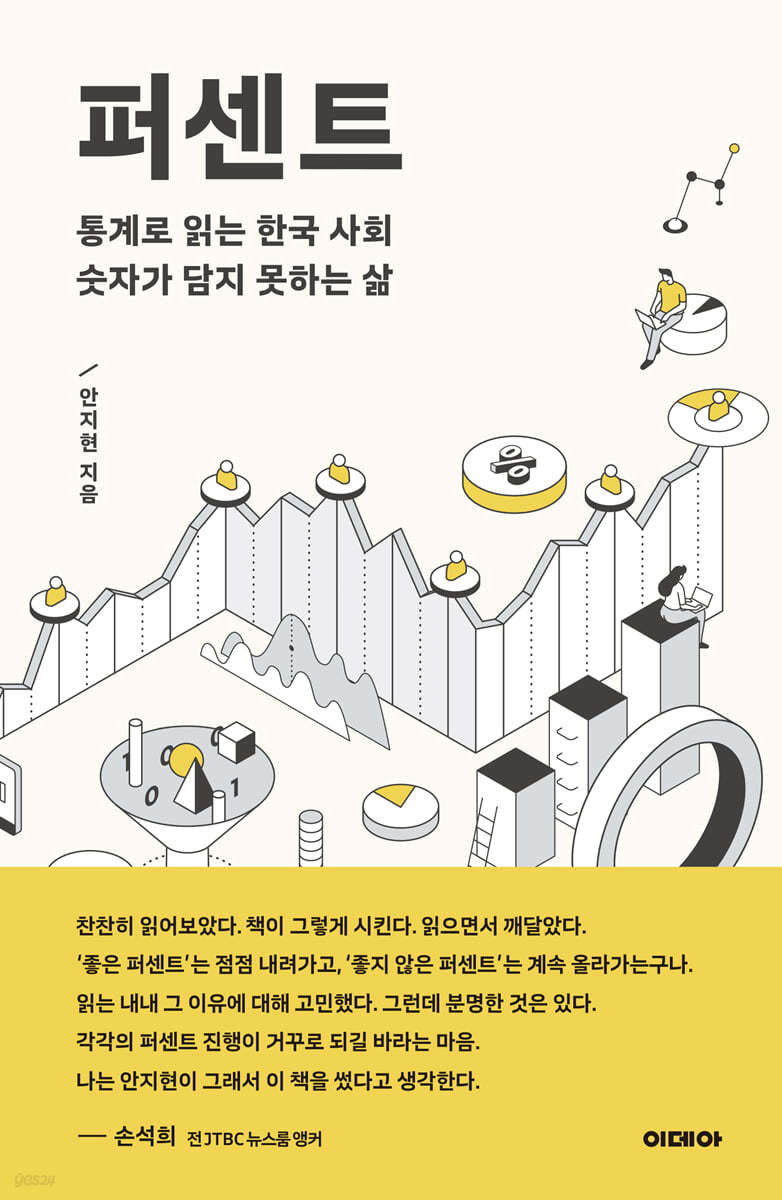
- This book, written by JBCB reporter Ahn Ji-hyun, looks at Korean society through statistics.
Child abuse 14.7%, disabled people going out 21.7%, women taking career breaks 25.3%, and intercity and express buses disappearing 41%.
It's a bad number.
It clearly reveals what is lacking in Korean society today and what needs to be improved.
- Son Min-gyu, Social and Political PD
The clear reality that statistics point to and the life that numbers cannot capture.
From 0% to 95.8%, domestic and international statistics and over 50 different graphs are included.
Covers 40 topics that permeate Korean society, including disasters, generations, housing, education, healthcare, gender, labor, and the environment.
It is not difficult to encounter statistics in Korean society.
Even now, statistics, or 'percentages', are constantly being announced somewhere, such as "OECD average %", "Statistics Korea announcement %", and "OO party approval rating %".
The percentages we encounter in our daily lives allow us to intuitively see reality, but on the other hand, they also quickly evaporate.
Among the overflowing percentage of topics in Korean society, the book selected 40 topics and recorded the statistics.
Some are weighty and macroscopic topics, while others are microscopic topics that can easily be overlooked.
And each percentage figure is likely to change over time.
Nevertheless, the author of this book, Ji-Hyeon Ahn, hopes that “through the 40 topics and statistics contained in the book, we can understand Korean society a little better, and that it can convey the stories of people that percentages and numbers cannot fully convey.”
From 0% to 95.8%, domestic and international statistics and over 50 different graphs are included.
Covers 40 topics that permeate Korean society, including disasters, generations, housing, education, healthcare, gender, labor, and the environment.
It is not difficult to encounter statistics in Korean society.
Even now, statistics, or 'percentages', are constantly being announced somewhere, such as "OECD average %", "Statistics Korea announcement %", and "OO party approval rating %".
The percentages we encounter in our daily lives allow us to intuitively see reality, but on the other hand, they also quickly evaporate.
Among the overflowing percentage of topics in Korean society, the book selected 40 topics and recorded the statistics.
Some are weighty and macroscopic topics, while others are microscopic topics that can easily be overlooked.
And each percentage figure is likely to change over time.
Nevertheless, the author of this book, Ji-Hyeon Ahn, hopes that “through the 40 topics and statistics contained in the book, we can understand Korean society a little better, and that it can convey the stories of people that percentages and numbers cannot fully convey.”
- You can preview some of the book's contents.
Preview
index
prolog
0%~10%
≒0%: The second Sayuri
0.01%: Vietnam War reparations
0.08%: Greenwashing
0.3%: Escape from the semi-basement
0.4%: Security personnel required during congestion
1%: Psychopath
1.6%: 13-year-old juvenile offenders
2.4%: Drug treatment
6.2%: Safe Fare System
11%~30%
12.4%: Women in management positions in science and technology
12.9%: College Admission for Youth Preparing for Independence
14.1%: Elective subject 'Environment'
14.7%: Child abuse
17.3%: Despair among school violence victims
18%: MZ Generation's Communication Methods
21.7%: Disabled people going out
23%: Which jobs will disappear due to AI?
25.3%: Women with career gaps
25.5%: Children who 'cannot eat meat or fish even once a week'
31%~50%
31%: Generation Z's video consumption
35%: Summer in Korea 20 years later
35.7%: Gender equality in Korean films
36%: Housing prices and birth rates
39%: Limitations of School Sexual Violence Disciplinary Action
39.7%: The Real Face of Call Center Labor
41%: Disappearing intercity and express buses
41%: Autistic people
42.2%: Drunk driving
45.5%: MZ generation job change
47%: Why can't I catch a taxi in Seoul?
49.1%: Critically ill emergency patients who 'could not get to the hospital on time'
51%~95.8%
52.4%: The Future of Women Entering Law School
53%: The existence of domestic universities
57%: People who 'cannot accept homosexuality'
66.3%: Death from loneliness
67.8%: Teenagers in the Metaverse
69.5% of MZ Generation respondents said it would be difficult to move up the social ladder.
76.1%: Annual leave usage by Korean workers
81%: Trauma of Sewol Ferry victims' families
95.8%: Without KakaoTalk...
Epilogue
0%~10%
≒0%: The second Sayuri
0.01%: Vietnam War reparations
0.08%: Greenwashing
0.3%: Escape from the semi-basement
0.4%: Security personnel required during congestion
1%: Psychopath
1.6%: 13-year-old juvenile offenders
2.4%: Drug treatment
6.2%: Safe Fare System
11%~30%
12.4%: Women in management positions in science and technology
12.9%: College Admission for Youth Preparing for Independence
14.1%: Elective subject 'Environment'
14.7%: Child abuse
17.3%: Despair among school violence victims
18%: MZ Generation's Communication Methods
21.7%: Disabled people going out
23%: Which jobs will disappear due to AI?
25.3%: Women with career gaps
25.5%: Children who 'cannot eat meat or fish even once a week'
31%~50%
31%: Generation Z's video consumption
35%: Summer in Korea 20 years later
35.7%: Gender equality in Korean films
36%: Housing prices and birth rates
39%: Limitations of School Sexual Violence Disciplinary Action
39.7%: The Real Face of Call Center Labor
41%: Disappearing intercity and express buses
41%: Autistic people
42.2%: Drunk driving
45.5%: MZ generation job change
47%: Why can't I catch a taxi in Seoul?
49.1%: Critically ill emergency patients who 'could not get to the hospital on time'
51%~95.8%
52.4%: The Future of Women Entering Law School
53%: The existence of domestic universities
57%: People who 'cannot accept homosexuality'
66.3%: Death from loneliness
67.8%: Teenagers in the Metaverse
69.5% of MZ Generation respondents said it would be difficult to move up the social ladder.
76.1%: Annual leave usage by Korean workers
81%: Trauma of Sewol Ferry victims' families
95.8%: Without KakaoTalk...
Epilogue
Detailed image
Into the book
“Even if reality doesn’t change immediately, I believe that if we empathize with others we didn’t know existed and share small hopes for improvement, reality will eventually change.”
--- p.7
“Even if we look at just the two villages where the two Nguyen Thi Thanhs were, among the 209 victims [of the Vietnam War massacre], only three, or 1.4%, were men aged 20 to 51.
“Children under the age of 10 accounted for 39.7%, and 70.3% of all victims were female.”
--- p.27
“[After the Seoul Metropolitan Government’s heavy rain countermeasures] As of 2021, only 650 households in Seoul had moved out of semi-basement housing (Ministry of Land, Infrastructure and Transport).
“It was around 0.3% of households living in basements or semi-basements in Seoul.”
--- p.37
“Let’s go back to the percentage of 13-year-old juvenile detention centers that the Ministry of Justice said has increased sharply.
Although it is true that there are more than 10, 11, and 12-year-olds, it still accounts for 1.6% of all juvenile detention center inmates (Ministry of Justice, 2019-2021).
“For this 1.6%, was our society giving them enough opportunities to return to society before talking about criminal ‘punishment’ rather than ‘discipline’?”
--- p.60
“In Korea, the percentage of female executives in domestic listed corporations remains at a mere 5.2% (Ministry of Gender Equality and Family, 2021), and 63.7% of listed companies (Ministry of Gender Equality and Family, 2021) do not have a single female executive.”
--- p.84
“The college advancement rate of those [childcare center] ‘youth preparing for independence’ who turned 18 was surprisingly only 12.9% (1,478 people, Ministry of Health and Welfare, 2021).
There was a significant difference from the national college advancement rate of high school students, which was 73.7% (Jongro Academy, 2021).
“Where would they be if they hadn’t gone to college?”
--- p.86
“Among the respondents who said they did not report school violence, there was a notable figure.
Exactly 17.3%.
When asked why they did not report school violence, the majority of respondents said, “I thought it would be useless to talk about it.”
--- p.107
“Children from low-income families who answered that they “cannot eat meat or fish even once a week” accounted for 25.5% of respondents, or about a quarter.
“It was 1.7% of children in general households, which is 14 times higher.”
--- p.139
“Limited to Korea, the current rice self-sufficiency rate is 92.8%, but a study found that in the worst case scenario due to the climate crisis, it could drop to 55%, or nearly half, in 30 years (Ministry of Agriculture, Food and Rural Affairs; Korea Rural Economic Institute, 2020).
Ultimately, this is why ‘climate change’ is called a ‘climate crisis’ that threatens human life.”
--- p.153
“After the first school MeToo incident, we analyzed sexual violence statistics.
According to statistics on sexual violence reported in 1,348 elementary, middle, and high schools in Seoul over a four-year period starting in 2018, 39% of cases involved reports of assault or sexual harassment, but no action was taken by the school.
“If we include cases that were dismissed with only warnings or cautions, 63% of cases were not actually disciplined.”
--- p.167
“In the past five years, the proportion of deaths due to accidents, such as suicide or falls, among people with autism has reached 41%.
The rate of accidental deaths among people with intellectual disabilities, who are classified as developmentally disabled along with people with autism, was nearly four times higher at 10.4%.
“That’s why the average age at death was 23.8 years old.”
--- p.191
“In a survey conducted in 2020, 57% of respondents answered that they “cannot accept homosexuals in any relationship” (Korea Institute of Public Administration, Social Integration Survey, 2020).
“Compared to the response (69.4%) that ‘I cannot accept a ‘convict’ in any relationship’, the rejection of homosexuals was not that great.”
--- p.238
“Looking at Korea’s inequality index, the average income of the top 20% (KRW 73.39 million) is about six times higher than that of the bottom 20% (KRW 12.32 million) (Statistics Korea, 2021), and the average assets of the top 20% (KRW 1.2091 billion) account for 44% of the total domestic assets (Statistics Korea, 2022 Household Financial Welfare Survey).
Some analysts argue that this substantial inequality, coupled with the high global level of social media usage and time, has led to increased consumption of luxury goods.
--- p.261
“The annual leave utilization rate of Korean workers was 76.1% (Ministry of Culture, Sports and Tourism, 2021 Worker Vacation Status Survey), meaning that out of the average 15.2 days of annual leave granted per year, only 11.6 days were taken.
In this situation, the average annual working hours of Korean workers is 1,910 hours, the fourth highest among OECD member countries and nearly 200 hours more than the OECD average.”
--- p.268
“In a survey conducted in 2021, the percentage of [Sewol ferry victims’ families] who received psychological counseling from experts was not high at 21.5%.
The remaining 78.5% responded that they did not receive professional help (Ansan Onmaum Center, Survey on the Status of Victims of the Sewol Ferry Disaster, 2021).
The reasons were, “I don’t have time to take care of myself,” and “I feel sorry for my child who left first.”
--- p.7
“Even if we look at just the two villages where the two Nguyen Thi Thanhs were, among the 209 victims [of the Vietnam War massacre], only three, or 1.4%, were men aged 20 to 51.
“Children under the age of 10 accounted for 39.7%, and 70.3% of all victims were female.”
--- p.27
“[After the Seoul Metropolitan Government’s heavy rain countermeasures] As of 2021, only 650 households in Seoul had moved out of semi-basement housing (Ministry of Land, Infrastructure and Transport).
“It was around 0.3% of households living in basements or semi-basements in Seoul.”
--- p.37
“Let’s go back to the percentage of 13-year-old juvenile detention centers that the Ministry of Justice said has increased sharply.
Although it is true that there are more than 10, 11, and 12-year-olds, it still accounts for 1.6% of all juvenile detention center inmates (Ministry of Justice, 2019-2021).
“For this 1.6%, was our society giving them enough opportunities to return to society before talking about criminal ‘punishment’ rather than ‘discipline’?”
--- p.60
“In Korea, the percentage of female executives in domestic listed corporations remains at a mere 5.2% (Ministry of Gender Equality and Family, 2021), and 63.7% of listed companies (Ministry of Gender Equality and Family, 2021) do not have a single female executive.”
--- p.84
“The college advancement rate of those [childcare center] ‘youth preparing for independence’ who turned 18 was surprisingly only 12.9% (1,478 people, Ministry of Health and Welfare, 2021).
There was a significant difference from the national college advancement rate of high school students, which was 73.7% (Jongro Academy, 2021).
“Where would they be if they hadn’t gone to college?”
--- p.86
“Among the respondents who said they did not report school violence, there was a notable figure.
Exactly 17.3%.
When asked why they did not report school violence, the majority of respondents said, “I thought it would be useless to talk about it.”
--- p.107
“Children from low-income families who answered that they “cannot eat meat or fish even once a week” accounted for 25.5% of respondents, or about a quarter.
“It was 1.7% of children in general households, which is 14 times higher.”
--- p.139
“Limited to Korea, the current rice self-sufficiency rate is 92.8%, but a study found that in the worst case scenario due to the climate crisis, it could drop to 55%, or nearly half, in 30 years (Ministry of Agriculture, Food and Rural Affairs; Korea Rural Economic Institute, 2020).
Ultimately, this is why ‘climate change’ is called a ‘climate crisis’ that threatens human life.”
--- p.153
“After the first school MeToo incident, we analyzed sexual violence statistics.
According to statistics on sexual violence reported in 1,348 elementary, middle, and high schools in Seoul over a four-year period starting in 2018, 39% of cases involved reports of assault or sexual harassment, but no action was taken by the school.
“If we include cases that were dismissed with only warnings or cautions, 63% of cases were not actually disciplined.”
--- p.167
“In the past five years, the proportion of deaths due to accidents, such as suicide or falls, among people with autism has reached 41%.
The rate of accidental deaths among people with intellectual disabilities, who are classified as developmentally disabled along with people with autism, was nearly four times higher at 10.4%.
“That’s why the average age at death was 23.8 years old.”
--- p.191
“In a survey conducted in 2020, 57% of respondents answered that they “cannot accept homosexuals in any relationship” (Korea Institute of Public Administration, Social Integration Survey, 2020).
“Compared to the response (69.4%) that ‘I cannot accept a ‘convict’ in any relationship’, the rejection of homosexuals was not that great.”
--- p.238
“Looking at Korea’s inequality index, the average income of the top 20% (KRW 73.39 million) is about six times higher than that of the bottom 20% (KRW 12.32 million) (Statistics Korea, 2021), and the average assets of the top 20% (KRW 1.2091 billion) account for 44% of the total domestic assets (Statistics Korea, 2022 Household Financial Welfare Survey).
Some analysts argue that this substantial inequality, coupled with the high global level of social media usage and time, has led to increased consumption of luxury goods.
--- p.261
“The annual leave utilization rate of Korean workers was 76.1% (Ministry of Culture, Sports and Tourism, 2021 Worker Vacation Status Survey), meaning that out of the average 15.2 days of annual leave granted per year, only 11.6 days were taken.
In this situation, the average annual working hours of Korean workers is 1,910 hours, the fourth highest among OECD member countries and nearly 200 hours more than the OECD average.”
--- p.268
“In a survey conducted in 2021, the percentage of [Sewol ferry victims’ families] who received psychological counseling from experts was not high at 21.5%.
The remaining 78.5% responded that they did not receive professional help (Ansan Onmaum Center, Survey on the Status of Victims of the Sewol Ferry Disaster, 2021).
The reasons were, “I don’t have time to take care of myself,” and “I feel sorry for my child who left first.”
--- p.272
Publisher's Review
What 0% and 25.3% mean
The book starts at 0% (strictly speaking, close to 0, ≒0%).
The world was shocked when broadcaster Sayuri gave birth to a blue-eyed child in 2020.
This was because it was the first case of ‘female childbirth alone’ or ‘childbirth out of wedlock’ to appear in Korean society.
Until then, there had been no reported cases of ‘giving birth through sperm donation without marriage in Korea.’
Is this impossible in Korea, where birth rates hit record lows every year? Surprisingly, there's no law prohibiting it.
However, the ethical guidelines of the Korean Society of Obstetrics and Gynecology were problematic.
This is because sperm donation required for female childbirth is limited to “couples, including common-law couples.”
In May 2022, the National Human Rights Commission of Korea issued a recommendation stating that “restricting childbirth by unmarried women when there is no legal prohibition is discrimination,” but the society rejected it, stating that “social consensus takes precedence.”
Since Sayuri's birth, the demand for women to give birth alone has been steadily increasing. According to a 2021 survey by the Seoul Foundation for Women and Family, 26% of unmarried female respondents "have thought about having a child without getting married." The book examines related statistics from overseas and also introduces a recent case (late 2023) in Korea where a same-sex couple gave birth.
So the percentage for this topic was initially '0%', but was finally revised to '≒0%' before publication.
Statistics that can be used to infer Korea's 'birth rate problem' also appear in other topics in the book, one of which is as follows.
“It was found that when housing prices in the metropolitan area increased by 20%, the total fertility rate decreased by 36% (Korea Institute of Public Finance, 2021).
“When looking at the birth rate by income, there was also a study result that showed that the birth rate of the lower income bracket (1st quintile) was only 39.1% of that of the upper income bracket (3rd quintile) (Korea Economic Research Institute, 2022).”
And “among married women (aged 15-54, 4,536,000) living with children under 18, 25.3%, or one in four (Statistics Korea, 2022)” are experiencing a “career gap” for Korean women, and “the employment rate for women plummets to 57.5% in their mid-30s when childbirth and childcare become more concentrated (Ministry of Strategy and Finance, 2021).” It is not difficult to guess what these statistics indicate.
Statistics read separately but together
In this way, the book's statistics explain each topic (out-of-wedlock childbirth, women on career breaks, housing prices) while also connecting to a single topic (Korea's birth rate), providing an opportunity to view Korean society in a more three-dimensional way.
As another example, the 'right to move' helps us approach common problems facing Korean society through different topics.
For example, behind the struggle for the right to mobility of the disabled that shook up Korean society, there are statistics like this.
According to a 2020 survey by the Ministry of Health and Welfare, 21.7% of respondents with disabilities go out less than three times a month.
The proportion of low-floor buses that are wheelchair accessible is 30.6% (Ministry of Land, Infrastructure and Transport, 2012), and even among these, 48% have experienced being denied boarding (National Human Rights Commission, 2019).
This is why they had no choice but to become 'bad disabled people' who block the subway.
Is this a problem unique to people with disabilities? Since COVID-19, 28% of bus terminals nationwide have closed (National Passenger Transport Terminal Association, 2022). According to 2022 T-money computerized statistics, express and intercity bus service has decreased by 41% compared to pre-COVID-19 levels, and 27% of routes have been eliminated.
In addition, the book presents some interesting statistics.
"Why is it so hard to catch a taxi in Seoul late at night?" A 2022 Kakao Mobility survey provides the answer.
At midnight, 47% of Seoul taxis stay in Gyeonggi Province, not Seoul.
Why is this? With an average age of 63.5, Seoul taxi drivers, due to their aging population, avoid long-distance nighttime driving. They begin long-distance trips to the outskirts of Seoul around 8 p.m., and most are out of the city by midnight.
In addition, the taxi operation rate in Seoul after COVID-19 hit a record low of 31.5% (Seoul Taxi Policy Team, 2022), and this is largely due to the fact that the approximately 30,000 drivers who left during COVID-19 (National Federation of Taxi Transport Associations, 2022) are not returning.
A life that numbers cannot fully reveal
The book also presents statistics on those who have been relatively overlooked in Korean society.
As the author states in the book's prologue, these are "people with disabilities, women who have taken a break from their careers, Generation Z, sexual minorities, semi-basement dwellers, Vietnam War victims, drivers, and young people preparing for independence.
They are all the main characters of “Percent” that I paid attention to.
And we pay special attention to 'low-income children who cannot eat meat or fish even once a week (25.5%, Ministry of Health and Welfare, 2018)', 'children who do not report school violence even after being bullied (17.3%, Ministry of Education, 2022)', 'children who are already abused and are being abused again (14.7%, Ministry of Health and Welfare, 2021)', and 'youth who become independent from orphanages and then advance to university (12.9%, Ministry of Health and Welfare, 2021)'.
And we listen to and record as much as possible the lives of those whose numbers cannot fully reveal them.
Children who can only go to convenience stores with a ‘meal card’, children who say ‘even if I report it…’, children who prioritize love over parental punishment, teenagers in an environment where the word ‘independence’ is meaningless…
In this way, the book emphasizes that while statistics and numbers are important, Korean society should pay attention to the specific lives behind them.
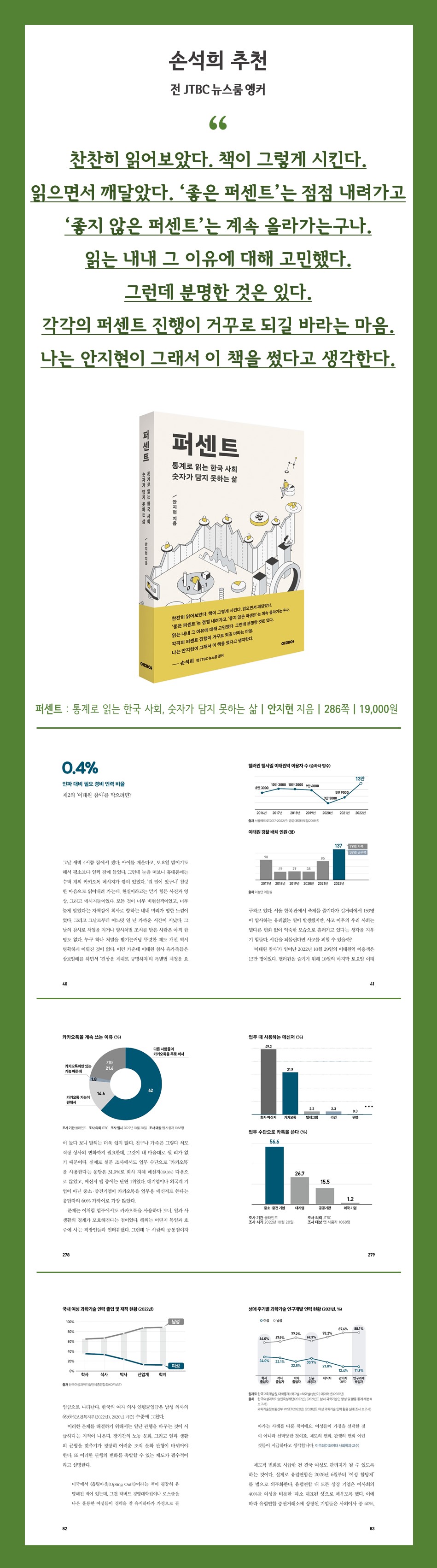
“The percentage of good things keeps going down, and the percentage of bad things keeps going up.
I kept wondering why as I read.
But one thing is clear.
I wish each percentage progress would be reversed.
“I think that’s why [author] Ji-Hyeon Ahn wrote this book,” said former JTBC Newsroom anchor Seok-Hee Son, who recommended the book.
The book starts at 0% (strictly speaking, close to 0, ≒0%).
The world was shocked when broadcaster Sayuri gave birth to a blue-eyed child in 2020.
This was because it was the first case of ‘female childbirth alone’ or ‘childbirth out of wedlock’ to appear in Korean society.
Until then, there had been no reported cases of ‘giving birth through sperm donation without marriage in Korea.’
Is this impossible in Korea, where birth rates hit record lows every year? Surprisingly, there's no law prohibiting it.
However, the ethical guidelines of the Korean Society of Obstetrics and Gynecology were problematic.
This is because sperm donation required for female childbirth is limited to “couples, including common-law couples.”
In May 2022, the National Human Rights Commission of Korea issued a recommendation stating that “restricting childbirth by unmarried women when there is no legal prohibition is discrimination,” but the society rejected it, stating that “social consensus takes precedence.”
Since Sayuri's birth, the demand for women to give birth alone has been steadily increasing. According to a 2021 survey by the Seoul Foundation for Women and Family, 26% of unmarried female respondents "have thought about having a child without getting married." The book examines related statistics from overseas and also introduces a recent case (late 2023) in Korea where a same-sex couple gave birth.
So the percentage for this topic was initially '0%', but was finally revised to '≒0%' before publication.
Statistics that can be used to infer Korea's 'birth rate problem' also appear in other topics in the book, one of which is as follows.
“It was found that when housing prices in the metropolitan area increased by 20%, the total fertility rate decreased by 36% (Korea Institute of Public Finance, 2021).
“When looking at the birth rate by income, there was also a study result that showed that the birth rate of the lower income bracket (1st quintile) was only 39.1% of that of the upper income bracket (3rd quintile) (Korea Economic Research Institute, 2022).”
And “among married women (aged 15-54, 4,536,000) living with children under 18, 25.3%, or one in four (Statistics Korea, 2022)” are experiencing a “career gap” for Korean women, and “the employment rate for women plummets to 57.5% in their mid-30s when childbirth and childcare become more concentrated (Ministry of Strategy and Finance, 2021).” It is not difficult to guess what these statistics indicate.
Statistics read separately but together
In this way, the book's statistics explain each topic (out-of-wedlock childbirth, women on career breaks, housing prices) while also connecting to a single topic (Korea's birth rate), providing an opportunity to view Korean society in a more three-dimensional way.
As another example, the 'right to move' helps us approach common problems facing Korean society through different topics.
For example, behind the struggle for the right to mobility of the disabled that shook up Korean society, there are statistics like this.
According to a 2020 survey by the Ministry of Health and Welfare, 21.7% of respondents with disabilities go out less than three times a month.
The proportion of low-floor buses that are wheelchair accessible is 30.6% (Ministry of Land, Infrastructure and Transport, 2012), and even among these, 48% have experienced being denied boarding (National Human Rights Commission, 2019).
This is why they had no choice but to become 'bad disabled people' who block the subway.
Is this a problem unique to people with disabilities? Since COVID-19, 28% of bus terminals nationwide have closed (National Passenger Transport Terminal Association, 2022). According to 2022 T-money computerized statistics, express and intercity bus service has decreased by 41% compared to pre-COVID-19 levels, and 27% of routes have been eliminated.
In addition, the book presents some interesting statistics.
"Why is it so hard to catch a taxi in Seoul late at night?" A 2022 Kakao Mobility survey provides the answer.
At midnight, 47% of Seoul taxis stay in Gyeonggi Province, not Seoul.
Why is this? With an average age of 63.5, Seoul taxi drivers, due to their aging population, avoid long-distance nighttime driving. They begin long-distance trips to the outskirts of Seoul around 8 p.m., and most are out of the city by midnight.
In addition, the taxi operation rate in Seoul after COVID-19 hit a record low of 31.5% (Seoul Taxi Policy Team, 2022), and this is largely due to the fact that the approximately 30,000 drivers who left during COVID-19 (National Federation of Taxi Transport Associations, 2022) are not returning.
A life that numbers cannot fully reveal
The book also presents statistics on those who have been relatively overlooked in Korean society.
As the author states in the book's prologue, these are "people with disabilities, women who have taken a break from their careers, Generation Z, sexual minorities, semi-basement dwellers, Vietnam War victims, drivers, and young people preparing for independence.
They are all the main characters of “Percent” that I paid attention to.
And we pay special attention to 'low-income children who cannot eat meat or fish even once a week (25.5%, Ministry of Health and Welfare, 2018)', 'children who do not report school violence even after being bullied (17.3%, Ministry of Education, 2022)', 'children who are already abused and are being abused again (14.7%, Ministry of Health and Welfare, 2021)', and 'youth who become independent from orphanages and then advance to university (12.9%, Ministry of Health and Welfare, 2021)'.
And we listen to and record as much as possible the lives of those whose numbers cannot fully reveal them.
Children who can only go to convenience stores with a ‘meal card’, children who say ‘even if I report it…’, children who prioritize love over parental punishment, teenagers in an environment where the word ‘independence’ is meaningless…
In this way, the book emphasizes that while statistics and numbers are important, Korean society should pay attention to the specific lives behind them.
“The percentage of good things keeps going down, and the percentage of bad things keeps going up.
I kept wondering why as I read.
But one thing is clear.
I wish each percentage progress would be reversed.
“I think that’s why [author] Ji-Hyeon Ahn wrote this book,” said former JTBC Newsroom anchor Seok-Hee Son, who recommended the book.
GOODS SPECIFICS
- Date of issue: April 8, 2024
- Page count, weight, size: 286 pages | 390g | 140*215*18mm
- ISBN13: 9791189143466
You may also like
카테고리
korean


korean

![GQ KOREA Mark (Monthly): December [2025]](http://librairie.coreenne.fr/cdn/shop/files/8ef265dbbfbf186523ed75ba7319009d.jpg?v=1765340328&width=3840)


