

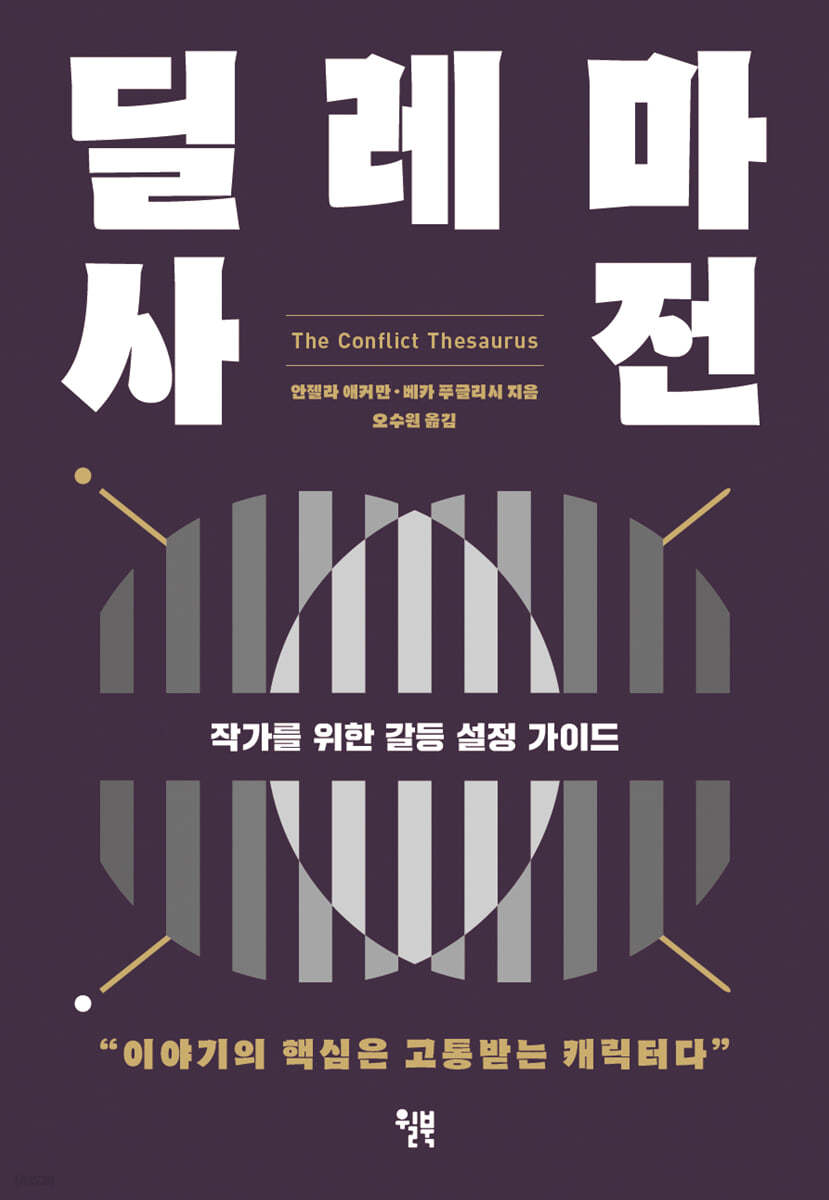
Dilemma Dictionary
 |
Description
Book Introduction
- The more exquisite the crisis the character falls into, the more interesting the story becomes.
- A guide to creating conflict that creates a compelling story.
- A new book in the bestselling "Trauma Dictionary", "Detail Dictionary", and "Character Occupation Dictionary" series.
* Recommended by author Simneul
“This dictionary seems to contain all the pain and suffering of human history.”
A fun writing guide has been published that encapsulates all sorts of conflicts and dilemmas that can cause pain and suffering to your painstakingly created characters.
This new book in the "Writer's Dictionary" series by Angela Ackerman and Becca Puglisi, which has received enthusiastic responses from working writers, is an essential guidebook that should be on every storyteller's bookshelf, regardless of genre.
An essential element of a compelling story is a character in conflict.
Captivating characters are always in danger, big or small, throughout the story.
The more closely the characters face their enemies and struggle with choices, the more immersive the story becomes.
"The Dictionary of Dilemmas," which relentlessly delves into the types of conflicts and dilemmas characters can experience, provides a friendly guide to the fundamentals of conflict setting and scenarios essential for creating vivid stories.
It provides 110 conflict types that can drive a character into a corner, such as 'falling in love with someone you shouldn't love', 'witnessing corruption', 'losing a bet', and 'not being able to save everyone'.
For each type, there are also specific, practical examples that can be applied directly to the scene, such as the expected character behavior patterns and psychological traits.
Additionally, the 100-page introduction meticulously lays out the fundamentals of a writer's craft for creating and handling character dilemmas, including how to combine plot and conflict, and the difference between internal and external conflict, using examples from popular films and novels.
What if the story you're writing isn't progressing? Want to make your character's journey more compelling? Want to portray their emotions and actions more vividly? Are you struggling with a scene that just won't resolve? Let's open up the "Dilemma Dictionary" and choose the type of conflict that best suits your story.
Before you know it, new scenes will start to appear that will make you slap your knees.
- A guide to creating conflict that creates a compelling story.
- A new book in the bestselling "Trauma Dictionary", "Detail Dictionary", and "Character Occupation Dictionary" series.
* Recommended by author Simneul
“This dictionary seems to contain all the pain and suffering of human history.”
A fun writing guide has been published that encapsulates all sorts of conflicts and dilemmas that can cause pain and suffering to your painstakingly created characters.
This new book in the "Writer's Dictionary" series by Angela Ackerman and Becca Puglisi, which has received enthusiastic responses from working writers, is an essential guidebook that should be on every storyteller's bookshelf, regardless of genre.
An essential element of a compelling story is a character in conflict.
Captivating characters are always in danger, big or small, throughout the story.
The more closely the characters face their enemies and struggle with choices, the more immersive the story becomes.
"The Dictionary of Dilemmas," which relentlessly delves into the types of conflicts and dilemmas characters can experience, provides a friendly guide to the fundamentals of conflict setting and scenarios essential for creating vivid stories.
It provides 110 conflict types that can drive a character into a corner, such as 'falling in love with someone you shouldn't love', 'witnessing corruption', 'losing a bet', and 'not being able to save everyone'.
For each type, there are also specific, practical examples that can be applied directly to the scene, such as the expected character behavior patterns and psychological traits.
Additionally, the 100-page introduction meticulously lays out the fundamentals of a writer's craft for creating and handling character dilemmas, including how to combine plot and conflict, and the difference between internal and external conflict, using examples from popular films and novels.
What if the story you're writing isn't progressing? Want to make your character's journey more compelling? Want to portray their emotions and actions more vividly? Are you struggling with a scene that just won't resolve? Let's open up the "Dilemma Dictionary" and choose the type of conflict that best suits your story.
Before you know it, new scenes will start to appear that will make you slap your knees.
- You can preview some of the book's contents.
Preview
index
Recommendation
introduction
Conflict is what creates character.
Combination of plot and conflict
Exploring Inner Conflict Deeply
Failure builds character
3Cs: Conflict, Choice, Consequence
Various enemies that block the character's path
Finding the right conflict for your story
Final advice for writers
1.
Relationship conflict
Domestic violence/family secrets come out/being forced into marriage/being taken for granted or treated as insignificant/being subject to peer pressure/being insulted/being ignored or treated as if they don't exist/being betrayed or abandoned by a trusted friend or ally/being cheated on by a spouse or lover/being found out about a spouse's secret/being caught having an affair or infidelity/having to hurt the feelings of a loved one/an ambiguous relationship in which the other person makes no effort/disappointing the other person/being unable to forgive the other person/sexual dysfunction/an estranged relative reappearing/being interrupted in a relationship/a rival appears in a relationship/being rejected by the person you want to date/your lover starts dating someone else/an unwanted relationship progresses/divorce or breakup/your child wants to live with your ex-spouse/being manipulated/having to betray a friend or loved one/losing your composure and getting angry/your ex-spouse or lover interfering in your life/ex-married Find out that your lover is seeing someone new
2.
failures and mistakes
Get caught lying/A lie influences others/Make a bad judgment/Lose a bet/Share incorrect information unknowingly/Confide in a secret to someone who shouldn't know/Do something foolish while drunk or under the influence of drugs/Fail/Send a private message to the wrong person/Receive advice from the wrong person/Underestimate a risk/Cause a car accident/Induce a hazard at work/Get caught doing something wrong/Be unprepared/Break or destroy something important/Have a one-night stand with a coworker/Make a serious mistake at work/Make a situation worse with a practical joke/Make a mistake in a job you are responsible for/Make a bad investment/Losing your phone
3.
Moral Dilemmas and Temptations
Become aware of manipulation of outcomes/Sacrifice ethics or morals for the greater good/Indulge in something you shouldn't eat or use/Witness corruption/Have an opportunity to commit fraud/Be offered dirty money/Fall in love with someone you shouldn't/Let someone pay for their actions/Have to deliberately sabotage someone to win/Have to decide whether or not to help someone/Be taken off life support/Break the law to do good/Be offered an easy way out/Face a decision with no easy answers/Be caught doing evil/Learn something that threatens a bond or friendship/Be forced to steal to obtain something important/Witness discrimination/Be pressured to shield a friend/Witness abuse
4.
Duties and Responsibilities
Be bogged down in bureaucracy/lose your transportation/be tasked with delivering bad news/be forced to care for an elderly relative/get a poor performance evaluation/take on an unpleasant person/be assigned an unpleasant task/have to punish someone/childcare doesn't go as planned/have to break a promise/your work-life balance is threatened/your child gets sick/your child gets into trouble at school/have to work with the enemy/have to disobey instructions or orders/lose your job/be distressed by a poor leader
5.
Increased pressure and time pressure
Have to wait/Get lost/Have an earlier deadline/Have to prove your innocence/Be late due to trouble/Be in the spotlight/Incur unexpected expenses/Be given unexpected responsibilities/Be subject to unwanted attention or scrutiny/Be under pressure to finish work/Find yourself at a disadvantage/Miss an important meeting, gathering, or deadline/Receive an ultimatum/Be pursued/Be threatened
6.
A no-win scenario
Sacrifice the minority for the benefit of the majority/You can't save everyone/No matter what you do, you'll end up ruined/You have to hurt someone to save them from the worst fate/Be in conflict with conflicting desires or needs/Be in a bind/Have to choose the lesser of two evils
supplement
introduction
Conflict is what creates character.
Combination of plot and conflict
Exploring Inner Conflict Deeply
Failure builds character
3Cs: Conflict, Choice, Consequence
Various enemies that block the character's path
Finding the right conflict for your story
Final advice for writers
1.
Relationship conflict
Domestic violence/family secrets come out/being forced into marriage/being taken for granted or treated as insignificant/being subject to peer pressure/being insulted/being ignored or treated as if they don't exist/being betrayed or abandoned by a trusted friend or ally/being cheated on by a spouse or lover/being found out about a spouse's secret/being caught having an affair or infidelity/having to hurt the feelings of a loved one/an ambiguous relationship in which the other person makes no effort/disappointing the other person/being unable to forgive the other person/sexual dysfunction/an estranged relative reappearing/being interrupted in a relationship/a rival appears in a relationship/being rejected by the person you want to date/your lover starts dating someone else/an unwanted relationship progresses/divorce or breakup/your child wants to live with your ex-spouse/being manipulated/having to betray a friend or loved one/losing your composure and getting angry/your ex-spouse or lover interfering in your life/ex-married Find out that your lover is seeing someone new
2.
failures and mistakes
Get caught lying/A lie influences others/Make a bad judgment/Lose a bet/Share incorrect information unknowingly/Confide in a secret to someone who shouldn't know/Do something foolish while drunk or under the influence of drugs/Fail/Send a private message to the wrong person/Receive advice from the wrong person/Underestimate a risk/Cause a car accident/Induce a hazard at work/Get caught doing something wrong/Be unprepared/Break or destroy something important/Have a one-night stand with a coworker/Make a serious mistake at work/Make a situation worse with a practical joke/Make a mistake in a job you are responsible for/Make a bad investment/Losing your phone
3.
Moral Dilemmas and Temptations
Become aware of manipulation of outcomes/Sacrifice ethics or morals for the greater good/Indulge in something you shouldn't eat or use/Witness corruption/Have an opportunity to commit fraud/Be offered dirty money/Fall in love with someone you shouldn't/Let someone pay for their actions/Have to deliberately sabotage someone to win/Have to decide whether or not to help someone/Be taken off life support/Break the law to do good/Be offered an easy way out/Face a decision with no easy answers/Be caught doing evil/Learn something that threatens a bond or friendship/Be forced to steal to obtain something important/Witness discrimination/Be pressured to shield a friend/Witness abuse
4.
Duties and Responsibilities
Be bogged down in bureaucracy/lose your transportation/be tasked with delivering bad news/be forced to care for an elderly relative/get a poor performance evaluation/take on an unpleasant person/be assigned an unpleasant task/have to punish someone/childcare doesn't go as planned/have to break a promise/your work-life balance is threatened/your child gets sick/your child gets into trouble at school/have to work with the enemy/have to disobey instructions or orders/lose your job/be distressed by a poor leader
5.
Increased pressure and time pressure
Have to wait/Get lost/Have an earlier deadline/Have to prove your innocence/Be late due to trouble/Be in the spotlight/Incur unexpected expenses/Be given unexpected responsibilities/Be subject to unwanted attention or scrutiny/Be under pressure to finish work/Find yourself at a disadvantage/Miss an important meeting, gathering, or deadline/Receive an ultimatum/Be pursued/Be threatened
6.
A no-win scenario
Sacrifice the minority for the benefit of the majority/You can't save everyone/No matter what you do, you'll end up ruined/You have to hurt someone to save them from the worst fate/Be in conflict with conflicting desires or needs/Be in a bind/Have to choose the lesser of two evils
supplement
Detailed image

Into the book
In fiction, conflict serves to test and develop characters, and is broadly divided into external conflict and internal conflict.
(…) Ultimately, the conflict forces the character to choose between old ways of thinking and acting or new, evolved ways of being.
Because only one of them will help the character get what he wants.
---From "Creating a character is about conflict"
When it comes to storytelling, the more conflict, the better.
A great story must present obstacles, distractions, and challenges that are so mind-boggling that you can't even come to your senses.
Each moment of the story is freshened by the problem it introduces.
That doesn't mean it's okay to throw conflicts in randomly or to lack structure.
---From "Combination of Plot and Conflict"
Internal conflict prevents characters from getting what they need most.
Therefore, it is essential to check the character's internal and external motivations.
Only then will it become easier to figure out which internal conflict is most appropriate to hinder the character's efforts.
---From "An In-Depth Exploration of Internal Conflict"
What traits does a three-dimensional, believable character possess? It's flaws.
For example, you may have weaknesses, blind spots, and character flaws that you are unaware of or unwilling to change.
Because no one is perfect, flaws and weaknesses add authenticity to characters and make them more relatable.
---From "Failure Makes Character Grow"
Two things immediately come to mind when thinking about the dynamics of a story.
It's the plot and the characters.
Plot and character are the two pillars of fiction, including novels and films.
A story needs a central character and external events that challenge and shape him.
But if these two elements aren't properly woven together so that the character actively moves toward his or her goal, the elements of character and plot will remain stagnant, just waiting.
This is not a story.
---From "3C: Conflict, Choice, Result"
Conflict usually occurs when the protagonist's goals, needs, and desires clash with those of the enemy.
The protagonist and the enemy, the two characters, may share a past or may be newly acquainted.
Or maybe you've never met in person and just know each other.
In any case, friction exists, and as the crisis escalates and the characters' goals become closer, the conflict between them increases.
The two fight desperately until one ultimately emerges victorious in a contest of will, strength, and spirit.
---Among the various enemies that obstruct the character's path
Conflict provides opportunities for failure and growth, heightens the sense of crisis, and gradually elevates the emotions of both characters and readers.
Additionally, both conflict at the level of the entire story (macro conflict) and conflict at the level of the scene (micro conflict) are necessary.
(…) One very important thing: conflict must move the story forward.
(…) Ultimately, the conflict forces the character to choose between old ways of thinking and acting or new, evolved ways of being.
Because only one of them will help the character get what he wants.
---From "Creating a character is about conflict"
When it comes to storytelling, the more conflict, the better.
A great story must present obstacles, distractions, and challenges that are so mind-boggling that you can't even come to your senses.
Each moment of the story is freshened by the problem it introduces.
That doesn't mean it's okay to throw conflicts in randomly or to lack structure.
---From "Combination of Plot and Conflict"
Internal conflict prevents characters from getting what they need most.
Therefore, it is essential to check the character's internal and external motivations.
Only then will it become easier to figure out which internal conflict is most appropriate to hinder the character's efforts.
---From "An In-Depth Exploration of Internal Conflict"
What traits does a three-dimensional, believable character possess? It's flaws.
For example, you may have weaknesses, blind spots, and character flaws that you are unaware of or unwilling to change.
Because no one is perfect, flaws and weaknesses add authenticity to characters and make them more relatable.
---From "Failure Makes Character Grow"
Two things immediately come to mind when thinking about the dynamics of a story.
It's the plot and the characters.
Plot and character are the two pillars of fiction, including novels and films.
A story needs a central character and external events that challenge and shape him.
But if these two elements aren't properly woven together so that the character actively moves toward his or her goal, the elements of character and plot will remain stagnant, just waiting.
This is not a story.
---From "3C: Conflict, Choice, Result"
Conflict usually occurs when the protagonist's goals, needs, and desires clash with those of the enemy.
The protagonist and the enemy, the two characters, may share a past or may be newly acquainted.
Or maybe you've never met in person and just know each other.
In any case, friction exists, and as the crisis escalates and the characters' goals become closer, the conflict between them increases.
The two fight desperately until one ultimately emerges victorious in a contest of will, strength, and spirit.
---Among the various enemies that obstruct the character's path
Conflict provides opportunities for failure and growth, heightens the sense of crisis, and gradually elevates the emotions of both characters and readers.
Additionally, both conflict at the level of the entire story (macro conflict) and conflict at the level of the scene (micro conflict) are necessary.
(…) One very important thing: conflict must move the story forward.
---From "Finding the Conflict That Fits My Story"
Publisher's Review
A great writer puts his characters in intense crisis!
A new encyclopedia of dilemmas from the authors of the bestselling "Trauma Dictionary."
The new book in the bestselling "Writer's Dictionary" series in the writing field, "Dilemma Dictionary," has been published.
This series, which has received enthusiastic responses from creators by pointing out the core elements of compelling stories and providing just the right materials for the right occasion, including 『Trauma Dictionary』, 『Detail Dictionary』, and 『Character Occupation Dictionary』, is a series by the world-renowned writing coaches Angela Ackerman and Becca Puglisi.
The new work, 『Dictionary of Dilemmas』, which lives up to high expectations, focuses on 'conflict', an essential resource and element for a solid story.
Anyone who has watched even a little bit of novels, movies, or dramas will immediately know how important a well-crafted conflict is in a work of art.
No matter how fantastic the setting and background, if nothing happens to the character, the story can't begin, and there can't be a subsequent scene.
Characters encounter difficult situations both inside and outside the world they live in, confront other characters, or grapple with inner problems.
The characters' suffering and actions as they face crises big and small that affect their daily lives are heartbreaking and make you look forward to the next scene.
It is no exaggeration to say that the extent to which readers or viewers become immersed in a story and find it entertaining and moving depends on how closely the conflicts are intertwined.
This book is the most practical and exciting storytelling bible, unfolding a wide range of choices for the characters the author has painstakingly created: what mistakes they might make, what doubts they might have, what temptations and pressures they might face, and how they might make interesting choices.
110 vivid and specific dilemma types that will enhance the immersion of the work.
A solid digest of literary theory on the relationship between story and conflict elements.
What if I had to steal to get what's most important to me? What if I fell in love with someone I shouldn't? What if I got stranded in an accident on a peaceful morning? What if I told a small lie and things snowballed? What if I was betrayed by a trusted friend? "The Dictionary of Dilemmas," filled with various conflicts, adversaries, and crisis scenarios that will trigger character ups and downs, offers even more complex and mischievous challenges to thwart characters.
If you want to make your character make a major mistake or increase the tension, refer to the "Relationship Conflicts" and "Failures and Mistakes" sections of the book.
In addition, it is filled with 110 ideas that will put your characters in a difficult situation, such as 'moral dilemmas and temptations' and 'no-win scenarios', so you can plan scenes that will touch the reader's heart.
To captivate readers who are drawn into the story by empathizing with the characters' situations, which are no different from their own, a writer must painstakingly devise and devise bait. For this writer, a book will be the most reliable friend on the desk, accompanying them at every moment of creation.
This dictionary of conflict types, organized into six themes, can be helpful when you want to brainstorm specific situations and events at the beginning of a scene.
It can be useful whenever you are stuck on what choices a character should make in a certain situation to be more convincing, or what actions or psychology they should show to create a more detailed plot.
It details the choices and emotions you can consider from the character's perspective, so you can find inspiration not only during the planning stage but also by opening the bookshelf in between writing.
In addition to the various types of dilemmas and ideas that can be readily applied, this book includes a 100-page introduction with theoretical columns that provide a literary and accessible explanation of how conflict elements operate within great narrative works.
This is an essential guidebook that should be on every storyteller's bookshelf, regardless of genre, as it covers the core concept of 'conflict', which is essential to plot formation, and allows them to refer to the basics of creation whenever necessary.
A new encyclopedia of dilemmas from the authors of the bestselling "Trauma Dictionary."
The new book in the bestselling "Writer's Dictionary" series in the writing field, "Dilemma Dictionary," has been published.
This series, which has received enthusiastic responses from creators by pointing out the core elements of compelling stories and providing just the right materials for the right occasion, including 『Trauma Dictionary』, 『Detail Dictionary』, and 『Character Occupation Dictionary』, is a series by the world-renowned writing coaches Angela Ackerman and Becca Puglisi.
The new work, 『Dictionary of Dilemmas』, which lives up to high expectations, focuses on 'conflict', an essential resource and element for a solid story.
Anyone who has watched even a little bit of novels, movies, or dramas will immediately know how important a well-crafted conflict is in a work of art.
No matter how fantastic the setting and background, if nothing happens to the character, the story can't begin, and there can't be a subsequent scene.
Characters encounter difficult situations both inside and outside the world they live in, confront other characters, or grapple with inner problems.
The characters' suffering and actions as they face crises big and small that affect their daily lives are heartbreaking and make you look forward to the next scene.
It is no exaggeration to say that the extent to which readers or viewers become immersed in a story and find it entertaining and moving depends on how closely the conflicts are intertwined.
This book is the most practical and exciting storytelling bible, unfolding a wide range of choices for the characters the author has painstakingly created: what mistakes they might make, what doubts they might have, what temptations and pressures they might face, and how they might make interesting choices.
110 vivid and specific dilemma types that will enhance the immersion of the work.
A solid digest of literary theory on the relationship between story and conflict elements.
What if I had to steal to get what's most important to me? What if I fell in love with someone I shouldn't? What if I got stranded in an accident on a peaceful morning? What if I told a small lie and things snowballed? What if I was betrayed by a trusted friend? "The Dictionary of Dilemmas," filled with various conflicts, adversaries, and crisis scenarios that will trigger character ups and downs, offers even more complex and mischievous challenges to thwart characters.
If you want to make your character make a major mistake or increase the tension, refer to the "Relationship Conflicts" and "Failures and Mistakes" sections of the book.
In addition, it is filled with 110 ideas that will put your characters in a difficult situation, such as 'moral dilemmas and temptations' and 'no-win scenarios', so you can plan scenes that will touch the reader's heart.
To captivate readers who are drawn into the story by empathizing with the characters' situations, which are no different from their own, a writer must painstakingly devise and devise bait. For this writer, a book will be the most reliable friend on the desk, accompanying them at every moment of creation.
This dictionary of conflict types, organized into six themes, can be helpful when you want to brainstorm specific situations and events at the beginning of a scene.
It can be useful whenever you are stuck on what choices a character should make in a certain situation to be more convincing, or what actions or psychology they should show to create a more detailed plot.
It details the choices and emotions you can consider from the character's perspective, so you can find inspiration not only during the planning stage but also by opening the bookshelf in between writing.
In addition to the various types of dilemmas and ideas that can be readily applied, this book includes a 100-page introduction with theoretical columns that provide a literary and accessible explanation of how conflict elements operate within great narrative works.
This is an essential guidebook that should be on every storyteller's bookshelf, regardless of genre, as it covers the core concept of 'conflict', which is essential to plot formation, and allows them to refer to the basics of creation whenever necessary.
GOODS SPECIFICS
- Publication date: August 26, 2022
- Page count, weight, size: 552 pages | 794g | 152*220*34mm
- ISBN13: 9791155815168
- ISBN10: 1155815165
You may also like
카테고리
korean


korean

![GQ KOREA Mark (Monthly): December [2025]](http://librairie.coreenne.fr/cdn/shop/files/8ef265dbbfbf186523ed75ba7319009d.jpg?v=1765340328&width=3840)


