

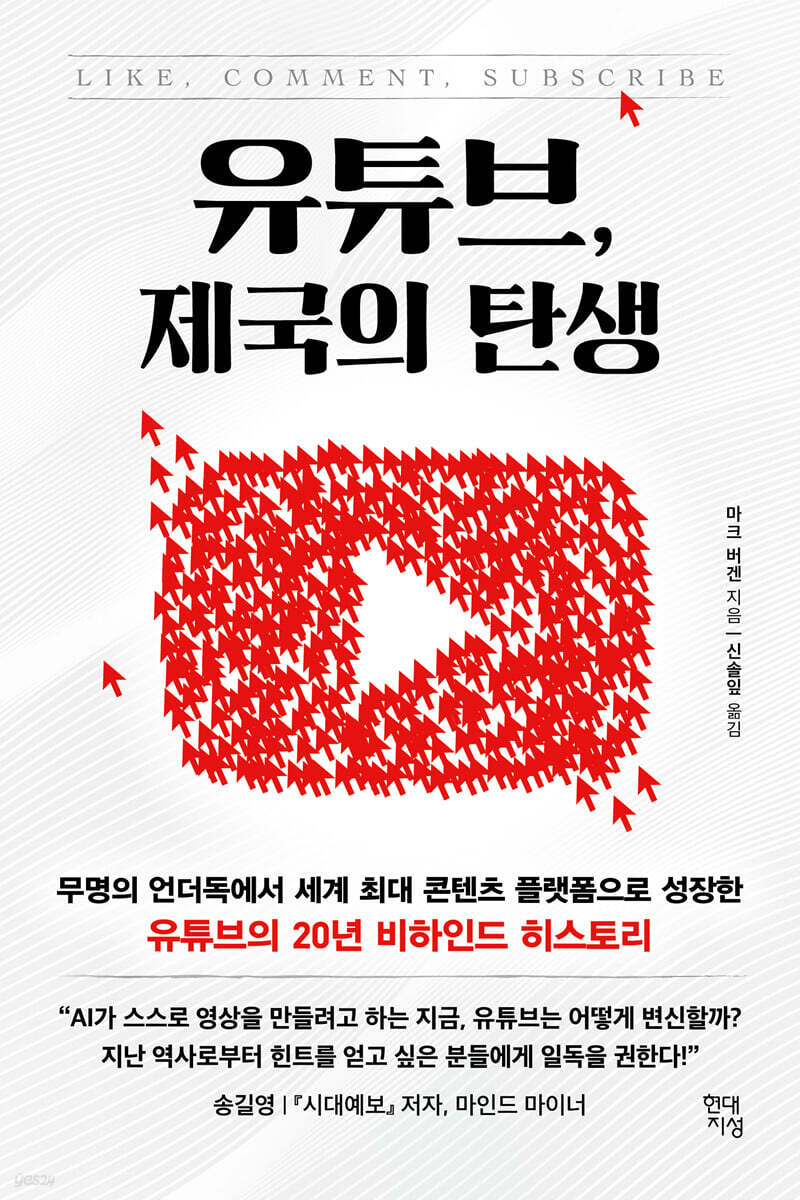
YouTube, the birth of an empire
 |
Description
Book Introduction
YouTube, Pandora's box is opened!
YouTube changed the world, and everyone in the world knows about it.
But, no one knows how YouTube has been run for the past 20 years!
Mark Bergen, the reporter who knows Google best in Silicon Valley
We'll reveal every detail of the history surrounding YouTube, both inside and outside!
“How will YouTube change now that AI is trying to create videos on its own?
“I highly recommend this book to anyone who wants to learn from past history!”
Song Gil-young | Author of "Sidae Yebo" and Mind Minor
- Highly recommended by bestselling authors including Song Gil-young, Koo Bon-kwon, Brad Stone, and Ashley Barnes!
- Praise from the New Yorker, Associated Press, Kirkus Reviews, Publisher's Weekly, and more!
- 'Best Book of the Month' selected by Amazon editors in the US!
Over 1 billion hours watched per day, with over 500 hours of video uploaded every minute.
What started as an obscure Silicon Valley startup has grown into the world's largest content platform over the past 20 years.
YouTube has completely changed the way people consume content and their lifestyles, and now there is no one in the world who does not know YouTube.
But strangely enough, very few people really know how YouTube has been run over the past 20 years, or what's been going on inside the company called YouTube!
Mark Bergen, a reporter for the economic magazine Bloomberg, is a business journalist who has covered all things Google since 2010 and is known as the reporter who knows Google best in Silicon Valley.
Having interviewed over 300 people who have been a part of YouTube's history over the past decade, he has delved into the various conflicts, scandals, struggles, and growth that have occurred both inside and outside YouTube, from the site's birth to the recent pandemic, in a very sophisticated, sharp, and interesting way.
Readers will be drawn into this YouTube exploration story, one they've never heard or seen before, as if they were reading an absorbing novel, and lose track of time!
YouTube changed the world, and everyone in the world knows about it.
But, no one knows how YouTube has been run for the past 20 years!
Mark Bergen, the reporter who knows Google best in Silicon Valley
We'll reveal every detail of the history surrounding YouTube, both inside and outside!
“How will YouTube change now that AI is trying to create videos on its own?
“I highly recommend this book to anyone who wants to learn from past history!”
Song Gil-young | Author of "Sidae Yebo" and Mind Minor
- Highly recommended by bestselling authors including Song Gil-young, Koo Bon-kwon, Brad Stone, and Ashley Barnes!
- Praise from the New Yorker, Associated Press, Kirkus Reviews, Publisher's Weekly, and more!
- 'Best Book of the Month' selected by Amazon editors in the US!
Over 1 billion hours watched per day, with over 500 hours of video uploaded every minute.
What started as an obscure Silicon Valley startup has grown into the world's largest content platform over the past 20 years.
YouTube has completely changed the way people consume content and their lifestyles, and now there is no one in the world who does not know YouTube.
But strangely enough, very few people really know how YouTube has been run over the past 20 years, or what's been going on inside the company called YouTube!
Mark Bergen, a reporter for the economic magazine Bloomberg, is a business journalist who has covered all things Google since 2010 and is known as the reporter who knows Google best in Silicon Valley.
Having interviewed over 300 people who have been a part of YouTube's history over the past decade, he has delved into the various conflicts, scandals, struggles, and growth that have occurred both inside and outside YouTube, from the site's birth to the recent pandemic, in a very sophisticated, sharp, and interesting way.
Readers will be drawn into this YouTube exploration story, one they've never heard or seen before, as if they were reading an absorbing novel, and lose track of time!
- You can preview some of the book's contents.
Preview
index
Prologue | March 15, 2019
Part 1
Chapter 1: Ordinary People
Chapter 2 Primitive and Random
Chapter 3 Two Emperors
Chapter 4: The Assault Team
Chapter 5 Clown Co.
Chapter 6: Google's Poet
Chapter 7 Running at Full Speed
Part 2
Chapter 8: Diamond Factory
Chapter 9 Nerd Fighters
Chapter 10 Kitesurfing TV
Chapter 11: See It Now
Chapter 12: Will that make the ship go faster?
Chapter 13 Let's Play
Chapter 14: Disney Baby Pop-Up Pals Easter Egg Surprise
Chapter 15 Five Families
Chapter 16: Lynn Baek
Chapter 17: Google's Mother
Part 3
Chapter 18: Deflated Tube
Chapter 19: Real News
Chapter 20: Distrust
Chapter 21: The Boy and the Toy
Chapter 22 Spotlight
Chapter 23: Pranks, Threats, and Self-Evident
Chapter 24 The Party Is Over
Chapter 25: Adpocalypse
Chapter 26 Rainforce
Chapter 27: Elsa Gate
Chapter 28: Villains
Chapter 29 901 Cherry Avenue
Chapter 30 Boil the sea water
Chapter 31: The Master's Extension
Part 4
Chapter 32 Rumba
Chapter 33: What kind of YouTube will it be?
Epilogue
Acknowledgements
Source
Americas
Source of the illustration
Part 1
Chapter 1: Ordinary People
Chapter 2 Primitive and Random
Chapter 3 Two Emperors
Chapter 4: The Assault Team
Chapter 5 Clown Co.
Chapter 6: Google's Poet
Chapter 7 Running at Full Speed
Part 2
Chapter 8: Diamond Factory
Chapter 9 Nerd Fighters
Chapter 10 Kitesurfing TV
Chapter 11: See It Now
Chapter 12: Will that make the ship go faster?
Chapter 13 Let's Play
Chapter 14: Disney Baby Pop-Up Pals Easter Egg Surprise
Chapter 15 Five Families
Chapter 16: Lynn Baek
Chapter 17: Google's Mother
Part 3
Chapter 18: Deflated Tube
Chapter 19: Real News
Chapter 20: Distrust
Chapter 21: The Boy and the Toy
Chapter 22 Spotlight
Chapter 23: Pranks, Threats, and Self-Evident
Chapter 24 The Party Is Over
Chapter 25: Adpocalypse
Chapter 26 Rainforce
Chapter 27: Elsa Gate
Chapter 28: Villains
Chapter 29 901 Cherry Avenue
Chapter 30 Boil the sea water
Chapter 31: The Master's Extension
Part 4
Chapter 32 Rumba
Chapter 33: What kind of YouTube will it be?
Epilogue
Acknowledgements
Source
Americas
Source of the illustration
Detailed image
.jpg)
Into the book
The three eventually decided to create a website where people could share and watch videos.
On Valentine's Day, they stayed up late in the cramped garage, even adding Hurley's dog, and came up with a name for the site they envisioned.
Hurley, who had come up with several words reminiscent of personal televisions, began to modify the old slang term for television, "boob tube."
A tube for you.
I searched for that word on Google.
No results were obtained.
That evening, the three purchased the domain YouTube.com, marking the first step in their ambitious plan.
--- p.36
Initially, Chad Hurley was against providing income to YouTubers.
“I didn’t want to create a system where monetary rewards were the motivation,” he said at a conference.
Google's demands also did not mention any monetary compensation.
“You two can run it completely on your own,” Eric Schmidt told Steve Chen during the acquisition talks.
“If you agree to just one checkbox here,” Schmidt said, “grow your users, videos, and views.” Another executive reported that Schmidt also added:
“You just have to grow these.
“Don’t worry about the cost.”
--- p.104
NextNewNetworks, a newcomer from the Atlantic coast, has made one thing clear within YouTube.
It was a name used to refer to people who do YouTube.
Those who first started working on the site, both those who created videos and those who watched them, were all 'users'.
As stars emerged, YouTube experimented with different names.
'YouTuber' was an inaccurate term.
There were filmmakers, there were makeup artists, and there were just geeks with webcams.
'Partner' was too business-like.
Next New Networks had 'audience' and 'creator', and 'creator' was an inclusive term that encompassed all elements of web media production.
The term 'creator' has been accepted on YouTube.
--- p.173
That same month, the French magazine Charlie Hebdo published satirical cartoons of Muhammad, and terrorists killed an American diplomat in Benghazi.
The Arab Spring had gone off course, sparking a violent clash against freedom of expression, Western imperialism, and dogma.
YouTube is in turmoil.
YouTube was so busy expanding globally that it simply encouraged broadcasts to citizens in every language and country possible, without sufficient resources to carefully vet videos locally or address political issues.
The confusion was compounded by a flood of inaccurate news reports claiming a movie trailer on YouTube sparked the Benghazi attacks.
“All hell was breaking loose,” recalled a YouTube public relations representative.
--- p.198
At YouTube's annual leadership summit in Los Angeles, Mehrotra announced new OKRs for the following year.
YouTube said it was aiming to reach 1 billion daily watch hours within four years.
“I know what you all are thinking,” Mehrotra said.
You may think it's impossible.
Mehrotra, who once aspired to be a professor, addressed the audience like an excited TED speaker.
He explained the numbers in detail to the people.
He said that one billion hours a day is five times the amount of traffic on Facebook, which accounts for the largest share of internet traffic.
Then he added a decisive comment.
“Even so, it will only account for 20 percent of television.
“This 20 percent is our market share.”
--- p.212~213
Silicon Valley has long had a paradoxical parenting philosophy of keeping kids away from gadgets made there.
There are stories that Steve Jobs restricted his children's use of technology.
Like Jobs, YouTube employees spent hours reviewing code and business plans to maximize time on the site, only to go home and tell their kids to stop watching YouTube.
It was only natural that the site would be addictive to pre-pubescent children whose brains are like sponges.
Some employees even said they felt like they were working for a tobacco company.
YouTube executives and loyal Googlers wanted to measure this problem and put it into metrics.
--- p.238
Finally, the coders inferred the machine's logic.
If YouTube played an ad as soon as a viewer reached the site, the viewer would likely leave the site.
However, if I waited until they had started spending time on the site, watching a 10- or 20-minute video, and then played the ad, they were more tolerant of the ad interruption.
The machine deduced that if people watch more videos, they will ultimately watch more ads.
It also fit well with another novel format that YouTube was introducing at the time.
It was a “skippable ad” that allowed viewers to fast-forward.
Advertisers only had to pay if viewers didn't skip, which meant they had to create compelling ads (unless viewers were too lazy or too young to hit the skip button).
--- p.261
It's been 20 years since phone-in debate radio became widespread, so YouTube should have realized that extreme political voices can wield significant influence and prepared accordingly.
But YouTube leaders, stuck in progressive California, had never interacted with far-right iconoclasts or even cultural conservatives.
“No one knew how to deal with right-wingers,” one employee explained.
For quite some time, the most unsavory characters have been relegated to the innermost shelves of YouTube, in the narrow space between the ground and the building.
Most of them were also active on Facebook and Twitter.
--- p.303
Manger Link began to have doubts.
As I've observed machine learning for a long time, I've discovered that most of the errors in these systems aren't due to a failure to think like humans, but rather to thinking "too much" like humans. AI, like us, can be sexist, racist, and even cruel.
He later said:
“Anything that reveals bias, AI can spot it instantly.”
--- p.312
Beginning in 2014, Wojcicki launched an advertising campaign promoting these influencers to mainstream audiences.
According to a survey published by Variety that summer, American teenagers were more familiar with Smosh and PewDiePie than A-listers like Jennifer Lawrence and Johnny Depp.
The survey results quickly spread throughout YouTube's offices, reinforcing the new belief that the old strategy of recruiting celebrities was outdated.
YouTube had its own celebrities.
Nicknamed "Spotlight," the ad campaign for Wojcicki saw YouTube stars' faces plastered across billboards, subways, and TV spots, starting with a trio of YouTubers known for their "lifestyle" videos (makeup, "haul" videos, and cooking, respectively).
YouTube had a new word for stars with commercial appeal.
'Endemic creators' were native.
--- p.329~330
Longtime YouTubers like the Joes and Kleins noticed this trend was coming, but most people, especially parents of young children, and even Google employees, didn't even know this content existed.
At YouTube, where everything is tracked online, employees noticed a surprisingly heated reaction on Twitter surrounding Breedle's post.
As Madison Avenue shrank again, the atmosphere seemed to indicate that another catastrophe was imminent.
Newspaper reporters, who had been combing through Breedle's writings, began to track down the only person whose face had appeared: Greg Chism, the father of Toy Freaks.
The Times of London reported that advertisers who had run ads on Chism's videos were outraged and began withdrawing their funds.
Article Title: Child Abuse on YouTube.
Subtitle: Google Makes Millions From Shocking Video.”
--- p.410
On the morning of the incident, Aghdam headed to the local shooting range.
Just after noon, she returned to the YouTube office and parked her car in the parking lot right next to the office.
At the entrance, an employee stopped me and asked for my ID.
Aghdam pulled a gun out of her handbag, and the employee immediately ran away and called 911.
Aghdam headed to the courtyard of the building.
Diana Anspiger, a YouTube project manager, saw a dark-haired outsider firing a gun.
Instinctively, Anspiger shouted.
“It’s a shooter!” a citizen passing by told TV cameras.
"oh my god.
The gunshots continued.
It was merciless.
“It was really ruthless,” said a YouTube manager who was watching the stairs inside the office and saw blood on the floor.
--- p.433
Virality has often been a gift throughout YouTube's history.
YouTube was like an infinite repository of the internet.
Videos that were first broadcast elsewhere, like the Christchurch live broadcast, quickly made their way to YouTube and gained rapid popularity.
To fulfill that role, YouTube redesigned its algorithm to spread more breaking news, encouraging people to go straight to YouTube after events like mass shootings by turning on their TVs—and they did, too.
Even bizarre occurrences in YouTube land, such as the "Subscribe to PewDiePie" slogan, were making headlines.
Unlike social networks that offer crude search functions, YouTube was a platform where anything could be found with incredible ease.
All these mechanisms that made YouTube a success as a business, tools built without any consideration of the unintended consequences they might bring, were now fueling a nightmare that the company was powerless to address.
--- p.468~469
As CEO, Wojcicki faced the challenges posed by the lockdown.
We had to run our business remotely, manage stressed employees, and prepare for a recession.
She also had to manage the influx of coronavirus-related videos.
This virus was a lie, a nightmare, a plague originating in China and a conspiracy secretly orchestrated by Bill Gates and Big Pharma.
A folk remedy has emerged that claims that this one thing will get rid of the virus.
Doctors continued to post videos about virology.
One doctor posted a video detailing how to thoroughly wash groceries, but it turned out to be completely ineffective against the virus, yet the video went viral.
Everyone was stuck indoors, scouring the internet for news, caught up in what health officials called an "infodemic."
On Valentine's Day, they stayed up late in the cramped garage, even adding Hurley's dog, and came up with a name for the site they envisioned.
Hurley, who had come up with several words reminiscent of personal televisions, began to modify the old slang term for television, "boob tube."
A tube for you.
I searched for that word on Google.
No results were obtained.
That evening, the three purchased the domain YouTube.com, marking the first step in their ambitious plan.
--- p.36
Initially, Chad Hurley was against providing income to YouTubers.
“I didn’t want to create a system where monetary rewards were the motivation,” he said at a conference.
Google's demands also did not mention any monetary compensation.
“You two can run it completely on your own,” Eric Schmidt told Steve Chen during the acquisition talks.
“If you agree to just one checkbox here,” Schmidt said, “grow your users, videos, and views.” Another executive reported that Schmidt also added:
“You just have to grow these.
“Don’t worry about the cost.”
--- p.104
NextNewNetworks, a newcomer from the Atlantic coast, has made one thing clear within YouTube.
It was a name used to refer to people who do YouTube.
Those who first started working on the site, both those who created videos and those who watched them, were all 'users'.
As stars emerged, YouTube experimented with different names.
'YouTuber' was an inaccurate term.
There were filmmakers, there were makeup artists, and there were just geeks with webcams.
'Partner' was too business-like.
Next New Networks had 'audience' and 'creator', and 'creator' was an inclusive term that encompassed all elements of web media production.
The term 'creator' has been accepted on YouTube.
--- p.173
That same month, the French magazine Charlie Hebdo published satirical cartoons of Muhammad, and terrorists killed an American diplomat in Benghazi.
The Arab Spring had gone off course, sparking a violent clash against freedom of expression, Western imperialism, and dogma.
YouTube is in turmoil.
YouTube was so busy expanding globally that it simply encouraged broadcasts to citizens in every language and country possible, without sufficient resources to carefully vet videos locally or address political issues.
The confusion was compounded by a flood of inaccurate news reports claiming a movie trailer on YouTube sparked the Benghazi attacks.
“All hell was breaking loose,” recalled a YouTube public relations representative.
--- p.198
At YouTube's annual leadership summit in Los Angeles, Mehrotra announced new OKRs for the following year.
YouTube said it was aiming to reach 1 billion daily watch hours within four years.
“I know what you all are thinking,” Mehrotra said.
You may think it's impossible.
Mehrotra, who once aspired to be a professor, addressed the audience like an excited TED speaker.
He explained the numbers in detail to the people.
He said that one billion hours a day is five times the amount of traffic on Facebook, which accounts for the largest share of internet traffic.
Then he added a decisive comment.
“Even so, it will only account for 20 percent of television.
“This 20 percent is our market share.”
--- p.212~213
Silicon Valley has long had a paradoxical parenting philosophy of keeping kids away from gadgets made there.
There are stories that Steve Jobs restricted his children's use of technology.
Like Jobs, YouTube employees spent hours reviewing code and business plans to maximize time on the site, only to go home and tell their kids to stop watching YouTube.
It was only natural that the site would be addictive to pre-pubescent children whose brains are like sponges.
Some employees even said they felt like they were working for a tobacco company.
YouTube executives and loyal Googlers wanted to measure this problem and put it into metrics.
--- p.238
Finally, the coders inferred the machine's logic.
If YouTube played an ad as soon as a viewer reached the site, the viewer would likely leave the site.
However, if I waited until they had started spending time on the site, watching a 10- or 20-minute video, and then played the ad, they were more tolerant of the ad interruption.
The machine deduced that if people watch more videos, they will ultimately watch more ads.
It also fit well with another novel format that YouTube was introducing at the time.
It was a “skippable ad” that allowed viewers to fast-forward.
Advertisers only had to pay if viewers didn't skip, which meant they had to create compelling ads (unless viewers were too lazy or too young to hit the skip button).
--- p.261
It's been 20 years since phone-in debate radio became widespread, so YouTube should have realized that extreme political voices can wield significant influence and prepared accordingly.
But YouTube leaders, stuck in progressive California, had never interacted with far-right iconoclasts or even cultural conservatives.
“No one knew how to deal with right-wingers,” one employee explained.
For quite some time, the most unsavory characters have been relegated to the innermost shelves of YouTube, in the narrow space between the ground and the building.
Most of them were also active on Facebook and Twitter.
--- p.303
Manger Link began to have doubts.
As I've observed machine learning for a long time, I've discovered that most of the errors in these systems aren't due to a failure to think like humans, but rather to thinking "too much" like humans. AI, like us, can be sexist, racist, and even cruel.
He later said:
“Anything that reveals bias, AI can spot it instantly.”
--- p.312
Beginning in 2014, Wojcicki launched an advertising campaign promoting these influencers to mainstream audiences.
According to a survey published by Variety that summer, American teenagers were more familiar with Smosh and PewDiePie than A-listers like Jennifer Lawrence and Johnny Depp.
The survey results quickly spread throughout YouTube's offices, reinforcing the new belief that the old strategy of recruiting celebrities was outdated.
YouTube had its own celebrities.
Nicknamed "Spotlight," the ad campaign for Wojcicki saw YouTube stars' faces plastered across billboards, subways, and TV spots, starting with a trio of YouTubers known for their "lifestyle" videos (makeup, "haul" videos, and cooking, respectively).
YouTube had a new word for stars with commercial appeal.
'Endemic creators' were native.
--- p.329~330
Longtime YouTubers like the Joes and Kleins noticed this trend was coming, but most people, especially parents of young children, and even Google employees, didn't even know this content existed.
At YouTube, where everything is tracked online, employees noticed a surprisingly heated reaction on Twitter surrounding Breedle's post.
As Madison Avenue shrank again, the atmosphere seemed to indicate that another catastrophe was imminent.
Newspaper reporters, who had been combing through Breedle's writings, began to track down the only person whose face had appeared: Greg Chism, the father of Toy Freaks.
The Times of London reported that advertisers who had run ads on Chism's videos were outraged and began withdrawing their funds.
Article Title: Child Abuse on YouTube.
Subtitle: Google Makes Millions From Shocking Video.”
--- p.410
On the morning of the incident, Aghdam headed to the local shooting range.
Just after noon, she returned to the YouTube office and parked her car in the parking lot right next to the office.
At the entrance, an employee stopped me and asked for my ID.
Aghdam pulled a gun out of her handbag, and the employee immediately ran away and called 911.
Aghdam headed to the courtyard of the building.
Diana Anspiger, a YouTube project manager, saw a dark-haired outsider firing a gun.
Instinctively, Anspiger shouted.
“It’s a shooter!” a citizen passing by told TV cameras.
"oh my god.
The gunshots continued.
It was merciless.
“It was really ruthless,” said a YouTube manager who was watching the stairs inside the office and saw blood on the floor.
--- p.433
Virality has often been a gift throughout YouTube's history.
YouTube was like an infinite repository of the internet.
Videos that were first broadcast elsewhere, like the Christchurch live broadcast, quickly made their way to YouTube and gained rapid popularity.
To fulfill that role, YouTube redesigned its algorithm to spread more breaking news, encouraging people to go straight to YouTube after events like mass shootings by turning on their TVs—and they did, too.
Even bizarre occurrences in YouTube land, such as the "Subscribe to PewDiePie" slogan, were making headlines.
Unlike social networks that offer crude search functions, YouTube was a platform where anything could be found with incredible ease.
All these mechanisms that made YouTube a success as a business, tools built without any consideration of the unintended consequences they might bring, were now fueling a nightmare that the company was powerless to address.
--- p.468~469
As CEO, Wojcicki faced the challenges posed by the lockdown.
We had to run our business remotely, manage stressed employees, and prepare for a recession.
She also had to manage the influx of coronavirus-related videos.
This virus was a lie, a nightmare, a plague originating in China and a conspiracy secretly orchestrated by Bill Gates and Big Pharma.
A folk remedy has emerged that claims that this one thing will get rid of the virus.
Doctors continued to post videos about virology.
One doctor posted a video detailing how to thoroughly wash groceries, but it turned out to be completely ineffective against the virus, yet the video went viral.
Everyone was stuck indoors, scouring the internet for news, caught up in what health officials called an "infodemic."
--- p.485~486
Publisher's Review
An unknown video site that started out as a joke
Growing into the world's largest content platform
YouTube: Our Brand Mission
https://www.youtube.com/watch?v=kwmFPKQAX4g
The video ended with a familiar phrase and YouTube's brand mission.
“It gives everyone a voice and shows them the world.” “It’s so weird,” Stapleton thought.
So much has changed in the world since her team first created this motivational video in 2017.
So much has changed on YouTube.
Since then, we've had countless conversations about revising the brand mission, but the company still plays this old video for motivational purposes.
She kept this thought to herself.
_From "Prologue"
Worldwide, people watch more than a billion hours of YouTube every day, and more than 500 hours of video are uploaded every minute.
In Korea, as of March 2024, the average monthly YouTube usage time per person has exceeded 40 hours, surpassing KakaoTalk, which is considered the national app, and has been ranked first for three consecutive months.
This figure has nearly doubled over the past five years.
What started as a joke by three young men in a rat-infested, shabby office in Silicon Valley 20 years ago has now grown into the world's largest content platform, dominating the globe.
YouTube has completely changed the way people around the world enjoy and consume content, and the way they acquire knowledge and information.
Nowadays, there is no one in the world who does not know YouTube.
Yet, few people truly understand how YouTube has operated over the past two decades, or what has been going on inside the company.
We interviewed over 300 people who have been with YouTube's history.
Uncovering the entire history surrounding YouTube
This book, "YouTube: The Birth of an Empire," is the first to delve into the technology and business behind YouTube.
Through the eyes of YouTube's executives and influencers, we delve into how YouTube, an underdog startup, transformed into a global tech giant.
YouTube, driven by the simple idea that anyone can make money online, blindly trusts its technology and busily pursues a massive business opportunity, ultimately creating a machine of madness and addiction that has escaped corporate control and exposed the naked truth about human nature.
Business journalist Mark Bergen, who has covered all things Google since 2010, is known in Silicon Valley as "the reporter who knows Google best."
Over the past decade, he has scoured YouTube for nearly every official record, every communication with sources, and every key document he has personally obtained.
We also conducted extensive interviews with over 300 people who have been part of YouTube's history. More than half are current or former YouTube and Google employees, while the other half include various business partners, consumer advocates, regulators, researchers, and dozens of YouTube creators themselves.
This book delves into the behind-the-scenes history of all the conflicts, scandals, struggles, and growth that have occurred both inside and outside the company, including the early days of the video site and the recent pandemic, the uneasy relationship between YouTube and its parent company Google, the power struggles between YouTube and influencers, machine learning issues such as AI algorithms, issues related to the US presidential election, the YouTube headquarters shooting, inappropriate scandals within Google, the Christchurch incident, and fake news about COVID-19, in a very sophisticated, sharp, and interesting way.
To readers who might be surprised by this book, the author says, “Every story in this book is based on real events.”
Now, readers will lose track of time as they delve into the detailed and fast-paced exploration of YouTube's inner workings!
Growing into the world's largest content platform
YouTube: Our Brand Mission
https://www.youtube.com/watch?v=kwmFPKQAX4g
The video ended with a familiar phrase and YouTube's brand mission.
“It gives everyone a voice and shows them the world.” “It’s so weird,” Stapleton thought.
So much has changed in the world since her team first created this motivational video in 2017.
So much has changed on YouTube.
Since then, we've had countless conversations about revising the brand mission, but the company still plays this old video for motivational purposes.
She kept this thought to herself.
_From "Prologue"
Worldwide, people watch more than a billion hours of YouTube every day, and more than 500 hours of video are uploaded every minute.
In Korea, as of March 2024, the average monthly YouTube usage time per person has exceeded 40 hours, surpassing KakaoTalk, which is considered the national app, and has been ranked first for three consecutive months.
This figure has nearly doubled over the past five years.
What started as a joke by three young men in a rat-infested, shabby office in Silicon Valley 20 years ago has now grown into the world's largest content platform, dominating the globe.
YouTube has completely changed the way people around the world enjoy and consume content, and the way they acquire knowledge and information.
Nowadays, there is no one in the world who does not know YouTube.
Yet, few people truly understand how YouTube has operated over the past two decades, or what has been going on inside the company.
We interviewed over 300 people who have been with YouTube's history.
Uncovering the entire history surrounding YouTube
This book, "YouTube: The Birth of an Empire," is the first to delve into the technology and business behind YouTube.
Through the eyes of YouTube's executives and influencers, we delve into how YouTube, an underdog startup, transformed into a global tech giant.
YouTube, driven by the simple idea that anyone can make money online, blindly trusts its technology and busily pursues a massive business opportunity, ultimately creating a machine of madness and addiction that has escaped corporate control and exposed the naked truth about human nature.
Business journalist Mark Bergen, who has covered all things Google since 2010, is known in Silicon Valley as "the reporter who knows Google best."
Over the past decade, he has scoured YouTube for nearly every official record, every communication with sources, and every key document he has personally obtained.
We also conducted extensive interviews with over 300 people who have been part of YouTube's history. More than half are current or former YouTube and Google employees, while the other half include various business partners, consumer advocates, regulators, researchers, and dozens of YouTube creators themselves.
This book delves into the behind-the-scenes history of all the conflicts, scandals, struggles, and growth that have occurred both inside and outside the company, including the early days of the video site and the recent pandemic, the uneasy relationship between YouTube and its parent company Google, the power struggles between YouTube and influencers, machine learning issues such as AI algorithms, issues related to the US presidential election, the YouTube headquarters shooting, inappropriate scandals within Google, the Christchurch incident, and fake news about COVID-19, in a very sophisticated, sharp, and interesting way.
To readers who might be surprised by this book, the author says, “Every story in this book is based on real events.”
Now, readers will lose track of time as they delve into the detailed and fast-paced exploration of YouTube's inner workings!
GOODS SPECIFICS
- Date of issue: April 12, 2024
- Page count, weight, size: 560 pages | 922g | 150*225*35mm
- ISBN13: 9791139716771
- ISBN10: 1139716778
You may also like
카테고리
korean


korean

![GQ KOREA Mark (Monthly): December [2025]](http://librairie.coreenne.fr/cdn/shop/files/8ef265dbbfbf186523ed75ba7319009d.jpg?v=1765340328&width=3840)


