

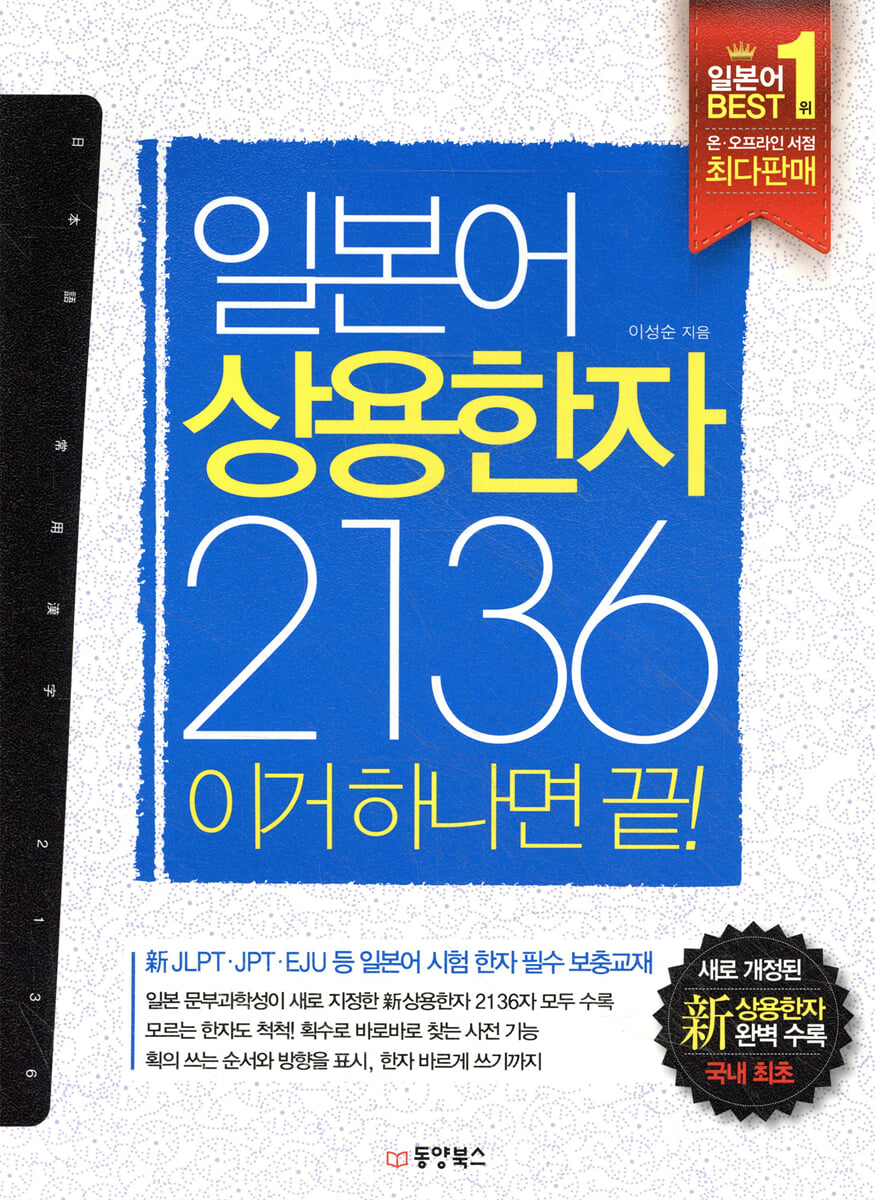
2136 Japanese common kanji characters. This one is all you need!
 |
Description
Book Introduction
In November 2010, the Japanese Ministry of Education, Culture, Sports, Science and Technology announced a new set of commonly used kanji characters, deleting five characters from the existing 1,945 commonly used kanji characters and adding 196 new characters.
This book contains all 2,136 newly designated common kanji characters, arranged in order of total strokes, and is useful for preparing for the kanji section of Japanese language tests such as the JLPT.
Even if you see a Chinese character for the first time, you can easily find it if you know the total strokes, and you can learn the Chinese character accurately by showing the order and direction of the strokes.
The example words in Chinese characters are mainly composed of words frequently used in real life, and easily confusing homonyms are explained with easy examples and fun pictures.
As an appendix to the book, we have included similar Chinese characters and surnames that even Japanese people find confusing, and organized the 2,136 commonly used Chinese characters in a mini bromide format so that they can be viewed at a glance.
This book contains all 2,136 newly designated common kanji characters, arranged in order of total strokes, and is useful for preparing for the kanji section of Japanese language tests such as the JLPT.
Even if you see a Chinese character for the first time, you can easily find it if you know the total strokes, and you can learn the Chinese character accurately by showing the order and direction of the strokes.
The example words in Chinese characters are mainly composed of words frequently used in real life, and easily confusing homonyms are explained with easy examples and fun pictures.
As an appendix to the book, we have included similar Chinese characters and surnames that even Japanese people find confusing, and organized the 2,136 commonly used Chinese characters in a mini bromide format so that they can be viewed at a glance.
- You can preview some of the book's contents.
Preview
index
preface
time
Note
About Japanese Kanji
1 stroke
2 strokes
3 strokes
4 strokes
5 strokes
6 strokes
7 strokes
8 strokes
9 strokes
10 strokes
11 strokes
12 strokes
13 strokes
14 strokes
15 strokes
16 strokes
17 strokes
18 strokes
19 strokes
20 strokes
21 strokes
22 strokes
23 strokes
29 strokes
Japan's annual events
Similar Chinese characters
Reading Japanese surnames
Japanese historical periods and era names
Japanese place names
Search
time
Note
About Japanese Kanji
1 stroke
2 strokes
3 strokes
4 strokes
5 strokes
6 strokes
7 strokes
8 strokes
9 strokes
10 strokes
11 strokes
12 strokes
13 strokes
14 strokes
15 strokes
16 strokes
17 strokes
18 strokes
19 strokes
20 strokes
21 strokes
22 strokes
23 strokes
29 strokes
Japan's annual events
Similar Chinese characters
Reading Japanese surnames
Japanese historical periods and era names
Japanese place names
Search
Publisher's Review
Structure of this book
① Serial number: This is the number of the Chinese character according to stroke order and alphabetical order.
② Title and stroke order: The numbers inside the Chinese characters indicate the writing order, and the arrows indicate the writing direction.
③ In the case of educational Chinese characters (1006 characters), the elementary school grade is indicated.
④ Korean pronunciation and spelling: The pronunciation and spelling of Chinese characters used in our country are written here.
⑤ Examples of Japanese on-reading words / Examples of kun-reading words: These are representative words using each kanji.
⑥ [Special]: This is a special reading that is different from the original Japanese pronunciation.
⑦ In cases where the sound is the same but the Chinese characters and meaning are different, the differences are explained with meanings, examples, and pictures.
⑧ Japanese reading/reading: This is how kanji is read in Japan. Cases that do not exist or are rarely used are not indicated.
⑨ Korean Hanja: In cases where Hanja (orthodox characters) used in our country are available, they are indicated separately.
⑩ □□: This is a box where you can check the memorized letters.
② Title and stroke order: The numbers inside the Chinese characters indicate the writing order, and the arrows indicate the writing direction.
③ In the case of educational Chinese characters (1006 characters), the elementary school grade is indicated.
④ Korean pronunciation and spelling: The pronunciation and spelling of Chinese characters used in our country are written here.
⑤ Examples of Japanese on-reading words / Examples of kun-reading words: These are representative words using each kanji.
⑥ [Special]: This is a special reading that is different from the original Japanese pronunciation.
⑦ In cases where the sound is the same but the Chinese characters and meaning are different, the differences are explained with meanings, examples, and pictures.
⑧ Japanese reading/reading: This is how kanji is read in Japan. Cases that do not exist or are rarely used are not indicated.
⑨ Korean Hanja: In cases where Hanja (orthodox characters) used in our country are available, they are indicated separately.
⑩ □□: This is a box where you can check the memorized letters.
GOODS SPECIFICS
- Date of issue: March 15, 2011
- Page count, weight, size: 624 pages | 1,132g | 188*257*35mm
- ISBN13: 9788983007131
- ISBN10: 8983007133
You may also like
카테고리
korean


korean

![GQ KOREA Mark (Monthly): December [2025]](http://librairie.coreenne.fr/cdn/shop/files/8ef265dbbfbf186523ed75ba7319009d.jpg?v=1765340328&width=3840)


