

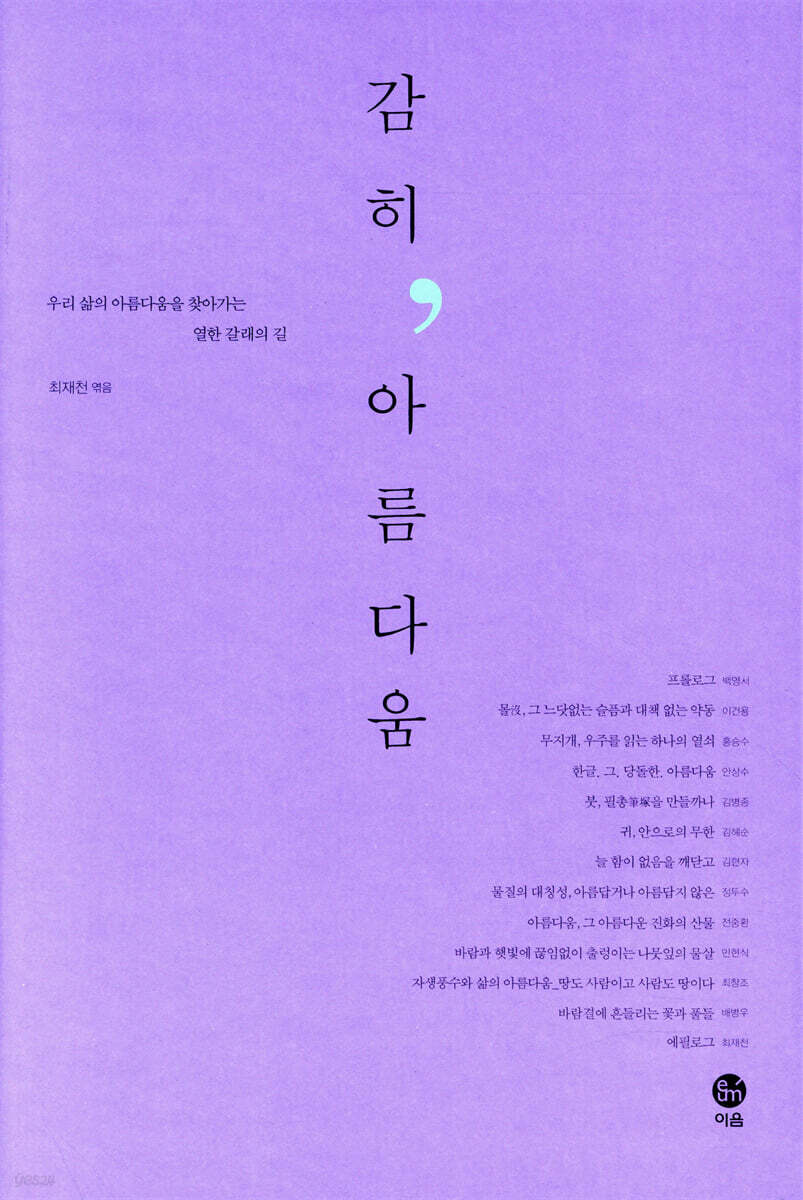
Dare, beauty
 |
Description
Book Introduction
The Beauty of My Life as Told by 11 Leading Intellectuals of Our Time
Traditionally, 'beauty' has been a topic of aesthetics and philosophy.
Books that delve into the subject matter are also specialized fields that can be difficult and unfamiliar to general readers.
However, the self-confessed 'beauty' presented by 11 intellectuals representing this era strikes the hearts of readers in a completely new way.
Starting with the keyword 'the beauty of my life', 11 leading intellectuals encompassing 'art', 'humanities and social sciences', and 'natural science' each unfold 'beauty' that they have realized and pursued throughout their lives and fields, sometimes sincerely and sometimes like a drama.
What exactly is beauty? Architect Min Hyun-sik and musician Lee Geon-yong answer, "Change and creation."
Dr. Jeon Jung-hwan, an evolutionary psychologist, says, “The beauty we feel is human nature that has accumulated over millions of years in the African savannah grasslands.” Dr. Jeong Du-su, a chemist, raises questions about the “beauty of symmetry” by presenting the immovable fact that nature is stable in a one-sided state, like a vine twisting only to the right, using the examples of enantiomers and cyrillic acid.
At first glance, this book may seem difficult, but it is, above all, easy and moving.
It provides an excellent opportunity to witness the convergence of science and art, where they communicate and converse on the topic of beauty.
Traditionally, 'beauty' has been a topic of aesthetics and philosophy.
Books that delve into the subject matter are also specialized fields that can be difficult and unfamiliar to general readers.
However, the self-confessed 'beauty' presented by 11 intellectuals representing this era strikes the hearts of readers in a completely new way.
Starting with the keyword 'the beauty of my life', 11 leading intellectuals encompassing 'art', 'humanities and social sciences', and 'natural science' each unfold 'beauty' that they have realized and pursued throughout their lives and fields, sometimes sincerely and sometimes like a drama.
What exactly is beauty? Architect Min Hyun-sik and musician Lee Geon-yong answer, "Change and creation."
Dr. Jeon Jung-hwan, an evolutionary psychologist, says, “The beauty we feel is human nature that has accumulated over millions of years in the African savannah grasslands.” Dr. Jeong Du-su, a chemist, raises questions about the “beauty of symmetry” by presenting the immovable fact that nature is stable in a one-sided state, like a vine twisting only to the right, using the examples of enantiomers and cyrillic acid.
At first glance, this book may seem difficult, but it is, above all, easy and moving.
It provides an excellent opportunity to witness the convergence of science and art, where they communicate and converse on the topic of beauty.
index
Prologue: A Beautiful Journey to Discover Beauty_Focusing on the East Asian Paradigm | Baek Young-seo
ㆍMol, that sudden sadness and helpless trembling | Lee Geon-yong
Rainbow, a Key to Understanding the Universe | Hong Seung-su
ㆍ Korean.
that.
Bold.
Beauty | Ahn Sang-soo
Should I Make a Brush or a Brush Gun? | Kim Byeong-jong
Ears, Infinity Inside | Kim Hye-soon
ㆍ Realizing that there is always nothing | Kim Hyun-ja
ㆍ The Symmetry of Matter, Beautiful or Unbeautiful | Jeong Du-su
Beauty, the beautiful product of evolution | Jeon Jung-hwan
The ripples of leaves constantly swaying in the wind and sunlight | Min Hyeon-sik
ㆍ Native Feng Shui and the Beauty of Life_The Land is People, and People are the Land | Choi Chang-jo
Flowers and grass swaying in the breeze | Bae Byeong-woo
Epilogue: Dare to Objectify Beauty | Choi Jae-cheon
ㆍMol, that sudden sadness and helpless trembling | Lee Geon-yong
Rainbow, a Key to Understanding the Universe | Hong Seung-su
ㆍ Korean.
that.
Bold.
Beauty | Ahn Sang-soo
Should I Make a Brush or a Brush Gun? | Kim Byeong-jong
Ears, Infinity Inside | Kim Hye-soon
ㆍ Realizing that there is always nothing | Kim Hyun-ja
ㆍ The Symmetry of Matter, Beautiful or Unbeautiful | Jeong Du-su
Beauty, the beautiful product of evolution | Jeon Jung-hwan
The ripples of leaves constantly swaying in the wind and sunlight | Min Hyeon-sik
ㆍ Native Feng Shui and the Beauty of Life_The Land is People, and People are the Land | Choi Chang-jo
Flowers and grass swaying in the breeze | Bae Byeong-woo
Epilogue: Dare to Objectify Beauty | Choi Jae-cheon
Detailed image
Into the book
There are surprisingly many people who like the sunset.
Take time to climb a nearby hill or take a walk along the river and watch the sunset.
Feeling a sense of awe while gazing at the sunset seems to be a universal human emotion. The book "The Great Teachers of Mankind" contains the story of a zoologist who spent his life studying nature in Africa.
One day, he was watching the sunset that was fading away, painting the African sky red.
Then, out of nowhere, a chimpanzee appeared in the forest holding a bunch of papayas.
It is said that the chimpanzee, upon discovering the setting sun, quietly put down the papaya he was holding and gazed at the ever-changing sunset for 15 minutes before trudging back into the forest when the sun had completely disappeared.
The papaya that was placed on the ground was completely forgotten.
Does the chimpanzee's life, in moments of peace, extend beyond that distant eternity? Perhaps in those moments, he too was seeking something beyond the food necessary for sustaining life.
--- From "Epilogue"
Even when I had an exhibition in Sweden, the people there were amazed.
The reason is that in Sweden, pine trees account for about 30 percent of all trees.
I worked on the Alhambra for over two years, and the most important tree there is the pine tree.
So, as a joke, my junior said, “Teacher, you’re famous not because you take good pictures, but because our country’s pine trees are the most beautiful.”
Yes, that's right.
That's right.
Our pine trees are uniquely shaped.
Objectively, the most unique tree is our pine tree.
What's interesting is that the pine trees of each country resemble the people of that country.
The order of resemblance is pine trees first and people later, but anyway, Spanish pine trees resemble Spanish people and Swedish pine trees resemble Swedes.
However, the pine trees of New Caledonia are tall, while the islanders are plump.
Upon closer inspection, it was tuna.
Those people resemble tuna.
In this way, people are close to nature.
--- From “Flowers and Grass Swaying in the Wind”
The dance of temptation that Salome performed in front of King Herod while asking for the head of John the Baptist.
It must have been very captivating, but it was probably the worst dance ever.
So what is the best dance?
When the Buddha gave his last sermon on Vulture Peak, he held up a lotus flower in front of him and showed it to the assembly. Only his disciple, Mahakasyapa, understood the meaning, smiled, stood up, and danced.
That dance was the dance that united the minds of Buddha and Mahakasyapa.
That 'telepathy' may be referring to some truth of the universe or a great enlightenment that we cannot express in words.
If there is such a gesture of enlightenment, such a dance, then it will be the best dance.
In this way, aren't composition and art not separate, but rather one in the midst of changing life?
If it were to be like that, it would be truly beautiful.
--- From "Realizing that there is always nothing to do"
This is the space where the spirit of Gi-o is manifested, where one can confess, “I leaned against the window and calmed my mind. Although the room was small, I found comfort.”
This shift in thinking allows us to move from 'representational architecture' to 'architecture that goes beyond the level of objectification.'
Rather than gathering spaces with certain characteristics to create a special place or environment, that is, rather than constructing a certain beauty inherent in architecture, the goal is to derive architecture from the conditions of the environment or land.
Rather than sweeping everything away, making a blank sheet of paper, and then creating new beauty on top of it, I hope that, among what already exists, another beauty will be dynamically created at every moment.
--- From "The waves of leaves swaying ceaselessly in the wind and sunlight"
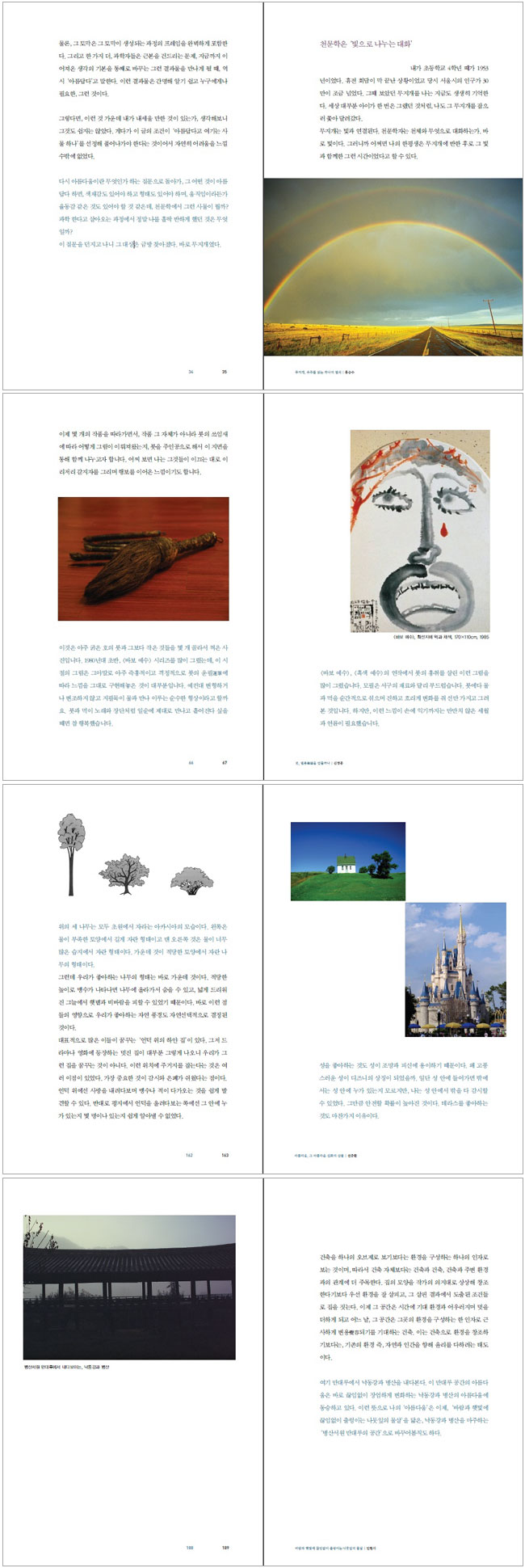
Here we discover a most natural and yet most mysterious phenomenon: if there is an element called A, we can compare the abundances of the elements on Earth, those found in meteorites that have fallen to Earth from space, and those found in the solar atmosphere, and we find that they are all surprisingly consistent.
In the figure above, the horizontal axis represents the elemental content ratio of the Allende meteorite, and the vertical axis represents the elemental content ratio of the solar atmosphere.
The chemical composition of meteorites and the solar atmosphere are thus similar.
This means that the material that makes up 'my body' is essentially the same as the material that makes up not only the sun, but also the universe at the atomic level.
This is an amazing discovery that can be approached starting from the rainbow.
Take time to climb a nearby hill or take a walk along the river and watch the sunset.
Feeling a sense of awe while gazing at the sunset seems to be a universal human emotion. The book "The Great Teachers of Mankind" contains the story of a zoologist who spent his life studying nature in Africa.
One day, he was watching the sunset that was fading away, painting the African sky red.
Then, out of nowhere, a chimpanzee appeared in the forest holding a bunch of papayas.
It is said that the chimpanzee, upon discovering the setting sun, quietly put down the papaya he was holding and gazed at the ever-changing sunset for 15 minutes before trudging back into the forest when the sun had completely disappeared.
The papaya that was placed on the ground was completely forgotten.
Does the chimpanzee's life, in moments of peace, extend beyond that distant eternity? Perhaps in those moments, he too was seeking something beyond the food necessary for sustaining life.
--- From "Epilogue"
Even when I had an exhibition in Sweden, the people there were amazed.
The reason is that in Sweden, pine trees account for about 30 percent of all trees.
I worked on the Alhambra for over two years, and the most important tree there is the pine tree.
So, as a joke, my junior said, “Teacher, you’re famous not because you take good pictures, but because our country’s pine trees are the most beautiful.”
Yes, that's right.
That's right.
Our pine trees are uniquely shaped.
Objectively, the most unique tree is our pine tree.
What's interesting is that the pine trees of each country resemble the people of that country.
The order of resemblance is pine trees first and people later, but anyway, Spanish pine trees resemble Spanish people and Swedish pine trees resemble Swedes.
However, the pine trees of New Caledonia are tall, while the islanders are plump.
Upon closer inspection, it was tuna.
Those people resemble tuna.
In this way, people are close to nature.
--- From “Flowers and Grass Swaying in the Wind”
The dance of temptation that Salome performed in front of King Herod while asking for the head of John the Baptist.
It must have been very captivating, but it was probably the worst dance ever.
So what is the best dance?
When the Buddha gave his last sermon on Vulture Peak, he held up a lotus flower in front of him and showed it to the assembly. Only his disciple, Mahakasyapa, understood the meaning, smiled, stood up, and danced.
That dance was the dance that united the minds of Buddha and Mahakasyapa.
That 'telepathy' may be referring to some truth of the universe or a great enlightenment that we cannot express in words.
If there is such a gesture of enlightenment, such a dance, then it will be the best dance.
In this way, aren't composition and art not separate, but rather one in the midst of changing life?
If it were to be like that, it would be truly beautiful.
--- From "Realizing that there is always nothing to do"
This is the space where the spirit of Gi-o is manifested, where one can confess, “I leaned against the window and calmed my mind. Although the room was small, I found comfort.”
This shift in thinking allows us to move from 'representational architecture' to 'architecture that goes beyond the level of objectification.'
Rather than gathering spaces with certain characteristics to create a special place or environment, that is, rather than constructing a certain beauty inherent in architecture, the goal is to derive architecture from the conditions of the environment or land.
Rather than sweeping everything away, making a blank sheet of paper, and then creating new beauty on top of it, I hope that, among what already exists, another beauty will be dynamically created at every moment.
--- From "The waves of leaves swaying ceaselessly in the wind and sunlight"
Here we discover a most natural and yet most mysterious phenomenon: if there is an element called A, we can compare the abundances of the elements on Earth, those found in meteorites that have fallen to Earth from space, and those found in the solar atmosphere, and we find that they are all surprisingly consistent.
In the figure above, the horizontal axis represents the elemental content ratio of the Allende meteorite, and the vertical axis represents the elemental content ratio of the solar atmosphere.
The chemical composition of meteorites and the solar atmosphere are thus similar.
This means that the material that makes up 'my body' is essentially the same as the material that makes up not only the sun, but also the universe at the atomic level.
This is an amazing discovery that can be approached starting from the rainbow.
--- From "Rainbow, One Key to Reading the Universe"
Publisher's Review
A true synthesis drawn together from the well of intellect of our time.
The story of masters who have spent their entire lives drawing, building, holding, singing, and even wept over "beauty."
The greatest feature of this book is that it allows readers to share with us the vivid, bare face of 'beauty,' one of the conditions of our lives.
Traditionally, beauty has been a subject of aesthetics and philosophy.
Books that delve into the subject matter are also specialized fields that can be difficult and unfamiliar to general readers.
However, the self-confessed 'beauty' presented by 11 intellectuals representing this era captures the hearts of readers in a completely new way.
Starting with the keyword "the beauty of my life," 11 leading intellectuals encompassing "art," "humanities," and "natural science" each spend their lives realizing and striving for "beauty" in their own lives and fields. This book runs through this book, sometimes sincerely, and sometimes like a drama.
And above all, this book is easy and touching.
This is a unique opportunity to witness the convergence of science and art, where they communicate and converse on the topic of beauty.
What exactly is beauty in our time?
“I am not a god, so I can feel beauty, even if only for a moment.”
Architect Min Hyun-sik and musician Lee Geon-yong say that what they discovered during their decades-long journey in search of beauty was ‘change and creation.’
They focus on the moment of creation of beauty, that is, change.
The moment we put aside our daily lives, we feel a 'movement without a plan' and discover the reason for 'difference' in the ripples of leaves constantly swaying in the wind and sunlight.
Painter Kim Byeong-jong and dancer Kim Hyeon-ja confess how they quietly walked the path of creation and pioneered their own artistic world through self-denial.
Kim Byeong-jong, who praises the brush that has been with him his entire life, ponders how time and wear and tear have approached beauty, and this way of thinking leads us to Kim Hyeon-ja's 'unity with nature', who has pushed the raw 'dance of life' with her whole body, allowing us to once again look back at the essence of art.
Meanwhile, evolutionary psychologist Dr. Jeon Jung-hwan says, “The beauty we perceive is human nature that has accumulated over millions of years in the African savannah.”
In other words, it is not objective, but a product of evolution.
This perspective has many implications when it comes to understanding the standards of beauty and human behavior when choosing a home.
However, chemist Dr. Jeong Du-su questions the 'beauty of symmetry' by citing the examples of mirror images and cyrillicity and presenting the unmovable fact that the natural state is stable in a state biased to one side, like a vine twisting only to the right.
Designer Sangsoo Ahn's writings on the Korean alphabet as a truly grand design and astronomer Seungsoo Hong's writings on the rainbow as a way to understand the fundamental conditions of humanity and the universe clearly and interestingly illustrate why the word "beauty" comes from the root word "to know."
Poet Kim Hye-sun, with her unique prose, speaks of the paradox of beauty, writing that this ear receives and records the chaos before the world and the lonely silence before the world in poetry.
She says I can feel beauty because I am not a god.
The story of masters who have spent their entire lives drawing, building, holding, singing, and even wept over "beauty."
The greatest feature of this book is that it allows readers to share with us the vivid, bare face of 'beauty,' one of the conditions of our lives.
Traditionally, beauty has been a subject of aesthetics and philosophy.
Books that delve into the subject matter are also specialized fields that can be difficult and unfamiliar to general readers.
However, the self-confessed 'beauty' presented by 11 intellectuals representing this era captures the hearts of readers in a completely new way.
Starting with the keyword "the beauty of my life," 11 leading intellectuals encompassing "art," "humanities," and "natural science" each spend their lives realizing and striving for "beauty" in their own lives and fields. This book runs through this book, sometimes sincerely, and sometimes like a drama.
And above all, this book is easy and touching.
This is a unique opportunity to witness the convergence of science and art, where they communicate and converse on the topic of beauty.
What exactly is beauty in our time?
“I am not a god, so I can feel beauty, even if only for a moment.”
Architect Min Hyun-sik and musician Lee Geon-yong say that what they discovered during their decades-long journey in search of beauty was ‘change and creation.’
They focus on the moment of creation of beauty, that is, change.
The moment we put aside our daily lives, we feel a 'movement without a plan' and discover the reason for 'difference' in the ripples of leaves constantly swaying in the wind and sunlight.
Painter Kim Byeong-jong and dancer Kim Hyeon-ja confess how they quietly walked the path of creation and pioneered their own artistic world through self-denial.
Kim Byeong-jong, who praises the brush that has been with him his entire life, ponders how time and wear and tear have approached beauty, and this way of thinking leads us to Kim Hyeon-ja's 'unity with nature', who has pushed the raw 'dance of life' with her whole body, allowing us to once again look back at the essence of art.
Meanwhile, evolutionary psychologist Dr. Jeon Jung-hwan says, “The beauty we perceive is human nature that has accumulated over millions of years in the African savannah.”
In other words, it is not objective, but a product of evolution.
This perspective has many implications when it comes to understanding the standards of beauty and human behavior when choosing a home.
However, chemist Dr. Jeong Du-su questions the 'beauty of symmetry' by citing the examples of mirror images and cyrillicity and presenting the unmovable fact that the natural state is stable in a state biased to one side, like a vine twisting only to the right.
Designer Sangsoo Ahn's writings on the Korean alphabet as a truly grand design and astronomer Seungsoo Hong's writings on the rainbow as a way to understand the fundamental conditions of humanity and the universe clearly and interestingly illustrate why the word "beauty" comes from the root word "to know."
Poet Kim Hye-sun, with her unique prose, speaks of the paradox of beauty, writing that this ear receives and records the chaos before the world and the lonely silence before the world in poetry.
She says I can feel beauty because I am not a god.
GOODS SPECIFICS
- Date of issue: June 7, 2022
- Page count, weight, size: 248 pages | 476g | 152*228*20mm
- ISBN13: 9791190944748
- ISBN10: 119094474X
You may also like
카테고리
korean


korean

![GQ KOREA Mark (Monthly): December [2025]](http://librairie.coreenne.fr/cdn/shop/files/8ef265dbbfbf186523ed75ba7319009d.jpg?v=1765340328&width=3840)


