

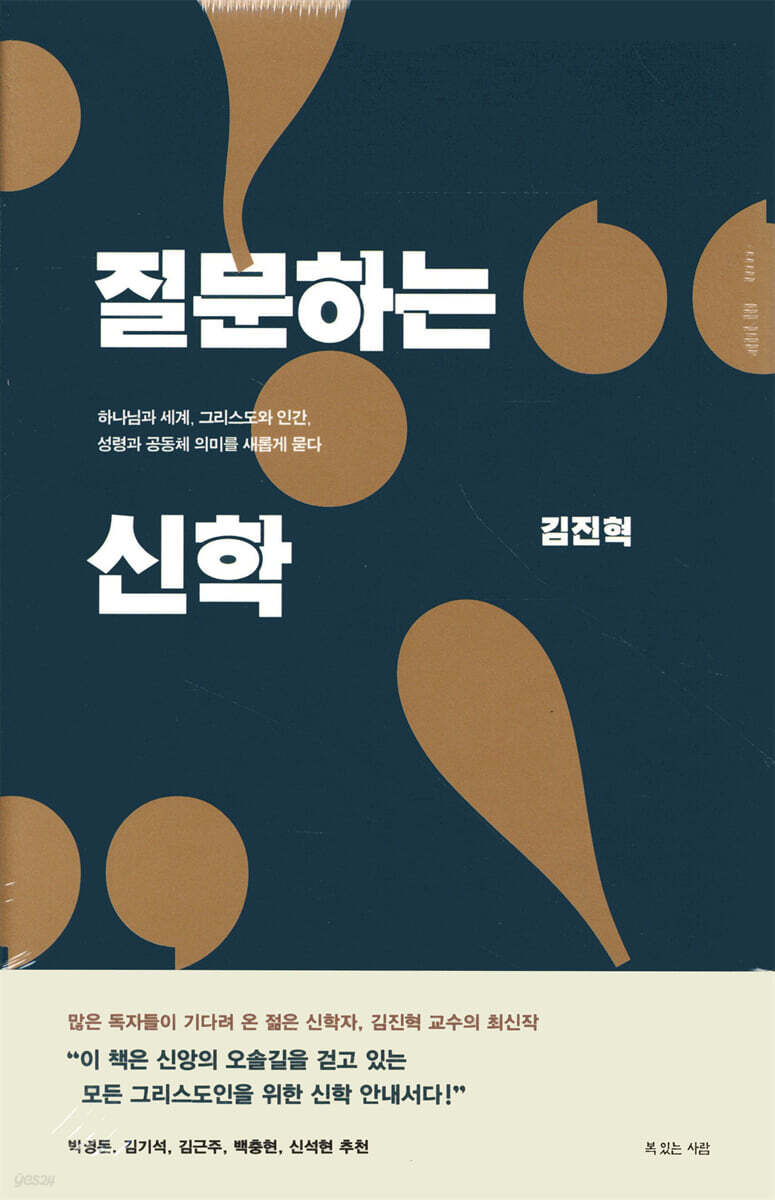
Questioning theology
 |
Description
Book Introduction
“This book is for those who are walking the path of faith. “A theological guide for all Christians!” - Recommended by Park Young-don, Kim Ki-seok, Kim Geun-ju, Baek Chung-hyun, and Shin Seok-hyun In search of the beauty of theology Theology is one of the oldest and most deeply studied disciplines in human history. If theology did not have the joy and charm of studying it, would it have been able to capture the hearts of so many people on earth for so long? By unraveling the core teachings of Christianity through "questions," this book helps us regain the ability to contemplate and enjoy the original beauty of theology, which has become unfamiliar and difficult. |
- You can preview some of the book's contents.
Preview
index
preface
How to use this book?
I.
God and the world
Part 1: Definition and Resources of Theology
Chapter 1 Defining Theology: What is Theology and Why is it Needed?
Chapter 2 Theological Resources: Do You Really Need a Lot of Books to Study Theology?
Chapter 3 Biblical Theory: Is the Bible the Word of God or a Book Written by Man?
Part 2 New Theory
Chapter 4: The Trinity: How Can Three Be One?
Chapter 5 Revelation: How does God reveal himself to humans?
Chapter 6 God's Attributes: What Is God Like?
Chapter 7 Creationism: How and For What Does the Universe Exist?
Chapter 8: Providence: How are God's providence and human freedom in harmony?
Part 3 God and the World
Chapter 9 God's Will: Are War and Disease God's Will?
Chapter 10 Theodicy I: How Should We Understand Evil and Suffering?
Chapter 11 Theodicy II: Why is there evil in a world created by a good God?
Chapter 12 Theodicy III: Does God Suffer When We Suffer?
II.
Jesus Christ and humanity
Part 4 Christology
Chapter 13 Christology: How Can We Know Jesus Christ, a First-Century Figure?
Chapter 14 The Life and Ministry of Jesus: Who Was Jesus of Nazareth and How Did He Live?
Chapter 15: Incarnation and Resurrection: What is the greatest miracle Christians believe in?
Chapter 16: Atonement: How Does One Man's Death Save Others?
Part 5: Anthropology
Chapter 17 The Image of God: What Makes Humans Human?
Chapter 18 Soul and Body: What Are Humans Made of?
Chapter 19: Theory of Desire: Why Did God Create So Many Desires?
Chapter 20: On Sin: Is Christianity, Which Emphasizes Sin, Pessimistic?
Chapter 21: The Fall and Original Sin: Why Are We Judged Because of Adam?
Part 6 God-Man in Christ
Chapter 22 Justification and the Christian Life: Can One Become Righteous by Faith Alone?
Chapter 23 The Grace of Forgiveness: What Makes Humanity and the World Whole?
Chapter 24 Religious Art: How Can Artists Depict the Invisible God?
III.
Holy Spirit and Community
Part 7: Pneumatology and Ecclesiology
Chapter 25: Theology of the Holy Spirit I: Who is the Holy Spirit who came at Pentecost?
Chapter 26: Pneumatology II: What Does the Holy Spirit Do in the Church and the World?
Chapter 27: The Gifts of the Holy Spirit: What Does a Spirit-Filled Life Look Like?
Chapter 28 Ecclesiology I: What is the Church and Why is it Needed?
Chapter 29 Ecclesiology II: Why Must One Belong to a Church to Become a Christian?
Part 8: Life in the Church
Chapter 30: Sacramentalism: Are Sacraments Still Important in Word-Centered Protestantism?
Chapter 31: Baptism: Why Must We Be Baptized to Become a Christian?
Chapter 32 The Eucharist: Is it necessary for Christians to eat bread and wine?
Chapter 33 Prayer: Why should we pray to an omnipotent and omniscient being?
Part 9: Eschatology
Chapter 34 Eschatology I: What lies beyond this life?
Chapter 35 Eschatology II: Why Should Christians Wait for the End?
Chapter 36: Is the Sabbath Still Important to Christians?
Postscript
Note
How to use this book?
I.
God and the world
Part 1: Definition and Resources of Theology
Chapter 1 Defining Theology: What is Theology and Why is it Needed?
Chapter 2 Theological Resources: Do You Really Need a Lot of Books to Study Theology?
Chapter 3 Biblical Theory: Is the Bible the Word of God or a Book Written by Man?
Part 2 New Theory
Chapter 4: The Trinity: How Can Three Be One?
Chapter 5 Revelation: How does God reveal himself to humans?
Chapter 6 God's Attributes: What Is God Like?
Chapter 7 Creationism: How and For What Does the Universe Exist?
Chapter 8: Providence: How are God's providence and human freedom in harmony?
Part 3 God and the World
Chapter 9 God's Will: Are War and Disease God's Will?
Chapter 10 Theodicy I: How Should We Understand Evil and Suffering?
Chapter 11 Theodicy II: Why is there evil in a world created by a good God?
Chapter 12 Theodicy III: Does God Suffer When We Suffer?
II.
Jesus Christ and humanity
Part 4 Christology
Chapter 13 Christology: How Can We Know Jesus Christ, a First-Century Figure?
Chapter 14 The Life and Ministry of Jesus: Who Was Jesus of Nazareth and How Did He Live?
Chapter 15: Incarnation and Resurrection: What is the greatest miracle Christians believe in?
Chapter 16: Atonement: How Does One Man's Death Save Others?
Part 5: Anthropology
Chapter 17 The Image of God: What Makes Humans Human?
Chapter 18 Soul and Body: What Are Humans Made of?
Chapter 19: Theory of Desire: Why Did God Create So Many Desires?
Chapter 20: On Sin: Is Christianity, Which Emphasizes Sin, Pessimistic?
Chapter 21: The Fall and Original Sin: Why Are We Judged Because of Adam?
Part 6 God-Man in Christ
Chapter 22 Justification and the Christian Life: Can One Become Righteous by Faith Alone?
Chapter 23 The Grace of Forgiveness: What Makes Humanity and the World Whole?
Chapter 24 Religious Art: How Can Artists Depict the Invisible God?
III.
Holy Spirit and Community
Part 7: Pneumatology and Ecclesiology
Chapter 25: Theology of the Holy Spirit I: Who is the Holy Spirit who came at Pentecost?
Chapter 26: Pneumatology II: What Does the Holy Spirit Do in the Church and the World?
Chapter 27: The Gifts of the Holy Spirit: What Does a Spirit-Filled Life Look Like?
Chapter 28 Ecclesiology I: What is the Church and Why is it Needed?
Chapter 29 Ecclesiology II: Why Must One Belong to a Church to Become a Christian?
Part 8: Life in the Church
Chapter 30: Sacramentalism: Are Sacraments Still Important in Word-Centered Protestantism?
Chapter 31: Baptism: Why Must We Be Baptized to Become a Christian?
Chapter 32 The Eucharist: Is it necessary for Christians to eat bread and wine?
Chapter 33 Prayer: Why should we pray to an omnipotent and omniscient being?
Part 9: Eschatology
Chapter 34 Eschatology I: What lies beyond this life?
Chapter 35 Eschatology II: Why Should Christians Wait for the End?
Chapter 36: Is the Sabbath Still Important to Christians?
Postscript
Note
Into the book
Instead of relying on the structure of traditional systematic theology, this book uses the questions that pastors, seminarians, and the general public might have as a basic framework for opening and closing the core issues of each doctrine.
Even when explaining doctrine, I thought again about whether there were any examples that could resonate in real life or church life.
Even with limited knowledge, I tried to help people avoid confusing the 'unfamiliarity' of theology with the 'difficulty' of theology by recklessly utilizing cultural materials such as novels, poetry, and movies.
To avoid the feeling of defending or introducing the theological position of a particular denomination, we have tried to present a balanced and faithful presentation of various voices that have developed within the Christian tradition while remaining grounded in the Bible.
---From the "Preface"
Why has anti-intellectualism, now identified as a major problem in Korean Protestantism, emerged? Has the will to power and personal greed taken the place of theological reflection and the dynamism of church practice? Are we concealing our weak theological reflections behind the cloak of prestigious university degrees or overseas studies? Rather than seriously studying the relationship between church and society, have we too readily become hostile to society and culture? These distorted aspects of the Korean church, one wonders, are they not the result of a lack of theological understanding?
---From "Chapter 1: Definition of Theology"
The biblical creation story is the result of God revealing the origin of the universe in a 'special way' for finite humans, especially humans before the development of modern science.
Genesis is not a complete cosmology in itself, but rather a beautiful, wise, and authoritative account given by God to help humans mature and grow in their faith in creation.
Genesis is also a place where we can see God's 'humility' in lowering himself to the level of human perception and language.
Therefore, only those with a humble heart can learn the mystery of creation by following the light of the Holy Spirit that illuminates the darkened heart.
---From "Chapter 7 Creationism"
If we read the Old Testament by changing ‘God’s will’ to ‘what God likes,’ we will come to know better what kind of person God is.
God is not a personal being who watches and judges us to see whether we live according to His hidden will or not, but who desires to rejoice in us, even though we are imperfect.
God created humans not as anxious and compulsive beings seeking the hidden will of God, but as free and individual beings who can bring joy to their Creator in their own unique way.
It's like parents don't demand a single right answer from their children, but rather love their very existence and find joy in doing things they never thought possible.
---From “Chapter 9 God’s Will”
There are also specific Christological images that are essential in pastoral or missionary work.
But aren't today's discourse on Christology dominated by our desires, the needs of the times, the demands of the church, and the logic of the field, rather than the true nature of Jesus of Nazareth? Aren't we trying to tame Jesus Christ, the eternal "stranger," into modern culture, making him easier to explain, easier to handle, and easier to utilize? T.
S. Eliot used the poetic expression 'Christ the tiger', or C.
Wasn't it the case that S. Lewis portrayed Christ as the lion Aslan, an attempt to alienate him from the religious psychology that treats even Christ like a pet?
---「Chapter 13.
From “Christology”
No matter how misused desire may be, it still serves an essential function in God's creation.
Rather, it seems that the greater the necessity and importance of desire, the more likely it is that there have been many cases of misuse.
If desire is not to mold the idols desired by the masses, on the one hand, we must not oppose the fundamental longing for God with the desire for finite existence, and on the other hand, we must be able to relativize the various desires of everyday life with the longing for eternity.
---From "Chapter 19: Theory of Desire"
Eschatology is an invitation to imagine and foresee the future that God has dreamed of, and to bring justice and peace, love and reconciliation into the bleak reality.
Therefore, eschatology is a doctrine thoroughly about the future and a doctrine thoroughly connected to reality.
It is a doctrine about a destiny that we cannot control or achieve with our own hands, but it is also a doctrine that emphasizes the importance of our obedience and responsibility.
Eschatology is a teaching that creates a "qualitative difference" in everyday life by connecting hope for the future with today's life.
---Chapter 34.
From "Eschatology I"
The Christian tradition was formed as countless people's questions gathered and accumulated over a long period of time, and it was interesting throughout the writing that questions are the key that allows us to enter the world of meaning that unfolds within the treasure trove of tradition... Questions not only open the perspectives of those participating in the conversation, but at the same time guide the conversation in a certain direction so that meaning can be formed.
Therefore, questions not only offer the possibility of gaining true knowledge, but also serve as a condition for creating genuine and fulfilling conversations.
Even when explaining doctrine, I thought again about whether there were any examples that could resonate in real life or church life.
Even with limited knowledge, I tried to help people avoid confusing the 'unfamiliarity' of theology with the 'difficulty' of theology by recklessly utilizing cultural materials such as novels, poetry, and movies.
To avoid the feeling of defending or introducing the theological position of a particular denomination, we have tried to present a balanced and faithful presentation of various voices that have developed within the Christian tradition while remaining grounded in the Bible.
---From the "Preface"
Why has anti-intellectualism, now identified as a major problem in Korean Protestantism, emerged? Has the will to power and personal greed taken the place of theological reflection and the dynamism of church practice? Are we concealing our weak theological reflections behind the cloak of prestigious university degrees or overseas studies? Rather than seriously studying the relationship between church and society, have we too readily become hostile to society and culture? These distorted aspects of the Korean church, one wonders, are they not the result of a lack of theological understanding?
---From "Chapter 1: Definition of Theology"
The biblical creation story is the result of God revealing the origin of the universe in a 'special way' for finite humans, especially humans before the development of modern science.
Genesis is not a complete cosmology in itself, but rather a beautiful, wise, and authoritative account given by God to help humans mature and grow in their faith in creation.
Genesis is also a place where we can see God's 'humility' in lowering himself to the level of human perception and language.
Therefore, only those with a humble heart can learn the mystery of creation by following the light of the Holy Spirit that illuminates the darkened heart.
---From "Chapter 7 Creationism"
If we read the Old Testament by changing ‘God’s will’ to ‘what God likes,’ we will come to know better what kind of person God is.
God is not a personal being who watches and judges us to see whether we live according to His hidden will or not, but who desires to rejoice in us, even though we are imperfect.
God created humans not as anxious and compulsive beings seeking the hidden will of God, but as free and individual beings who can bring joy to their Creator in their own unique way.
It's like parents don't demand a single right answer from their children, but rather love their very existence and find joy in doing things they never thought possible.
---From “Chapter 9 God’s Will”
There are also specific Christological images that are essential in pastoral or missionary work.
But aren't today's discourse on Christology dominated by our desires, the needs of the times, the demands of the church, and the logic of the field, rather than the true nature of Jesus of Nazareth? Aren't we trying to tame Jesus Christ, the eternal "stranger," into modern culture, making him easier to explain, easier to handle, and easier to utilize? T.
S. Eliot used the poetic expression 'Christ the tiger', or C.
Wasn't it the case that S. Lewis portrayed Christ as the lion Aslan, an attempt to alienate him from the religious psychology that treats even Christ like a pet?
---「Chapter 13.
From “Christology”
No matter how misused desire may be, it still serves an essential function in God's creation.
Rather, it seems that the greater the necessity and importance of desire, the more likely it is that there have been many cases of misuse.
If desire is not to mold the idols desired by the masses, on the one hand, we must not oppose the fundamental longing for God with the desire for finite existence, and on the other hand, we must be able to relativize the various desires of everyday life with the longing for eternity.
---From "Chapter 19: Theory of Desire"
Eschatology is an invitation to imagine and foresee the future that God has dreamed of, and to bring justice and peace, love and reconciliation into the bleak reality.
Therefore, eschatology is a doctrine thoroughly about the future and a doctrine thoroughly connected to reality.
It is a doctrine about a destiny that we cannot control or achieve with our own hands, but it is also a doctrine that emphasizes the importance of our obedience and responsibility.
Eschatology is a teaching that creates a "qualitative difference" in everyday life by connecting hope for the future with today's life.
---Chapter 34.
From "Eschatology I"
The Christian tradition was formed as countless people's questions gathered and accumulated over a long period of time, and it was interesting throughout the writing that questions are the key that allows us to enter the world of meaning that unfolds within the treasure trove of tradition... Questions not only open the perspectives of those participating in the conversation, but at the same time guide the conversation in a certain direction so that meaning can be formed.
Therefore, questions not only offer the possibility of gaining true knowledge, but also serve as a condition for creating genuine and fulfilling conversations.
---From the “Postscript”
Publisher's Review
Theology for Everyone
Theology is the sound of wonder planted in the human heart resonating and spreading out as it encounters the Word of God.
Thanks to the amazing ability the Creator has gifted humanity, we constantly discover new things about God, humanity, and the world, even amidst the familiarity of life.
Therefore, theology is neither merely part of the training to become a pastor nor merely a specialized task performed at the desks of scholars.
Theology is a life skill for all who live their daily lives perceiving them as God's creation.
Theology that Enriches Life
The long history of theology is also a history of encounters.
Wherever there is a church, diverse encounters between people, languages, scholarship, art, and culture take place.
Therefore, theology is not a tedious or harsh discipline that explores the content and history of doctrine.
Studying theology is also about learning to cherish the rich meaning of unexpected encounters in history and culture.
This book unravels the layers of encounters that have shaped Christianity, and, seeking to inspire new encounters for believers today, poses essential questions on behalf of all Christians on the path of theology.
Honest questions about faith and theology, insightful answers that dispel dogmatism and misunderstandings.
This book honestly and boldly poses questions that have been lingering in readers' minds about God, the world, humanity, and the church, and guides them into a place of rich conversation and learning.
And it provides insightful, non-dogmatic answers based on theological data such as Scripture, tradition, reason, and experience.
To ensure that anyone with faith can read it, we tried to minimize the use of specialized academic terms as much as possible, and used artistic materials such as novels, poetry, and films to connect theology to life and make it understandable.
Furthermore, rather than defending or biasedly introducing the theological positions of a specific denomination, it broadens the readers' horizons by introducing the intentions and contributions of theologians representing various theological positions and denominations.
Each chapter includes questions for reflection and discussion, making it ideal for individual study or group study at church or book clubs.
characteristic
- A work that advances the popularization of theology to a wide readership.
- Reframes the topic of systematic theology into intriguing questions and provides insightful answers.
- Introduces theology in a non-dry manner with rich humanities knowledge.
- Each chapter includes questions for group discussion.
For readers
- Anyone who wants to understand God, the world, and humanity
- A minister who prepares answers to questions from believers and non-believers
- Students who want to regain interest when theology feels boring.
- A believer who wants to know Christianity in depth
Theology is the sound of wonder planted in the human heart resonating and spreading out as it encounters the Word of God.
Thanks to the amazing ability the Creator has gifted humanity, we constantly discover new things about God, humanity, and the world, even amidst the familiarity of life.
Therefore, theology is neither merely part of the training to become a pastor nor merely a specialized task performed at the desks of scholars.
Theology is a life skill for all who live their daily lives perceiving them as God's creation.
Theology that Enriches Life
The long history of theology is also a history of encounters.
Wherever there is a church, diverse encounters between people, languages, scholarship, art, and culture take place.
Therefore, theology is not a tedious or harsh discipline that explores the content and history of doctrine.
Studying theology is also about learning to cherish the rich meaning of unexpected encounters in history and culture.
This book unravels the layers of encounters that have shaped Christianity, and, seeking to inspire new encounters for believers today, poses essential questions on behalf of all Christians on the path of theology.
Honest questions about faith and theology, insightful answers that dispel dogmatism and misunderstandings.
This book honestly and boldly poses questions that have been lingering in readers' minds about God, the world, humanity, and the church, and guides them into a place of rich conversation and learning.
And it provides insightful, non-dogmatic answers based on theological data such as Scripture, tradition, reason, and experience.
To ensure that anyone with faith can read it, we tried to minimize the use of specialized academic terms as much as possible, and used artistic materials such as novels, poetry, and films to connect theology to life and make it understandable.
Furthermore, rather than defending or biasedly introducing the theological positions of a specific denomination, it broadens the readers' horizons by introducing the intentions and contributions of theologians representing various theological positions and denominations.
Each chapter includes questions for reflection and discussion, making it ideal for individual study or group study at church or book clubs.
characteristic
- A work that advances the popularization of theology to a wide readership.
- Reframes the topic of systematic theology into intriguing questions and provides insightful answers.
- Introduces theology in a non-dry manner with rich humanities knowledge.
- Each chapter includes questions for group discussion.
For readers
- Anyone who wants to understand God, the world, and humanity
- A minister who prepares answers to questions from believers and non-believers
- Students who want to regain interest when theology feels boring.
- A believer who wants to know Christianity in depth
GOODS SPECIFICS
- Date of publication: February 28, 2019
- Page count, weight, size: 864 pages | 1,123g | 140*217*40mm
- ISBN13: 9791170831044
- ISBN10: 1170831044
You may also like
카테고리
korean


korean

![ELLE 엘르 스페셜 에디션 A형 : 12월 [2025]](http://librairie.coreenne.fr/cdn/shop/files/b8e27a3de6c9538896439686c6b0e8fb.jpg?v=1766436872&width=3840)


