

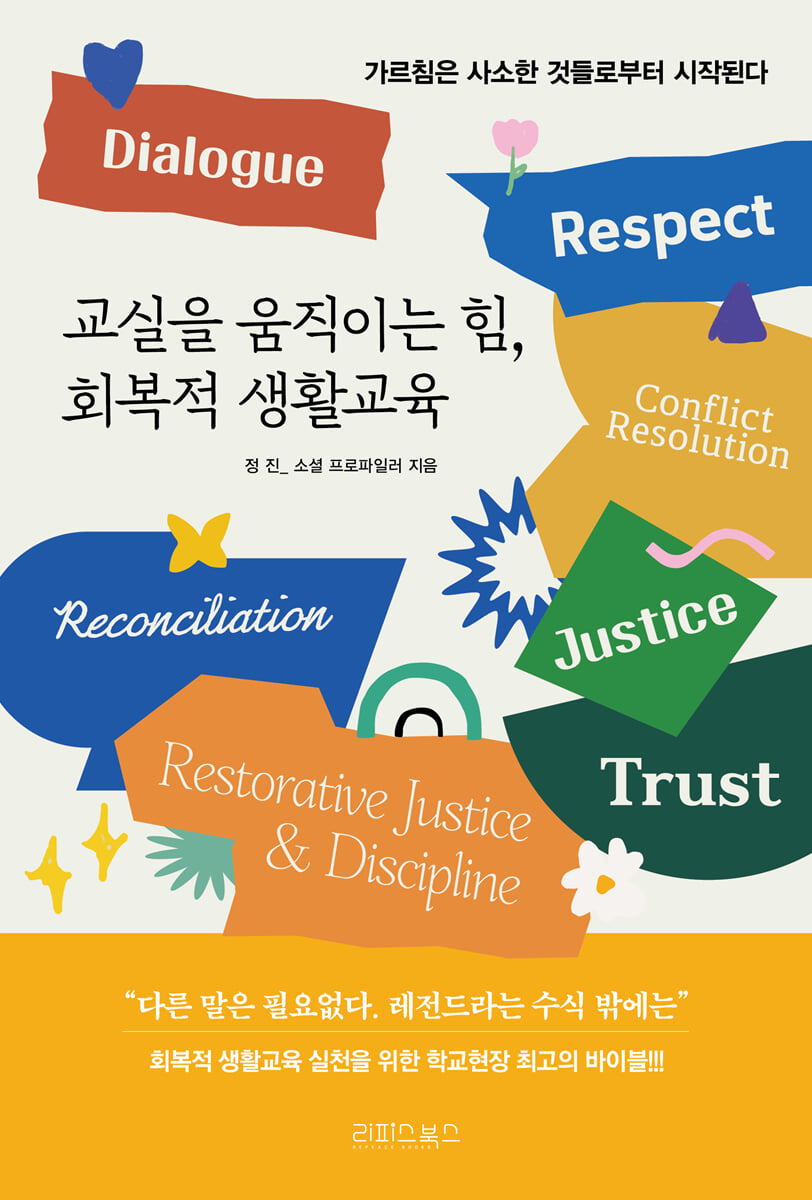
The Power of Classroom Movement: Restorative Life Education
 |
Description
index
Recommendation
· Let us stand together on the border to move towards a world of peace.
· The standard for classroom solutions that can be interpreted as your own
Prologue: Early in the morning, getting ready for school.
Part 1.
People I met on my way to school
· What would you do?
Chapter 1.
Child and Father's Choice
Chapter 2.
Is it painful to choose peace?
Chapter 3.
When I became a party to the incident
Part 2.
Things I thought about as I entered the school gate
· How can we learn about relationships in school?
Chapter 1.
Compass of Relationships, Restorative Life Education
Chapter 2.
A model of relationship formation and relationship repair
Chapter 3.
Restorative education is peace education.
Part 3.
Our classroom has 'relationship-based communication'
· Relationship building takes practice.
Chapter 1.
Creating a Classroom of Hospitality
Chapter 2.
There is a 'government office' in our classroom.
Chapter 3.
Mom Play + Mam Play: Building Class Relationships
Part 4.
A conversation that creates a roadmap for your relationship
· 'Decompose' the classroom network
Chapter 1.
We practice conversation every day.
Chapter 2.
Circle conversation by all, for all
Chapter 3.
We really need to talk to our children at home.
Chapter 4.
As an education professional, I collaborate with parents through dialogue.
Part 5.
The road to conflict transformation
· Conflict is not the problem.
Chapter 1.
Conflict creates new relationships.
Chapter 2.
Analytical techniques for conflict resolution
Chapter 3.
Key Questions to Ask in Classroom Conflicts
Epilogue: On the way home from work, passing through the school matrix
References
· Let us stand together on the border to move towards a world of peace.
· The standard for classroom solutions that can be interpreted as your own
Prologue: Early in the morning, getting ready for school.
Part 1.
People I met on my way to school
· What would you do?
Chapter 1.
Child and Father's Choice
Chapter 2.
Is it painful to choose peace?
Chapter 3.
When I became a party to the incident
Part 2.
Things I thought about as I entered the school gate
· How can we learn about relationships in school?
Chapter 1.
Compass of Relationships, Restorative Life Education
Chapter 2.
A model of relationship formation and relationship repair
Chapter 3.
Restorative education is peace education.
Part 3.
Our classroom has 'relationship-based communication'
· Relationship building takes practice.
Chapter 1.
Creating a Classroom of Hospitality
Chapter 2.
There is a 'government office' in our classroom.
Chapter 3.
Mom Play + Mam Play: Building Class Relationships
Part 4.
A conversation that creates a roadmap for your relationship
· 'Decompose' the classroom network
Chapter 1.
We practice conversation every day.
Chapter 2.
Circle conversation by all, for all
Chapter 3.
We really need to talk to our children at home.
Chapter 4.
As an education professional, I collaborate with parents through dialogue.
Part 5.
The road to conflict transformation
· Conflict is not the problem.
Chapter 1.
Conflict creates new relationships.
Chapter 2.
Analytical techniques for conflict resolution
Chapter 3.
Key Questions to Ask in Classroom Conflicts
Epilogue: On the way home from work, passing through the school matrix
References
Detailed image

Into the book
Even when teachers provide instruction and guidance on forming relationships, children are naturally more sensitive and prioritize the gaze of their peers over the teacher's voice.
So, after the "relationship building week" in the classroom at the beginning of the school year, peer relationships loosen up, allowing violent subcultures to take advantage of this gap.
---From the "Prologue"
“I was vague about what I should do to recover from the damage, but I am grateful for this discussion group because it allowed me to honestly express everything I wanted to say and discuss taking responsibility for restoring our relationship.
“I think I can feel at ease now.”
When the moderator asked for his thoughts, the teacher answered calmly.
The child's parents also apologized and promised to take responsibility for the teacher's recovery.
In this way, restorative justice provides a practical path to recovery when faced with different choices to resolve a problem.
--- p.34
Restorative living education considers trust, based on respect, to be the fundamental foundation of community relationships.
As trust builds, we can begin to talk about a just and equitable classroom, where each person can safely share their stories.
However, some people think that restorative living education is the solution to the problem.
Such misunderstandings often arise when restorative justice, which originated in the legal stream, is limited to problem-solving-focused programs such as "victim-offender dialogue meetings" and "victim-offender reconciliation programs." However, we must not forget that restorative justice and life education encompass a spectrum from relationship formation to relationship restoration.
--- p.46
Relationships, empathy, and communication are values that encompass each other, functions, and atoms that create an expanded process.
A complete and healthy relationship encompasses communication and empathy, producing different values depending on each connection.
Relationships built on communication enable the transfer of trust, and within relationships where empathy occurs, the role of healing and recovery is born.
Likewise, communication that is alive with empathy bears the fruit of sensitivity and plays a role in producing another aspect, 'a relationship of mutual respect.'
Ultimately, the connection between public institutions not only motivates individuals to engage in creative work by stimulating their own initiative, but also helps them create a culture of individuality by continuously attempting new things or transitioning in their lives.
--- p.85
But most of us are not good at conversation.
We live every day "conversing" with people, yet we're not good at it. What does that mean? What we usually call "conversation" is usually "conversation."
As we live by exchanging knowledge and information, conversation occupies a very important position in everyday communication.
But the conversation takes on a different tone.
--- p.127
The way dysfunctional families communicate is more like a self-justification for fake love.
The wounds received from the original family by parents and caregivers are personified, and the child tends to believe that he or she was a 'bad child' who deserved to be scolded like that.
This is because obedience to parents was considered a great virtue, and because the phenomenon of 'co-dependence', which was chosen to survive in the harmful education of the patriarchal system, exists as an interpretation and reconstruction of one's own life.
--- p.176
Teachers 'analyze' the conflicts between students they encounter almost every day in the classroom.
Even if something happened right away, we will check the facts and analyze it.
Because homeroom teachers deal with incidents based on the context of their students' daily lives, they sometimes allow their own emotions to become immersed in the incident, failing to objectify the "incident" that occurred at the time. Instead, they make the mistake of making vague assumptions about the student's past behavior.
Teachers can also have difficulty regulating their emotions.
--- p.220
Ultimately, the atmosphere of the class is formed based on who takes the lead.
Steal it proudly! I ask again.
Isn't the power of imagination to create a positive principle of alignment in the classroom, one that avoids being swept up in the oppressive tendencies of any particular group, and to serve as a starting point for peer pressure to form within a horizontal structure? The imagination found in nature requires intense concentration, observation, and patience.
John Paul Lederach says there must be spirituality.
We will proudly steal imagination from nature.
So, after the "relationship building week" in the classroom at the beginning of the school year, peer relationships loosen up, allowing violent subcultures to take advantage of this gap.
---From the "Prologue"
“I was vague about what I should do to recover from the damage, but I am grateful for this discussion group because it allowed me to honestly express everything I wanted to say and discuss taking responsibility for restoring our relationship.
“I think I can feel at ease now.”
When the moderator asked for his thoughts, the teacher answered calmly.
The child's parents also apologized and promised to take responsibility for the teacher's recovery.
In this way, restorative justice provides a practical path to recovery when faced with different choices to resolve a problem.
--- p.34
Restorative living education considers trust, based on respect, to be the fundamental foundation of community relationships.
As trust builds, we can begin to talk about a just and equitable classroom, where each person can safely share their stories.
However, some people think that restorative living education is the solution to the problem.
Such misunderstandings often arise when restorative justice, which originated in the legal stream, is limited to problem-solving-focused programs such as "victim-offender dialogue meetings" and "victim-offender reconciliation programs." However, we must not forget that restorative justice and life education encompass a spectrum from relationship formation to relationship restoration.
--- p.46
Relationships, empathy, and communication are values that encompass each other, functions, and atoms that create an expanded process.
A complete and healthy relationship encompasses communication and empathy, producing different values depending on each connection.
Relationships built on communication enable the transfer of trust, and within relationships where empathy occurs, the role of healing and recovery is born.
Likewise, communication that is alive with empathy bears the fruit of sensitivity and plays a role in producing another aspect, 'a relationship of mutual respect.'
Ultimately, the connection between public institutions not only motivates individuals to engage in creative work by stimulating their own initiative, but also helps them create a culture of individuality by continuously attempting new things or transitioning in their lives.
--- p.85
But most of us are not good at conversation.
We live every day "conversing" with people, yet we're not good at it. What does that mean? What we usually call "conversation" is usually "conversation."
As we live by exchanging knowledge and information, conversation occupies a very important position in everyday communication.
But the conversation takes on a different tone.
--- p.127
The way dysfunctional families communicate is more like a self-justification for fake love.
The wounds received from the original family by parents and caregivers are personified, and the child tends to believe that he or she was a 'bad child' who deserved to be scolded like that.
This is because obedience to parents was considered a great virtue, and because the phenomenon of 'co-dependence', which was chosen to survive in the harmful education of the patriarchal system, exists as an interpretation and reconstruction of one's own life.
--- p.176
Teachers 'analyze' the conflicts between students they encounter almost every day in the classroom.
Even if something happened right away, we will check the facts and analyze it.
Because homeroom teachers deal with incidents based on the context of their students' daily lives, they sometimes allow their own emotions to become immersed in the incident, failing to objectify the "incident" that occurred at the time. Instead, they make the mistake of making vague assumptions about the student's past behavior.
Teachers can also have difficulty regulating their emotions.
--- p.220
Ultimately, the atmosphere of the class is formed based on who takes the lead.
Steal it proudly! I ask again.
Isn't the power of imagination to create a positive principle of alignment in the classroom, one that avoids being swept up in the oppressive tendencies of any particular group, and to serve as a starting point for peer pressure to form within a horizontal structure? The imagination found in nature requires intense concentration, observation, and patience.
John Paul Lederach says there must be spirituality.
We will proudly steal imagination from nature.
---From the "Epilogue"
GOODS SPECIFICS
- Date of issue: February 23, 2024
- Page count, weight, size: 256 pages | 478g | 152*223*20mm
- ISBN13: 9791198607409
- ISBN10: 1198607408
You may also like
카테고리
korean


korean

![GQ KOREA Mark (Monthly): December [2025]](http://librairie.coreenne.fr/cdn/shop/files/8ef265dbbfbf186523ed75ba7319009d.jpg?v=1765340328&width=3840)


