

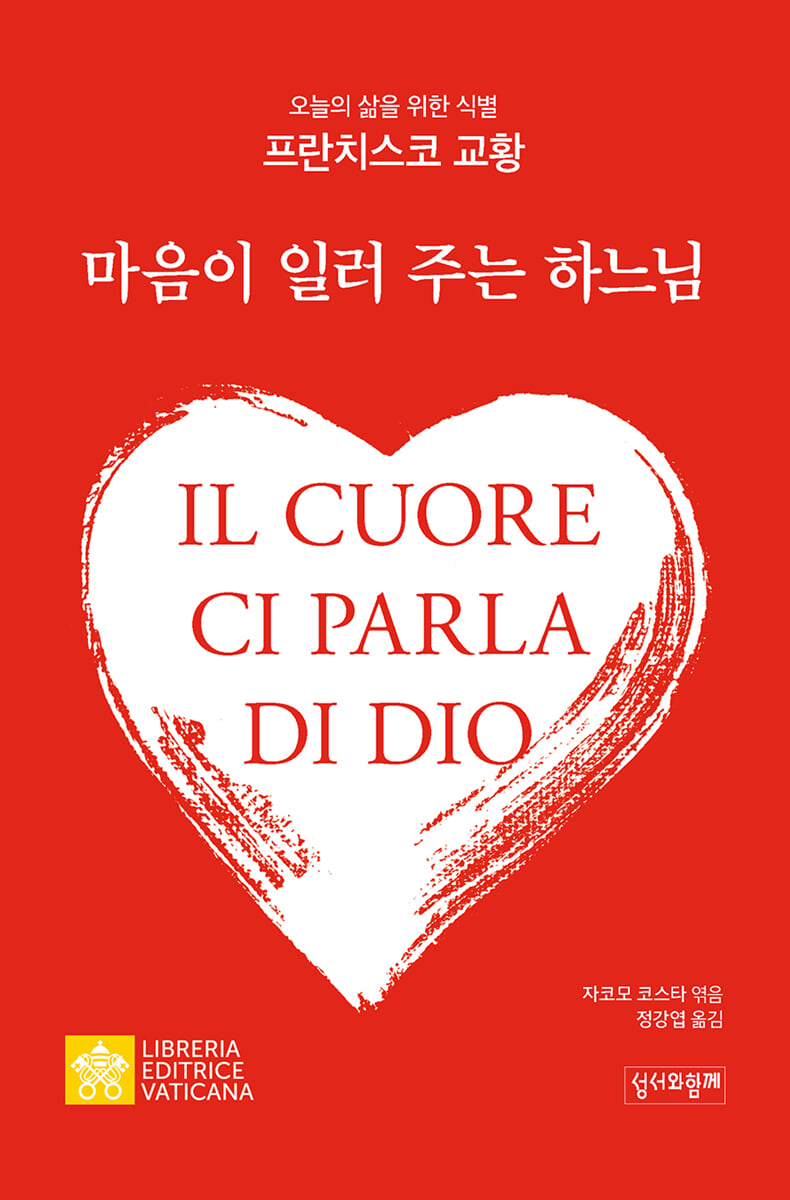
God who speaks to the heart
 |
Description
Book Introduction
Who speaks to you in the various situations you encounter in life?
Is it life? Is it the Lord? Or is it the devil? And how will you react?
"God Who Teacheth the Heart" is a book that contains the teachings on discernment given by Pope Francis during the first ten years after his election.
He emphasizes that discernment is an attitude of mind and wisdom, and that learning to discern requires study and practice.
Part 1 reconstructs 14 catechetical courses presented in the Wednesday General Audience from August 31, 2022, to January 4, 2023.
In particular, Pope Francis presents guidelines for discernment based on the Ignatian spirituality tradition he personally lived as a Jesuit.
Part 2 is an excerpt from documents and speeches left during the pontificate of Pope Francis that deal with discernment.
Chapter I, "Listening to the Holy Spirit," emphasizes the profound spiritual nature of the practice of discernment. Chapter II, "Communal Dynamics," argues that discernment, as a spiritual practice, is always an activity of the Church. Chapter III, "Called to Mission," focuses on the missionary orientation that demonstrates a truly spiritual and ecclesial discernment.
Finally, we conclude with Pope Francis' own account of his experience of discernment.
The Pope shows how he discovered discernment in his life and began to walk this path of discernment without giving up.
He also asks that the practice of discernment become the story of our lives, inviting us to walk the path of building our own discernment experience rather than simply listening to his.
The example of discernment that Pope Francis speaks of can also be found in the Gospel.
Perhaps the greatest moment of discernment Jesus ever demonstrated was when he prayed in Gethsemane: "Father, if you are willing, take this cup from me.
Yet, not my will, but yours be done.” Jesus, facing great suffering, chooses to believe and follow the plans and work of God the Father.
And he accepts the price of that voluntary will: suffering and death on the cross.
The life and identity of Jesus, who came into the world to save mankind, are right here.
We too must make choices through identification at every moment of our lives, and these choices come together to define our individual lives and identities.
"Where does the greatest love for me lie?" With this question in mind, will you listen to Pope Francis's story, so that you can discern, and be willing to accept the cost that comes with discernment, and become truly free in God? "Discernment," the Pope says, "is a skill."
Discernment is something that can be learned, but it must be practiced over and over again so that it becomes a habit.
This book will help you break free from the preconception that discernment is something difficult, something to be achieved through arduous practice, and instead, you can live a life of discernment right here, right now.
Is it life? Is it the Lord? Or is it the devil? And how will you react?
"God Who Teacheth the Heart" is a book that contains the teachings on discernment given by Pope Francis during the first ten years after his election.
He emphasizes that discernment is an attitude of mind and wisdom, and that learning to discern requires study and practice.
Part 1 reconstructs 14 catechetical courses presented in the Wednesday General Audience from August 31, 2022, to January 4, 2023.
In particular, Pope Francis presents guidelines for discernment based on the Ignatian spirituality tradition he personally lived as a Jesuit.
Part 2 is an excerpt from documents and speeches left during the pontificate of Pope Francis that deal with discernment.
Chapter I, "Listening to the Holy Spirit," emphasizes the profound spiritual nature of the practice of discernment. Chapter II, "Communal Dynamics," argues that discernment, as a spiritual practice, is always an activity of the Church. Chapter III, "Called to Mission," focuses on the missionary orientation that demonstrates a truly spiritual and ecclesial discernment.
Finally, we conclude with Pope Francis' own account of his experience of discernment.
The Pope shows how he discovered discernment in his life and began to walk this path of discernment without giving up.
He also asks that the practice of discernment become the story of our lives, inviting us to walk the path of building our own discernment experience rather than simply listening to his.
The example of discernment that Pope Francis speaks of can also be found in the Gospel.
Perhaps the greatest moment of discernment Jesus ever demonstrated was when he prayed in Gethsemane: "Father, if you are willing, take this cup from me.
Yet, not my will, but yours be done.” Jesus, facing great suffering, chooses to believe and follow the plans and work of God the Father.
And he accepts the price of that voluntary will: suffering and death on the cross.
The life and identity of Jesus, who came into the world to save mankind, are right here.
We too must make choices through identification at every moment of our lives, and these choices come together to define our individual lives and identities.
"Where does the greatest love for me lie?" With this question in mind, will you listen to Pope Francis's story, so that you can discern, and be willing to accept the cost that comes with discernment, and become truly free in God? "Discernment," the Pope says, "is a skill."
Discernment is something that can be learned, but it must be practiced over and over again so that it becomes a habit.
This book will help you break free from the preconception that discernment is something difficult, something to be achieved through arduous practice, and instead, you can live a life of discernment right here, right now.
- You can preview some of the book's contents.
Preview
index
Introduction _4
Introduction _8
Part 1: Guidance on Identification
Wednesday General Audience Catechism
1.
What is Identification? _18
2.
A Case of Discernment - St. Ignatius of Loyola _24
3.
Elements of Discernment - Intimacy with the Lord _32
4.
Elements of Identification - Self-Awareness _39
5.
Elements of Identification - Longing _46
6.
The Elements of Identification - The Book of Your Own Life _53
7.
Object of Identification - Spiritual Disappointment _60
8.
Why Do We Fall into Spiritual Disappointment? _67
9.
Spiritual Comfort _73
10.
True Spiritual Comfort _81
11.
Confirmation of a Good Choice _87
12.
Stay Awake _93
13.
Help for identification _100
14.
Spiritual Companionship _110
Part II: Dialogue, Speeches, and Teachings on the Practice of Discernment in Church Life
Ⅰ.
Listening to the Holy Spirit
1.
Becoming a Disciple _124
2.
Listening to the Voice of Conscience: Between Regulation and Freedom _134
3.
Gift to be requested _144
Ⅱ.
communal dynamics
1.
The Beauty and Power of the Religious Instinct _154
2.
Authority of Identification _159
3.
Accompanying Community _172
Ⅲ.
Called to Mission
1.
Identification and Mission _186
2.
Who Am I for?: Identifying for Response _196
3.
Place of Identification _207
Conclusion_This is my experience of discernment_213
Introduction _8
Part 1: Guidance on Identification
Wednesday General Audience Catechism
1.
What is Identification? _18
2.
A Case of Discernment - St. Ignatius of Loyola _24
3.
Elements of Discernment - Intimacy with the Lord _32
4.
Elements of Identification - Self-Awareness _39
5.
Elements of Identification - Longing _46
6.
The Elements of Identification - The Book of Your Own Life _53
7.
Object of Identification - Spiritual Disappointment _60
8.
Why Do We Fall into Spiritual Disappointment? _67
9.
Spiritual Comfort _73
10.
True Spiritual Comfort _81
11.
Confirmation of a Good Choice _87
12.
Stay Awake _93
13.
Help for identification _100
14.
Spiritual Companionship _110
Part II: Dialogue, Speeches, and Teachings on the Practice of Discernment in Church Life
Ⅰ.
Listening to the Holy Spirit
1.
Becoming a Disciple _124
2.
Listening to the Voice of Conscience: Between Regulation and Freedom _134
3.
Gift to be requested _144
Ⅱ.
communal dynamics
1.
The Beauty and Power of the Religious Instinct _154
2.
Authority of Identification _159
3.
Accompanying Community _172
Ⅲ.
Called to Mission
1.
Identification and Mission _186
2.
Who Am I for?: Identifying for Response _196
3.
Place of Identification _207
Conclusion_This is my experience of discernment_213
Into the book
As one Christmas card says, “Be like God.
I saw a sign that said, “Be a human being!”
Pope Francis' catechesis on discernment provides excellent guidance for us to move forward each day in the light of the Word, "to become human."
--- P.7
As we reach the end of our journey through life, important questions arise.
To understand what we are looking for, we need to go back on that journey.
As we move a little further into life, the question arises: "But why am I walking in this direction? What am I seeking?"
That's where identification happens.
--- P.27
Staying in prayer doesn't mean talking a lot.
No, not at all.
To remain in prayer is to open my heart to Jesus, to draw close to Him, to allow Him to enter my heart, and to feel His presence.
In prayer, we can discern when Jesus is present and when our thoughts often wander from what Jesus wants.
--- P.36-37
Don't be afraid of spiritual disappointment.
Face it with patience.
Don't run away.
Even in spiritual disappointment, strive to seek the heart of Christ and seek the Lord.
Then there will always be an answer.
… Even when difficulties arise, I hope that you will never be discouraged and face trials with steadfast determination, empowered by God’s boundless grace.
If we hear a voice within us that persistently tempts us to turn away from prayer, it is the voice of the devil.
Let's learn how to unmask that devil.
Don't get caught up in it.
Let's do the opposite of what that voice tells us!
--- P.72
Brothers and sisters, we must understand what is happening in our hearts.
And it takes an examination of conscience to figure out what happened today.
"I was angry today, so I didn't do that..." Why didn't I do it? Only by transcending that "why" can we uncover the root of these mistakes.
But “I was happy today, but I was bored because I had to help people.
Still, I was satisfied that I was able to help in the end.” The Holy Spirit is here.
Let us learn to read the events of the day in the book of our hearts.
Just try it for 2 minutes.
I'm sure it will be of great help.
--- P.86
Discernment is an arte, a skill that can be learned, and a skill that has its own rules.
If we learn this well, we can live our lives more beautifully and orderly, spiritually fulfilling.
Above all, you should not consider yourself an expert in identification or think that you are sufficient on your own.
Discernment is a gift from God that we must always ask for.
Lord, give me the grace to discern what I need to do and what I need to understand in each moment of my life.
Give me the grace to discern, and send me someone to help me discern.
--- P.118
Only in deep silence can we hear God's voice and recognize the traces of God's language when we pray.
We also have access to His truth, a very different light, a light that “does not lie on the intellect like oil on water.”
This light is far superior to all others because it can only be known by those who “know the truth.”
--- P.138
Future priests must be trained to discern clearly and distinctly the subtle movements of the Spirit, not general or abstract ideas.
Because only then can we truly help the specific lives of believers.
Life cannot be viewed solely from a dichotomous perspective.
Not everything in life is black and white! There's more to life than just shades of gray.
Therefore, it is necessary to teach them to discern in this gray area.
--- P.172-173
Here we can see the importance of ‘forming conscience’.
This allows for discernment to be deeply rooted in faith in God.
“The formation of conscience is a lifelong journey.
Through this journey, we learn to cultivate the very heart of Jesus Christ, imitating the criteria that underpinned his choices and the intentions behind his actions (cf. Phil 2:5).”
--- P.197-198
“Why are you afraid? Do you still have no faith?” (Mark 4:40).
Jesus' rebuke to his disciples makes us realize that it is not disbelief but fear that hinders faith.
In this sense, the process of identification helps us overcome our fears by identifying what we fear, opening our hearts to life, and calmly facing the challenges we face.
Especially as Christians, we must be careful not to let fear consume us.
Rather, Christians should use fear as an opportunity to act with faith in God and in our lives! This means trusting in the fundamental goodness of our existence, given to us by God.
We believe that God leads us to a good ending even through mysterious circumstances and twists and turns.
I saw a sign that said, “Be a human being!”
Pope Francis' catechesis on discernment provides excellent guidance for us to move forward each day in the light of the Word, "to become human."
--- P.7
As we reach the end of our journey through life, important questions arise.
To understand what we are looking for, we need to go back on that journey.
As we move a little further into life, the question arises: "But why am I walking in this direction? What am I seeking?"
That's where identification happens.
--- P.27
Staying in prayer doesn't mean talking a lot.
No, not at all.
To remain in prayer is to open my heart to Jesus, to draw close to Him, to allow Him to enter my heart, and to feel His presence.
In prayer, we can discern when Jesus is present and when our thoughts often wander from what Jesus wants.
--- P.36-37
Don't be afraid of spiritual disappointment.
Face it with patience.
Don't run away.
Even in spiritual disappointment, strive to seek the heart of Christ and seek the Lord.
Then there will always be an answer.
… Even when difficulties arise, I hope that you will never be discouraged and face trials with steadfast determination, empowered by God’s boundless grace.
If we hear a voice within us that persistently tempts us to turn away from prayer, it is the voice of the devil.
Let's learn how to unmask that devil.
Don't get caught up in it.
Let's do the opposite of what that voice tells us!
--- P.72
Brothers and sisters, we must understand what is happening in our hearts.
And it takes an examination of conscience to figure out what happened today.
"I was angry today, so I didn't do that..." Why didn't I do it? Only by transcending that "why" can we uncover the root of these mistakes.
But “I was happy today, but I was bored because I had to help people.
Still, I was satisfied that I was able to help in the end.” The Holy Spirit is here.
Let us learn to read the events of the day in the book of our hearts.
Just try it for 2 minutes.
I'm sure it will be of great help.
--- P.86
Discernment is an arte, a skill that can be learned, and a skill that has its own rules.
If we learn this well, we can live our lives more beautifully and orderly, spiritually fulfilling.
Above all, you should not consider yourself an expert in identification or think that you are sufficient on your own.
Discernment is a gift from God that we must always ask for.
Lord, give me the grace to discern what I need to do and what I need to understand in each moment of my life.
Give me the grace to discern, and send me someone to help me discern.
--- P.118
Only in deep silence can we hear God's voice and recognize the traces of God's language when we pray.
We also have access to His truth, a very different light, a light that “does not lie on the intellect like oil on water.”
This light is far superior to all others because it can only be known by those who “know the truth.”
--- P.138
Future priests must be trained to discern clearly and distinctly the subtle movements of the Spirit, not general or abstract ideas.
Because only then can we truly help the specific lives of believers.
Life cannot be viewed solely from a dichotomous perspective.
Not everything in life is black and white! There's more to life than just shades of gray.
Therefore, it is necessary to teach them to discern in this gray area.
--- P.172-173
Here we can see the importance of ‘forming conscience’.
This allows for discernment to be deeply rooted in faith in God.
“The formation of conscience is a lifelong journey.
Through this journey, we learn to cultivate the very heart of Jesus Christ, imitating the criteria that underpinned his choices and the intentions behind his actions (cf. Phil 2:5).”
--- P.197-198
“Why are you afraid? Do you still have no faith?” (Mark 4:40).
Jesus' rebuke to his disciples makes us realize that it is not disbelief but fear that hinders faith.
In this sense, the process of identification helps us overcome our fears by identifying what we fear, opening our hearts to life, and calmly facing the challenges we face.
Especially as Christians, we must be careful not to let fear consume us.
Rather, Christians should use fear as an opportunity to act with faith in God and in our lives! This means trusting in the fundamental goodness of our existence, given to us by God.
We believe that God leads us to a good ending even through mysterious circumstances and twists and turns.
--- P.202
GOODS SPECIFICS
- Date of issue: March 8, 2024
- Page count, weight, size: 220 pages | 135*205*20mm
- ISBN13: 9788976354280
- ISBN10: 8976354281
You may also like
카테고리
korean


korean

![ELLE 엘르 스페셜 에디션 A형 : 12월 [2025]](http://librairie.coreenne.fr/cdn/shop/files/b8e27a3de6c9538896439686c6b0e8fb.jpg?v=1766436872&width=3840)


