

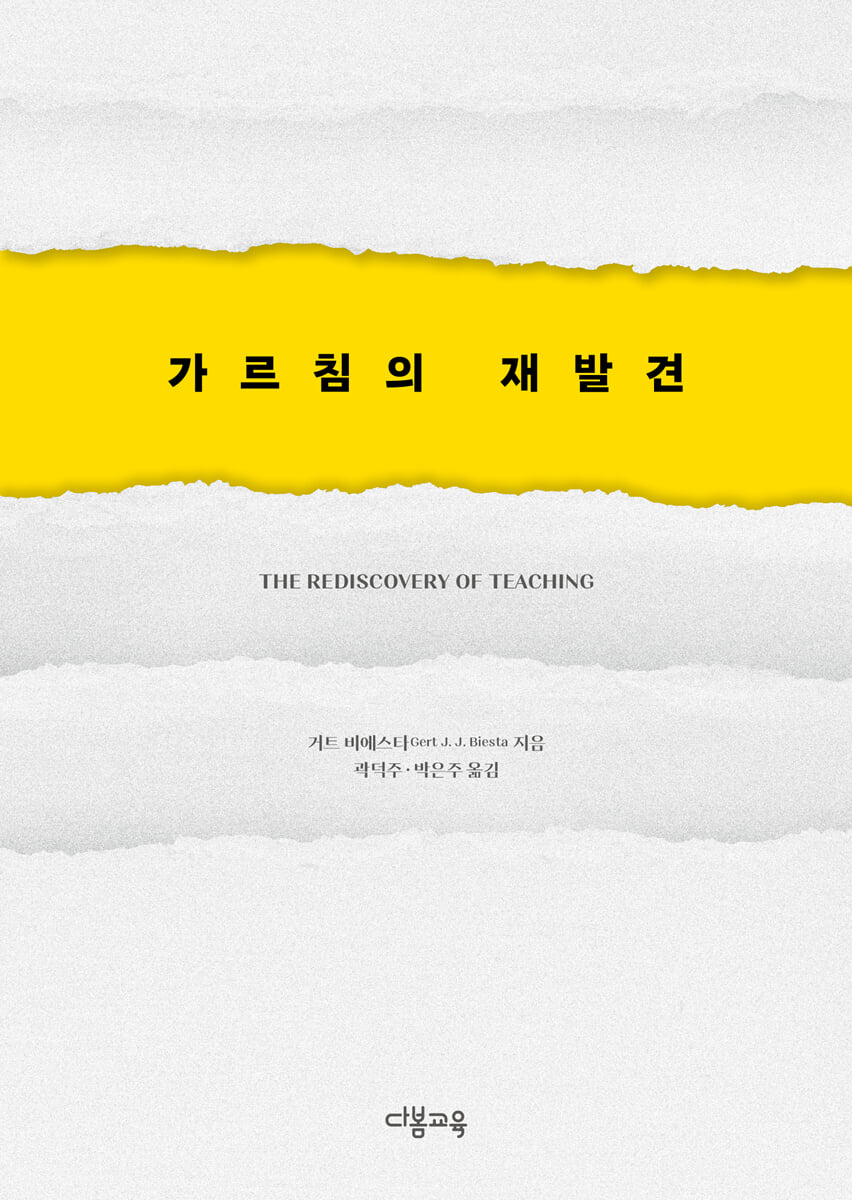
Rediscovering Teaching
 |
Description
Book Introduction
Finding the Role of Teaching and Teachers in Learner-Centered Education
How Teaching Matters and Why It Matters
『Rediscovering Teaching』 is the fourth book of educational theory and philosophy published by educational philosopher Gert Biesta, who pursues the progressive meaning of 'teaching', following 『Beyond Learning』, 『What is Good Education in the Age of Measurement』, and 『The Beautiful Risk of Education』.
Biesta sees this era as one in which control of learning has shifted from teachers to students, under the name of so-called "self-directed learning."
Faced with a proliferation of educational policies designed without serious inquiry into teachers and their teaching, and a classroom reality where teachers have lost their authority and been relegated to the role of facilitators of student learning, Biesta feels the need for a very solid and explicit explanation of the importance of teaching and teachers.
The core of ‘Rediscovering Teaching’ is that ‘teaching is important.’
However, Biesta diagnoses the educational problems of this era and presents a new 'educational' vision to respond to them by questioning and rediscovering how teaching is important and for what purpose, rather than whether 'teaching' itself is important or not.
However, this does not mean that a simple and quick solution is proposed.
Biesta invites and guides readers to think and participate in the discussion by closely arranging discussions on the purpose of education, the relationship between teaching and learning, and the relationship between teaching and freedom, relying on the concepts and theories of contemporary philosophers such as Sartre, Arendt, Levinas, John Dewey, Freire, Rancière, Piaget, and Vygotsky.
As if he were demonstrating and practicing the spirit of his 'rediscovered teachings'.
How Teaching Matters and Why It Matters
『Rediscovering Teaching』 is the fourth book of educational theory and philosophy published by educational philosopher Gert Biesta, who pursues the progressive meaning of 'teaching', following 『Beyond Learning』, 『What is Good Education in the Age of Measurement』, and 『The Beautiful Risk of Education』.
Biesta sees this era as one in which control of learning has shifted from teachers to students, under the name of so-called "self-directed learning."
Faced with a proliferation of educational policies designed without serious inquiry into teachers and their teaching, and a classroom reality where teachers have lost their authority and been relegated to the role of facilitators of student learning, Biesta feels the need for a very solid and explicit explanation of the importance of teaching and teachers.
The core of ‘Rediscovering Teaching’ is that ‘teaching is important.’
However, Biesta diagnoses the educational problems of this era and presents a new 'educational' vision to respond to them by questioning and rediscovering how teaching is important and for what purpose, rather than whether 'teaching' itself is important or not.
However, this does not mean that a simple and quick solution is proposed.
Biesta invites and guides readers to think and participate in the discussion by closely arranging discussions on the purpose of education, the relationship between teaching and learning, and the relationship between teaching and freedom, relying on the concepts and theories of contemporary philosophers such as Sartre, Arendt, Levinas, John Dewey, Freire, Rancière, Piaget, and Vygotsky.
As if he were demonstrating and practicing the spirit of his 'rediscovered teachings'.
- You can preview some of the book's contents.
Preview
index
· Acknowledgements
· Prologue - The Need for Teaching, Rediscovery, and Recovery
① What is the task of education?
② Liberating teaching from learning
③ Rediscovery of teachings
④ Don't be fooled by an 'ignorant teacher'
⑤ Asking for the Impossible: Teaching as Discord
Epilogue - Putting Teaching Back into Education
· Translator's Note
· References
· Index
· Prologue - The Need for Teaching, Rediscovery, and Recovery
① What is the task of education?
② Liberating teaching from learning
③ Rediscovery of teachings
④ Don't be fooled by an 'ignorant teacher'
⑤ Asking for the Impossible: Teaching as Discord
Epilogue - Putting Teaching Back into Education
· Translator's Note
· References
· Index
Into the book
The educational task is to enable other human beings to exist in the world and with the world in a mature (grown-up) way.
To put it more precisely, the educational task consists in arousing in other human beings the desire to exist in the world and with the world in a mature way, that is, the desire to exist as a subject.
--- p.30, from “① What is the task of education?”
“My uniqueness lies in my responsibility to others.
“Just as no one can take my place at the moment of my death, no one can free me from this.” With this, Levinas explains a very different concept of freedom.
That is, ‘freedom’ means ‘submission to the absolute’, not the liberal freedom to do as one pleases, but the freedom to “do what no one can do in my place.”
--- p.141, from “③ Rediscovery of Teachings”
The contradictions inherent in the liberation of modern logic strongly recall what Freire called “banking education.”
This is an aspect of education that makes students “containers who must be filled by teachers.”
In other words, education is an act of “saving money” by the teacher, with the student being the depository and the teacher being the depositor.
--- p.162, from “④ Do not be fooled by an ‘ignorant teacher’”
What is important from an educational perspective is that the teacher's trust opens up the 'space' in which children or students need to encounter their freedom and understand what they will do with it.
In other words, trust jeopardizes their subjectivity.
Without trust, such a space would probably never open, and the future as a possibility of existence as a subject would remain blocked.
To put it more precisely, the educational task consists in arousing in other human beings the desire to exist in the world and with the world in a mature way, that is, the desire to exist as a subject.
--- p.30, from “① What is the task of education?”
“My uniqueness lies in my responsibility to others.
“Just as no one can take my place at the moment of my death, no one can free me from this.” With this, Levinas explains a very different concept of freedom.
That is, ‘freedom’ means ‘submission to the absolute’, not the liberal freedom to do as one pleases, but the freedom to “do what no one can do in my place.”
--- p.141, from “③ Rediscovery of Teachings”
The contradictions inherent in the liberation of modern logic strongly recall what Freire called “banking education.”
This is an aspect of education that makes students “containers who must be filled by teachers.”
In other words, education is an act of “saving money” by the teacher, with the student being the depository and the teacher being the depositor.
--- p.162, from “④ Do not be fooled by an ‘ignorant teacher’”
What is important from an educational perspective is that the teacher's trust opens up the 'space' in which children or students need to encounter their freedom and understand what they will do with it.
In other words, trust jeopardizes their subjectivity.
Without trust, such a space would probably never open, and the future as a possibility of existence as a subject would remain blocked.
--- p.234, from “⑤ Asking for the Impossible: Teaching as Discord”
Publisher's Review
First, let's think about what the goal of education is.
Liberating teaching from learning
What is education for?
In other words, what is the role of a teacher as an educator? Biesta answers that the primary task of education and educators is to enable other human beings to become "mature beings," or to foster in them the desire and aspiration to exist in the world in a mature manner.
He gives new meaning to the concept of 'maturity' by viewing it as an ontological term rather than a developmental term.
It shows why this approach to education can be meaningful and what is required of teachers by emphasizing its role in transforming relations of interruption, suspension, continuation, and power into relations of authority.
The key question for ‘rediscovering teaching’ is understanding the relationship between teaching and learning.
Biesta believes that the relationship between teaching and learning is neither inevitable nor always desirable.
It is a departure from the idea that teaching is not the cause of learning, and that the goal of teaching is necessarily to bring about learning.
So, if learning isn't the purpose of teaching, what is? By exploring the literature on the relationship between teaching and learning and sharing his experience of disrupting students' learning, he argues that education can be meaningful without learning, and that teaching involves more than just learning.
If we criticize teaching as control, what is the solution?
How should we view the "authority" of teachers and the "freedom" of students?
A review of the numerous research publications and policy documents on teaching published over the past two decades reveals a dominant argument that so-called traditional teaching—that is, the teacher talks and students listen and passively receive information—is bad and outdated.
On the other hand, an education that places an emphasis on facilitating students' learning is considered more modern, better, more desirable, and more futuristic.
But it's a profound paradox that today's most popular forms of technology-based education—TED Talks, MOOCs (Massive Open Online Courses), and YouTube videos overflowing with lectures from experts and amateurs—are all being demonstrated in the "traditional" way: someone talks and explains, and someone else watches and listens and learns.
Biesta questions the idea that the only solution to authoritarian forms of teaching lies in the abolition of teaching and a shift towards learning.
He points out that a third option that seeks to reframe our understanding of teaching and teachers is not considered, explaining that in this third option freedom is neither the opposition to authority nor an escape from authority, but rather has to do with establishing a 'mature' relationship with empowering authority in our lives.
And, by exploring Levinas's theory and concepts, we propose a third option that goes beyond teaching as control and freedom as learning.
Re-examining the role of teaching and teachers from a critical pedagogy perspective.
Rediscovering Teaching through the Discourse of Freire and Rancière
Biesta seeks to rediscover teachings by exploring the connection between teachings and liberation.
To this end, we discuss the role of teaching and teachers in liberation education from the perspective of critical pedagogy, especially through the discourses of Freire and Rancière.
Addressing recent problematic approaches and interpretations of Rancière's The Ignorant Teacher, he explains that what is important in liberation education is not the transfer of knowledge from a teacher who (already) knows to a student who (yet) does not know, but rather two inseparable things: the teacher and the process of teaching by the teacher.
Unlike Freire, who argues that education should be done without teachers, for Rancière, the liberating teacher is someone who is deeply involved in the act of teaching.
Through Biesta's exploration, readers will discover why teachers and teaching remain important for liberation education in Rancière's educational philosophy, unlike in Freire's.
In this way, the concepts presented in “Rediscovering Teaching” are related to philosophical discussions about human existence and humans.
For this reason, it is interesting to consider the main philosophical implications of each discussion that Biesta addresses.
This may be because, as he suggests, human subjectivity is not located in the capacity to learn, form meaning, and give meaning, but rather in the 'ability' to be articulated, addressed, and taught.
Liberating teaching from learning
What is education for?
In other words, what is the role of a teacher as an educator? Biesta answers that the primary task of education and educators is to enable other human beings to become "mature beings," or to foster in them the desire and aspiration to exist in the world in a mature manner.
He gives new meaning to the concept of 'maturity' by viewing it as an ontological term rather than a developmental term.
It shows why this approach to education can be meaningful and what is required of teachers by emphasizing its role in transforming relations of interruption, suspension, continuation, and power into relations of authority.
The key question for ‘rediscovering teaching’ is understanding the relationship between teaching and learning.
Biesta believes that the relationship between teaching and learning is neither inevitable nor always desirable.
It is a departure from the idea that teaching is not the cause of learning, and that the goal of teaching is necessarily to bring about learning.
So, if learning isn't the purpose of teaching, what is? By exploring the literature on the relationship between teaching and learning and sharing his experience of disrupting students' learning, he argues that education can be meaningful without learning, and that teaching involves more than just learning.
If we criticize teaching as control, what is the solution?
How should we view the "authority" of teachers and the "freedom" of students?
A review of the numerous research publications and policy documents on teaching published over the past two decades reveals a dominant argument that so-called traditional teaching—that is, the teacher talks and students listen and passively receive information—is bad and outdated.
On the other hand, an education that places an emphasis on facilitating students' learning is considered more modern, better, more desirable, and more futuristic.
But it's a profound paradox that today's most popular forms of technology-based education—TED Talks, MOOCs (Massive Open Online Courses), and YouTube videos overflowing with lectures from experts and amateurs—are all being demonstrated in the "traditional" way: someone talks and explains, and someone else watches and listens and learns.
Biesta questions the idea that the only solution to authoritarian forms of teaching lies in the abolition of teaching and a shift towards learning.
He points out that a third option that seeks to reframe our understanding of teaching and teachers is not considered, explaining that in this third option freedom is neither the opposition to authority nor an escape from authority, but rather has to do with establishing a 'mature' relationship with empowering authority in our lives.
And, by exploring Levinas's theory and concepts, we propose a third option that goes beyond teaching as control and freedom as learning.
Re-examining the role of teaching and teachers from a critical pedagogy perspective.
Rediscovering Teaching through the Discourse of Freire and Rancière
Biesta seeks to rediscover teachings by exploring the connection between teachings and liberation.
To this end, we discuss the role of teaching and teachers in liberation education from the perspective of critical pedagogy, especially through the discourses of Freire and Rancière.
Addressing recent problematic approaches and interpretations of Rancière's The Ignorant Teacher, he explains that what is important in liberation education is not the transfer of knowledge from a teacher who (already) knows to a student who (yet) does not know, but rather two inseparable things: the teacher and the process of teaching by the teacher.
Unlike Freire, who argues that education should be done without teachers, for Rancière, the liberating teacher is someone who is deeply involved in the act of teaching.
Through Biesta's exploration, readers will discover why teachers and teaching remain important for liberation education in Rancière's educational philosophy, unlike in Freire's.
In this way, the concepts presented in “Rediscovering Teaching” are related to philosophical discussions about human existence and humans.
For this reason, it is interesting to consider the main philosophical implications of each discussion that Biesta addresses.
This may be because, as he suggests, human subjectivity is not located in the capacity to learn, form meaning, and give meaning, but rather in the 'ability' to be articulated, addressed, and taught.
GOODS SPECIFICS
- Date of issue: January 19, 2024
- Page count, weight, size: 276 pages | 314g | 135*190*17mm
- ISBN13: 9791192148908
- ISBN10: 1192148908
You may also like
카테고리
korean


korean

![GQ KOREA Mark (Monthly): December [2025]](http://librairie.coreenne.fr/cdn/shop/files/8ef265dbbfbf186523ed75ba7319009d.jpg?v=1765340328&width=3840)


