

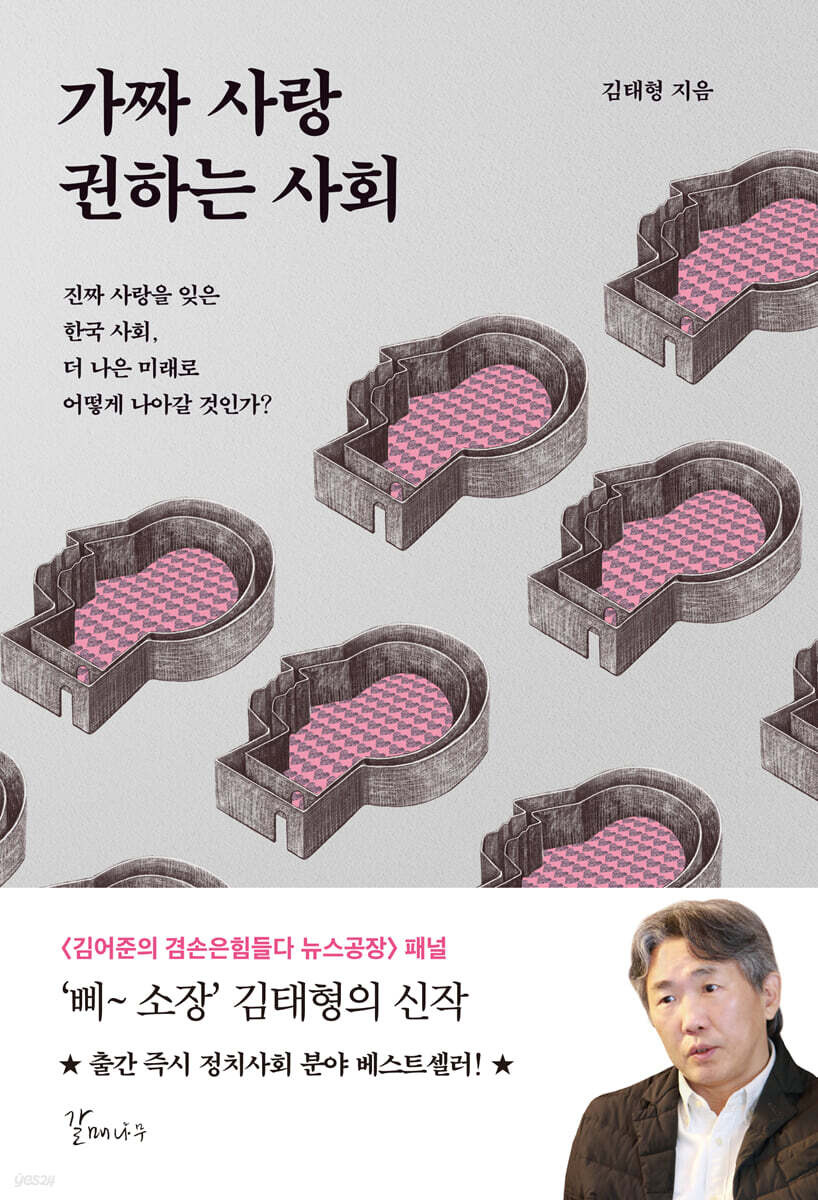
A society that encourages fake love
 |
Description
Book Introduction
In an era of endless competition among fragmented individuals, A progressive question posed by the passionate social psychologist Kim Tae-hyung. What is the psychology behind people showing off their love as if they were fighting over it? Why does mainstream psychology obscure the real cause of the problem? Why does true love inevitably lead to social reform? Overcoming the anxiety and selfishness fostered by a society where each person is responsible for their own survival Sharp diagnosis and suggestions to help you find true love again. Recently, a series of random crimes targeting an unspecified number of people have occurred, shocking people. Moreover, as if responding to these crimes, many posts threatening indiscriminate killings were posted on the Internet, increasing the fear. This phenomenon showed that the sense of deprivation from being left behind in a fiercely competitive society and the resulting hostility toward others are rampant in Korean society today. On one hand, feelings of deprivation and alienation are dangerously vented, while on the other hand, social media and mass media are competing to display images of perfect happiness and love. It can be said that modern Korean society is experiencing a serious disconnect, falling into 'fake love' rather than true love. Fake love is instrumental love that uses the other person according to one's needs, and it inevitably leads to psychological pain and human alienation. As fake love becomes more prevalent, people become more and more unhappy, and they show off their happiness as a means of hiding or alleviating this unhappiness. Kim Tae-hyung, author of "A Society That Promotes Fake Love," analyzes the types of fake love and their harmful effects in detail, and finds the fundamental cause that hinders true love in the bleak face of current Korean society. Love is usually considered a private emotion, and failure in love is often attributed to personal problems. In fact, mainstream psychology attributes failure in love to individual character flaws or mental pathology. But this only conceals the fundamental cause of society. In a society that promotes selfishness, it is extremely difficult to cultivate the ability to love others unconditionally. In today's Korean society, the capitalist competition for survival has reached its peak, and people suffer from extreme anxiety that their survival will be in jeopardy if they do not win the competition. The real reason for fake love is the selfishness and community breakdown that this anxiety brings about. This is why the author argues that solving social problems must accompany progress toward a society where true love is possible. Kim Tae-hyung, who has been active as a "fighting psychologist" by revealing the causal relationship between individual psychological problems and Korean society and sharply criticizing the limitations of mainstream psychology in "A Society that Promotes False Self-Esteem" and "A Society that Promotes False Happiness," diagnoses the current state of Korean society with a focus on "love" in this book. Part 1, “Korean Society That Has Forgotten True Love,” examines the most prominent forms of fake love in Korea today and presents the harmful effects of such practices. In Part 2, "Why Mainstream Psychology Hides the Cause of the Problem," we delve into the types and causes of fake love and discover why mainstream psychology hides the real causes that make love impossible. Finally, in Part 3, “Why True Love Leads to Social Reform,” we explain the meaning of true love and examine why true love is the driving force behind social reform. |
- You can preview some of the book's contents.
Preview
index
Entering 5
Part 1: A Korean Society That Has Forgotten True Love
Chapter 1.
Why is everyone failing in love?
"I wish we could all just die!" 16 / The Age of Each for Himself, 'The Kiss of Death' 22
Chapter 2.
A lie called love
The Parent's Lie: "It's All for You" (30) / The Lover's Lie: "I Love You So Much" (39) / The Blind Believer's Lie: "I Believe!" (51)
Part 2: Why Mainstream Psychology Hides the Causes of the Problem
Chapter 3.
What is fake love?
Why Dating Becomes More and More Devastating 58 / When Relationships Become Transactional 67 / The Selfish Way of Love in a Fragmented Society 77 / Adults Who Never Graduated from Childhood 83
Chapter 4.
Why do people fall for fake love?
The Real Problem Mainstream Psychology Hides 92 / Mental Health Is Shaped by Society's Rules 104 / A Sick Society Undermines Our Ability to Love 120
Chapter 5.
Discerning the fake from the real
Sacrifice is not proof of love 124 / The selfish motives of savior love 133 / Is fiery love the only romantic thing? 137 / True love makes people live 145
Part 3: Why True Love Leads to Social Reform
Chapter 6.
What is true love?
Love is in human nature 154 / Love is a heart that cherishes and cherishes 161 / Equality is the foundation of human love 170 / Love is the driving force of growth 182 / The natural desires that love evokes 188
Chapter 7.
How should I love?
A Relationship Built on True Love 196 / The Personal Effort Required for Love 214
Chapter 8.
A society that encourages true love
Love Changes Only When Society Changes 232 / If Everyone Could Be Respected Unconditionally 238
Reference 246
Americas 247
Part 1: A Korean Society That Has Forgotten True Love
Chapter 1.
Why is everyone failing in love?
"I wish we could all just die!" 16 / The Age of Each for Himself, 'The Kiss of Death' 22
Chapter 2.
A lie called love
The Parent's Lie: "It's All for You" (30) / The Lover's Lie: "I Love You So Much" (39) / The Blind Believer's Lie: "I Believe!" (51)
Part 2: Why Mainstream Psychology Hides the Causes of the Problem
Chapter 3.
What is fake love?
Why Dating Becomes More and More Devastating 58 / When Relationships Become Transactional 67 / The Selfish Way of Love in a Fragmented Society 77 / Adults Who Never Graduated from Childhood 83
Chapter 4.
Why do people fall for fake love?
The Real Problem Mainstream Psychology Hides 92 / Mental Health Is Shaped by Society's Rules 104 / A Sick Society Undermines Our Ability to Love 120
Chapter 5.
Discerning the fake from the real
Sacrifice is not proof of love 124 / The selfish motives of savior love 133 / Is fiery love the only romantic thing? 137 / True love makes people live 145
Part 3: Why True Love Leads to Social Reform
Chapter 6.
What is true love?
Love is in human nature 154 / Love is a heart that cherishes and cherishes 161 / Equality is the foundation of human love 170 / Love is the driving force of growth 182 / The natural desires that love evokes 188
Chapter 7.
How should I love?
A Relationship Built on True Love 196 / The Personal Effort Required for Love 214
Chapter 8.
A society that encourages true love
Love Changes Only When Society Changes 232 / If Everyone Could Be Respected Unconditionally 238
Reference 246
Americas 247
Detailed image

Into the book
Is there a fundamental reason why people continue to fail in love, a root cause of fake love, within the individual? I believe the fundamental cause of love's inability is a pathological society.
Of course, it is clear that ignorance or misunderstanding about love and deteriorating mental health are also major causes.
However, they cannot be said to be the fundamental cause, as they are essentially caused or forced by a sick society.
--- p.6~7
A young man I met said, “Humans are inherently evil.
They all have to die.
Koreans in particular are the biggest problem.
“I wish they would all die,” he said.
When asked about his opinion on the 'Sillim-dong knife murder', he answered without hesitation that he sympathized with the criminal's feelings.
The era of mass shootings in Korea is now dawning.
South Korea's high suicide rate and the country's version of mass shootings are evidence that Korean society is experiencing serious problems with love.
--- p.21
Nowadays, many psychologists blame parents whenever a problem arises with a child.
But it is rarely said that the cause of parents' anxiety is a sick society.
Of course, we cannot say that parents are not responsible, and it is the parents who directly hurt their children.
However, blaming parents does not help solve the problem, as parents are also victims of a sick society.
--- p.37
As the neoliberal era progressed, Korea degenerated into a society of terrible individualism, where individuals, crushed by the immense weight of survival anxiety, fought fiercely to secure their own rice bowls and snatch the crumbs of bread thrown to them by a tiny, wealthy minority.
People who are isolated and suffering from survival anxiety are so busy putting out the fire at their own feet that they pay little attention to the community.
His attention is focused solely on his own rice bowl, and as a result, he becomes an egoist.
It is impossible for an egoist to experience true love, a healthy love.
--- p.78~79
In a society where competition is rampant, self-esteem is seen as evidence of victory in competition.
This means that high self-esteem is considered a sign that I am better than others or that I am in a higher position than others.
The reason people are so afraid of low self-esteem is because they perceive low self-esteem as a low status.
--- p.108
Even when a person dies, the things he loved still remain in the world.
That is why people who love humanity and have public goals do not commit suicide together.
The reason Romeo and Juliet committed suicide together was because they had no public goal.
A person without a public goal does not love humanity, and therefore cannot love anyone.
If he loves someone, it is fake love.
--- p.148
Love connects people and unites them, enabling them to grow from powerless and weak individuals into great beings.
The more people love each other, and the more people love each other, the more human power and ability to change the world grows.
This is the role that love plays in the progress of social history.
--- p.185~186
Saying that you have the ability to love doesn't mean that you have to acquire dating skills.
Living while loving one another is the natural way of life for humans as social beings.
The ability to love is not a special ability that exists separately from other abilities, but rather it is a part of the ability to live and act as a social being that all humans should have, or a part of such abilities.
--- p.218
To alleviate or eliminate the anxiety of isolated survival, we must build a basic society.
A basic society is one in which the state is responsible for and guarantees the survival of its citizens.
The state must take responsibility for the survival of its citizens through basic income, basic jobs, basic loans, and basic housing, as well as free education, free medical care, and, if necessary, free housing systems.
This way, people can be freed from basic survival anxiety.
Of course, it is clear that ignorance or misunderstanding about love and deteriorating mental health are also major causes.
However, they cannot be said to be the fundamental cause, as they are essentially caused or forced by a sick society.
--- p.6~7
A young man I met said, “Humans are inherently evil.
They all have to die.
Koreans in particular are the biggest problem.
“I wish they would all die,” he said.
When asked about his opinion on the 'Sillim-dong knife murder', he answered without hesitation that he sympathized with the criminal's feelings.
The era of mass shootings in Korea is now dawning.
South Korea's high suicide rate and the country's version of mass shootings are evidence that Korean society is experiencing serious problems with love.
--- p.21
Nowadays, many psychologists blame parents whenever a problem arises with a child.
But it is rarely said that the cause of parents' anxiety is a sick society.
Of course, we cannot say that parents are not responsible, and it is the parents who directly hurt their children.
However, blaming parents does not help solve the problem, as parents are also victims of a sick society.
--- p.37
As the neoliberal era progressed, Korea degenerated into a society of terrible individualism, where individuals, crushed by the immense weight of survival anxiety, fought fiercely to secure their own rice bowls and snatch the crumbs of bread thrown to them by a tiny, wealthy minority.
People who are isolated and suffering from survival anxiety are so busy putting out the fire at their own feet that they pay little attention to the community.
His attention is focused solely on his own rice bowl, and as a result, he becomes an egoist.
It is impossible for an egoist to experience true love, a healthy love.
--- p.78~79
In a society where competition is rampant, self-esteem is seen as evidence of victory in competition.
This means that high self-esteem is considered a sign that I am better than others or that I am in a higher position than others.
The reason people are so afraid of low self-esteem is because they perceive low self-esteem as a low status.
--- p.108
Even when a person dies, the things he loved still remain in the world.
That is why people who love humanity and have public goals do not commit suicide together.
The reason Romeo and Juliet committed suicide together was because they had no public goal.
A person without a public goal does not love humanity, and therefore cannot love anyone.
If he loves someone, it is fake love.
--- p.148
Love connects people and unites them, enabling them to grow from powerless and weak individuals into great beings.
The more people love each other, and the more people love each other, the more human power and ability to change the world grows.
This is the role that love plays in the progress of social history.
--- p.185~186
Saying that you have the ability to love doesn't mean that you have to acquire dating skills.
Living while loving one another is the natural way of life for humans as social beings.
The ability to love is not a special ability that exists separately from other abilities, but rather it is a part of the ability to live and act as a social being that all humans should have, or a part of such abilities.
--- p.218
To alleviate or eliminate the anxiety of isolated survival, we must build a basic society.
A basic society is one in which the state is responsible for and guarantees the survival of its citizens.
The state must take responsibility for the survival of its citizens through basic income, basic jobs, basic loans, and basic housing, as well as free education, free medical care, and, if necessary, free housing systems.
This way, people can be freed from basic survival anxiety.
--- p.235~236
Publisher's Review
Why is everyone failing in love?
While social media and mass media display false images of love,
We are losing equal and genuine relationships.
Recently, an article about a culture of flaunting extravagant proposals on social media has been widely shared and has garnered attention among young people.
Many people today live their lives exposed to images of perfect love on a daily basis, and feel deprived when they see those close to them living richer and happier lives than they do.
But as one study found, when a relationship is unstable, people are more likely to post on social media to flaunt their relationship, and this display behavior has little to do with whether or not a person is actually happy in their life.
Rather, it is closer to an obsession with showing off so as not to be seen as a loser in a Korean society where even happiness is considered a measure of economic success.
The bigger problem is that this kind of behavior further fuels feelings of inferiority in others, making society more miserable.
The problem is that these types of posts and images mislead people into misunderstanding reality, causing them even more pain.
If the vast majority were to honestly confess their difficulties and failures in love, or to lament their unhappiness, people might realize that they are not the only ones suffering from love failure and unhappiness, and that this is a problem for everyone. They might then rationally question, "If everyone is failing in love, isn't it because of a flawed society, not an individual?"
However, people living in a fiercely competitive and hierarchical society are afraid to honestly reveal the difficulties or unhappiness they experience in love.
--- p.24~25 (Chapter 1_Why is everyone failing in love?)
Today's Korean society is full of factors that make true love impossible.
People grow through experiences of being loved unconditionally, and move forward with the support of the community.
However, modern Korea's neoliberal, infinitely competitive system converts the value of everything, including humans, into money and turns it into a tool.
People who have internalized this system naturally weigh the pros and cons in their interpersonal relationships and try to avoid love that will result in loss, which inevitably leads to human alienation and individualization.
In addition, the anxiety about survival that one's very survival will be threatened if one loses in competition and fails to make money, and the anxiety about respect that one will be looked down upon by society if one is economically poorer than others, cause everyone else to be viewed as a potential competitor, which fuels hostility toward those around them and destroys the community.
These two causes of social anxiety, namely, survival anxiety and respect anxiety, are the main culprits that worsen people's mental health and lead to failure in love.
Why do people fall for fake love?
Exploring the psychological problems hidden by mainstream psychology
Discerning the fake from the real
Why have social problems stemming from deteriorating mental health become so prevalent? Mainstream psychology tends to dismiss various psychological pathologies in modern society as individual problems.
If a person consistently fails to form healthy relationships, the primary cause is said to be a personality flaw or a psychological pathology resulting from childhood psychological trauma.
However, this perspective is a superficial approach that ignores the aspect of humans as social beings.
This is because humans are beings who recognize their surroundings from the moment they are born and strive to keep pace with the world and want to get along.
Therefore, a person's psychological state is inextricably linked to society, and in fact, society is closer to being the main factor influencing a person's mental health.
However, since this leads to the argument that the social system must be changed for individual happiness, mainstream psychology, which is a system-conforming discipline, cannot help but conceal this fact.
So people suffer even more, blaming themselves for their failures in love and happiness.
Why do people fake love? Mainstream American psychology generally attributes the primary obstacles to love to individuals.
For example, if you don't receive love from your parents during childhood, you may develop emotional wounds or mental disorders, which may prevent you from experiencing healthy love.
However, it is an unscientific view to look for the cause of collective and social problems in parenting or individual psychology.
Furthermore, it is also an anti-reformist view that obscures and misleads the true cause, hindering people from moving toward social reform.
--- p.92 (Chapter 4: Why Do People Fall for Fake Love?)
Of course, this problem is not unrelated to the unique characteristics of each individual.
There is certainly effort that must be made on a personal level to succeed in love.
For example, through psychotherapy, you can identify the unhealthy desires hidden in your unconscious and learn how those desires are affecting your current relationships, which may help you reduce failures in love to some extent.
However, it is virtually impossible to completely overcome on an individual level the anxiety of parents who force their children to study while believing that it is love, the delusion of lovers who cling to love while repeating harmful relationships such as dating violence, and the bleak human relationships of modern society that are obsessed with equivalent exchange while not even being able to distinguish between devotion and sacrifice.
Focusing solely on psychological counseling or self-development while ignoring the fundamental cause, society, is only a stopgap measure.
In fact, many scholars have already noted the connection between society and love, and Erich Fromm is a representative figure.
Erich Fromm, in his classic work The Art of Loving, pointed out that it is very difficult to cultivate the ability to love in a society that does not have the conditions for true love.
Sociologist Eva Illouz also criticized psychology for placing all responsibility for love on the individual, pointing out the enormous influence society has on things like the standards for an ideal partner.
Society? Generally, the rules of the game are set by the ruling class, such as the monopoly capitalists who dominate that society, to their advantage. The distribution of wealth, the way interpersonal relationships are formed, and the rules of the game determined by the ruling class have a profound impact on human psychology and mental health.
Neoliberal capitalist society has created a polarized society with a 1 vs. 99 ratio by distributing power and wealth very unequally, and has destroyed human relationships by imposing on people the rules of competition based on the principle of winner-take-all.
People living in such a society suffer from a significant deterioration in their overall mental health because they are unable to realize their humane and healthy needs and desires.
--- p.105 (Chapter 4: Why Do People Fall for Fake Love?)
In modern times, when capitalist values have become the norm and the competitive life is even openly said to be human nature, this social psychological perspective is even more urgent.
In this context, the author of this book, Kim Tae-hyung, has consistently strived to reveal that the real cause of the psychological suffering prevalent among Koreans today is society.
The author exposed the illusion of psychological elements that Koreans are obsessed with, such as 'self-esteem' and 'happiness', and argued that rather than focusing on superficial satisfaction, we should strive to reform society, the source of this obsession, so that everyone can live a healthy life.
As we discuss the "age of nuclear individualization," and human relationships become more fragmented than ever, the author's sharp criticism of fake love gains even more traction.
True love makes people live,
It has the power to advance society and history.
So how can we regain the ability to truly love? The first step is to understand human nature.
To love any living being means to love that being's essence, so to rebuild deteriorating relationships and regain true love, we must first understand human nature.
At the core of human nature is the desire to live as social beings.
As social beings, humans have a desire to connect with others and form a community.
The need for communication and integration is so important to humans that being isolated from others and in a lonely state causes suffering even when all other conditions are favorable.
Therefore, creating a society where this human nature can be expressed is the fundamental way for us to restore love.
In a society where people are respected for being human, people naturally choose to unite with those around them rather than fight.
This tendency is soon connected to the desire for a society where everyone can prosper together, and becomes the driving force behind social and historical development.
The nature of human beings as social beings is to become one with others through love, to live freely and autonomously as masters of the world, and to engage in productive and creative activities that contribute to the world.
Therefore, cherishing and loving human nature means loving our neighbors and living as one with them, fighting to reform society against injustice, and supporting and encouraging others to live by contributing to society.
At the same time, when someone lives a life that does not conform to human nature, we criticize and guide them.
--- p.177~178 (Chapter 6_What is true love?)
To restore this true love, each individual must first face and liberate themselves from their unhealthy desires.
Furthermore, one must have the ability to love.
I'm not talking about dating techniques like honeymoon.
It takes courage to not be afraid of encounters and conflicts between people and to decisively cut off bad relationships.
As Erich Fromm said, “Even personal love cannot succeed unless one has the ability to love one’s neighbor, unless one has true humility, courage, faith, and discipline.”
Ultimately, in order to create a society where love is possible, the most urgent task is to eliminate the aforementioned anxiety about survival and anxiety about respect.
The fear that these two anxieties inflict on individuals is so extreme that it is impossible for people to properly develop their human nature as social beings as long as society enforces them as they do today.
The author proposes a ‘basic society’ as a solution to this problem.
As capitalism enters an era of low growth, the state must establish a basic society that guarantees the basic living conditions of its citizens—income, jobs, housing, etc.
If a basic society is realized, at least people can be freed from the anxiety of survival that survival itself will become difficult if they fall behind in competition.
This also leads to the resolution of respect anxiety, because in a society where everyone is guaranteed a basic livelihood, it becomes difficult to use the power that comes from economic superiority to trample on the dignity of others.
As anxiety fades and the pathological pleasure derived from looking down on others becomes less attainable, people gradually turn to the happiness that comes from true cooperation and connection.
If the state guarantees the survival of its citizens, people will realize that there is a communal way to live, one where they love and cooperate with others, rather than trying to forge their own paths, and they will also realize that this way is far superior.
A life of struggle for survival in isolation forces us to feel the urgency of putting out the fire at our own feet, and it inevitably forces us to be selfish, narrowing our perspective to focus only on ourselves rather than on our neighbors and community.
--- p.236 (Chapter 8_A Society That Encourages True Love)
As we have seen above, the fundamental cause of the fake love that occurs in Korea today is society, so the solution to regaining true love inevitably has to be social reform.
The establishment of a 'basic society' in which the state guarantees a humane life for all is not an unrealistic idealism, but a necessary condition for living while displaying human nature.
Therefore, we must recognize the pressures of society that force us to be selfish, break free from those shackles, and work to change the world by uniting with others.
I hope that the message of this book will bring comfort and hope to those who are isolated as individuals and suffering from the failure of love.
While social media and mass media display false images of love,
We are losing equal and genuine relationships.
Recently, an article about a culture of flaunting extravagant proposals on social media has been widely shared and has garnered attention among young people.
Many people today live their lives exposed to images of perfect love on a daily basis, and feel deprived when they see those close to them living richer and happier lives than they do.
But as one study found, when a relationship is unstable, people are more likely to post on social media to flaunt their relationship, and this display behavior has little to do with whether or not a person is actually happy in their life.
Rather, it is closer to an obsession with showing off so as not to be seen as a loser in a Korean society where even happiness is considered a measure of economic success.
The bigger problem is that this kind of behavior further fuels feelings of inferiority in others, making society more miserable.
The problem is that these types of posts and images mislead people into misunderstanding reality, causing them even more pain.
If the vast majority were to honestly confess their difficulties and failures in love, or to lament their unhappiness, people might realize that they are not the only ones suffering from love failure and unhappiness, and that this is a problem for everyone. They might then rationally question, "If everyone is failing in love, isn't it because of a flawed society, not an individual?"
However, people living in a fiercely competitive and hierarchical society are afraid to honestly reveal the difficulties or unhappiness they experience in love.
--- p.24~25 (Chapter 1_Why is everyone failing in love?)
Today's Korean society is full of factors that make true love impossible.
People grow through experiences of being loved unconditionally, and move forward with the support of the community.
However, modern Korea's neoliberal, infinitely competitive system converts the value of everything, including humans, into money and turns it into a tool.
People who have internalized this system naturally weigh the pros and cons in their interpersonal relationships and try to avoid love that will result in loss, which inevitably leads to human alienation and individualization.
In addition, the anxiety about survival that one's very survival will be threatened if one loses in competition and fails to make money, and the anxiety about respect that one will be looked down upon by society if one is economically poorer than others, cause everyone else to be viewed as a potential competitor, which fuels hostility toward those around them and destroys the community.
These two causes of social anxiety, namely, survival anxiety and respect anxiety, are the main culprits that worsen people's mental health and lead to failure in love.
Why do people fall for fake love?
Exploring the psychological problems hidden by mainstream psychology
Discerning the fake from the real
Why have social problems stemming from deteriorating mental health become so prevalent? Mainstream psychology tends to dismiss various psychological pathologies in modern society as individual problems.
If a person consistently fails to form healthy relationships, the primary cause is said to be a personality flaw or a psychological pathology resulting from childhood psychological trauma.
However, this perspective is a superficial approach that ignores the aspect of humans as social beings.
This is because humans are beings who recognize their surroundings from the moment they are born and strive to keep pace with the world and want to get along.
Therefore, a person's psychological state is inextricably linked to society, and in fact, society is closer to being the main factor influencing a person's mental health.
However, since this leads to the argument that the social system must be changed for individual happiness, mainstream psychology, which is a system-conforming discipline, cannot help but conceal this fact.
So people suffer even more, blaming themselves for their failures in love and happiness.
Why do people fake love? Mainstream American psychology generally attributes the primary obstacles to love to individuals.
For example, if you don't receive love from your parents during childhood, you may develop emotional wounds or mental disorders, which may prevent you from experiencing healthy love.
However, it is an unscientific view to look for the cause of collective and social problems in parenting or individual psychology.
Furthermore, it is also an anti-reformist view that obscures and misleads the true cause, hindering people from moving toward social reform.
--- p.92 (Chapter 4: Why Do People Fall for Fake Love?)
Of course, this problem is not unrelated to the unique characteristics of each individual.
There is certainly effort that must be made on a personal level to succeed in love.
For example, through psychotherapy, you can identify the unhealthy desires hidden in your unconscious and learn how those desires are affecting your current relationships, which may help you reduce failures in love to some extent.
However, it is virtually impossible to completely overcome on an individual level the anxiety of parents who force their children to study while believing that it is love, the delusion of lovers who cling to love while repeating harmful relationships such as dating violence, and the bleak human relationships of modern society that are obsessed with equivalent exchange while not even being able to distinguish between devotion and sacrifice.
Focusing solely on psychological counseling or self-development while ignoring the fundamental cause, society, is only a stopgap measure.
In fact, many scholars have already noted the connection between society and love, and Erich Fromm is a representative figure.
Erich Fromm, in his classic work The Art of Loving, pointed out that it is very difficult to cultivate the ability to love in a society that does not have the conditions for true love.
Sociologist Eva Illouz also criticized psychology for placing all responsibility for love on the individual, pointing out the enormous influence society has on things like the standards for an ideal partner.
Society? Generally, the rules of the game are set by the ruling class, such as the monopoly capitalists who dominate that society, to their advantage. The distribution of wealth, the way interpersonal relationships are formed, and the rules of the game determined by the ruling class have a profound impact on human psychology and mental health.
Neoliberal capitalist society has created a polarized society with a 1 vs. 99 ratio by distributing power and wealth very unequally, and has destroyed human relationships by imposing on people the rules of competition based on the principle of winner-take-all.
People living in such a society suffer from a significant deterioration in their overall mental health because they are unable to realize their humane and healthy needs and desires.
--- p.105 (Chapter 4: Why Do People Fall for Fake Love?)
In modern times, when capitalist values have become the norm and the competitive life is even openly said to be human nature, this social psychological perspective is even more urgent.
In this context, the author of this book, Kim Tae-hyung, has consistently strived to reveal that the real cause of the psychological suffering prevalent among Koreans today is society.
The author exposed the illusion of psychological elements that Koreans are obsessed with, such as 'self-esteem' and 'happiness', and argued that rather than focusing on superficial satisfaction, we should strive to reform society, the source of this obsession, so that everyone can live a healthy life.
As we discuss the "age of nuclear individualization," and human relationships become more fragmented than ever, the author's sharp criticism of fake love gains even more traction.
True love makes people live,
It has the power to advance society and history.
So how can we regain the ability to truly love? The first step is to understand human nature.
To love any living being means to love that being's essence, so to rebuild deteriorating relationships and regain true love, we must first understand human nature.
At the core of human nature is the desire to live as social beings.
As social beings, humans have a desire to connect with others and form a community.
The need for communication and integration is so important to humans that being isolated from others and in a lonely state causes suffering even when all other conditions are favorable.
Therefore, creating a society where this human nature can be expressed is the fundamental way for us to restore love.
In a society where people are respected for being human, people naturally choose to unite with those around them rather than fight.
This tendency is soon connected to the desire for a society where everyone can prosper together, and becomes the driving force behind social and historical development.
The nature of human beings as social beings is to become one with others through love, to live freely and autonomously as masters of the world, and to engage in productive and creative activities that contribute to the world.
Therefore, cherishing and loving human nature means loving our neighbors and living as one with them, fighting to reform society against injustice, and supporting and encouraging others to live by contributing to society.
At the same time, when someone lives a life that does not conform to human nature, we criticize and guide them.
--- p.177~178 (Chapter 6_What is true love?)
To restore this true love, each individual must first face and liberate themselves from their unhealthy desires.
Furthermore, one must have the ability to love.
I'm not talking about dating techniques like honeymoon.
It takes courage to not be afraid of encounters and conflicts between people and to decisively cut off bad relationships.
As Erich Fromm said, “Even personal love cannot succeed unless one has the ability to love one’s neighbor, unless one has true humility, courage, faith, and discipline.”
Ultimately, in order to create a society where love is possible, the most urgent task is to eliminate the aforementioned anxiety about survival and anxiety about respect.
The fear that these two anxieties inflict on individuals is so extreme that it is impossible for people to properly develop their human nature as social beings as long as society enforces them as they do today.
The author proposes a ‘basic society’ as a solution to this problem.
As capitalism enters an era of low growth, the state must establish a basic society that guarantees the basic living conditions of its citizens—income, jobs, housing, etc.
If a basic society is realized, at least people can be freed from the anxiety of survival that survival itself will become difficult if they fall behind in competition.
This also leads to the resolution of respect anxiety, because in a society where everyone is guaranteed a basic livelihood, it becomes difficult to use the power that comes from economic superiority to trample on the dignity of others.
As anxiety fades and the pathological pleasure derived from looking down on others becomes less attainable, people gradually turn to the happiness that comes from true cooperation and connection.
If the state guarantees the survival of its citizens, people will realize that there is a communal way to live, one where they love and cooperate with others, rather than trying to forge their own paths, and they will also realize that this way is far superior.
A life of struggle for survival in isolation forces us to feel the urgency of putting out the fire at our own feet, and it inevitably forces us to be selfish, narrowing our perspective to focus only on ourselves rather than on our neighbors and community.
--- p.236 (Chapter 8_A Society That Encourages True Love)
As we have seen above, the fundamental cause of the fake love that occurs in Korea today is society, so the solution to regaining true love inevitably has to be social reform.
The establishment of a 'basic society' in which the state guarantees a humane life for all is not an unrealistic idealism, but a necessary condition for living while displaying human nature.
Therefore, we must recognize the pressures of society that force us to be selfish, break free from those shackles, and work to change the world by uniting with others.
I hope that the message of this book will bring comfort and hope to those who are isolated as individuals and suffering from the failure of love.
GOODS SPECIFICS
- Date of issue: December 10, 2023
- Page count, weight, size: 252 pages | 346g | 143*210*17mm
- ISBN13: 9791191842593
- ISBN10: 1191842592
You may also like
카테고리
korean


korean

![GQ KOREA Mark (Monthly): December [2025]](http://librairie.coreenne.fr/cdn/shop/files/8ef265dbbfbf186523ed75ba7319009d.jpg?v=1765340328&width=3840)


