

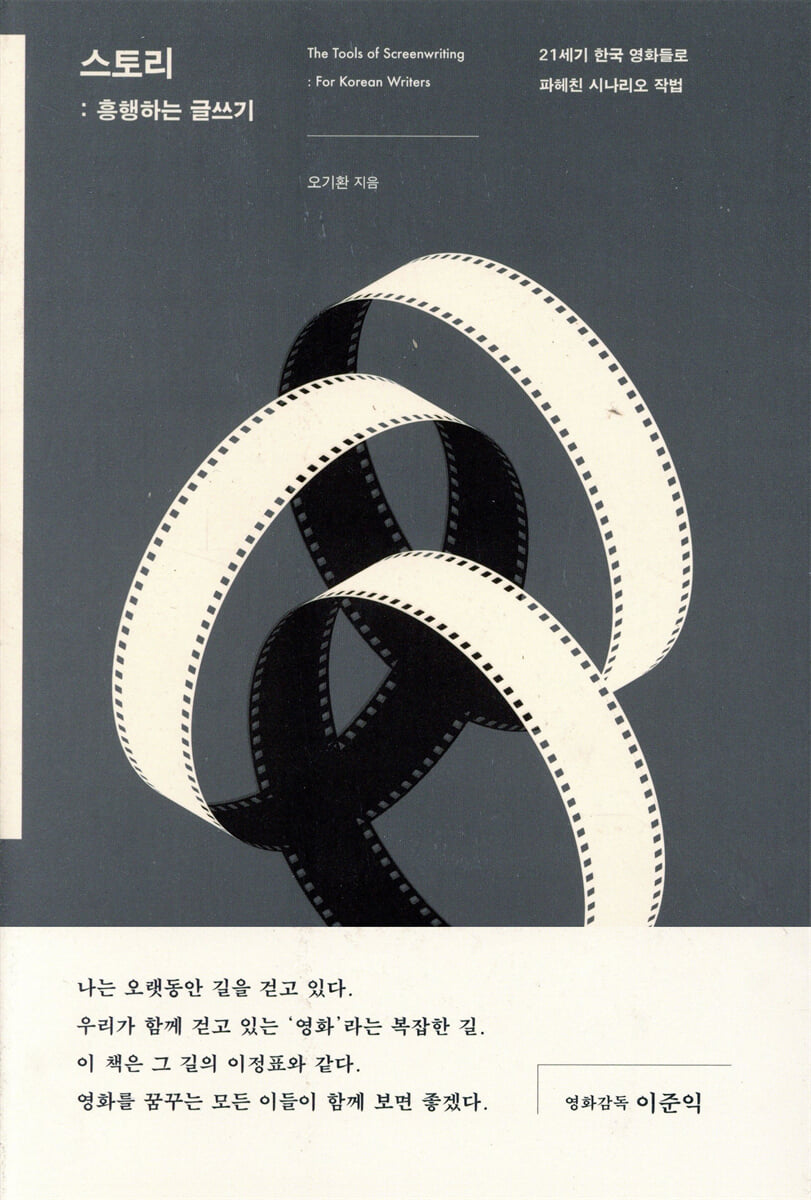
Story: Writing that Hits
 |
Description
Book Introduction
A book with the charm to render existing writing books powerless! - Analysis of scenarios filled with 21st century Korean films - A must-read recommended by current film directors and screenwriters. - The secrets of scenario structure revealed through the 'Five-Eight Formula' - The wisest and kindest answer about screenplays and writing Do writers read writing manuals? Of course. Famous authors like Stephen King and James Michener have published books on writing, and Haruki Murakami has detailed his writing habits in several essays. Also, presidential secretaries, journalists, publishers and magazine editors, and people who write for a living in various professions have published books on writing. Of course, the writing discussed in 『Story: Writing for Success』 is not novels or essays, but the visual industry, namely, film and drama writing. However, the author is also significant in that he takes care not only of writing techniques but also of the attitude and mindset toward writing. "Story: Writing for the Box" is the result of the author's long experience and passion as a film director and screenwriter. This is the answer to the questions: why must screenwriting manuals be boring? Why must South Korean writers study from Hollywood film manuals? How long must we analyze Citizen Kane, made in 1941? And why isn't there a book that offers a helping hand, saying, "Let's write together!" rather than, "Start writing on your own!" Film director Min Kyu-dong commented that the book is like Ariadne's thread, a must-read for Theseus (writers) who are trapped in the maze of blocked writing. The author concisely analyzes all the movies in the world using the 'Oh (Ki-Hwan) formula' he developed, while not losing sight of the movie's message or the author's thematic consciousness. The reader's question, "Will I be able to write a good screenplay after reading this book?" is completely resolved after closing the book. |
- You can preview some of the book's contents.
Preview
index
Recommendation 1 (Film Director Min Kyu-dong)
Recommendation 2 (Film Director Shin Yeon-sik)
Entering
Before reading this book 1: Book structure
Before reading this book 2: Characteristics of the book
01 Theory of Story
1.
Story: How to Write a Screenplay
2.
Scenario Guide & Scenario Master
3.
What is a Scenario & Scenario Workbook
4.
Save the Cat!: 8 Rules for Writing a Hit Movie Screenplay
5.
The Secret of Poetry & Storytelling
6.
Essential elements
02 Plot
1.
Act 3
2.
A plot is a plan
03 Main Character
1.
Find the main character
2.
The protagonist's actions
3.
past, present, future
4.
The Thinker vs.
Action taker
5.
The protagonist is a man of action
6.
Action is the main character
04 Concept of formula
1.
Oh Gi-hwan's formula
2.
triangle of plot
3.
The protagonist's formula
4.
The antagonist's formula
05 Principle of the formula
1.
The plan is completed
2.
The setting rushes towards the climax.
3.
'Attack Point 1' and 'Attack Point 3' are twins.
06 Surface narrative and deep narrative
1.
Bohemian Rhapsody
2.
"monster"
3.
"helminth"
4.
Exit
5.
"city"
07 Application of the formula
08 Laws of Genre
1.
The formula of the genre
2.
Melo
3.
Human
4.
sports
5.
horror
6.
thriller
7.
Undercover
8.
Caper
9.
Action
10.
calamity
11.
Genre Summary
09 Story Creation
1.
The foundation of creation
2.
hero
3.
value
10. The order of creation
1.
The protagonist's formula
2.
Value setting
3.
Setting and climax
4.
Main antagonist setting
5.
Setting up a sub-antagonist
6.
Surface narrative and deep narrative
7.
Cross-check
8.
Story Writing
11 Writing by Genre
1.
Melo
2.
Human
3.
horror
4.
thriller
5.
Caper
6.
Action
7.
Drama creation
12 checkpoints
1.
Once the first act is complete, the first draft can be completed.
2.
Subplot
3.
Edit completed
4.
Socialization of my writing
Before closing this book
Going out
Recommendation 2 (Film Director Shin Yeon-sik)
Entering
Before reading this book 1: Book structure
Before reading this book 2: Characteristics of the book
01 Theory of Story
1.
Story: How to Write a Screenplay
2.
Scenario Guide & Scenario Master
3.
What is a Scenario & Scenario Workbook
4.
Save the Cat!: 8 Rules for Writing a Hit Movie Screenplay
5.
The Secret of Poetry & Storytelling
6.
Essential elements
02 Plot
1.
Act 3
2.
A plot is a plan
03 Main Character
1.
Find the main character
2.
The protagonist's actions
3.
past, present, future
4.
The Thinker vs.
Action taker
5.
The protagonist is a man of action
6.
Action is the main character
04 Concept of formula
1.
Oh Gi-hwan's formula
2.
triangle of plot
3.
The protagonist's formula
4.
The antagonist's formula
05 Principle of the formula
1.
The plan is completed
2.
The setting rushes towards the climax.
3.
'Attack Point 1' and 'Attack Point 3' are twins.
06 Surface narrative and deep narrative
1.
Bohemian Rhapsody
2.
"monster"
3.
"helminth"
4.
Exit
5.
"city"
07 Application of the formula
08 Laws of Genre
1.
The formula of the genre
2.
Melo
3.
Human
4.
sports
5.
horror
6.
thriller
7.
Undercover
8.
Caper
9.
Action
10.
calamity
11.
Genre Summary
09 Story Creation
1.
The foundation of creation
2.
hero
3.
value
10. The order of creation
1.
The protagonist's formula
2.
Value setting
3.
Setting and climax
4.
Main antagonist setting
5.
Setting up a sub-antagonist
6.
Surface narrative and deep narrative
7.
Cross-check
8.
Story Writing
11 Writing by Genre
1.
Melo
2.
Human
3.
horror
4.
thriller
5.
Caper
6.
Action
7.
Drama creation
12 checkpoints
1.
Once the first act is complete, the first draft can be completed.
2.
Subplot
3.
Edit completed
4.
Socialization of my writing
Before closing this book
Going out
Detailed image
.jpg)
Into the book
This book is not about the future.
Praise the beauty of masterpieces that adorned our wonderful past.
All great stories of the future are born from subversion and betrayal.
Most masterpieces are born from a path different from normal expectations, and for that reason they survive for a long time and become established as classics.
What's interesting is that these masterpieces were only possible after fully digesting the past concepts and principles embroidered in this book and unfolding their own visions on unfamiliar paths.
In that sense, 『Story: Writing for Box Office』, unraveled by a current South Korean film director, may be the Ariadne's thread that we Theseuses desperately need to find a way out of the labyrinthine wall of blocked writing.
Do you know by any chance?
I just pulled it lightly, and that alone would work its magic to open up the passage.
--- From the "Recommendation" by film director Min Kyu-dong (Herstory, Everything About My Wife)
By establishing various perspectives and theories on scenario structure, it provides a clearer picture of the treasures each writer must seek for when writing a new scenario.
Beginner travelers can easily be dazzled by the dazzling treasures.
I hope that through this book you will learn how to read maps and practice finding your own treasures.
It will definitely be a fun and happy trip.
And when you reach your destination and look back, you will realize that the path you have taken was meant for you.
--- From the "Recommendation" by film director Shin Yeon-sik (《1 Win》 《Dongju》 [screenplay])
Writing a story, creating a new world, is so hard.
Unlike the manufacturing process of industrial products, the beginning and end are unclear.
No one knows exactly where and how it begins, or when and how it ends.
But if you make up your mind and decide on a beginning and an end for your writing, the story will begin and end.
I will sit next to you, cheering you on and helping you complete this path to the end.
Think of it as a 'pacemaker'.
I know that way well.
I've completed the race many times, and I'm still starting again every day without stopping.
If you give us the signal that you are mentally prepared, we will depart right away.
--- From 'Entering'
I believe that the perfect combination of a stable plot and an active protagonist makes for a perfect story.
The plot is the plan, and it is responsible for the overall skeleton of the story. The protagonist must take powerful actions within that plan and advance steadily toward a single goal.
That's the beautiful story I imagine.
Therefore, a character who does not move cannot be called the main character (in the story).
You need to move the main character in your writing right now.
Only then will the story come alive.
Shall we start moving strongly now? Ready, action!
--- From Chapter 3, “Protagonist (Character)”
In real life, very few people have a perfect plan.
The majority live their lives doing their best in the given environment.
The same goes for movies.
There are protagonists who live with strong will and plans, but there are also protagonists who do their best in a given environment and situation.
So, I'm going to look at movies that feature protagonists who don't have any powerful plans of their own.
This is director Jang Joon-hwan's 《1987》(2017).
The main characters of this film include Director Park (played by Kim Yun-seok), Chief of the Public Security Bureau (played by Ha Jung-woo), Yeon-hee (played by Kim Tae-ri), and Lee Han-yeol (played by Kang Dong-won).
Who among them has their own plans?
--- From Chapter 5, “The Principle of Formulas”
What if there were a deeper narrative beneath the expressive narrative? That's what Poetry is.
There is another layer of deep narrative beneath the deep narrative.
Here's why:
In the second half, Mija submits a poem she wrote and then disappears.
He hasn't shown up since.
The person reciting the poem written by Mija is not Mija herself, but a girl who is presumed to be the person who died and floated down the water at the very beginning of the film.
Who could it be?
--- From Chapter 6, “Surface Narrative and Deep Narrative”
Now, let's look at the various forms of the genre.
I will cut deep into the story before you with a sharp knife, carefully removing the flesh and fully revealing the shape of the bones.
If you go to a raw fish restaurant, there is a menu called Seodeori Tang.
It's a soup made by boiling fish bones.
Just by looking at the bones, anglers can tell at a glance whether a lot of flounder was sold the day before or a lot of red sea bream was cut.
You can guess the level of the store by the technique of removing the bones and flesh.
From now on, I will be using a good knife like a top chef to cut through the flesh of each 'genre'.
And let's dismantle all the 'bones of the genre'.
These bones are the path, the plot, of the writing we must follow.
The reason I placed genre analysis in the second half of the book is to add a "plot map" called "genre formula" to the story theory we've learned so far.
--- From Chapter 8, “The Laws of Genre”
Just because you start writing doesn't mean you'll finish.
There's a reason why the writing never ends.
It means that there are still unresolved issues.
We've covered the root cause of the problem several times before, but there's still one issue we haven't addressed yet.
The following is a tribute to all the writers who are struggling with stagnant and repetitive stories.
These are elements that can be referenced at every stage by everyone, from amateur writers just starting out to professional writers who are about to submit a finished copy of a contracted piece.
Please open a place that suits your situation.
--- From Chapter 12, "Checkpoint"
In this book, I explained all the stories by substituting them into the 'Oh's Formula'.
Readers, you may agree or disagree with this formula.
it's okay.
I, too, read the screenwriting books of the great writers, and was inspired by some parts and rebutted others.
Many people write their own stories in their own ways.
This book is my method.
I kept asking you guys if you had your own 'tool'.
"Story: Writing for Success" should be the tool to get there.
Don't worry or feel impatient if you don't have your own formula yet.
I, too, decided to write a book, and it took me 10 years to finally finish it.
Is that any consolation? The most important thing is your attitude toward writing, the direction you like to pursue, and your determination to see it through to the end.
And you, the ones who stay up all night again today, hovering between these three words: plot, protagonist, and value, are the real winners.
Praise the beauty of masterpieces that adorned our wonderful past.
All great stories of the future are born from subversion and betrayal.
Most masterpieces are born from a path different from normal expectations, and for that reason they survive for a long time and become established as classics.
What's interesting is that these masterpieces were only possible after fully digesting the past concepts and principles embroidered in this book and unfolding their own visions on unfamiliar paths.
In that sense, 『Story: Writing for Box Office』, unraveled by a current South Korean film director, may be the Ariadne's thread that we Theseuses desperately need to find a way out of the labyrinthine wall of blocked writing.
Do you know by any chance?
I just pulled it lightly, and that alone would work its magic to open up the passage.
--- From the "Recommendation" by film director Min Kyu-dong (Herstory, Everything About My Wife)
By establishing various perspectives and theories on scenario structure, it provides a clearer picture of the treasures each writer must seek for when writing a new scenario.
Beginner travelers can easily be dazzled by the dazzling treasures.
I hope that through this book you will learn how to read maps and practice finding your own treasures.
It will definitely be a fun and happy trip.
And when you reach your destination and look back, you will realize that the path you have taken was meant for you.
--- From the "Recommendation" by film director Shin Yeon-sik (《1 Win》 《Dongju》 [screenplay])
Writing a story, creating a new world, is so hard.
Unlike the manufacturing process of industrial products, the beginning and end are unclear.
No one knows exactly where and how it begins, or when and how it ends.
But if you make up your mind and decide on a beginning and an end for your writing, the story will begin and end.
I will sit next to you, cheering you on and helping you complete this path to the end.
Think of it as a 'pacemaker'.
I know that way well.
I've completed the race many times, and I'm still starting again every day without stopping.
If you give us the signal that you are mentally prepared, we will depart right away.
--- From 'Entering'
I believe that the perfect combination of a stable plot and an active protagonist makes for a perfect story.
The plot is the plan, and it is responsible for the overall skeleton of the story. The protagonist must take powerful actions within that plan and advance steadily toward a single goal.
That's the beautiful story I imagine.
Therefore, a character who does not move cannot be called the main character (in the story).
You need to move the main character in your writing right now.
Only then will the story come alive.
Shall we start moving strongly now? Ready, action!
--- From Chapter 3, “Protagonist (Character)”
In real life, very few people have a perfect plan.
The majority live their lives doing their best in the given environment.
The same goes for movies.
There are protagonists who live with strong will and plans, but there are also protagonists who do their best in a given environment and situation.
So, I'm going to look at movies that feature protagonists who don't have any powerful plans of their own.
This is director Jang Joon-hwan's 《1987》(2017).
The main characters of this film include Director Park (played by Kim Yun-seok), Chief of the Public Security Bureau (played by Ha Jung-woo), Yeon-hee (played by Kim Tae-ri), and Lee Han-yeol (played by Kang Dong-won).
Who among them has their own plans?
--- From Chapter 5, “The Principle of Formulas”
What if there were a deeper narrative beneath the expressive narrative? That's what Poetry is.
There is another layer of deep narrative beneath the deep narrative.
Here's why:
In the second half, Mija submits a poem she wrote and then disappears.
He hasn't shown up since.
The person reciting the poem written by Mija is not Mija herself, but a girl who is presumed to be the person who died and floated down the water at the very beginning of the film.
Who could it be?
--- From Chapter 6, “Surface Narrative and Deep Narrative”
Now, let's look at the various forms of the genre.
I will cut deep into the story before you with a sharp knife, carefully removing the flesh and fully revealing the shape of the bones.
If you go to a raw fish restaurant, there is a menu called Seodeori Tang.
It's a soup made by boiling fish bones.
Just by looking at the bones, anglers can tell at a glance whether a lot of flounder was sold the day before or a lot of red sea bream was cut.
You can guess the level of the store by the technique of removing the bones and flesh.
From now on, I will be using a good knife like a top chef to cut through the flesh of each 'genre'.
And let's dismantle all the 'bones of the genre'.
These bones are the path, the plot, of the writing we must follow.
The reason I placed genre analysis in the second half of the book is to add a "plot map" called "genre formula" to the story theory we've learned so far.
--- From Chapter 8, “The Laws of Genre”
Just because you start writing doesn't mean you'll finish.
There's a reason why the writing never ends.
It means that there are still unresolved issues.
We've covered the root cause of the problem several times before, but there's still one issue we haven't addressed yet.
The following is a tribute to all the writers who are struggling with stagnant and repetitive stories.
These are elements that can be referenced at every stage by everyone, from amateur writers just starting out to professional writers who are about to submit a finished copy of a contracted piece.
Please open a place that suits your situation.
--- From Chapter 12, "Checkpoint"
In this book, I explained all the stories by substituting them into the 'Oh's Formula'.
Readers, you may agree or disagree with this formula.
it's okay.
I, too, read the screenwriting books of the great writers, and was inspired by some parts and rebutted others.
Many people write their own stories in their own ways.
This book is my method.
I kept asking you guys if you had your own 'tool'.
"Story: Writing for Success" should be the tool to get there.
Don't worry or feel impatient if you don't have your own formula yet.
I, too, decided to write a book, and it took me 10 years to finally finish it.
Is that any consolation? The most important thing is your attitude toward writing, the direction you like to pursue, and your determination to see it through to the end.
And you, the ones who stay up all night again today, hovering between these three words: plot, protagonist, and value, are the real winners.
--- From "Going Out"
Publisher's Review
Lee Joon-ik, Min Kyu-dong, Heo Jin-ho, Yoon Je-kyun, Jang Hang-jun, etc.
Admiration from current film directors and screenwriters
“Easy, fun, sharp, and useful!”
"Will I be able to write a good screenplay after reading this book?"
The author's plan regarding the reader's question
If you chose "Story: Writing for Success," you are likely a film or TV screenwriter, or an aspiring writer.
Even if you are not a film major, you may be a student who wants to systematically read film texts, or you may have a desire to write something even in the midst of a busy daily life.
Above all, you must have wondered, 'Will I be able to write a good screenplay after reading this book?'
To this, the author confidently answers, "After reading this book, you will be able to create a screenplay."
Just as a good movie needs a solid plot, a good book also needs a well-built plot.
The plot of this book is the table of contents.
Chapter 1, 'Theory of Story', concisely summarizes the contents of existing story theory and writing books.
Through this, we examine the basic elements of scenario theory.
Chapter 2, 'Plot' and Chapter 3, 'Protagonist' cover the basic theory of story.
And from Chapter 4, ‘The Concept of the Formula’ to Chapter 7, ‘Application of the Formula’, the internal cycle of the story is explained.
From the plot triangle that supports the world of the story, to the causality between the setting and the climax, and the connection between attack points 1 and 3, it ultimately proves that the story is a living organism.
Chapter 8, 'The Laws of Genre', is the answer to the question of what form and structure all stories in the world have.
We have explained the shape and format of each genre through 10 genres.
Through this, you can become familiar with various basic narrative rules of various genres such as melodrama, human, sports, horror, and action.
It also covers what types of stories were preferred in each era, how the form of stories changed over time, and what genres are preferred in today's video industry.
Chapter 9, 'Story Creation', Chapter 10, 'The Order of Creation', and Chapter 11, 'Writing by Genre', examine the entire process of story creation in detail.
Chapters 9, 10, and 11, which correspond to the third act of the film, connect 'theory' and 'creation' in a way that no other story theorist or creative writing book has ever shown.
Before you know it, you'll find yourself closing the book, predicting the future of the story and making plans for how you'll enter the film industry.
All films across genres, nationalities, and series
Solve it with 'Oh (Ki-Hwan)'s formula'
'Oh (Ki-Hwan)'s Formula' put forward the author's name.
(He is the first person in South Korea to receive a doctorate in screenwriting.) If you look closely, it is the sum of two formulas.
First, there is the protagonist's formula, which is completed with two circles and one arrow, and then there is the antagonist's formula, which is completed with three circles and three arrows.
Through this formula, the author analyzes a variety of films, from popular films like [Midnight Runners] and [Exit] to art films like [Poetry], and films that capture both popularity and artistry, such as [Parasite], [The Host], and [Architecture 101].
Also, various genres such as action, melodrama, thriller, caper, undercover, sports, and human can be solved with this one formula.
In a word, it is versatile.
The protagonist formula is a formula about the protagonist (character) who leads a movie from beginning to end.
That is, it is responsible for the beginning and the end of the story.
The direction of the arrows from left to right represents the protagonist's actions.
On the other hand, the antagonist's formula is responsible for fun and value.
Because a story without an antagonist is boring.
That is, it completes the story.
The reason there are three circles is because of the three-act structure, which develops the story by connecting the acts together.
The 'formula of five' is a living organism with internal rules and flow, just like the properties of writing.
Detailed explanations of the narrative layers and genre-specific writing tips are all included in the book.
Still struggling with the unresolved issue
For the writer
Some films are loved by the public and critics alike, while some scripts remain on the writer's desk their entire lives, never to be released into the world.
Why? The truth is, anyone can write a story.
Just think back to writing a diary in elementary school.
If you were forced to write it, a letter to your lover would be good too.
So writing is not inherently difficult.
So the answer to the question, "Can I write?" is, "Write right now!"
However, this is a superficial question and answer.
Just as there are surface narratives and deep narratives in movies, there are also deep difficulties in screenwriting.
The problem that really makes it difficult for creators is writing stories that 'other people like'.
This is the deep and fundamental difficulty.
The author's answer can be summarized as follows:
First, 'writing' means thinking of something that is not currently in my head, organizing it in advance, and then writing it.
Second, we must distinguish between ‘writing’, which involves organizing and writing in advance, and ‘typing’, which involves starting without thinking.
Third, the item must be described by four elements: the protagonist, the protagonist's purpose, the protagonist's plan, and the antagonist.
Fourth, items are like living things.
Born small and whole, growing up to be fully formed.
Fifth, for an item to grow well, it must have an end.
An endless item is not an item, it is simply an idea.
This cannot be completed.
Sixth, you should start writing when the process is clear and the ending scene is clear.
Seventh, if you are going to publish something out into the world, you must secure positive feedback from others before you begin writing in earnest.
The author encourages the reader with all his might, saying, “The world is waiting for your writing!”
Admiration from current film directors and screenwriters
“Easy, fun, sharp, and useful!”
"Will I be able to write a good screenplay after reading this book?"
The author's plan regarding the reader's question
If you chose "Story: Writing for Success," you are likely a film or TV screenwriter, or an aspiring writer.
Even if you are not a film major, you may be a student who wants to systematically read film texts, or you may have a desire to write something even in the midst of a busy daily life.
Above all, you must have wondered, 'Will I be able to write a good screenplay after reading this book?'
To this, the author confidently answers, "After reading this book, you will be able to create a screenplay."
Just as a good movie needs a solid plot, a good book also needs a well-built plot.
The plot of this book is the table of contents.
Chapter 1, 'Theory of Story', concisely summarizes the contents of existing story theory and writing books.
Through this, we examine the basic elements of scenario theory.
Chapter 2, 'Plot' and Chapter 3, 'Protagonist' cover the basic theory of story.
And from Chapter 4, ‘The Concept of the Formula’ to Chapter 7, ‘Application of the Formula’, the internal cycle of the story is explained.
From the plot triangle that supports the world of the story, to the causality between the setting and the climax, and the connection between attack points 1 and 3, it ultimately proves that the story is a living organism.
Chapter 8, 'The Laws of Genre', is the answer to the question of what form and structure all stories in the world have.
We have explained the shape and format of each genre through 10 genres.
Through this, you can become familiar with various basic narrative rules of various genres such as melodrama, human, sports, horror, and action.
It also covers what types of stories were preferred in each era, how the form of stories changed over time, and what genres are preferred in today's video industry.
Chapter 9, 'Story Creation', Chapter 10, 'The Order of Creation', and Chapter 11, 'Writing by Genre', examine the entire process of story creation in detail.
Chapters 9, 10, and 11, which correspond to the third act of the film, connect 'theory' and 'creation' in a way that no other story theorist or creative writing book has ever shown.
Before you know it, you'll find yourself closing the book, predicting the future of the story and making plans for how you'll enter the film industry.
All films across genres, nationalities, and series
Solve it with 'Oh (Ki-Hwan)'s formula'
'Oh (Ki-Hwan)'s Formula' put forward the author's name.
(He is the first person in South Korea to receive a doctorate in screenwriting.) If you look closely, it is the sum of two formulas.
First, there is the protagonist's formula, which is completed with two circles and one arrow, and then there is the antagonist's formula, which is completed with three circles and three arrows.
Through this formula, the author analyzes a variety of films, from popular films like [Midnight Runners] and [Exit] to art films like [Poetry], and films that capture both popularity and artistry, such as [Parasite], [The Host], and [Architecture 101].
Also, various genres such as action, melodrama, thriller, caper, undercover, sports, and human can be solved with this one formula.
In a word, it is versatile.
The protagonist formula is a formula about the protagonist (character) who leads a movie from beginning to end.
That is, it is responsible for the beginning and the end of the story.
The direction of the arrows from left to right represents the protagonist's actions.
On the other hand, the antagonist's formula is responsible for fun and value.
Because a story without an antagonist is boring.
That is, it completes the story.
The reason there are three circles is because of the three-act structure, which develops the story by connecting the acts together.
The 'formula of five' is a living organism with internal rules and flow, just like the properties of writing.
Detailed explanations of the narrative layers and genre-specific writing tips are all included in the book.
Still struggling with the unresolved issue
For the writer
Some films are loved by the public and critics alike, while some scripts remain on the writer's desk their entire lives, never to be released into the world.
Why? The truth is, anyone can write a story.
Just think back to writing a diary in elementary school.
If you were forced to write it, a letter to your lover would be good too.
So writing is not inherently difficult.
So the answer to the question, "Can I write?" is, "Write right now!"
However, this is a superficial question and answer.
Just as there are surface narratives and deep narratives in movies, there are also deep difficulties in screenwriting.
The problem that really makes it difficult for creators is writing stories that 'other people like'.
This is the deep and fundamental difficulty.
The author's answer can be summarized as follows:
First, 'writing' means thinking of something that is not currently in my head, organizing it in advance, and then writing it.
Second, we must distinguish between ‘writing’, which involves organizing and writing in advance, and ‘typing’, which involves starting without thinking.
Third, the item must be described by four elements: the protagonist, the protagonist's purpose, the protagonist's plan, and the antagonist.
Fourth, items are like living things.
Born small and whole, growing up to be fully formed.
Fifth, for an item to grow well, it must have an end.
An endless item is not an item, it is simply an idea.
This cannot be completed.
Sixth, you should start writing when the process is clear and the ending scene is clear.
Seventh, if you are going to publish something out into the world, you must secure positive feedback from others before you begin writing in earnest.
The author encourages the reader with all his might, saying, “The world is waiting for your writing!”
GOODS SPECIFICS
- Publication date: October 29, 2020
- Page count, weight, size: 460 pages | 690g | 154*225*25mm
- ISBN13: 9791165792268
- ISBN10: 1165792265
You may also like
카테고리
korean


korean

![GQ KOREA Mark (Monthly): December [2025]](http://librairie.coreenne.fr/cdn/shop/files/8ef265dbbfbf186523ed75ba7319009d.jpg?v=1765340328&width=3840)


