

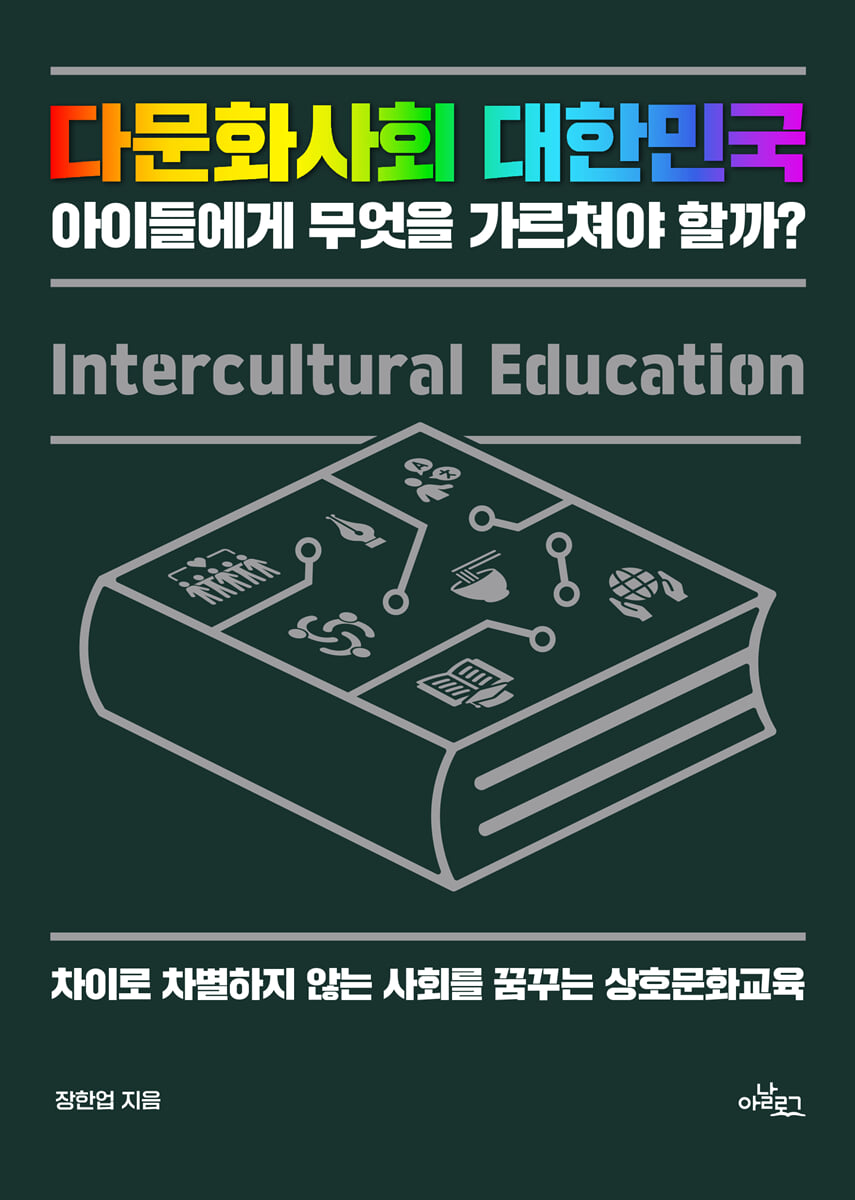
What should we teach children in a multicultural society like Korea?
 |
Description
Book Introduction
Professor Jang Han-eop, who has long been dedicated to multicultural/intercultural education, presents a new book titled "The Language of Discrimination." “In Korean society, which is on the verge of entering a multicultural society, intercultural education is “It is the most necessary and realistic educational alternative for children who will live in the future!” According to Statistics Korea, the number of foreign residents in Korea, including foreign workers, marriage immigrants and their children, international students, and compatriots, was approximately 2.25 million in 2022, accounting for 4.4 percent of the total population, and is projected to increase to 6.9 percent (3.52 million) by 2040. Accordingly, the number of students with immigrant backgrounds (multicultural students) has also increased significantly, reaching 160,000 as of 2021, accounting for 3 percent of the total student population. It is now common to see students from immigrant backgrounds in the classroom. However, the discrimination that has been prevalent in Korean society for a long time continues to affect children, and discrimination and hatred against students of immigrant backgrounds occur at school for reasons such as different ethnicity, different skin color, and not being able to speak Korean. Professor Jang Han-eop, director of the Multicultural Research Institute at Ewha Womans University, who has long been dedicated to multicultural/intercultural education, presents educational alternatives for creating a society that respects diversity and does not discriminate based on differences through “What Should We Teach Children in a Multicultural Society in Korea?” Based on various case studies and statistical data, this book examines the current status of students with immigrant backgrounds, the types of discrimination they face, and the need for multicultural/intercultural education. It also provides detailed explanations of how teachers can integrate intercultural education into their curriculum and creative experiential activities. It also introduces the need for bilingual education and level-based education for students with immigrant backgrounds, methods for creating a multicultural-friendly educational environment, and examples of creating intercultural classrooms in advanced multicultural countries. This book provides teachers and educators who must implement multicultural/intercultural education with practical methods and key information on 'what, how, and why' to teach. It will also serve as the most realistic manual for readers who want to know how to live well together in a future multicultural society, bringing about concrete changes in language, behavior, and way of thinking. |
- You can preview some of the book's contents.
Preview
index
Introducing the book: Multicultural/intercultural education is education for children's future.
Part 1: Understanding Multicultural Society
Chapter 1: Why Multicultural/Intercultural Education is Necessary
Chapter 2: A Society That Discriminates Against Differences
Part 2: The Reality of Students with Immigrant Backgrounds
Chapter 1: Children Discriminated Against at School
Chapter 2: The Current State of Multicultural Education in Schools
Part 3: Multicultural Education and Intercultural Education
Chapter 1 Multicultural Education
Chapter 2 Intercultural Education
Part 4 Multicultural Education Policy School
Chapter 1: Multicultural Education Policy School Operation Guidelines
Chapter 2: Multicultural Education: What Should We Teach and How?
Part 5: Curriculum Linkage of Multicultural/Intercultural Education
Chapter 1: Korean Language Curriculum and Multicultural/Intercultural Education
Chapter 2: English Language Teaching and Multicultural/Intercultural Education
Chapter 3: Mathematics Curriculum and Multicultural/Intercultural Education
Chapter 4 Social Studies and Multicultural/Intercultural Education
Chapter 5: History Curriculum and Multicultural/Intercultural Education
Chapter 6: Geography and Multicultural/Intercultural Education
Chapter 7: Science Curriculum and Multicultural/Intercultural Education
Chapter 8: Technology and Home Economics and Multicultural/Intercultural Education
Chapter 9: Art Curriculum and Multicultural/Intercultural Education
Chapter 10: Music Curriculum and Multicultural/Intercultural Education
Chapter 11: Physical Education and Multicultural/Intercultural Education
Chapter 12: Creative Extracurricular Activities and Multicultural/Intercultural Education
Part 6: Customized Education for Students with Immigrant Backgrounds
Chapter 1 Korean Language Education
Chapter 2 Bilingual Education
Part 7: Multiculturally Friendly Educational Environment
Chapter 1: Creating a Multiculturally Friendly School Environment
Chapter 2: Creating a Multicultural-Friendly Social Environment
Part 8: Cases and Advice from Multicultural Developed Countries
Chapter 1: Creating an Intercultural Classroom in Europe
Chapter 2: Creating an Intercultural Classroom in Ireland
Chapter 3: Creating Intercultural Classrooms in Canada
Chapter 4: Creating an Intercultural Classroom in Australia
Part 1: Understanding Multicultural Society
Chapter 1: Why Multicultural/Intercultural Education is Necessary
Chapter 2: A Society That Discriminates Against Differences
Part 2: The Reality of Students with Immigrant Backgrounds
Chapter 1: Children Discriminated Against at School
Chapter 2: The Current State of Multicultural Education in Schools
Part 3: Multicultural Education and Intercultural Education
Chapter 1 Multicultural Education
Chapter 2 Intercultural Education
Part 4 Multicultural Education Policy School
Chapter 1: Multicultural Education Policy School Operation Guidelines
Chapter 2: Multicultural Education: What Should We Teach and How?
Part 5: Curriculum Linkage of Multicultural/Intercultural Education
Chapter 1: Korean Language Curriculum and Multicultural/Intercultural Education
Chapter 2: English Language Teaching and Multicultural/Intercultural Education
Chapter 3: Mathematics Curriculum and Multicultural/Intercultural Education
Chapter 4 Social Studies and Multicultural/Intercultural Education
Chapter 5: History Curriculum and Multicultural/Intercultural Education
Chapter 6: Geography and Multicultural/Intercultural Education
Chapter 7: Science Curriculum and Multicultural/Intercultural Education
Chapter 8: Technology and Home Economics and Multicultural/Intercultural Education
Chapter 9: Art Curriculum and Multicultural/Intercultural Education
Chapter 10: Music Curriculum and Multicultural/Intercultural Education
Chapter 11: Physical Education and Multicultural/Intercultural Education
Chapter 12: Creative Extracurricular Activities and Multicultural/Intercultural Education
Part 6: Customized Education for Students with Immigrant Backgrounds
Chapter 1 Korean Language Education
Chapter 2 Bilingual Education
Part 7: Multiculturally Friendly Educational Environment
Chapter 1: Creating a Multiculturally Friendly School Environment
Chapter 2: Creating a Multicultural-Friendly Social Environment
Part 8: Cases and Advice from Multicultural Developed Countries
Chapter 1: Creating an Intercultural Classroom in Europe
Chapter 2: Creating an Intercultural Classroom in Ireland
Chapter 3: Creating Intercultural Classrooms in Canada
Chapter 4: Creating an Intercultural Classroom in Australia
Detailed image

Into the book
In a multicultural society, it is crucial that everyone respects each other's differences.
The belief that differences should be respected in this way is ‘diversity.’
According to Naver Dictionary, this means “having many characteristics such as shape, color, form, and style,” but it is also a belief that we must respect each other’s differences.
In short, we can say that 'difference is the reality we face, and diversity is a value we must pursue.'
In this way, the intelligent information society demands that differences be tolerated, and the multicultural society demands that differences be respected.
Multicultural education or intercultural education is an education that seeks to meet these contemporary demands.
--- p.23
As of 2020, the number of foreign residents entering the country reached 2.15 million.
In short, foreign residents are people accepted as a 'last resort' to fill the structural gap in Korean society.
Therefore, it can be said that these are people who contribute to Korean society to some extent.
Looking at examples from developed countries, it is said that “over time, immigrants contribute more to government finances through labor and income taxes than they receive from government social welfare policies.”
From now on, I hope you will think of the word "contribution" more often when talking about foreign residents.
--- p.34
Most interpersonal problems, which are problems that prevent students from getting along well with their peers, are caused by being ignored, discriminated against, or excluded by regular students.
As we have seen, regular students ignore and discriminate against students from immigrant backgrounds based on various factors such as ethnicity, appearance, language, and grades.
To prevent this, we must clearly teach students the normality of diversity and the human right to be different.
This training must be provided in every class and by every teacher.
For this reason, multicultural education is included in the cross-curricular learning topic.
I propose to combine multicultural education and intercultural education and call this education the “Multicultural/Intercultural Education Plan.”
--- p.78
Empathy is also very important in school life.
“This is because a teacher’s competence means the ability to design and implement empathy education with interest and enthusiasm for developing students’ empathy.”
In other words, teachers must understand students' egos and emotions, have interest and enthusiasm for students, understand empathy education, and be able to design and implement empathy classes.
The belief that differences should be respected in this way is ‘diversity.’
According to Naver Dictionary, this means “having many characteristics such as shape, color, form, and style,” but it is also a belief that we must respect each other’s differences.
In short, we can say that 'difference is the reality we face, and diversity is a value we must pursue.'
In this way, the intelligent information society demands that differences be tolerated, and the multicultural society demands that differences be respected.
Multicultural education or intercultural education is an education that seeks to meet these contemporary demands.
--- p.23
As of 2020, the number of foreign residents entering the country reached 2.15 million.
In short, foreign residents are people accepted as a 'last resort' to fill the structural gap in Korean society.
Therefore, it can be said that these are people who contribute to Korean society to some extent.
Looking at examples from developed countries, it is said that “over time, immigrants contribute more to government finances through labor and income taxes than they receive from government social welfare policies.”
From now on, I hope you will think of the word "contribution" more often when talking about foreign residents.
--- p.34
Most interpersonal problems, which are problems that prevent students from getting along well with their peers, are caused by being ignored, discriminated against, or excluded by regular students.
As we have seen, regular students ignore and discriminate against students from immigrant backgrounds based on various factors such as ethnicity, appearance, language, and grades.
To prevent this, we must clearly teach students the normality of diversity and the human right to be different.
This training must be provided in every class and by every teacher.
For this reason, multicultural education is included in the cross-curricular learning topic.
I propose to combine multicultural education and intercultural education and call this education the “Multicultural/Intercultural Education Plan.”
--- p.78
Empathy is also very important in school life.
“This is because a teacher’s competence means the ability to design and implement empathy education with interest and enthusiasm for developing students’ empathy.”
In other words, teachers must understand students' egos and emotions, have interest and enthusiasm for students, understand empathy education, and be able to design and implement empathy classes.
--- p.308
Publisher's Review
As of 2022, the number of foreign residents residing in Korea is approximately 2.25 million (4.4% of the total population).
With a multicultural society on the horizon, is Korean society ready for change?
Foreigners began to enter Korea in earnest from China and Southeast Asia in the 1990s, and the number of foreign residents who entered the country this way reached 2.15 million as of 2020.
Moreover, as the total fertility rate in our country has fallen below 1.0 since 2018, we are actively promoting the influx of more foreigners as a practical way to address the various problems that arise.
According to Statistics Korea, the number of foreign residents in Korea, including foreign workers, marriage immigrants and their children, international students, and compatriots, was approximately 2.25 million as of 2022, accounting for 4.4 percent of the total population, and is projected to increase to 6.9 percent (3.52 million) by 2040.
Generally, a society is classified as multicultural when the foreign population exceeds 5%, so Korea is now a multicultural society with a mixture of different cultures, and it is becoming a natural part of society not only for adults but also for children.
So, is Korean society ready for this kind of change? For a long time, we have emphasized a "single ethnicity," failing to recognize differences in language, nationality, ethnicity, and culture, and discriminating against, hating, and excluding foreign residents.
According to the Education Statistics Service of the Korea Educational Development Institute, the number of students with immigrant backgrounds (multicultural students) has increased significantly, reaching 160,000 in 2021, accounting for 3 percent of the total student population.
It is now common to see students from immigrant backgrounds in the classroom.
However, the discrimination prevalent in society also affects children, and discrimination and hatred against students of immigrant backgrounds occur within schools due to their appearance, their inability to speak Korean, and various other cultural differences.
To create a society that respects diversity and does not discriminate based on differences
Intercultural education: the most realistic and essential educational alternative
If a multicultural society is our present reality, shouldn't we now teach our children how to understand and respect other cultures and coexist with them? Professor Jang Han-up, director of the Multicultural Research Institute at Ewha Womans University and a longtime advocate for multicultural and intercultural education, presents the most realistic educational alternatives for creating a future society where diversity is respected and where differences are not discriminated against.
Although multicultural education is still more widely known, Professor Jang Han-eop believes that intercultural education is more suitable for the reality of our country than multicultural education.
If multicultural education, which emerged in the 1960s in the United States in the process of demanding equality between blacks and whites, teaches coexistence and equality of diverse cultures, intercultural education is an education implemented when countries with a relatively stable national identity, such as Germany, France, Switzerland, and Ireland, accept a large number of immigrants and live together with them, and teaches encounters with people of different cultures.
In other words, it is an education that fosters intercultural competencies that enable effective and appropriate interaction with people of different cultures and languages, and focuses more on the coexistence of immigrants and permanent residents.
This book is largely divided into two parts.
The first part examines the necessity of multicultural education/intercultural education, and details the current status of students with immigrant backgrounds, the types of discrimination they face, the Ministry of Education's existing multicultural policies, and the differences between multicultural education and intercultural education, based on real-life cases and statistical data.
The latter part provides examples of how teachers can provide intercultural education to children through curriculum and creative experiential activities in real-world settings.
It also introduces the need for bilingual education and level-based education for students with immigrant backgrounds, methods for creating a multicultural-friendly educational environment, and examples of creating intercultural classrooms in advanced multicultural countries.
Teachers and educators who are looking for educational methods for children living in a multicultural society
A book for all those concerned about a better future for the Republic of Korea.
A multicultural society is already a reality before our eyes.
For children living in such a society, differences and differences must be accepted as diversity, not discrimination and exclusion.
We must expand our thinking flexibly by understanding diverse cultures, lowering language barriers, and eliminating prejudices based on race or skin color.
Above all, future society demands critical thinking and creativity, and to achieve this, we must first and foremost be able to respect and understand perspectives different from our own.
In a society dominated by a self-centered, ethnocentric atmosphere and a passive educational culture, multicultural/intercultural education will be an excellent alternative for children who will live in the future society.
This book provides teachers, educators, and parents who must implement multicultural/intercultural education in actual educational settings with practical methods and key information on 'what, how, and why' to teach.
It will also serve as an excellent manual for readers who want to learn how to live well together in a multicultural society, bringing about specific changes in language, behavior, and way of thinking.
With a multicultural society on the horizon, is Korean society ready for change?
Foreigners began to enter Korea in earnest from China and Southeast Asia in the 1990s, and the number of foreign residents who entered the country this way reached 2.15 million as of 2020.
Moreover, as the total fertility rate in our country has fallen below 1.0 since 2018, we are actively promoting the influx of more foreigners as a practical way to address the various problems that arise.
According to Statistics Korea, the number of foreign residents in Korea, including foreign workers, marriage immigrants and their children, international students, and compatriots, was approximately 2.25 million as of 2022, accounting for 4.4 percent of the total population, and is projected to increase to 6.9 percent (3.52 million) by 2040.
Generally, a society is classified as multicultural when the foreign population exceeds 5%, so Korea is now a multicultural society with a mixture of different cultures, and it is becoming a natural part of society not only for adults but also for children.
So, is Korean society ready for this kind of change? For a long time, we have emphasized a "single ethnicity," failing to recognize differences in language, nationality, ethnicity, and culture, and discriminating against, hating, and excluding foreign residents.
According to the Education Statistics Service of the Korea Educational Development Institute, the number of students with immigrant backgrounds (multicultural students) has increased significantly, reaching 160,000 in 2021, accounting for 3 percent of the total student population.
It is now common to see students from immigrant backgrounds in the classroom.
However, the discrimination prevalent in society also affects children, and discrimination and hatred against students of immigrant backgrounds occur within schools due to their appearance, their inability to speak Korean, and various other cultural differences.
To create a society that respects diversity and does not discriminate based on differences
Intercultural education: the most realistic and essential educational alternative
If a multicultural society is our present reality, shouldn't we now teach our children how to understand and respect other cultures and coexist with them? Professor Jang Han-up, director of the Multicultural Research Institute at Ewha Womans University and a longtime advocate for multicultural and intercultural education, presents the most realistic educational alternatives for creating a future society where diversity is respected and where differences are not discriminated against.
Although multicultural education is still more widely known, Professor Jang Han-eop believes that intercultural education is more suitable for the reality of our country than multicultural education.
If multicultural education, which emerged in the 1960s in the United States in the process of demanding equality between blacks and whites, teaches coexistence and equality of diverse cultures, intercultural education is an education implemented when countries with a relatively stable national identity, such as Germany, France, Switzerland, and Ireland, accept a large number of immigrants and live together with them, and teaches encounters with people of different cultures.
In other words, it is an education that fosters intercultural competencies that enable effective and appropriate interaction with people of different cultures and languages, and focuses more on the coexistence of immigrants and permanent residents.
This book is largely divided into two parts.
The first part examines the necessity of multicultural education/intercultural education, and details the current status of students with immigrant backgrounds, the types of discrimination they face, the Ministry of Education's existing multicultural policies, and the differences between multicultural education and intercultural education, based on real-life cases and statistical data.
The latter part provides examples of how teachers can provide intercultural education to children through curriculum and creative experiential activities in real-world settings.
It also introduces the need for bilingual education and level-based education for students with immigrant backgrounds, methods for creating a multicultural-friendly educational environment, and examples of creating intercultural classrooms in advanced multicultural countries.
Teachers and educators who are looking for educational methods for children living in a multicultural society
A book for all those concerned about a better future for the Republic of Korea.
A multicultural society is already a reality before our eyes.
For children living in such a society, differences and differences must be accepted as diversity, not discrimination and exclusion.
We must expand our thinking flexibly by understanding diverse cultures, lowering language barriers, and eliminating prejudices based on race or skin color.
Above all, future society demands critical thinking and creativity, and to achieve this, we must first and foremost be able to respect and understand perspectives different from our own.
In a society dominated by a self-centered, ethnocentric atmosphere and a passive educational culture, multicultural/intercultural education will be an excellent alternative for children who will live in the future society.
This book provides teachers, educators, and parents who must implement multicultural/intercultural education in actual educational settings with practical methods and key information on 'what, how, and why' to teach.
It will also serve as an excellent manual for readers who want to learn how to live well together in a multicultural society, bringing about specific changes in language, behavior, and way of thinking.
GOODS SPECIFICS
- Publication date: November 25, 2023
- Page count, weight, size: 400 pages | 552g | 152*210*20mm
- ISBN13: 9791192706160
- ISBN10: 1192706161
You may also like
카테고리
korean


korean

![GQ KOREA Mark (Monthly): December [2025]](http://librairie.coreenne.fr/cdn/shop/files/8ef265dbbfbf186523ed75ba7319009d.jpg?v=1765340328&width=3840)


