

I'm red
 |
Description
Book Introduction
Poetry collection by Park Seong-woo, winner of the Shin Dong-yup Creative Writing Award
This is a poetry collection by poet Park Seong-woo, who has received attention from the literary world by winning the Shin Dong-yup Creative Writing Award, the Fireworks Literature Award, and other awards.
The poet, who has published lyric poetry through collections of poetry such as 『Spider』 and 『Light Sleep』, and has built a diverse readership by writing children's poetry collections such as 『Bad Crab』, attempts to communicate with teenagers this time through 『I'm Red』.
This poetry collection, which was selected as a winner of the Korea Publication Ethics Commission's '2009 Youth Writing and Publication Support Project', contains 56 poems expressing the daily lives and dreams of teenagers.
Kim Je-gon, who wrote the commentary for this collection of poems, praised the poem for bringing a meaningful look into the barren territory of youth poetry in our society, and pointed out that the world of youth was well depicted through the colors of 'light green' and 'red.'
That is, 'green' symbolizes incompleteness, and 'red' symbolizes individuality, which means that the poetic imagery was successful.
These two colors serve as important keywords symbolizing youth, revealing that they are still in an unfinished state, yet possess infinite potential.
The author of this book, through the 'Poet's Words', conveys the hope that we should occasionally think about what color we dream of.
I wanted to portray the concerns about the future and dreams that today's youth are experiencing in a warm and emotional style.
On the other hand, it overturns reality and reveals a delightful world without reservation based on the imagination that emerges from within children.
Through this, we hope to help people realize that the genre of 'poetry' is sometimes very suitable for expressing their lives.
This is a poetry collection by poet Park Seong-woo, who has received attention from the literary world by winning the Shin Dong-yup Creative Writing Award, the Fireworks Literature Award, and other awards.
The poet, who has published lyric poetry through collections of poetry such as 『Spider』 and 『Light Sleep』, and has built a diverse readership by writing children's poetry collections such as 『Bad Crab』, attempts to communicate with teenagers this time through 『I'm Red』.
This poetry collection, which was selected as a winner of the Korea Publication Ethics Commission's '2009 Youth Writing and Publication Support Project', contains 56 poems expressing the daily lives and dreams of teenagers.
Kim Je-gon, who wrote the commentary for this collection of poems, praised the poem for bringing a meaningful look into the barren territory of youth poetry in our society, and pointed out that the world of youth was well depicted through the colors of 'light green' and 'red.'
That is, 'green' symbolizes incompleteness, and 'red' symbolizes individuality, which means that the poetic imagery was successful.
These two colors serve as important keywords symbolizing youth, revealing that they are still in an unfinished state, yet possess infinite potential.
The author of this book, through the 'Poet's Words', conveys the hope that we should occasionally think about what color we dream of.
I wanted to portray the concerns about the future and dreams that today's youth are experiencing in a warm and emotional style.
On the other hand, it overturns reality and reveals a delightful world without reservation based on the imagination that emerges from within children.
Through this, we hope to help people realize that the genre of 'poetry' is sometimes very suitable for expressing their lives.
- You can preview some of the book's contents.
Preview
index
Part 1 Still Green
Exciting nightmare
rippling
Why on earth are you like that?
Horse razor clams
Still green
Oppression star
...
Don't you?
Park cigarettes
errand
My friend, Seonmi
War and Peace
Are you in puberty?
I'm red
wet dreams
1318 Diet
Secret Shave
I'm red
After shaving
passersby
No, I don't think so
academy
hula hoop
transfer
bad son
Commentary_Fresh lime green, lively red (Kim Je-gon)
Poet's words
Exciting nightmare
rippling
Why on earth are you like that?
Horse razor clams
Still green
Oppression star
...
Don't you?
Park cigarettes
errand
My friend, Seonmi
War and Peace
Are you in puberty?
I'm red
wet dreams
1318 Diet
Secret Shave
I'm red
After shaving
passersby
No, I don't think so
academy
hula hoop
transfer
bad son
Commentary_Fresh lime green, lively red (Kim Je-gon)
Poet's words
Publisher's Review
I'll be red, bright red
Our first poetry collection for teenagers
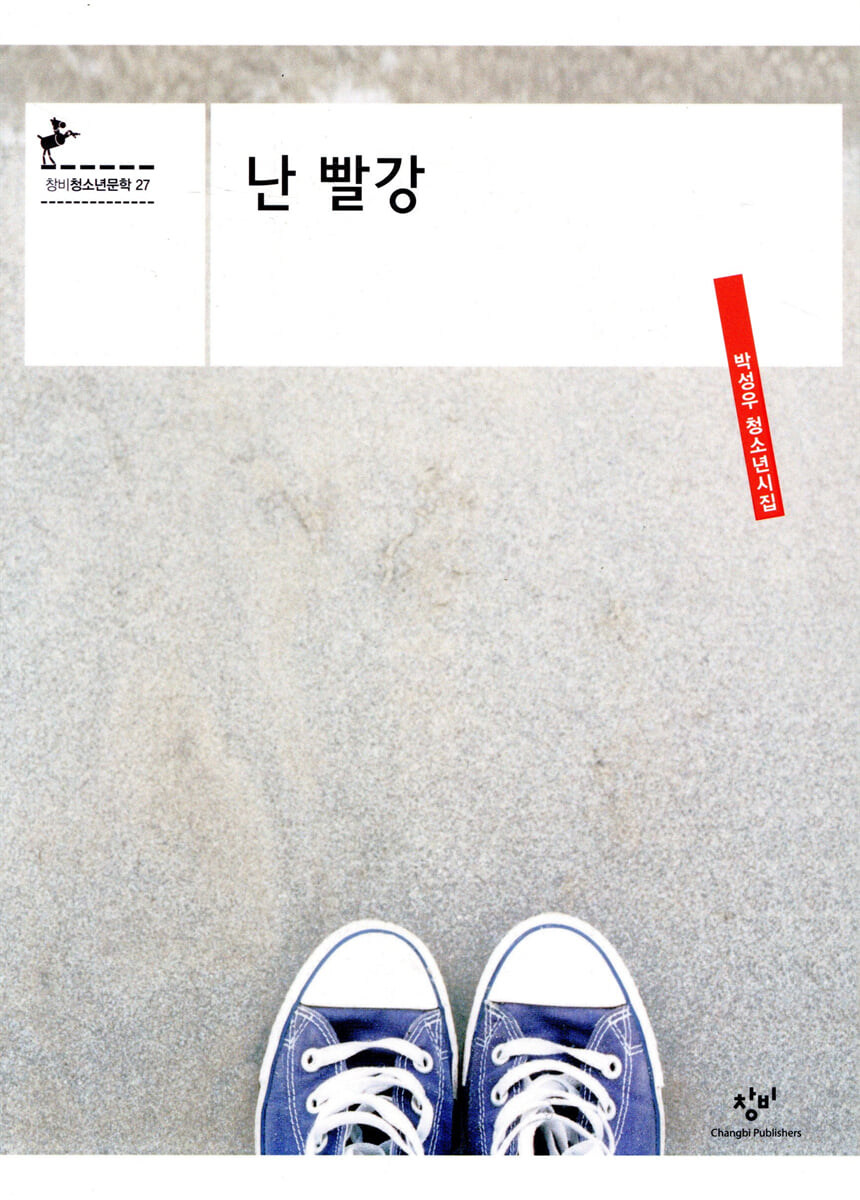
Park Seong-woo's poetry collection, "I'm Red," has been published as the 27th volume in the "Changbi Youth Literature" series, which has led a new trend in our youth literature.
Although young adult novels have been actively published and widely read by readers recently, 'young adult poetry' has been practically barren.
Poet Park Seong-woo, who debuted in 2000 and emerged as a promising star in the lyric poetry world with poetry collections such as “Spider” and “Light Sleep,” received renewed attention last year with the publication of his poetry collection “Bad Crab.”
The poet, who had been expanding his interest to include children's literature, wrote poems about the deep stories he learned from meeting teenagers in person, and as a result, he presented his first poetry collection for teenagers, "I'm Red."
This poetry collection was also selected as a winner of the '2009 Youth Writing and Publication Support Project' by the Korea Publication Ethics Committee.
Fresh lime green, lively red
The first thing that catches the eye in Park Seong-woo's poetry collection are the two words 'light green' and 'red'.
I like light green, not green
Washed in well water and chewed crunchy
It seems to smell like a fresh cucumber
Wipe it on your collar and eat it with a crunchy bite
A light green that seems to smell like sour green apples
―The "Still Green" part
I'm attracted to red, bright red
A lively red that makes you want to go all out
Red that stands out without caring what anyone says
―The "I'm Red" part
These two colors, green and red, are important keywords that symbolize youth.
The green color, combined with adjectives like “fresh,” “sour,” and “bitter,” reveals that although youth is not yet fully developed, it is nevertheless open to countless possibilities.
On the other hand, red symbolizes the spirit of youth who want to be independent and not conform to existing values, with expressions such as “not caring what others say, standing out, wild.”
In this way, the poet draws the image of youth with his own unique style of speaking, focusing his attention on the worries and conflicts that youth are experiencing 'here and now.'
The vivid depiction of teenagers' daily lives and dreams
In all the works included in ‘I am Red’, the poetic speakers are the youth themselves.
They are treated as studying machines rather than flesh-and-blood humans ("Study Machine"), they want to go to academies but have to endure it due to difficult family circumstances ("Academy"), they get upset whenever they are compared to other children and discriminated against ("Errands" and "Receive Forgiveness"), and they express their curiosity about sex in an unfiltered and humorous way ("Really Curious").
In this way, 『I'm Red』 easily elicits empathy because it mainly deals with content that teenagers can easily read, relate to, and imagine at their eye level.
On the other hand, the poet relies on the imagination that emerges from within children to overturn reality and create a cheerful and exciting world.
“I went to school to take the final exam/and a gorilla was eating the classroom like a biscuit” (“Exciting Nightmare”) “When I suddenly miss you, I pull the road with all my might and you, ripple ripple, come to me” (“Ripple Ripple”) In addition to these, the poet does not miss the diverse spectrum that exists within the minds of adolescents.
For example, in “The Clam,” which depicts the desolate inner self of the poetic speaker by comparing it to a dead clam with its mouth open on a drained riverbank, and in “The Chicken,” which calmly describes the maternal love of a hen holding her chicks on a rainy day, there is a heavy and serious gaze that is different from the liveliness we have seen before.
The first poetry collection for young people, "Now Here"
These days, when we think of poetry, we often think of it as something only elementary school children read.
However, even around the time of liberation, the main readers of poetry were teenagers, and the term "boys' poetry" was also used.
Unfortunately, however, this tradition has not continued to this day.
Most of the poetry books that are available to teenagers, regardless of grade level, who are suffering from the pressure of entrance exams, are textbook-related books such as “Poetry that Middle School Students Should Know” and “Reading Poetry in Korean Class.”
In this situation, it is not surprising that young people are caught up in the prejudice that 'poetry is difficult and a headache.'
In fact, if you think about it, poetry is the genre closest to teenagers who are in the transitional period from child to adult.
Poetry that always pays attention to boundaries wanders in search of meanings that are newly created and constantly moving rather than meanings that have already been solidified.
It may be for the same reason that many poets begin their writing in their youth.
Poet Park Seong-woo said in “The Poet’s Words,” “Guys, we are poetry.
“Our story is a poem.” / Just, please read it with excitement and fun. / Even if your eyes turn red, I hope you quickly become happy. / Please hit the past when you were at a loss in front of poetry. / Every so often, think carefully about what color I dream of.”
I believe that through my first poetry collection, “I’m Red,” written for young readers, our youth will “feel that poetry is a powerful means of expressing their lives” (Kim Joo-hwan).
Our first poetry collection for teenagers
Park Seong-woo's poetry collection, "I'm Red," has been published as the 27th volume in the "Changbi Youth Literature" series, which has led a new trend in our youth literature.
Although young adult novels have been actively published and widely read by readers recently, 'young adult poetry' has been practically barren.
Poet Park Seong-woo, who debuted in 2000 and emerged as a promising star in the lyric poetry world with poetry collections such as “Spider” and “Light Sleep,” received renewed attention last year with the publication of his poetry collection “Bad Crab.”
The poet, who had been expanding his interest to include children's literature, wrote poems about the deep stories he learned from meeting teenagers in person, and as a result, he presented his first poetry collection for teenagers, "I'm Red."
This poetry collection was also selected as a winner of the '2009 Youth Writing and Publication Support Project' by the Korea Publication Ethics Committee.
Fresh lime green, lively red
The first thing that catches the eye in Park Seong-woo's poetry collection are the two words 'light green' and 'red'.
I like light green, not green
Washed in well water and chewed crunchy
It seems to smell like a fresh cucumber
Wipe it on your collar and eat it with a crunchy bite
A light green that seems to smell like sour green apples
―The "Still Green" part
I'm attracted to red, bright red
A lively red that makes you want to go all out
Red that stands out without caring what anyone says
―The "I'm Red" part
These two colors, green and red, are important keywords that symbolize youth.
The green color, combined with adjectives like “fresh,” “sour,” and “bitter,” reveals that although youth is not yet fully developed, it is nevertheless open to countless possibilities.
On the other hand, red symbolizes the spirit of youth who want to be independent and not conform to existing values, with expressions such as “not caring what others say, standing out, wild.”
In this way, the poet draws the image of youth with his own unique style of speaking, focusing his attention on the worries and conflicts that youth are experiencing 'here and now.'
The vivid depiction of teenagers' daily lives and dreams
In all the works included in ‘I am Red’, the poetic speakers are the youth themselves.
They are treated as studying machines rather than flesh-and-blood humans ("Study Machine"), they want to go to academies but have to endure it due to difficult family circumstances ("Academy"), they get upset whenever they are compared to other children and discriminated against ("Errands" and "Receive Forgiveness"), and they express their curiosity about sex in an unfiltered and humorous way ("Really Curious").
In this way, 『I'm Red』 easily elicits empathy because it mainly deals with content that teenagers can easily read, relate to, and imagine at their eye level.
On the other hand, the poet relies on the imagination that emerges from within children to overturn reality and create a cheerful and exciting world.
“I went to school to take the final exam/and a gorilla was eating the classroom like a biscuit” (“Exciting Nightmare”) “When I suddenly miss you, I pull the road with all my might and you, ripple ripple, come to me” (“Ripple Ripple”) In addition to these, the poet does not miss the diverse spectrum that exists within the minds of adolescents.
For example, in “The Clam,” which depicts the desolate inner self of the poetic speaker by comparing it to a dead clam with its mouth open on a drained riverbank, and in “The Chicken,” which calmly describes the maternal love of a hen holding her chicks on a rainy day, there is a heavy and serious gaze that is different from the liveliness we have seen before.
The first poetry collection for young people, "Now Here"
These days, when we think of poetry, we often think of it as something only elementary school children read.
However, even around the time of liberation, the main readers of poetry were teenagers, and the term "boys' poetry" was also used.
Unfortunately, however, this tradition has not continued to this day.
Most of the poetry books that are available to teenagers, regardless of grade level, who are suffering from the pressure of entrance exams, are textbook-related books such as “Poetry that Middle School Students Should Know” and “Reading Poetry in Korean Class.”
In this situation, it is not surprising that young people are caught up in the prejudice that 'poetry is difficult and a headache.'
In fact, if you think about it, poetry is the genre closest to teenagers who are in the transitional period from child to adult.
Poetry that always pays attention to boundaries wanders in search of meanings that are newly created and constantly moving rather than meanings that have already been solidified.
It may be for the same reason that many poets begin their writing in their youth.
Poet Park Seong-woo said in “The Poet’s Words,” “Guys, we are poetry.
“Our story is a poem.” / Just, please read it with excitement and fun. / Even if your eyes turn red, I hope you quickly become happy. / Please hit the past when you were at a loss in front of poetry. / Every so often, think carefully about what color I dream of.”
I believe that through my first poetry collection, “I’m Red,” written for young readers, our youth will “feel that poetry is a powerful means of expressing their lives” (Kim Joo-hwan).
GOODS SPECIFICS
- Date of publication: February 26, 2010
- Page count, weight, size: 128 pages | 216g | 148*210*20mm
- ISBN13: 9788936456276
- ISBN10: 893645627X
You may also like
카테고리
korean


korean

![GQ KOREA Mark (Monthly): December [2025]](http://librairie.coreenne.fr/cdn/shop/files/8ef265dbbfbf186523ed75ba7319009d.jpg?v=1765340328&width=3840)


