

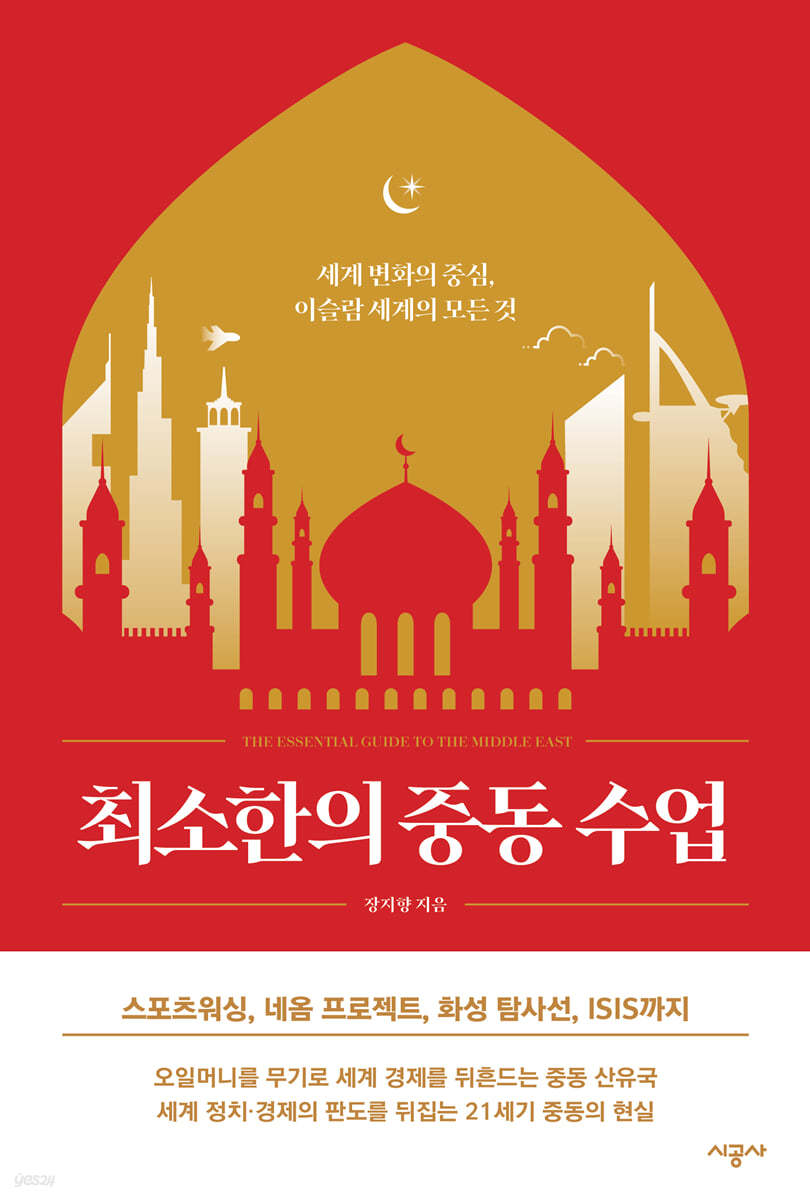
Minimal Middle Eastern classes
 |
Description
Book Introduction
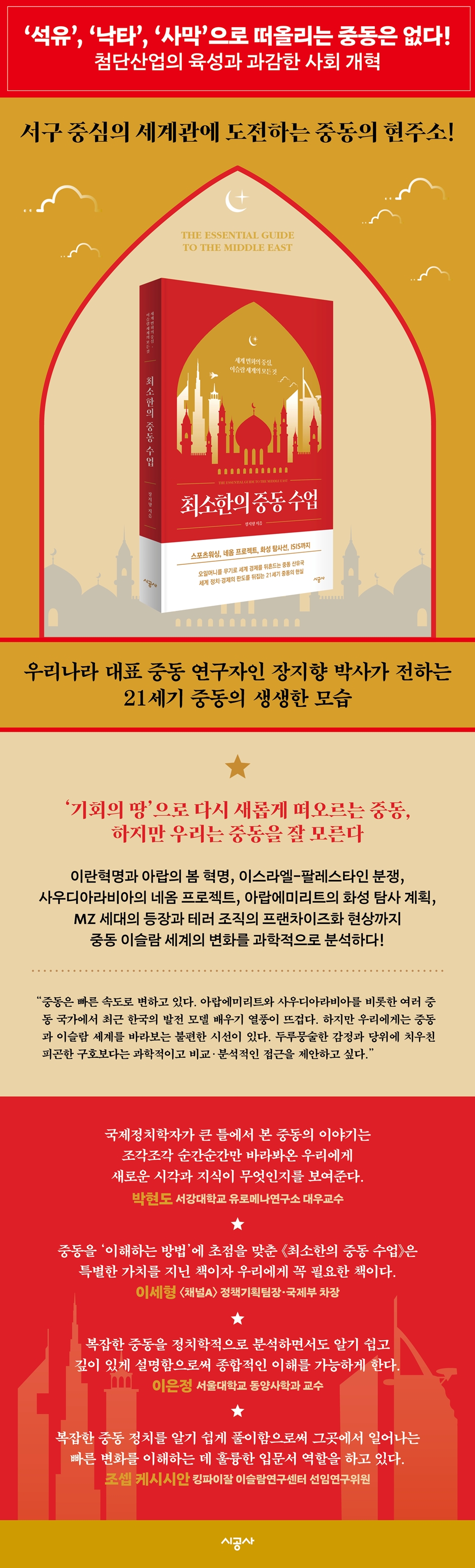
There is no Middle East that comes to mind when you think of 'oil', 'camels', and 'deserts'!
Sports washing, the Neom project, the Mars probe, and even ISIS.
The Reality of the 21st Century Middle East: A World That's Upending the Political and Economic Landscape
Today, the Islamic world of the Middle East is at the center of global change.
Despite the long history of exchanges between us, we still view Middle Eastern Islamic culture as relatively difficult, complex, and unfamiliar compared to other cultures.
Above all, this is largely due to the lack of opportunities for in-depth learning about Islamic culture and the geopolitical characteristics of the Middle East.
In this context, Dr. Jang Ji-hyang's "Minimal Middle East Lessons" will be of great help in comprehensively understanding the Middle Eastern Islamic world.
As our society continues to change, countries in the Middle East are also experiencing changes that can be called 'cataclysmic'.
The Israeli-Palestinian conflict continues, but it appears to be taking on different aspects than in the past.
Many Middle Eastern countries, led by Saudi Arabia in particular, are embarking on radical reforms.
As seen in the Abraham Accords, a strategic alliance is being formed between Israel and Arab states, and yesterday's enemies are becoming today's allies amidst turbulent geopolitical changes.
Behind the changes in the Middle Eastern Islamic world lie the dreams and common sense of the MZ generation in the region.
Compared to the progress made by Western societies, the Middle East is a 'young region' brimming with innovation.
A proper understanding is necessary to discover new opportunities and value in the Middle East going forward.
This book, written by an author who has studied the Middle East for a long time, will be of great help in accurately viewing the reality of the Middle East and predicting its future.
Sports washing, the Neom project, the Mars probe, and even ISIS.
The Reality of the 21st Century Middle East: A World That's Upending the Political and Economic Landscape
Today, the Islamic world of the Middle East is at the center of global change.
Despite the long history of exchanges between us, we still view Middle Eastern Islamic culture as relatively difficult, complex, and unfamiliar compared to other cultures.
Above all, this is largely due to the lack of opportunities for in-depth learning about Islamic culture and the geopolitical characteristics of the Middle East.
In this context, Dr. Jang Ji-hyang's "Minimal Middle East Lessons" will be of great help in comprehensively understanding the Middle Eastern Islamic world.
As our society continues to change, countries in the Middle East are also experiencing changes that can be called 'cataclysmic'.
The Israeli-Palestinian conflict continues, but it appears to be taking on different aspects than in the past.
Many Middle Eastern countries, led by Saudi Arabia in particular, are embarking on radical reforms.
As seen in the Abraham Accords, a strategic alliance is being formed between Israel and Arab states, and yesterday's enemies are becoming today's allies amidst turbulent geopolitical changes.
Behind the changes in the Middle Eastern Islamic world lie the dreams and common sense of the MZ generation in the region.
Compared to the progress made by Western societies, the Middle East is a 'young region' brimming with innovation.
A proper understanding is necessary to discover new opportunities and value in the Middle East going forward.
This book, written by an author who has studied the Middle East for a long time, will be of great help in accurately viewing the reality of the Middle East and predicting its future.
- You can preview some of the book's contents.
Preview
index
Recommendation
Prologue: There is no Middle East as we 'know' it.
Part 1: A Glance at the Complex Realities of the Middle East
Chapter 1: The Middle East: A World of Diverse Ethnicities, Religions, and Sects
Chapter 2: How Do We View the Middle East?
Chapter 3: Analysis of the Middle East: Still 2% Short
Part 2: The World's Eyes on the Middle East
Chapter 1: Gulf Oil-Producing Countries Declaring Radical Reform and Openness
Chapter 2: In the Name of Abraham: Arab-Israeli Détente
Chapter 3: The Regional Hegemony Is Mine
Chapter 4: The Decline of Democracy in the Middle East and American Intervention
Part 3: The Unpredictable Upheaval of the Middle East
Chapter 1: The Dictator's Delusion, the Elite's Change of Heart, the Citizen's Calculation
Chapter 2: The Arab Spring and the Ten Years After
Chapter 3: The Taliban Returns to Power in Afghanistan in 2021
Part 4: The Rise of the MZ Generation and the Transformation of Islamic Terrorist Organizations
Chapter 1: Characteristic Changes in the Islamist Movement
Chapter 2: The Fear of "Terrorism," an Asymmetrical Threat Attack
Chapter 3: Franchising Islamic Terrorist Organizations
Epilogue: The Middle East Problem: It's Not Someone Else's Problem
main
References
Source of the illustration
Prologue: There is no Middle East as we 'know' it.
Part 1: A Glance at the Complex Realities of the Middle East
Chapter 1: The Middle East: A World of Diverse Ethnicities, Religions, and Sects
Chapter 2: How Do We View the Middle East?
Chapter 3: Analysis of the Middle East: Still 2% Short
Part 2: The World's Eyes on the Middle East
Chapter 1: Gulf Oil-Producing Countries Declaring Radical Reform and Openness
Chapter 2: In the Name of Abraham: Arab-Israeli Détente
Chapter 3: The Regional Hegemony Is Mine
Chapter 4: The Decline of Democracy in the Middle East and American Intervention
Part 3: The Unpredictable Upheaval of the Middle East
Chapter 1: The Dictator's Delusion, the Elite's Change of Heart, the Citizen's Calculation
Chapter 2: The Arab Spring and the Ten Years After
Chapter 3: The Taliban Returns to Power in Afghanistan in 2021
Part 4: The Rise of the MZ Generation and the Transformation of Islamic Terrorist Organizations
Chapter 1: Characteristic Changes in the Islamist Movement
Chapter 2: The Fear of "Terrorism," an Asymmetrical Threat Attack
Chapter 3: Franchising Islamic Terrorist Organizations
Epilogue: The Middle East Problem: It's Not Someone Else's Problem
main
References
Source of the illustration
Detailed image
Into the book
Reading the Middle East: Where to Begin? First, the Middle East is diverse and complex.
There are 20 countries in the Middle East, and Arabs, Turks, Persians, Jews, and Kurds live in these countries and practice Islam, Christianity, and Judaism.
Arabs are the majority ethnic group in Tunisia, Egypt, the Palestinian Authority, Iraq, Algeria, Lebanon, Saudi Arabia, the United Arab Emirates, Qatar, Bahrain, Oman, Kuwait, Jordan, Morocco, Syria, Libya, and Yemen.
The Turkic people are the majority in Turkiye, the Persian people are the majority in Iran, the Jewish people are the majority in Israel, and the Kurdish people are a minority within Turkiye, Iran, Iraq, and Syria.
Except for Israel, all countries have a majority Muslim population, but even among Muslims, they are divided into Shia and Sunni.
Israel is a country where the majority of its citizens are Jewish.
Saudi Arabia is a Sunni-dominated country, while Iran is a Shiite-dominated country.
About 40% of Lebanon's population is Christian, and Coptic Christians in Egypt make up 10-15% of the country's population of over 100 million.
Eight countries, including the United Arab Emirates, where skiing in the middle of the desert and the sheer number of dizzying skyscrapers make for a breathtaking sight, still have monarchs.
Among non-monarchical countries, all but Tunisia and Israel are non-democratic.
Among these Middle Eastern countries, Turkey and Saudi Arabia are G20 members.
--- p.23~24
There is a sharp divide in the views on the Middle East, with some claiming that the cause of the endless violence and conflict is 'Islamic culture' itself and others arguing that it is the 'legacy of colonial rule'.
In academic circles, the latter voice is quite loud.
This is a relatable story, as many countries have laid the foundations of modern states under the influence of imperialism, only to suffer the side effects of an oversized state and a weakened civil society.
Even though the new elite after independence restored the colonial era's power structure under the pretext of development and implemented dictatorship, some believe that the original sin lies with imperialism.
Our situation is similar.
The accusation that Islam, the religion of peace, is being misunderstood and the claim that the chaos in the Middle East is a conspiracy of American hegemony and Jewish capital following Anglo-French imperialism are gaining strength.
This view is shared by Edward W.
It relies heavily on Said's Orientalism.
Said, a former professor of English at Columbia University, says that the problems of the Orient, that is, the Middle Eastern Islamic world, are entirely due to imperialism.
Furthermore, he emphasizes that the West intentionally disparaged the Orient and systematized the discipline of Orientalism in order to conceal the destructive conspiracy of imperialism.
Side is on the opposite spectrum from Huntington.
--- p.60
Born in 1985, Crown Prince Mohammed bin Salman, Saudi Arabia's living "absolute ruler," is emerging as a symbol of reform in the Middle East.
Under the Crown Prince's leadership, bold reforms are being implemented at a rapid pace, aiming for industrial diversification and an open society, in response to the crisis facing the oil-dependent economy and the changing perceptions of the younger generation.
The crown prince has removed from the streets the 5,000-strong religious police force that wielded unchecked power to enforce citizens' adherence to Islamic law.
It allowed women to drive, enter soccer stadiums, allow men and women to sit together, screen movies and hold concerts, banned whipping, and discussed abolishing the death penalty.
The new state-run broadcaster covers gay topics and even lifts the ban on dating apps.
For the first time since the founding of the country, taxes were collected and the subsidy system was abolished.
The entire world is competing to win contracts for the Neom project, which the crown prince is ambitiously pursuing.
(…omitted…) However, in relation to the reform of Saudi Arabia’s power, only the domestic social and economic sectors received the spotlight.
In fact, Crown Prince Mohammed bin Salman also announced a groundbreaking shift in foreign policy.
Saudi Arabia faces a security crisis due to the expansionism of Iran, a Shiite powerhouse, and the United States' declaration of a reduced role in the region.
Russia's rising influence and the intensifying US-China competition have also made geopolitical instability more apparent.
The pace of change in the foreign policy environment was much faster than the fiscal pressure caused by low oil prices.
The Crown Prince declared transparent and diverse diplomatic and security prescriptions.
This is a groundbreaking departure for Saudi Arabia, which has insisted on pro-American, backroom diplomacy.
--- p.76~78
The armed conflict between Israel and Palestine rages on almost every year, following a familiar storyline.
Palestinians living in the West Bank and Gaza Strip, or Arab Israeli citizens within Israel, and Palestinian residents of East Jerusalem clash with Israeli military and police.
Using this as an excuse, Hamas, an armed political party on Earth, fires rockets at Israel.
After intercepting most of the rockets, Israel launches a massive airstrike against the Gaza Strip.
Ultimately, there are numerous civilian casualties in Gaza and the international community condemns Israel.
And as usual, the US, Europe and Middle Eastern countries intervene, the two sides agree to a ceasefire, and both Israel and Hamas declare victory.
In 2019, two Palestinian youths were killed by Israeli fire while releasing explosive balloons near the Gaza Strip separation barrier.
In retaliation, Hamas fired 250 rockets, killing four Israeli civilians.
It was the first civilian casualty in Israel since 2014.
Israeli warplanes immediately launched airstrikes, killing 27 Palestinian civilians and militants.
In 2018, Israeli forces opened fire on Palestinian protesters throwing explosives at the Gaza Strip separation barrier, killing 60 of them.
In 2018, more than 1,000 rockets were fired from the Gaza Strip and Israel carried out over 300 airstrikes.
--- p.110~111
In December 2010, Mohamed Bouazizi, a young fruit and vegetable vendor in Sidi Bouzid, a small city in central Tunisia, set himself on fire to protest against the tyranny of corrupt officials.
Bouazizi stopped by city hall to retrieve confiscated street vendor goods, but was so insulted that he could not bear it and set himself on fire in front of the city hall.
Citizens of Sidi Bouzid, who saw the self-immolation scene in a video posted on social media by a cousin, immediately began protesting.
Afterwards, anti-dictatorship protests spread like wildfire across the country and even spread uncontrollably to neighboring countries.
It was the beginning of the Arab Spring revolution.
The dictatorships of Tunisia, Egypt, Libya, Yemen, and Syria were brought to the brink of collapse in the blink of an eye, and the dictators of all four countries except Syria resigned one after another.
Long-term absolute power collapsed in vain before peaceful protesters.
Just like the Iranian Revolution of 1979, no one could have predicted the Arab Spring revolutions of 2011.
As we saw in the previous article on the Iranian Revolution, revolutions are inherently like that.
Arab dictatorships collapsed suddenly, like the French absolute monarchy, the Russian Empire, the Pahlavi dynasty in Iran, and the communist regimes of Eastern Europe.
--- p.194
The attacks outside of northeastern Syria and northwestern Iraq, the strongholds of ISIS leadership and its main organization, are the work of ISIS franchise groups. Not everyone who claims to be ISIS is ISIS.
These franchise groups first committed acts of public property bombing, mass shootings, and "random killings" before declaring allegiance to ISIS.
Shortly after, ISIS's central leadership also confirmed their allegiance and acknowledged their mastermind.
The new self-proclaimed ISIS branch in the Middle East has long existed but has received little attention, borrowing the brand to capitalize on ISIS's popularity.
The same is true for cases outside the Middle East.
It is more like a phenomenon in which anti-social anarchist individuals or organized crime criminals who have been living on the fringes of society in Europe, North America, and the Asia-Pacific region use the ISIS brand for criminal activities.
This franchise phenomenon has little to do with the capabilities of the ISIS organization itself.
In fact, even if a small group of extremist groups commits terrorism first and then claims responsibility for ISIS, ISIS's leadership has nothing to lose.
There are 20 countries in the Middle East, and Arabs, Turks, Persians, Jews, and Kurds live in these countries and practice Islam, Christianity, and Judaism.
Arabs are the majority ethnic group in Tunisia, Egypt, the Palestinian Authority, Iraq, Algeria, Lebanon, Saudi Arabia, the United Arab Emirates, Qatar, Bahrain, Oman, Kuwait, Jordan, Morocco, Syria, Libya, and Yemen.
The Turkic people are the majority in Turkiye, the Persian people are the majority in Iran, the Jewish people are the majority in Israel, and the Kurdish people are a minority within Turkiye, Iran, Iraq, and Syria.
Except for Israel, all countries have a majority Muslim population, but even among Muslims, they are divided into Shia and Sunni.
Israel is a country where the majority of its citizens are Jewish.
Saudi Arabia is a Sunni-dominated country, while Iran is a Shiite-dominated country.
About 40% of Lebanon's population is Christian, and Coptic Christians in Egypt make up 10-15% of the country's population of over 100 million.
Eight countries, including the United Arab Emirates, where skiing in the middle of the desert and the sheer number of dizzying skyscrapers make for a breathtaking sight, still have monarchs.
Among non-monarchical countries, all but Tunisia and Israel are non-democratic.
Among these Middle Eastern countries, Turkey and Saudi Arabia are G20 members.
--- p.23~24
There is a sharp divide in the views on the Middle East, with some claiming that the cause of the endless violence and conflict is 'Islamic culture' itself and others arguing that it is the 'legacy of colonial rule'.
In academic circles, the latter voice is quite loud.
This is a relatable story, as many countries have laid the foundations of modern states under the influence of imperialism, only to suffer the side effects of an oversized state and a weakened civil society.
Even though the new elite after independence restored the colonial era's power structure under the pretext of development and implemented dictatorship, some believe that the original sin lies with imperialism.
Our situation is similar.
The accusation that Islam, the religion of peace, is being misunderstood and the claim that the chaos in the Middle East is a conspiracy of American hegemony and Jewish capital following Anglo-French imperialism are gaining strength.
This view is shared by Edward W.
It relies heavily on Said's Orientalism.
Said, a former professor of English at Columbia University, says that the problems of the Orient, that is, the Middle Eastern Islamic world, are entirely due to imperialism.
Furthermore, he emphasizes that the West intentionally disparaged the Orient and systematized the discipline of Orientalism in order to conceal the destructive conspiracy of imperialism.
Side is on the opposite spectrum from Huntington.
--- p.60
Born in 1985, Crown Prince Mohammed bin Salman, Saudi Arabia's living "absolute ruler," is emerging as a symbol of reform in the Middle East.
Under the Crown Prince's leadership, bold reforms are being implemented at a rapid pace, aiming for industrial diversification and an open society, in response to the crisis facing the oil-dependent economy and the changing perceptions of the younger generation.
The crown prince has removed from the streets the 5,000-strong religious police force that wielded unchecked power to enforce citizens' adherence to Islamic law.
It allowed women to drive, enter soccer stadiums, allow men and women to sit together, screen movies and hold concerts, banned whipping, and discussed abolishing the death penalty.
The new state-run broadcaster covers gay topics and even lifts the ban on dating apps.
For the first time since the founding of the country, taxes were collected and the subsidy system was abolished.
The entire world is competing to win contracts for the Neom project, which the crown prince is ambitiously pursuing.
(…omitted…) However, in relation to the reform of Saudi Arabia’s power, only the domestic social and economic sectors received the spotlight.
In fact, Crown Prince Mohammed bin Salman also announced a groundbreaking shift in foreign policy.
Saudi Arabia faces a security crisis due to the expansionism of Iran, a Shiite powerhouse, and the United States' declaration of a reduced role in the region.
Russia's rising influence and the intensifying US-China competition have also made geopolitical instability more apparent.
The pace of change in the foreign policy environment was much faster than the fiscal pressure caused by low oil prices.
The Crown Prince declared transparent and diverse diplomatic and security prescriptions.
This is a groundbreaking departure for Saudi Arabia, which has insisted on pro-American, backroom diplomacy.
--- p.76~78
The armed conflict between Israel and Palestine rages on almost every year, following a familiar storyline.
Palestinians living in the West Bank and Gaza Strip, or Arab Israeli citizens within Israel, and Palestinian residents of East Jerusalem clash with Israeli military and police.
Using this as an excuse, Hamas, an armed political party on Earth, fires rockets at Israel.
After intercepting most of the rockets, Israel launches a massive airstrike against the Gaza Strip.
Ultimately, there are numerous civilian casualties in Gaza and the international community condemns Israel.
And as usual, the US, Europe and Middle Eastern countries intervene, the two sides agree to a ceasefire, and both Israel and Hamas declare victory.
In 2019, two Palestinian youths were killed by Israeli fire while releasing explosive balloons near the Gaza Strip separation barrier.
In retaliation, Hamas fired 250 rockets, killing four Israeli civilians.
It was the first civilian casualty in Israel since 2014.
Israeli warplanes immediately launched airstrikes, killing 27 Palestinian civilians and militants.
In 2018, Israeli forces opened fire on Palestinian protesters throwing explosives at the Gaza Strip separation barrier, killing 60 of them.
In 2018, more than 1,000 rockets were fired from the Gaza Strip and Israel carried out over 300 airstrikes.
--- p.110~111
In December 2010, Mohamed Bouazizi, a young fruit and vegetable vendor in Sidi Bouzid, a small city in central Tunisia, set himself on fire to protest against the tyranny of corrupt officials.
Bouazizi stopped by city hall to retrieve confiscated street vendor goods, but was so insulted that he could not bear it and set himself on fire in front of the city hall.
Citizens of Sidi Bouzid, who saw the self-immolation scene in a video posted on social media by a cousin, immediately began protesting.
Afterwards, anti-dictatorship protests spread like wildfire across the country and even spread uncontrollably to neighboring countries.
It was the beginning of the Arab Spring revolution.
The dictatorships of Tunisia, Egypt, Libya, Yemen, and Syria were brought to the brink of collapse in the blink of an eye, and the dictators of all four countries except Syria resigned one after another.
Long-term absolute power collapsed in vain before peaceful protesters.
Just like the Iranian Revolution of 1979, no one could have predicted the Arab Spring revolutions of 2011.
As we saw in the previous article on the Iranian Revolution, revolutions are inherently like that.
Arab dictatorships collapsed suddenly, like the French absolute monarchy, the Russian Empire, the Pahlavi dynasty in Iran, and the communist regimes of Eastern Europe.
--- p.194
The attacks outside of northeastern Syria and northwestern Iraq, the strongholds of ISIS leadership and its main organization, are the work of ISIS franchise groups. Not everyone who claims to be ISIS is ISIS.
These franchise groups first committed acts of public property bombing, mass shootings, and "random killings" before declaring allegiance to ISIS.
Shortly after, ISIS's central leadership also confirmed their allegiance and acknowledged their mastermind.
The new self-proclaimed ISIS branch in the Middle East has long existed but has received little attention, borrowing the brand to capitalize on ISIS's popularity.
The same is true for cases outside the Middle East.
It is more like a phenomenon in which anti-social anarchist individuals or organized crime criminals who have been living on the fringes of society in Europe, North America, and the Asia-Pacific region use the ISIS brand for criminal activities.
This franchise phenomenon has little to do with the capabilities of the ISIS organization itself.
In fact, even if a small group of extremist groups commits terrorism first and then claims responsibility for ISIS, ISIS's leadership has nothing to lose.
--- p.262~263
Publisher's Review
The Israeli-Palestinian conflict alone cannot contain
A detailed look at the Middle East in the 21st century!
The Iranian Revolution and the Arab Spring Revolution, the Israeli-Palestinian conflict,
Saudi Arabia's Neom project and the United Arab Emirates' Mars exploration plan
From the emergence of the MZ generation to the transformation of terrorist organizations into franchises.
A vivid picture of the Middle East from Korea's leading Middle East scholar.
These days, the 'Middle East' is becoming a global issue.
Of course, the conflict between Israel and Palestine, which is heading towards war, concerns about the political and military confrontation between Iran and the United States, and the bombing attacks by ISIS in the name of Islamic jihad are not new.
However, changes we could not have predicted include sportswashing, which involves buying famous professional soccer teams and players with massive financial resources, Saudi Arabia's announcement of the Neom project, the United Arab Emirates' plan to explore Mars, and the strategic alliance between Israel and Arab countries through the Abraham Accords.
In this way, the Middle Eastern Islamic world is moving beyond the image of 'oil', 'camels', and 'desert' and establishing itself as the center of global political, economic, and cultural trends.
Armed with the development and promotion of cutting-edge technologies and social reforms based on oil money, they have already begun to crack the Western-centric worldview.
As Middle Eastern Islamic culture, once considered peripheral, enters the center of world culture, understanding the geopolitical specificities and culture of the Middle East is now becoming essential.
Did a democratic revolution take place in an Arab country too?
Our Misconceptions About the Islamic World and the Truth Behind Them
Are you familiar with the "Arab Spring" democratic revolution that occurred in 2011? Unfortunately, most people don't know much about it.
The Arab Spring democratic revolutions that spread like wildfire across the Middle East played a role in overthrowing long-term dictatorships in Arab countries such as Tunisia, Libya, Egypt, Yemen, and Syria.
Of course, Tunisia, the birthplace of the Arab Spring revolution, succeeded in creating a democratic government, while other Arab countries saw the reemergence of military dictatorships or experienced serious civil wars.
Although the Arab Spring revolutions appear to have failed when viewed solely in their final form, their significance lies in the fact that they allowed citizens' expectations for an open society to erupt through the revolutions, and in the fact that they led to the implementation of radical domestic and international reform and openness policies by the Gulf oil-producing monarchies that had suppressed the revolutions.
As the author reveals in "Minimal Middle East Lessons," the Arab Spring revolutions, while still incomplete, have served as a signal to break the long-standing inertia within and outside the Middle East by bringing about change in the Gulf oil-producing countries.
Since the revolutions, the youth of the United Arab Emirates and Saudi Arabia have increasingly shown a preference for individualism and democracy, and in line with this, the two countries have recently declared a new pragmatic course by implementing de-oil and de-Islamic reforms and agreeing to normalize diplomatic relations with Israel.
They also decided to break with the past, when they condoned the incompetence of the Palestinian Authority, the suppression of civil society, the embezzlement of aid funds, and corruption, for emotional reasons, as a fellow Palestinian nation but weaker than Israel.
A careful examination of the Middle East-related content covered in this book will be of great help in understanding the turbulent political climate in the Middle East.
Now, we gather members through the Internet.
The Rise of the MZ Generation and the Franchise of Islamic Terrorist Organizations
The emergence of ISIS in 2014 ushered in the rise of an extremist force that transcended previous generations. The uncontrolled terrorism unleashed by ISIS was a new and dangerous form of terrorism never before seen.
These individuals, who appeared as a corporate terrorist organization, displayed a very cruel side, using terrorism that took innocent lives as if it were a business with the goal of generating profit.
They even committed indiscriminate violence against fellow Sunni Muslims who did not align with them. ISIS is a transnational, multiethnic, and multilingual group characterized by transnationalism. Some of the foreign fighters who flocked to extremist online chatrooms from around the world developed their own Twitter app, produced sophisticated propaganda in English, and indiscriminately distributed it on social media.
In particular, ISIS members are those who have become entangled in extremism online and have joined the group of their own free will, a stark contrast to the past, when the organization's leadership would personally step in and spend a long time carefully selecting and recruiting members.
In this book, the author details the emergence of Hamas, an Islamic radical armed group, and its conflict with Fatah, the largest faction of the Palestine Liberation Organization. He also introduces the characteristics of terrorist organizations that are becoming franchised, unlike in the past, and analyzes the nature and changing aspects of terrorism in detail.
This author's analysis allows us to rethink the origins and causes of increasingly brutal and unpredictable terrorism worldwide.
Is the 'Israel vs. Arab States' conflict a thing of the past?
It captures the rapidly changing face of the Middle East, responding to the demands of the times.
The core conflict in the Islamic world of the Middle East in recent times is the conflict between Sunni and Shia within the Islamic civilization.
As the conflict between Sunni and Shia Muslims intensified, Sunni Arab countries and the Jewish state of Israel signed the Abraham Accords in 2020 to form a strategic alliance to counter the expansionist actions of Shia-majority Iran.
The United Arab Emirates, a leading Abrahamic nation, has a vibrant Jewish community and plans to build a large Hindu temple.
Also, when Libyan dictator Gaddafi bloodily suppressed pro-democracy protests in 2011, the United Arab Emirates actively participated in NATO's 'Operation Odyssey Dawn' to punish Gaddafi, earning the nicknames 'Little Sparta' and 'America's right-hand man' from US and NATO generals.
Saudi Arabia also changed rapidly.
Saudi Arabia's sweeping transformation began in 2016 with the "Vision 2030" reform project announced by then-ruling Crown Prince Mohammed bin Salman.
In 2017, a public concert was held for the first time in 25 years, and in 2018, a movie screening resumed after 35 years, creating a scene where men and women sat side by side and enjoyed the film together.
Not only that, women were allowed to enter soccer stadiums and drive, and religious police, who supervised citizens' adherence to Islamic law in their daily lives, disappeared from the streets.
In 2019, a BTS concert was held in the capital city of Riyadh, drawing envy from young people in neighboring countries.
It is now possible for a female teacher to teach third-grade boys in public elementary schools and for a male coach to coach a tenth-grade girls' basketball team.
The changes in the United Arab Emirates and Saudi Arabia cannot be understood through the conventional perspective of the Middle East.
For a long time, Israel and the rest of the Middle Eastern Islamic world seemed like oil and water, never to be able to reconcile.
However, today's Middle East is changing in line with the changing times, abandoning its unconditional confrontational stance and moving toward a direction that pursues practical interests.
Dr. Jang Ji-hyang, who has studied the Middle East for a long time, provides the most basic and core knowledge for understanding the Middle Eastern Islamic world through “Minimum Middle East Class.”
It covers in detail not only the history and existing evaluations of the Middle East, but also the winds of reform and change currently taking place in the Middle East.
Through the author's scientific, comparative, and analytical writings on the Islamic world of the Middle East, we can move beyond fragmentary understanding and acquire systematic and comprehensive "knowledge."
A detailed look at the Middle East in the 21st century!
The Iranian Revolution and the Arab Spring Revolution, the Israeli-Palestinian conflict,
Saudi Arabia's Neom project and the United Arab Emirates' Mars exploration plan
From the emergence of the MZ generation to the transformation of terrorist organizations into franchises.
A vivid picture of the Middle East from Korea's leading Middle East scholar.
These days, the 'Middle East' is becoming a global issue.
Of course, the conflict between Israel and Palestine, which is heading towards war, concerns about the political and military confrontation between Iran and the United States, and the bombing attacks by ISIS in the name of Islamic jihad are not new.
However, changes we could not have predicted include sportswashing, which involves buying famous professional soccer teams and players with massive financial resources, Saudi Arabia's announcement of the Neom project, the United Arab Emirates' plan to explore Mars, and the strategic alliance between Israel and Arab countries through the Abraham Accords.
In this way, the Middle Eastern Islamic world is moving beyond the image of 'oil', 'camels', and 'desert' and establishing itself as the center of global political, economic, and cultural trends.
Armed with the development and promotion of cutting-edge technologies and social reforms based on oil money, they have already begun to crack the Western-centric worldview.
As Middle Eastern Islamic culture, once considered peripheral, enters the center of world culture, understanding the geopolitical specificities and culture of the Middle East is now becoming essential.
Did a democratic revolution take place in an Arab country too?
Our Misconceptions About the Islamic World and the Truth Behind Them
Are you familiar with the "Arab Spring" democratic revolution that occurred in 2011? Unfortunately, most people don't know much about it.
The Arab Spring democratic revolutions that spread like wildfire across the Middle East played a role in overthrowing long-term dictatorships in Arab countries such as Tunisia, Libya, Egypt, Yemen, and Syria.
Of course, Tunisia, the birthplace of the Arab Spring revolution, succeeded in creating a democratic government, while other Arab countries saw the reemergence of military dictatorships or experienced serious civil wars.
Although the Arab Spring revolutions appear to have failed when viewed solely in their final form, their significance lies in the fact that they allowed citizens' expectations for an open society to erupt through the revolutions, and in the fact that they led to the implementation of radical domestic and international reform and openness policies by the Gulf oil-producing monarchies that had suppressed the revolutions.
As the author reveals in "Minimal Middle East Lessons," the Arab Spring revolutions, while still incomplete, have served as a signal to break the long-standing inertia within and outside the Middle East by bringing about change in the Gulf oil-producing countries.
Since the revolutions, the youth of the United Arab Emirates and Saudi Arabia have increasingly shown a preference for individualism and democracy, and in line with this, the two countries have recently declared a new pragmatic course by implementing de-oil and de-Islamic reforms and agreeing to normalize diplomatic relations with Israel.
They also decided to break with the past, when they condoned the incompetence of the Palestinian Authority, the suppression of civil society, the embezzlement of aid funds, and corruption, for emotional reasons, as a fellow Palestinian nation but weaker than Israel.
A careful examination of the Middle East-related content covered in this book will be of great help in understanding the turbulent political climate in the Middle East.
Now, we gather members through the Internet.
The Rise of the MZ Generation and the Franchise of Islamic Terrorist Organizations
The emergence of ISIS in 2014 ushered in the rise of an extremist force that transcended previous generations. The uncontrolled terrorism unleashed by ISIS was a new and dangerous form of terrorism never before seen.
These individuals, who appeared as a corporate terrorist organization, displayed a very cruel side, using terrorism that took innocent lives as if it were a business with the goal of generating profit.
They even committed indiscriminate violence against fellow Sunni Muslims who did not align with them. ISIS is a transnational, multiethnic, and multilingual group characterized by transnationalism. Some of the foreign fighters who flocked to extremist online chatrooms from around the world developed their own Twitter app, produced sophisticated propaganda in English, and indiscriminately distributed it on social media.
In particular, ISIS members are those who have become entangled in extremism online and have joined the group of their own free will, a stark contrast to the past, when the organization's leadership would personally step in and spend a long time carefully selecting and recruiting members.
In this book, the author details the emergence of Hamas, an Islamic radical armed group, and its conflict with Fatah, the largest faction of the Palestine Liberation Organization. He also introduces the characteristics of terrorist organizations that are becoming franchised, unlike in the past, and analyzes the nature and changing aspects of terrorism in detail.
This author's analysis allows us to rethink the origins and causes of increasingly brutal and unpredictable terrorism worldwide.
Is the 'Israel vs. Arab States' conflict a thing of the past?
It captures the rapidly changing face of the Middle East, responding to the demands of the times.
The core conflict in the Islamic world of the Middle East in recent times is the conflict between Sunni and Shia within the Islamic civilization.
As the conflict between Sunni and Shia Muslims intensified, Sunni Arab countries and the Jewish state of Israel signed the Abraham Accords in 2020 to form a strategic alliance to counter the expansionist actions of Shia-majority Iran.
The United Arab Emirates, a leading Abrahamic nation, has a vibrant Jewish community and plans to build a large Hindu temple.
Also, when Libyan dictator Gaddafi bloodily suppressed pro-democracy protests in 2011, the United Arab Emirates actively participated in NATO's 'Operation Odyssey Dawn' to punish Gaddafi, earning the nicknames 'Little Sparta' and 'America's right-hand man' from US and NATO generals.
Saudi Arabia also changed rapidly.
Saudi Arabia's sweeping transformation began in 2016 with the "Vision 2030" reform project announced by then-ruling Crown Prince Mohammed bin Salman.
In 2017, a public concert was held for the first time in 25 years, and in 2018, a movie screening resumed after 35 years, creating a scene where men and women sat side by side and enjoyed the film together.
Not only that, women were allowed to enter soccer stadiums and drive, and religious police, who supervised citizens' adherence to Islamic law in their daily lives, disappeared from the streets.
In 2019, a BTS concert was held in the capital city of Riyadh, drawing envy from young people in neighboring countries.
It is now possible for a female teacher to teach third-grade boys in public elementary schools and for a male coach to coach a tenth-grade girls' basketball team.
The changes in the United Arab Emirates and Saudi Arabia cannot be understood through the conventional perspective of the Middle East.
For a long time, Israel and the rest of the Middle Eastern Islamic world seemed like oil and water, never to be able to reconcile.
However, today's Middle East is changing in line with the changing times, abandoning its unconditional confrontational stance and moving toward a direction that pursues practical interests.
Dr. Jang Ji-hyang, who has studied the Middle East for a long time, provides the most basic and core knowledge for understanding the Middle Eastern Islamic world through “Minimum Middle East Class.”
It covers in detail not only the history and existing evaluations of the Middle East, but also the winds of reform and change currently taking place in the Middle East.
Through the author's scientific, comparative, and analytical writings on the Islamic world of the Middle East, we can move beyond fragmentary understanding and acquire systematic and comprehensive "knowledge."
GOODS SPECIFICS
- Date of issue: October 20, 2023
- Page count, weight, size: 300 pages | 562g | 152*225*17mm
- ISBN13: 9791171251506
- ISBN10: 1171251505
You may also like
카테고리
korean


korean

![GQ KOREA Mark (Monthly): December [2025]](http://librairie.coreenne.fr/cdn/shop/files/8ef265dbbfbf186523ed75ba7319009d.jpg?v=1765340328&width=3840)


