

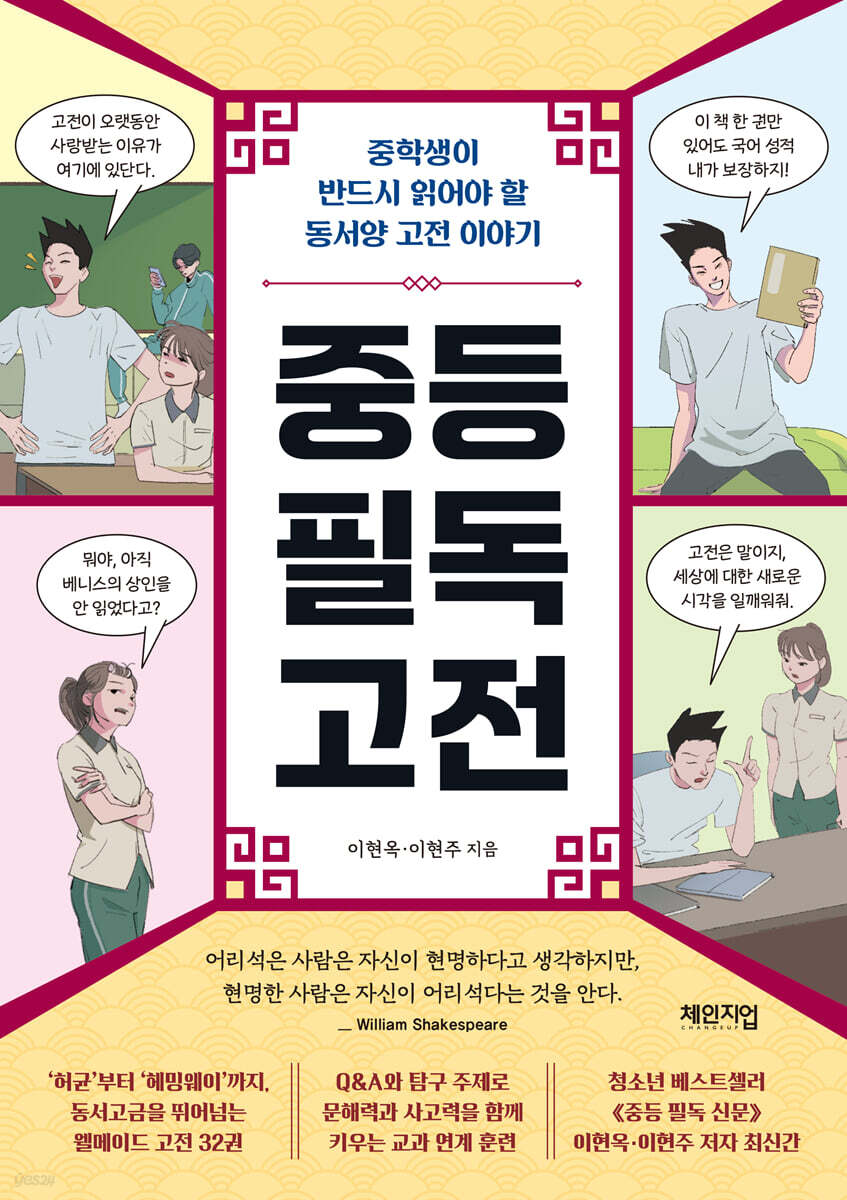
Must-read classics for middle school students
 |
Description
Book Introduction
The future generation led by AI,
32 Humanities Stories AI Will Never Tell
“If you don’t read the classics because they are not fun,
“That’s all for your argument.”
Classics transcend time and culture and have been loved for a long time.
Through classics that blend history, literature, and philosophy, we can glimpse the true meaning and wisdom of life.
Although we still struggle to shake off the stereotype that "classics are difficult," most classic works actually deal with familiar themes such as love, friendship, justice, and the true meaning of life.
In the process of reading and analyzing classics, we gain a new perspective on critically examining human relationships and social phenomena, and furthermore, we are able to cultivate the 'power' of thought.
Curriculum-linked training that simultaneously develops literacy and critical thinking skills
A Selection of Well-Made Classics That Middle School Students Must Read
“Before cultivating media literacy, read the ‘classics’ first!”
Classics are the undisputed 'kings' of old media.
Good classics contain the knowledge and wisdom necessary for living life, as well as many possibilities for what we can do as human beings.
A generation that has not read these classics and has only been exposed to so-called new media will most likely be lost.
Because we lack the ability to decipher it, utilize it, and apply it properly.
This affects education as a whole.
Classics are frequently mentioned in college entrance exams, various written tests, and even in everyday conversations, consistently proving their valid value.
《Middle School Essential Classics》 lowers the barrier to entry to classics and helps improve thinking skills, creativity, and logical thinking.
We must not forget that the true value of 'text heap' begins with the classics.
32 Humanities Stories AI Will Never Tell
“If you don’t read the classics because they are not fun,
“That’s all for your argument.”
Classics transcend time and culture and have been loved for a long time.
Through classics that blend history, literature, and philosophy, we can glimpse the true meaning and wisdom of life.
Although we still struggle to shake off the stereotype that "classics are difficult," most classic works actually deal with familiar themes such as love, friendship, justice, and the true meaning of life.
In the process of reading and analyzing classics, we gain a new perspective on critically examining human relationships and social phenomena, and furthermore, we are able to cultivate the 'power' of thought.
Curriculum-linked training that simultaneously develops literacy and critical thinking skills
A Selection of Well-Made Classics That Middle School Students Must Read
“Before cultivating media literacy, read the ‘classics’ first!”
Classics are the undisputed 'kings' of old media.
Good classics contain the knowledge and wisdom necessary for living life, as well as many possibilities for what we can do as human beings.
A generation that has not read these classics and has only been exposed to so-called new media will most likely be lost.
Because we lack the ability to decipher it, utilize it, and apply it properly.
This affects education as a whole.
Classics are frequently mentioned in college entrance exams, various written tests, and even in everyday conversations, consistently proving their valid value.
《Middle School Essential Classics》 lowers the barrier to entry to classics and helps improve thinking skills, creativity, and logical thinking.
We must not forget that the true value of 'text heap' begins with the classics.
- You can preview some of the book's contents.
Preview
index
Prologue_ The Power of Classics Still Relevant
Chapter 1.
Oriental Classics - Classical Literature
* The Story of Hong Gildong, Heo Gyun
* Guunmong, Kim Man-jung
* Lucky day, Hyun Jin-geon
* When Buckwheat Flowers Bloom, Lee Hyo-seok
* Camellia, Kim Yoo-jung
* Square, Choi In-hoon
* Samdae, Yeom Sang-seop
* Mujin Gihaeng, Kim Seung-ok
Chapter 2.
Eastern Classics - Philosophy and Ethics
* Analects, Confucius
* Mencius, Mencius
* Sunja, Sunja
* Jangja, Jangja
* Tao Te Ching, Lao Tzu
* Samguk Yusa, Ilyeon
* Mokminsimseo, Jeong Yak-yong
* Jeolha Diary, Park Ji-won
Chapter 3.
Western Classics - Classical Literature
* The Little Prince, Saint-Exupéry
* Oedipus the King, Sophocles
* The Merchant of Venice, Shakespeare
* The Old Man and the Sea, Hemingway
* 1984, George Orwell
* Frankenstein, Mary Shelley
* The Death of Ivan Ilyich, Tolstoy
* The Stranger, Albert Camus
Chapter 4.
Western Classics - Philosophy and Ethics
* Discipline and Punish, Foucault
* Dialogues, Plato
* Republic, Plato
* Nicomachean Ethics, Aristotle
* Discourse on Method, Descartes
* Critique of Pure Reason, Kant
* Logic, Hegel
* Being and Nothingness, Sartre
Epilogue_ People I know and people I don't know
Chapter 1.
Oriental Classics - Classical Literature
* The Story of Hong Gildong, Heo Gyun
* Guunmong, Kim Man-jung
* Lucky day, Hyun Jin-geon
* When Buckwheat Flowers Bloom, Lee Hyo-seok
* Camellia, Kim Yoo-jung
* Square, Choi In-hoon
* Samdae, Yeom Sang-seop
* Mujin Gihaeng, Kim Seung-ok
Chapter 2.
Eastern Classics - Philosophy and Ethics
* Analects, Confucius
* Mencius, Mencius
* Sunja, Sunja
* Jangja, Jangja
* Tao Te Ching, Lao Tzu
* Samguk Yusa, Ilyeon
* Mokminsimseo, Jeong Yak-yong
* Jeolha Diary, Park Ji-won
Chapter 3.
Western Classics - Classical Literature
* The Little Prince, Saint-Exupéry
* Oedipus the King, Sophocles
* The Merchant of Venice, Shakespeare
* The Old Man and the Sea, Hemingway
* 1984, George Orwell
* Frankenstein, Mary Shelley
* The Death of Ivan Ilyich, Tolstoy
* The Stranger, Albert Camus
Chapter 4.
Western Classics - Philosophy and Ethics
* Discipline and Punish, Foucault
* Dialogues, Plato
* Republic, Plato
* Nicomachean Ethics, Aristotle
* Discourse on Method, Descartes
* Critique of Pure Reason, Kant
* Logic, Hegel
* Being and Nothingness, Sartre
Epilogue_ People I know and people I don't know
Detailed image

Into the book
During the Joseon Dynasty, Hong Pan-seo had an illegitimate son named Hong Gil-dong who had outstanding abilities.
Gil-dong suffers from discrimination as an illegitimate child, unable to call his father ‘father’ or his older brother ‘brother’.
He learned Taoism from a young age and showed extraordinary abilities, but was unable to use them due to his social status.
Hong Pan-seo's concubine, Cho-ran, fears losing his favor and sends an assassin to kill Gil-dong. Gil-dong, sensing the plot to kill him, leaves home and wanders the world.
Afterwards, he gathered like-minded comrades in the mountains and formed a group of bandits called 'Hwalbindang'.
The Hwalbindang took the wealth of corrupt officials and the rich who had accumulated wealth through illicit means and distributed it to the poor.
Gildong traveled around the eight provinces of the country, fooling government officials with his mysterious abilities such as disguise and clone magic.
--- p.10
Sartre says that we are all thrown into the world 'by chance'.
Rather than being born with a definite meaning or purpose, I believe that each person must first exist and then create the meaning of their life.
Sartre said, “Existence precedes essence,” meaning that the reason for existence and the way of life are not given from the outside, but are formed through one’s own choices and actions.
What is important in existentialism is none other than ‘freedom’ and ‘responsibility’.
Everyone is the master of their own life and faces a crossroads of choice at every moment.
This also means that each and every action becomes one's self.
So existentialism can be burdensome at times, but at the same time it gives us hope that we can live truly free lives.
Because there is no right way to live, freedom can also be fraught with anxiety and loneliness.
--- p.39
《Geumo Shinhwa》 is the first collection of Korean novels written in Chinese characters by Kim Si-seup, a poet and thinker of the early Joseon Dynasty. It contains fantastical and philosophical stories about human desire, morality, fate, and reality.
Each short story in the work vividly depicts the fragility of human nature, the moral confusion of real society, and the conflict between desire and ethics, along with mysterious and strange tales.
The protagonists experience transcendent beings and otherworldly situations, and deeply reflect on the conflict between worldly desires and morality, and ultimately the limits of human existence and salvation.
Both “Sunja” and “Geumo Shinhwa” are similar in that they take human nature, morality, and social norms as their core themes.
Sunja believes that human nature is evil and emphasizes that it must be corrected through external efforts such as education, etiquette, and systems, while Kim Si-seup also realizes problems arising from desire, reality, and the essential limitations of human beings through fictional fantasy and moral reversal.
Both works assume that humans can easily fall into desire or evil, but also open up the possibility of a good life or moral improvement through effort.
--- p.100
The Metamorphoses is an epic poem that encompasses various myths, legends, and heroic tales of ancient Rome.
The work mysteriously weaves together the origins of gods and humans, nature and the human world, the exploits of heroes and the transformation of the universe, and in numerous episodes, human fate and change, love, desire and trials unfold with the motif of dramatic transformation.
Scenes in which gods, heroes, and ordinary people are transformed into animals, plants, stars, rivers, and other things through mystical intervention or their own emotions exemplify the values and imagination of the ancient Western world.
《Samguk Yusa》 and 《Metamorphosis Story》 are similar in that they both bring together various stories, including myths, folktales, and legends, of a people or civilization to reveal the historical and cultural identity and worldview of the time.
It freely crosses the boundaries between sacred beings and humans, legendary lands and everyday life, and is a concentration of imagination and collective memory from East Asia and the West, respectively.
--- p.124
Victor Frankenstein, a talented young scientist, explores the secrets of life.
He challenges the realm of the gods and harbors ambitions to create new life forms by gathering pieces of dead bodies.
Finally, he creates a giant, hideous creature called the 'Monster'.
However, Victor is so horrified by his own creation that he abandons the monster and runs away.
Monsters left alone in the world are constantly rejected and suffer from pain by humans.
The monster learns human language and knowledge, deepening its understanding of the world, but still cannot shake the feeling of abandonment.
The monster seeks out Victor, his creator, and begs him to understand him.
The monster demands that another being like itself be created to free him from his loneliness.
Victor reluctantly begins the second creation, but abandons the plan for fear of creating another monster.
--- p.184
Kant criticizes reason itself to reveal what we can and cannot know.
It aimed to present a new path by criticizing both 'empiricism', which states that knowledge is obtained only from experience, and 'rationalism', which states that knowledge is obtained only from reason.
Kant explains that there are two major factors that influence how we perceive the world.
First, ‘emotion’ is our ability to receive external information through our senses.
But even before we experience anything, we perceive everything within the framework of our minds called ‘time’ and ‘space.’
Time and space do not come from the outside, but are like internal forms that we use to perceive objects.
Second, 'five senses' is the ability to organize and understand the miscellaneous information received through the senses, and conceptually understand the world through 12 rules called 'categories' (e.g., cause and effect, quantity, quality).
--- p.252
Publisher's Review
“How did Camus denounce social injustice?”
“What was the marlin to Hemingway?”
“How would the country have changed if Jeong Yak-yong had been king?”
Another name for study that goes beyond learning,
Pieces of wisdom stolen from intellectuals of the past
Although we live in an era where AI can instantly provide answers to questions, we cannot entrust AI with even the most important decisions in life.
Youth should be at the center of that decision, and if you need wisdom when making choices, let's borrow the power of the classics.
The classics, beloved for hundreds of years and a compass for life, will provide the answer.
It is an old saying that classics do not provide immediate help in education or grades.
If the essay is focused on the subject, it is even more important.
Of course, reading the classics requires time and will.
Because the amount is quite large.
However, if you develop the habit of reading from now on, you will be able to kill two birds with one stone: studying and having fun.
The boundless power of classics to lead the educational environment
Become the 'leading player' of the future as a source of insight!
In the future educational environment, the role of 'reading classics' is expected to become much more important than it is now.
The reason is simple.
Because classics are a ‘source of insight’ that connects the past and the present.
In the AI era, where things change rapidly, not only information and thinking skills but also character education is required.
The life wisdom students gain from classics will be of great help in solving the complex problems of future society.
Moreover, reading classics helps to strengthen the cultural literacy and spirit needed for future generations.
'Reading classics' will become a core liberal arts content in future education and play a crucial role in helping students develop holistically (intellectually, emotionally, and willfully).
“What was the marlin to Hemingway?”
“How would the country have changed if Jeong Yak-yong had been king?”
Another name for study that goes beyond learning,
Pieces of wisdom stolen from intellectuals of the past
Although we live in an era where AI can instantly provide answers to questions, we cannot entrust AI with even the most important decisions in life.
Youth should be at the center of that decision, and if you need wisdom when making choices, let's borrow the power of the classics.
The classics, beloved for hundreds of years and a compass for life, will provide the answer.
It is an old saying that classics do not provide immediate help in education or grades.
If the essay is focused on the subject, it is even more important.
Of course, reading the classics requires time and will.
Because the amount is quite large.
However, if you develop the habit of reading from now on, you will be able to kill two birds with one stone: studying and having fun.
The boundless power of classics to lead the educational environment
Become the 'leading player' of the future as a source of insight!
In the future educational environment, the role of 'reading classics' is expected to become much more important than it is now.
The reason is simple.
Because classics are a ‘source of insight’ that connects the past and the present.
In the AI era, where things change rapidly, not only information and thinking skills but also character education is required.
The life wisdom students gain from classics will be of great help in solving the complex problems of future society.
Moreover, reading classics helps to strengthen the cultural literacy and spirit needed for future generations.
'Reading classics' will become a core liberal arts content in future education and play a crucial role in helping students develop holistically (intellectually, emotionally, and willfully).
GOODS SPECIFICS
- Date of issue: October 29, 2025
- Page count, weight, size: 280 pages | 148*210*20mm
- ISBN13: 9791191378849
- ISBN10: 1191378845
You may also like
카테고리
korean


korean

![GQ KOREA Mark (Monthly): December [2025]](http://librairie.coreenne.fr/cdn/shop/files/8ef265dbbfbf186523ed75ba7319009d.jpg?v=1765340328&width=3840)


