

Cartoon Cut Split Classroom
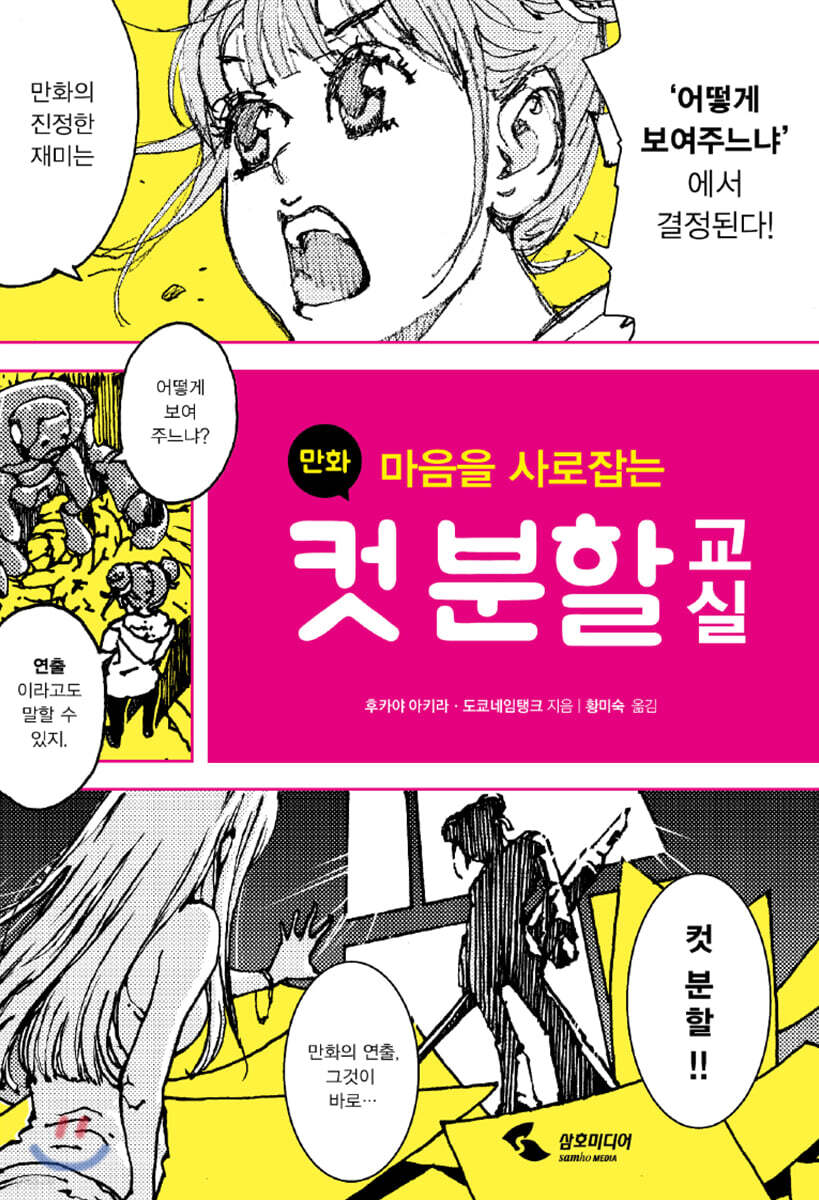 |
Description
Book Introduction
"The Captivating Manga Cut Division Classroom" is an "introductory book on Manga Cut Division" for beginners who are trying their hand at drawing manga for the first time, those who have some experience but still find storyboarding or directing difficult, and those who want to improve their expressiveness and tell stories in a more interesting way.
The author, a skilled cartoonist with 25 years of experience, teaches cut division classes to numerous students at the manga story research institute 'Tokyo Name Tank'.
This book is based on systematically organized materials that cover the core cut-splitting techniques covered in the course, as well as practical training methods implemented in collaboration with students.
The author, a skilled cartoonist with 25 years of experience, teaches cut division classes to numerous students at the manga story research institute 'Tokyo Name Tank'.
This book is based on systematically organized materials that cover the core cut-splitting techniques covered in the course, as well as practical training methods implemented in collaboration with students.
- You can preview some of the book's contents.
Preview
index
Entering _5
▶ Part 1 Basic Techniques for Splitting Cuts
Technique 1: Dividing the Cut _14
A sneak peek into the work of this talented cartoonist with 25 years of experience! _24
Technique 2: Changes in Drawing _26
Technique 3 Angle _30
Technique 4 Perspective _34
Technique 5 Framing _40
Technique 6: Premonitions and Reactions _44
▶ Part 2: Easy-to-understand cut segmentation lesson with examples
About the [Cut Split Space] Course _54
Practical Editing Notes | Dialogue Scene Composition 1: Socks and Shoes _56
Practical Editing Notes | Dialogue Scene Composition 2: Proposal _82
Practical Editing Notes | Dialogue Scene Composition 3 Alone _108
Practical Editing Notes | Action Scene Composition 1: The Girl Who Breaks Plates _134
Practical Editing Notes | Action Scene Composition 2: Abandoned School and Steamed Buns _160
Practical Editing Notes | Action Scene Composition 3: The Witch Teacher _186
Practical Editing Notes | Action Scene Composition 4: Love Letter _212
Practical Editing Notes | Action Scene Composition 5: Ice Cream _246
Let's take on more challenges! _272
▶ Part 3 Before & After: A Pro's Works 20 Years Later
Past Works Editing 1_274
Past Works Editing 2_278
Past Works Editing 3_282
▶ Part 4: Drawing a Short Comic of Two Faces
Drawing two cartoon patterns with one scenario _288
Pattern A _290
Pattern B _294
Commentary on the work _298
Coming out _301
▶ Part 1 Basic Techniques for Splitting Cuts
Technique 1: Dividing the Cut _14
A sneak peek into the work of this talented cartoonist with 25 years of experience! _24
Technique 2: Changes in Drawing _26
Technique 3 Angle _30
Technique 4 Perspective _34
Technique 5 Framing _40
Technique 6: Premonitions and Reactions _44
▶ Part 2: Easy-to-understand cut segmentation lesson with examples
About the [Cut Split Space] Course _54
Practical Editing Notes | Dialogue Scene Composition 1: Socks and Shoes _56
Practical Editing Notes | Dialogue Scene Composition 2: Proposal _82
Practical Editing Notes | Dialogue Scene Composition 3 Alone _108
Practical Editing Notes | Action Scene Composition 1: The Girl Who Breaks Plates _134
Practical Editing Notes | Action Scene Composition 2: Abandoned School and Steamed Buns _160
Practical Editing Notes | Action Scene Composition 3: The Witch Teacher _186
Practical Editing Notes | Action Scene Composition 4: Love Letter _212
Practical Editing Notes | Action Scene Composition 5: Ice Cream _246
Let's take on more challenges! _272
▶ Part 3 Before & After: A Pro's Works 20 Years Later
Past Works Editing 1_274
Past Works Editing 2_278
Past Works Editing 3_282
▶ Part 4: Drawing a Short Comic of Two Faces
Drawing two cartoon patterns with one scenario _288
Pattern A _290
Pattern B _294
Commentary on the work _298
Coming out _301
Detailed image
.jpg)
Publisher's Review
Just by changing the cut division, the comic becomes much more interesting!
More engaging and more fun! The first step to dramatically improving your expressiveness in comics.
A cartoonist with 25 years of experience explains the basics of cut-and-slice techniques and their practical application.
The true fun of comics is determined by 'how it is presented'!
Even if the story is the same and the dialogue is the same, the impression of the cartoon changes dramatically depending on how the cuts are divided.
It means that while 'what is drawn (content)' is important, the fun and charm of the work are greatly influenced by 'how it is shown (directing)'.
“I’m confident in my drawing skills to a certain extent, but it’s so difficult to express them in a cartoon.” “The cartoons always end up focusing on the characters’ faces.” “The story I want to tell isn’t being conveyed well.” These concerns also stem from the lack of skill in dividing the panels.
Let's understand with a simple example.
When you hear someone tell you about something that happened yesterday, the feeling you get from hearing it from a eloquent speaker is quite different from hearing it from someone who is not good at explaining or expressing themselves, even if it is the same event.
Although it is just 'speaking', there is 'direction' in it, such as where and in what order to speak, which parts to omit and which to emphasize, at what speed and with what rich explanation to speak.
And the thing that plays such an important role in comics is ‘cut division.’
Naturally acquire a practical sense of cut segmentation through various training tasks, examples, and expert commentary.
"The Captivating Manga Cut Division Classroom" is an "introductory book on Manga Cut Division" for beginners who are trying their hand at drawing manga for the first time, those who have some experience but still find storyboarding or directing difficult, and those who want to improve their expressiveness and tell stories in a more interesting way.
The author, a skilled cartoonist with 25 years of experience, teaches cut division classes to numerous students at the manga story research institute 'Tokyo Name Tank'.
This book is based on systematically organized materials that cover the core cut-splitting techniques covered in the course, as well as practical training methods implemented in collaboration with students.
Part 1 explains the basics and key points of cut splitting techniques that are good to know in an easy-to-understand manner.
In Part 2, we will introduce various examples of cut segmentation that are more fun and attractive, based on the techniques we have discussed above.
The author included examples of training assignments he conducted in offline classes and actual creative works created by students at the time.
By meticulously analyzing students' work from an expert's perspective, detailed commentary is provided for each cut, and the author's rewritten version reflecting this information is shown, allowing students to learn specific failure patterns and improvement techniques.
We broadened the scope of empathy and understanding through vivid and realistic examples of novice or amateur creators.
Part 3 presents excerpts from the author's work published 20 years ago, rewritten and presented anew, and Part 4 presents two short comics with different directing and development based on a single scenario, utilizing the techniques and know-how we've explored so far.
Unlike other theory-oriented writing books, the greatest strength of "The Captivating Manga Cut Classroom" is that it is a practical book that encourages readers to specifically identify their own shortcomings and improve and develop them.
By actively challenging interesting tasks and encountering various cases and commentary, you will naturally develop a practical sense of how to utilize cut segmentation.
More engaging and more fun! The first step to dramatically improving your expressiveness in comics.
A cartoonist with 25 years of experience explains the basics of cut-and-slice techniques and their practical application.
The true fun of comics is determined by 'how it is presented'!
Even if the story is the same and the dialogue is the same, the impression of the cartoon changes dramatically depending on how the cuts are divided.
It means that while 'what is drawn (content)' is important, the fun and charm of the work are greatly influenced by 'how it is shown (directing)'.
“I’m confident in my drawing skills to a certain extent, but it’s so difficult to express them in a cartoon.” “The cartoons always end up focusing on the characters’ faces.” “The story I want to tell isn’t being conveyed well.” These concerns also stem from the lack of skill in dividing the panels.
Let's understand with a simple example.
When you hear someone tell you about something that happened yesterday, the feeling you get from hearing it from a eloquent speaker is quite different from hearing it from someone who is not good at explaining or expressing themselves, even if it is the same event.
Although it is just 'speaking', there is 'direction' in it, such as where and in what order to speak, which parts to omit and which to emphasize, at what speed and with what rich explanation to speak.
And the thing that plays such an important role in comics is ‘cut division.’
Naturally acquire a practical sense of cut segmentation through various training tasks, examples, and expert commentary.
"The Captivating Manga Cut Division Classroom" is an "introductory book on Manga Cut Division" for beginners who are trying their hand at drawing manga for the first time, those who have some experience but still find storyboarding or directing difficult, and those who want to improve their expressiveness and tell stories in a more interesting way.
The author, a skilled cartoonist with 25 years of experience, teaches cut division classes to numerous students at the manga story research institute 'Tokyo Name Tank'.
This book is based on systematically organized materials that cover the core cut-splitting techniques covered in the course, as well as practical training methods implemented in collaboration with students.
Part 1 explains the basics and key points of cut splitting techniques that are good to know in an easy-to-understand manner.
In Part 2, we will introduce various examples of cut segmentation that are more fun and attractive, based on the techniques we have discussed above.
The author included examples of training assignments he conducted in offline classes and actual creative works created by students at the time.
By meticulously analyzing students' work from an expert's perspective, detailed commentary is provided for each cut, and the author's rewritten version reflecting this information is shown, allowing students to learn specific failure patterns and improvement techniques.
We broadened the scope of empathy and understanding through vivid and realistic examples of novice or amateur creators.
Part 3 presents excerpts from the author's work published 20 years ago, rewritten and presented anew, and Part 4 presents two short comics with different directing and development based on a single scenario, utilizing the techniques and know-how we've explored so far.
Unlike other theory-oriented writing books, the greatest strength of "The Captivating Manga Cut Classroom" is that it is a practical book that encourages readers to specifically identify their own shortcomings and improve and develop them.
By actively challenging interesting tasks and encountering various cases and commentary, you will naturally develop a practical sense of how to utilize cut segmentation.
GOODS SPECIFICS
- Date of publication: July 27, 2020
- Page count, weight, size: 304 pages | 542g | 152*224*30mm
- ISBN13: 9788978496223
- ISBN10: 8978496229
You may also like
카테고리
korean


korean

![GQ KOREA Mark (Monthly): December [2025]](http://librairie.coreenne.fr/cdn/shop/files/8ef265dbbfbf186523ed75ba7319009d.jpg?v=1765340328&width=3840)


