

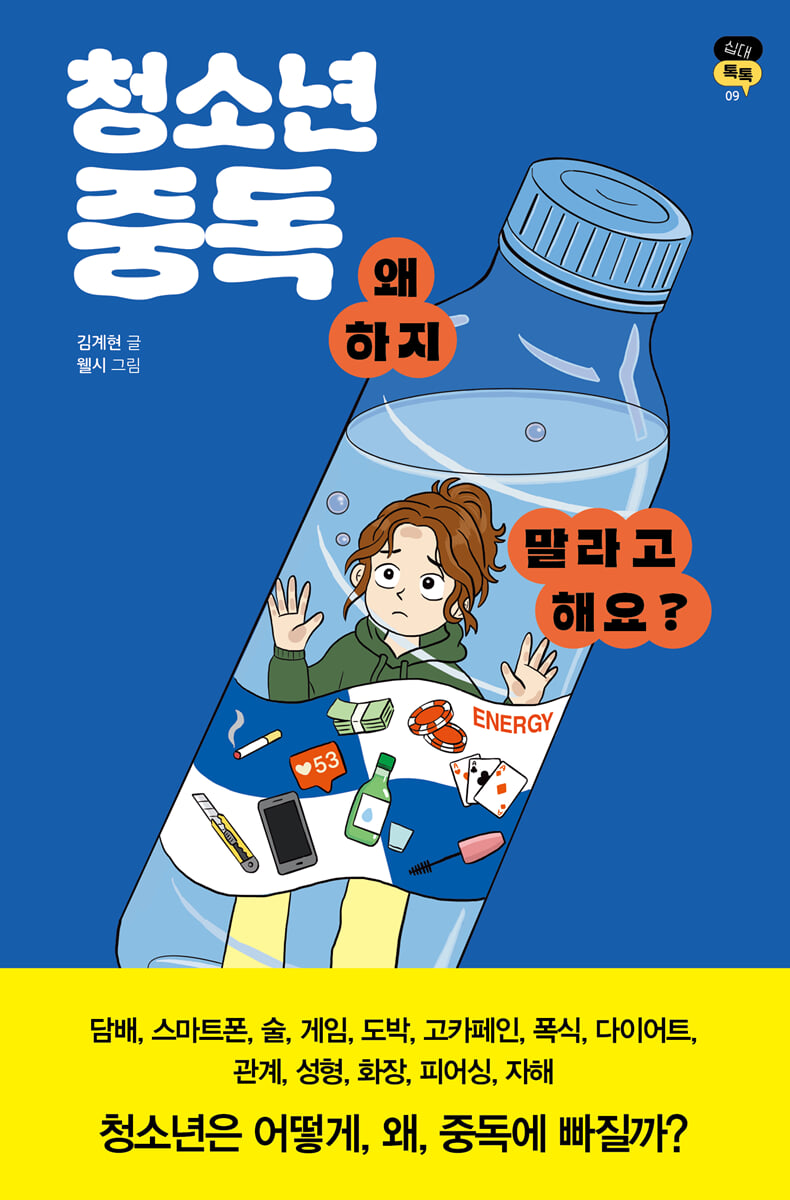
Teen Addiction: Why Don't You?
 |
Description
Book Introduction
How and why do teenagers become addicted?
Smartphone addiction, appearance addiction, cigarette addiction, relationship addiction, self-harm addiction, gambling addiction,
The Reality of Youth Addiction: Digging into Six Types
Is addiction still just an adult problem? Every year, approximately 3,000 teenagers seek treatment for alcohol, drug, gambling, and internet addiction.
But perhaps there are even more young people suffering from addiction problems, left helpless.
Addiction refers to both physical addiction and mental dependence, and addiction among youth is more prominent in behavioral addiction expressed as dependence.
Teenagers are suffering from a variety of behavioral addictions, including excessive piercing, high-caffeine beverage consumption, binge eating and dieting, relationship obsession, plastic surgery or makeup addiction, gambling or theft, and habitual self-harm or suicide attempts.
In 2019, the World Health Organization (WHO) changed its stance from recognizing only food addiction as a disease to also recognizing behavioral addiction (dependent addiction) as a disease.
Behavioral addiction is not only an individual's illness, but also a serious social problem.
This book examines the reality of addiction among youth, explains why people become addicted, and provides detailed methods for overcoming addiction.
This book kindly empowers young people to protect themselves from addiction.
Smartphone addiction, appearance addiction, cigarette addiction, relationship addiction, self-harm addiction, gambling addiction,
The Reality of Youth Addiction: Digging into Six Types
Is addiction still just an adult problem? Every year, approximately 3,000 teenagers seek treatment for alcohol, drug, gambling, and internet addiction.
But perhaps there are even more young people suffering from addiction problems, left helpless.
Addiction refers to both physical addiction and mental dependence, and addiction among youth is more prominent in behavioral addiction expressed as dependence.
Teenagers are suffering from a variety of behavioral addictions, including excessive piercing, high-caffeine beverage consumption, binge eating and dieting, relationship obsession, plastic surgery or makeup addiction, gambling or theft, and habitual self-harm or suicide attempts.
In 2019, the World Health Organization (WHO) changed its stance from recognizing only food addiction as a disease to also recognizing behavioral addiction (dependent addiction) as a disease.
Behavioral addiction is not only an individual's illness, but also a serious social problem.
This book examines the reality of addiction among youth, explains why people become addicted, and provides detailed methods for overcoming addiction.
This book kindly empowers young people to protect themselves from addiction.
- You can preview some of the book's contents.
Preview
index
Entering_Addicted Children
It's fun, but what's the problem? / What exactly is addiction? / Addiction is a spectrum. / The beginning of the solution: Seeing the 'pain', not the 'problem'.
Chapter 1: Smartphone Addiction
Inho, who loves smartphone games / Smartphones, the boundary between possibility and danger / The impact of smartphones on the brain / Smartphone addiction, what we are missing / Smartphones, finding a balance between convenience and dependence / [TokTok Plus] Am I also in the high-risk group? / [TokTok Plus] For parents concerned about smartphone addiction
Chapter 2: Appearance Addiction
Hyemi, who is dissatisfied with her appearance / Is it an interest in appearance or an obsession? / The dangers of obsession with appearance / Why changing your appearance doesn't improve your self-esteem / Practical ways to break free from appearance addiction
Chapter 3: Tobacco Addiction
Seonjae, who repeats regret and self-reproach / Why quitting smoking is difficult / Why smoking by teenagers is especially dangerous / E-cigarettes are not safe either / The best way to quit smoking is not to start / 6 ways to break up with cigarettes / [TokTok Plus] The success rate of quitting smoking increases by 3 times if you get help from an expert
Chapter 4: Relationship Addiction
Minji, struggling between obsession and friendship / Why relationships are important for teenagers / What is relationship addiction / Why are we obsessed with relationships / Creating relationships that are good for both you and me / Practical tips for cherishing myself
Chapter 5: Self-harm addiction
Youngmi's inner feelings hidden under her clothes / The wounds that are visible on the outside, the wounds that are inside / I don't want to die, but when self-harm becomes a habit / How can I stop self-harming?
Chapter 6 Gambling Addiction
Minsu, who fell into gambling thinking it was a game / What is the difference between games and gambling / Gambling, a trap you can fall into without realizing it / Why it's hard to escape once you're hooked on gambling / What should you do?
Going out_Don't you want to create real happiness?
Decide for yourself what life you want
It's fun, but what's the problem? / What exactly is addiction? / Addiction is a spectrum. / The beginning of the solution: Seeing the 'pain', not the 'problem'.
Chapter 1: Smartphone Addiction
Inho, who loves smartphone games / Smartphones, the boundary between possibility and danger / The impact of smartphones on the brain / Smartphone addiction, what we are missing / Smartphones, finding a balance between convenience and dependence / [TokTok Plus] Am I also in the high-risk group? / [TokTok Plus] For parents concerned about smartphone addiction
Chapter 2: Appearance Addiction
Hyemi, who is dissatisfied with her appearance / Is it an interest in appearance or an obsession? / The dangers of obsession with appearance / Why changing your appearance doesn't improve your self-esteem / Practical ways to break free from appearance addiction
Chapter 3: Tobacco Addiction
Seonjae, who repeats regret and self-reproach / Why quitting smoking is difficult / Why smoking by teenagers is especially dangerous / E-cigarettes are not safe either / The best way to quit smoking is not to start / 6 ways to break up with cigarettes / [TokTok Plus] The success rate of quitting smoking increases by 3 times if you get help from an expert
Chapter 4: Relationship Addiction
Minji, struggling between obsession and friendship / Why relationships are important for teenagers / What is relationship addiction / Why are we obsessed with relationships / Creating relationships that are good for both you and me / Practical tips for cherishing myself
Chapter 5: Self-harm addiction
Youngmi's inner feelings hidden under her clothes / The wounds that are visible on the outside, the wounds that are inside / I don't want to die, but when self-harm becomes a habit / How can I stop self-harming?
Chapter 6 Gambling Addiction
Minsu, who fell into gambling thinking it was a game / What is the difference between games and gambling / Gambling, a trap you can fall into without realizing it / Why it's hard to escape once you're hooked on gambling / What should you do?
Going out_Don't you want to create real happiness?
Decide for yourself what life you want
Detailed image

Publisher's Review
▶ It specifically covers the types of addiction that teenagers easily fall into, as well as the causes and processes of addiction.
Games, YouTube, makeup, coffee, alcohol, energy drinks, fast food—the things we enjoy aren't inherently bad.
Being obsessed with something isn't a bad thing in itself.
Having something fun and engaging to do adds vitality to life.
However, if the behavior is repeated mindlessly for fun or to relieve stress, it can become an addiction.
If you can't stop yourself even when you should, if you have trouble maintaining your daily life, and if you have conflicts with people around you and can't break free even when you want to, then you are addicted.
Addiction doesn't happen overnight.
If you repeat certain behaviors, you will reach a serious state without realizing it.
Especially adolescents who are in the process of growing up, often begin addictive behaviors at first simply for fun, out of curiosity, or because their friends are doing it.
You need to know what addiction is and how to become addicted so that you can avoid becoming addicted and, if you become addicted, how to get out of it.
This book provides detailed information on the types of addictions that teenagers easily fall into, as well as the causes and processes of addiction in teenagers.
▶ The author, a youth counselor, included real stories from youth he met in counseling settings.
“I get anxious as exam period approaches.
Then scratch your wrist.
Even when something makes me angry, I scratch my wrist.
“When you feel pain, your mind becomes blank for a moment and you can forget your anxiety.”
“I can’t go out without putting on makeup.
“When I go out with my bare face, I feel naked.”
“At first, it was just curiosity.
“I just followed my friends and smoked a few cigarettes… Now I don’t know if I can quit.”
“We were best friends who got along well with each other.
But now I'm worried that she might hate me and leave me.
“I can’t let go of this obsession.”
The author, a youth counselor and counseling psychology expert, has captured the stories of children he has met in counseling settings in warm and heartfelt prose.
We listen to the pain of these children and provide realistic advice, along with ways for them to overcome their addiction problems on their own.
It provides comfort and courage not only to children struggling with addiction issues, but also to children struggling with various stresses and problems.
The author says that just as countless small choices we make every day add up to create our day, ultimately, our choices determine our lives.
I hope that through this book, young people can decide for themselves what kind of life they want and make choices that will lead them to happiness.
▶ Parents of teenage children can read this book and gain a better understanding of their children.
Self-harm is considered a serious mental illness, but some people self-harm regardless of specific mental health issues.
If you ask teenagers who actually self-harm, many of them will say they choose self-harm as a means of emotional control, such as 'because I feel depressed', 'because I'm in a bad mood', 'just because', or 'to get revenge on a friend who rejected me'.
Teenagers who cannot control their strong emotions choose extreme methods.
People may choose self-harm to gain temporary relief, to confirm their own existence, or when they feel that no one understands their feelings.
Smartphone addiction can be seen as a problem that arose not because of the children's problems, but because of the environment in which they were inevitably exposed to excessive digital devices from a young age and the expansion of the digital content market.
Adolescents with less developed prefrontal cortex are more likely to be driven by impulses or make emotional judgments.
However, if we dismiss the problem of children who are addicted as being due to their weak will, it will only end up breaking their hearts.
A vicious cycle occurs where people label themselves as problem children, find it difficult to endure this state, and fall back into addiction.
This book details the difficult realities and stressful situations that teenagers face.
Parents of teenage children can read this book and gain a better understanding of their children.
Games, YouTube, makeup, coffee, alcohol, energy drinks, fast food—the things we enjoy aren't inherently bad.
Being obsessed with something isn't a bad thing in itself.
Having something fun and engaging to do adds vitality to life.
However, if the behavior is repeated mindlessly for fun or to relieve stress, it can become an addiction.
If you can't stop yourself even when you should, if you have trouble maintaining your daily life, and if you have conflicts with people around you and can't break free even when you want to, then you are addicted.
Addiction doesn't happen overnight.
If you repeat certain behaviors, you will reach a serious state without realizing it.
Especially adolescents who are in the process of growing up, often begin addictive behaviors at first simply for fun, out of curiosity, or because their friends are doing it.
You need to know what addiction is and how to become addicted so that you can avoid becoming addicted and, if you become addicted, how to get out of it.
This book provides detailed information on the types of addictions that teenagers easily fall into, as well as the causes and processes of addiction in teenagers.
▶ The author, a youth counselor, included real stories from youth he met in counseling settings.
“I get anxious as exam period approaches.
Then scratch your wrist.
Even when something makes me angry, I scratch my wrist.
“When you feel pain, your mind becomes blank for a moment and you can forget your anxiety.”
“I can’t go out without putting on makeup.
“When I go out with my bare face, I feel naked.”
“At first, it was just curiosity.
“I just followed my friends and smoked a few cigarettes… Now I don’t know if I can quit.”
“We were best friends who got along well with each other.
But now I'm worried that she might hate me and leave me.
“I can’t let go of this obsession.”
The author, a youth counselor and counseling psychology expert, has captured the stories of children he has met in counseling settings in warm and heartfelt prose.
We listen to the pain of these children and provide realistic advice, along with ways for them to overcome their addiction problems on their own.
It provides comfort and courage not only to children struggling with addiction issues, but also to children struggling with various stresses and problems.
The author says that just as countless small choices we make every day add up to create our day, ultimately, our choices determine our lives.
I hope that through this book, young people can decide for themselves what kind of life they want and make choices that will lead them to happiness.
▶ Parents of teenage children can read this book and gain a better understanding of their children.
Self-harm is considered a serious mental illness, but some people self-harm regardless of specific mental health issues.
If you ask teenagers who actually self-harm, many of them will say they choose self-harm as a means of emotional control, such as 'because I feel depressed', 'because I'm in a bad mood', 'just because', or 'to get revenge on a friend who rejected me'.
Teenagers who cannot control their strong emotions choose extreme methods.
People may choose self-harm to gain temporary relief, to confirm their own existence, or when they feel that no one understands their feelings.
Smartphone addiction can be seen as a problem that arose not because of the children's problems, but because of the environment in which they were inevitably exposed to excessive digital devices from a young age and the expansion of the digital content market.
Adolescents with less developed prefrontal cortex are more likely to be driven by impulses or make emotional judgments.
However, if we dismiss the problem of children who are addicted as being due to their weak will, it will only end up breaking their hearts.
A vicious cycle occurs where people label themselves as problem children, find it difficult to endure this state, and fall back into addiction.
This book details the difficult realities and stressful situations that teenagers face.
Parents of teenage children can read this book and gain a better understanding of their children.
GOODS SPECIFICS
- Date of issue: October 13, 2025
- Page count, weight, size: 192 pages | 294g | 135*205*11mm
- ISBN13: 9791165736828
- ISBN10: 1165736829
You may also like
카테고리
korean


korean

![GQ KOREA Mark (Monthly): December [2025]](http://librairie.coreenne.fr/cdn/shop/files/8ef265dbbfbf186523ed75ba7319009d.jpg?v=1765340328&width=3840)


