

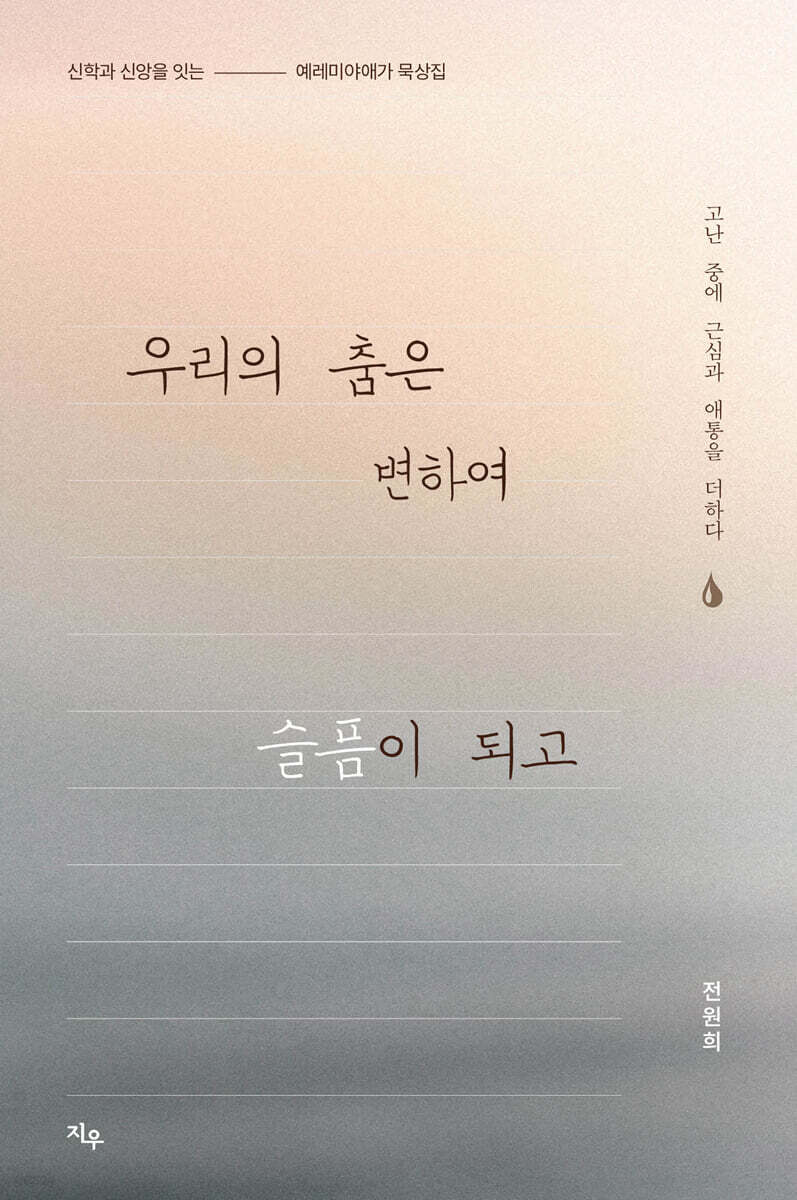
Our dance changes into sorrow
 |
Description
Book Introduction
This is the first book in a series of meditations that connect theology and faith, helping readers meditate on the Book of Lamentations in detail over 40 days. To help readers gain a deeper understanding of the text, it includes original language explanations of important expressions and phrases, contextual interpretations, and the author's guidance to help with application. Based on these, it is structured so that readers can write their own meditations and prayers. Through this book, I hope readers will meditate more deeply on the lamentations filled with sorrow and lamentation, and, as they face their miserable situation, look to God, their only hope. Furthermore, I hope that readers will embody the author's direction and method of meditating on the Bible, and thus be able to move beyond light-hearted meditation to deeper theological contemplation. |
- You can preview some of the book's contents.
Preview
index
Abbreviation Table·································································9
Publisher's Preface··························································10
Author's Preface ································································13
How to Use the Meditation Book····································17
The child begins to meditate·················································19
Lamentations 1
Before Meditating on Chapter 1··················································31
Day 1:1-3································································32
Day 2 1:4-6································································36
Day 3 1:7-9················································40
Day 4 1:10-11·············································44
Day 5 1:12-17·············································48
Day 6 1:18-22································52
Lamentations 2
Before Meditating on Chapter 2··································58
7 days 2:1···················································60
Day 8 2:2-5················································64
9th Day 2:6-10·································68
10th 2:11-13······························72
11th 2:14-17······························76
12th 2:18····························································80
13th 2:19···············································84
14th 2:20-22···········································88
Lamentations 3
Before Meditating on Chapter 3··································95
15th 3:1-3···························································96
16th 3:4-12···········································100
17th 3:13-15············································104
18th 3:16-18············································108
19th 3:19-21······················································112
20th 3:22-24······················································116
21st 3:25-27·········································120
22nd 3:28-30············································124
23rd 3:31-33············································128
24th 3:34-36······················································132
25th 3:37-39············································136
26th 3:40-42·························································140
27th 3:43-45············································144
28th 3:46-51············································148
29th 3:52-56············································152
30th 3:57·············································156
31st 3:58-66············································160
Lamentations 4
Before Meditating on Chapter 4·················· 166
32nd Day 4:1-2··········································· 168
33rd Day 4:3-6············································172
34th Day 4:7-10··········································176
Day 35 4:11-16········································ 180
Day 36 4:17-22········································ 184
Lamentations 5
Before Meditating on Chapter 5···································191
37th Day 5:1-2··········································· 192
38th Day 5:3-6··········································· 196
Day 39 5:7-20··························································200
Day 40 5:21-22············································206
As the child finishes his meditation··················································210
References to Help You Meditate on the Aega························219
Publisher's Preface··························································10
Author's Preface ································································13
How to Use the Meditation Book····································17
The child begins to meditate·················································19
Lamentations 1
Before Meditating on Chapter 1··················································31
Day 1:1-3································································32
Day 2 1:4-6································································36
Day 3 1:7-9················································40
Day 4 1:10-11·············································44
Day 5 1:12-17·············································48
Day 6 1:18-22································52
Lamentations 2
Before Meditating on Chapter 2··································58
7 days 2:1···················································60
Day 8 2:2-5················································64
9th Day 2:6-10·································68
10th 2:11-13······························72
11th 2:14-17······························76
12th 2:18····························································80
13th 2:19···············································84
14th 2:20-22···········································88
Lamentations 3
Before Meditating on Chapter 3··································95
15th 3:1-3···························································96
16th 3:4-12···········································100
17th 3:13-15············································104
18th 3:16-18············································108
19th 3:19-21······················································112
20th 3:22-24······················································116
21st 3:25-27·········································120
22nd 3:28-30············································124
23rd 3:31-33············································128
24th 3:34-36······················································132
25th 3:37-39············································136
26th 3:40-42·························································140
27th 3:43-45············································144
28th 3:46-51············································148
29th 3:52-56············································152
30th 3:57·············································156
31st 3:58-66············································160
Lamentations 4
Before Meditating on Chapter 4·················· 166
32nd Day 4:1-2··········································· 168
33rd Day 4:3-6············································172
34th Day 4:7-10··········································176
Day 35 4:11-16········································ 180
Day 36 4:17-22········································ 184
Lamentations 5
Before Meditating on Chapter 5···································191
37th Day 5:1-2··········································· 192
38th Day 5:3-6··········································· 196
Day 39 5:7-20··························································200
Day 40 5:21-22············································206
As the child finishes his meditation··················································210
References to Help You Meditate on the Aega························219
Into the book
The situation they are in now is because they have sinned greatly… They have sinned not only against God, but also against those who live with them.
By mentioning sin, Lamentations urges Israel to confess their sins.
--- p.41
Jerusalem is pleading with God to see her now.
According to their past experience, salvation came when God saw it--- p. Exodus 2:23-25; 3:7, 9-10.
--- p.46
It seems that until the final judgment came upon Israel, there was one 'corner of faith' in their hearts.
In the text, it is called 'warriors'.
How foolish it is to cling to something so insignificant before the incomparable God. Yet, in reality, we often fail to regard the great God as the One we most rely on.
--- p.51
The poet says that God has covered his daughter Zion with a cloud.
A direct translation of 'covered with a cloud' is 'darkened by his anger.'
Why did God act this way? Several expressions in Lamentations show that what was once a symbol of God's salvation has now become a symbol of judgment.
--- p.61
Israel failed to realize that not hearing God's word was the true end.
Until the very last moment, they were busy making unfair profits.
Meanwhile, all threads of hope that could connect us to God were broken.
We need to reflect on whether our interest is in hearing God's word often.
--- p.71
What if we pause for a moment from praying solely for ourselves and turn our gaze to our surroundings? Aren't there various situations surrounding us that God desperately wants to see? While it's important to examine our personal devotional life, I want to emphasize that opening our eyes to those around us and praying for them is also a form of devotional practice we should have.
--- p.91
A characteristic of Chapter 3 is that, unlike the previous chapters, it features a masculine speaker who switches between the first-person singular and plural.
This is clearly different from the previous one where the speaker was a female poet, a personified Zion.
This may have been a way to show that the suffering Israel was experiencing at the time was shared by everyone by presenting speakers of all genders in a balanced manner.
--- p.95
The Hebrew word 'shevet', translated as 'rod', is the same word as the 'rod' used by the shepherd to protect his sheep in Psalm 23.
In the Psalms this rod is a symbol of grace, but here it becomes a symbol of God's wrath.
--- p.98
The word 'Rahamim' for mercy originally refers to the intestines, the inside, the womb --- p. placenta, the seat of mercy, etc.
Because that is God's heart toward mankind, God has not yet given up on Israel.
If we keep this memory in our hearts, we can remember these characteristics of God.
Because this word implies a sacrifice that must be made by the one who shows mercy.
--- p.117
The fact that God is always watching may seem like a great fear to us, but it also helps us live righteously.
How can we love evil, ignore the wronged, and live in disregard of justice and righteousness when God is watching? Let us never forget that God is always watching us and that we stand before Him.
By mentioning sin, Lamentations urges Israel to confess their sins.
--- p.41
Jerusalem is pleading with God to see her now.
According to their past experience, salvation came when God saw it--- p. Exodus 2:23-25; 3:7, 9-10.
--- p.46
It seems that until the final judgment came upon Israel, there was one 'corner of faith' in their hearts.
In the text, it is called 'warriors'.
How foolish it is to cling to something so insignificant before the incomparable God. Yet, in reality, we often fail to regard the great God as the One we most rely on.
--- p.51
The poet says that God has covered his daughter Zion with a cloud.
A direct translation of 'covered with a cloud' is 'darkened by his anger.'
Why did God act this way? Several expressions in Lamentations show that what was once a symbol of God's salvation has now become a symbol of judgment.
--- p.61
Israel failed to realize that not hearing God's word was the true end.
Until the very last moment, they were busy making unfair profits.
Meanwhile, all threads of hope that could connect us to God were broken.
We need to reflect on whether our interest is in hearing God's word often.
--- p.71
What if we pause for a moment from praying solely for ourselves and turn our gaze to our surroundings? Aren't there various situations surrounding us that God desperately wants to see? While it's important to examine our personal devotional life, I want to emphasize that opening our eyes to those around us and praying for them is also a form of devotional practice we should have.
--- p.91
A characteristic of Chapter 3 is that, unlike the previous chapters, it features a masculine speaker who switches between the first-person singular and plural.
This is clearly different from the previous one where the speaker was a female poet, a personified Zion.
This may have been a way to show that the suffering Israel was experiencing at the time was shared by everyone by presenting speakers of all genders in a balanced manner.
--- p.95
The Hebrew word 'shevet', translated as 'rod', is the same word as the 'rod' used by the shepherd to protect his sheep in Psalm 23.
In the Psalms this rod is a symbol of grace, but here it becomes a symbol of God's wrath.
--- p.98
The word 'Rahamim' for mercy originally refers to the intestines, the inside, the womb --- p. placenta, the seat of mercy, etc.
Because that is God's heart toward mankind, God has not yet given up on Israel.
If we keep this memory in our hearts, we can remember these characteristics of God.
Because this word implies a sacrifice that must be made by the one who shows mercy.
--- p.117
The fact that God is always watching may seem like a great fear to us, but it also helps us live righteously.
How can we love evil, ignore the wronged, and live in disregard of justice and righteousness when God is watching? Let us never forget that God is always watching us and that we stand before Him.
--- p.135
Publisher's Review
“Our heart has ceased from joy; our dancing has been turned into mourning” (Lamentations 5:15).
I spent some time thinking about the title before publication.
At first, I was thinking of a unique and provocative title.
I looked for so-called "keywords" that were frequently searched, and I also searched in fields with many unique and eye-catching titles, such as essays and self-help books.
But it didn't come out as well as I thought.
Then, recalling the original intent of the publication—to “make readers face their own misery and add to it their own worries and sorrows”—I turned my attention back to the text and manuscript, determined to find a title that embodied that intent.
The title I came across at that time was 'Our dance changes and becomes sadness'.
The suffering that appears in the song is indescribably miserable.
The temple was conquered and everything in it was plundered (chapters 1-2).
Young children suffer and die in their mothers' arms from hunger (2:11-12).
It even gets to the point where parents, unable to bear the hunger, eat their own children (2:20).
Their situation was so cruel and miserable that it was said that it was better to die by the sword than by hunger (4:9).
It is only natural to lament and sigh in such a miserable situation.
Perhaps at first, it was just a sigh of frustration and anger, feeling resentful and wronged, without even knowing what was going on.
But now, in the heart of the poet who sings the lament, the realization that this is because of his own sin begins to take hold.
The poet's confession, such as "He has bound and entangled the yoke of my iniquities with his hand" (1:14), "I have rebelled against his commandment" (1:18), and "My rebellion is very great" (1:20), reaches its climax in chapter 3, "I am he who has suffered by the rod of the Lord's anger" (3:1).
There is no hopeful conclusion to the elegy.
I just cry.
We continue to petition and seek God's mercy.
And finally, the poet of Lament confesses his sins to God.
After this, Israel was scattered and God was silent for hundreds of years.
Instead, God responded by helping Israel recognize who they were and who God was.
This is precisely why I hope that through this book, readers will face their own misery and be filled with worry and sorrow.
The ability to mourn and lament over ourselves is a grace that God bestows upon us.
It's a wonderfully positive time, where your grief can be shared on the internet and social media, and within minutes, you can be comforted by dozens or even hundreds of people.
We live in a time when sadness evaporates faster than ever.
For us, who are filled with hope and positivity, there is no room for sorrow and lamentation.
I simply hope that the theology of lament contained in this book and the method and flow of meditation guided by the author will be of some help in our mourning and lamentation toward God.
We have also provided a space for personal records, so we encourage you to fill it with your own interpretations, meditations, and prayers.
I hope that readers will meditate on the Lamentations, create a space of sorrow and lament, and fill that space with the peace and rest that God gives.
jiwoo
I spent some time thinking about the title before publication.
At first, I was thinking of a unique and provocative title.
I looked for so-called "keywords" that were frequently searched, and I also searched in fields with many unique and eye-catching titles, such as essays and self-help books.
But it didn't come out as well as I thought.
Then, recalling the original intent of the publication—to “make readers face their own misery and add to it their own worries and sorrows”—I turned my attention back to the text and manuscript, determined to find a title that embodied that intent.
The title I came across at that time was 'Our dance changes and becomes sadness'.
The suffering that appears in the song is indescribably miserable.
The temple was conquered and everything in it was plundered (chapters 1-2).
Young children suffer and die in their mothers' arms from hunger (2:11-12).
It even gets to the point where parents, unable to bear the hunger, eat their own children (2:20).
Their situation was so cruel and miserable that it was said that it was better to die by the sword than by hunger (4:9).
It is only natural to lament and sigh in such a miserable situation.
Perhaps at first, it was just a sigh of frustration and anger, feeling resentful and wronged, without even knowing what was going on.
But now, in the heart of the poet who sings the lament, the realization that this is because of his own sin begins to take hold.
The poet's confession, such as "He has bound and entangled the yoke of my iniquities with his hand" (1:14), "I have rebelled against his commandment" (1:18), and "My rebellion is very great" (1:20), reaches its climax in chapter 3, "I am he who has suffered by the rod of the Lord's anger" (3:1).
There is no hopeful conclusion to the elegy.
I just cry.
We continue to petition and seek God's mercy.
And finally, the poet of Lament confesses his sins to God.
After this, Israel was scattered and God was silent for hundreds of years.
Instead, God responded by helping Israel recognize who they were and who God was.
This is precisely why I hope that through this book, readers will face their own misery and be filled with worry and sorrow.
The ability to mourn and lament over ourselves is a grace that God bestows upon us.
It's a wonderfully positive time, where your grief can be shared on the internet and social media, and within minutes, you can be comforted by dozens or even hundreds of people.
We live in a time when sadness evaporates faster than ever.
For us, who are filled with hope and positivity, there is no room for sorrow and lamentation.
I simply hope that the theology of lament contained in this book and the method and flow of meditation guided by the author will be of some help in our mourning and lamentation toward God.
We have also provided a space for personal records, so we encourage you to fill it with your own interpretations, meditations, and prayers.
I hope that readers will meditate on the Lamentations, create a space of sorrow and lament, and fill that space with the peace and rest that God gives.
jiwoo
GOODS SPECIFICS
- Date of issue: February 12, 2024
- Page count, weight, size: 224 pages | 280g | 125*188*20mm
- ISBN13: 9791193664018
- ISBN10: 1193664012
You may also like
카테고리
korean


korean

![GQ KOREA Mark (Monthly): December [2025]](http://librairie.coreenne.fr/cdn/shop/files/8ef265dbbfbf186523ed75ba7319009d.jpg?v=1765340328&width=3840)


