

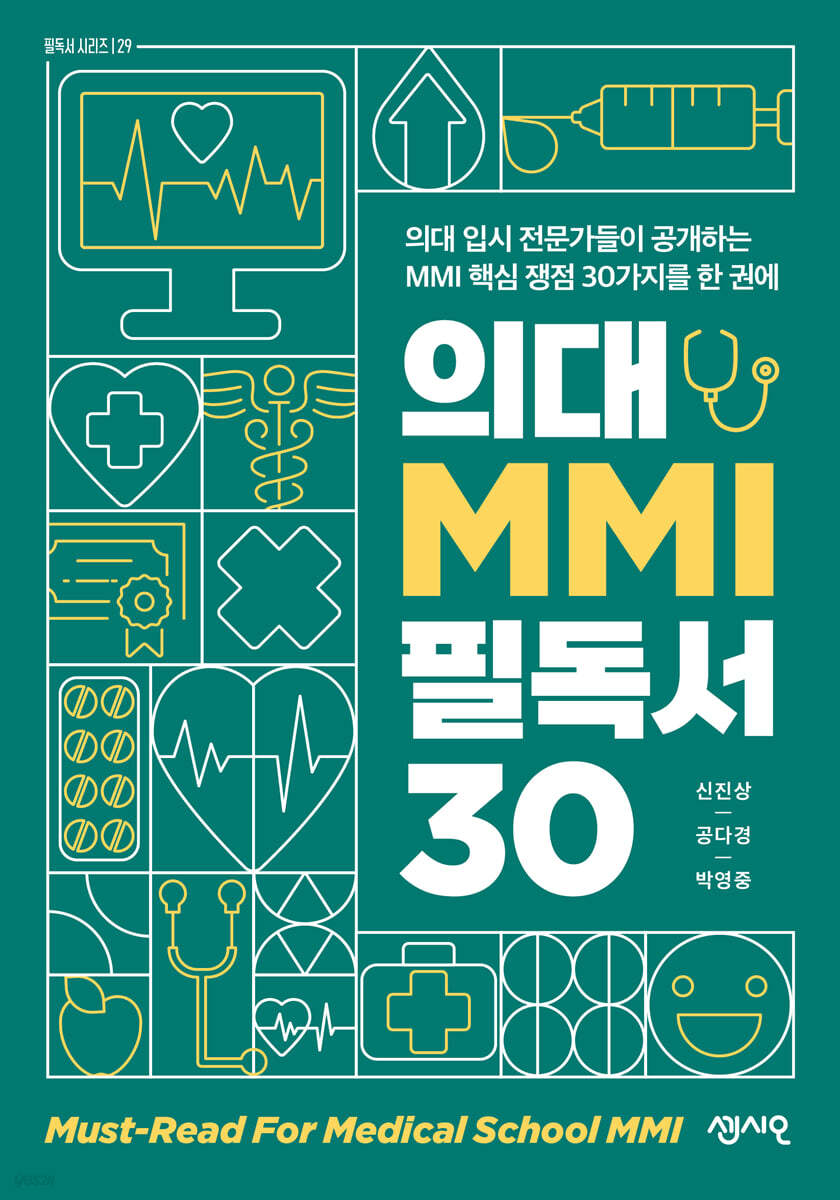
30 Must-Read Books for Medical School MMI
 |
Description
Book Introduction
The most reliable roadmap to overcoming the MMI, the final hurdle to medical school acceptance.
How to conquer MMI with 30 key issues!
After the 2025 medical school entrance exam, which was noisy due to the expansion of the recruitment quota, the recruitment quota for the 2026 school year has returned to the level before the increase.
But whether the number of medical school seats increases or decreases, the important thing does not change.
Medical school entrance exams are always difficult.
At the heart of this cause is the MMI (Medical School Aptitude Test).
The MMI, administered by Korea's top medical schools, including Seoul National University, Yonsei University, and Korea University, is an interview exam that evaluates the multifaceted qualities required of future medical professionals.
This is a difficult test to handle with simple memorization of knowledge or formulated answers, as it requires a high level of communication skills to logically organize and clearly convey one's thoughts in a short period of time regarding unfamiliar situations or dilemmas that were not learned in school or academies.
"30 Must-Read Medical School MMI Books" is a book that presents a roadmap for passing the medical school entrance exam through 30 must-read medical school books and 30 key MMI issues extracted from them.
The book was written by the top medical school consultant in Korea, Shin Jin-sang, who has produced over 1,000 medical school admissions candidates, Gong Da-kyung, an admissions expert who has experience in both advanced studies and multidisciplinary education, and Park Young-joong, an AI expert with a PhD in brain science who is currently working as an admissions consultant.
These three admissions experts thoroughly analyze numerous MMI question types, dividing them into six categories (ethical dilemmas, empathy and understanding, communication skills, humanities knowledge, current medical issues, and the future of artificial intelligence and medicine). They then present 30 key issues based on these categories through 30 must-read books, thereby uncovering the essence of MMI.
MMI is by no means a formal test.
Getting one question wrong on the CSAT won't guarantee you'll fail your medical school application, but one mistake during the MMI interview could lead to your failure.
To pass the MMI, which tests whether you have the qualities of a cool-headed medical professional with a warm humanity and logical thinking, you must accumulate consistent reading experience.
This book will serve as an optimal reference for medical school applicants, helping them develop the ability to logically express their opinions without being flustered by any question, based on their own strong arguments.
How to conquer MMI with 30 key issues!
After the 2025 medical school entrance exam, which was noisy due to the expansion of the recruitment quota, the recruitment quota for the 2026 school year has returned to the level before the increase.
But whether the number of medical school seats increases or decreases, the important thing does not change.
Medical school entrance exams are always difficult.
At the heart of this cause is the MMI (Medical School Aptitude Test).
The MMI, administered by Korea's top medical schools, including Seoul National University, Yonsei University, and Korea University, is an interview exam that evaluates the multifaceted qualities required of future medical professionals.
This is a difficult test to handle with simple memorization of knowledge or formulated answers, as it requires a high level of communication skills to logically organize and clearly convey one's thoughts in a short period of time regarding unfamiliar situations or dilemmas that were not learned in school or academies.
"30 Must-Read Medical School MMI Books" is a book that presents a roadmap for passing the medical school entrance exam through 30 must-read medical school books and 30 key MMI issues extracted from them.
The book was written by the top medical school consultant in Korea, Shin Jin-sang, who has produced over 1,000 medical school admissions candidates, Gong Da-kyung, an admissions expert who has experience in both advanced studies and multidisciplinary education, and Park Young-joong, an AI expert with a PhD in brain science who is currently working as an admissions consultant.
These three admissions experts thoroughly analyze numerous MMI question types, dividing them into six categories (ethical dilemmas, empathy and understanding, communication skills, humanities knowledge, current medical issues, and the future of artificial intelligence and medicine). They then present 30 key issues based on these categories through 30 must-read books, thereby uncovering the essence of MMI.
MMI is by no means a formal test.
Getting one question wrong on the CSAT won't guarantee you'll fail your medical school application, but one mistake during the MMI interview could lead to your failure.
To pass the MMI, which tests whether you have the qualities of a cool-headed medical professional with a warm humanity and logical thinking, you must accumulate consistent reading experience.
This book will serve as an optimal reference for medical school applicants, helping them develop the ability to logically express their opinions without being flustered by any question, based on their own strong arguments.
- You can preview some of the book's contents.
Preview
index
introduction
How can I ensure I pass the MMI, the hurdle I must overcome to get into medical school?
PART1.
The key to passing medical school: how to prepare perfectly for the MMI
Know MMI to win at MMI
Develop your skills by type
Logical and multi-layered capabilities lead to passing.
Successful applicants answer like this
Answers you shouldn't give, attitudes you should avoid
Fundamental reading experience is important, not superficial answers and memorization.
PART2.
Key MMI Issues by Type
chapter1.
ethical dilemma
BOOK 1.
The Doctor's Dilemma - George Bernard Shaw
Limited medical resources: how should they be distributed?
BOOK 2.
"I Visited a Euthanasia Site in Switzerland" - Shin A-yeon
In search of the right to decide on a dignified death
BOOK 3.
Equity in the Distribution of Medical Services - Jang Dong-min
Limited medical resources and justice in distribution
BOOK 4.
The Vaccine Betrayal - Robert F.
Kennedy Jr.
Individuals' right to make treatment decisions in the face of vaccine risks
BOOK 5.
Bioethics -, Kim Jae-hee et al.
Cutting-edge life science technology: between hope and concern
Chapter 2.
Empathy and understanding skills
BOOK 6.
The Empathetic Gene - Joachim Bauer
The selfish gene? No, the empathetic gene!
BOOK 7.
The Best Pain - Paul Bloom,
How Pain Enriches Our Lives
BOOK 8.
Letters to My Palestinian Neighbors - Yossi Klein Halevi
The possibility of difficult but meaningful communication
BOOK 9.
『White』 - Han River
The inner strength to heal one's own sense of loss
BOOK 10.
What is a Doctor? - Yang Eok-gwan
The inner strength to heal one's own sense of loss
Chapter 3.
communication skills
BOOK 11.
"So I Chose Life Again" - Choi Ji-eun
Words to life from the brink of death
BOOK 12.
The Distrusted Word - Deborah Turkheimer
For true communication that transcends power relations
BOOK 13.
The Resurrection of Teamwork - Patrick Lencioni
Key Principles for Building Teamwork
BOOK 14.
Fake and Fact - David Robert Grimes
Beyond cognitive biases and logical errors, into the world of facts.
BOOK 15.
The Healing Mind - Jerome Groopman and Pamela Hartzband
A doctor's "healing heart" reads the patient's "medical mind."
Chapter 4.
humanities knowledge
BOOK 16.
The Recovering Human - Han Kang
Understanding the primal suffering of human beings
BOOK 17.
『The Will Note』 - Yoo Seong-ho
Affirming life by facing death
BOOK 18.
Philosophy of Medicine - Choi Jong-deok
Beyond medicine and science, towards humanities
BOOK 19.
Death is Not a Straight Line - Kim Beom-seok
Philosophical reflections on life and death
BOOK 20.
Meaning, Between Medicine and Art - Jeon Ju-hong and Choi Byeong-jin
How Medicine and Art Intersect
Chapter 5.
Medical News
BOOK 21.
The Economics of Your Medical Chart - Anupam B.
Jenna et al.
Why Medical Practices So Often Become Irrational
BOOK 22.
『Clinic Capitalism』 - Jeon Young-woong
The power of money to drive healthcare
BOOK 23.
Social Immunity - Roberto Esposito
Uncovering the Truth About Social Immune Systems Through Epidemics
BOOK 24.
Conceptual Medicine - Jaeyoung Park
How Doctors Are Wasteful in Korea's Healthcare System
BOOK 25.
The Age of Medical Disaster - Na Baek-ju and Jeong Hyeong-jun
How Politics Causes Medical Disasters
Chapter 6.
Artificial Intelligence and the Future of Medicine
BOOK 26.
Moral AI - Walter Sinnet Armstrong et al.
For the ethical coexistence of humans and AI
BOOK 27.
Explainable Medical AI - Sangmin Park
How to address AI misdiagnosis
BOOK 28.
AI 2025 Trends & Application Encyclopedia - Kim Deok-jin
A Guide for Those Who Want to Master AI
BOOK 29.
Emergency Room Robot Doctor - Yoon Yeo-kyung and Jung Ji-hoon
A complex and profound story unfolding between AI doctors and human doctors.
BOOK 30.
"I'm Going to the Hospital of the Future" - Kim Young-hoon
Dreaming of a shift in the innovative medical paradigm
How can I ensure I pass the MMI, the hurdle I must overcome to get into medical school?
PART1.
The key to passing medical school: how to prepare perfectly for the MMI
Know MMI to win at MMI
Develop your skills by type
Logical and multi-layered capabilities lead to passing.
Successful applicants answer like this
Answers you shouldn't give, attitudes you should avoid
Fundamental reading experience is important, not superficial answers and memorization.
PART2.
Key MMI Issues by Type
chapter1.
ethical dilemma
BOOK 1.
The Doctor's Dilemma - George Bernard Shaw
Limited medical resources: how should they be distributed?
BOOK 2.
"I Visited a Euthanasia Site in Switzerland" - Shin A-yeon
In search of the right to decide on a dignified death
BOOK 3.
Equity in the Distribution of Medical Services - Jang Dong-min
Limited medical resources and justice in distribution
BOOK 4.
The Vaccine Betrayal - Robert F.
Kennedy Jr.
Individuals' right to make treatment decisions in the face of vaccine risks
BOOK 5.
Bioethics -, Kim Jae-hee et al.
Cutting-edge life science technology: between hope and concern
Chapter 2.
Empathy and understanding skills
BOOK 6.
The Empathetic Gene - Joachim Bauer
The selfish gene? No, the empathetic gene!
BOOK 7.
The Best Pain - Paul Bloom,
How Pain Enriches Our Lives
BOOK 8.
Letters to My Palestinian Neighbors - Yossi Klein Halevi
The possibility of difficult but meaningful communication
BOOK 9.
『White』 - Han River
The inner strength to heal one's own sense of loss
BOOK 10.
What is a Doctor? - Yang Eok-gwan
The inner strength to heal one's own sense of loss
Chapter 3.
communication skills
BOOK 11.
"So I Chose Life Again" - Choi Ji-eun
Words to life from the brink of death
BOOK 12.
The Distrusted Word - Deborah Turkheimer
For true communication that transcends power relations
BOOK 13.
The Resurrection of Teamwork - Patrick Lencioni
Key Principles for Building Teamwork
BOOK 14.
Fake and Fact - David Robert Grimes
Beyond cognitive biases and logical errors, into the world of facts.
BOOK 15.
The Healing Mind - Jerome Groopman and Pamela Hartzband
A doctor's "healing heart" reads the patient's "medical mind."
Chapter 4.
humanities knowledge
BOOK 16.
The Recovering Human - Han Kang
Understanding the primal suffering of human beings
BOOK 17.
『The Will Note』 - Yoo Seong-ho
Affirming life by facing death
BOOK 18.
Philosophy of Medicine - Choi Jong-deok
Beyond medicine and science, towards humanities
BOOK 19.
Death is Not a Straight Line - Kim Beom-seok
Philosophical reflections on life and death
BOOK 20.
Meaning, Between Medicine and Art - Jeon Ju-hong and Choi Byeong-jin
How Medicine and Art Intersect
Chapter 5.
Medical News
BOOK 21.
The Economics of Your Medical Chart - Anupam B.
Jenna et al.
Why Medical Practices So Often Become Irrational
BOOK 22.
『Clinic Capitalism』 - Jeon Young-woong
The power of money to drive healthcare
BOOK 23.
Social Immunity - Roberto Esposito
Uncovering the Truth About Social Immune Systems Through Epidemics
BOOK 24.
Conceptual Medicine - Jaeyoung Park
How Doctors Are Wasteful in Korea's Healthcare System
BOOK 25.
The Age of Medical Disaster - Na Baek-ju and Jeong Hyeong-jun
How Politics Causes Medical Disasters
Chapter 6.
Artificial Intelligence and the Future of Medicine
BOOK 26.
Moral AI - Walter Sinnet Armstrong et al.
For the ethical coexistence of humans and AI
BOOK 27.
Explainable Medical AI - Sangmin Park
How to address AI misdiagnosis
BOOK 28.
AI 2025 Trends & Application Encyclopedia - Kim Deok-jin
A Guide for Those Who Want to Master AI
BOOK 29.
Emergency Room Robot Doctor - Yoon Yeo-kyung and Jung Ji-hoon
A complex and profound story unfolding between AI doctors and human doctors.
BOOK 30.
"I'm Going to the Hospital of the Future" - Kim Young-hoon
Dreaming of a shift in the innovative medical paradigm
Detailed image

Into the book
This book argues that reading is more important than speaking practice in order to most effectively prepare for the difficult MMI.
You need to build up your basic physical strength through reading. Learning at an academy in a short period of time will never improve your skills.
While writing this book, I compiled the books I've actually used in my classes while guiding and consulting students preparing for medical school, as well as newly released books that are ideal for medical school interviews, to select a total of 30 must-read books.
From the perspective of a medical school applicant, we introduce the book's content and topics, present MMI issues that may appear in actual medical school interviews, and provide model answers that can lead to good results.
--- p.5
This book will provide you with the most reliable and fundamental mountaineering gear to conquer the massive mountain called MMI.
Rather than following the paths laid out by others, we will help you develop your own logic that will remain unshaken by any question by reading books on a variety of topics in depth and fostering the power of independent thought.
--- p.7
This is a sophisticated interview method designed to comprehensively and in-depth evaluate the various competencies behind an applicant's academic achievements during the selection process for professional positions, including medical schools.
The purpose is to go beyond simply verifying knowledge and evaluate the multifaceted qualities that future medical professionals must possess, including character, empathy, communication skills, ethical judgment, critical thinking, problem-solving skills, and humanities knowledge.
--- p.16~17
Seoul National University's MMI is characterized by its assessment of basic communication skills, ethical judgment, and problem-solving abilities, as well as humanities literacy, stress tests in unexpected situations, and adaptability to random situations.
It also mentions that “the distance between texts such as pictures, statistics, photos, and dialogues and the patient is measured,” which can be seen as meaning that it goes beyond simply understanding the data and places importance on how to empathize and interpret such data in a human context, especially in the relationship with the patient.
--- p.24
The MMI is not simply a test to select students with extensive knowledge or fluency. It's crucial to understand that it's a sophisticated assessment process designed to identify individuals who possess the right character, values, empathy, communication skills, and the potential for continuous reflection and development—those who can positively impact patients, colleagues, and society as future medical professionals.
To become such a person, one must be born with a good personality and communication skills or acquire them later in life through reading.
--- p.33
At Seoul National University Medical School's MMI, it is crucial for applicants to actively promote their potential and prepared capabilities, while also avoiding any specific tendencies or attitudes that could be deemed unsuitable for future medical professionals.
The spirit of the Hippocratic Oath, which values character and qualifications, still functions as a cool-headed standard in the process of selecting future doctors who will live in the era of advanced medicine.
Is this only true at Seoul National University College of Medicine? Absolutely not.
All medical schools are the same.
--- p.36~37
BOOK 2.
I visited a euthanasia site in Switzerland.
"I Visited the Euthanasia Site in Switzerland" is a book that conveys to readers the very sensitive and important topics of a dignified death and refusal of life-prolonging medical treatment through the vivid experiences of individuals.
Although the book reflects the author's personal shift in beliefs, it also prompts doctors to reflect on the importance of respecting patients' right to self-determination, as well as the depth of physical and mental suffering experienced by terminally ill patients.
It also raises serious questions about how medical professionals should communicate with patients and their families and support or mediate their decisions when faced with difficult ethical issues such as withdrawal of life-sustaining treatment or assisted suicide.
?MMI Issues and Analysis
"Who should make the decision to die with dignity?" "A Visit to Euthanasia in Switzerland" offers a deeper look into the complexities of the decision-making process and its diverse ethical and emotional dimensions, rather than providing a single answer to this question.
To analyze this issue, we need to examine the various entities that can participate in the decision-making process and their basis.
?MMI Model Answer
The decision-making body for a dignified death is a very important ethical issue.
"I Visited a Swiss Euthanasia Site" offers a deep reflection on this issue.
This book clearly demonstrates that a patient's right to self-determination is a key factor in determining a dignified death.
If a patient clearly wishes to end their life in extreme pain, I believe that their wishes should be given the utmost respect.
(…) I believe that decisions regarding a dignified death should be centered on the patient’s own wishes, but also require a multi-layered approach that takes into account sufficient communication with all relevant parties and social and institutional support.
You need to build up your basic physical strength through reading. Learning at an academy in a short period of time will never improve your skills.
While writing this book, I compiled the books I've actually used in my classes while guiding and consulting students preparing for medical school, as well as newly released books that are ideal for medical school interviews, to select a total of 30 must-read books.
From the perspective of a medical school applicant, we introduce the book's content and topics, present MMI issues that may appear in actual medical school interviews, and provide model answers that can lead to good results.
--- p.5
This book will provide you with the most reliable and fundamental mountaineering gear to conquer the massive mountain called MMI.
Rather than following the paths laid out by others, we will help you develop your own logic that will remain unshaken by any question by reading books on a variety of topics in depth and fostering the power of independent thought.
--- p.7
This is a sophisticated interview method designed to comprehensively and in-depth evaluate the various competencies behind an applicant's academic achievements during the selection process for professional positions, including medical schools.
The purpose is to go beyond simply verifying knowledge and evaluate the multifaceted qualities that future medical professionals must possess, including character, empathy, communication skills, ethical judgment, critical thinking, problem-solving skills, and humanities knowledge.
--- p.16~17
Seoul National University's MMI is characterized by its assessment of basic communication skills, ethical judgment, and problem-solving abilities, as well as humanities literacy, stress tests in unexpected situations, and adaptability to random situations.
It also mentions that “the distance between texts such as pictures, statistics, photos, and dialogues and the patient is measured,” which can be seen as meaning that it goes beyond simply understanding the data and places importance on how to empathize and interpret such data in a human context, especially in the relationship with the patient.
--- p.24
The MMI is not simply a test to select students with extensive knowledge or fluency. It's crucial to understand that it's a sophisticated assessment process designed to identify individuals who possess the right character, values, empathy, communication skills, and the potential for continuous reflection and development—those who can positively impact patients, colleagues, and society as future medical professionals.
To become such a person, one must be born with a good personality and communication skills or acquire them later in life through reading.
--- p.33
At Seoul National University Medical School's MMI, it is crucial for applicants to actively promote their potential and prepared capabilities, while also avoiding any specific tendencies or attitudes that could be deemed unsuitable for future medical professionals.
The spirit of the Hippocratic Oath, which values character and qualifications, still functions as a cool-headed standard in the process of selecting future doctors who will live in the era of advanced medicine.
Is this only true at Seoul National University College of Medicine? Absolutely not.
All medical schools are the same.
--- p.36~37
BOOK 2.
I visited a euthanasia site in Switzerland.
"I Visited the Euthanasia Site in Switzerland" is a book that conveys to readers the very sensitive and important topics of a dignified death and refusal of life-prolonging medical treatment through the vivid experiences of individuals.
Although the book reflects the author's personal shift in beliefs, it also prompts doctors to reflect on the importance of respecting patients' right to self-determination, as well as the depth of physical and mental suffering experienced by terminally ill patients.
It also raises serious questions about how medical professionals should communicate with patients and their families and support or mediate their decisions when faced with difficult ethical issues such as withdrawal of life-sustaining treatment or assisted suicide.
?MMI Issues and Analysis
"Who should make the decision to die with dignity?" "A Visit to Euthanasia in Switzerland" offers a deeper look into the complexities of the decision-making process and its diverse ethical and emotional dimensions, rather than providing a single answer to this question.
To analyze this issue, we need to examine the various entities that can participate in the decision-making process and their basis.
?MMI Model Answer
The decision-making body for a dignified death is a very important ethical issue.
"I Visited a Swiss Euthanasia Site" offers a deep reflection on this issue.
This book clearly demonstrates that a patient's right to self-determination is a key factor in determining a dignified death.
If a patient clearly wishes to end their life in extreme pain, I believe that their wishes should be given the utmost respect.
(…) I believe that decisions regarding a dignified death should be centered on the patient’s own wishes, but also require a multi-layered approach that takes into account sufficient communication with all relevant parties and social and institutional support.
--- Main text 「BOOK 2.
From "I Visited a Euthanasia Site in Switzerland"
From "I Visited a Euthanasia Site in Switzerland"
Publisher's Review
From analysis of past exam questions to model answers
The perfect guide to passing the MMI exam
The shortcut to passing any test is to clearly understand the examiner's intentions.
This is especially true for MMI, which is considered the final gateway and hurdle to passing medical school.
"30 Must-Read Books for the Medical School MMI" is a complete guide created by experts in the field to help you prepare for the MMI, which determines your chances of getting into medical school.
Director Shin Jin-sang, a medical school specialist consultant who has produced 10 students accepted to Seoul National University College of Medicine and over 1,000 students accepted to medical schools in one year; Director Gong Da-kyung, an entrance exam specialist who has gone through Jinhaksa and multi-disciplinary education and runs an entrance exam YouTube channel with 3 million views; and author Park Young-joong, a consultant specializing in medical schools and a doctor of neuroscience and an AI expert, thoroughly analyzed numerous types of MMI questions while writing this book and divided them into 6 types (ethical dilemma, empathy and understanding ability, communication ability, humanities literacy, medical current affairs, artificial intelligence and the future of medicine).
By presenting 30 key issues through 30 must-read books, we delve into the essence of MMI.
This book is fundamentally different from the numerous existing MMI preparation books that simply list expected MMI questions and provide plausible answers.
We help medical school applicants develop their own unwavering logic by reading books on a variety of topics in depth and developing the ability to think independently.
Through this process, applicants can develop the ability to actively demonstrate their qualifications as a prospective physician based on strong arguments.
The 30 required readings include 'MMI Issues and Analysis' and 'Model Answers'.
It is designed to help applicants broaden their thinking by accurately understanding the interviewer's intentions and presenting methods to distill key issues.
To achieve the result of being accepted to medical school, you must go beyond simply memorizing superficial answers.
This book supports test takers in achieving their desired goals through a fundamental attitude of true understanding and reflection.
The essence of MMI is reading ability!
Consistent reading experience determines success.
The weight and importance of MMI in medical school admissions is increasing day by day.
Even if you get a perfect score on the CSAT or a grade 1 in all subjects, you may still fail the MMI, as the MMI has become the final gateway and key variable for getting into medical school.
As a result, many test takers and parents are enthusiastic about preparing for the MMI, but it is difficult to understand the essence of the MMI with only the answer books of past exam questions available on the market or academy classes.
Because the MMI is not a test where you simply guess the correct answers.
The purpose of the MMI is to comprehensively evaluate the applicant's depth of thought, empathy, communication skills, and ethical judgment, all of which are essential qualities for a doctor.
The most effective and fundamental training method for developing these capabilities is reading.
"30 Must-Read Books for Medical School MMI" introduces books from various fields, including novels, essays, humanities, and self-development, and connects them to core MMI issues to broaden your thinking.
Not only will you learn about the realities of the medical field that college students have never experienced, such as 『The Doctor's Dilemma』, 『Equity in Medical Service Distribution』, and 『Bioethics』, but you will also learn about 『The Empathetic Gene』 and 『The Best Pain』, which emphasize the importance of empathy and understanding, 『The Philosophy of Medicine』 and 『Meaning, Between Medicine and Art』, which are suitable for developing humanities knowledge, and 『Moral AI』 and 『Emergency Room Robot Doctor』, which will show the connection between the future of humanity and medicine. This will lead to the improvement of logical and thinking skills along with the pleasure of intellectual exploration.
Special consulting exclusively from MMI experts
Written by three admissions experts who have successfully helped countless medical school students pass the MMI, "30 Essential Readings for Medical School MMI" provides a clear understanding of the MMI, a vast and comprehensive exam that can often feel vague and daunting. It also clearly outlines its requirements. For those who have relied on academies or past exam books, unsure of how to prepare for the MMI and how to study, this book will help them prepare more effectively and fundamentally.
Ultimately, the MMI is a test that verifies the qualifications of a doctor.
It also means that this is not a test where there is only one correct answer.
If you're curious about what qualities a doctor must possess to demonstrate the qualities of a warm, compassionate, and determined doctor who empathizes with patients and connects with other medical professionals, then you should read this book.
Through the 30 books and key issues introduced in this book, applicants will learn and master the optimal answers and attitudes desired by MMI interviewers.
The perfect guide to passing the MMI exam
The shortcut to passing any test is to clearly understand the examiner's intentions.
This is especially true for MMI, which is considered the final gateway and hurdle to passing medical school.
"30 Must-Read Books for the Medical School MMI" is a complete guide created by experts in the field to help you prepare for the MMI, which determines your chances of getting into medical school.
Director Shin Jin-sang, a medical school specialist consultant who has produced 10 students accepted to Seoul National University College of Medicine and over 1,000 students accepted to medical schools in one year; Director Gong Da-kyung, an entrance exam specialist who has gone through Jinhaksa and multi-disciplinary education and runs an entrance exam YouTube channel with 3 million views; and author Park Young-joong, a consultant specializing in medical schools and a doctor of neuroscience and an AI expert, thoroughly analyzed numerous types of MMI questions while writing this book and divided them into 6 types (ethical dilemma, empathy and understanding ability, communication ability, humanities literacy, medical current affairs, artificial intelligence and the future of medicine).
By presenting 30 key issues through 30 must-read books, we delve into the essence of MMI.
This book is fundamentally different from the numerous existing MMI preparation books that simply list expected MMI questions and provide plausible answers.
We help medical school applicants develop their own unwavering logic by reading books on a variety of topics in depth and developing the ability to think independently.
Through this process, applicants can develop the ability to actively demonstrate their qualifications as a prospective physician based on strong arguments.
The 30 required readings include 'MMI Issues and Analysis' and 'Model Answers'.
It is designed to help applicants broaden their thinking by accurately understanding the interviewer's intentions and presenting methods to distill key issues.
To achieve the result of being accepted to medical school, you must go beyond simply memorizing superficial answers.
This book supports test takers in achieving their desired goals through a fundamental attitude of true understanding and reflection.
The essence of MMI is reading ability!
Consistent reading experience determines success.
The weight and importance of MMI in medical school admissions is increasing day by day.
Even if you get a perfect score on the CSAT or a grade 1 in all subjects, you may still fail the MMI, as the MMI has become the final gateway and key variable for getting into medical school.
As a result, many test takers and parents are enthusiastic about preparing for the MMI, but it is difficult to understand the essence of the MMI with only the answer books of past exam questions available on the market or academy classes.
Because the MMI is not a test where you simply guess the correct answers.
The purpose of the MMI is to comprehensively evaluate the applicant's depth of thought, empathy, communication skills, and ethical judgment, all of which are essential qualities for a doctor.
The most effective and fundamental training method for developing these capabilities is reading.
"30 Must-Read Books for Medical School MMI" introduces books from various fields, including novels, essays, humanities, and self-development, and connects them to core MMI issues to broaden your thinking.
Not only will you learn about the realities of the medical field that college students have never experienced, such as 『The Doctor's Dilemma』, 『Equity in Medical Service Distribution』, and 『Bioethics』, but you will also learn about 『The Empathetic Gene』 and 『The Best Pain』, which emphasize the importance of empathy and understanding, 『The Philosophy of Medicine』 and 『Meaning, Between Medicine and Art』, which are suitable for developing humanities knowledge, and 『Moral AI』 and 『Emergency Room Robot Doctor』, which will show the connection between the future of humanity and medicine. This will lead to the improvement of logical and thinking skills along with the pleasure of intellectual exploration.
Special consulting exclusively from MMI experts
Written by three admissions experts who have successfully helped countless medical school students pass the MMI, "30 Essential Readings for Medical School MMI" provides a clear understanding of the MMI, a vast and comprehensive exam that can often feel vague and daunting. It also clearly outlines its requirements. For those who have relied on academies or past exam books, unsure of how to prepare for the MMI and how to study, this book will help them prepare more effectively and fundamentally.
Ultimately, the MMI is a test that verifies the qualifications of a doctor.
It also means that this is not a test where there is only one correct answer.
If you're curious about what qualities a doctor must possess to demonstrate the qualities of a warm, compassionate, and determined doctor who empathizes with patients and connects with other medical professionals, then you should read this book.
Through the 30 books and key issues introduced in this book, applicants will learn and master the optimal answers and attitudes desired by MMI interviewers.
GOODS SPECIFICS
- Date of issue: August 11, 2025
- Page count, weight, size: 338 pages | 481g | 140*200*20mm
- ISBN13: 9791166572043
- ISBN10: 1166572048
You may also like
카테고리
korean


korean

![GQ KOREA Mark (Monthly): December [2025]](http://librairie.coreenne.fr/cdn/shop/files/8ef265dbbfbf186523ed75ba7319009d.jpg?v=1765340328&width=3840)


