

Guide to reading comprehension
 |
Description
Book Introduction
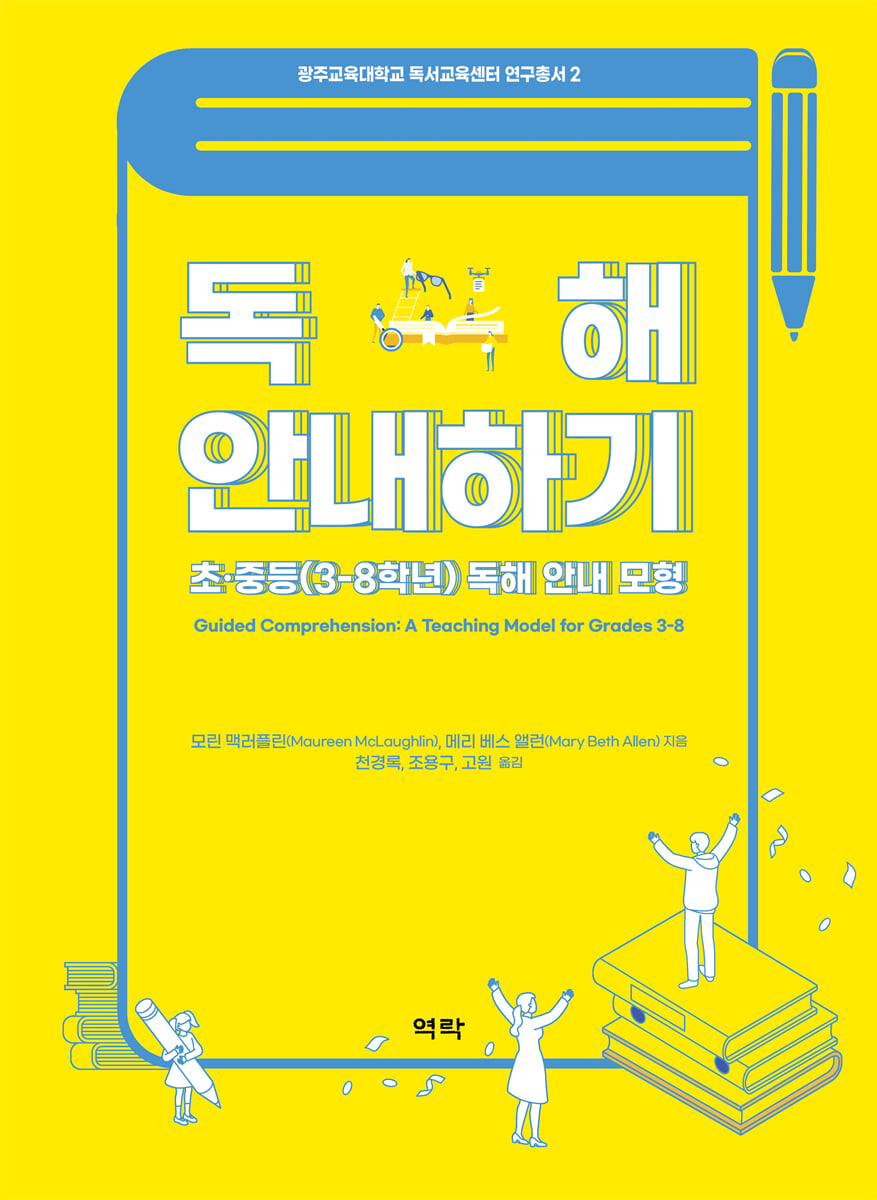
This book was translated to help teachers teach reading comprehension in Korean language classes in elementary and middle schools.
The original book was Guided Comprehension: A Teaching Model for Grades 3-8, co-authored by Professors Maureen McLaughlin and Mary Beth Allen, and published by the International Reading Association in 2002.
This book belongs to the field of teaching and learning theory and describes how teachers should design and implement reading classes for multiple students.
It shows what characteristics of reading instruction are emphasized in recent reading research, how to directly teach students how to read, how to promote students' meaning construction, how to select texts appropriate for students' level, how to utilize reading assessments in class, and how to reflect on one's own reading instruction.
In this book, ‘guiding’ means ‘scaffolding.’
Scaffolding is a concept that emerged from Vygotsky's social constructivism theory and has become a core concept in today's teaching and learning theory.
Almost all books that deal with teaching and learning for each subject and each area present teaching methods that teachers can use in teaching that subject or area, which are equivalent to scaffolding.
This book presents an appropriate scaffolding for Korean language reading classes for 3rd and 8th graders.
The authors present not only scaffolding activities for reading but also models for reading instruction.
After synthesizing the scaffolding activities that develop reading skills, these are integrated and explained as the [Guided Comprehension Model].
This model consists of three major stages: a teacher-led whole group guidance stage, a teacher- and student-led small group activity stage, and a teacher-led whole group reflection stage.
The second stage again takes into account the students' level and consists of 'teacher-guided small group instruction, student-led reading routine, and student-led reading center'.
This book emphasizes the leadership of teachers and students in reading classes.
Proactiveness is a concept introduced by the OECD's Education 2030 initiative. The OECD emphasized "transformative competencies" as the competencies necessary for survival in an uncertain future, and emphasized the need for "agency" on the part of teachers and learners to teach and learn these competencies.
This book designs a [reading guidance model] to enable teachers and students to participate in reading classes by taking initiative as collaborative actors at each stage of the class.
In summary, the content, methods, and background philosophy of reading teaching and learning explained in this book are all well connected to modern reading theory.
The concepts emphasized in this book, such as guidance, scaffolding, reading strategies, direct teaching, matching readers and texts, agent-led learning, learning group management (whole group → small group → whole group), and informal assessment, are concepts emphasized in the theories of social constructivism, cognitive constructivism, small group cooperative learning, metacognition, and transformative capacity, which explain modern reading classes.
Moreover, this book does not stop at explaining such concepts at an abstract level, but also presents worksheets, assessment tools, lesson models, and teaching plans so that teachers in the field can follow them concretely.
We hope that this book will help teachers who teach reading in elementary and middle school Korean language classes, as well as prospective teachers studying at teacher training colleges, understand reading instruction and help them develop practical knowledge about reading instruction.
Today, reading guidance is carried out not only in schools but also outside of schools, such as at home, local children's centers, reading education centers, libraries, religious institutions, and academies.
I hope this book will also be helpful to reading teachers at social education institutions.
The original book was Guided Comprehension: A Teaching Model for Grades 3-8, co-authored by Professors Maureen McLaughlin and Mary Beth Allen, and published by the International Reading Association in 2002.
This book belongs to the field of teaching and learning theory and describes how teachers should design and implement reading classes for multiple students.
It shows what characteristics of reading instruction are emphasized in recent reading research, how to directly teach students how to read, how to promote students' meaning construction, how to select texts appropriate for students' level, how to utilize reading assessments in class, and how to reflect on one's own reading instruction.
In this book, ‘guiding’ means ‘scaffolding.’
Scaffolding is a concept that emerged from Vygotsky's social constructivism theory and has become a core concept in today's teaching and learning theory.
Almost all books that deal with teaching and learning for each subject and each area present teaching methods that teachers can use in teaching that subject or area, which are equivalent to scaffolding.
This book presents an appropriate scaffolding for Korean language reading classes for 3rd and 8th graders.
The authors present not only scaffolding activities for reading but also models for reading instruction.
After synthesizing the scaffolding activities that develop reading skills, these are integrated and explained as the [Guided Comprehension Model].
This model consists of three major stages: a teacher-led whole group guidance stage, a teacher- and student-led small group activity stage, and a teacher-led whole group reflection stage.
The second stage again takes into account the students' level and consists of 'teacher-guided small group instruction, student-led reading routine, and student-led reading center'.
This book emphasizes the leadership of teachers and students in reading classes.
Proactiveness is a concept introduced by the OECD's Education 2030 initiative. The OECD emphasized "transformative competencies" as the competencies necessary for survival in an uncertain future, and emphasized the need for "agency" on the part of teachers and learners to teach and learn these competencies.
This book designs a [reading guidance model] to enable teachers and students to participate in reading classes by taking initiative as collaborative actors at each stage of the class.
In summary, the content, methods, and background philosophy of reading teaching and learning explained in this book are all well connected to modern reading theory.
The concepts emphasized in this book, such as guidance, scaffolding, reading strategies, direct teaching, matching readers and texts, agent-led learning, learning group management (whole group → small group → whole group), and informal assessment, are concepts emphasized in the theories of social constructivism, cognitive constructivism, small group cooperative learning, metacognition, and transformative capacity, which explain modern reading classes.
Moreover, this book does not stop at explaining such concepts at an abstract level, but also presents worksheets, assessment tools, lesson models, and teaching plans so that teachers in the field can follow them concretely.
We hope that this book will help teachers who teach reading in elementary and middle school Korean language classes, as well as prospective teachers studying at teacher training colleges, understand reading instruction and help them develop practical knowledge about reading instruction.
Today, reading guidance is carried out not only in schools but also outside of schools, such as at home, local children's centers, reading education centers, libraries, religious institutions, and academies.
I hope this book will also be helpful to reading teachers at social education institutions.
index
Translator's Preface
Author's Preface
Chapter 1.
Concepts and Principles of [Reading Guide]
1.
The concept of [Guiding Reading]
2.
Principles of Reading Comprehension
1) Reading is a socially constructed process.
2) Balanced literacy is a framework for teaching reading comprehension.
3) A competent reading teacher influences student learning.
4) Skilled readers are strategic and take an active role in the reading process.
5) Reading must occur in a meaningful context.
6) Students are encouraged to engage with a variety of texts at different levels.
7) Vocabulary development and instruction influence reading comprehension.
8) Immersion is a key factor in the reading process.
9) Reading strategies and skills can be taught.
10) Dynamic assessment informs reading instruction.
Chapter 2.
Step 1: Teacher-led whole-group guidance
1.
Organizing Step 1
2.
Participate in direct teaching
1) Steps of direct teaching
2) Reading Strategy: Focus on Guidance
3.
Reading Routine
1) Ask the author a question
2) Complementary teaching method
3) Reading Circle
Chapter 3.
Step 2: Teacher-guided small group and student-led independent practice
1.
Organizing Step 2
2.
Teacher-guided small group instruction
1) Recall the strategy
2) Guide students
3) Put it into practice
4) Reflect and Expand
3.
Student-Led Reading Center
1) Student responsibility
2) Ideas for creating a reading center
4.
Student-led reading routine
1) Ask the author a question
2) Complementary teaching method
3) Reading circle
Chapter 4.
Step 3: Teacher-led whole-group reflection and goal setting
1.
Organizing Step 3
2.
Reflection and Goal Setting in the [Reading Guide Model]
1) Diversify components
2) Provide a prompt
Chapter 5.
Text by level
1.
Student reading level and accessible text
2.
Factors affecting accessibility
1) Reader factor
2) Text factor
3.
Selecting appropriate texts for students
1) Student information
2) Text information
4.
How to distinguish between text levels
1) Level classification system
2) Teacher's judgment
3) Comparison with existing level-based book lists
4) List of publications and websites for books by level
5.
Organizing Text in the Classroom
Chapter 6.
Evaluation in [Reading Guide]
1.
The various roles of assessment in [Guiding Reading]
2.
Connection to state-level assessments
3.
Assessment techniques that can be applied in the classroom
1) Evaluation techniques to understand students' backgrounds
2) Techniques for assessing students' reading level and strategy use
4.
Using Assessment Results: Grouping and Student-Text Pairing
5.
[Reading Guide Profile]
Chapter 7.
Classroom Application of [Reading Guide]
1.
[Reading Guide] Classroom
2.
[Reading Guide] Plan (Lesson Plan)
1) Example of Teacher Beth's 4th Grade [Reading Guide] Plan
2) Example of Teacher Jacquelyn's 6th Grade [Reading Guide] Plan
3) Example of Mr. Richard's 8th grade [Guiding Reading] plan
Chapter 8.
Reflections on [Guiding Reading]
1.
Teacher's Response to [Guiding Reading]
1) Mr. Kim's reflections
2) Other teachers' reactions
2.
Student Responses to [Guiding Reading]
3.
Reflections from our authors
4.
finish
Appendix A: Map Ideas (Techniques) and Activity Materials
Appendix B: Worksheet Forms for Organizing and Operating Reading Centers and Routines
Appendix C Reading Response Prompts (Questions and Instructions)
Appendix D Level-Based Book Resources
Appendix E Evaluation Form
Appendix F [Reading Guide] Example Lesson Plan
REFERENCES
Author's Preface
Chapter 1.
Concepts and Principles of [Reading Guide]
1.
The concept of [Guiding Reading]
2.
Principles of Reading Comprehension
1) Reading is a socially constructed process.
2) Balanced literacy is a framework for teaching reading comprehension.
3) A competent reading teacher influences student learning.
4) Skilled readers are strategic and take an active role in the reading process.
5) Reading must occur in a meaningful context.
6) Students are encouraged to engage with a variety of texts at different levels.
7) Vocabulary development and instruction influence reading comprehension.
8) Immersion is a key factor in the reading process.
9) Reading strategies and skills can be taught.
10) Dynamic assessment informs reading instruction.
Chapter 2.
Step 1: Teacher-led whole-group guidance
1.
Organizing Step 1
2.
Participate in direct teaching
1) Steps of direct teaching
2) Reading Strategy: Focus on Guidance
3.
Reading Routine
1) Ask the author a question
2) Complementary teaching method
3) Reading Circle
Chapter 3.
Step 2: Teacher-guided small group and student-led independent practice
1.
Organizing Step 2
2.
Teacher-guided small group instruction
1) Recall the strategy
2) Guide students
3) Put it into practice
4) Reflect and Expand
3.
Student-Led Reading Center
1) Student responsibility
2) Ideas for creating a reading center
4.
Student-led reading routine
1) Ask the author a question
2) Complementary teaching method
3) Reading circle
Chapter 4.
Step 3: Teacher-led whole-group reflection and goal setting
1.
Organizing Step 3
2.
Reflection and Goal Setting in the [Reading Guide Model]
1) Diversify components
2) Provide a prompt
Chapter 5.
Text by level
1.
Student reading level and accessible text
2.
Factors affecting accessibility
1) Reader factor
2) Text factor
3.
Selecting appropriate texts for students
1) Student information
2) Text information
4.
How to distinguish between text levels
1) Level classification system
2) Teacher's judgment
3) Comparison with existing level-based book lists
4) List of publications and websites for books by level
5.
Organizing Text in the Classroom
Chapter 6.
Evaluation in [Reading Guide]
1.
The various roles of assessment in [Guiding Reading]
2.
Connection to state-level assessments
3.
Assessment techniques that can be applied in the classroom
1) Evaluation techniques to understand students' backgrounds
2) Techniques for assessing students' reading level and strategy use
4.
Using Assessment Results: Grouping and Student-Text Pairing
5.
[Reading Guide Profile]
Chapter 7.
Classroom Application of [Reading Guide]
1.
[Reading Guide] Classroom
2.
[Reading Guide] Plan (Lesson Plan)
1) Example of Teacher Beth's 4th Grade [Reading Guide] Plan
2) Example of Teacher Jacquelyn's 6th Grade [Reading Guide] Plan
3) Example of Mr. Richard's 8th grade [Guiding Reading] plan
Chapter 8.
Reflections on [Guiding Reading]
1.
Teacher's Response to [Guiding Reading]
1) Mr. Kim's reflections
2) Other teachers' reactions
2.
Student Responses to [Guiding Reading]
3.
Reflections from our authors
4.
finish
Appendix A: Map Ideas (Techniques) and Activity Materials
Appendix B: Worksheet Forms for Organizing and Operating Reading Centers and Routines
Appendix C Reading Response Prompts (Questions and Instructions)
Appendix D Level-Based Book Resources
Appendix E Evaluation Form
Appendix F [Reading Guide] Example Lesson Plan
REFERENCES
Publisher's Review
I am deeply grateful to Yeokrak Publishing for deciding to publish this book during these difficult times.
I received a lot of help from various teachers at the publishing company, including copyright consultation, design, editing, proofreading, and promotion.
I would also like to take this opportunity to express my gratitude to the professors who shared their valuable opinions while reading the first draft of the translation of this book with me in the Reading, Discussion, and Writing Education major at Gwangju National University of Education Graduate School during the summer semester of 2022.
July 2023
Translator's note
I received a lot of help from various teachers at the publishing company, including copyright consultation, design, editing, proofreading, and promotion.
I would also like to take this opportunity to express my gratitude to the professors who shared their valuable opinions while reading the first draft of the translation of this book with me in the Reading, Discussion, and Writing Education major at Gwangju National University of Education Graduate School during the summer semester of 2022.
July 2023
Translator's note
GOODS SPECIFICS
- Date of issue: September 20, 2023
- Page count, weight, size: 432 pages | 188*257*18mm
- ISBN13: 9791167425447
You may also like
카테고리
korean


korean

![GQ KOREA Mark (Monthly): December [2025]](http://librairie.coreenne.fr/cdn/shop/files/8ef265dbbfbf186523ed75ba7319009d.jpg?v=1765340328&width=3840)


