

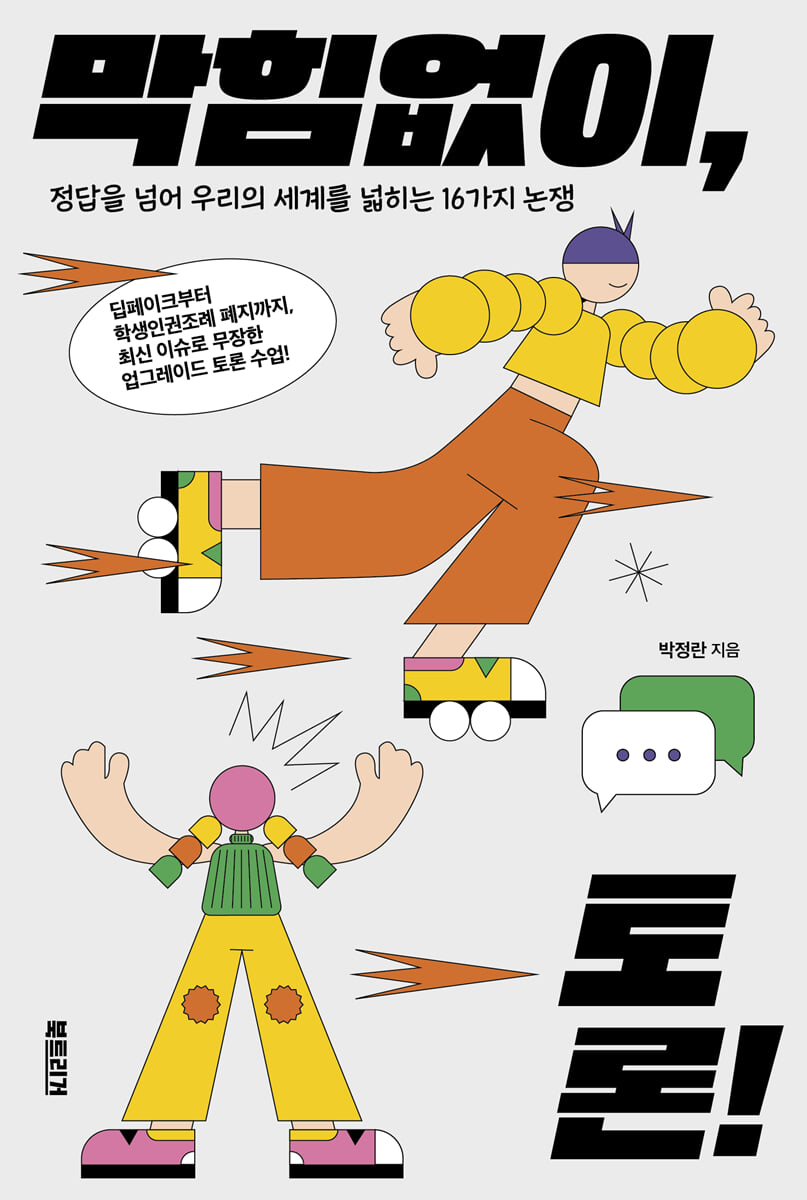
Let's discuss without hesitation!
 |
Description
Book Introduction
Social issues that are heating up various media today,
Prepared for youth who do not turn away from the problems of real society
16 debates that are currently shaping Korean society!
The third book in the Book Trigger [Debating Teens] series, 『Debate Without Hesitation!』, follows 『Debate Without Hesitation!』 and 『Debate Without Hesitation!』, introducing the latest debates of today and providing an opportunity to organize one's opinions and arguments through pro and con debates.
In today's world, where the pace of change is accelerating day by day, families, schools, society, and institutions are all changing at a breathtaking pace.
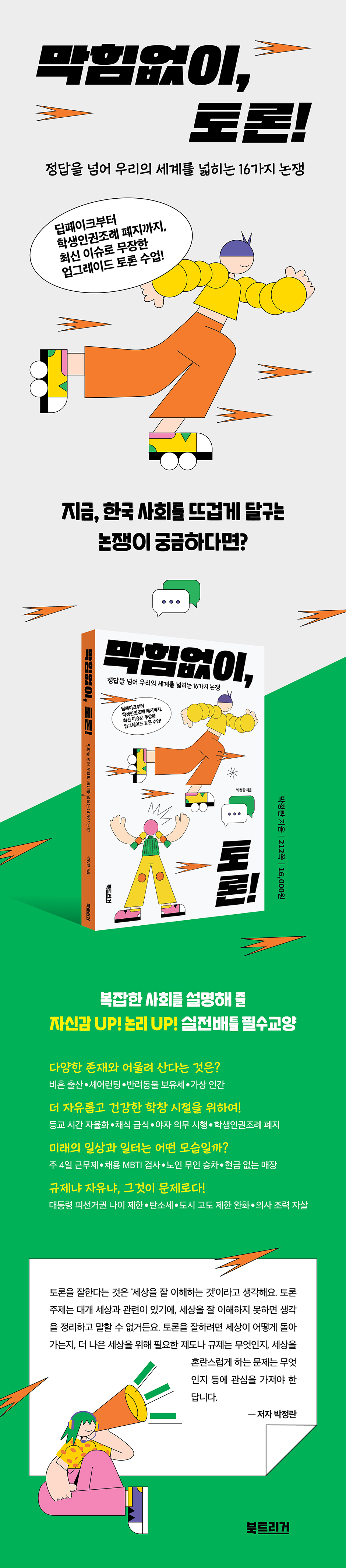
Change always sparks controversy! We'll conduct mock debates focusing on 16 controversial issues in Korean society, including out-of-wedlock childbirth, vegetarian school meals, the four-day workweek, cashless stores, and the carbon tax.
Through this book, students will gain knowledge and insight into current social issues they have only vaguely known about, while also developing the critical thinking skills to logically think about various social issues both inside and outside the classroom and understand them from different perspectives.
Rather than blindly opposing or opposing for the sake of opposing, you can learn how to understand others who have different opinions and discuss social issues from a different perspective.
Prepared for youth who do not turn away from the problems of real society
16 debates that are currently shaping Korean society!
The third book in the Book Trigger [Debating Teens] series, 『Debate Without Hesitation!』, follows 『Debate Without Hesitation!』 and 『Debate Without Hesitation!』, introducing the latest debates of today and providing an opportunity to organize one's opinions and arguments through pro and con debates.
In today's world, where the pace of change is accelerating day by day, families, schools, society, and institutions are all changing at a breathtaking pace.
Change always sparks controversy! We'll conduct mock debates focusing on 16 controversial issues in Korean society, including out-of-wedlock childbirth, vegetarian school meals, the four-day workweek, cashless stores, and the carbon tax.
Through this book, students will gain knowledge and insight into current social issues they have only vaguely known about, while also developing the critical thinking skills to logically think about various social issues both inside and outside the classroom and understand them from different perspectives.
Rather than blindly opposing or opposing for the sake of opposing, you can learn how to understand others who have different opinions and discuss social issues from a different perspective.
- You can preview some of the book's contents.
Preview
index
Chapter 1.
New Family: Living with Diverse Beings
Should out-of-wedlock childbirth be recognized?
Should sharenting be regulated?
Should a pet ownership tax be introduced?
Is it okay for virtual humans to continue to evolve?
Chapter 2.
New School: For a Freer and Healthier School Life
Should school start times be voluntary?
Should vegetarian meals be expanded?
Should night self-study be made mandatory?
Should the Student Human Rights Ordinance be abolished?
Chapter 3.
The New Society: What Will Our Daily Lives and Workplaces of the Future Look Like?
Should a four-day workweek be introduced?
Can the MBTI test be used in the hiring process?
Should free subway rides for seniors be abolished?
Should cashless stores be banned?
Chapter 4.
The New System: Regulation or Freedom? The More Complex Role of the State
Should the age limit for presidential elections be relaxed?
Should a carbon tax be introduced?
Should height restrictions in cities be relaxed?
Should physician-assisted suicide be permitted?
New Family: Living with Diverse Beings
Should out-of-wedlock childbirth be recognized?
Should sharenting be regulated?
Should a pet ownership tax be introduced?
Is it okay for virtual humans to continue to evolve?
Chapter 2.
New School: For a Freer and Healthier School Life
Should school start times be voluntary?
Should vegetarian meals be expanded?
Should night self-study be made mandatory?
Should the Student Human Rights Ordinance be abolished?
Chapter 3.
The New Society: What Will Our Daily Lives and Workplaces of the Future Look Like?
Should a four-day workweek be introduced?
Can the MBTI test be used in the hiring process?
Should free subway rides for seniors be abolished?
Should cashless stores be banned?
Chapter 4.
The New System: Regulation or Freedom? The More Complex Role of the State
Should the age limit for presidential elections be relaxed?
Should a carbon tax be introduced?
Should height restrictions in cities be relaxed?
Should physician-assisted suicide be permitted?
Detailed image
Into the book
There are also opinions that children who become teenagers may suffer later in life due to their parents' sharenting.
Currently, countless photos of children containing private and sensitive information are being shared on social media.
There is a good chance that future children will see this and feel ashamed or offended.
If you see this during your teenage years when you are trying to find your own identity, you may feel confused about the identity that your parents have already created online.
In severe cases, there are concerns that sharenting may expose people to bullying such as cyberbullying.
One digital funeral director even interviewed clients who requested services related to the right to be forgotten – 55% of them were children and adolescents.
--- pp.30-31 From "Chapter 1: 'Should Sharenting Be Regulated?'"
It is true that violation of religious rights is a serious social problem today.
However, the argument that the student human rights ordinance must be abolished in order to restore teachers' rights seems inconsistent.
Teachers' rights and students' human rights are not conflicting concepts, but separate values.
Looking at <Data 2>, we can see that there is not a significant difference between the number of educational activity violations in areas where student human rights ordinances are in place and in areas where they are not.
This means that the Student Human Rights Ordinance does not have a significant impact on teachers' exercise of their right to education.
--- p.102 From “Chapter 2: ‘Should the Student Human Rights Ordinance Be Abolished?’”
It is true that the use of cards and mobile payments has increased significantly.
But there are still many people who use cash.
As can be seen in <Data 3>, the elderly are less adept at using digital devices and thus have a higher rate of cash usage.
We also need to consider those who rely on cash as their primary means of payment, such as low-income families, children, and adolescents who have difficulty obtaining credit cards or conducting digital financial transactions.
Just because the majority of people don't use cash, these minorities shouldn't be left out of financial transactions.
We need to actively protect them by banning cashless stores.
--- p.154 From Chapter 3, “Should Cashless Stores Be Banned?”
The introduction of a carbon tax is a global trend.
Our country emits more carbon dioxide than the global average, yet has not yet introduced a carbon tax.
According to <Data 1>, in 2021, our country's carbon emissions were the tenth highest in the world.
But most people probably don't know that our country emits such a large amount of carbon.
The introduction of a carbon tax is expected to raise public awareness of the impact of carbon emissions on climate change and help improve lifestyles.
Meanwhile, with the European Union and the United States pushing for the introduction of a carbon border tax, some are suggesting that a carbon tax should be introduced to prepare for this.
Currently, countless photos of children containing private and sensitive information are being shared on social media.
There is a good chance that future children will see this and feel ashamed or offended.
If you see this during your teenage years when you are trying to find your own identity, you may feel confused about the identity that your parents have already created online.
In severe cases, there are concerns that sharenting may expose people to bullying such as cyberbullying.
One digital funeral director even interviewed clients who requested services related to the right to be forgotten – 55% of them were children and adolescents.
--- pp.30-31 From "Chapter 1: 'Should Sharenting Be Regulated?'"
It is true that violation of religious rights is a serious social problem today.
However, the argument that the student human rights ordinance must be abolished in order to restore teachers' rights seems inconsistent.
Teachers' rights and students' human rights are not conflicting concepts, but separate values.
Looking at <Data 2>, we can see that there is not a significant difference between the number of educational activity violations in areas where student human rights ordinances are in place and in areas where they are not.
This means that the Student Human Rights Ordinance does not have a significant impact on teachers' exercise of their right to education.
--- p.102 From “Chapter 2: ‘Should the Student Human Rights Ordinance Be Abolished?’”
It is true that the use of cards and mobile payments has increased significantly.
But there are still many people who use cash.
As can be seen in <Data 3>, the elderly are less adept at using digital devices and thus have a higher rate of cash usage.
We also need to consider those who rely on cash as their primary means of payment, such as low-income families, children, and adolescents who have difficulty obtaining credit cards or conducting digital financial transactions.
Just because the majority of people don't use cash, these minorities shouldn't be left out of financial transactions.
We need to actively protect them by banning cashless stores.
--- p.154 From Chapter 3, “Should Cashless Stores Be Banned?”
The introduction of a carbon tax is a global trend.
Our country emits more carbon dioxide than the global average, yet has not yet introduced a carbon tax.
According to <Data 1>, in 2021, our country's carbon emissions were the tenth highest in the world.
But most people probably don't know that our country emits such a large amount of carbon.
The introduction of a carbon tax is expected to raise public awareness of the impact of carbon emissions on climate change and help improve lifestyles.
Meanwhile, with the European Union and the United States pushing for the introduction of a carbon border tax, some are suggesting that a carbon tax should be introduced to prepare for this.
--- p.177 From “Chapter 4: ‘Should a Carbon Tax Be Introduced?’”
Publisher's Review
The constant influx of information and the growing social conflicts,
From what position can we express our opinions?
A solid discussion guide for students who find debate difficult and worrying.
We have entered an era where an active participation attitude and the ability to express and organize one's own thoughts are important.
The problem is that it is not easy to establish your own opinion amidst the mountain of new information that piles up after you wake up and the sharply conflicting arguments based on each position.
Book Trigger's "Teenagers Who Discuss" series helps young people living in this complex society to engage in in-depth discussions on social issues that are closely related to current students.
Young readers will gain a sense of reality and have the opportunity to reflect on their own situation as members of society through 16 ongoing debates.
Furthermore, rather than simply reading through a one-on-one exchange of pros and cons, the pros and cons are presented in two alternating presentations based on reliable sources, allowing for a clear understanding of the social phenomenon being discussed.
A thorough understanding of the debates surrounding society will soon lead to organizing one's own thoughts and positions, opening the door to logically expressing opinions.
It will be very useful for debate classes and essay preparation that are frequently held at school, and it will help students who have previously found debate difficult and scary to discuss given issues from various perspectives in a three-dimensional way.
From changing social issues to current issues closely related to youth of this era.
Face the debate that needs to be discussed right now
"Debate Without Hesitation!" demonstrates the fundamentals of a tense, evenly-contested debate, backed by abundant supporting evidence.
This book helps students overcome the difficulties they face in debating through realistic mock debates tailored to the needs of young people, and presents contemporary debate topics that can be applied directly in the classroom.
What makes it different from other discussion books is that it is not limited to a specific topic.
While most discussions tend to focus on a single, long-standing topic, such as climate change, science, or wealth redistribution, "Let's Talk Without Hesitation!" explores a diverse range of contemporary topics, encompassing society, education, the environment, and the economy.
Chapter 1, "The New Family: Living with Diverse Beings," discusses the family structure that must be respected and protected in today's world, where family forms are diversifying beyond the traditional concept of family, with issues such as out-of-wedlock childbirth, sharenting, pet ownership taxes, and virtual humans.
Chapter 2, "New School: For a Freer and Healthier School Life," discusses ways for students to grow healthier, freer, and more confident in their rights by addressing current educational issues, such as flexible school hours, vegetarian meals, nighttime self-study, and student human rights ordinances.
Chapter 3, "The New Society: What Will the Future of Daily Life and Workplaces Look Like," carefully discusses changes that will directly impact our lives now and in the future, such as the four-day workweek, the use of the MBTI test in the hiring process, free subway rides for seniors, and cashless stores.
Chapter 4, "New Institutions: Regulation or Freedom, and the More Complex Role of the State," discusses smart ways for the countless people who make up society to create a better society, such as age limits for presidential candidacy, carbon taxes, urban height restrictions, and physician-assisted suicide.
An efficient structure that naturally enhances logical thinking and judgment skills.
This book helps develop logical thinking and judgment skills on a given topic by arranging components that can be thought about step by step.
Before we begin a full-scale discussion, let me explain the social background that gave rise to the topic we wish to discuss.
And in 'Think Before Discussion', we ask three or more questions to give students time to think about the problem and answer it on their own.
Next, related materials mentioned in various media are included in the form of QR codes to help students gain rich background knowledge on the topic.
The debate featured two proponents and two opponents, each with solid arguments based on accurate sources, allowing for a rich range of opinions without being biased towards one side.
After a heated debate, we help open-minded thinking by discussing the pros and cons of the previous debate and points to consider in the future through a 'debate wrap-up'.
At the end of the book, a list of related topics is included so that related content can be checked in the textbook.
From what position can we express our opinions?
A solid discussion guide for students who find debate difficult and worrying.
We have entered an era where an active participation attitude and the ability to express and organize one's own thoughts are important.
The problem is that it is not easy to establish your own opinion amidst the mountain of new information that piles up after you wake up and the sharply conflicting arguments based on each position.
Book Trigger's "Teenagers Who Discuss" series helps young people living in this complex society to engage in in-depth discussions on social issues that are closely related to current students.
Young readers will gain a sense of reality and have the opportunity to reflect on their own situation as members of society through 16 ongoing debates.
Furthermore, rather than simply reading through a one-on-one exchange of pros and cons, the pros and cons are presented in two alternating presentations based on reliable sources, allowing for a clear understanding of the social phenomenon being discussed.
A thorough understanding of the debates surrounding society will soon lead to organizing one's own thoughts and positions, opening the door to logically expressing opinions.
It will be very useful for debate classes and essay preparation that are frequently held at school, and it will help students who have previously found debate difficult and scary to discuss given issues from various perspectives in a three-dimensional way.
From changing social issues to current issues closely related to youth of this era.
Face the debate that needs to be discussed right now
"Debate Without Hesitation!" demonstrates the fundamentals of a tense, evenly-contested debate, backed by abundant supporting evidence.
This book helps students overcome the difficulties they face in debating through realistic mock debates tailored to the needs of young people, and presents contemporary debate topics that can be applied directly in the classroom.
What makes it different from other discussion books is that it is not limited to a specific topic.
While most discussions tend to focus on a single, long-standing topic, such as climate change, science, or wealth redistribution, "Let's Talk Without Hesitation!" explores a diverse range of contemporary topics, encompassing society, education, the environment, and the economy.
Chapter 1, "The New Family: Living with Diverse Beings," discusses the family structure that must be respected and protected in today's world, where family forms are diversifying beyond the traditional concept of family, with issues such as out-of-wedlock childbirth, sharenting, pet ownership taxes, and virtual humans.
Chapter 2, "New School: For a Freer and Healthier School Life," discusses ways for students to grow healthier, freer, and more confident in their rights by addressing current educational issues, such as flexible school hours, vegetarian meals, nighttime self-study, and student human rights ordinances.
Chapter 3, "The New Society: What Will the Future of Daily Life and Workplaces Look Like," carefully discusses changes that will directly impact our lives now and in the future, such as the four-day workweek, the use of the MBTI test in the hiring process, free subway rides for seniors, and cashless stores.
Chapter 4, "New Institutions: Regulation or Freedom, and the More Complex Role of the State," discusses smart ways for the countless people who make up society to create a better society, such as age limits for presidential candidacy, carbon taxes, urban height restrictions, and physician-assisted suicide.
An efficient structure that naturally enhances logical thinking and judgment skills.
This book helps develop logical thinking and judgment skills on a given topic by arranging components that can be thought about step by step.
Before we begin a full-scale discussion, let me explain the social background that gave rise to the topic we wish to discuss.
And in 'Think Before Discussion', we ask three or more questions to give students time to think about the problem and answer it on their own.
Next, related materials mentioned in various media are included in the form of QR codes to help students gain rich background knowledge on the topic.
The debate featured two proponents and two opponents, each with solid arguments based on accurate sources, allowing for a rich range of opinions without being biased towards one side.
After a heated debate, we help open-minded thinking by discussing the pros and cons of the previous debate and points to consider in the future through a 'debate wrap-up'.
At the end of the book, a list of related topics is included so that related content can be checked in the textbook.
GOODS SPECIFICS
- Date of issue: May 20, 2024
- Page count, weight, size: 212 pages | 330g | 138*205*13mm
- ISBN13: 9791193378168
- ISBN10: 1193378168
You may also like
카테고리
korean


korean

![GQ KOREA Mark (Monthly): December [2025]](http://librairie.coreenne.fr/cdn/shop/files/8ef265dbbfbf186523ed75ba7319009d.jpg?v=1765340328&width=3840)


