

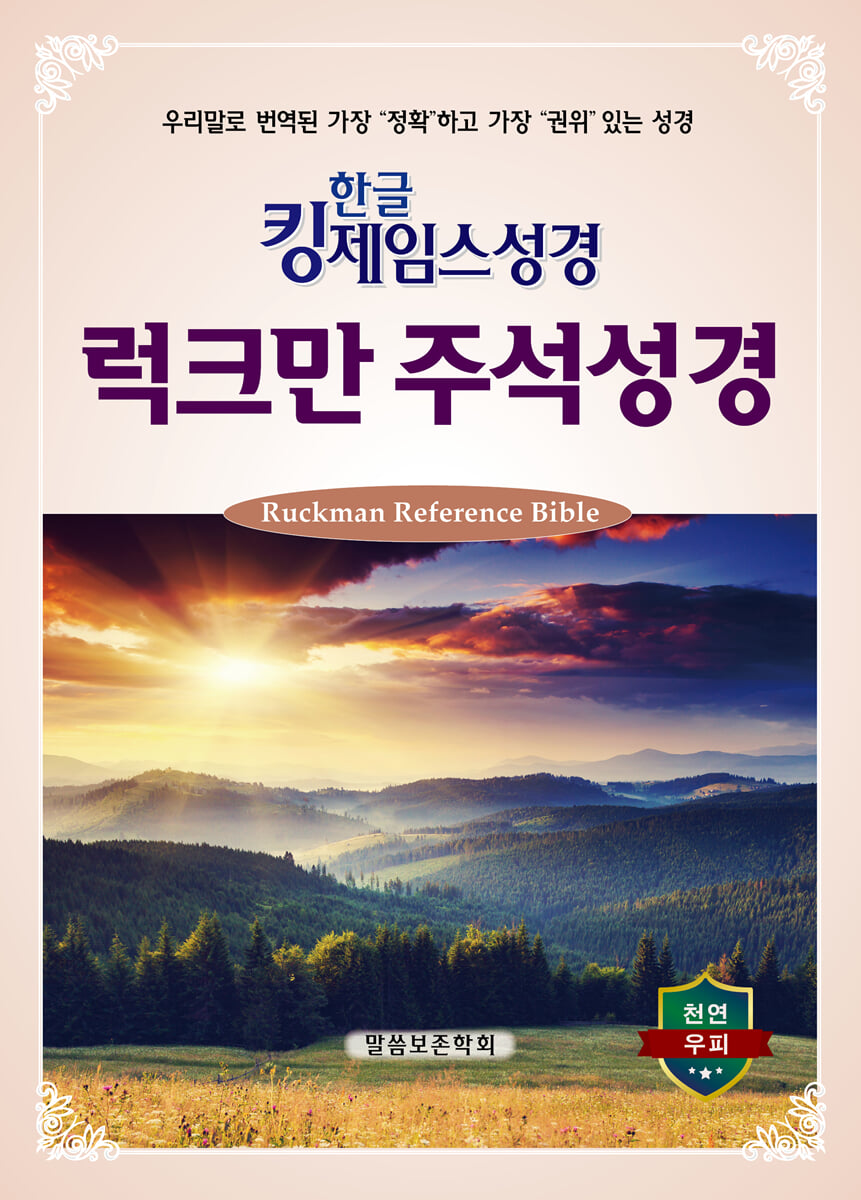
Korean King James Bible with Ruckman Commentary (Index/Middle)
 |
Description
Book Introduction
"The Bible No One Can Controversially Controversial"
The definitive edition of 52 years of research by Dr. Peter Luckman, a world-renowned authority on the King James Bible.
An outstanding commentary that surpasses all other commentaries on the Bible published so far.
A biblical commentary that corrects the errors of all commentators since John Calvin.
The Lucky Man Bible is different.
First, almost every chapter contains footnotes, which not only link related passages within each book of the Bible, but also clearly explain each passage.
Second, the footnotes on almost every page clearly explain various topics discussed in the Bible.
Third, the commentary and annotations, especially those related to prophecy, are excellent, detailing how prophecies declared in the Old Testament were fulfilled in the New Testament, or how they were and will be fulfilled in the first and second comings of Christ.
The sheer number of fulfilled prophecies in the Old and New Testaments provides compelling evidence that even unfulfilled prophecies will be literally fulfilled.
Fourth, it systematically organizes premillennialism and dispensational truths according to the "sure word of prophecy," and provides clear truth about the great theme of the Bible: Jesus Christ and His kingdom.
Fifth, the book provides a chronology for each page, facilitating a clear understanding of the era and providing detailed explanations of the history behind each event, providing a wealth of knowledge not only about Israel but also about world history.
In particular, you can understand Israel's modern history and future history given in prophecy in detail from a biblical perspective.
Sixth, the rich spiritual truths presented throughout not only provide spiritual inspiration to readers but also provide valuable sermon material for preachers.
Seventh, 118 appendices on various topics, including theology, doctrine, history, thought, art, and religion, are included, allowing you to gain insights into Dr. Luckman's knowledge.
Eighth, the maps at the back of the Bible are not just a simple historical reference; they are also a valuable resource for understanding the themes of the Bible.
The definitive edition of 52 years of research by Dr. Peter Luckman, a world-renowned authority on the King James Bible.
An outstanding commentary that surpasses all other commentaries on the Bible published so far.
A biblical commentary that corrects the errors of all commentators since John Calvin.
The Lucky Man Bible is different.
First, almost every chapter contains footnotes, which not only link related passages within each book of the Bible, but also clearly explain each passage.
Second, the footnotes on almost every page clearly explain various topics discussed in the Bible.
Third, the commentary and annotations, especially those related to prophecy, are excellent, detailing how prophecies declared in the Old Testament were fulfilled in the New Testament, or how they were and will be fulfilled in the first and second comings of Christ.
The sheer number of fulfilled prophecies in the Old and New Testaments provides compelling evidence that even unfulfilled prophecies will be literally fulfilled.
Fourth, it systematically organizes premillennialism and dispensational truths according to the "sure word of prophecy," and provides clear truth about the great theme of the Bible: Jesus Christ and His kingdom.
Fifth, the book provides a chronology for each page, facilitating a clear understanding of the era and providing detailed explanations of the history behind each event, providing a wealth of knowledge not only about Israel but also about world history.
In particular, you can understand Israel's modern history and future history given in prophecy in detail from a biblical perspective.
Sixth, the rich spiritual truths presented throughout not only provide spiritual inspiration to readers but also provide valuable sermon material for preachers.
Seventh, 118 appendices on various topics, including theology, doctrine, history, thought, art, and religion, are included, allowing you to gain insights into Dr. Luckman's knowledge.
Eighth, the maps at the back of the Bible are not just a simple historical reference; they are also a valuable resource for understanding the themes of the Bible.
index
The Old Testament
Genesis
Exodus
Leviticus
Numbers
Deuteronomy
Joshua
Judge's period
ruth
1 Samuel
2 Samuel
1 Kings
2 Kings
Chronicles
2 Chronicles
Ezra
Nehemiah
Esther
job
Psalter
Proverbs
Ecclesiastes
Song of Solomon
Isaiah
Jeremiah
lamentations
Ezekiel
Daniel
Hosea
Joel
Amos
Obadiah
Jonah
Mika
Nahum
Habakkuk
Spagna
Haggae
Skarya
Malachi
The New Testament
Gospel of Matthew
Gospel of Mark
Gospel of Luke
Gospel of John
Acts of the Apostles
Romans
1 Corinthians
2 Corinthians
Galatians
Ephesians
Philippians
Colossians
1 Thessalonians
2 Thessalonians
1 Timothy
2 Timothy
Titus
Philemon
hebrews
Night report
1 Peter
2 Peter
1 John
2 John
3 John
Jude
Revelation
* Appendix Table of Contents
1.
Hebrew Names for God in the Old Testament
2.
The names given to people and sins
3.
Law of First Mention
4.
History of the Pine Tree
5.
Moon
6.
Anglo-Israeli
7.
“Popular Expressions” (Examples of Biblical expressions used in English)
8.
Higher Criticism
9.
History of Egypt
10.
tower of Babel
11.
Tabernacle
12.
deluge
13.
Jewish Months and Seasons
14.
Gold and Millionaires
15.
“Genocide” (Holocaust)
16.
Catholic conspiracies
17.
Peace on earth.
18.
History of Jerusalem
19.
Two Kinds of Prophets
20.
Space and Science
21.
The King James Bible, recognized as authoritative
22.
Fake religions
23.
Santa Claus
24.
Menorah (candlestick)
25.
A few “coincidences”
26.
Pope's blessings
27.
A collection of books by people who believe in the Bible
28.
Evolution as a Religion
29.
philosophy
30.
Proposed (possible) year systems
31.
Donkeys in the Bible
32.
false gods
33.
false messiahs
34.
The number seven
35.
Fallen Angels and Modern Scholars
36.
Tithe: one-tenth
37.
Mark of the Beast
38.
Biblical Hermeneutics
39.
Statistics about the Bible
40.
New Jerusalem
41.
Aaron's Breastplate
42.
Maps related to biblical history and modern Israel
43.
Lucy and the Big Bang Theory
44.
Scientific laws that can actually be verified and proven
45.
The so-called “errors” of the King James Bible
46.
Major wars and battles in foreign history
47.
The fiction of Calvin's "eternal judgment" (decree)
48.
Dead Sea Scrolls
49.
The meaning of italics in the King James Bible
50.
prophet
51.
Signs of the Second Coming
52.
God bless America!
53.
What is sin?
54.
cat
55.
Unicorns and Dragons
56.
Murphy's Law
57.
Canon of the Bible
58.
Israel and Israel's enemies
59.
Bible vs.
tradition
60.
Rebuilding the temple
61.
Those who change the word of God
62.
Christmas for Psychos
63.
God vs.
United Nations (UN)
64.
Expressions to misrepresent facts
65.
The central verses of the Bible
66.
Hebrew Old Testament original text
67.
The heretical doctrine of the “Baptist-Priest”
68.
negative extremes
69.
Trinity
70.
car bumper stickers
71.
Weight, Coins, Dimensions
72.
The origin of heresies
73.
Authenticity of the Byzantine original
74.
Ancient Babylon
75.
Latin words in the New Testament
76.
Bob Jones University and the Great Apostasy
77.
The so-called “holy” Quran
78.
Simon Peter's Tomb
79.
Six Ways to Spell Nebuchadnezzar
80.
Jewish population
81.
Mentally Ill Scholars
82.
Pseudonyms of movie stars
83.
The main cause of crime in the United States
84.
America, a country led by women
85.
The term “Only Begotten Son”
86.
The historical Jesus
87.
Special Bible Vocabulary: “tion” (Noun Ending)
88.
Small Things
89.
Electricity
90.
Very exaggerated words
91.
“Waltzing Matilda” and “The Victory Ball”
92.
ET: The Holy Maggot
93.
The land God gave to Israel
94.
Nine Corrupt Old Men: The Supreme Court
95.
Altered counterfeit Bibles
96.
Vocations in the Bible
97.
The Gospel and Time Dating for the Tribulation Period
98.
Demons and Devils
99.
All plots for all movies, television, and books are sourced from AD
It was already provided before 90 years ago.
100.
Absurd Models of Christ
101.
The claims of the Sopherim
102. NIV, The Nutty Idiots' Version
103.
Passover 104.
Figurative expressions
105.
Erasmus and Revelation 22
106.
Christian universities
107.
Liberation theology
108.
Code of Hammurabi
109.
Schedule and selection
110.
The Restored Kingdom
111.
From east to west
112.
20 Biblical Definitions of the Number “5” as Meaning Death
113.
The number 10
114.
Rain and UFOs
115.
The Covenant of Moses
116.
Exodus 20 and 33
117.
Additional Notes on Old Testament Passages
118.
Additional Notes on New Testament Passages
Genesis
Exodus
Leviticus
Numbers
Deuteronomy
Joshua
Judge's period
ruth
1 Samuel
2 Samuel
1 Kings
2 Kings
Chronicles
2 Chronicles
Ezra
Nehemiah
Esther
job
Psalter
Proverbs
Ecclesiastes
Song of Solomon
Isaiah
Jeremiah
lamentations
Ezekiel
Daniel
Hosea
Joel
Amos
Obadiah
Jonah
Mika
Nahum
Habakkuk
Spagna
Haggae
Skarya
Malachi
The New Testament
Gospel of Matthew
Gospel of Mark
Gospel of Luke
Gospel of John
Acts of the Apostles
Romans
1 Corinthians
2 Corinthians
Galatians
Ephesians
Philippians
Colossians
1 Thessalonians
2 Thessalonians
1 Timothy
2 Timothy
Titus
Philemon
hebrews
Night report
1 Peter
2 Peter
1 John
2 John
3 John
Jude
Revelation
* Appendix Table of Contents
1.
Hebrew Names for God in the Old Testament
2.
The names given to people and sins
3.
Law of First Mention
4.
History of the Pine Tree
5.
Moon
6.
Anglo-Israeli
7.
“Popular Expressions” (Examples of Biblical expressions used in English)
8.
Higher Criticism
9.
History of Egypt
10.
tower of Babel
11.
Tabernacle
12.
deluge
13.
Jewish Months and Seasons
14.
Gold and Millionaires
15.
“Genocide” (Holocaust)
16.
Catholic conspiracies
17.
Peace on earth.
18.
History of Jerusalem
19.
Two Kinds of Prophets
20.
Space and Science
21.
The King James Bible, recognized as authoritative
22.
Fake religions
23.
Santa Claus
24.
Menorah (candlestick)
25.
A few “coincidences”
26.
Pope's blessings
27.
A collection of books by people who believe in the Bible
28.
Evolution as a Religion
29.
philosophy
30.
Proposed (possible) year systems
31.
Donkeys in the Bible
32.
false gods
33.
false messiahs
34.
The number seven
35.
Fallen Angels and Modern Scholars
36.
Tithe: one-tenth
37.
Mark of the Beast
38.
Biblical Hermeneutics
39.
Statistics about the Bible
40.
New Jerusalem
41.
Aaron's Breastplate
42.
Maps related to biblical history and modern Israel
43.
Lucy and the Big Bang Theory
44.
Scientific laws that can actually be verified and proven
45.
The so-called “errors” of the King James Bible
46.
Major wars and battles in foreign history
47.
The fiction of Calvin's "eternal judgment" (decree)
48.
Dead Sea Scrolls
49.
The meaning of italics in the King James Bible
50.
prophet
51.
Signs of the Second Coming
52.
God bless America!
53.
What is sin?
54.
cat
55.
Unicorns and Dragons
56.
Murphy's Law
57.
Canon of the Bible
58.
Israel and Israel's enemies
59.
Bible vs.
tradition
60.
Rebuilding the temple
61.
Those who change the word of God
62.
Christmas for Psychos
63.
God vs.
United Nations (UN)
64.
Expressions to misrepresent facts
65.
The central verses of the Bible
66.
Hebrew Old Testament original text
67.
The heretical doctrine of the “Baptist-Priest”
68.
negative extremes
69.
Trinity
70.
car bumper stickers
71.
Weight, Coins, Dimensions
72.
The origin of heresies
73.
Authenticity of the Byzantine original
74.
Ancient Babylon
75.
Latin words in the New Testament
76.
Bob Jones University and the Great Apostasy
77.
The so-called “holy” Quran
78.
Simon Peter's Tomb
79.
Six Ways to Spell Nebuchadnezzar
80.
Jewish population
81.
Mentally Ill Scholars
82.
Pseudonyms of movie stars
83.
The main cause of crime in the United States
84.
America, a country led by women
85.
The term “Only Begotten Son”
86.
The historical Jesus
87.
Special Bible Vocabulary: “tion” (Noun Ending)
88.
Small Things
89.
Electricity
90.
Very exaggerated words
91.
“Waltzing Matilda” and “The Victory Ball”
92.
ET: The Holy Maggot
93.
The land God gave to Israel
94.
Nine Corrupt Old Men: The Supreme Court
95.
Altered counterfeit Bibles
96.
Vocations in the Bible
97.
The Gospel and Time Dating for the Tribulation Period
98.
Demons and Devils
99.
All plots for all movies, television, and books are sourced from AD
It was already provided before 90 years ago.
100.
Absurd Models of Christ
101.
The claims of the Sopherim
102. NIV, The Nutty Idiots' Version
103.
Passover 104.
Figurative expressions
105.
Erasmus and Revelation 22
106.
Christian universities
107.
Liberation theology
108.
Code of Hammurabi
109.
Schedule and selection
110.
The Restored Kingdom
111.
From east to west
112.
20 Biblical Definitions of the Number “5” as Meaning Death
113.
The number 10
114.
Rain and UFOs
115.
The Covenant of Moses
116.
Exodus 20 and 33
117.
Additional Notes on Old Testament Passages
118.
Additional Notes on New Testament Passages
Detailed image

Into the book
When the Bible is divided into two parts, the first part is called the “Old Testament.”
This is because it deals with the history of the Israelites under the Mosaic Covenant from Exodus 19 onwards, and it is also called “old” as in Hebrews 8:13 because God will establish a “new covenant” as He said in Jeremiah 31:31.
Contrary to popular belief, the Bible is not a religious book.
The Bible is a history book that records God's dealings with mankind.
If we look at 『Correctly Dividing the Word of Truth』, we can see that the Bible is divided as follows.
Genesis 1-3, Genesis 3-12, Genesis 12-Exodus 19, Exodus 19-Matthew 26, Matthew 26-Acts 2, Acts 2-Revelation 4, Revelation 4-Revelation 19, Revelation 19-22.
According to Jesus Christ, the Old Testament can be divided into three parts.
The Law, the Prophets, and the Psalms (Luke 24:44).
This is a standard distinction accepted by all Orthodox or Conservative Jews.
In the Hebrew Bible, these three parts are called “Torah,” “Nevi’im,” and “Ketuvim.”
“Torah” refers to the first five canonical books written by Moses.
Christian scholars call this law the Pentateuch, a Greek term.
“Nevi’im” includes Joshua, Judges, 1 and 2 Samuel, 1 and 2 Kings, Isaiah, Jeremiah, Ezekiel, and the 12 books of the Minor Prophets.
Sometimes the Book of Ruth is included in the Book of Judges, and sometimes the Book of Lamentations is attached to the Book of Jeremiah.
“Ketuvim” includes Psalms, Proverbs, Job, Song of Solomon, Ruth, Lamentations, Esther, Ecclesiastes, Daniel, Ezra and Nehemiah (sometimes treated as one book), and 1 and 2 Chronicles.
The Hebrew Bible is arranged so that it begins with Genesis and ends with 2 Chronicles (Matthew 23:35).
Although the order of the books is different, the books included are the same as in the King James Bible.
There is no Apocrypha in the Hebrew Bible.
Therefore, Martin Luther and the translators of the King James Bible separated the Apocrypha from the Old and New Testaments.
Unlike Roman Catholics, they believed that the Apocrypha did not belong in either the Old or New Testament.
--- From "Introduction to the Bible and the Old Testament"
The reason the New Testament of the Bible is called “the New Testament of our Lord and Savior Jesus Christ” is because the New Testament deals with the death of Jesus Christ, and because the Lord is the “Testament” of the “New Covenant” (Hebrews 9:16-17).
Although both “covenant” and “testament” are used in the King James Version when speaking of the covenant, “testament,” with its connotation of “will,” is more appropriate to refer to the two major divisions of the Bible, especially when speaking of the New Testament.
Because “Testament” deals with the death of the one who spoke the covenant.
The expression “the deceased’s last wishes and will” is also commonly used.
The New Testament consists of 27 books, 7,959 verses, and 181,253 words in the English King James Bible.
The central book of the New Testament is 2 Thessalonians, the central chapter is Romans 13-14, and the central verse is Acts 17:17.
The New Testament quotes the Old Testament directly, indirectly, or implicitly in nearly 1,000 places.
Of these, 333 citations refer to Jesus Christ.
None of Jesus Christ, the Apostles, or the writers of the New Testament ever quoted from the Apocrypha.
The Apostle Paul quoted pagan poetry, but not the Apocrypha.
The same goes for the writings of Mormons, Christian Science, and any other Gnostic cult.
If the Old Testament is the history of God the Father opposing the world, then the four Gospels in the New Testament can be said to be the history of God the Son opposing the devil, and the Pauline letters can be said to be the history of God the Holy Spirit opposing the flesh.
The Old and New Testaments are most strikingly linked by the fulfillment of indisputable prophecies, which distinguish the Bible from all other scriptures of the world.
For example, the four uses of the term “branch” to refer to the Messiah are closely related to the theme of the four Gospels.
The term “branch” appears in Jeremiah 23:5, Zechariah 3:8; 6:12-13, and Isaiah 4:2.
Jeremiah 23:5 reveals that the Branch is the king of Israel who comes through David.
The theme of the Gospel of Matthew is 'Jesus Christ is the King of the Jews,' and in the Gospel of Matthew, Jesus' genealogy is traced back to David and then to Abraham, the ancestor of the Jews.
Zechariah 3:8 calls the Branch a servant of God, which is consistent with the theme of the Gospel of Mark, which describes Jesus Christ as the servant of God.
Zechariah 6:12 says, "Behold the man whose name is Branch."
Luke describes Christ as the Son of Man.
To make sure that all this is not coincidental, Isaiah speaks of Christ as “the Branch of the Lord,” that is, the Branch who is the Lord, which is in line with the theme of the Gospel of John, which presents Jesus Christ as “the Son of God.”
This is a phenomenon that can only be seen in the New Testament.
The four Gospels contain the exact fulfillment of more than 48 prophecies about one man, all of which were proclaimed at least 400 years before the birth of Jesus Christ.
No matter how much higher critics try to shift the date of the Bible's composition, the fact that the Old Testament was written long before the events of the New Testament cannot be denied.
The mathematical laws of probability more than prove that this phenomenon is true.
Peter Stoner, a professor of mathematics and astronomy at Pasadena City College and Westmont College, has shown through statistical probability that the odds that anyone other than Jesus of Nazareth could fulfill these Old Testament prophecies are astronomical and probabilistically impossible.
Dr. Stoner wrote in his book that the odds that someone else could fulfill the 48 prophecies Jesus fulfilled in the four Gospels are only 1 in 10^157 (10 to the 157th power), which is 1 followed by 157 zeros.
(Dr. Stoner's book is available online.
(You can check the mathematical methods he used to calculate these probabilities one by one.) The total number of electrons in the known universe is 1052, which is 1 followed by 52 zeros.
Simply put, the probability that Jesus Christ could fulfill all 48 prophecies is beyond the realms of science and nature itself.
It doesn't end here.
This is just a calculation using 48 prophecies.
There are over 500 prophecies in the Bible that remain to be fulfilled, and these prophecies will be fulfilled in the near future.
Therefore, anyone who does not believe that the text of the Bible is supernatural is not only not intelligent, but also insane.
Any scholar of any field, of any creed, who considers the Bible to be like any other “religious book” is nothing but a self-deceiving fool.
Finally, we must be mindful that God placed three stumbling blocks in the New Testament to trouble all the Gentile Christians from Europe who did not share and study the Word of Truth.
These three “mines” are the Gospel of Matthew, the Acts of the Apostles, and the Epistle to the Hebrews.
Fundamentalists commit theological suicide in Hebrews, charismatics hang themselves in Acts, and Roman Catholics disqualify themselves from eternal life in Matthew.
These three books are “transitional books.”
In the Gospel of Matthew, we see the transition from the Old Testament to the New Testament, in the Book of Acts, the transition from the nation of Israel to the church, and in the Epistle to the Hebrews, the transition from the church age to the Great Tribulation.
It is precisely in these parts that most theology professors and commentators find themselves lost and confused.
This problem can be solved simply.
If you find statements in Matthew, Acts, and Hebrews that are doctrinally inconsistent with the doctrines of Paul's epistles, then they are not doctrinal statements written for Christians living in the church age.
The Gospel of Matthew also contains spiritual truths for Christians.
The book of Acts also contains spiritual treasures for Christians.
The Book of Hebrews also contains words that greatly uplift and encourage Christians.
Also, the doctrines of Paul's epistles sometimes appear in these books.
However, if the particular statement in question contradicts what the Apostle Paul wrote from Romans to Philemon, then it is not a doctrinal statement applicable to the church age.
Therefore, be careful when studying the New Testament.
To treat the holy scriptures carelessly is to endanger one's own well-being.
This is because it deals with the history of the Israelites under the Mosaic Covenant from Exodus 19 onwards, and it is also called “old” as in Hebrews 8:13 because God will establish a “new covenant” as He said in Jeremiah 31:31.
Contrary to popular belief, the Bible is not a religious book.
The Bible is a history book that records God's dealings with mankind.
If we look at 『Correctly Dividing the Word of Truth』, we can see that the Bible is divided as follows.
Genesis 1-3, Genesis 3-12, Genesis 12-Exodus 19, Exodus 19-Matthew 26, Matthew 26-Acts 2, Acts 2-Revelation 4, Revelation 4-Revelation 19, Revelation 19-22.
According to Jesus Christ, the Old Testament can be divided into three parts.
The Law, the Prophets, and the Psalms (Luke 24:44).
This is a standard distinction accepted by all Orthodox or Conservative Jews.
In the Hebrew Bible, these three parts are called “Torah,” “Nevi’im,” and “Ketuvim.”
“Torah” refers to the first five canonical books written by Moses.
Christian scholars call this law the Pentateuch, a Greek term.
“Nevi’im” includes Joshua, Judges, 1 and 2 Samuel, 1 and 2 Kings, Isaiah, Jeremiah, Ezekiel, and the 12 books of the Minor Prophets.
Sometimes the Book of Ruth is included in the Book of Judges, and sometimes the Book of Lamentations is attached to the Book of Jeremiah.
“Ketuvim” includes Psalms, Proverbs, Job, Song of Solomon, Ruth, Lamentations, Esther, Ecclesiastes, Daniel, Ezra and Nehemiah (sometimes treated as one book), and 1 and 2 Chronicles.
The Hebrew Bible is arranged so that it begins with Genesis and ends with 2 Chronicles (Matthew 23:35).
Although the order of the books is different, the books included are the same as in the King James Bible.
There is no Apocrypha in the Hebrew Bible.
Therefore, Martin Luther and the translators of the King James Bible separated the Apocrypha from the Old and New Testaments.
Unlike Roman Catholics, they believed that the Apocrypha did not belong in either the Old or New Testament.
--- From "Introduction to the Bible and the Old Testament"
The reason the New Testament of the Bible is called “the New Testament of our Lord and Savior Jesus Christ” is because the New Testament deals with the death of Jesus Christ, and because the Lord is the “Testament” of the “New Covenant” (Hebrews 9:16-17).
Although both “covenant” and “testament” are used in the King James Version when speaking of the covenant, “testament,” with its connotation of “will,” is more appropriate to refer to the two major divisions of the Bible, especially when speaking of the New Testament.
Because “Testament” deals with the death of the one who spoke the covenant.
The expression “the deceased’s last wishes and will” is also commonly used.
The New Testament consists of 27 books, 7,959 verses, and 181,253 words in the English King James Bible.
The central book of the New Testament is 2 Thessalonians, the central chapter is Romans 13-14, and the central verse is Acts 17:17.
The New Testament quotes the Old Testament directly, indirectly, or implicitly in nearly 1,000 places.
Of these, 333 citations refer to Jesus Christ.
None of Jesus Christ, the Apostles, or the writers of the New Testament ever quoted from the Apocrypha.
The Apostle Paul quoted pagan poetry, but not the Apocrypha.
The same goes for the writings of Mormons, Christian Science, and any other Gnostic cult.
If the Old Testament is the history of God the Father opposing the world, then the four Gospels in the New Testament can be said to be the history of God the Son opposing the devil, and the Pauline letters can be said to be the history of God the Holy Spirit opposing the flesh.
The Old and New Testaments are most strikingly linked by the fulfillment of indisputable prophecies, which distinguish the Bible from all other scriptures of the world.
For example, the four uses of the term “branch” to refer to the Messiah are closely related to the theme of the four Gospels.
The term “branch” appears in Jeremiah 23:5, Zechariah 3:8; 6:12-13, and Isaiah 4:2.
Jeremiah 23:5 reveals that the Branch is the king of Israel who comes through David.
The theme of the Gospel of Matthew is 'Jesus Christ is the King of the Jews,' and in the Gospel of Matthew, Jesus' genealogy is traced back to David and then to Abraham, the ancestor of the Jews.
Zechariah 3:8 calls the Branch a servant of God, which is consistent with the theme of the Gospel of Mark, which describes Jesus Christ as the servant of God.
Zechariah 6:12 says, "Behold the man whose name is Branch."
Luke describes Christ as the Son of Man.
To make sure that all this is not coincidental, Isaiah speaks of Christ as “the Branch of the Lord,” that is, the Branch who is the Lord, which is in line with the theme of the Gospel of John, which presents Jesus Christ as “the Son of God.”
This is a phenomenon that can only be seen in the New Testament.
The four Gospels contain the exact fulfillment of more than 48 prophecies about one man, all of which were proclaimed at least 400 years before the birth of Jesus Christ.
No matter how much higher critics try to shift the date of the Bible's composition, the fact that the Old Testament was written long before the events of the New Testament cannot be denied.
The mathematical laws of probability more than prove that this phenomenon is true.
Peter Stoner, a professor of mathematics and astronomy at Pasadena City College and Westmont College, has shown through statistical probability that the odds that anyone other than Jesus of Nazareth could fulfill these Old Testament prophecies are astronomical and probabilistically impossible.
Dr. Stoner wrote in his book that the odds that someone else could fulfill the 48 prophecies Jesus fulfilled in the four Gospels are only 1 in 10^157 (10 to the 157th power), which is 1 followed by 157 zeros.
(Dr. Stoner's book is available online.
(You can check the mathematical methods he used to calculate these probabilities one by one.) The total number of electrons in the known universe is 1052, which is 1 followed by 52 zeros.
Simply put, the probability that Jesus Christ could fulfill all 48 prophecies is beyond the realms of science and nature itself.
It doesn't end here.
This is just a calculation using 48 prophecies.
There are over 500 prophecies in the Bible that remain to be fulfilled, and these prophecies will be fulfilled in the near future.
Therefore, anyone who does not believe that the text of the Bible is supernatural is not only not intelligent, but also insane.
Any scholar of any field, of any creed, who considers the Bible to be like any other “religious book” is nothing but a self-deceiving fool.
Finally, we must be mindful that God placed three stumbling blocks in the New Testament to trouble all the Gentile Christians from Europe who did not share and study the Word of Truth.
These three “mines” are the Gospel of Matthew, the Acts of the Apostles, and the Epistle to the Hebrews.
Fundamentalists commit theological suicide in Hebrews, charismatics hang themselves in Acts, and Roman Catholics disqualify themselves from eternal life in Matthew.
These three books are “transitional books.”
In the Gospel of Matthew, we see the transition from the Old Testament to the New Testament, in the Book of Acts, the transition from the nation of Israel to the church, and in the Epistle to the Hebrews, the transition from the church age to the Great Tribulation.
It is precisely in these parts that most theology professors and commentators find themselves lost and confused.
This problem can be solved simply.
If you find statements in Matthew, Acts, and Hebrews that are doctrinally inconsistent with the doctrines of Paul's epistles, then they are not doctrinal statements written for Christians living in the church age.
The Gospel of Matthew also contains spiritual truths for Christians.
The book of Acts also contains spiritual treasures for Christians.
The Book of Hebrews also contains words that greatly uplift and encourage Christians.
Also, the doctrines of Paul's epistles sometimes appear in these books.
However, if the particular statement in question contradicts what the Apostle Paul wrote from Romans to Philemon, then it is not a doctrinal statement applicable to the church age.
Therefore, be careful when studying the New Testament.
To treat the holy scriptures carelessly is to endanger one's own well-being.
--- From the "Introduction to the New Testament"
Publisher's Review
We Christians live in a fierce spiritual war.
This war began in Genesis 3, continues to this day, and will not end until Revelation 20.
This war is fought between two camps: God's camp and Satan's camp.
God's camp is led by the Holy Spirit, and Satan's camp is led by Satan.
Those who hear the gospel of Jesus Christ and are born again by the Holy Spirit belong to the kingdom of God, while those who reject the gospel and are not born again belong to the world.
There is no neutral ground here, no exceptions.
Even those who are born again can be further refined into those who believe in the Bible and recognize its authority and those who do not believe in the Bible.
Those who say they believe in the Bible but do not believe in the Bible belong to the latter group.
The Word of God is the revelation of Jesus Christ, which first gives birth to God's children through the gospel, and this gospel becomes the power of God for salvation to everyone who believes (Romans 1:16).
Therefore, in this spiritual war, Satan's primary target for destruction is the original text of the Bible and the Bible in the language of that country.
The Bible is God's authority in the faith and practice of the saints, and because its authority is absolute and final, Satan does not hesitate to use any means necessary to confuse and degrade this authority.
Since the early church, Satan has raised up countless false theologians to distort the Bible and deceive people into believing that it is the true word of God.
We can see from the history of the New Testament church that Satan's followers have consistently defended the altered Bible as the Word of God and taught it in their churches and seminaries.
When they were discussing which Bible is the true Word of God, the altered Bible and the unaltered Bible, they always said that the altered Bible is the Word of God.
These are people who not only do not need the true word of God, but also cannot recognize its value.
Because they do not have the Spirit of God, they cannot receive the illumination that the Holy Spirit gives.
God's people have suffered countless persecutions from evil forces that distort the Bible in order to preserve God's word, and countless servants of the Lord have lost their lives in order to protect this word.
The Old Testament has been preserved without much controversy in the original Hebrew Masoretic text, but the New Testament is in AD
Philo (BC 250), who did not recognize the divinity of Jesus Christ as equal to God the Father
20 AD
50) and Origen (AD
184-254), and a significant portion of it was altered by his followers, and from the Bible altered by them, Eusebius copied 50 copies of the Bible under the order of Constantine, which spread and became the seed of the altered copies.
The Latin Vulgate was created by Jerome from the manuscript copied by Eusebius, which became the original text of the Catholic Bible. These corrupted manuscripts were mainly corrupted in Alexandria and Caesarea in North Africa and then spread to Rome and other regions. Among these, the most representative manuscripts are the Vaticanus and the Sinaiticus, both known to date from the 4th century, which is the same date as the production of the 50 manuscripts copied by Eusebius.
The Vaticanus was discovered in 1481, and the Sinaiticus was discovered in 1844.
Some people claim that these two copies transmitted the original text, but this claim has no textual critical basis and is not convincing.
Compared to the traditional text, the Vaticanus has as many as 5,788 changes and many parts have been deleted (Matt. 19:9; 20:16; 20:22; 20:23; 23:14; 28:9; Mark 6:11; 9:44; 9:46; 9:49; 10:21; 11:26; 13:14; 15:28; Luke 2:33; 4:4; 4:8; 4:41; 23:38; John 1:14; 1:27; 3:15; 5:4; 6:69; 9:35; Acts 2:30; 8:37; 9:6).
Those who claim the authenticity of this manuscript believe that their Bible manuscripts did not begin until after 1481, which would mean that there was no correct Bible from the early church until 1481.
But how did the churches, without a proper Bible for over 1,400 years, maintain their faith, and for what did they sacrifice their lives? Furthermore, these manuscripts even include the Apocrypha as the Word of God.
Based on these two manuscripts, Westcott and Hort in England published a Greek New Testament in 1881, and in Germany, Nestle followed suit and published the so-called Nestle edition in 1898.
From the Westcott and Holt manuscripts came the English Revised Version (RV, 1884), the American Standard Version (ASV, 1901), the Revised Standard Version (RSV, 1952), and the New International Version (NIV, 1978), and with the help of the Nestlé edition, the American Standard Version (ASV), and the Chinese Bible, the Revised Korean Version of the Bible was born.
These Bible changers have recently been releasing the New American Standard Version (NASV) and the New Revised Standard Version (NRSV) for commercial purposes.
Meanwhile, the original text of the New Testament had been scattered among the local churches and saints of Asia Minor since the apostolic age, and these copies were brought by the hands of faithful saints from Antioch, where believers were first called Christians, across the Balkan Peninsula and the Alps to Europe, and from Germany to England.
This original text has been passed down without ever being broken despite attempts by evil forces to change the Bible and various persecutions, and thus it is called the Traditional Text.
This Bible used in the early church was AD
In the Church of Northern Italy in 157 AD
In 177 AD, in the French Church of Gauls,
It was used in the Syrian church around 200 AD, especially in AD
It was used in all the churches of the Byzantine Empire for over a thousand years, from 312 to 1453, and was compiled into the standard text (Textus Receptus) by Erasmus (1535), Stephanus (1551), Beza (1598), and Elzevirs (1633).
In this original text, the German Reformation Bible, the Luther Bible, came out in 1534, and in English, the King James Bible came out in 1611.
The Revised Korean Version of the Bible was created by foreign missionaries who, realizing that it was impossible to spread the gospel of Christ without the Bible, had little knowledge of original text criticism or insight into manuscript evidence. Considering the social circumstances of the time, it is believed that the fact that it was possible to produce it was due to the great sense of mission and passion of the people involved.
Among these Bibles, the 1938 edition in particular has been revised several times, and in 1952 it was revised in accordance with the unified Korean spelling system. After that, it went through many revisions and has maintained its unique position as the Bible to this day.
However, this Bible should have been used as a temporary Bible until the correct Bible came out, but it has been used for too long because a responsible Bible translator has not appeared.
At this point, I don't think it's necessary to point out the shortcomings of this Bible.
Because it was the only Bible, despite 64 revisions, Bible readers had no other choice but to use it.
Meanwhile, the Korean Bible Society, with the intention of replacing this Bible, released a joint translation in 1977 as a joint effort between Protestants and Catholics, but it was so poor that it could not even be called a Bible, so they named it the “Joint Translation Bible,” and now it has disappeared into everyone’s oblivion, unused by anyone except Catholics.
The Bible Society tried again and created the New Standard Version in 1993, but this Bible, too, could not withstand the scourge of criticism and eventually fell to its knees.
There is no true faith without true Scripture.
The Bible is the standard (Canon) for measuring doctrine, and doctrine cannot be measured correctly with the wrong standard.
God does not give any light to those who do not acknowledge His absolute authority to understand His truth.
Many people talk about reform, but reformation comes only when we return to the unaltered Bible and first acknowledge the authority of God's Word.
God reveals his will through the “book” (1 Sam. 3:1, 7, 19, 21).
The Holy Spirit also guides the saints as the Bible says (John 16:13).
God reveals His will only to those who fear His word.
God does not accomplish His will through corrupted Scriptures published from Alexandrian manuscripts that degrade the deity of Jesus Christ (Luke 2:33, Acts 8:37, 1 Timothy 3:16) or that elevate Satan to the position of Jesus Christ (Daniel 9:27, Isaiah 14:12,15, Revelation 6:2).
The living God does not consider the work done with a corrupted Bible as His work, and He is not pleased with the work of evangelizing with such a Bible.
God does not praise the dissemination of such Bibles, nor does He give light through such Bibles.
Could such a Bible be the sword of the Holy Spirit? The Word of God is the infallible, inspired Scripture.
But which Bible is that? Do you have one in your hand right now?
The purpose of translating this Bible is to provide our people with the true Word of God.
Since the publication of the Four Gospels under the name of “New Bible” in 1988, the New Testament was published in 1990, and the complete Old and New Testaments, the Korean King James Bible, were published in 1994.
The Old Testament was translated from the King James Bible, which completely transmitted the Hebrew Masoretic original text into English from the beginning, and the New Testament was initially translated directly from the Greek standard text, and the vocabulary was thoroughly aligned with the King James Bible through comparison with the King James Bible. By comparing and projecting the vocabulary of the Old Testament with the Hebrew Masoretic original text, efforts were made to narrow the linguistic gap that could inevitably arise when translating Hebrew, Greek, and English into Korean.
In addition, we avoided the practice of first establishing a framework and then inserting it into the translation by insisting on the principles of translation, and we boldly chose expression techniques that we judged to be better than the previous ones.
We tried not to be conscious of the cultural and traditional conventions that we have become accustomed to with the Revised Korean Bible, and rather than uniformly following the vocabulary of the Bible dictionary (Young's Concordance), we focused on the unity of vocabulary and the conveyance of meaning with the attitude of creating a new Bible dictionary using the vocabulary of this Bible.
In the beginning, God said, “Let there be light,” and the voice of God, who created light, was translated into our Korean language and published. This cannot be anything other than God’s providence.
Especially in these last days, when the Lord's second coming is imminent, we cannot help but feel that the publication of this Bible is the grace of the Lord, who wants to enable even just one more person to be born again through the gospel of God's salvation.
This Bible is the double-edged sword of the Spirit (Hebrews 4:12).
This is incomparable to any toy sword that has ever been used, and it is the sharp sword that will come out of the Lord's mouth at His second coming (Rev. 19:15).
Saints should keep in mind that when true Christians become a force armed with the sword of the Holy Spirit, evil spiritual forces will disappear.
Whether it's Hebrew, Greek, or English, they are all foreign languages to our people.
There are those who praise foreign language Bibles, but for those who do not know foreign languages, they are nothing more than a pie in the sky.
For Koreans, only the Korean Bible, well translated into Korean, is useful, and only that Bible can become God's absolute authority.
Because a Bible that has been deleted and altered cannot be the infallible word of God, we now have a Bible preserved in Korean.
Please carefully examine how accurately the meaning of the original text has been translated into Korean.
I am so grateful that with the publication of this Bible, countless works that have cited the King James Bible can now be translated and published without restriction.
When these books are published and read by the saints, liberal beliefs will disappear, false pastors and scholars will be exposed for their true nature, and only then will the long-awaited wave of true reformation sweep across this land, and the number of people who believe in the Bible will increase, leading to a long-awaited return of the Lord.
Without the unwavering passion and effort of the Bible Preservation Society's Bible Review Committee, without the fervent love and support of the members of the Bible Baptist Church, and without the support of faithful believers at home and abroad, this Bible would not have been possible.
From now on, we will prepare a commentary Bible and explain the terms used in this Bible, thereby theologically correcting the errors made in existing Bible commentaries and enabling readers to better understand it.
I earnestly pray that this Bible will be read by Christians in this land as the complete word of God.
Truly I tell you, this generation will certainly not pass away until all these things take place.
Heaven and earth will pass away, but my words will never pass away.’ (Matthew 24:34-35)
This war began in Genesis 3, continues to this day, and will not end until Revelation 20.
This war is fought between two camps: God's camp and Satan's camp.
God's camp is led by the Holy Spirit, and Satan's camp is led by Satan.
Those who hear the gospel of Jesus Christ and are born again by the Holy Spirit belong to the kingdom of God, while those who reject the gospel and are not born again belong to the world.
There is no neutral ground here, no exceptions.
Even those who are born again can be further refined into those who believe in the Bible and recognize its authority and those who do not believe in the Bible.
Those who say they believe in the Bible but do not believe in the Bible belong to the latter group.
The Word of God is the revelation of Jesus Christ, which first gives birth to God's children through the gospel, and this gospel becomes the power of God for salvation to everyone who believes (Romans 1:16).
Therefore, in this spiritual war, Satan's primary target for destruction is the original text of the Bible and the Bible in the language of that country.
The Bible is God's authority in the faith and practice of the saints, and because its authority is absolute and final, Satan does not hesitate to use any means necessary to confuse and degrade this authority.
Since the early church, Satan has raised up countless false theologians to distort the Bible and deceive people into believing that it is the true word of God.
We can see from the history of the New Testament church that Satan's followers have consistently defended the altered Bible as the Word of God and taught it in their churches and seminaries.
When they were discussing which Bible is the true Word of God, the altered Bible and the unaltered Bible, they always said that the altered Bible is the Word of God.
These are people who not only do not need the true word of God, but also cannot recognize its value.
Because they do not have the Spirit of God, they cannot receive the illumination that the Holy Spirit gives.
God's people have suffered countless persecutions from evil forces that distort the Bible in order to preserve God's word, and countless servants of the Lord have lost their lives in order to protect this word.
The Old Testament has been preserved without much controversy in the original Hebrew Masoretic text, but the New Testament is in AD
Philo (BC 250), who did not recognize the divinity of Jesus Christ as equal to God the Father
20 AD
50) and Origen (AD
184-254), and a significant portion of it was altered by his followers, and from the Bible altered by them, Eusebius copied 50 copies of the Bible under the order of Constantine, which spread and became the seed of the altered copies.
The Latin Vulgate was created by Jerome from the manuscript copied by Eusebius, which became the original text of the Catholic Bible. These corrupted manuscripts were mainly corrupted in Alexandria and Caesarea in North Africa and then spread to Rome and other regions. Among these, the most representative manuscripts are the Vaticanus and the Sinaiticus, both known to date from the 4th century, which is the same date as the production of the 50 manuscripts copied by Eusebius.
The Vaticanus was discovered in 1481, and the Sinaiticus was discovered in 1844.
Some people claim that these two copies transmitted the original text, but this claim has no textual critical basis and is not convincing.
Compared to the traditional text, the Vaticanus has as many as 5,788 changes and many parts have been deleted (Matt. 19:9; 20:16; 20:22; 20:23; 23:14; 28:9; Mark 6:11; 9:44; 9:46; 9:49; 10:21; 11:26; 13:14; 15:28; Luke 2:33; 4:4; 4:8; 4:41; 23:38; John 1:14; 1:27; 3:15; 5:4; 6:69; 9:35; Acts 2:30; 8:37; 9:6).
Those who claim the authenticity of this manuscript believe that their Bible manuscripts did not begin until after 1481, which would mean that there was no correct Bible from the early church until 1481.
But how did the churches, without a proper Bible for over 1,400 years, maintain their faith, and for what did they sacrifice their lives? Furthermore, these manuscripts even include the Apocrypha as the Word of God.
Based on these two manuscripts, Westcott and Hort in England published a Greek New Testament in 1881, and in Germany, Nestle followed suit and published the so-called Nestle edition in 1898.
From the Westcott and Holt manuscripts came the English Revised Version (RV, 1884), the American Standard Version (ASV, 1901), the Revised Standard Version (RSV, 1952), and the New International Version (NIV, 1978), and with the help of the Nestlé edition, the American Standard Version (ASV), and the Chinese Bible, the Revised Korean Version of the Bible was born.
These Bible changers have recently been releasing the New American Standard Version (NASV) and the New Revised Standard Version (NRSV) for commercial purposes.
Meanwhile, the original text of the New Testament had been scattered among the local churches and saints of Asia Minor since the apostolic age, and these copies were brought by the hands of faithful saints from Antioch, where believers were first called Christians, across the Balkan Peninsula and the Alps to Europe, and from Germany to England.
This original text has been passed down without ever being broken despite attempts by evil forces to change the Bible and various persecutions, and thus it is called the Traditional Text.
This Bible used in the early church was AD
In the Church of Northern Italy in 157 AD
In 177 AD, in the French Church of Gauls,
It was used in the Syrian church around 200 AD, especially in AD
It was used in all the churches of the Byzantine Empire for over a thousand years, from 312 to 1453, and was compiled into the standard text (Textus Receptus) by Erasmus (1535), Stephanus (1551), Beza (1598), and Elzevirs (1633).
In this original text, the German Reformation Bible, the Luther Bible, came out in 1534, and in English, the King James Bible came out in 1611.
The Revised Korean Version of the Bible was created by foreign missionaries who, realizing that it was impossible to spread the gospel of Christ without the Bible, had little knowledge of original text criticism or insight into manuscript evidence. Considering the social circumstances of the time, it is believed that the fact that it was possible to produce it was due to the great sense of mission and passion of the people involved.
Among these Bibles, the 1938 edition in particular has been revised several times, and in 1952 it was revised in accordance with the unified Korean spelling system. After that, it went through many revisions and has maintained its unique position as the Bible to this day.
However, this Bible should have been used as a temporary Bible until the correct Bible came out, but it has been used for too long because a responsible Bible translator has not appeared.
At this point, I don't think it's necessary to point out the shortcomings of this Bible.
Because it was the only Bible, despite 64 revisions, Bible readers had no other choice but to use it.
Meanwhile, the Korean Bible Society, with the intention of replacing this Bible, released a joint translation in 1977 as a joint effort between Protestants and Catholics, but it was so poor that it could not even be called a Bible, so they named it the “Joint Translation Bible,” and now it has disappeared into everyone’s oblivion, unused by anyone except Catholics.
The Bible Society tried again and created the New Standard Version in 1993, but this Bible, too, could not withstand the scourge of criticism and eventually fell to its knees.
There is no true faith without true Scripture.
The Bible is the standard (Canon) for measuring doctrine, and doctrine cannot be measured correctly with the wrong standard.
God does not give any light to those who do not acknowledge His absolute authority to understand His truth.
Many people talk about reform, but reformation comes only when we return to the unaltered Bible and first acknowledge the authority of God's Word.
God reveals his will through the “book” (1 Sam. 3:1, 7, 19, 21).
The Holy Spirit also guides the saints as the Bible says (John 16:13).
God reveals His will only to those who fear His word.
God does not accomplish His will through corrupted Scriptures published from Alexandrian manuscripts that degrade the deity of Jesus Christ (Luke 2:33, Acts 8:37, 1 Timothy 3:16) or that elevate Satan to the position of Jesus Christ (Daniel 9:27, Isaiah 14:12,15, Revelation 6:2).
The living God does not consider the work done with a corrupted Bible as His work, and He is not pleased with the work of evangelizing with such a Bible.
God does not praise the dissemination of such Bibles, nor does He give light through such Bibles.
Could such a Bible be the sword of the Holy Spirit? The Word of God is the infallible, inspired Scripture.
But which Bible is that? Do you have one in your hand right now?
The purpose of translating this Bible is to provide our people with the true Word of God.
Since the publication of the Four Gospels under the name of “New Bible” in 1988, the New Testament was published in 1990, and the complete Old and New Testaments, the Korean King James Bible, were published in 1994.
The Old Testament was translated from the King James Bible, which completely transmitted the Hebrew Masoretic original text into English from the beginning, and the New Testament was initially translated directly from the Greek standard text, and the vocabulary was thoroughly aligned with the King James Bible through comparison with the King James Bible. By comparing and projecting the vocabulary of the Old Testament with the Hebrew Masoretic original text, efforts were made to narrow the linguistic gap that could inevitably arise when translating Hebrew, Greek, and English into Korean.
In addition, we avoided the practice of first establishing a framework and then inserting it into the translation by insisting on the principles of translation, and we boldly chose expression techniques that we judged to be better than the previous ones.
We tried not to be conscious of the cultural and traditional conventions that we have become accustomed to with the Revised Korean Bible, and rather than uniformly following the vocabulary of the Bible dictionary (Young's Concordance), we focused on the unity of vocabulary and the conveyance of meaning with the attitude of creating a new Bible dictionary using the vocabulary of this Bible.
In the beginning, God said, “Let there be light,” and the voice of God, who created light, was translated into our Korean language and published. This cannot be anything other than God’s providence.
Especially in these last days, when the Lord's second coming is imminent, we cannot help but feel that the publication of this Bible is the grace of the Lord, who wants to enable even just one more person to be born again through the gospel of God's salvation.
This Bible is the double-edged sword of the Spirit (Hebrews 4:12).
This is incomparable to any toy sword that has ever been used, and it is the sharp sword that will come out of the Lord's mouth at His second coming (Rev. 19:15).
Saints should keep in mind that when true Christians become a force armed with the sword of the Holy Spirit, evil spiritual forces will disappear.
Whether it's Hebrew, Greek, or English, they are all foreign languages to our people.
There are those who praise foreign language Bibles, but for those who do not know foreign languages, they are nothing more than a pie in the sky.
For Koreans, only the Korean Bible, well translated into Korean, is useful, and only that Bible can become God's absolute authority.
Because a Bible that has been deleted and altered cannot be the infallible word of God, we now have a Bible preserved in Korean.
Please carefully examine how accurately the meaning of the original text has been translated into Korean.
I am so grateful that with the publication of this Bible, countless works that have cited the King James Bible can now be translated and published without restriction.
When these books are published and read by the saints, liberal beliefs will disappear, false pastors and scholars will be exposed for their true nature, and only then will the long-awaited wave of true reformation sweep across this land, and the number of people who believe in the Bible will increase, leading to a long-awaited return of the Lord.
Without the unwavering passion and effort of the Bible Preservation Society's Bible Review Committee, without the fervent love and support of the members of the Bible Baptist Church, and without the support of faithful believers at home and abroad, this Bible would not have been possible.
From now on, we will prepare a commentary Bible and explain the terms used in this Bible, thereby theologically correcting the errors made in existing Bible commentaries and enabling readers to better understand it.
I earnestly pray that this Bible will be read by Christians in this land as the complete word of God.
Truly I tell you, this generation will certainly not pass away until all these things take place.
Heaven and earth will pass away, but my words will never pass away.’ (Matthew 24:34-35)
GOODS SPECIFICS
- Date of issue: December 1, 2023
- Page count, weight, size: 2,024 pages | 1,140g | 140*210*45mm
- ISBN13: 9791167270627
- ISBN10: 1167270622
You may also like
카테고리
korean


korean

![GQ KOREA Mark (Monthly): December [2025]](http://librairie.coreenne.fr/cdn/shop/files/8ef265dbbfbf186523ed75ba7319009d.jpg?v=1765340328&width=3840)


