

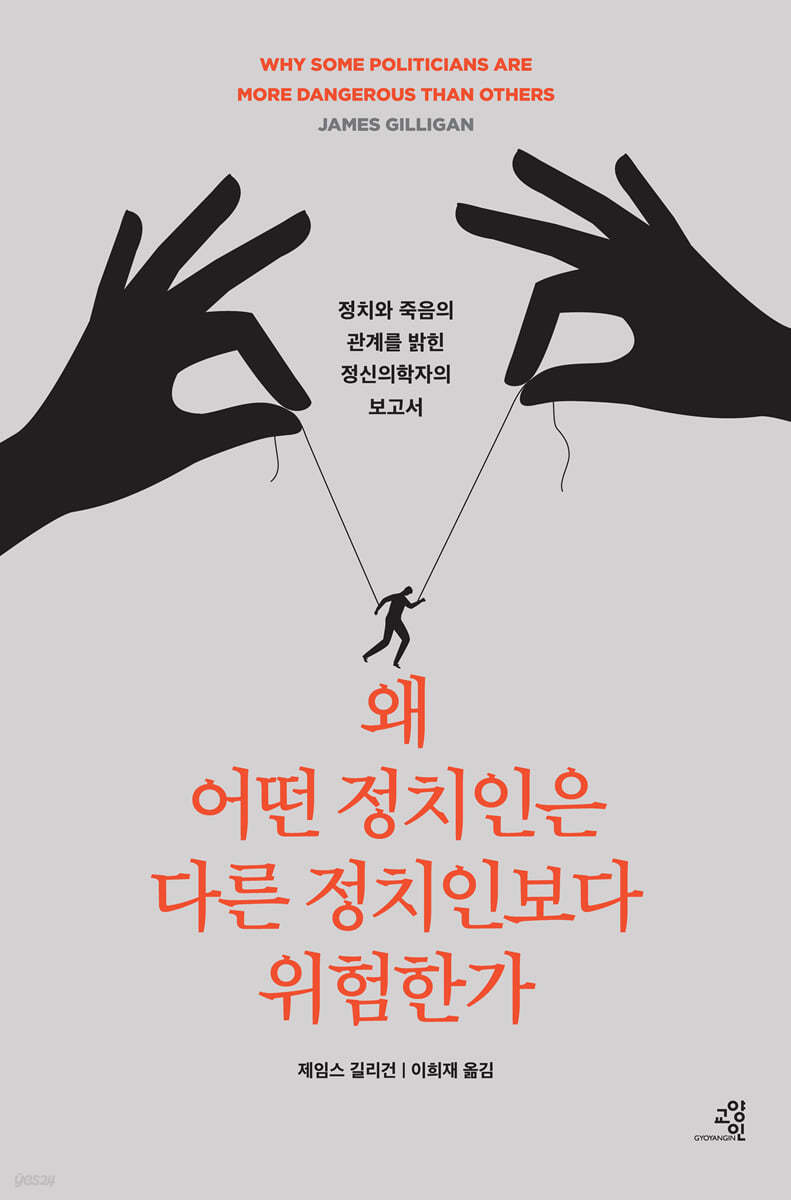
Why Some Politicians Are More Dangerous Than Others
 |
Description
Book Introduction
“Life and death depend on which side we vote for.”
“Whenever conservatives are in power, more people die.”
Solving the Mystery Surrounding a Century of Violent Deaths
A psychiatrist who had been studying violence for decades encountered a strange puzzle one day while analyzing statistics.
The data he analyzed were statistics on suicide and homicide rates in the United States from 1900 to 2007.
For a century, suicide and murder rates consistently soared simultaneously, then fell sharply at the same time.
Why do suicide and homicide rates move in lockstep? Why do the numbers of people who commit suicide out of sadness or "madness" and those who commit murder with criminal motives rise and then fall simultaneously?
The person who challenged this riddle was American psychiatrist James Gilligan.
He discovered a shocking truth that had been hidden in plain sight for a century.
Every time a conservative, or Republican, president becomes president, the entire country suffers from a "deadly contagious violence" of suicide and murder.
He analyzed various statistics and existing research results showing the correlation between population changes in the United States over the past 100 years and economic and social variables such as unemployment, recession, and inequality.
The results revealed a clear causal relationship between the ruling party and suicide and murder rates.
This book is a revised edition of Why Some Politicians Are More Harmful Than Others, published in 2012, and Dangerous Politicians, published in 2015.
“Whenever conservatives are in power, more people die.”
Solving the Mystery Surrounding a Century of Violent Deaths
A psychiatrist who had been studying violence for decades encountered a strange puzzle one day while analyzing statistics.
The data he analyzed were statistics on suicide and homicide rates in the United States from 1900 to 2007.
For a century, suicide and murder rates consistently soared simultaneously, then fell sharply at the same time.
Why do suicide and homicide rates move in lockstep? Why do the numbers of people who commit suicide out of sadness or "madness" and those who commit murder with criminal motives rise and then fall simultaneously?
The person who challenged this riddle was American psychiatrist James Gilligan.
He discovered a shocking truth that had been hidden in plain sight for a century.
Every time a conservative, or Republican, president becomes president, the entire country suffers from a "deadly contagious violence" of suicide and murder.
He analyzed various statistics and existing research results showing the correlation between population changes in the United States over the past 100 years and economic and social variables such as unemployment, recession, and inequality.
The results revealed a clear causal relationship between the ruling party and suicide and murder rates.
This book is a revised edition of Why Some Politicians Are More Harmful Than Others, published in 2012, and Dangerous Politicians, published in 2015.
- You can preview some of the book's contents.
Preview
index
Recommendation | Why Murder and Suicide Increase When Conservatives Take Power (by Cho Hyo-je)
■ Preface | The Mystery of Death and Politics
Chapter 1: The Question of Life and Death
When the Republicans take power, a deadly epidemic spreads.
Long-term rule steepens the death curve.
Why didn't anyone know this?
Chapter 2: The Real Culprit of Suicide and Murder: Inequality
Why did he kill his family?
As inequality increases, murder and suicide rates rise.
Chapter 3: Are conservatives strong on the economy, and progressives weak on the economy?
Why does inequality increase under Republicans and increase under Democrats?
Is it decreasing?
The decisive factor is the president.
1 percent profit vs. 99 percent profit
The 'war on crime' drives up crime rates.
Suicide is a political issue
Chapter 4 Shame Kills
Behind violence lies shame.
The Ethics of Shame and the Ethics of Guilt
There is no violence in an equal society.
Chapter 5: As unemployment increases, shame grows.
The feeling of being abandoned
Chapter 6: Supporters of Conservative and Progressive Parties
The conflict between violent and less violent cultures
Violence is contagious
Authoritarian vs. Egalitarian Personality
My Prison Equality Experiment - Violence Can Be Eliminated
Chapter 7: Politics Decides Between Life and Death
Murder and suicide are political weather vanes.
Politics and the Happiness of the People
Why Murder and Suicide Must Be Viewed Together
In search of politics that saves lives
■ How accurate and complete is the data in Appendix A?
■ Appendix B Figures and Tables
■ Translator's Note
■ Search
■ Preface | The Mystery of Death and Politics
Chapter 1: The Question of Life and Death
When the Republicans take power, a deadly epidemic spreads.
Long-term rule steepens the death curve.
Why didn't anyone know this?
Chapter 2: The Real Culprit of Suicide and Murder: Inequality
Why did he kill his family?
As inequality increases, murder and suicide rates rise.
Chapter 3: Are conservatives strong on the economy, and progressives weak on the economy?
Why does inequality increase under Republicans and increase under Democrats?
Is it decreasing?
The decisive factor is the president.
1 percent profit vs. 99 percent profit
The 'war on crime' drives up crime rates.
Suicide is a political issue
Chapter 4 Shame Kills
Behind violence lies shame.
The Ethics of Shame and the Ethics of Guilt
There is no violence in an equal society.
Chapter 5: As unemployment increases, shame grows.
The feeling of being abandoned
Chapter 6: Supporters of Conservative and Progressive Parties
The conflict between violent and less violent cultures
Violence is contagious
Authoritarian vs. Egalitarian Personality
My Prison Equality Experiment - Violence Can Be Eliminated
Chapter 7: Politics Decides Between Life and Death
Murder and suicide are political weather vanes.
Politics and the Happiness of the People
Why Murder and Suicide Must Be Viewed Together
In search of politics that saves lives
■ How accurate and complete is the data in Appendix A?
■ Appendix B Figures and Tables
■ Translator's Note
■ Search
Detailed image
.jpg)
Publisher's Review
“There are politicians who are more dangerous than others.
It's not that they are bad people or that they don't do any good things.
Because the policies they pursue bring death.”
Why do people continue to vote for the conservative party that pushes them toward a world of increasing inequality and violence? Why do these parties, and the presidents they produce, continue to pursue policies that exacerbate inequality and violence? What drives 99 percent of voters to give over 40 percent of the nation's wealth to just 1 percent of the population? This book answers these questions, one by one.
The author consistently demonstrates the correlation between politics and death with meticulous and cool logic, shockingly showing that suicide and murder are not problems for which individuals should be held responsible, but rather issues for which politics should be held responsible.
Sharp, caustic, and sometimes witty sentences make the book even more engaging.
This book will serve as an important guide for all citizens, voters, and politicians who desire a truly democratic and humane nation.
A psychiatrist studying the causes of violence discovers a shocking truth.
When the conservative Republican Party is in power, the suicide and murder rates in the United States increase, and when the progressive Democratic Party is in power, the rates decrease.
This is a proven fact based on statistical data published by the U.S. government over a period of 107 years from 1900 to 2007.
These changes were too large to be explained by chance, and they showed a consistency strong enough to transcend other variables, including historical upheavals like wars and depressions and differences in the personalities of individual presidents.
There is a crucial difference between the policies of conservative and progressive parties that affects people's lives.
The person who made this shocking discovery was American psychiatrist James Gilligan.
As an expert on violence issues who has been studying the causes and prevention of violence for over 40 years, he stumbled upon this fact while analyzing statistical data and couldn't believe his eyes.
To verify that his findings were not distorted, he reviewed all available data, including official statistics published by the U.S. government, and even broke down the time period under investigation into detail and tried various calculation methods.
But there was no doubt about the outcome.
Another surprising finding is that suicide and homicide rates tend to move in tandem.
This suggests that whatever causes one side to rise is likely to also raise the other side.
Conventional wisdom suggests that murder and suicide are unrelated incidents.
Murder is something that bad criminals do, and suicide is something that sad or 'crazy' people do, so there's no reason to go up and down with them.
But the statistics turn our conventional wisdom upside down.
It is clear that murder and suicide are not individual incidents, but rather social phenomena that move simultaneously under the influence of the same factors.
The author views murder and suicide as fundamentally the same type of violence, as they are acts of violence committed by society against individuals, and calls them “violent homicide.”
To view suicide as an individual mental illness and murder as an individual ethical failing ignores the extent to which both are driven in part by social, economic, and political pressures.
While it is true that numerous personal variables, such as genetics, life experiences, and personality structure, can increase or decrease an individual's tendency to commit suicide or murder, the epidemic of such violent deaths is due to changes in the social environment, including politics and the economy.
― Chapter 3: Are conservatives strong on the economy, and progressives weak on the economy? (Page 120)
To uncover how the correlations shown in statistical figures work in reality, the author delves into political, economic, and social analysis.
The author confesses that he never expected to conduct such an analysis, having lived as a doctor who identifies the causes of mental suffering and disability in people's personal lives rather than in political events.
I am a doctor, not an economist or political scientist.
My interests and the areas in which I was trained and experienced were life and death issues, not recessions and elections.
… … When, while studying the causes and prevention of deaths due to violence, I unexpectedly realized that certain political and economic phenomena could act as “risk factors” that trigger life-threatening behavior or as “protective factors” that prevent or cure such behavior, I was astonished as anyone else.
― Chapter 7: Politics Divides Life and Death (p. 219)
Medicine is not originally a discipline that makes value judgments.
However, if there is one exception, it is when we must protect the value of human life, or the dignity of human life, which is the reason for the existence of medicine.
"Why Some Politicians Are More Dangerous Than Others" is a book about politics, but it is also a book about life. It is a sharp indictment of politics that invites death, and a desperate appeal to find politics that saves lives.
Are conservatives strong on the economy, and progressives weak on the economy?
The most important factor affecting the increase or decrease in suicide and homicide rates is unemployment.
As unemployment rises, homicide and suicide rates rise, and economic variables related to unemployment—poverty, inequality, and recession—are also directly proportional to the incidence of violent deaths.
The problem is that unemployment, poverty, inequality, and recession are worse under Republican administrations than under Democrats.
In the United States, the Republican Party has a strong image as the party that grows the economy, while the Democratic Party is known to be unsuited to growing the economy due to excessive regulations and welfare policies.
However, the results of data analysis are the exact opposite of this common belief.
Under Republican administrations, unemployment was higher, recessions were more frequent, more severe, and longer lasting, and per capita gross national product (GNP) growth was lower than under Democratic administrations.
Policies that reduce inequality lead to economic prosperity.
These differences in the economic performance of the two parties stem from their different economic policies.
The Republican Party pursues policies that concentrate wealth among the wealthy, while the Democratic Party pursues policies that benefit relatively low- and middle-income earners.
If you concentrate all the wealth in the top 1 percent, the other 99 percent will become poorer.
In fact, during the Republican administration, the income growth rate of the low- and middle-income classes was significantly lower than that of the wealthy, and was also significantly lower than that of the low- and middle-income classes during the Democratic administration.
It was the New Deal, which lasted from 1933 to the late 1960s, that reversed the wealth polarization achieved by the Republican Party during the Roaring Twenties.
This was achieved through the introduction of a de facto 'maximum wage' system, which raised the top income tax rate to 90 percent alongside a 'minimum wage', reducing unemployment and providing income support for the first time to those in need (social security, unemployment benefits, etc.), thereby preventing wealth from being concentrated in the hands of a few.
These systems and other policies have resulted in what some economic historians call the "Great Compression," as the gap between income and wealth has narrowed significantly.
From roughly 1940 to 1970, the United States enjoyed not only its most prosperous but also its most economically egalitarian and least violent … … era.
― Chapter 3: Are conservatives strong on the economy, and progressives weak on the economy? (pp. 96-97)
But the era of equality ended with the Republicans' return to power in 1969, and by the Reagan era in the 1980s, inequality had returned to 1920s levels.
When the Clinton administration took office in the 1990s, the rate of increase in inequality slowed to one-third of that of previous Republican presidents.
This was thanks to Clinton's successful implementation of policies that had the effect of redistributing some of the nation's wealth and income from the rich to the poor by reducing unemployment and raising the top income tax, the earned income tax (a negative income tax that gives money to people with jobs but low incomes), the average wage, and the minimum wage.
Why would the 99 percent of have-nots vote for a party that serves the 1 percent?
The Republican Party is not only increasing murder and suicide rates, but also has a disappointing economic performance.
So why do Americans still vote Republican? The author reveals the paradoxical structure in which policies that exacerbate inequality and violence are precisely what help the Republican Party win.
Inequality increases violent crime.
When crime appears to be on the rise, Americans tend to criticize progressive policies that prioritize human rights and welfare and turn to conservative candidates.
This is because they agree with policies that punish criminals harshly and are reluctant to 'freely' give welfare benefits to low-income people, who make up the majority of criminals.
The author emphasizes that the Republican Party maintains power based on a "divide and conquer" strategy that makes the upper and lower middle classes hate the poorest.
Since the main victims of violent crime are the poor, even if violent crime increases, the wealthy do not feel much threatened because they live in communal housing areas guarded by security guards or pay expensive private security companies.
… … As crime and violence rates rise, the middle class and the poor are tricked into hating each other, and it becomes harder for them to realize that the people who are really picking their pockets are not the relatively small number of armed robbers in their midst, but the even smaller number of very well-off people and the Republican politicians who represent them and move money from the poor and middle class to the very rich.
― Chapter 3: Are conservatives strong on the economy, and progressives weak on the economy? (pp. 103-104)
Senator Charles Schumer characterizes the Republican strategy this way:
“The Republican Party wants to see more criminals.
The Republican Party only wins when it is divided over race.
… … If you try to win over non-racial issues like abortion or homosexuality, you will always lose.
That's why the Republican Party is so obsessed with crime.
… … Then you win.
The Republican Party knows that.” ― Chapter 3 Are conservatives strong on the economy, and progressives weak on the economy? (pp. 105-106)
The key to divide and conquer is high crime rates
Divide and conquer is aided by high crime rates.
Republicans advocate policies that deal harshly with criminals, but those policies actually encourage crime.
Since the mid-1970s, when Republican President Nixon declared a "war on crime," the U.S. incarceration rate has increased sevenfold.
The author cites research showing that Republican policies, including strict drug crackdowns, transferring juveniles to adult prisons, legalizing corporal punishment of children, and legalizing private gun ownership, fuel violence.
For example, despite numerous studies showing that severe punishment of children increases their tendency to violence, the Republican administration continues to push for legalization of corporal punishment of children, and Republican lawmakers and supporters strongly support this policy.
Between 1984 and 1994, the murder and homicide rates among American youth ages 14 to 17 tripled, most of which involved handguns.
However, it is still a long way from banning private gun ownership in the United States.
The Republican Party supports the National Rifle Association, a key lobbying group opposing handgun control, and the NRA supports the Republican Party.
So, Republicans can claim that they want to bring down crime by cracking down on crime while actually increasing it, and they can gain the upper hand by accusing Democrats of being lukewarm in their approach to crime.
If crime rates weren't high, Republicans would lose their strategy of sweeping votes by projecting an image as a party that punishes crime hard.
Shame kills
To understand violence, we must understand the social causes as well as the psychology of the individuals who commit violence.
Since the individual is ultimately the main perpetrator of violence, whether the victim is oneself or another, we cannot understand or explain violence without understanding what drives individuals to violence.
The author points out shame as the root cause of violence.
When people are suffering unbearably from shame, they try to escape from the shame by transferring the shame within them onto others, or they use violence against others to avoid the pain of feeling shame in the first place.
The reason people hurt others is because they want to prove that they are weaker and that it is not they who should feel shame, but others.
Meanwhile, shame causes not only murder but also suicide.
People who feel 'guilt' over the impulse to relieve shame by harming others often aim their aggression arrows at themselves rather than others.
The violent impulses that shame triggers toward others are sometimes so powerful that they can only be prevented from being directed at others if they are directed at oneself.
Because both murder and suicide are rooted in shame, in societies where people feel a lot of shame, both murder and suicide rates rise simultaneously.
People sometimes choose suicide as the only means of escape from unbearably painful shame.
… … To properly understand the full picture of suicide, we must also consider another emotion: guilt.
Guilt is an emotion that scolds oneself.
… … Shame can lead to aggressive and aggressive behavior towards others, which in some exceptional circumstances can even escalate to murder.
The psychological function of guilt is to inhibit (or block) the aggression toward others that shame stimulates.
But the hostile and violent impulses toward others that shame stimulates are sometimes so powerful that we have to vent them on ourselves to prevent them from being directed at others.
― Chapter 4 Shame Kills People (pp. 127-128)
Shame is a core emotion of right-wing politics.
The ethics of shame advocates a hierarchical social system in which the superior enjoy honor and the inferior feel shame, while the ethics of guilt advocates egalitarianism so that no one feels superior to others and experiences the humiliation of being considered inferior.
A two-pronged value system can be identified in Plato, Aristotle, Nietzsche, Christian thought, psychology, and anthropology.
In politics, shame is a core emotion of right-wing politics, and guilt is a core emotion of left-wing politics.
The difference in ethics between the two is clearly evident in the modern American right-wing Republican Party and the left-wing Democratic Party.
A political example of such contrasting attitudes can be seen in the contrasting platforms put forward by Presidents Franklin Roosevelt and Ronald Reagan.
Roosevelt said.
“The success or failure of progress depends not on whether we add to the abundance of those who have too much, but on whether we give enough to those who have too little.” On the other hand, Reagan said (referring to the Republican Party):
“We are the party that wants to see an America where people can continue to get richer.” Roosevelt… … actually achieved that goal through his economic policies and political activities.
Reagan can be seen as favoring the powerful—a concept meaningless without a comparatively poorer group—who could still become richer, and as advocating for increasing inequality. (He achieved this goal through economic policies and political actions, such as tax cuts for the rich, reduced welfare benefits for the poor, reduced corporate regulation, and suppression of unions.) ― Chapter 4: Shame Kills (pp. 133–134)
Conservative party supporters vs. progressive party supporters
On November 7, 2000, Republican George W.
Bush and Democrat Al Gore engaged in a fierce battle for the 43rd President of the United States.
The next morning, Americans saw a startling map on television and in the newspapers.
The country was politically divided into 'red states' and 'blue states'.
Red states voted for Bush, blue states voted for Gore.
This was not simply a political confrontation, but also a confrontation between more violent and less violent cultures.
In Republican-controlled areas, violence increases, just as it did in Republican-controlled times, and in Democratic-controlled areas, violence decreases, just as it did in Democratic-controlled times.
In 2004, the violent death rate in red states was 19.6 per 100,000 people, compared to 14.2 in blue states.
Red states also have significantly higher rates of death penalty and incarceration than blue states.
Between 1976 and 2009, 1,177 people were executed in red states, compared to 54 in blue states.
Most of the red states are in the southern and western regions of the United States.
In the South and West, racial discrimination, honor duels, and lynchings long persisted.
The ethics of shame are deeply rooted in this culture of violence.
Societies like the American South, which might be called more "extreme" shame cultures, have, both past and present, perpetuated practices that contribute significantly to shame and violent behavior.
One of them is… …the strengthening of social classes.
Slavery was an extreme form of this social stratification, and racial stratification continues today through means such as the high incarceration rates and disenfranchisement of African Americans.
To demote a group within the same nation to a lower position in the status hierarchy is to bring shame and humiliation upon them.
… … This would result in an increase in violence, as seen in the South.
― Chapter 6: Conservative and Progressive Party Supporters (p. 168)
The difference between red and blue states is similar to the difference between the ethics of shame and the ethics of guilt, and similar to the policy differences between Republicans and Democrats.
In a culture dominated by the ethic of shame, like the Red State, shame-driven personalities thrive, and shame-driven personalities reproduce Republican administrations that enact policies that create the conditions of inferiority that foster shame.
The cases of red states and blue states clearly show the close connection between three variables: party affiliation, culture, and personality.
My family's life depends on my vote.
Why Some Politicians Are More Dangerous Than Others shows that some politicians are more harmful than others.
It's not because they are bad people, but because the policies they pursue lead to death.
In other words, the political party that produces the president has a greater influence on social change than the president's personal character.
Knowing these facts, voters' voting criteria are bound to change.
The author emphasizes that it is important to remember that we are voting for the party to which he belongs, not the individual, and that we are voting based on all the ideologies associated with that party, whether we like them or not.
In fact, one of the purposes of framing the campaign as a purely personal contest between the two candidates is to distract voters from the real policy differences between the two parties.
This is because the debate focuses on individuals, on what they have personally accomplished and what scandals they have been involved in, and not on the results of the two parties' policies and their political and economic performance.
― Chapter 7: Politics Divides Life and Death (p. 217)
Another valuable lesson this book conveys is that it is far more effective and important to identify the social and economic risk factors that lead to violence and the protective factors that prevent it, rather than providing post-hoc prescriptions, such as treatment or imprisonment, after a violent act has occurred.
In the 19th century, we realized that a clean water supply and sewer system were more effective in preventing death than all the doctors, medicines, and hospitals in the world.
In the 20th century, we learned that it is much cheaper and more effective to prevent food contamination than to treat food poisoning after it occurs.
In the same vein, in the 21st century, we need to learn that preventing and controlling the epidemics of suicide and homicide is far more effective when we create clean political and economic systems by reducing the inequality, shame, and despair that are directly linked to these epidemics than when we pour our limited resources into treating or punishing those already exposed to these risk factors.
Chapter 7: Politics Divides Life and Death (pp. 222-223)
It's not that they are bad people or that they don't do any good things.
Because the policies they pursue bring death.”
Why do people continue to vote for the conservative party that pushes them toward a world of increasing inequality and violence? Why do these parties, and the presidents they produce, continue to pursue policies that exacerbate inequality and violence? What drives 99 percent of voters to give over 40 percent of the nation's wealth to just 1 percent of the population? This book answers these questions, one by one.
The author consistently demonstrates the correlation between politics and death with meticulous and cool logic, shockingly showing that suicide and murder are not problems for which individuals should be held responsible, but rather issues for which politics should be held responsible.
Sharp, caustic, and sometimes witty sentences make the book even more engaging.
This book will serve as an important guide for all citizens, voters, and politicians who desire a truly democratic and humane nation.
A psychiatrist studying the causes of violence discovers a shocking truth.
When the conservative Republican Party is in power, the suicide and murder rates in the United States increase, and when the progressive Democratic Party is in power, the rates decrease.
This is a proven fact based on statistical data published by the U.S. government over a period of 107 years from 1900 to 2007.
These changes were too large to be explained by chance, and they showed a consistency strong enough to transcend other variables, including historical upheavals like wars and depressions and differences in the personalities of individual presidents.
There is a crucial difference between the policies of conservative and progressive parties that affects people's lives.
The person who made this shocking discovery was American psychiatrist James Gilligan.
As an expert on violence issues who has been studying the causes and prevention of violence for over 40 years, he stumbled upon this fact while analyzing statistical data and couldn't believe his eyes.
To verify that his findings were not distorted, he reviewed all available data, including official statistics published by the U.S. government, and even broke down the time period under investigation into detail and tried various calculation methods.
But there was no doubt about the outcome.
Another surprising finding is that suicide and homicide rates tend to move in tandem.
This suggests that whatever causes one side to rise is likely to also raise the other side.
Conventional wisdom suggests that murder and suicide are unrelated incidents.
Murder is something that bad criminals do, and suicide is something that sad or 'crazy' people do, so there's no reason to go up and down with them.
But the statistics turn our conventional wisdom upside down.
It is clear that murder and suicide are not individual incidents, but rather social phenomena that move simultaneously under the influence of the same factors.
The author views murder and suicide as fundamentally the same type of violence, as they are acts of violence committed by society against individuals, and calls them “violent homicide.”
To view suicide as an individual mental illness and murder as an individual ethical failing ignores the extent to which both are driven in part by social, economic, and political pressures.
While it is true that numerous personal variables, such as genetics, life experiences, and personality structure, can increase or decrease an individual's tendency to commit suicide or murder, the epidemic of such violent deaths is due to changes in the social environment, including politics and the economy.
― Chapter 3: Are conservatives strong on the economy, and progressives weak on the economy? (Page 120)
To uncover how the correlations shown in statistical figures work in reality, the author delves into political, economic, and social analysis.
The author confesses that he never expected to conduct such an analysis, having lived as a doctor who identifies the causes of mental suffering and disability in people's personal lives rather than in political events.
I am a doctor, not an economist or political scientist.
My interests and the areas in which I was trained and experienced were life and death issues, not recessions and elections.
… … When, while studying the causes and prevention of deaths due to violence, I unexpectedly realized that certain political and economic phenomena could act as “risk factors” that trigger life-threatening behavior or as “protective factors” that prevent or cure such behavior, I was astonished as anyone else.
― Chapter 7: Politics Divides Life and Death (p. 219)
Medicine is not originally a discipline that makes value judgments.
However, if there is one exception, it is when we must protect the value of human life, or the dignity of human life, which is the reason for the existence of medicine.
"Why Some Politicians Are More Dangerous Than Others" is a book about politics, but it is also a book about life. It is a sharp indictment of politics that invites death, and a desperate appeal to find politics that saves lives.
Are conservatives strong on the economy, and progressives weak on the economy?
The most important factor affecting the increase or decrease in suicide and homicide rates is unemployment.
As unemployment rises, homicide and suicide rates rise, and economic variables related to unemployment—poverty, inequality, and recession—are also directly proportional to the incidence of violent deaths.
The problem is that unemployment, poverty, inequality, and recession are worse under Republican administrations than under Democrats.
In the United States, the Republican Party has a strong image as the party that grows the economy, while the Democratic Party is known to be unsuited to growing the economy due to excessive regulations and welfare policies.
However, the results of data analysis are the exact opposite of this common belief.
Under Republican administrations, unemployment was higher, recessions were more frequent, more severe, and longer lasting, and per capita gross national product (GNP) growth was lower than under Democratic administrations.
Policies that reduce inequality lead to economic prosperity.
These differences in the economic performance of the two parties stem from their different economic policies.
The Republican Party pursues policies that concentrate wealth among the wealthy, while the Democratic Party pursues policies that benefit relatively low- and middle-income earners.
If you concentrate all the wealth in the top 1 percent, the other 99 percent will become poorer.
In fact, during the Republican administration, the income growth rate of the low- and middle-income classes was significantly lower than that of the wealthy, and was also significantly lower than that of the low- and middle-income classes during the Democratic administration.
It was the New Deal, which lasted from 1933 to the late 1960s, that reversed the wealth polarization achieved by the Republican Party during the Roaring Twenties.
This was achieved through the introduction of a de facto 'maximum wage' system, which raised the top income tax rate to 90 percent alongside a 'minimum wage', reducing unemployment and providing income support for the first time to those in need (social security, unemployment benefits, etc.), thereby preventing wealth from being concentrated in the hands of a few.
These systems and other policies have resulted in what some economic historians call the "Great Compression," as the gap between income and wealth has narrowed significantly.
From roughly 1940 to 1970, the United States enjoyed not only its most prosperous but also its most economically egalitarian and least violent … … era.
― Chapter 3: Are conservatives strong on the economy, and progressives weak on the economy? (pp. 96-97)
But the era of equality ended with the Republicans' return to power in 1969, and by the Reagan era in the 1980s, inequality had returned to 1920s levels.
When the Clinton administration took office in the 1990s, the rate of increase in inequality slowed to one-third of that of previous Republican presidents.
This was thanks to Clinton's successful implementation of policies that had the effect of redistributing some of the nation's wealth and income from the rich to the poor by reducing unemployment and raising the top income tax, the earned income tax (a negative income tax that gives money to people with jobs but low incomes), the average wage, and the minimum wage.
Why would the 99 percent of have-nots vote for a party that serves the 1 percent?
The Republican Party is not only increasing murder and suicide rates, but also has a disappointing economic performance.
So why do Americans still vote Republican? The author reveals the paradoxical structure in which policies that exacerbate inequality and violence are precisely what help the Republican Party win.
Inequality increases violent crime.
When crime appears to be on the rise, Americans tend to criticize progressive policies that prioritize human rights and welfare and turn to conservative candidates.
This is because they agree with policies that punish criminals harshly and are reluctant to 'freely' give welfare benefits to low-income people, who make up the majority of criminals.
The author emphasizes that the Republican Party maintains power based on a "divide and conquer" strategy that makes the upper and lower middle classes hate the poorest.
Since the main victims of violent crime are the poor, even if violent crime increases, the wealthy do not feel much threatened because they live in communal housing areas guarded by security guards or pay expensive private security companies.
… … As crime and violence rates rise, the middle class and the poor are tricked into hating each other, and it becomes harder for them to realize that the people who are really picking their pockets are not the relatively small number of armed robbers in their midst, but the even smaller number of very well-off people and the Republican politicians who represent them and move money from the poor and middle class to the very rich.
― Chapter 3: Are conservatives strong on the economy, and progressives weak on the economy? (pp. 103-104)
Senator Charles Schumer characterizes the Republican strategy this way:
“The Republican Party wants to see more criminals.
The Republican Party only wins when it is divided over race.
… … If you try to win over non-racial issues like abortion or homosexuality, you will always lose.
That's why the Republican Party is so obsessed with crime.
… … Then you win.
The Republican Party knows that.” ― Chapter 3 Are conservatives strong on the economy, and progressives weak on the economy? (pp. 105-106)
The key to divide and conquer is high crime rates
Divide and conquer is aided by high crime rates.
Republicans advocate policies that deal harshly with criminals, but those policies actually encourage crime.
Since the mid-1970s, when Republican President Nixon declared a "war on crime," the U.S. incarceration rate has increased sevenfold.
The author cites research showing that Republican policies, including strict drug crackdowns, transferring juveniles to adult prisons, legalizing corporal punishment of children, and legalizing private gun ownership, fuel violence.
For example, despite numerous studies showing that severe punishment of children increases their tendency to violence, the Republican administration continues to push for legalization of corporal punishment of children, and Republican lawmakers and supporters strongly support this policy.
Between 1984 and 1994, the murder and homicide rates among American youth ages 14 to 17 tripled, most of which involved handguns.
However, it is still a long way from banning private gun ownership in the United States.
The Republican Party supports the National Rifle Association, a key lobbying group opposing handgun control, and the NRA supports the Republican Party.
So, Republicans can claim that they want to bring down crime by cracking down on crime while actually increasing it, and they can gain the upper hand by accusing Democrats of being lukewarm in their approach to crime.
If crime rates weren't high, Republicans would lose their strategy of sweeping votes by projecting an image as a party that punishes crime hard.
Shame kills
To understand violence, we must understand the social causes as well as the psychology of the individuals who commit violence.
Since the individual is ultimately the main perpetrator of violence, whether the victim is oneself or another, we cannot understand or explain violence without understanding what drives individuals to violence.
The author points out shame as the root cause of violence.
When people are suffering unbearably from shame, they try to escape from the shame by transferring the shame within them onto others, or they use violence against others to avoid the pain of feeling shame in the first place.
The reason people hurt others is because they want to prove that they are weaker and that it is not they who should feel shame, but others.
Meanwhile, shame causes not only murder but also suicide.
People who feel 'guilt' over the impulse to relieve shame by harming others often aim their aggression arrows at themselves rather than others.
The violent impulses that shame triggers toward others are sometimes so powerful that they can only be prevented from being directed at others if they are directed at oneself.
Because both murder and suicide are rooted in shame, in societies where people feel a lot of shame, both murder and suicide rates rise simultaneously.
People sometimes choose suicide as the only means of escape from unbearably painful shame.
… … To properly understand the full picture of suicide, we must also consider another emotion: guilt.
Guilt is an emotion that scolds oneself.
… … Shame can lead to aggressive and aggressive behavior towards others, which in some exceptional circumstances can even escalate to murder.
The psychological function of guilt is to inhibit (or block) the aggression toward others that shame stimulates.
But the hostile and violent impulses toward others that shame stimulates are sometimes so powerful that we have to vent them on ourselves to prevent them from being directed at others.
― Chapter 4 Shame Kills People (pp. 127-128)
Shame is a core emotion of right-wing politics.
The ethics of shame advocates a hierarchical social system in which the superior enjoy honor and the inferior feel shame, while the ethics of guilt advocates egalitarianism so that no one feels superior to others and experiences the humiliation of being considered inferior.
A two-pronged value system can be identified in Plato, Aristotle, Nietzsche, Christian thought, psychology, and anthropology.
In politics, shame is a core emotion of right-wing politics, and guilt is a core emotion of left-wing politics.
The difference in ethics between the two is clearly evident in the modern American right-wing Republican Party and the left-wing Democratic Party.
A political example of such contrasting attitudes can be seen in the contrasting platforms put forward by Presidents Franklin Roosevelt and Ronald Reagan.
Roosevelt said.
“The success or failure of progress depends not on whether we add to the abundance of those who have too much, but on whether we give enough to those who have too little.” On the other hand, Reagan said (referring to the Republican Party):
“We are the party that wants to see an America where people can continue to get richer.” Roosevelt… … actually achieved that goal through his economic policies and political activities.
Reagan can be seen as favoring the powerful—a concept meaningless without a comparatively poorer group—who could still become richer, and as advocating for increasing inequality. (He achieved this goal through economic policies and political actions, such as tax cuts for the rich, reduced welfare benefits for the poor, reduced corporate regulation, and suppression of unions.) ― Chapter 4: Shame Kills (pp. 133–134)
Conservative party supporters vs. progressive party supporters
On November 7, 2000, Republican George W.
Bush and Democrat Al Gore engaged in a fierce battle for the 43rd President of the United States.
The next morning, Americans saw a startling map on television and in the newspapers.
The country was politically divided into 'red states' and 'blue states'.
Red states voted for Bush, blue states voted for Gore.
This was not simply a political confrontation, but also a confrontation between more violent and less violent cultures.
In Republican-controlled areas, violence increases, just as it did in Republican-controlled times, and in Democratic-controlled areas, violence decreases, just as it did in Democratic-controlled times.
In 2004, the violent death rate in red states was 19.6 per 100,000 people, compared to 14.2 in blue states.
Red states also have significantly higher rates of death penalty and incarceration than blue states.
Between 1976 and 2009, 1,177 people were executed in red states, compared to 54 in blue states.
Most of the red states are in the southern and western regions of the United States.
In the South and West, racial discrimination, honor duels, and lynchings long persisted.
The ethics of shame are deeply rooted in this culture of violence.
Societies like the American South, which might be called more "extreme" shame cultures, have, both past and present, perpetuated practices that contribute significantly to shame and violent behavior.
One of them is… …the strengthening of social classes.
Slavery was an extreme form of this social stratification, and racial stratification continues today through means such as the high incarceration rates and disenfranchisement of African Americans.
To demote a group within the same nation to a lower position in the status hierarchy is to bring shame and humiliation upon them.
… … This would result in an increase in violence, as seen in the South.
― Chapter 6: Conservative and Progressive Party Supporters (p. 168)
The difference between red and blue states is similar to the difference between the ethics of shame and the ethics of guilt, and similar to the policy differences between Republicans and Democrats.
In a culture dominated by the ethic of shame, like the Red State, shame-driven personalities thrive, and shame-driven personalities reproduce Republican administrations that enact policies that create the conditions of inferiority that foster shame.
The cases of red states and blue states clearly show the close connection between three variables: party affiliation, culture, and personality.
My family's life depends on my vote.
Why Some Politicians Are More Dangerous Than Others shows that some politicians are more harmful than others.
It's not because they are bad people, but because the policies they pursue lead to death.
In other words, the political party that produces the president has a greater influence on social change than the president's personal character.
Knowing these facts, voters' voting criteria are bound to change.
The author emphasizes that it is important to remember that we are voting for the party to which he belongs, not the individual, and that we are voting based on all the ideologies associated with that party, whether we like them or not.
In fact, one of the purposes of framing the campaign as a purely personal contest between the two candidates is to distract voters from the real policy differences between the two parties.
This is because the debate focuses on individuals, on what they have personally accomplished and what scandals they have been involved in, and not on the results of the two parties' policies and their political and economic performance.
― Chapter 7: Politics Divides Life and Death (p. 217)
Another valuable lesson this book conveys is that it is far more effective and important to identify the social and economic risk factors that lead to violence and the protective factors that prevent it, rather than providing post-hoc prescriptions, such as treatment or imprisonment, after a violent act has occurred.
In the 19th century, we realized that a clean water supply and sewer system were more effective in preventing death than all the doctors, medicines, and hospitals in the world.
In the 20th century, we learned that it is much cheaper and more effective to prevent food contamination than to treat food poisoning after it occurs.
In the same vein, in the 21st century, we need to learn that preventing and controlling the epidemics of suicide and homicide is far more effective when we create clean political and economic systems by reducing the inequality, shame, and despair that are directly linked to these epidemics than when we pour our limited resources into treating or punishing those already exposed to these risk factors.
Chapter 7: Politics Divides Life and Death (pp. 222-223)
GOODS SPECIFICS
- Date of issue: May 26, 2023
- Page count, weight, size: 276 pages | 386g | 140*208*15mm
- ISBN13: 9791187064992
- ISBN10: 1187064998
You may also like
카테고리
korean


korean

![GQ KOREA Mark (Monthly): December [2025]](http://librairie.coreenne.fr/cdn/shop/files/8ef265dbbfbf186523ed75ba7319009d.jpg?v=1765340328&width=3840)


