

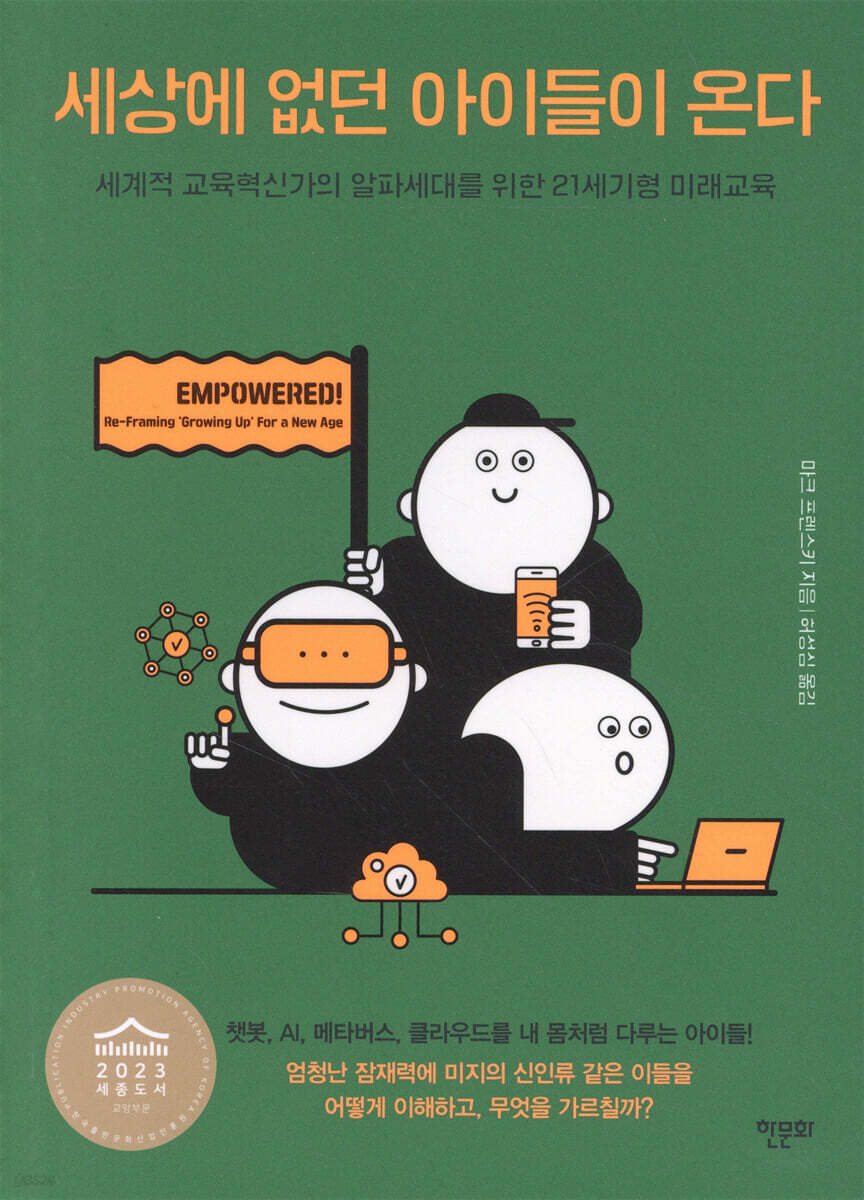
Children who never existed before are coming to the world.
 |
Description
Book Introduction
Children who treat chatbots, AI, the metaverse, and the cloud as if they were their own bodies.
How can we understand and teach these new, unknown beings with enormous potential?
How should education change for the 21st-century alpha generation, who cannot be defined by the established generation?
"The World's First Children Are Coming" is a book by Mark Prensky, a world-renowned educational innovator and futurist, that presents a paradigm for future education for 21st century youth.
He focuses on the world 20 years from now (around 2040), a future that is neither too far nor too near.
Most of today's older generations worry about what will happen to their children in the next two to three years, or they tend to focus on relatively short-term periods, such as the 10-year plans put forth by the UN or OECD.
But it's important to focus on a longer-term, more predictable future.
This is because this period is equivalent to the time it takes for today's youth to grow up and lead the world.
The author defines today's youth as 'hybrid humans' who have become one with technology from birth.
He is also the first generation of 'digital natives', a new term he coined 20 years ago, and can be said to be a new generation of humans and the alpha generation with completely different capabilities, values, and beliefs from today's adults.
Therefore, a completely different 'perception (frame) shift' is needed not only in educating and nurturing them, but also in various areas such as their growth process, titles, living space, learning and skills, and occupations.
Because we can no longer help children with the old 20th century framework.
This book presents innovative and timely ideas about the new world our children will inhabit, and will challenge readers to think in a completely different way.
For educators confused about how to guide students who are so different from the older generation, parents of children who are addicted to smartphones, video games, and YouTube, and anyone curious about the future of education or seeking a shift in mindset, this will present the ultimate vision for understanding and preparing for the future.
How can we understand and teach these new, unknown beings with enormous potential?
How should education change for the 21st-century alpha generation, who cannot be defined by the established generation?
"The World's First Children Are Coming" is a book by Mark Prensky, a world-renowned educational innovator and futurist, that presents a paradigm for future education for 21st century youth.
He focuses on the world 20 years from now (around 2040), a future that is neither too far nor too near.
Most of today's older generations worry about what will happen to their children in the next two to three years, or they tend to focus on relatively short-term periods, such as the 10-year plans put forth by the UN or OECD.
But it's important to focus on a longer-term, more predictable future.
This is because this period is equivalent to the time it takes for today's youth to grow up and lead the world.
The author defines today's youth as 'hybrid humans' who have become one with technology from birth.
He is also the first generation of 'digital natives', a new term he coined 20 years ago, and can be said to be a new generation of humans and the alpha generation with completely different capabilities, values, and beliefs from today's adults.
Therefore, a completely different 'perception (frame) shift' is needed not only in educating and nurturing them, but also in various areas such as their growth process, titles, living space, learning and skills, and occupations.
Because we can no longer help children with the old 20th century framework.
This book presents innovative and timely ideas about the new world our children will inhabit, and will challenge readers to think in a completely different way.
For educators confused about how to guide students who are so different from the older generation, parents of children who are addicted to smartphones, video games, and YouTube, and anyone curious about the future of education or seeking a shift in mindset, this will present the ultimate vision for understanding and preparing for the future.
- You can preview some of the book's contents.
Preview
index
Part 1 │ Capacity Building for a New Generation
Chapter 1.
A New Journey for Youth: A 20-Year Vision for Change and Growth
Part 2 │ Changing the Framework for Viewing the 21st Century
Chapter 2.
Seeing the World in a New Way - From Old Frames to 21st Century Frames
Chapter 3.
The Age of Youth - From the Fourth Industrial Revolution to the Age of Capacity Building
Chapter 4.
Who are the youth? - From human with tools to hybrid human
Chapter 5.
A youth's living space - from the world of imagination to the world of the cloud
Chapter 6.
Youth Beliefs - From Old Beliefs to Empowering Beliefs
Chapter 7.
The Future of Youth - A Frontier to Explore in the Experiential World
Chapter 8.
Youth's Ambition - From Replacers of the Old Generation to Role Creators
Chapter 9.
The Education Youth Needs - From Academic Success to Social Participation
Chapter 10.
The title for youth - from children or little ones to the first generation of empowerment or the alpha generation
Part 3 │ A New Perception of the Future of Learning and Technology
Chapter 11.
Youth learning - as a means of social participation, not an end goal
Chapter 12.
Skills Youth Need - From 21st Century Skills to Diamond Skills
Part 4 │ A New Perception of the Growth Process
Chapter 13.
Growth that strengthens capabilities - From an old framework to a framework for realizing dreams
Chapter 14.
Parenting for a New Era - From Ownership and Control to Curating and Empowerment
Chapter 15.
Basic skills for a new era - from reading, writing, and arithmetic to coexistence with technology.
Chapter 16.
School Days and Curriculum - From Classroom Lessons to Real-Life Projects That Change the World
Chapter 17.
What is a Capacity Building Hub? - A space for realizing projects at the school's center.
Chapter 18.
Evaluation Methods in the Era of Capacity Building - From Ranking to Pre- and Post-Difference Comparison and MPI
Chapter 19.
Higher Education for a New Era - From the Process of Obtaining Certification to the Process of Finding Colleagues
Chapter 20.
Defining work for the new era - activities that add unique value to one's job
Part 5 │ A New Perception of Humanity
Chapter 21.
Towards a new humanity - from individuals made in the image of God to humanity with a collective mind
main
Chapter 1.
A New Journey for Youth: A 20-Year Vision for Change and Growth
Part 2 │ Changing the Framework for Viewing the 21st Century
Chapter 2.
Seeing the World in a New Way - From Old Frames to 21st Century Frames
Chapter 3.
The Age of Youth - From the Fourth Industrial Revolution to the Age of Capacity Building
Chapter 4.
Who are the youth? - From human with tools to hybrid human
Chapter 5.
A youth's living space - from the world of imagination to the world of the cloud
Chapter 6.
Youth Beliefs - From Old Beliefs to Empowering Beliefs
Chapter 7.
The Future of Youth - A Frontier to Explore in the Experiential World
Chapter 8.
Youth's Ambition - From Replacers of the Old Generation to Role Creators
Chapter 9.
The Education Youth Needs - From Academic Success to Social Participation
Chapter 10.
The title for youth - from children or little ones to the first generation of empowerment or the alpha generation
Part 3 │ A New Perception of the Future of Learning and Technology
Chapter 11.
Youth learning - as a means of social participation, not an end goal
Chapter 12.
Skills Youth Need - From 21st Century Skills to Diamond Skills
Part 4 │ A New Perception of the Growth Process
Chapter 13.
Growth that strengthens capabilities - From an old framework to a framework for realizing dreams
Chapter 14.
Parenting for a New Era - From Ownership and Control to Curating and Empowerment
Chapter 15.
Basic skills for a new era - from reading, writing, and arithmetic to coexistence with technology.
Chapter 16.
School Days and Curriculum - From Classroom Lessons to Real-Life Projects That Change the World
Chapter 17.
What is a Capacity Building Hub? - A space for realizing projects at the school's center.
Chapter 18.
Evaluation Methods in the Era of Capacity Building - From Ranking to Pre- and Post-Difference Comparison and MPI
Chapter 19.
Higher Education for a New Era - From the Process of Obtaining Certification to the Process of Finding Colleagues
Chapter 20.
Defining work for the new era - activities that add unique value to one's job
Part 5 │ A New Perception of Humanity
Chapter 21.
Towards a new humanity - from individuals made in the image of God to humanity with a collective mind
main
Detailed image

Into the book
The journey to capacity building is expected to take approximately 20 years.
This period is equivalent to the time it takes for today's youth born in the 21st century to grow up and lead the world.
This book is about today's youth generation and the process by which their capabilities are gradually strengthened.
And if the older generation doesn't block the way, this is a story about the space where the younger generation will live around 2040.
We must pay attention to this 20-year period.
This is because most of the current generation is concerned about what will happen to their children in the next two to three years, or they tend to focus on relatively short-term periods, such as the UN's 'Sustainable Development Goals' or the OECD's '10-year plan'.
For our children, it's important to focus on a more long-term, predictable future.
---「Chapter 1.
From “A New Journey for Youth”
Today's adults were born and raised in a 20th-century world where virtually no power was granted to a still-growing child.
Therefore, the new journey toward capacity building must begin with today's youth.
A key element in this journey is to transform the way today's youth, the 21st century human race, view the world.
Compared to the world of the 20th century, their world would be significantly different from what adults perceive.
Although most young people cannot yet articulate this clearly, some young people and adults are beginning to accept that the world is changing rapidly and that success in the mid- to late-21st century requires a "new growth process."
---「Chapter 1.
From “A New Journey for Youth”
If usefulness and benefit are the most important criteria for selecting a frame, it would not be optimal to define the frame of our time solely based on human dominance, industrial development, or technology.
I believe the most helpful framework for the coming new era is the “empowerment framework,” which focuses on the empowerment and strength of young people.
If the new generation uses this power only positively, this frame will have a positive impact on all aspects, including humans, industry, technology, and society as a whole.
Empowering young people will ultimately lead to empowering all of humanity.
I believe the most beneficial frame for the 21st century is one where youth have moved from a time when they were almost powerless to one where they can participate in society with greater power than ever before in history.
---「Chapter 3.
From "The Age of Youth"
Young people have already begun to move into a symbiotic relationship with technology.
Anyone who has experienced how difficult it is to completely take smartphones away from teenagers will nod in agreement.
So why is it so hard to put our smartphones away? Is it because they're so addictive? This is a common view, but it's flawed.
There are things that humans crave immediately after experiencing them, such as comfort or ease.
But we don't say we are 'addicted' to comfort or ease.
Our desire for more technology is not an addiction, but rather a kind of natural selection or evolution.
Humans who have technology always carry weapons that can maximize their abilities.
It's like having a new arm that can reach out wherever you want.
---「Chapter 4.
From "Who are the youth?"
The shift in perception I propose is to move away from viewing parents as the owners and controllers of their children, to viewing them as curators who bring out the uniqueness and added value of their children.
To help children develop their uniqueness and unique added value, and to strengthen their capabilities, parents must foster self-understanding, empower children, and allow them to form new symbiotic relationships with digital technologies from an early age.
Even in this new era of empowerment, adults can still play a vital role in children's development.
Adult guidance will be of great help in the child's growth process.
However, we must first realize that for this to become a growth process that leads to true capacity building, a new kind of guidance is needed.
---「Chapter 14.
From “Parenting for a New Era”
As we enter a new era of capacity building, activities that were once continuous, such as academic learning, are evolving into "short-term activities" with measurable results.
This is also in line with the trend of the times, which seeks speed and simplicity over complexity or boredom.
While some schools already offer project-based learning, as we've seen, these are often little more than a modified version of existing learning methods.
But now there is a way.
If our children are to thrive more than they do now, we need a shift in how we prepare them for adulthood.
So, I believe we need to move beyond the notion that preparing for adulthood requires taking courses or completing job training, and instead move toward a new approach: continuously working on real-world projects that impact the world, and in the process acquiring the knowledge and skills necessary to successfully complete them.
---「 Chapter 17.
From "What is a Capacity Building Hub?"
Today's youth face a world where applying their uniqueness and creativity is paramount, rather than preparing for the future or replacing previous generations.
In the new world, it is important to create added value in your own unique way.
Humans in the 21st century will be best able to help the world when they discover their true selves through the process of creating unique added value.
There will never be a shortage of dreams for humanity to realize, problems to fix, and people in need, and a desire to help others.
In this new era of empowerment, realizing dreams, solving problems, and helping people will be the "new things."
This period is equivalent to the time it takes for today's youth born in the 21st century to grow up and lead the world.
This book is about today's youth generation and the process by which their capabilities are gradually strengthened.
And if the older generation doesn't block the way, this is a story about the space where the younger generation will live around 2040.
We must pay attention to this 20-year period.
This is because most of the current generation is concerned about what will happen to their children in the next two to three years, or they tend to focus on relatively short-term periods, such as the UN's 'Sustainable Development Goals' or the OECD's '10-year plan'.
For our children, it's important to focus on a more long-term, predictable future.
---「Chapter 1.
From “A New Journey for Youth”
Today's adults were born and raised in a 20th-century world where virtually no power was granted to a still-growing child.
Therefore, the new journey toward capacity building must begin with today's youth.
A key element in this journey is to transform the way today's youth, the 21st century human race, view the world.
Compared to the world of the 20th century, their world would be significantly different from what adults perceive.
Although most young people cannot yet articulate this clearly, some young people and adults are beginning to accept that the world is changing rapidly and that success in the mid- to late-21st century requires a "new growth process."
---「Chapter 1.
From “A New Journey for Youth”
If usefulness and benefit are the most important criteria for selecting a frame, it would not be optimal to define the frame of our time solely based on human dominance, industrial development, or technology.
I believe the most helpful framework for the coming new era is the “empowerment framework,” which focuses on the empowerment and strength of young people.
If the new generation uses this power only positively, this frame will have a positive impact on all aspects, including humans, industry, technology, and society as a whole.
Empowering young people will ultimately lead to empowering all of humanity.
I believe the most beneficial frame for the 21st century is one where youth have moved from a time when they were almost powerless to one where they can participate in society with greater power than ever before in history.
---「Chapter 3.
From "The Age of Youth"
Young people have already begun to move into a symbiotic relationship with technology.
Anyone who has experienced how difficult it is to completely take smartphones away from teenagers will nod in agreement.
So why is it so hard to put our smartphones away? Is it because they're so addictive? This is a common view, but it's flawed.
There are things that humans crave immediately after experiencing them, such as comfort or ease.
But we don't say we are 'addicted' to comfort or ease.
Our desire for more technology is not an addiction, but rather a kind of natural selection or evolution.
Humans who have technology always carry weapons that can maximize their abilities.
It's like having a new arm that can reach out wherever you want.
---「Chapter 4.
From "Who are the youth?"
The shift in perception I propose is to move away from viewing parents as the owners and controllers of their children, to viewing them as curators who bring out the uniqueness and added value of their children.
To help children develop their uniqueness and unique added value, and to strengthen their capabilities, parents must foster self-understanding, empower children, and allow them to form new symbiotic relationships with digital technologies from an early age.
Even in this new era of empowerment, adults can still play a vital role in children's development.
Adult guidance will be of great help in the child's growth process.
However, we must first realize that for this to become a growth process that leads to true capacity building, a new kind of guidance is needed.
---「Chapter 14.
From “Parenting for a New Era”
As we enter a new era of capacity building, activities that were once continuous, such as academic learning, are evolving into "short-term activities" with measurable results.
This is also in line with the trend of the times, which seeks speed and simplicity over complexity or boredom.
While some schools already offer project-based learning, as we've seen, these are often little more than a modified version of existing learning methods.
But now there is a way.
If our children are to thrive more than they do now, we need a shift in how we prepare them for adulthood.
So, I believe we need to move beyond the notion that preparing for adulthood requires taking courses or completing job training, and instead move toward a new approach: continuously working on real-world projects that impact the world, and in the process acquiring the knowledge and skills necessary to successfully complete them.
---「 Chapter 17.
From "What is a Capacity Building Hub?"
Today's youth face a world where applying their uniqueness and creativity is paramount, rather than preparing for the future or replacing previous generations.
In the new world, it is important to create added value in your own unique way.
Humans in the 21st century will be best able to help the world when they discover their true selves through the process of creating unique added value.
There will never be a shortage of dreams for humanity to realize, problems to fix, and people in need, and a desire to help others.
In this new era of empowerment, realizing dreams, solving problems, and helping people will be the "new things."
---「Chapter 20.
From “Definition of Work for the New Era”
From “Definition of Work for the New Era”
Publisher's Review
ChatGPT, AI, Metaverse, Cloud…
The era of 'hybrid humans' who are one with technology has begun!
From Chat GPT, which has emerged as a keyword for 2023, to generative AI, the metaverse, and the cloud, the era of the Fourth Industrial Revolution is rapidly becoming a reality.
For so long, we've focused primarily on new technologies and the changes they bring, but we've neglected to consider our children, who will face the greatest transformations as they utilize them.
While the older generation fears the new world ahead, children, on the contrary, see this rapidly changing era as an exciting new frontier.
Mark Prensky first proposed the concept of "digital natives" over 20 years ago, referring to a generation that has been born with digital habits and thoughts due to the use of digital language and devices.
He says that today's children, the first generation of digital natives born in the 21st century, cannot be confined by the outdated thinking or traditional educational methods of the 20th century.
They are a generation that has been toying with technology since birth, connecting with friends from all over the world no matter where they are, and implementing projects that change their surroundings or benefit the world in surprising ways that older generations never imagined.
This book tells us that now is the time to look at these children from a completely different perspective than in the past.
He also emphasizes that it is time to think together about what can be done to develop their capabilities.
The golden time for educational innovation is right now!
A must-read if you want to raise your child to be a capable person.
It is a waste of time and money to teach today's youth, who will live in the mid-to-late 21st century, using the old methods that were popular in the 20th century.
The world has changed rapidly, and advances in digital technology have made it possible to connect and communicate with people from almost anywhere around the world.
However, if we look at the educational environment, we see adults with outdated 20th-century frames treating children as if they were their own children, still obsessed with spoon-fed knowledge education, and trying to lead them on the path they want.
It is now necessary to re-evaluate the unique identity of the youth generation, the places they will live, their beliefs, their future, and their aspirations.
Future learning and technology must also be viewed through a new framework of perception.
The development of artificial intelligence and various digital technologies is even changing the traditional roles of teachers and students.
What kind of talent should teachers and parents pursue, and what and how should they educate? As familiar boundaries are collapsing, this book will serve as the ultimate guide to helping children discover their uniqueness, utilize it to make the world a better place, and, in the process, realize their dreams.
It will show you in detail the changes that will come in the future.
Presenting pioneers and educational examples
You can meet examples of young pioneers who are concretely showing us the changes to come, such as youth activist Greta Thunberg, who spoke at the 'Climate Action Summit' held at the UN headquarters; Gitanjali Rao, who created a device to detect lead in the early stages of a serious water contamination crisis in Flint, Michigan; a 15-year-old boy who invented sandals that emit an alarm using the energy generated when walking for women in rural India; a 13-year-old girl who created a family tracking app for Alzheimer's patients; 3-year-old children in Spain who designed low-profile trash cans and then persuaded the mayor to install them on every utility pole; and a team of middle school girls in Georgia, USA, who created a prosthetic hand with a 3D printer and found users through social media.
We also share examples of schools that have strengthened children's capabilities by helping them participate in society, such as the 'Hi-Tech High' autonomous public school and Riverside School in the U.S., which teach in a different way from the existing curriculum, the Concept School in Brazil, and the student-led social participation project 'Design for Change (DFC)'.
Through examples like these, we can see realistic and concrete paths for our children to become leading figures in the world.
The era of 'hybrid humans' who are one with technology has begun!
From Chat GPT, which has emerged as a keyword for 2023, to generative AI, the metaverse, and the cloud, the era of the Fourth Industrial Revolution is rapidly becoming a reality.
For so long, we've focused primarily on new technologies and the changes they bring, but we've neglected to consider our children, who will face the greatest transformations as they utilize them.
While the older generation fears the new world ahead, children, on the contrary, see this rapidly changing era as an exciting new frontier.
Mark Prensky first proposed the concept of "digital natives" over 20 years ago, referring to a generation that has been born with digital habits and thoughts due to the use of digital language and devices.
He says that today's children, the first generation of digital natives born in the 21st century, cannot be confined by the outdated thinking or traditional educational methods of the 20th century.
They are a generation that has been toying with technology since birth, connecting with friends from all over the world no matter where they are, and implementing projects that change their surroundings or benefit the world in surprising ways that older generations never imagined.
This book tells us that now is the time to look at these children from a completely different perspective than in the past.
He also emphasizes that it is time to think together about what can be done to develop their capabilities.
The golden time for educational innovation is right now!
A must-read if you want to raise your child to be a capable person.
It is a waste of time and money to teach today's youth, who will live in the mid-to-late 21st century, using the old methods that were popular in the 20th century.
The world has changed rapidly, and advances in digital technology have made it possible to connect and communicate with people from almost anywhere around the world.
However, if we look at the educational environment, we see adults with outdated 20th-century frames treating children as if they were their own children, still obsessed with spoon-fed knowledge education, and trying to lead them on the path they want.
It is now necessary to re-evaluate the unique identity of the youth generation, the places they will live, their beliefs, their future, and their aspirations.
Future learning and technology must also be viewed through a new framework of perception.
The development of artificial intelligence and various digital technologies is even changing the traditional roles of teachers and students.
What kind of talent should teachers and parents pursue, and what and how should they educate? As familiar boundaries are collapsing, this book will serve as the ultimate guide to helping children discover their uniqueness, utilize it to make the world a better place, and, in the process, realize their dreams.
It will show you in detail the changes that will come in the future.
Presenting pioneers and educational examples
You can meet examples of young pioneers who are concretely showing us the changes to come, such as youth activist Greta Thunberg, who spoke at the 'Climate Action Summit' held at the UN headquarters; Gitanjali Rao, who created a device to detect lead in the early stages of a serious water contamination crisis in Flint, Michigan; a 15-year-old boy who invented sandals that emit an alarm using the energy generated when walking for women in rural India; a 13-year-old girl who created a family tracking app for Alzheimer's patients; 3-year-old children in Spain who designed low-profile trash cans and then persuaded the mayor to install them on every utility pole; and a team of middle school girls in Georgia, USA, who created a prosthetic hand with a 3D printer and found users through social media.
We also share examples of schools that have strengthened children's capabilities by helping them participate in society, such as the 'Hi-Tech High' autonomous public school and Riverside School in the U.S., which teach in a different way from the existing curriculum, the Concept School in Brazil, and the student-led social participation project 'Design for Change (DFC)'.
Through examples like these, we can see realistic and concrete paths for our children to become leading figures in the world.
GOODS SPECIFICS
- Date of issue: May 15, 2023
- Page count, weight, size: 284 pages | 152*210*20mm
- ISBN13: 9788956994505
- ISBN10: 8956994501
You may also like
카테고리
korean


korean

![GQ KOREA Mark (Monthly): December [2025]](http://librairie.coreenne.fr/cdn/shop/files/8ef265dbbfbf186523ed75ba7319009d.jpg?v=1765340328&width=3840)


