

Law Essays for Teens
 |
Description
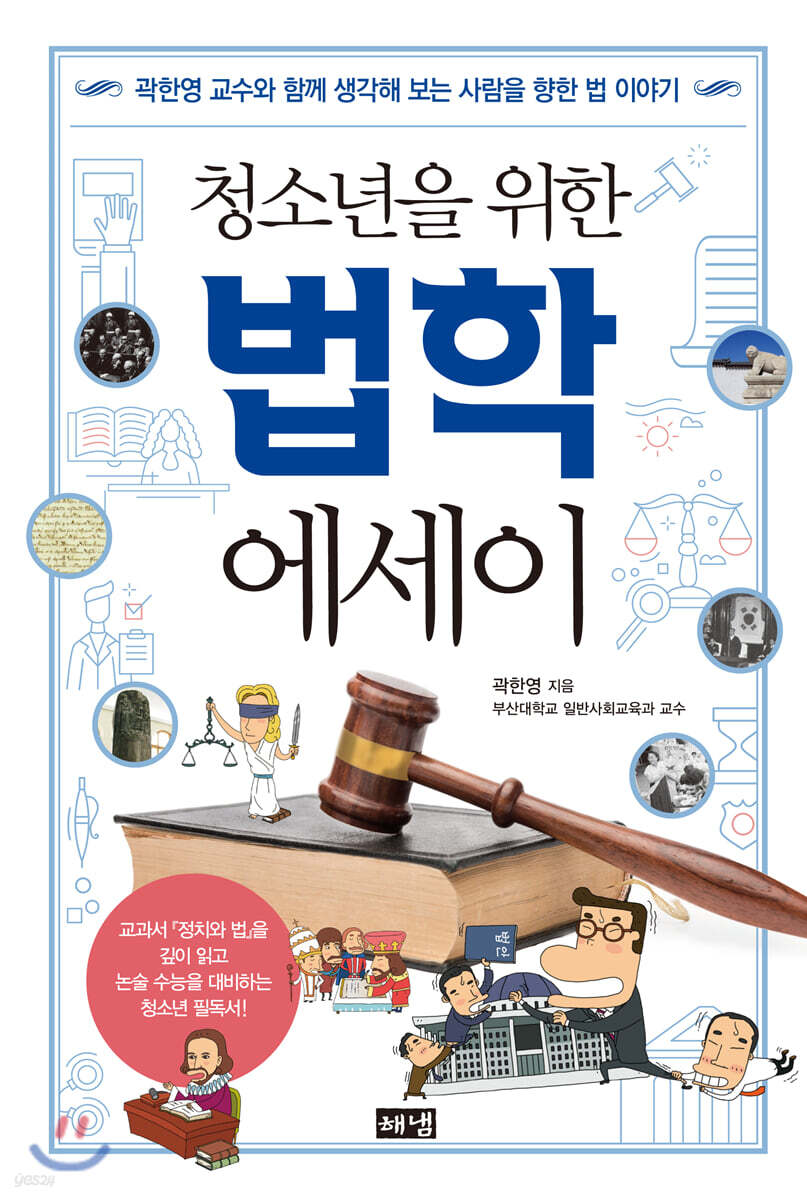
Book Introduction
Professor Kwak Han-young of Pusan National University, a leader in legal education for youth, guides youth through “Law Essays for Youth” to understand the history of law, the spirit of the Constitution, and the dynamics within social issues. This is also the sixteenth book in the 'Haeneum Youth Essay Series', which aims to enhance the culture and critical thinking skills of Korean youth. The author says that the 'law' is the minimum promise that must be kept in order to live a human life. The purpose of law is to establish justice in society, and to do this, we must be able to ask ourselves what is natural. Rather than simply explaining the concepts and types of law, this book poses various questions related to law, allowing young people to judge right and wrong in the world and contemplate how to live. |
- You can preview some of the book's contents.
Preview
index
Prologue: What is natural for humans?
Chapter 1: The Law: From God to Man
1 The Judge I Met in the Underworld
2 Haetae and unicorn, symbols of the law
3 Into an era of written laws that everyone can see and understand
4 Social violence in the name of God, witch trials
Going One Step Further: The Law That Became a Human Promise
Chapter 2: The Constitution and the Birth of Democracy
1 The Root of the Constitution, Magna Carta
2 Midnight Judge Begins Constitutional Court Tribunal
3. The Great Inefficiency for Democracy: Separation of Powers
4. The Constitution, Giving Birth to the Republic of Korea
5 How has our country's constitution changed?
Going one step further: Our country's first constitution
Chapter 3: Law Towards Human Rights
1. Guarantee women the right to vote! The Suffragette Movement
2 Separate things can never be equal. The abolition of racial discrimination in America.
3. The Beginning of the Miranda Rights: 'You Have the Right to an Attorney'
4. Women should be protected by men. Abolish the household system.
5. The Death Penalty: A Protection or Violation of Human Rights: The George Stinney Case
Going a Step Further: The Beginnings of Modern Criminal Law, Crime and Punishment
Chapter 4: Those Who Obeyed the Law, Those Who Established Justice
1. Qualifications of a Judge: Chief Justice Kim Byung-ro
2 Justice sometimes demands life Judge Giovanni Falcone
3. Standing on the side of the people in the name of conscience: Attorney Tatsuji Fuse
4. A path begins when someone goes first. Female lawyer Lee Tae-young.
Going One Step Further: Public Defenders Who Shine a Light in Dark Places
Chapter 5: The Unending Debate Surrounding Law and Humanity
1 Are Slaves Human? The Amistad Incident
2. Is it okay to harm others to survive? The Minyonet Incident
Is it a crime to follow the orders of a state? Eichmann Trial
4. My child won't go to school! The Yoder Incident
Going a Step Further: Why Do Judicial Robes Look Like Academic Robes?
References
Chapter 1: The Law: From God to Man
1 The Judge I Met in the Underworld
2 Haetae and unicorn, symbols of the law
3 Into an era of written laws that everyone can see and understand
4 Social violence in the name of God, witch trials
Going One Step Further: The Law That Became a Human Promise
Chapter 2: The Constitution and the Birth of Democracy
1 The Root of the Constitution, Magna Carta
2 Midnight Judge Begins Constitutional Court Tribunal
3. The Great Inefficiency for Democracy: Separation of Powers
4. The Constitution, Giving Birth to the Republic of Korea
5 How has our country's constitution changed?
Going one step further: Our country's first constitution
Chapter 3: Law Towards Human Rights
1. Guarantee women the right to vote! The Suffragette Movement
2 Separate things can never be equal. The abolition of racial discrimination in America.
3. The Beginning of the Miranda Rights: 'You Have the Right to an Attorney'
4. Women should be protected by men. Abolish the household system.
5. The Death Penalty: A Protection or Violation of Human Rights: The George Stinney Case
Going a Step Further: The Beginnings of Modern Criminal Law, Crime and Punishment
Chapter 4: Those Who Obeyed the Law, Those Who Established Justice
1. Qualifications of a Judge: Chief Justice Kim Byung-ro
2 Justice sometimes demands life Judge Giovanni Falcone
3. Standing on the side of the people in the name of conscience: Attorney Tatsuji Fuse
4. A path begins when someone goes first. Female lawyer Lee Tae-young.
Going One Step Further: Public Defenders Who Shine a Light in Dark Places
Chapter 5: The Unending Debate Surrounding Law and Humanity
1 Are Slaves Human? The Amistad Incident
2. Is it okay to harm others to survive? The Minyonet Incident
Is it a crime to follow the orders of a state? Eichmann Trial
4. My child won't go to school! The Yoder Incident
Going a Step Further: Why Do Judicial Robes Look Like Academic Robes?
References
Detailed image
Into the book
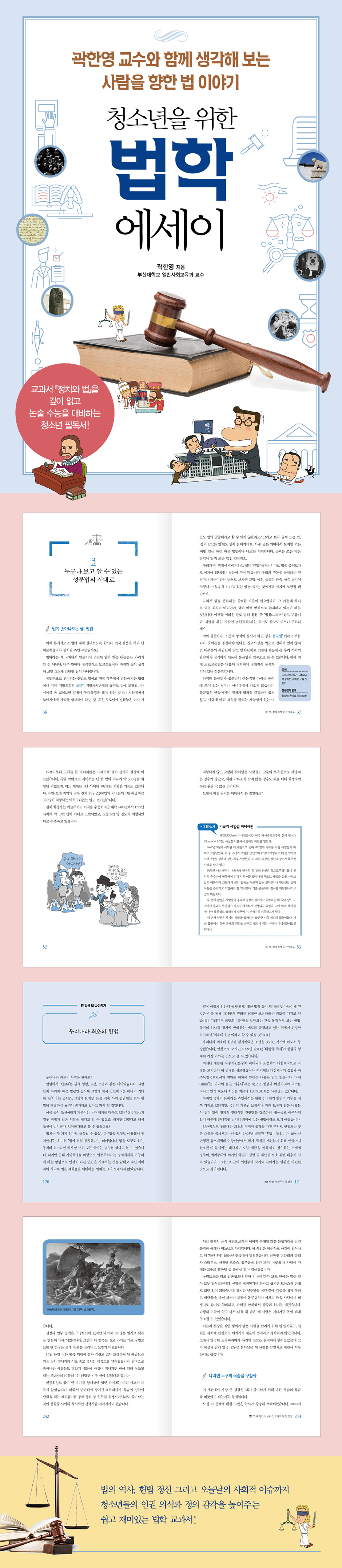
In 1884, a ship carrying four people - Captain Dudley, Mate Stevens, Seaman Brooks, and errand boy Parker - sank in a storm while heading to Australia.
They escaped on a lifeboat, but soon the boat ran out of food.
The captain suggested a lottery, but Brooks objected and it was abandoned.
But after enduring for a week, Parker, unable to bear his thirst, drank seawater and writhe in pain, so they agreed to make him a sacrifice since he was going to die anyway, and killed Parker.
It quenched my thirst and hunger.
Fortunately, four days after the tragedy, the remaining three were rescued by a passing German ship.
Captain Dudley did not consider cannibalism a crime because it was an act of saving the lives of those left behind and was considered a common practice among sailors.
So, as soon as he arrived in England, he told the whole story honestly, but contrary to his expectations, the British government decided to bring the three survivors to trial for murder.
The biggest issue in this case is whether it is okay to take another person's life in order to survive.
We often use the expression 'committed a crime', but strictly speaking, in legal terms, a crime is 'an act that disrupts social order', and the sanctions imposed by the state for this are called 'punishment'.
Because the state's power to punish individuals is so powerful, there is a risk that it could infringe on individual rights or lead to excessive punishment.
So, the criminal law sets very strict conditions for what constitutes a crime, to prevent the state from abusing its power to punish.
There are three steps to determine whether something is a crime or not, as if filtering it through a funnel: the elements of the crime, illegality, and responsibility.
A representative example of the reasons for the loss of responsibility is ‘acts performed under duress.’
If someone points a gun at another person's head and threatens them to hit their friend, it is clearly an assault, but it is not right to punish the person who hit them for a crime because it was an unavoidable act.
How would we judge this crime by applying it to Eichmann's case? He clearly participated in the crime of murdering Jews, so he could be considered a criminal, and the act of killing people cannot be exempt from the law.
But as a soldier, he was in a position where he had to obey orders.
He never killed anyone directly, he was just doing his job.
Indeed, one may question whether it would have been possible for an officer, as a soldier, to question the rightness or wrongness of an order, to resist or even refuse to follow it, especially in the special circumstances of war.
They escaped on a lifeboat, but soon the boat ran out of food.
The captain suggested a lottery, but Brooks objected and it was abandoned.
But after enduring for a week, Parker, unable to bear his thirst, drank seawater and writhe in pain, so they agreed to make him a sacrifice since he was going to die anyway, and killed Parker.
It quenched my thirst and hunger.
Fortunately, four days after the tragedy, the remaining three were rescued by a passing German ship.
Captain Dudley did not consider cannibalism a crime because it was an act of saving the lives of those left behind and was considered a common practice among sailors.
So, as soon as he arrived in England, he told the whole story honestly, but contrary to his expectations, the British government decided to bring the three survivors to trial for murder.
The biggest issue in this case is whether it is okay to take another person's life in order to survive.
We often use the expression 'committed a crime', but strictly speaking, in legal terms, a crime is 'an act that disrupts social order', and the sanctions imposed by the state for this are called 'punishment'.
Because the state's power to punish individuals is so powerful, there is a risk that it could infringe on individual rights or lead to excessive punishment.
So, the criminal law sets very strict conditions for what constitutes a crime, to prevent the state from abusing its power to punish.
There are three steps to determine whether something is a crime or not, as if filtering it through a funnel: the elements of the crime, illegality, and responsibility.
A representative example of the reasons for the loss of responsibility is ‘acts performed under duress.’
If someone points a gun at another person's head and threatens them to hit their friend, it is clearly an assault, but it is not right to punish the person who hit them for a crime because it was an unavoidable act.
How would we judge this crime by applying it to Eichmann's case? He clearly participated in the crime of murdering Jews, so he could be considered a criminal, and the act of killing people cannot be exempt from the law.
But as a soldier, he was in a position where he had to obey orders.
He never killed anyone directly, he was just doing his job.
Indeed, one may question whether it would have been possible for an officer, as a soldier, to question the rightness or wrongness of an order, to resist or even refuse to follow it, especially in the special circumstances of war.
---From the text
Publisher's Review
From the history of law, the spirit of the Constitution, to today's social issues
An easy and fun law textbook that raises young people's awareness of human rights and a sense of justice!
Why do judges' attire resemble those of clergymen? Where did the Miranda rule, often heard in crime films, begin with "You have the right to remain silent," come from? When did the witch trials we so often encounter on social media begin? The law is so ubiquitous in our daily lives, yet we often avoid it and distance ourselves from it due to the perception that it's fearful and rigid.
Young people, who are a major part of society, also often think that the 'law' is irrelevant to them and is inconvenient.
However, no one can ignore the law in order to live as a healthy citizen in a democratic society.
Because the law is an important social norm that maintains and functions properly in our society.
Professor Kwak Han-young of Pusan National University, who has been at the forefront of legal education for youth, kindly guides youth to understand the history of law, the spirit of the Constitution, and the dynamics within social issues through “Law Essays for Youth.”
This is also the sixteenth book in the 'Haeneum Youth Essay Series', which aims to enhance the culture and critical thinking skills of Korean youth.
The author says that the 'law' is the minimum promise that must be kept in order to live a human life.
The purpose of law is to establish justice in society, and to do this, we must be able to ask ourselves what is natural.
Rather than simply explaining the concepts and types of law, this book poses various questions related to law, allowing young people to judge right and wrong in the world and contemplate how to live.
Chapter 1, “Law, From God to Man,” introduces the process of reducing the law, which was God’s will, to the agreement of human beings, and deals with the sacrifices and suffering that occurred during that process, such as the “Witch Trials.”
Chapter 2, “The Constitution, the Birth of Democracy,” shows how the “Constitution,” the blueprint for the nation, protects human rights and happiness.
We will examine five functions of the Constitutional Court of Korea, including the beginning of constitutional adjudication.
We also clear up misunderstandings about our country's constitution and look into the process of its revision.
Chapter 3, "Law Towards Human Rights," examines the efforts of countless people and legal mechanisms to protect human rights from the state and society.
It shows where society should be headed through rulings on issues such as women's suffrage, racial discrimination, and the death penalty.
In Chapter 4, “People Who Upheld the Law, People Who Established Justice,” we meet historical legal figures who dedicated themselves to maintaining a democratic and civil society.
It introduces Korea's first Chief Justice Kim Byung-ro, Italian judge Giovanni Falcone who fought against criminal forces, and Japanese lawyer Tatsuji Fuse who stood up for Koreans.
Chapter 5, “The Unending Debate Surrounding Law and Humanity,” presents trials that remain controversial to this day, including the Mignonette case, the Eichmann trial, and the Yoder case.
It gives young people time to think for themselves about controversial issues such as whether humans can be bought and sold, whether the happiness of the majority is always justified, and whether it is a crime to commit massacre on the orders of the state.
This book is a general legal textbook that explains, from a young person's perspective, topics such as "what is law?", "how the legal system is created", and "what is the role of those who deal with law?"
Above all, the author, with his flowing writing style, covers the history of law from its inception to the present and explains interesting events that have occurred in the process of its evolution in an interesting way.
Moreover, this book does not simply instill one-sided knowledge about the law.
Each section has a 'Questions to Think About' section, which poses various questions to encourage young people to think about and discuss the reality surrounding them.
At the end of each chapter, the "Going One Step Further" section introduces ideas, legal provisions, and civic movements that have had a decisive impact on social change, providing an engaging account of how law has been connected to society and motivating young people to actively voice their opinions on social issues.
Recently, young people have filed a constitutional petition claiming that the government's passive response to greenhouse gas reduction agreements is unconstitutional, but most young people still feel that the law is difficult and distant.
This book will help young people bridge the gap between themselves and the law, giving them the opportunity to grow into individuals who value human rights and respect the values of freedom and justice.
It will serve as a valuable reference not only for teenagers but also for teachers and parents who want to raise children to be healthy citizens in our society.
An easy and fun law textbook that raises young people's awareness of human rights and a sense of justice!
Why do judges' attire resemble those of clergymen? Where did the Miranda rule, often heard in crime films, begin with "You have the right to remain silent," come from? When did the witch trials we so often encounter on social media begin? The law is so ubiquitous in our daily lives, yet we often avoid it and distance ourselves from it due to the perception that it's fearful and rigid.
Young people, who are a major part of society, also often think that the 'law' is irrelevant to them and is inconvenient.
However, no one can ignore the law in order to live as a healthy citizen in a democratic society.
Because the law is an important social norm that maintains and functions properly in our society.
Professor Kwak Han-young of Pusan National University, who has been at the forefront of legal education for youth, kindly guides youth to understand the history of law, the spirit of the Constitution, and the dynamics within social issues through “Law Essays for Youth.”
This is also the sixteenth book in the 'Haeneum Youth Essay Series', which aims to enhance the culture and critical thinking skills of Korean youth.
The author says that the 'law' is the minimum promise that must be kept in order to live a human life.
The purpose of law is to establish justice in society, and to do this, we must be able to ask ourselves what is natural.
Rather than simply explaining the concepts and types of law, this book poses various questions related to law, allowing young people to judge right and wrong in the world and contemplate how to live.
Chapter 1, “Law, From God to Man,” introduces the process of reducing the law, which was God’s will, to the agreement of human beings, and deals with the sacrifices and suffering that occurred during that process, such as the “Witch Trials.”
Chapter 2, “The Constitution, the Birth of Democracy,” shows how the “Constitution,” the blueprint for the nation, protects human rights and happiness.
We will examine five functions of the Constitutional Court of Korea, including the beginning of constitutional adjudication.
We also clear up misunderstandings about our country's constitution and look into the process of its revision.
Chapter 3, "Law Towards Human Rights," examines the efforts of countless people and legal mechanisms to protect human rights from the state and society.
It shows where society should be headed through rulings on issues such as women's suffrage, racial discrimination, and the death penalty.
In Chapter 4, “People Who Upheld the Law, People Who Established Justice,” we meet historical legal figures who dedicated themselves to maintaining a democratic and civil society.
It introduces Korea's first Chief Justice Kim Byung-ro, Italian judge Giovanni Falcone who fought against criminal forces, and Japanese lawyer Tatsuji Fuse who stood up for Koreans.
Chapter 5, “The Unending Debate Surrounding Law and Humanity,” presents trials that remain controversial to this day, including the Mignonette case, the Eichmann trial, and the Yoder case.
It gives young people time to think for themselves about controversial issues such as whether humans can be bought and sold, whether the happiness of the majority is always justified, and whether it is a crime to commit massacre on the orders of the state.
This book is a general legal textbook that explains, from a young person's perspective, topics such as "what is law?", "how the legal system is created", and "what is the role of those who deal with law?"
Above all, the author, with his flowing writing style, covers the history of law from its inception to the present and explains interesting events that have occurred in the process of its evolution in an interesting way.
Moreover, this book does not simply instill one-sided knowledge about the law.
Each section has a 'Questions to Think About' section, which poses various questions to encourage young people to think about and discuss the reality surrounding them.
At the end of each chapter, the "Going One Step Further" section introduces ideas, legal provisions, and civic movements that have had a decisive impact on social change, providing an engaging account of how law has been connected to society and motivating young people to actively voice their opinions on social issues.
Recently, young people have filed a constitutional petition claiming that the government's passive response to greenhouse gas reduction agreements is unconstitutional, but most young people still feel that the law is difficult and distant.
This book will help young people bridge the gap between themselves and the law, giving them the opportunity to grow into individuals who value human rights and respect the values of freedom and justice.
It will serve as a valuable reference not only for teenagers but also for teachers and parents who want to raise children to be healthy citizens in our society.
GOODS SPECIFICS
- Publication date: June 25, 2020
- Page count, weight, size: 280 pages | 498g | 153*224*20mm
- ISBN13: 9788965749455
- ISBN10: 896574945X
You may also like
카테고리
korean


korean

![GQ KOREA Mark (Monthly): December [2025]](http://librairie.coreenne.fr/cdn/shop/files/8ef265dbbfbf186523ed75ba7319009d.jpg?v=1765340328&width=3840)


