

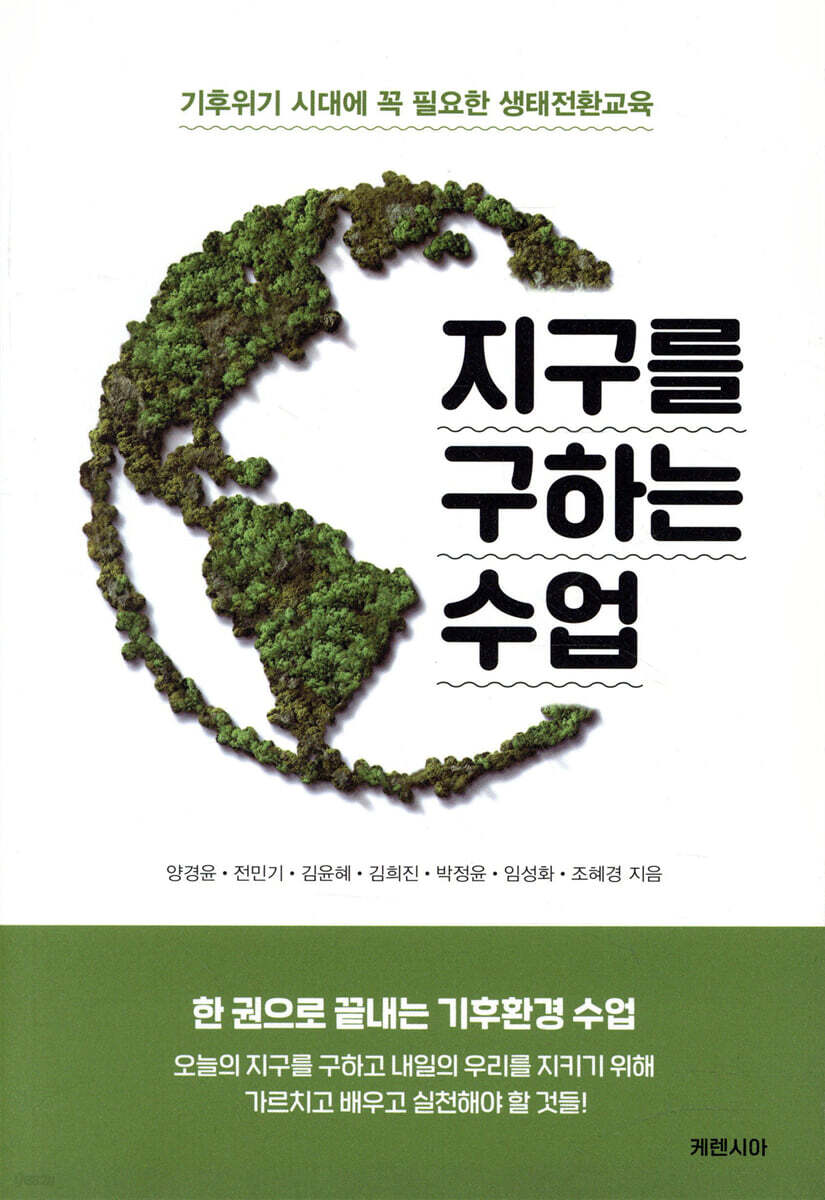
Classes to Save the Earth
 |
Description
Book Introduction
Climate and environment classes in one volume
To save the Earth today and protect us tomorrow
Things to teach, learn, and practice!
A Hands-On Guide to Climate and Environment Education You Can Practice Right Now
Awareness and interest in environmental issues, represented by the 'climate crisis', have greatly increased.
Global trends such as 'ESG' and 'RE100' tell us that we can no longer live without considering the 'environment'.
Accordingly, the need for environmental education has also greatly increased, and efforts are being made to ‘ecological transition education’ and ‘ecological environmental education.’
Although there have been efforts by teachers in the past to recognize the severity of environmental issues and the need for environmental education, environmental education remains difficult for most teachers, and even when they try to do so, they are at a loss as to how to proceed.
Teachers are already well aware of climate crisis and environmental issues.
However, the reason why we are unable to incorporate it into our classes is because we are tied down by the curriculum progress and do not know how to incorporate it into our classes.
To achieve this, it is crucial to have a proper understanding of why the climate crisis should be addressed in the curriculum.
So, this book contains climate topics that I hope will be given priority consideration and addressed in teacher training curricula.
And we organized the material so that it could be applied directly to class.
To save the Earth today and protect us tomorrow
Things to teach, learn, and practice!
A Hands-On Guide to Climate and Environment Education You Can Practice Right Now
Awareness and interest in environmental issues, represented by the 'climate crisis', have greatly increased.
Global trends such as 'ESG' and 'RE100' tell us that we can no longer live without considering the 'environment'.
Accordingly, the need for environmental education has also greatly increased, and efforts are being made to ‘ecological transition education’ and ‘ecological environmental education.’
Although there have been efforts by teachers in the past to recognize the severity of environmental issues and the need for environmental education, environmental education remains difficult for most teachers, and even when they try to do so, they are at a loss as to how to proceed.
Teachers are already well aware of climate crisis and environmental issues.
However, the reason why we are unable to incorporate it into our classes is because we are tied down by the curriculum progress and do not know how to incorporate it into our classes.
To achieve this, it is crucial to have a proper understanding of why the climate crisis should be addressed in the curriculum.
So, this book contains climate topics that I hope will be given priority consideration and addressed in teacher training curricula.
And we organized the material so that it could be applied directly to class.
- You can preview some of the book's contents.
Preview
index
Prologue - A Flower of Love for the Earth, Blooming Between Anxiety and Courage
Get 100% out of your books
What if the average global temperature rises by 1℃?
Chapter 1.
Earth, what's the problem now?
Earth's average temperature 1℃
Carbon dioxide, who are you?
How does the climate change?
Plastic, the decision to break up
When the glaciers disappear
Chapter 2.
The extinction crisis is a human crisis.
Reduced whale poop puts the Earth at risk!
If bees disappear, humanity will go extinct?
Coral bleaching, a distress signal from coral
The missing Christmas tree
My Eco Story - Cigarette butts end up in the whale's stomach
Chapter 3.
The climate crisis is an economic crisis
Water shortage leads to food shortage
Smart Consumption in the Age of Climate Crisis
ESG management for everyone
Food to save humanity
My Eco Story - So now, we're breaking up again
Chapter 4.
Climate activists who save the planet
Ocean Cleanup, Boyan Slat
Patagonia, Yvon Chouinard
Climate Messenger, Greta Thunberg
Upcycling, the Freitag brothers
Go Green Man, Jonathan Lee
My Eco Story - My hashtags #plogging #marinewaste
Chapter 5.
When the trash piles up and piles up
Earth's new terrain: garbage mountains
Disposable plastic in our home
The Truth About Our Class's Trash Can
Microplastics: My Clothes Are the Main Culprit
Chapter 6.
Carbon footprint that leaves a trace
The carbon footprint I left behind
Food, how far did you come from?
Using a smartphone produces carbon emissions?
My Eco Story - Your First Step into Climate and Environment Classes
Chapter 7.
Energy doesn't disappear
Energy efficiency and energy conservation
Our village is disappearing
Renewable Energy RE100
My Eco Story - Planting the Seeds of Eco-Citizenship
Chapter 8.
The climate crisis is unfair
Sinking Tuvalu: Who is to blame?
Why should we only emit 1/6?
My Eco Story - Let's Value It with Picture Books
Chapter 9.
Climate and environment classes using picture books
Do a creative experiential activity project
'Reading One Book a Semester' with Fairy Tales
Picture books tailored to the climate and environment theme
Chapter 10.
Let's act and practice together
Stepping onto the climate and environment ladder
Milk cartons are not paper 7
very small container
Let's follow nature
Natural materials utilization class
Washing dishes for the future
Epilogue - One Step Further Together
Thanks to
References
Get 100% out of your books
What if the average global temperature rises by 1℃?
Chapter 1.
Earth, what's the problem now?
Earth's average temperature 1℃
Carbon dioxide, who are you?
How does the climate change?
Plastic, the decision to break up
When the glaciers disappear
Chapter 2.
The extinction crisis is a human crisis.
Reduced whale poop puts the Earth at risk!
If bees disappear, humanity will go extinct?
Coral bleaching, a distress signal from coral
The missing Christmas tree
My Eco Story - Cigarette butts end up in the whale's stomach
Chapter 3.
The climate crisis is an economic crisis
Water shortage leads to food shortage
Smart Consumption in the Age of Climate Crisis
ESG management for everyone
Food to save humanity
My Eco Story - So now, we're breaking up again
Chapter 4.
Climate activists who save the planet
Ocean Cleanup, Boyan Slat
Patagonia, Yvon Chouinard
Climate Messenger, Greta Thunberg
Upcycling, the Freitag brothers
Go Green Man, Jonathan Lee
My Eco Story - My hashtags #plogging #marinewaste
Chapter 5.
When the trash piles up and piles up
Earth's new terrain: garbage mountains
Disposable plastic in our home
The Truth About Our Class's Trash Can
Microplastics: My Clothes Are the Main Culprit
Chapter 6.
Carbon footprint that leaves a trace
The carbon footprint I left behind
Food, how far did you come from?
Using a smartphone produces carbon emissions?
My Eco Story - Your First Step into Climate and Environment Classes
Chapter 7.
Energy doesn't disappear
Energy efficiency and energy conservation
Our village is disappearing
Renewable Energy RE100
My Eco Story - Planting the Seeds of Eco-Citizenship
Chapter 8.
The climate crisis is unfair
Sinking Tuvalu: Who is to blame?
Why should we only emit 1/6?
My Eco Story - Let's Value It with Picture Books
Chapter 9.
Climate and environment classes using picture books
Do a creative experiential activity project
'Reading One Book a Semester' with Fairy Tales
Picture books tailored to the climate and environment theme
Chapter 10.
Let's act and practice together
Stepping onto the climate and environment ladder
Milk cartons are not paper 7
very small container
Let's follow nature
Natural materials utilization class
Washing dishes for the future
Epilogue - One Step Further Together
Thanks to
References
Publisher's Review
In the class of recognition
Classes that lead to practice
Each chapter consists of a story about the topic and a class story.
It covers all the essential topics related to the climate crisis and the environment, including rising average temperatures, carbon dioxide, plastics, biodiversity extinction, waste, and even recent issues such as ESG and RE100.
You don't have to read them in order from the beginning. If there's a topic that interests you or you're drawn to, you can start with that topic.
Each chapter contains a "class story" for each topic. It is recommended that you read the topic story first, examine the overall climate and environment situation, and then apply the "How about this class?"
In particular, Chapter 9, ‘Climate and Environment Classes with Picture Books,’ has been reorganized to connect with the topics of Chapters 1 to 8, so it will be of great help when trying to utilize picture books that fit the topic of climate and environment.
In addition to the picture books used as examples in class, other picture books with similar themes are also introduced.
This book is recommended for reading together in a professional learning community.
Even if you are not part of a professional learning community, it is a good idea to read through each topic slowly with a fellow teacher.
Reading with fellow teachers will help you go deeper and further.
Lastly, and most importantly, practice.
Environmental education is meaningless if it ends with classes in the classroom.
This book is completed not by ending with what you learn in the classroom, but by continuing with practice outside the classroom.
It's not that I'm saying, "You shouldn't use plastic."
A class that asks the question, “What problems does plastic bring?”
As long as students are aware of these issues, they will begin to think about how to solve environmental problems and take action in various ways.
Therefore, rather than simply saying things like, 'Greenhouse gases are the problem' or 'You just have to stop throwing away trash,' we need to help people understand where and how the problem is occurring and recognize it as their own problem.
This book will be an excellent guide for teachers who still don't grasp the reality of the climate crisis and who don't know how to teach their students.
Classes that lead to practice
Each chapter consists of a story about the topic and a class story.
It covers all the essential topics related to the climate crisis and the environment, including rising average temperatures, carbon dioxide, plastics, biodiversity extinction, waste, and even recent issues such as ESG and RE100.
You don't have to read them in order from the beginning. If there's a topic that interests you or you're drawn to, you can start with that topic.
Each chapter contains a "class story" for each topic. It is recommended that you read the topic story first, examine the overall climate and environment situation, and then apply the "How about this class?"
In particular, Chapter 9, ‘Climate and Environment Classes with Picture Books,’ has been reorganized to connect with the topics of Chapters 1 to 8, so it will be of great help when trying to utilize picture books that fit the topic of climate and environment.
In addition to the picture books used as examples in class, other picture books with similar themes are also introduced.
This book is recommended for reading together in a professional learning community.
Even if you are not part of a professional learning community, it is a good idea to read through each topic slowly with a fellow teacher.
Reading with fellow teachers will help you go deeper and further.
Lastly, and most importantly, practice.
Environmental education is meaningless if it ends with classes in the classroom.
This book is completed not by ending with what you learn in the classroom, but by continuing with practice outside the classroom.
It's not that I'm saying, "You shouldn't use plastic."
A class that asks the question, “What problems does plastic bring?”
As long as students are aware of these issues, they will begin to think about how to solve environmental problems and take action in various ways.
Therefore, rather than simply saying things like, 'Greenhouse gases are the problem' or 'You just have to stop throwing away trash,' we need to help people understand where and how the problem is occurring and recognize it as their own problem.
This book will be an excellent guide for teachers who still don't grasp the reality of the climate crisis and who don't know how to teach their students.
GOODS SPECIFICS
- Date of issue: April 5, 2023
- Page count, weight, size: 276 pages | 145*210*20mm
- ISBN13: 9791197681165
- ISBN10: 1197681167
You may also like
카테고리
korean


korean

![GQ KOREA Mark (Monthly): December [2025]](http://librairie.coreenne.fr/cdn/shop/files/8ef265dbbfbf186523ed75ba7319009d.jpg?v=1765340328&width=3840)


