

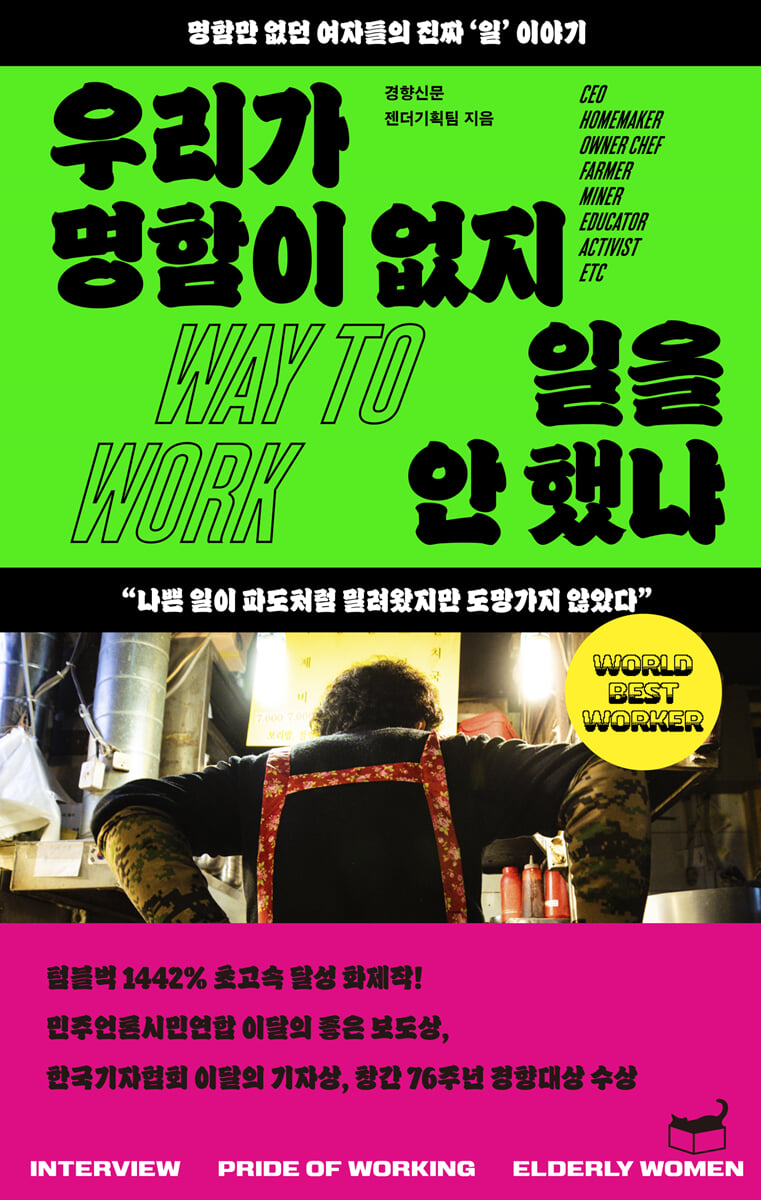
We didn't do any work because we didn't have business cards.
 |
Description
Book Introduction
“Bad things came crashing down like waves, but I didn’t run away.”
Interviews with older sisters in their 60s and 70s, whose lives are their calling cards.
How to take care of yourself and feel proud of yourself at work
Citizens' Coalition for Democratic Media's Good Report of the Month Award, Korea Press Association's Journalist of the Month Award, Kyunghyang Shinmun's 76th Anniversary Award,
Tumblbug's 1422% super-fast achievement is a hot topic!
This is a collection of interviews that look at the lives of older women who lived proudly with the pride of work, even though the world did not recognize it as 'work', from the perspective of work.
Women who lived their entire lives as 'N-jobbers', doing housework and outside work, saying, "We don't have business cards, so why didn't we work?"
It started with the goal of finding business cards for women who were called someone's wife or mother rather than their names.
The Kyunghyang Shinmun's gender planning team met and interviewed dozens of women and documented their lives.
It's not just a simple collection of interviews.
Through data and statistics, we examine the structural context in which their labor was undervalued, reexamine its value, and examine contemporary Korean historical events of the time.
Not only did it receive a lot of love and requests for additional publications, but it also achieved a 1442% social funding goal at lightning speed, and was finally officially published as a book.
All the stories from articles and independent publications are gathered together and presented in a new format, including editing and design suitable for a book, and even unpublished photos.
Let's get hints and pride for ourselves as we work from the wonderful older sisters who, despite the twists and turns of modern history and the waves of bad things that came crashing down on us, didn't run away and forged ahead in their own lives.
Interviews with older sisters in their 60s and 70s, whose lives are their calling cards.
How to take care of yourself and feel proud of yourself at work
Citizens' Coalition for Democratic Media's Good Report of the Month Award, Korea Press Association's Journalist of the Month Award, Kyunghyang Shinmun's 76th Anniversary Award,
Tumblbug's 1422% super-fast achievement is a hot topic!
This is a collection of interviews that look at the lives of older women who lived proudly with the pride of work, even though the world did not recognize it as 'work', from the perspective of work.
Women who lived their entire lives as 'N-jobbers', doing housework and outside work, saying, "We don't have business cards, so why didn't we work?"
It started with the goal of finding business cards for women who were called someone's wife or mother rather than their names.
The Kyunghyang Shinmun's gender planning team met and interviewed dozens of women and documented their lives.
It's not just a simple collection of interviews.
Through data and statistics, we examine the structural context in which their labor was undervalued, reexamine its value, and examine contemporary Korean historical events of the time.
Not only did it receive a lot of love and requests for additional publications, but it also achieved a 1442% social funding goal at lightning speed, and was finally officially published as a book.
All the stories from articles and independent publications are gathered together and presented in a new format, including editing and design suitable for a book, and even unpublished photos.
Let's get hints and pride for ourselves as we work from the wonderful older sisters who, despite the twists and turns of modern history and the waves of bad things that came crashing down on us, didn't run away and forged ahead in their own lives.
- You can preview some of the book's contents.
Preview
index
Prologue In search of that common voice
Have a good day on your first commute , it's your life, sisters.
Bad things came crashing down like waves, but I didn't run away.
[insight] 320,000 daughters were born in 1954.
Second commute we didn't do any work?
My wife is too small to contain Heeja.
Writer, Inhwa Jeong
[insight] What if one day their labor disappears?
From male superiority to female inferiority on the third commute to feminism
Sunja's sincere message to her daughters
[insight] What has changed and what hasn't
[insight] Daughters read women's labor from their mothers' labor.
Fourth commute to work. This place is different from the city.
Why Gwangwol has been the women's association president for 10 years
[insight] I am not an adult because I did not learn.
[insight] I was born to be a miner in this mine
The fifth commute to work, the sisters who are going to work today too
[insight] Sisters' future hopes
Anna's labor became love
Taesun is preparing for a new 70s.
I am my business card, I am myself
Eunsuk, who loves rap and Mondays
epilogue They were all one book
by-line
References
Have a good day on your first commute , it's your life, sisters.
Bad things came crashing down like waves, but I didn't run away.
[insight] 320,000 daughters were born in 1954.
Second commute we didn't do any work?
My wife is too small to contain Heeja.
Writer, Inhwa Jeong
[insight] What if one day their labor disappears?
From male superiority to female inferiority on the third commute to feminism
Sunja's sincere message to her daughters
[insight] What has changed and what hasn't
[insight] Daughters read women's labor from their mothers' labor.
Fourth commute to work. This place is different from the city.
Why Gwangwol has been the women's association president for 10 years
[insight] I am not an adult because I did not learn.
[insight] I was born to be a miner in this mine
The fifth commute to work, the sisters who are going to work today too
[insight] Sisters' future hopes
Anna's labor became love
Taesun is preparing for a new 70s.
I am my business card, I am myself
Eunsuk, who loves rap and Mondays
epilogue They were all one book
by-line
References
Detailed image

Into the book
You are truly amazing.
“What if it’s not great?”
--- p.32
I think you must be proud of having been the head of the household.
“Even if I go back, I don’t think I could do better.
It's so good now.
Since I was poor, my parents would come and go by KTX, and when my older sister was sick, I would make side dishes and send them to her.
I earn money to feed my uncle and also go to the university hospital.
He is also very popular with his granddaughters.
“How good it is.”
--- p.35
My daughter said, “Mom, you always give, but when will you receive it?”
I spoke bluntly.
Give the love you received from your mother plus extra to your daughter.
Then, you ask, isn't that vain?
He's my child, so what's the futility?
We worked hard and I worked hard, so I have no regrets.
--- p.38
Whenever I think about what my life has been like, I always think that I've just been someone's mother or someone's wife.
Talking like this makes me think that I'm a pretty good person.
'Housewife' friends, we're cool.
We all worked hard.
--- p.75
I've had many good thoughts in my life, even at that moment.
I never thought that raising a child would be so hard or so boring.
It's not that I'm particularly good at anything... I just lived my life saying I can't do anything I can't do.
--- p.86
In our time, women's work was not treated properly, and it was thought that hunting outside was work.
I never thought about working, but I did think that my family would be more comfortable if I stayed home.
I thought I wasn't just playing.
--- p.91
This society has been sustained by older women who have endured low wages, poor working conditions, unstable jobs, risk of infection, and a perception that their jobs are looked down upon.
Just as older women have built and maintained their homes with the mindset of, ‘I have to earn money to pay for side dishes,’ ‘I don’t want to be a burden to the children,’ and ‘My family can’t live without me,’ they have built and maintained this society.
--- p.109
Sunja, who regretted not being able to study, worked with the thought, “Even if I can’t put money in my daughters’ bank accounts, I want to put money in their heads.”
He nagged his three daughters, saying, “Go to college” and “Become working women.”
I hope my daughters don't have to live a difficult life like I did.
That was Sunja's driving force.
--- p.119
“How could Mom live with her mind intact?
I thought I was more patient than my mom, but I guess not.
Rather than saying, 'I won't live like my mother,' isn't it that living like my mother never even occurred to me in the first place?
--- p.127
It seems like you like learning, whether it's driving or studying.
“It’s fun to learn things one by one.
I also like knowing knowledge, being able to answer when someone asks me a question, and also being able to look at them again and say, 'Oh, that person.'
“How good it is for me to know what I know.”
--- p.164
Me? I should have taught you earlier.
I didn't know I had so many jobs.
That's what you should do when talking to adults.
I am a salaried worker.
I cook for you and do your laundry….
That makes sense, really.
--- p.183
In our society, work has been defined as ‘receiving financial compensation from an external source’ or ‘having a business card.’
But no matter how lazy eyes define them, there are people who have been defining and finding their own work for a long time.
--- p.222
The nickname my children gave me is 'Mrs. Lee Juk-ja.'
'This damn confidence.'
I'm not afraid or scared of trying new things.
If you don't know, you can learn.
That's the style.
--- p.262
I am my business card, myself.
“What if it’s not great?”
--- p.32
I think you must be proud of having been the head of the household.
“Even if I go back, I don’t think I could do better.
It's so good now.
Since I was poor, my parents would come and go by KTX, and when my older sister was sick, I would make side dishes and send them to her.
I earn money to feed my uncle and also go to the university hospital.
He is also very popular with his granddaughters.
“How good it is.”
--- p.35
My daughter said, “Mom, you always give, but when will you receive it?”
I spoke bluntly.
Give the love you received from your mother plus extra to your daughter.
Then, you ask, isn't that vain?
He's my child, so what's the futility?
We worked hard and I worked hard, so I have no regrets.
--- p.38
Whenever I think about what my life has been like, I always think that I've just been someone's mother or someone's wife.
Talking like this makes me think that I'm a pretty good person.
'Housewife' friends, we're cool.
We all worked hard.
--- p.75
I've had many good thoughts in my life, even at that moment.
I never thought that raising a child would be so hard or so boring.
It's not that I'm particularly good at anything... I just lived my life saying I can't do anything I can't do.
--- p.86
In our time, women's work was not treated properly, and it was thought that hunting outside was work.
I never thought about working, but I did think that my family would be more comfortable if I stayed home.
I thought I wasn't just playing.
--- p.91
This society has been sustained by older women who have endured low wages, poor working conditions, unstable jobs, risk of infection, and a perception that their jobs are looked down upon.
Just as older women have built and maintained their homes with the mindset of, ‘I have to earn money to pay for side dishes,’ ‘I don’t want to be a burden to the children,’ and ‘My family can’t live without me,’ they have built and maintained this society.
--- p.109
Sunja, who regretted not being able to study, worked with the thought, “Even if I can’t put money in my daughters’ bank accounts, I want to put money in their heads.”
He nagged his three daughters, saying, “Go to college” and “Become working women.”
I hope my daughters don't have to live a difficult life like I did.
That was Sunja's driving force.
--- p.119
“How could Mom live with her mind intact?
I thought I was more patient than my mom, but I guess not.
Rather than saying, 'I won't live like my mother,' isn't it that living like my mother never even occurred to me in the first place?
--- p.127
It seems like you like learning, whether it's driving or studying.
“It’s fun to learn things one by one.
I also like knowing knowledge, being able to answer when someone asks me a question, and also being able to look at them again and say, 'Oh, that person.'
“How good it is for me to know what I know.”
--- p.164
Me? I should have taught you earlier.
I didn't know I had so many jobs.
That's what you should do when talking to adults.
I am a salaried worker.
I cook for you and do your laundry….
That makes sense, really.
--- p.183
In our society, work has been defined as ‘receiving financial compensation from an external source’ or ‘having a business card.’
But no matter how lazy eyes define them, there are people who have been defining and finding their own work for a long time.
--- p.222
The nickname my children gave me is 'Mrs. Lee Juk-ja.'
'This damn confidence.'
I'm not afraid or scared of trying new things.
If you don't know, you can learn.
That's the style.
--- p.262
I am my business card, myself.
--- p.265
Publisher's Review
“Even if the world doesn’t know, I know how great a thing you’ve done.”
The real 'work' story of women who only had business cards.
This book contains stories of the lives of women in their 60s and 70s who have worked their entire lives but have no business cards, from the perspective of work.
The stories of their work and lives were often considered 'unimportant'.
I was always called someone's mother or wife rather than by my own name.
However, even during the IMF foreign exchange crisis and the turbulent times of male superiority and female inferiority, they worked their entire lives and lived proudly, carving out their own paths.
He plays the role of the true head of the household, from housework to outside work, and is still active as a N-jobber even at this moment.
Data and statistics support the view that without them, society would collapse.
But we often fail to recognize the value of their stories and work.
Because we've never really shined a light on it, because it's so common and taken for granted.
"The women we met said they didn't have business cards.
I have never taken a break from work.
"It's just that society didn't recognize their labor as 'work'." (Page 4) This book sheds light on the older sisters who don't have business cards, but whose lives themselves are business cards, and unfolds a story that contains the value of their work and their attitude toward life.
5 ways to work
Following the working lives of older sisters
The book consists of five 'commuting' sections.
On my first commute to work, I hear the story of Son Jeong-ae, born in 1954, who started work at 4 a.m. and has been running a noodle restaurant in the same location for over 20 years.
The story of Jeong-ae, who lived steadfastly despite the waves of bad things that came crashing down on her, opens a door to the lives and times of older sisters working.
In the second commute, we break the stereotype of whether women who have been in charge of household chores after marriage, called 'housewives' or 'housewives', really 'played around at home', and tell the stories of women who have taken on various tasks, from earning money to caring for their grandchildren.
In the third commute, we explore how mother and daughter view and connect with each other's work.
We take a look at the various aspects of women's labor in the era of male superiority and female inferiority and in the era of feminism.
The fourth commute follows how women in rural areas navigate life in the shadow of a patriarchal system distinct from the city.
On the fifth commute, there is a story about the older sisters who are taking on new challenges for the future, such as steady self-development and divorce.
The 11 'interviews' contained in the 5 commutes are vividly presented in various formats, such as Q&A and monologue, tailored to each character's life.
This depth of interview is possible thanks to months of reporting, five to six meetings with each person, and sometimes even two days and one night.
This is not just a simple collection of interviews.
In the 'Insight' corner, we follow the lives of our older sisters through statistics and data analysis.
We examined various data showing women's lives, from the Economic Planning Board's 1963 Korea Statistical Yearbook to Statistics Korea's 2021 microdata, as well as legal changes related to women's employment since the enactment of the Labor Standards Act in 1953.
Data, numbers, and graphs powerfully support the value of their lives and work.
Pride in work, a confident and warm attitude toward life
Support and solidarity from older sisters
“Live happily, don’t live hard.
“When I think about it, life isn’t that long.”
The book is full of advice and warm encouragement from senior colleagues.
It is said that among the older sisters, there were some who felt burdened by the interview request.
However, in the process of unraveling his work and life, he discovers that he loves his work and says, “I’m pretty cool,” and he doesn’t hide his pride in his work.
Every sentence is filled with that feeling.
In that story, we can discover the value of work and gain hints and strength to be proud of our work.
“It’s impossible for people to live without stress.
But I think I'll feel less stressed if I do what I like.
“I tell my kids to work hard and just rest when it’s time to rest.” (p. 37), “Anyone can achieve what they want as long as they set goals and don’t get too greedy.
“You just have to keep growing it by getting lost in the thought of ‘I’ll do it’” (p. 169), “I’m not afraid or scared of doing something new.
“If you don’t know, you can learn.” (p. 262)
Feel the message and encouragement that only older sisters can convey, who have steadfastly forged ahead in life even amidst the waves of adversity.
A book about 'work' created by working people
With the mindset that everyone needs an observer and recorder of life
This is a story brought together by an unprecedentedly diverse group of people from a single newspaper, including reporters, photographers, proofreaders, video producers, and data journalists.
It was first introduced as a newspaper article, and the independent publication, which was funded through social funding, achieved a super-fast 1442% growth, becoming a hot topic and receiving much love.
Requests for additional publications followed, and this book, “We Don’t Have Business Cards, So We Didn’t Do Anything,” was officially published in a new, paperback format.
As the story is created by a diverse group of professionals, the content and structure of the book are also rich.
In addition to written interviews, data analysis, and photos that capture the confident and cool appearances of the older sisters, a vivid video interview with a QR code is also included.
All these stories have been compiled and republished in a new format, with new editing, design, and additional photos to suit the book.
This book was created by working people who poured their best efforts into it, with the mindset that 'everyone needs an observer and recorder of life.'
How about reading the story to discover the value of work and gain a new perspective?
The real 'work' story of women who only had business cards.
This book contains stories of the lives of women in their 60s and 70s who have worked their entire lives but have no business cards, from the perspective of work.
The stories of their work and lives were often considered 'unimportant'.
I was always called someone's mother or wife rather than by my own name.
However, even during the IMF foreign exchange crisis and the turbulent times of male superiority and female inferiority, they worked their entire lives and lived proudly, carving out their own paths.
He plays the role of the true head of the household, from housework to outside work, and is still active as a N-jobber even at this moment.
Data and statistics support the view that without them, society would collapse.
But we often fail to recognize the value of their stories and work.
Because we've never really shined a light on it, because it's so common and taken for granted.
"The women we met said they didn't have business cards.
I have never taken a break from work.
"It's just that society didn't recognize their labor as 'work'." (Page 4) This book sheds light on the older sisters who don't have business cards, but whose lives themselves are business cards, and unfolds a story that contains the value of their work and their attitude toward life.
5 ways to work
Following the working lives of older sisters
The book consists of five 'commuting' sections.
On my first commute to work, I hear the story of Son Jeong-ae, born in 1954, who started work at 4 a.m. and has been running a noodle restaurant in the same location for over 20 years.
The story of Jeong-ae, who lived steadfastly despite the waves of bad things that came crashing down on her, opens a door to the lives and times of older sisters working.
In the second commute, we break the stereotype of whether women who have been in charge of household chores after marriage, called 'housewives' or 'housewives', really 'played around at home', and tell the stories of women who have taken on various tasks, from earning money to caring for their grandchildren.
In the third commute, we explore how mother and daughter view and connect with each other's work.
We take a look at the various aspects of women's labor in the era of male superiority and female inferiority and in the era of feminism.
The fourth commute follows how women in rural areas navigate life in the shadow of a patriarchal system distinct from the city.
On the fifth commute, there is a story about the older sisters who are taking on new challenges for the future, such as steady self-development and divorce.
The 11 'interviews' contained in the 5 commutes are vividly presented in various formats, such as Q&A and monologue, tailored to each character's life.
This depth of interview is possible thanks to months of reporting, five to six meetings with each person, and sometimes even two days and one night.
This is not just a simple collection of interviews.
In the 'Insight' corner, we follow the lives of our older sisters through statistics and data analysis.
We examined various data showing women's lives, from the Economic Planning Board's 1963 Korea Statistical Yearbook to Statistics Korea's 2021 microdata, as well as legal changes related to women's employment since the enactment of the Labor Standards Act in 1953.
Data, numbers, and graphs powerfully support the value of their lives and work.
Pride in work, a confident and warm attitude toward life
Support and solidarity from older sisters
“Live happily, don’t live hard.
“When I think about it, life isn’t that long.”
The book is full of advice and warm encouragement from senior colleagues.
It is said that among the older sisters, there were some who felt burdened by the interview request.
However, in the process of unraveling his work and life, he discovers that he loves his work and says, “I’m pretty cool,” and he doesn’t hide his pride in his work.
Every sentence is filled with that feeling.
In that story, we can discover the value of work and gain hints and strength to be proud of our work.
“It’s impossible for people to live without stress.
But I think I'll feel less stressed if I do what I like.
“I tell my kids to work hard and just rest when it’s time to rest.” (p. 37), “Anyone can achieve what they want as long as they set goals and don’t get too greedy.
“You just have to keep growing it by getting lost in the thought of ‘I’ll do it’” (p. 169), “I’m not afraid or scared of doing something new.
“If you don’t know, you can learn.” (p. 262)
Feel the message and encouragement that only older sisters can convey, who have steadfastly forged ahead in life even amidst the waves of adversity.
A book about 'work' created by working people
With the mindset that everyone needs an observer and recorder of life
This is a story brought together by an unprecedentedly diverse group of people from a single newspaper, including reporters, photographers, proofreaders, video producers, and data journalists.
It was first introduced as a newspaper article, and the independent publication, which was funded through social funding, achieved a super-fast 1442% growth, becoming a hot topic and receiving much love.
Requests for additional publications followed, and this book, “We Don’t Have Business Cards, So We Didn’t Do Anything,” was officially published in a new, paperback format.
As the story is created by a diverse group of professionals, the content and structure of the book are also rich.
In addition to written interviews, data analysis, and photos that capture the confident and cool appearances of the older sisters, a vivid video interview with a QR code is also included.
All these stories have been compiled and republished in a new format, with new editing, design, and additional photos to suit the book.
This book was created by working people who poured their best efforts into it, with the mindset that 'everyone needs an observer and recorder of life.'
How about reading the story to discover the value of work and gain a new perspective?
GOODS SPECIFICS
- Publication date: December 20, 2022
- Page count, weight, size: 296 pages | 416g | 128*200*20mm
- ISBN13: 9791160809350
- ISBN10: 1160809356
You may also like
카테고리
korean


korean

![GQ KOREA Mark (Monthly): December [2025]](http://librairie.coreenne.fr/cdn/shop/files/8ef265dbbfbf186523ed75ba7319009d.jpg?v=1765340328&width=3840)


