

The Earth and Me Care Revolution
 |
Description
Book Introduction
A new way of caring, as told by Professor Kim Man-kwon
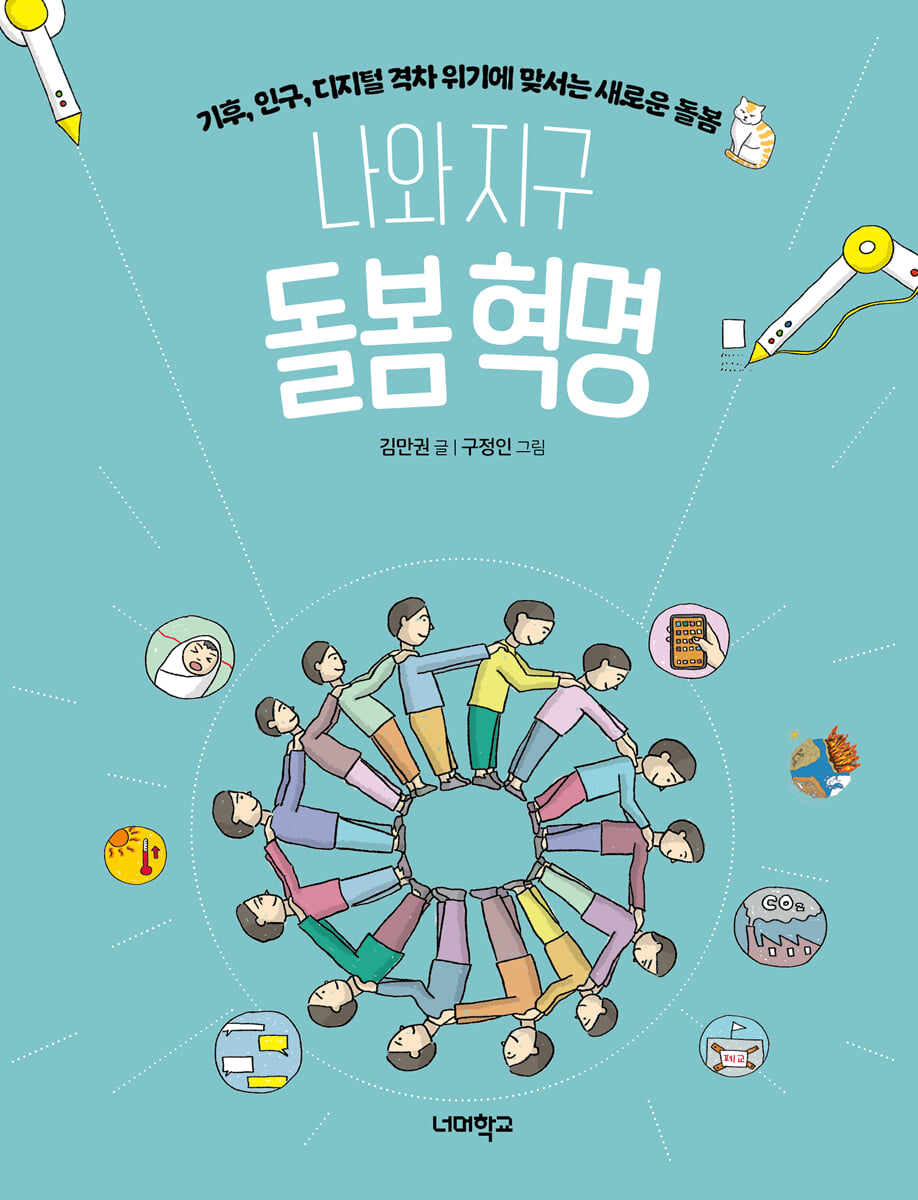
"The Care Revolution for Me and the Earth" is a book written by political philosopher Kim Man-kwon, vividly depicting the crises brought about by climate change, population decline, and the digital technology gap, and suggesting that we move toward a caring society that regards care as a human right and the most important principle as a solution.
Professor Kim Man-kwon, who has displayed a sharp perspective and deep thoughts critical of society through books such as “A New Poverty is Coming” and “Attack of Loneliness” and lectures, offers warm comfort to future generations, asking them to turn the weaknesses of ourselves and others revealed in the face of crisis into the strength to care for one another.
Artist Gu Jeong-in's drawings, filled with cartoonish imagination and bright colors, add to the enjoyment.
When we think of care, we tend to think of it as work done primarily by women at home, taking care of children, the elderly, and the sick.
"The Earth and I Care Revolution" clearly states that this is simply a prejudice stemming from a meritocratic and industrial patriarchal society.
The author vividly describes the realities created by climate, population, and the digital divide, and delves into the latest issues: how inequality causes greater suffering in poor countries and the vulnerable; why the gap between metropolitan areas and regional areas accelerates population decline; and how digital technology not only brings about disconnection, job losses, and intensified competition, but also accelerates climate change through excessive use of electricity and water, all of which are deeply and intricately intertwined.
The solution, he argues, is a compelling shift toward a new care society where care becomes a human right in itself, where everyone receives care according to their needs, and where it is appropriately distributed and recognized.
Bill Gates, who recently visited Korea, also emphasized that we must join forces to respond to the crises facing all of humanity, such as climate change, population, and the digital divide.
As a member of the established generation, Professor Kim Man-kwon sincerely apologizes to future generations and asks them to build a new world together through a “care revolution” by harnessing the unique human capacity for freedom to start anew.
I hope that reading and discussing this book together with future generations and adults can be the first step.
This is the sixth book in the 'Next Generation Guide Series', which aims to discuss ways to create a better society.
"The Care Revolution for Me and the Earth" is a book written by political philosopher Kim Man-kwon, vividly depicting the crises brought about by climate change, population decline, and the digital technology gap, and suggesting that we move toward a caring society that regards care as a human right and the most important principle as a solution.
Professor Kim Man-kwon, who has displayed a sharp perspective and deep thoughts critical of society through books such as “A New Poverty is Coming” and “Attack of Loneliness” and lectures, offers warm comfort to future generations, asking them to turn the weaknesses of ourselves and others revealed in the face of crisis into the strength to care for one another.
Artist Gu Jeong-in's drawings, filled with cartoonish imagination and bright colors, add to the enjoyment.
When we think of care, we tend to think of it as work done primarily by women at home, taking care of children, the elderly, and the sick.
"The Earth and I Care Revolution" clearly states that this is simply a prejudice stemming from a meritocratic and industrial patriarchal society.
The author vividly describes the realities created by climate, population, and the digital divide, and delves into the latest issues: how inequality causes greater suffering in poor countries and the vulnerable; why the gap between metropolitan areas and regional areas accelerates population decline; and how digital technology not only brings about disconnection, job losses, and intensified competition, but also accelerates climate change through excessive use of electricity and water, all of which are deeply and intricately intertwined.
The solution, he argues, is a compelling shift toward a new care society where care becomes a human right in itself, where everyone receives care according to their needs, and where it is appropriately distributed and recognized.
Bill Gates, who recently visited Korea, also emphasized that we must join forces to respond to the crises facing all of humanity, such as climate change, population, and the digital divide.
As a member of the established generation, Professor Kim Man-kwon sincerely apologizes to future generations and asks them to build a new world together through a “care revolution” by harnessing the unique human capacity for freedom to start anew.
I hope that reading and discussing this book together with future generations and adults can be the first step.
This is the sixth book in the 'Next Generation Guide Series', which aims to discuss ways to create a better society.
- You can preview some of the book's contents.
Preview
index
Prologue: Three Conditions of Life and Care
What is philosophy? What is political philosophy?
Three Changing Conditions of Life Concerned by 21st-Century Political Philosophy
For future generations, for those who care about future generations
Care Guidelines
Chapter 1: What is 'Rebuilding Care'?
The meaning of 'care'
meritocratic bias toward care
The stereotype that care is a woman's job at home
Expanding care
Extended Care One: Care is a Human Right
Extended Care 2: Care is Part of Political Activity
Chapter 2: Why Does Climate Change Need Care?
Even though it's hot, the Earth is too hot
Australia scorched by fire, East Africa devoured by floods and locusts
Pakistan under water
People with higher incomes emit more carbon.
Disasters caused by climate change are not equal.
Climate change is making even the mind sick.
Care is essential in the face of climate change.
Chapter 3: Why is care needed in a declining population?
Is South Korea's population decline faster than during the Black Death?
Is a declining population a blessing?
Population decline only benefits large cities.
As the population declines, a greater burden falls on future generations.
How to deal with population decline?
Care itself is the best response.
Chapter 4: Why Does the Digital Divide Need Care?
The Fourth Industrial Revolution? The Digital Revolution!
Distribution in the analog technology era
How will distribution change in the digital age?
Is the dream of cooperation coming true?
Is digital connecting us or disconnecting us?
Is digital truly a 'pure' technology?
The digital age demands new forms of care.
Epilogue The state is involved in new care
What is philosophy? What is political philosophy?
Three Changing Conditions of Life Concerned by 21st-Century Political Philosophy
For future generations, for those who care about future generations
Care Guidelines
Chapter 1: What is 'Rebuilding Care'?
The meaning of 'care'
meritocratic bias toward care
The stereotype that care is a woman's job at home
Expanding care
Extended Care One: Care is a Human Right
Extended Care 2: Care is Part of Political Activity
Chapter 2: Why Does Climate Change Need Care?
Even though it's hot, the Earth is too hot
Australia scorched by fire, East Africa devoured by floods and locusts
Pakistan under water
People with higher incomes emit more carbon.
Disasters caused by climate change are not equal.
Climate change is making even the mind sick.
Care is essential in the face of climate change.
Chapter 3: Why is care needed in a declining population?
Is South Korea's population decline faster than during the Black Death?
Is a declining population a blessing?
Population decline only benefits large cities.
As the population declines, a greater burden falls on future generations.
How to deal with population decline?
Care itself is the best response.
Chapter 4: Why Does the Digital Divide Need Care?
The Fourth Industrial Revolution? The Digital Revolution!
Distribution in the analog technology era
How will distribution change in the digital age?
Is the dream of cooperation coming true?
Is digital connecting us or disconnecting us?
Is digital truly a 'pure' technology?
The digital age demands new forms of care.
Epilogue The state is involved in new care
Into the book
Political philosophy addresses the same question based on the basic premise that a political community is a place where "living well, such a life, is realized."
As we have seen through the example of Plato, political philosophy is a natural combination of the desire for truth and the desire for an orderly life.
Looking back, political philosophy was at the beginning of philosophy.
--- p.12
Someone might say this:
"What? Can caregiving really do that?" If you're thinking this, it's because of your bias.
Looking back, for most people, caregiving has been a value and an act of being confined to the home.
Caregiving is often thought of as 'the work of a family looking after young children, elderly parents, or sick family members.'
However, the meaning and role of care goes beyond that.
Care is about considering 'me' as a being who lives a meaningful life, 'the community' as a place where we can live a valuable life, and 'the Earth' as the basic foundation where 'me' and 'the community' can live a more abundant life together.
--- p.15
To summarize briefly, the struggle over how a democratic system should combine economic activity and care has been a major thread in the history of democracy since the modern era.
I think that the current democratic politics are too far removed from caring.
In a word, the 'ethics of self-responsibility' dominates.
In a slightly more vulgar expression, it can be called the 'ethics of each for himself'.
Each person is left to fend for himself, which means that he cannot expect care from the state.
It can also be expressed as 'the rule of meritocracy'.
The idea that 'only the strong survive' justifies the idea that 'the capable monopolize.'
In a place where each person's ability to survive is dominant, care naturally loses its power.
--- p.39
So, to address the fundamental changes in our lives—climate change, population decline, and the digital divide—I propose a transition to a caring nation, and as the first step, a transition to a nation where care is practiced as a human right itself.
More specifically, I believe that a country where 'care as a human right itself' is practiced is one where both appropriate distribution and equal recognition are achieved for all.
Because care is an activity that cannot be properly carried out without proper distribution of that activity and, furthermore, without equal recognition of the object of care.
--- p.142
Bauman says that when we take care of each other like this, we can become truly happy.
While caring for one's own well-being is often unsatisfactory and fraught with dissatisfaction, "caring for the well-being of others and 'doing good' to them not only strengthens the 'feel good' feeling, but also increases the happiness of the caregiver."
“In this case, the conflict between selfishness and altruism melts away,” he says.
Personally, I find Bauman's statement that caring for others is the path to my happiness, or in other words, my own caring, very persuasive.
As we have seen through the example of Plato, political philosophy is a natural combination of the desire for truth and the desire for an orderly life.
Looking back, political philosophy was at the beginning of philosophy.
--- p.12
Someone might say this:
"What? Can caregiving really do that?" If you're thinking this, it's because of your bias.
Looking back, for most people, caregiving has been a value and an act of being confined to the home.
Caregiving is often thought of as 'the work of a family looking after young children, elderly parents, or sick family members.'
However, the meaning and role of care goes beyond that.
Care is about considering 'me' as a being who lives a meaningful life, 'the community' as a place where we can live a valuable life, and 'the Earth' as the basic foundation where 'me' and 'the community' can live a more abundant life together.
--- p.15
To summarize briefly, the struggle over how a democratic system should combine economic activity and care has been a major thread in the history of democracy since the modern era.
I think that the current democratic politics are too far removed from caring.
In a word, the 'ethics of self-responsibility' dominates.
In a slightly more vulgar expression, it can be called the 'ethics of each for himself'.
Each person is left to fend for himself, which means that he cannot expect care from the state.
It can also be expressed as 'the rule of meritocracy'.
The idea that 'only the strong survive' justifies the idea that 'the capable monopolize.'
In a place where each person's ability to survive is dominant, care naturally loses its power.
--- p.39
So, to address the fundamental changes in our lives—climate change, population decline, and the digital divide—I propose a transition to a caring nation, and as the first step, a transition to a nation where care is practiced as a human right itself.
More specifically, I believe that a country where 'care as a human right itself' is practiced is one where both appropriate distribution and equal recognition are achieved for all.
Because care is an activity that cannot be properly carried out without proper distribution of that activity and, furthermore, without equal recognition of the object of care.
--- p.142
Bauman says that when we take care of each other like this, we can become truly happy.
While caring for one's own well-being is often unsatisfactory and fraught with dissatisfaction, "caring for the well-being of others and 'doing good' to them not only strengthens the 'feel good' feeling, but also increases the happiness of the caregiver."
“In this case, the conflict between selfishness and altruism melts away,” he says.
Personally, I find Bauman's statement that caring for others is the path to my happiness, or in other words, my own caring, very persuasive.
--- p.144
Publisher's Review
Why is care important?
The Cambridge Dictionary defines care as “the process of protecting a person or thing and providing for its needs.”
However, the term 'care' as it is used in reality is often tinged with various prejudices.
“The Earth and I Care Revolution” first clearly criticizes this prejudice.
The first is the meritocratic bias.
In our society, care is often defined as caring for people who cannot take care of themselves, such as the sick, the elderly, and children.
In other words, care is seen as a concept in which the capable unilaterally help the incapable.
In this case, there is also a negative tendency to regard those receiving care as annoying or unnecessary.
The second is the prejudice that caregiving is something women do at home.
This bias arises because raising children, caring for the elderly, and caring for sick or disabled family members have traditionally been performed by women in the home.
Especially in industrial societies, as the value of production activities came to be highly valued, caregiving came to be regarded as an insignificant and unimportant activity.
The author emphasizes that care is not a charity that should be bestowed on certain people, but rather a 'human right' that all members of our society should enjoy.
This is because everyone receives care during their childhood and adolescence, becomes a caregiver while earning wages when they reach working age, and then once they retire and grow older, they must live while receiving care again.
In other words, everyone has to either give care or be the object of care.
It also emphasizes that care is one of the important political themes of modern democracy.
It is also true that the 'democratic welfare state' model emerged in the 1950s due to the need for care.
But with the rise of neoliberalism in the 1980s, people began to see a tendency to push care out of politics.
Because of the democratic welfare state model, citizens are criticized for becoming too dependent on the state, becoming lazy and unproductive, and suffering from 'welfare sickness'.
The author argues that this shift has led to a prevailing ethic of self-responsibility, whereby "I am responsible for my own life."
In addition, the reality is that the problem of care is being reduced to a problem caused by differences in individual abilities.
The author finds the reason why care is more urgent and necessary in this situation in the changes brought about by climate change, population decline, and digital technology.
Because these changes require a national and global response that goes beyond the individual.
Why does climate change require care?
Due to climate change, weather phenomena such as heat waves, tropical nights, extreme cold, heavy snow, wildfires, droughts, floods, and super typhoons are no longer disasters but are becoming part of everyday life.
However, the author argues that climate change should be treated not simply as a disaster, but as a matter of care.
The first reason is that economically advanced countries emit more carbon than developing countries.
As an example, the author cites the heavy rains that occurred in Pakistan between June and September 2022.
The torrential rains, which literally flooded a third of Pakistan, have been blamed by scientists as a "climate change-induced heatwave."
However, at the time, Pakistan's Minister of Climate Change, Sherri Rehman, insisted in an interview with the British newspaper The Guardian that "developed countries should take responsibility."
This is because developed countries are the ones that emit the most carbon dioxide, the main cause of climate change.
According to the United Nations Environment Programme (UNEP), the G20 countries, which are economically advanced, emit 79% of the world's greenhouse gases, but Pakistan, which accounted for only 0.4% of carbon emissions from 1959 to 2022, has suffered the consequences.
The second reason is that people with higher incomes emit more carbon.
According to a 2023 carbon emissions analysis report by Oxfam, a global poverty relief organization, and the Stockholm Environment Institute, the top 1% of income earners emitted 15% of all carbon, while the top 10% emitted 52%.
In comparison, the bottom 50% produced only 7%.
The unjust reality is revealed where the problems created by the top 10% are borne by the bottom 50%.
As such, disasters caused by climate change are not at all equal and are particularly greatly affected by income level.
Climate change is also affecting people's mental health, even creating a condition called 'climate depression.'
In this context, the author's argument that care is essential to improving the quality of life and holding those responsible for climate change accountable is persuasive.
Why is care needed in a declining population?
Our country's total population has been steadily declining since 2020, when the number of deaths reached 308,000 and the number of births reached 276,000.
This population decline is much faster than the National Statistical Office's predictions, so much so that even the American newspaper The New York Times analyzed Korea's population decline problem and talked about a "population extinction" scenario.
Some people say that there are too many humans, and that a smaller population would be good for the planet and children would not have to suffer from excessive competition.
However, the author argues that this is only a 'half-truth' and that, from a long-term perspective and from a national perspective, a rapid population decline in a short period of time is not desirable.
This is because most systems created by humans since the Industrial Revolution have been built on the premise that the population will continue to grow.
Therefore, it is difficult to expect preparation for a population decline.
Additionally, as the population declines, the size of the economy will decrease, which will inevitably lead to a contraction of the domestic economy, and environmental problems will arise as the number of vacant houses in rural areas and other areas will increase, turning the surrounding areas into ruins.
Also, the impact of population decline varies depending on whether it is urban or rural.
In our country, the population of Seoul and the Gyeonggi area is steadily increasing, while small and medium-sized cities in the provinces, and even large cities like Busan, are facing a human crisis due to population decline.
In Ulsan, where the automobile industry is a major industry, a significant number of young women are leaving the city in search of jobs, resulting in a gender ratio of 56 to 44 for the 2030 generation in 2023, a staggering 12% difference.
This unbalanced population decline could cause serious social problems.
Regarding the issue of population decline, the author states that first, the government should shoulder the burden of child-rearing costs through public spending; second, family members should have equal life opportunities, such as by equally sharing child-rearing responsibilities between men and women; and third, just as German Chancellor Angela Merkel has pursued an active refugee acceptance policy, our country should also actively accept immigrants.
For this too, care is essential!
Why does the digital divide need care?
These days, the world is talking about the advent of the Fourth Industrial Revolution, which is beyond the digital revolution of the Third Industrial Revolution.
This means that technological changes in our time are occurring rapidly and across a wide range of fields.
But how has this digital technology changed our lives? The author explains how digital technology is transforming the job landscape.
As robots and artificial intelligence replace human work, the number of high-skilled, good jobs has not increased much, the number of mid-skilled jobs has decreased significantly, and the number of low-skilled jobs has increased even more.
Jobs with double gravity are particularly likely to be replaced by robots and artificial intelligence because they involve a lot of repetitive tasks, making them relatively easy to replace and resulting in significant savings in labor costs.
Instead, low-skilled jobs that require physical or manual labor, such as cleaning, delivery, driving, errands, and data labeling, are growing, all tied to digital platforms.
High-skilled jobs are also unsafe, but occupations that require extensive training and accumulated experience to make decisions, such as finance, medicine, and law, are at greater risk of automation created by AI.
As high-skilled and medium-skilled jobs decline and low-skilled jobs increase, the incomes of many decline, creating income inequality and a gap in the level of protection for workers.
This is why care is needed to address these gaps.
The author uses various materials to demonstrate that digital technology disconnects rather than connects its users.
A 2017 US survey found that people who used social media more than 58 times a week felt lonelier than those who used it less than nine times.
The main reason is the feeling of inferiority that comes from comparing oneself to the great appearances of others.
Nevertheless, it is also a reality these days that many children and adolescents who have difficulty connecting with people are turning to chatbots as an escape.
The sentiment of a student who felt recognition and comfort from a friend's warm words, "You are a good person," is touching.
Digital also exacerbates environmental problems.
Many people mistakenly believe that the digital industry is a clean industry that operates online, but the lithium and other rare minerals used in digital devices are obtained through mining, a typical polluting industry.
Additionally, used batteries pile up all over the world, causing environmental problems.
It is also important to note that data centers that sustain digital industries emit enormous amounts of greenhouse gases.
This is why the scope of care must be expanded beyond the individual to the global level.
The author, who has presented the latest situation and discussion in clear sentences, offers a sincere apology for burdening future generations.
Borrowing Hannah Arendt's words that the ability to start anew is freedom and that starting anew is revolution, the conclusion that the new world built together by future generations and adults will be achieved through a 'revolution of care' will reach readers of all ages powerfully and affectionately.
The sixth book in the Beyond School Next Generation Guide series
This is the 6th book in the 'Guidebook Series for the Next Generation' that considers core issues in the present and future of our society with teenagers, following 『Guidebook for North Korea for the Next Generation』 that deals with the changing reality of North Korea, 『Guidebook for Unification for the Next Generation』 that examines the pros and cons of unification in detail, 『Where to Live?_Guidebook for Leaving Seoul for the Next Generation』 that talks about the issues of regional extinction and concentration in the metropolitan area in an easy and vivid way, 『Guidebook for 1% Power Agriculture』 told by a farmer who has been cooperatively farming eco-friendly crops for over 30 years, and 『Uncle on the 5th Floor_New Connections, Stories of the Joseonjok』 that provides a new understanding of the Joseonjok.
The Cambridge Dictionary defines care as “the process of protecting a person or thing and providing for its needs.”
However, the term 'care' as it is used in reality is often tinged with various prejudices.
“The Earth and I Care Revolution” first clearly criticizes this prejudice.
The first is the meritocratic bias.
In our society, care is often defined as caring for people who cannot take care of themselves, such as the sick, the elderly, and children.
In other words, care is seen as a concept in which the capable unilaterally help the incapable.
In this case, there is also a negative tendency to regard those receiving care as annoying or unnecessary.
The second is the prejudice that caregiving is something women do at home.
This bias arises because raising children, caring for the elderly, and caring for sick or disabled family members have traditionally been performed by women in the home.
Especially in industrial societies, as the value of production activities came to be highly valued, caregiving came to be regarded as an insignificant and unimportant activity.
The author emphasizes that care is not a charity that should be bestowed on certain people, but rather a 'human right' that all members of our society should enjoy.
This is because everyone receives care during their childhood and adolescence, becomes a caregiver while earning wages when they reach working age, and then once they retire and grow older, they must live while receiving care again.
In other words, everyone has to either give care or be the object of care.
It also emphasizes that care is one of the important political themes of modern democracy.
It is also true that the 'democratic welfare state' model emerged in the 1950s due to the need for care.
But with the rise of neoliberalism in the 1980s, people began to see a tendency to push care out of politics.
Because of the democratic welfare state model, citizens are criticized for becoming too dependent on the state, becoming lazy and unproductive, and suffering from 'welfare sickness'.
The author argues that this shift has led to a prevailing ethic of self-responsibility, whereby "I am responsible for my own life."
In addition, the reality is that the problem of care is being reduced to a problem caused by differences in individual abilities.
The author finds the reason why care is more urgent and necessary in this situation in the changes brought about by climate change, population decline, and digital technology.
Because these changes require a national and global response that goes beyond the individual.
Why does climate change require care?
Due to climate change, weather phenomena such as heat waves, tropical nights, extreme cold, heavy snow, wildfires, droughts, floods, and super typhoons are no longer disasters but are becoming part of everyday life.
However, the author argues that climate change should be treated not simply as a disaster, but as a matter of care.
The first reason is that economically advanced countries emit more carbon than developing countries.
As an example, the author cites the heavy rains that occurred in Pakistan between June and September 2022.
The torrential rains, which literally flooded a third of Pakistan, have been blamed by scientists as a "climate change-induced heatwave."
However, at the time, Pakistan's Minister of Climate Change, Sherri Rehman, insisted in an interview with the British newspaper The Guardian that "developed countries should take responsibility."
This is because developed countries are the ones that emit the most carbon dioxide, the main cause of climate change.
According to the United Nations Environment Programme (UNEP), the G20 countries, which are economically advanced, emit 79% of the world's greenhouse gases, but Pakistan, which accounted for only 0.4% of carbon emissions from 1959 to 2022, has suffered the consequences.
The second reason is that people with higher incomes emit more carbon.
According to a 2023 carbon emissions analysis report by Oxfam, a global poverty relief organization, and the Stockholm Environment Institute, the top 1% of income earners emitted 15% of all carbon, while the top 10% emitted 52%.
In comparison, the bottom 50% produced only 7%.
The unjust reality is revealed where the problems created by the top 10% are borne by the bottom 50%.
As such, disasters caused by climate change are not at all equal and are particularly greatly affected by income level.
Climate change is also affecting people's mental health, even creating a condition called 'climate depression.'
In this context, the author's argument that care is essential to improving the quality of life and holding those responsible for climate change accountable is persuasive.
Why is care needed in a declining population?
Our country's total population has been steadily declining since 2020, when the number of deaths reached 308,000 and the number of births reached 276,000.
This population decline is much faster than the National Statistical Office's predictions, so much so that even the American newspaper The New York Times analyzed Korea's population decline problem and talked about a "population extinction" scenario.
Some people say that there are too many humans, and that a smaller population would be good for the planet and children would not have to suffer from excessive competition.
However, the author argues that this is only a 'half-truth' and that, from a long-term perspective and from a national perspective, a rapid population decline in a short period of time is not desirable.
This is because most systems created by humans since the Industrial Revolution have been built on the premise that the population will continue to grow.
Therefore, it is difficult to expect preparation for a population decline.
Additionally, as the population declines, the size of the economy will decrease, which will inevitably lead to a contraction of the domestic economy, and environmental problems will arise as the number of vacant houses in rural areas and other areas will increase, turning the surrounding areas into ruins.
Also, the impact of population decline varies depending on whether it is urban or rural.
In our country, the population of Seoul and the Gyeonggi area is steadily increasing, while small and medium-sized cities in the provinces, and even large cities like Busan, are facing a human crisis due to population decline.
In Ulsan, where the automobile industry is a major industry, a significant number of young women are leaving the city in search of jobs, resulting in a gender ratio of 56 to 44 for the 2030 generation in 2023, a staggering 12% difference.
This unbalanced population decline could cause serious social problems.
Regarding the issue of population decline, the author states that first, the government should shoulder the burden of child-rearing costs through public spending; second, family members should have equal life opportunities, such as by equally sharing child-rearing responsibilities between men and women; and third, just as German Chancellor Angela Merkel has pursued an active refugee acceptance policy, our country should also actively accept immigrants.
For this too, care is essential!
Why does the digital divide need care?
These days, the world is talking about the advent of the Fourth Industrial Revolution, which is beyond the digital revolution of the Third Industrial Revolution.
This means that technological changes in our time are occurring rapidly and across a wide range of fields.
But how has this digital technology changed our lives? The author explains how digital technology is transforming the job landscape.
As robots and artificial intelligence replace human work, the number of high-skilled, good jobs has not increased much, the number of mid-skilled jobs has decreased significantly, and the number of low-skilled jobs has increased even more.
Jobs with double gravity are particularly likely to be replaced by robots and artificial intelligence because they involve a lot of repetitive tasks, making them relatively easy to replace and resulting in significant savings in labor costs.
Instead, low-skilled jobs that require physical or manual labor, such as cleaning, delivery, driving, errands, and data labeling, are growing, all tied to digital platforms.
High-skilled jobs are also unsafe, but occupations that require extensive training and accumulated experience to make decisions, such as finance, medicine, and law, are at greater risk of automation created by AI.
As high-skilled and medium-skilled jobs decline and low-skilled jobs increase, the incomes of many decline, creating income inequality and a gap in the level of protection for workers.
This is why care is needed to address these gaps.
The author uses various materials to demonstrate that digital technology disconnects rather than connects its users.
A 2017 US survey found that people who used social media more than 58 times a week felt lonelier than those who used it less than nine times.
The main reason is the feeling of inferiority that comes from comparing oneself to the great appearances of others.
Nevertheless, it is also a reality these days that many children and adolescents who have difficulty connecting with people are turning to chatbots as an escape.
The sentiment of a student who felt recognition and comfort from a friend's warm words, "You are a good person," is touching.
Digital also exacerbates environmental problems.
Many people mistakenly believe that the digital industry is a clean industry that operates online, but the lithium and other rare minerals used in digital devices are obtained through mining, a typical polluting industry.
Additionally, used batteries pile up all over the world, causing environmental problems.
It is also important to note that data centers that sustain digital industries emit enormous amounts of greenhouse gases.
This is why the scope of care must be expanded beyond the individual to the global level.
The author, who has presented the latest situation and discussion in clear sentences, offers a sincere apology for burdening future generations.
Borrowing Hannah Arendt's words that the ability to start anew is freedom and that starting anew is revolution, the conclusion that the new world built together by future generations and adults will be achieved through a 'revolution of care' will reach readers of all ages powerfully and affectionately.
The sixth book in the Beyond School Next Generation Guide series
This is the 6th book in the 'Guidebook Series for the Next Generation' that considers core issues in the present and future of our society with teenagers, following 『Guidebook for North Korea for the Next Generation』 that deals with the changing reality of North Korea, 『Guidebook for Unification for the Next Generation』 that examines the pros and cons of unification in detail, 『Where to Live?_Guidebook for Leaving Seoul for the Next Generation』 that talks about the issues of regional extinction and concentration in the metropolitan area in an easy and vivid way, 『Guidebook for 1% Power Agriculture』 told by a farmer who has been cooperatively farming eco-friendly crops for over 30 years, and 『Uncle on the 5th Floor_New Connections, Stories of the Joseonjok』 that provides a new understanding of the Joseonjok.
GOODS SPECIFICS
- Date of issue: September 15, 2025
- Pages, weight, size: 152 pages | 267g | 153*200*10mm
- ISBN13: 9791192894805
- ISBN10: 1192894804
You may also like
카테고리
korean


korean

![GQ KOREA Mark (Monthly): December [2025]](http://librairie.coreenne.fr/cdn/shop/files/8ef265dbbfbf186523ed75ba7319009d.jpg?v=1765340328&width=3840)


