

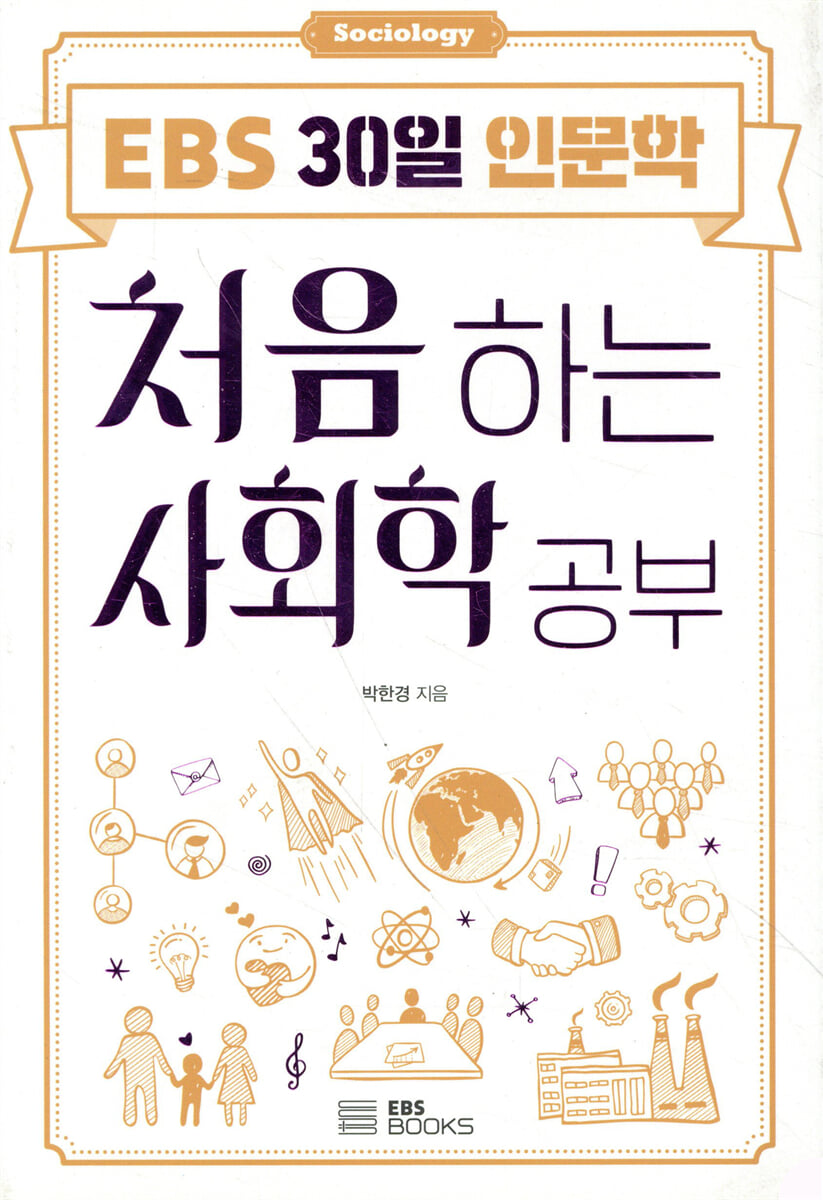
Studying sociology for the first time
 |
Description
Book Introduction
“Let’s use our sociological imagination to take a fresh look at our everyday lives!”
A sociological perspective forces us to step back and look at things in relation to their social context, rather than taking things for granted.
Then things that were invisible become visible.
(…) As a result, it gives us a clear understanding of the basis of our lives and the context in which our actions take place.
It also shows that a significant portion of what we thought was common sense was distorted.
Sociology is like a ladder that helps a frog in a well get out of the well.
I hope that this kind of sociology and sociological imagination will enrich all of our lives.
- From the closing remarks
The history and characteristics of sociology, as well as the main research methods
Even current sociological issues such as inequality, family, and gender issues are highlighted!
Let's use our sociological imagination to take a fresh look at our everyday lives!
Just as economics studies the 'economy' and political science studies 'politics', sociology is the study of 'society'.
However, economics and politics are also major elements that make up our society.
The same goes for journalism, management, communication, and statistics.
In that case, ‘society’, the subject of sociology’s study, becomes too broad.
So, what exactly is the "society" that sociology studies? Is there a separate "society" that is the subject of sociology's study?
To those outside of sociology, sociology is a mysterious discipline.
"Studying Sociology for Beginners" is a book that clearly organizes, in the form of one keyword per day, what sociology is, what it studies, how it began, and where it is now.
It also briefly covers current 'hot' issues in sociology, such as changes in family structure, urbanization, inequality, globalization, and gender issues, and their sociological interpretations.
Above all, we will gain a new perspective on our society through the fascinating tool of ‘sociological imagination.’
The 30 topics covered in this book were selected based on a comprehensive consideration of topics that well reflect the academic characteristics of sociology, are relevant to our daily lives, and are of interest.
Readers will discover the unique charm of 'sociology' as they lightly read through this book.
A sociological perspective forces us to step back and look at things in relation to their social context, rather than taking things for granted.
Then things that were invisible become visible.
(…) As a result, it gives us a clear understanding of the basis of our lives and the context in which our actions take place.
It also shows that a significant portion of what we thought was common sense was distorted.
Sociology is like a ladder that helps a frog in a well get out of the well.
I hope that this kind of sociology and sociological imagination will enrich all of our lives.
- From the closing remarks
The history and characteristics of sociology, as well as the main research methods
Even current sociological issues such as inequality, family, and gender issues are highlighted!
Let's use our sociological imagination to take a fresh look at our everyday lives!
Just as economics studies the 'economy' and political science studies 'politics', sociology is the study of 'society'.
However, economics and politics are also major elements that make up our society.
The same goes for journalism, management, communication, and statistics.
In that case, ‘society’, the subject of sociology’s study, becomes too broad.
So, what exactly is the "society" that sociology studies? Is there a separate "society" that is the subject of sociology's study?
To those outside of sociology, sociology is a mysterious discipline.
"Studying Sociology for Beginners" is a book that clearly organizes, in the form of one keyword per day, what sociology is, what it studies, how it began, and where it is now.
It also briefly covers current 'hot' issues in sociology, such as changes in family structure, urbanization, inequality, globalization, and gender issues, and their sociological interpretations.
Above all, we will gain a new perspective on our society through the fascinating tool of ‘sociological imagination.’
The 30 topics covered in this book were selected based on a comprehensive consideration of topics that well reflect the academic characteristics of sociology, are relevant to our daily lives, and are of interest.
Readers will discover the unique charm of 'sociology' as they lightly read through this book.
- You can preview some of the book's contents.
Preview
index
Opening Remarks: What is Sociology?
Sociology in One Day: The Kings of Social Science vs.
A Miscellaneous Study? _The Object of Sociology's Inquiry
Day 2 Society: What on Earth Is Society? _Characteristics of Human Society
3-Day Social Structure: There are invisible forces that move us in society _Social Forces
Day 4 Social Context: Why Do We Act in Certain Ways? _The Sociological Imagination
The Emergence of Modernity: How Did Sociology Arise? _The Birth of Sociology
Positivism and Social Darwinism: How Did Sociology Become a Science? _Auguste Comte and Herbert Spencer
7 Days of Suicide: Is Suicide Simply the Result of Personal Anxiety? _Emile Durkheim
8-Day Socialism: Is Economic Inequality Ultimately Inevitable? _Karl Marx
Family Day 18: Is Family Really Always Good? _Family and Sexuality
Day 19: Basic Social Institutions: So, What Is Family? _The Universal Concept of Family
20 Days of Collapse: Is the Family Weakening in Modern Society? _The Collapse of the Family
Marriage on the 21st: Why Are Marriages Being Delayed? _Later Marriage and the Changing Facets of Sexuality
Love Day 22: What Does Marriage Mean in Modern Society? _Marriage and Love
City of the 23rd: Scenes showing the characteristics of a modern city _ Modern City
24th Social Capital: On Living in the City: The Weakening of Community and Social Capital
25 Days of Inequality: How Did the Dirt Spoon Class Theory Come About? _The Class System of Society
Cultural Capital on the 26th: Do Art Preferences Differ by Social Class? _Distinguishing Cultural Capital
Education Day 27: Why is it so hard to rise from the gutter? _Education and Inequality
28th Globalization: How Does Globalization Affect Our Society? _The Meaning of Borders in Everyday Life
Information Technology Day 29: Is the Advancement of Information Technology Always a Good Thing? _Information Technology and Social Change
30-Day Perspective: What Uses Sociology? _The Usefulness of Sociology
Closing Remarks _ Let's question our taken-for-granted routines.
References
Sociology in One Day: The Kings of Social Science vs.
A Miscellaneous Study? _The Object of Sociology's Inquiry
Day 2 Society: What on Earth Is Society? _Characteristics of Human Society
3-Day Social Structure: There are invisible forces that move us in society _Social Forces
Day 4 Social Context: Why Do We Act in Certain Ways? _The Sociological Imagination
The Emergence of Modernity: How Did Sociology Arise? _The Birth of Sociology
Positivism and Social Darwinism: How Did Sociology Become a Science? _Auguste Comte and Herbert Spencer
7 Days of Suicide: Is Suicide Simply the Result of Personal Anxiety? _Emile Durkheim
8-Day Socialism: Is Economic Inequality Ultimately Inevitable? _Karl Marx
Family Day 18: Is Family Really Always Good? _Family and Sexuality
Day 19: Basic Social Institutions: So, What Is Family? _The Universal Concept of Family
20 Days of Collapse: Is the Family Weakening in Modern Society? _The Collapse of the Family
Marriage on the 21st: Why Are Marriages Being Delayed? _Later Marriage and the Changing Facets of Sexuality
Love Day 22: What Does Marriage Mean in Modern Society? _Marriage and Love
City of the 23rd: Scenes showing the characteristics of a modern city _ Modern City
24th Social Capital: On Living in the City: The Weakening of Community and Social Capital
25 Days of Inequality: How Did the Dirt Spoon Class Theory Come About? _The Class System of Society
Cultural Capital on the 26th: Do Art Preferences Differ by Social Class? _Distinguishing Cultural Capital
Education Day 27: Why is it so hard to rise from the gutter? _Education and Inequality
28th Globalization: How Does Globalization Affect Our Society? _The Meaning of Borders in Everyday Life
Information Technology Day 29: Is the Advancement of Information Technology Always a Good Thing? _Information Technology and Social Change
30-Day Perspective: What Uses Sociology? _The Usefulness of Sociology
Closing Remarks _ Let's question our taken-for-granted routines.
References
Into the book
Of the two perspectives on traffic accidents mentioned above, sociology takes the latter.
The position is that although the parties involved in traffic accidents are individuals, there are other factors that influence the behavior of those individuals, that is, cause traffic accidents.
These factors are beyond the control of the driver.
These are conditions that already exist in a society, and the individual act of driving is carried out within these conditions.
Sociology is interested in precisely these conditions.
When people point out, "It's because you drove badly," sociology examines whether there might be social factors, in addition to the person's negligence, that made driving that way inevitable.
--- pp.5~6
“Graduates entering society.”
“That person is good at socializing.”
“Return to society.”
The first expression is a common phrase heard in university graduation speeches.
The second is an expression often used to describe someone who adapts well to the company.
The third refers to cases where one is discharged or released from the military or prison.
Looking at these expressions, we see that there is a distinct entity called society, distinct from schools, homes, the military, and prisons.
However, schools, families, homes, the military, prisons, etc. are also part of the institutions and systems that make up society.
Even though these institutions are also part of society, we insist on calling the places we go after leaving school, leaving family, leaving the military, leaving prison, "society."
It can be said that within a broad society, there is a narrow society.
--- p.17
The representative concept that refers to these social forces studied in sociology is 'social structure'.
In everyday life, we often come across the expression “the structure is solid.”
Here, structure refers to something that has a frame, a skeleton.
A building is a representative structure that is constructed sturdily by combining various materials.
People entering a building are guided through the building's doors, hallways, etc.
Therefore, within the same building, people only walk along a certain path determined by the structure.
A kind of regularity emerges.
--- pp.29~30
The first step toward exercising sociological imagination is social distancing.
Familiar routines usually don't require explanation.
But even things that seem so familiar that they seem natural, actions that seem clearly the result of personal choices, when we step back and look at them from a distance, we see a larger social context that was previously invisible, and we realize that enormous forces outside of the individual are influencing our choices.
--- p.33
Sociology is a relatively young discipline.
The term "sociology" itself was first used in the 1830s, so its history is only about 200 years.
The scholar who coined the term sociology is known to be the Frenchman Auguste Comte (1798-1857), and the honor of being the first sociologist naturally goes to him.
--- p.37
However, if suicide were entirely a personal act, it would be difficult to find consistency in the suicide rate of a society, with rates fluctuating over time and being higher in some years and lower in others compared to other societies.
In this regard, Durkheim showed in his book “Suicide” published in 1897 that suicide is a social phenomenon caused by not only individual factors but also social factors.
--- pp.51~52
Weber's sociology is also called the 'sociology of understanding', and in this respect he shows characteristics that are different from those of the earlier sociologists.
For him, understanding social behavior was not enough to simply observe the outward appearance of the behavior.
Comte, Marx, Durkheim, and others, to varying degrees, made empirical and positive analysis of observable phenomena the core of their research methodology.
However, in Weber's sociology, observation of the action itself is not sufficient.
This is because social actions have a ‘subjective meaning’ in relation to other people.
Even if an action appears to be the same on the surface, the subjective meaning of the action may be different, so in order to understand social action, the action must be related to the actor's experience.
--- pp.67~68
Ultimately, we project the unbroken family that never existed into the past in the form of the Confucian traditional family, compare that image to the current family, and talk about the family's disintegration.
If the families of the past were less harmonious and less structurally sound than the families of today, then the hypothesis of family collapse or dissolution is difficult to establish.
It is reasonable to view the family not as collapsing but as changing.
--- p.140
Director Bong Joon-ho of the film “Parasite,” novelist Park Hyun-wook of “My Wife Got Married,” and singer Jang Ki-ha all majored in sociology in college.
They may humbly say that they did not study hard in college, but their work reveals deep sociological insight and reflection on society.
In particular, Park Hyun-wook's "My Wife Got Married" cleverly unfolds the story of a woman pursuing a polyandrous relationship by mobilizing key concepts and theories of family sociology.
The study of sociology has exerted a unique power in the field of literature.
The position is that although the parties involved in traffic accidents are individuals, there are other factors that influence the behavior of those individuals, that is, cause traffic accidents.
These factors are beyond the control of the driver.
These are conditions that already exist in a society, and the individual act of driving is carried out within these conditions.
Sociology is interested in precisely these conditions.
When people point out, "It's because you drove badly," sociology examines whether there might be social factors, in addition to the person's negligence, that made driving that way inevitable.
--- pp.5~6
“Graduates entering society.”
“That person is good at socializing.”
“Return to society.”
The first expression is a common phrase heard in university graduation speeches.
The second is an expression often used to describe someone who adapts well to the company.
The third refers to cases where one is discharged or released from the military or prison.
Looking at these expressions, we see that there is a distinct entity called society, distinct from schools, homes, the military, and prisons.
However, schools, families, homes, the military, prisons, etc. are also part of the institutions and systems that make up society.
Even though these institutions are also part of society, we insist on calling the places we go after leaving school, leaving family, leaving the military, leaving prison, "society."
It can be said that within a broad society, there is a narrow society.
--- p.17
The representative concept that refers to these social forces studied in sociology is 'social structure'.
In everyday life, we often come across the expression “the structure is solid.”
Here, structure refers to something that has a frame, a skeleton.
A building is a representative structure that is constructed sturdily by combining various materials.
People entering a building are guided through the building's doors, hallways, etc.
Therefore, within the same building, people only walk along a certain path determined by the structure.
A kind of regularity emerges.
--- pp.29~30
The first step toward exercising sociological imagination is social distancing.
Familiar routines usually don't require explanation.
But even things that seem so familiar that they seem natural, actions that seem clearly the result of personal choices, when we step back and look at them from a distance, we see a larger social context that was previously invisible, and we realize that enormous forces outside of the individual are influencing our choices.
--- p.33
Sociology is a relatively young discipline.
The term "sociology" itself was first used in the 1830s, so its history is only about 200 years.
The scholar who coined the term sociology is known to be the Frenchman Auguste Comte (1798-1857), and the honor of being the first sociologist naturally goes to him.
--- p.37
However, if suicide were entirely a personal act, it would be difficult to find consistency in the suicide rate of a society, with rates fluctuating over time and being higher in some years and lower in others compared to other societies.
In this regard, Durkheim showed in his book “Suicide” published in 1897 that suicide is a social phenomenon caused by not only individual factors but also social factors.
--- pp.51~52
Weber's sociology is also called the 'sociology of understanding', and in this respect he shows characteristics that are different from those of the earlier sociologists.
For him, understanding social behavior was not enough to simply observe the outward appearance of the behavior.
Comte, Marx, Durkheim, and others, to varying degrees, made empirical and positive analysis of observable phenomena the core of their research methodology.
However, in Weber's sociology, observation of the action itself is not sufficient.
This is because social actions have a ‘subjective meaning’ in relation to other people.
Even if an action appears to be the same on the surface, the subjective meaning of the action may be different, so in order to understand social action, the action must be related to the actor's experience.
--- pp.67~68
Ultimately, we project the unbroken family that never existed into the past in the form of the Confucian traditional family, compare that image to the current family, and talk about the family's disintegration.
If the families of the past were less harmonious and less structurally sound than the families of today, then the hypothesis of family collapse or dissolution is difficult to establish.
It is reasonable to view the family not as collapsing but as changing.
--- p.140
Director Bong Joon-ho of the film “Parasite,” novelist Park Hyun-wook of “My Wife Got Married,” and singer Jang Ki-ha all majored in sociology in college.
They may humbly say that they did not study hard in college, but their work reveals deep sociological insight and reflection on society.
In particular, Park Hyun-wook's "My Wife Got Married" cleverly unfolds the story of a woman pursuing a polyandrous relationship by mobilizing key concepts and theories of family sociology.
The study of sociology has exerted a unique power in the field of literature.
--- p.201
Publisher's Review
A map of 'sociology' clearly organized in one volume!
Knowing sociology opens up another perspective on the world!
As members of society, we live our lives playing our own roles within a specific social structure.
And the backgrounds of our lives, such as family, school, company, and country, seem so obvious at first glance.
But when viewed from the perspective of 'sociology', other aspects of society come into view and we begin to question our everyday lives.
‘Society’ is a word that is very familiar to us, but if we add the word ‘study’ to it, it becomes confusing.
What exactly is sociology? What exactly does it study, and what practical applications does it have? "Sociology for Beginners," as its title suggests, is a book that introduces sociology to the general public.
This book provides a brief glimpse into the discipline of sociology, focusing on its core content, from its inception to its present state, the various sociologists who have made decisive contributions, the research methods primarily employed by sociology, and key issues of note in modern society.
In particular, the ‘sociological imagination’ emphasized by the author is noteworthy.
The pioneers of sociology introduced in this book teach us the essence of sociological imagination.
They were caught up in the social upheaval and did not take it for granted, but recognized that it was fundamentally different from the previous social order.
And by applying a new methodology called science, they attempted to come up with a new explanation that had never been attempted before, and this attempt is still being made by subsequent scholars.
Taking a step back from reality and asking questions like this is the starting point of sociological imagination.
The sociological imagination is a powerful cognitive tool that helps us discover order and regularity even in a rapidly changing society like ours, and helps us confront the anxiety about an unknown future.
Even if you don't study or major in sociology, you will be able to gain a lot of 'sociological imagination' from this book.
Knowing sociology opens up another perspective on the world!
As members of society, we live our lives playing our own roles within a specific social structure.
And the backgrounds of our lives, such as family, school, company, and country, seem so obvious at first glance.
But when viewed from the perspective of 'sociology', other aspects of society come into view and we begin to question our everyday lives.
‘Society’ is a word that is very familiar to us, but if we add the word ‘study’ to it, it becomes confusing.
What exactly is sociology? What exactly does it study, and what practical applications does it have? "Sociology for Beginners," as its title suggests, is a book that introduces sociology to the general public.
This book provides a brief glimpse into the discipline of sociology, focusing on its core content, from its inception to its present state, the various sociologists who have made decisive contributions, the research methods primarily employed by sociology, and key issues of note in modern society.
In particular, the ‘sociological imagination’ emphasized by the author is noteworthy.
The pioneers of sociology introduced in this book teach us the essence of sociological imagination.
They were caught up in the social upheaval and did not take it for granted, but recognized that it was fundamentally different from the previous social order.
And by applying a new methodology called science, they attempted to come up with a new explanation that had never been attempted before, and this attempt is still being made by subsequent scholars.
Taking a step back from reality and asking questions like this is the starting point of sociological imagination.
The sociological imagination is a powerful cognitive tool that helps us discover order and regularity even in a rapidly changing society like ours, and helps us confront the anxiety about an unknown future.
Even if you don't study or major in sociology, you will be able to gain a lot of 'sociological imagination' from this book.
GOODS SPECIFICS
- Publication date: August 30, 2022
- Page count, weight, size: 212 pages | 348g | 145*215*14mm
- ISBN13: 9788954768504
- ISBN10: 8954768504
You may also like
카테고리
korean


korean

![GQ KOREA Mark (Monthly): December [2025]](http://librairie.coreenne.fr/cdn/shop/files/8ef265dbbfbf186523ed75ba7319009d.jpg?v=1765340328&width=3840)


