

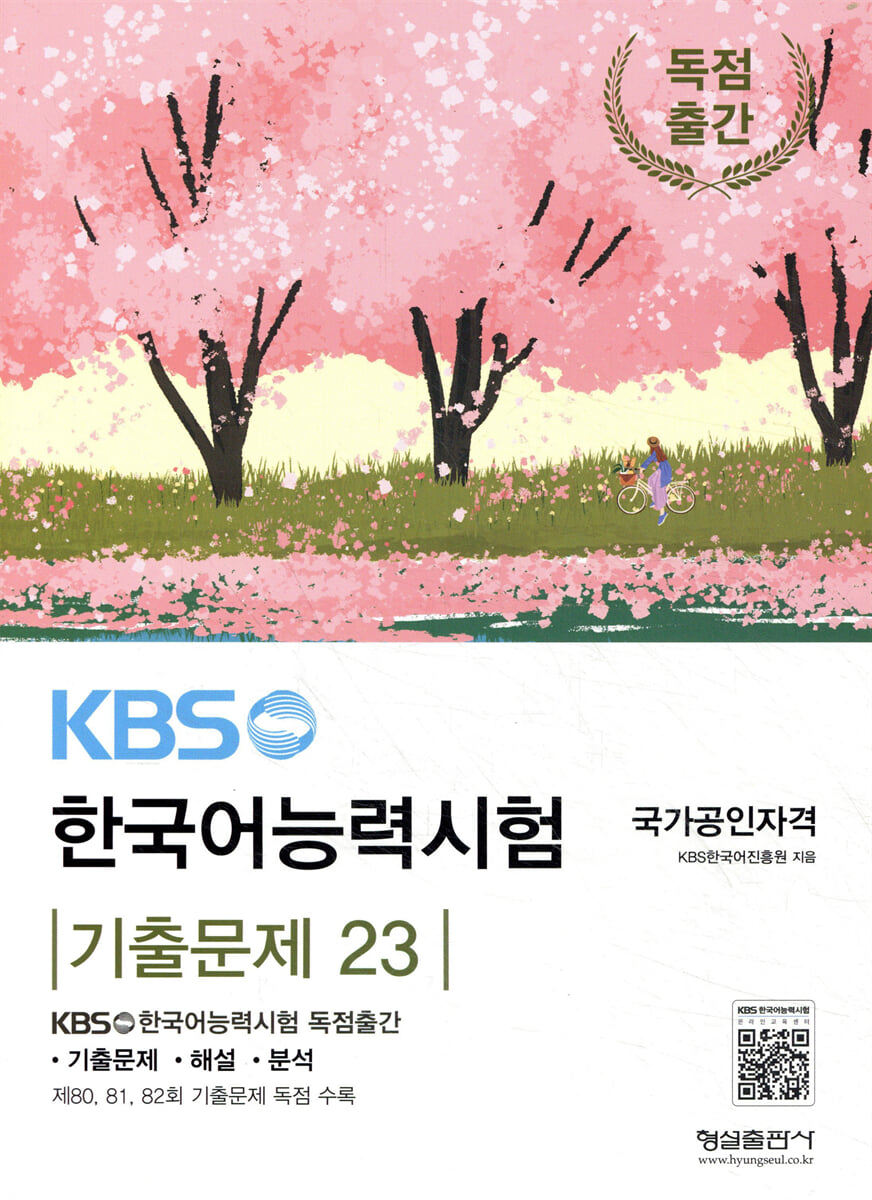
KBS Korean Language Proficiency Test Past Questions 23
 |
Description
Book Introduction
The KBS Korean Language Proficiency Test began its full-scale preparatory work in 2002, when discussions on the "National Language Basic Law" began. It commissioned basic research from various organizations to refine the assessment design, and recruited Korean language assessment experts to establish an assessment system related to measuring Korean language proficiency.
After that, the evaluation system was completed through the first KBS Korean Language Proficiency Test (August 8, 2004) for KBS applicants, and the test was administered twice in 2005, three times from 2006 to 2008, and four times from 2009 to 2021, and from 2022, the test will be administered six times a year.
After that, the evaluation system was completed through the first KBS Korean Language Proficiency Test (August 8, 2004) for KBS applicants, and the test was administered twice in 2005, three times from 2006 to 2008, and four times from 2009 to 2021, and from 2022, the test will be administered six times a year.
- You can preview some of the book's contents.
Preview
index
Past exam papers
ㆍForeword 2
ㆍKBS Korean Proficiency Test Overview 6
ㆍKBS Korean Proficiency Test National Certification 18
KBS Korean Proficiency Test Results 24
Past exam questions
80th KBS Korean Proficiency Test Past Questions 27
81st KBS Korean Proficiency Test Past Questions 77
82nd KBS Korean Proficiency Test Past Questions 131
Explanation of correct and incorrect answers
80th KBS Korean Proficiency Test Answers and Explanations 3
81st KBS Korean Language Proficiency Test Answers and Explanations 45
82nd KBS Korean Proficiency Test Answers and Explanations 87
ㆍForeword 2
ㆍKBS Korean Proficiency Test Overview 6
ㆍKBS Korean Proficiency Test National Certification 18
KBS Korean Proficiency Test Results 24
Past exam questions
80th KBS Korean Proficiency Test Past Questions 27
81st KBS Korean Proficiency Test Past Questions 77
82nd KBS Korean Proficiency Test Past Questions 131
Explanation of correct and incorrect answers
80th KBS Korean Proficiency Test Answers and Explanations 3
81st KBS Korean Language Proficiency Test Answers and Explanations 45
82nd KBS Korean Proficiency Test Answers and Explanations 87
Publisher's Review
preface
Today, national competitiveness has emerged as a hot topic for both nations and individuals, and each country is striving to enhance the competitiveness of its citizens.
What is definitely mentioned at this time is native language ability and foreign language ability.
Especially in this era of globalization, each country is putting its efforts into foreign language education. Following the linguistic law that one must be good at one's native language to be good at a foreign language, they are making enormous investments in native language education, which is the foundation for foreign language proficiency, and are doing their best to improve their citizens' native language skills.
In general, Korean language ability is composed of grammar ability, expression ability, comprehension ability, and literary ability.
Grammatical ability that pursues accuracy in using the Korean language, expression and comprehension ability that pursues fluency and efficiency in using the Korean language, and literary ability that pursues creativity in using the Korean language are basic abilities that people of any country must cultivate throughout their lives through home, school, and social education. In order to create a democratic society where rational communication takes place, Korean language ability is also a shortcut to achieving a democratic society.
However, during that time, people around us looked down on the Korean language and neglected to develop Korean language skills.
Even though I have received Korean language education for 12 years, I still have no knowledge of grammar or language standards, so I often make mistakes in spelling and grammar.
They lack confidence in speaking, listening, writing, and reading, and they use illogical, emotional, and error-filled writing and speech every day, leading to an unreasonable and uncultured language life. They are intellectually and emotionally poor in literary culture.
Daily Korean language life is dominated by foreign languages and Roman letters, and is overflowing with languages of unknown origin, and the vocabulary and thinking ability of the people have declined significantly.
As vocabulary declines, the ability to translate or purify foreign languages that are pouring in like a flood into Korean also dries up, creating a vicious cycle.
In government offices and schools, the will, ability, and education to purify the Korean language are disappearing.
Confucius warned, "If words are not in order, things will not succeed." This means, "A society where language is not in order will not succeed." The reason why there is so much discord in our society every day is due to our language skills.
In this situation, we cannot expect national competitiveness, let alone the people's Korean language skills and literacy, and we cannot achieve an advanced Korea.
Accordingly, in accordance with the founding spirit of KBS and the KBS Korean Language Research Association, which is to foster the Korean language skills of all citizens for proper Korean language use in order to create an advanced Korea, we have decided to establish a system to evaluate the Korean language skills of all citizens in order to continuously promote the cultivation of Korean language skills of all citizens, and to devise policies and measures to continuously improve the Korean language skills of the citizens through this evaluation system.
The KBS Korean Language Proficiency Test began its full-scale preparatory work in 2002, when discussions on the "National Language Basic Law" began. It commissioned basic research from various organizations to refine the assessment design, and recruited Korean language assessment experts to establish an assessment system related to measuring Korean language proficiency.
After that, the evaluation system was completed through the first KBS Korean Language Proficiency Test (August 8, 2004) for KBS applicants, and the test was administered twice in 2005, three times from 2006 to 2008, and four times from 2009 to 2021, and from 2022, the test will be administered six times a year.
Accordingly, KBS launched the KBS Korean Language Institute in 2007 to further develop this test and oversee the overall aspects of the test, while making greater efforts to establish the identity of the native language and secure the competitiveness of the Korean language.
Over 717,000 people have applied for the exam, which will be held 82 times through 2024. Furthermore, since it has been recognized as a nationally recognized qualification by the Ministry of Culture, Sports and Tourism since January 2009, those who pass this exam will receive benefits equivalent to those of national technical qualifications.
I hope that this test will help you improve your Korean language skills and help you get into college and get a job.
Director of KBS Korean Language Institute
Today, national competitiveness has emerged as a hot topic for both nations and individuals, and each country is striving to enhance the competitiveness of its citizens.
What is definitely mentioned at this time is native language ability and foreign language ability.
Especially in this era of globalization, each country is putting its efforts into foreign language education. Following the linguistic law that one must be good at one's native language to be good at a foreign language, they are making enormous investments in native language education, which is the foundation for foreign language proficiency, and are doing their best to improve their citizens' native language skills.
In general, Korean language ability is composed of grammar ability, expression ability, comprehension ability, and literary ability.
Grammatical ability that pursues accuracy in using the Korean language, expression and comprehension ability that pursues fluency and efficiency in using the Korean language, and literary ability that pursues creativity in using the Korean language are basic abilities that people of any country must cultivate throughout their lives through home, school, and social education. In order to create a democratic society where rational communication takes place, Korean language ability is also a shortcut to achieving a democratic society.
However, during that time, people around us looked down on the Korean language and neglected to develop Korean language skills.
Even though I have received Korean language education for 12 years, I still have no knowledge of grammar or language standards, so I often make mistakes in spelling and grammar.
They lack confidence in speaking, listening, writing, and reading, and they use illogical, emotional, and error-filled writing and speech every day, leading to an unreasonable and uncultured language life. They are intellectually and emotionally poor in literary culture.
Daily Korean language life is dominated by foreign languages and Roman letters, and is overflowing with languages of unknown origin, and the vocabulary and thinking ability of the people have declined significantly.
As vocabulary declines, the ability to translate or purify foreign languages that are pouring in like a flood into Korean also dries up, creating a vicious cycle.
In government offices and schools, the will, ability, and education to purify the Korean language are disappearing.
Confucius warned, "If words are not in order, things will not succeed." This means, "A society where language is not in order will not succeed." The reason why there is so much discord in our society every day is due to our language skills.
In this situation, we cannot expect national competitiveness, let alone the people's Korean language skills and literacy, and we cannot achieve an advanced Korea.
Accordingly, in accordance with the founding spirit of KBS and the KBS Korean Language Research Association, which is to foster the Korean language skills of all citizens for proper Korean language use in order to create an advanced Korea, we have decided to establish a system to evaluate the Korean language skills of all citizens in order to continuously promote the cultivation of Korean language skills of all citizens, and to devise policies and measures to continuously improve the Korean language skills of the citizens through this evaluation system.
The KBS Korean Language Proficiency Test began its full-scale preparatory work in 2002, when discussions on the "National Language Basic Law" began. It commissioned basic research from various organizations to refine the assessment design, and recruited Korean language assessment experts to establish an assessment system related to measuring Korean language proficiency.
After that, the evaluation system was completed through the first KBS Korean Language Proficiency Test (August 8, 2004) for KBS applicants, and the test was administered twice in 2005, three times from 2006 to 2008, and four times from 2009 to 2021, and from 2022, the test will be administered six times a year.
Accordingly, KBS launched the KBS Korean Language Institute in 2007 to further develop this test and oversee the overall aspects of the test, while making greater efforts to establish the identity of the native language and secure the competitiveness of the Korean language.
Over 717,000 people have applied for the exam, which will be held 82 times through 2024. Furthermore, since it has been recognized as a nationally recognized qualification by the Ministry of Culture, Sports and Tourism since January 2009, those who pass this exam will receive benefits equivalent to those of national technical qualifications.
I hope that this test will help you improve your Korean language skills and help you get into college and get a job.
Director of KBS Korean Language Institute
GOODS SPECIFICS
- Date of issue: February 28, 2025
- Page count, weight, size: 312 pages | 188*257*30mm
- ISBN13: 9788947287319
- ISBN10: 8947287318
You may also like
카테고리
korean


korean

![GQ KOREA Mark (Monthly): December [2025]](http://librairie.coreenne.fr/cdn/shop/files/8ef265dbbfbf186523ed75ba7319009d.jpg?v=1765340328&width=3840)


