

Some words of appeal
 |
Description
Book Introduction
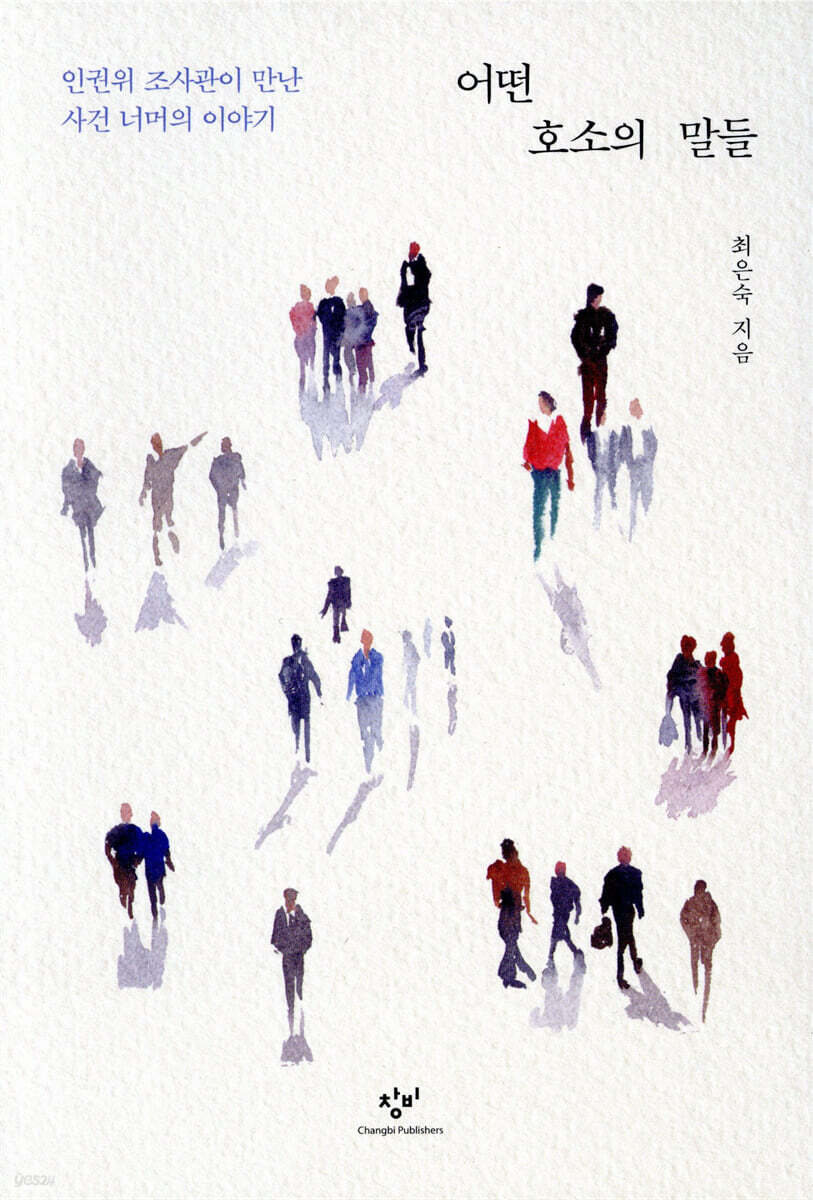
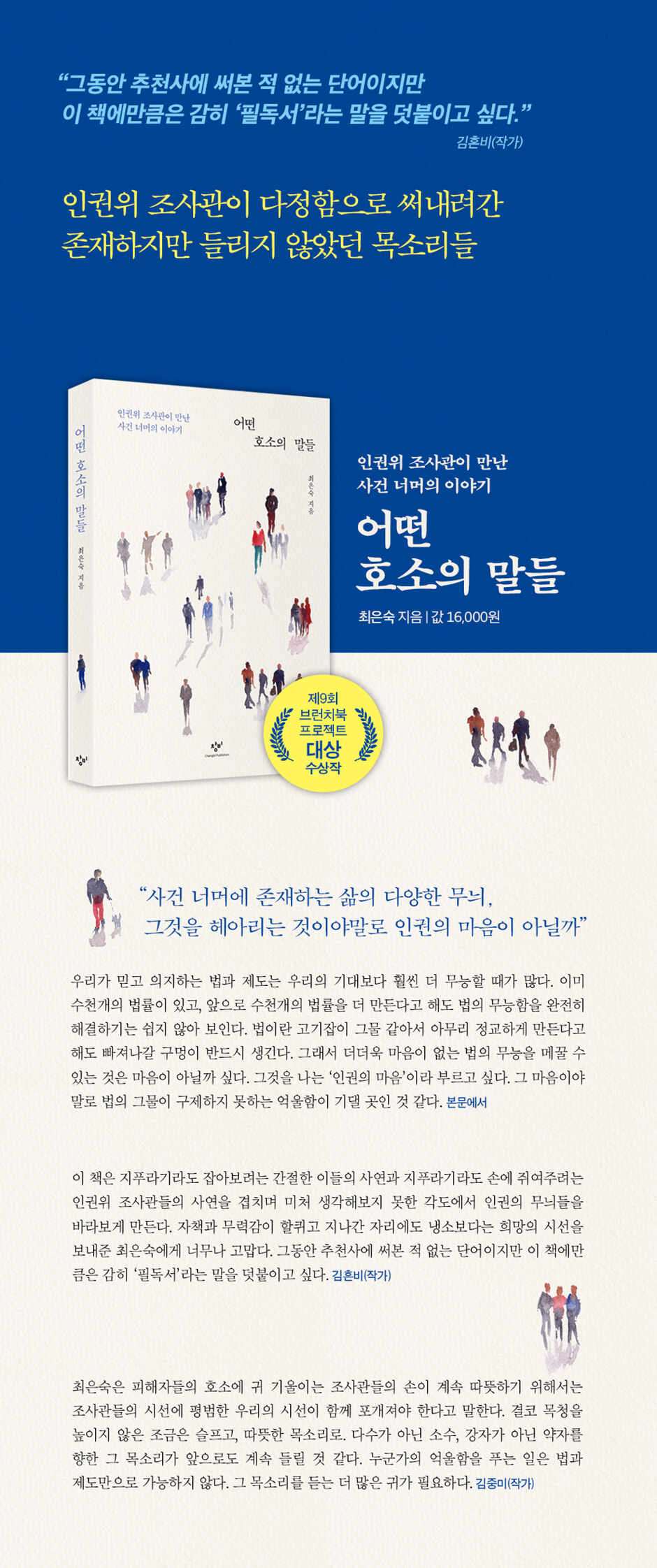
The 9th Brunch Book Project Grand Prize Winner “It’s a word I’ve never used in a letter of recommendation before, I dare to add the word 'must-read' to this book. "Kim Hon-bi (author) Written with affection by a human rights investigator Stories that existed but were not seen The National Human Rights Commission receives over 10,000 complaints annually (as of 2021). Investigators affiliated with the National Human Rights Commission are responsible for determining the truth of cases filed by complainants and directly investigating whether human rights violations have occurred. Investigators investigate hundreds of cases each year to help victims who have suffered harm but have not received proper help. Author Choi Eun-sook, who has worked as an investigator at the National Human Rights Commission of Korea since 2002 on the front lines of human rights, has also had to deal with countless cases and face the injustices that are difficult to fully describe in a report. In 『Words of Appeal: Stories Beyond the Cases Encountered by a Human Rights Commission Investigator』, the author shares his affectionate feelings about the victims he met and their stories while working as an investigator for over 20 years. Author Choi Eun-sook meticulously examines the inner workings of individuals that cannot be known through trial results or news articles alone: elderly people who cannot read or write and thus find it difficult to file even simple civil complaints, migrant workers who are confined to mental hospitals because they cannot communicate, athletes who endure violence because it is customary, and those who, desperately seeking the National Human Rights Commission of Korea, ultimately turn their backs on the world. While looking at those who are in the blind spot of the law and system with a warm gaze, he also honestly reveals the limitations he feels as an individual investigator. The author argues that while it is the job of human rights investigators to verify facts, the true spirit of human rights lies in understanding the diverse patterns of life that exist beyond the facts. The author's courageous and honest voice toward minorities and the underprivileged will touch the hearts of readers. |
- You can preview some of the book's contents.
Preview
index
Prologue: We are a little sad and cute beings
Part 1 | Words of Appeal
That man's blatant lie
To the child in that room in Yongjugol
How he became Jean Valjean
Someone's best clothes
It's our responsibility, not God's.
What we truly support
There is no one who would never do that
And no one took responsibility
Words I endured while earning minimum wage
Suin's white hands
The Last Lie
Why is my email ID 'Hoso'?
On the topic of gulbi vendors
Part 2 | Just This Much Affection
The joys and sorrows of work
The sound of the threshing machine in the investigation department
On the way to Phnom Penh
Recipient dies
That damn human rights
Pitch a tent next to the grave
The tightrope walk of a friendly investigator
Who is more of a villain?
Between the ‘Guardian of Human Rights’ and the ‘Human Rights Traitor’
Speeding in front of the Blue House
Occupational disease of investigators
Ten people each took a spoonful of rice
The fear of the night
Dissuading my son from working part-time
Even the sunset must have had its own circumstances.
Being able to dance is a human right.
What I learned from my cat, Bul-i
Part 1 | Words of Appeal
That man's blatant lie
To the child in that room in Yongjugol
How he became Jean Valjean
Someone's best clothes
It's our responsibility, not God's.
What we truly support
There is no one who would never do that
And no one took responsibility
Words I endured while earning minimum wage
Suin's white hands
The Last Lie
Why is my email ID 'Hoso'?
On the topic of gulbi vendors
Part 2 | Just This Much Affection
The joys and sorrows of work
The sound of the threshing machine in the investigation department
On the way to Phnom Penh
Recipient dies
That damn human rights
Pitch a tent next to the grave
The tightrope walk of a friendly investigator
Who is more of a villain?
Between the ‘Guardian of Human Rights’ and the ‘Human Rights Traitor’
Speeding in front of the Blue House
Occupational disease of investigators
Ten people each took a spoonful of rice
The fear of the night
Dissuading my son from working part-time
Even the sunset must have had its own circumstances.
Being able to dance is a human right.
What I learned from my cat, Bul-i
Detailed image
Publisher's Review
“The various patterns of life that exist beyond events,
“Isn’t it the very heart of human rights to count it?”
“I called with the mindset of grasping at straws.
help.
“It’s unfair.” Every day, voices of people complaining about injustice resonate through the Human Rights Commission.
Each story is different, but it is clear that they are desperate enough to contact the National Human Rights Commission.
The author reveals the real stories of "people" beyond the incidents that are not readily apparent in documents such as statistics or investigation reports on human rights violations.
Part 1 contains the stories of various people the author met.
I met young people who silently endured unfair treatment at work, and victims who were wrongly accused due to flawed investigations and judgments by the authorities.
While some complainants apologize to the investigators, saying that they made them come a long way for a trivial matter, others cause confusion in the investigation by telling blatant lies.
Once, a prisoner in prison called the investigator directly and requested a 'face-to-face complaint'.
The author, who had been questioning the system because there were many cases of abuse of the face-to-face petition system, only learned after meeting the petitioner in person that he could not read or write and could not even submit a simple complaint on his own.
Because of my preconceived notions, I almost turned away from people who needed help.
One day, I met a ‘malicious complainant’ who filed complaints every other day.
He filed complaints with the police station every day over seemingly trivial matters, claiming that police officers were violating citizens' human rights.
The day I met Jinjeongin, he gave up his day's work and came out wearing his best clothes, thanking me for meeting him.
After listening to the truth, I realized that there was a reason for his actions.
The author confesses that he has long regretted prematurely labeling a man dressed in shabby, out-of-style clothes as "malicious" and not listening to what he had to say.
Every case became more complicated the more we looked into it and the circumstances of the parties involved were known.
The author says that while knowledge and information about human rights are necessary to reduce injustice, the most important thing is the attitude of listening to others' stories.
This book introduces stories that clearly exist around us but have been overlooked, and the desperate plight of those who fall into the blind spots of law and institutions, allowing us to view human rights from a new perspective.
With good intentions, passion and courage
An investigator's honest confession
A national institution like the National Human Rights Commission cannot resolve all cases, and investigators are also limited by their individuality.
In Part 2, the author explains why, despite the times when he was “sometimes astonished, sometimes heartbroken, and sometimes wanting to turn away” while working as an investigator, he was able to continue without losing passion and courage.
I honestly reveal the hardships, joys, frustrations, and satisfactions I have experienced as a working person and as a human being.
As my career as an investigator grew, I sometimes became tired of the work and treated complainants in a formal and stiff manner.
I became accustomed to asking questions one by one, causing trouble to my family and friends, and I shed tears of helplessness as I realized the limitations of the Human Rights Commission, which has no legal enforcement power.
However, the author confesses that after wrapping up the case, he was able to regain his composure after seeing the grateful words and warm hands of the person who had been investigating, and the fellow investigators who worked hard with the same purpose.
It's painful to listen to other people's complicated circumstances.
There are many sleepless nights, worrying that rather than alleviating someone's grievance, the situation will only get worse.
After dismissing the petitioner's petition several times, I was cursed at for being malicious, received a phone call out of the blue screaming at me for being a "human rights activist," and there was even a day when I realized that I was wearing the wrong pair of shoes after working all day.
Sometimes, the author is overcome by a sense of helplessness and wants to turn away from everything, but despite this, he never loses motivation and keeps his mind sharp.
This happened when a sexual harassment incident occurred at a Korean organization in Cambodia.
The author, who encountered limitations while investigating an incident that occurred overseas in Korea, decided to conduct field research overseas.
The director of the investigation was embarrassed because it was unprecedented and there was no separate budget, but the author went ahead with the business trip.
Looking back, it was a reckless attempt, but thanks to it, we were able to uncover the truth of the incident and relieve the victims of their grievances.
This would not have been possible without good will and passion.
The author also shares an episode where he gained courage from fellow investigators he worked with.
There is a senior investigator who visited the grave of a victim who died under suspicious circumstances 20 years ago in an attempt to clear his name, but there is almost no related information.
He said that he pitched a tent next to the victim's grave and spent several days there, hoping that the victim might appear in his dreams if he spent the night there.
The author also has fond memories of working with fellow investigators to raise money for children in refugee camps in Thailand and opening a fund to support human rights activists working in the field.
Eating together, going to the mountains, sharing stories, and supporting each other are the colleagues who give me the strength to endure the hard work.
From the perspective of the Human Rights Commission investigator
Current State of Human Rights Sensitivity in Korean Society
Eunsuk Choi says that while legal knowledge and administrative skills are necessary to clear someone's name, she is constantly reminded that convictions like courage, goodwill, and honesty are even more important.
Even when presented with a bundle of documents filled with conflicting claims, unreasonable measures, and far-fetched, wordy excuses, the mindset of an investigator who begins a thorough investigation while understanding the true circumstances of the case carefully reaches out to those who have been wronged.
While an incident that violates someone's rights is problematic in itself, the process of resolving the problem often reveals the limitations of unreasonable laws and systems.
The author points out that if human rights are defined solely through laws and systems, there will inevitably be those who do not receive proper protection, and that human rights sensitivity is what complements this limitation.
A heart that cares for minorities and the weak, and a way of thinking from diverse perspectives while abandoning prejudice can make our society a slightly more livable place.
To bridge the limits of the law, we need an attitude of listening to the voices of others.
As we follow the author's example of demonstrating this attitude, the 'heart of human rights' will soon seep into the readers.
“The laws and institutions we trust and rely on are often far more incompetent than we expect.
There are already thousands of laws, and even if thousands more were to be created in the future, it would be difficult to completely resolve the incompetence of the law.
Law is like a fishing net; no matter how elaborately it is made, there are bound to be holes through which one can escape.
So, I think that what can compensate for the incompetence of the law, which has no heart, is the heart.
As important as it is to create good laws and systems, it is also important to consider who carries out the work and with what mindset.
And I think it should be even more so when it comes to human rights.
I would like to call it 'the heart of human rights'.
“It seems that this very heart is where the injustice that the net of the law cannot relieve can be relied on.” (pp. 159-60)
“Isn’t it the very heart of human rights to count it?”
“I called with the mindset of grasping at straws.
help.
“It’s unfair.” Every day, voices of people complaining about injustice resonate through the Human Rights Commission.
Each story is different, but it is clear that they are desperate enough to contact the National Human Rights Commission.
The author reveals the real stories of "people" beyond the incidents that are not readily apparent in documents such as statistics or investigation reports on human rights violations.
Part 1 contains the stories of various people the author met.
I met young people who silently endured unfair treatment at work, and victims who were wrongly accused due to flawed investigations and judgments by the authorities.
While some complainants apologize to the investigators, saying that they made them come a long way for a trivial matter, others cause confusion in the investigation by telling blatant lies.
Once, a prisoner in prison called the investigator directly and requested a 'face-to-face complaint'.
The author, who had been questioning the system because there were many cases of abuse of the face-to-face petition system, only learned after meeting the petitioner in person that he could not read or write and could not even submit a simple complaint on his own.
Because of my preconceived notions, I almost turned away from people who needed help.
One day, I met a ‘malicious complainant’ who filed complaints every other day.
He filed complaints with the police station every day over seemingly trivial matters, claiming that police officers were violating citizens' human rights.
The day I met Jinjeongin, he gave up his day's work and came out wearing his best clothes, thanking me for meeting him.
After listening to the truth, I realized that there was a reason for his actions.
The author confesses that he has long regretted prematurely labeling a man dressed in shabby, out-of-style clothes as "malicious" and not listening to what he had to say.
Every case became more complicated the more we looked into it and the circumstances of the parties involved were known.
The author says that while knowledge and information about human rights are necessary to reduce injustice, the most important thing is the attitude of listening to others' stories.
This book introduces stories that clearly exist around us but have been overlooked, and the desperate plight of those who fall into the blind spots of law and institutions, allowing us to view human rights from a new perspective.
With good intentions, passion and courage
An investigator's honest confession
A national institution like the National Human Rights Commission cannot resolve all cases, and investigators are also limited by their individuality.
In Part 2, the author explains why, despite the times when he was “sometimes astonished, sometimes heartbroken, and sometimes wanting to turn away” while working as an investigator, he was able to continue without losing passion and courage.
I honestly reveal the hardships, joys, frustrations, and satisfactions I have experienced as a working person and as a human being.
As my career as an investigator grew, I sometimes became tired of the work and treated complainants in a formal and stiff manner.
I became accustomed to asking questions one by one, causing trouble to my family and friends, and I shed tears of helplessness as I realized the limitations of the Human Rights Commission, which has no legal enforcement power.
However, the author confesses that after wrapping up the case, he was able to regain his composure after seeing the grateful words and warm hands of the person who had been investigating, and the fellow investigators who worked hard with the same purpose.
It's painful to listen to other people's complicated circumstances.
There are many sleepless nights, worrying that rather than alleviating someone's grievance, the situation will only get worse.
After dismissing the petitioner's petition several times, I was cursed at for being malicious, received a phone call out of the blue screaming at me for being a "human rights activist," and there was even a day when I realized that I was wearing the wrong pair of shoes after working all day.
Sometimes, the author is overcome by a sense of helplessness and wants to turn away from everything, but despite this, he never loses motivation and keeps his mind sharp.
This happened when a sexual harassment incident occurred at a Korean organization in Cambodia.
The author, who encountered limitations while investigating an incident that occurred overseas in Korea, decided to conduct field research overseas.
The director of the investigation was embarrassed because it was unprecedented and there was no separate budget, but the author went ahead with the business trip.
Looking back, it was a reckless attempt, but thanks to it, we were able to uncover the truth of the incident and relieve the victims of their grievances.
This would not have been possible without good will and passion.
The author also shares an episode where he gained courage from fellow investigators he worked with.
There is a senior investigator who visited the grave of a victim who died under suspicious circumstances 20 years ago in an attempt to clear his name, but there is almost no related information.
He said that he pitched a tent next to the victim's grave and spent several days there, hoping that the victim might appear in his dreams if he spent the night there.
The author also has fond memories of working with fellow investigators to raise money for children in refugee camps in Thailand and opening a fund to support human rights activists working in the field.
Eating together, going to the mountains, sharing stories, and supporting each other are the colleagues who give me the strength to endure the hard work.
From the perspective of the Human Rights Commission investigator
Current State of Human Rights Sensitivity in Korean Society
Eunsuk Choi says that while legal knowledge and administrative skills are necessary to clear someone's name, she is constantly reminded that convictions like courage, goodwill, and honesty are even more important.
Even when presented with a bundle of documents filled with conflicting claims, unreasonable measures, and far-fetched, wordy excuses, the mindset of an investigator who begins a thorough investigation while understanding the true circumstances of the case carefully reaches out to those who have been wronged.
While an incident that violates someone's rights is problematic in itself, the process of resolving the problem often reveals the limitations of unreasonable laws and systems.
The author points out that if human rights are defined solely through laws and systems, there will inevitably be those who do not receive proper protection, and that human rights sensitivity is what complements this limitation.
A heart that cares for minorities and the weak, and a way of thinking from diverse perspectives while abandoning prejudice can make our society a slightly more livable place.
To bridge the limits of the law, we need an attitude of listening to the voices of others.
As we follow the author's example of demonstrating this attitude, the 'heart of human rights' will soon seep into the readers.
“The laws and institutions we trust and rely on are often far more incompetent than we expect.
There are already thousands of laws, and even if thousands more were to be created in the future, it would be difficult to completely resolve the incompetence of the law.
Law is like a fishing net; no matter how elaborately it is made, there are bound to be holes through which one can escape.
So, I think that what can compensate for the incompetence of the law, which has no heart, is the heart.
As important as it is to create good laws and systems, it is also important to consider who carries out the work and with what mindset.
And I think it should be even more so when it comes to human rights.
I would like to call it 'the heart of human rights'.
“It seems that this very heart is where the injustice that the net of the law cannot relieve can be relied on.” (pp. 159-60)
GOODS SPECIFICS
- Publication date: July 13, 2022
- Page count, weight, size: 236 pages | 318g | 128*188*15mm
- ISBN13: 9788936486815
- ISBN10: 8936486810
You may also like
카테고리
korean


korean

![GQ KOREA Mark (Monthly): December [2025]](http://librairie.coreenne.fr/cdn/shop/files/8ef265dbbfbf186523ed75ba7319009d.jpg?v=1765340328&width=3840)


