

Park Chung-hee's Yushin dictatorship and Chun Doo-hwan's military dictatorship
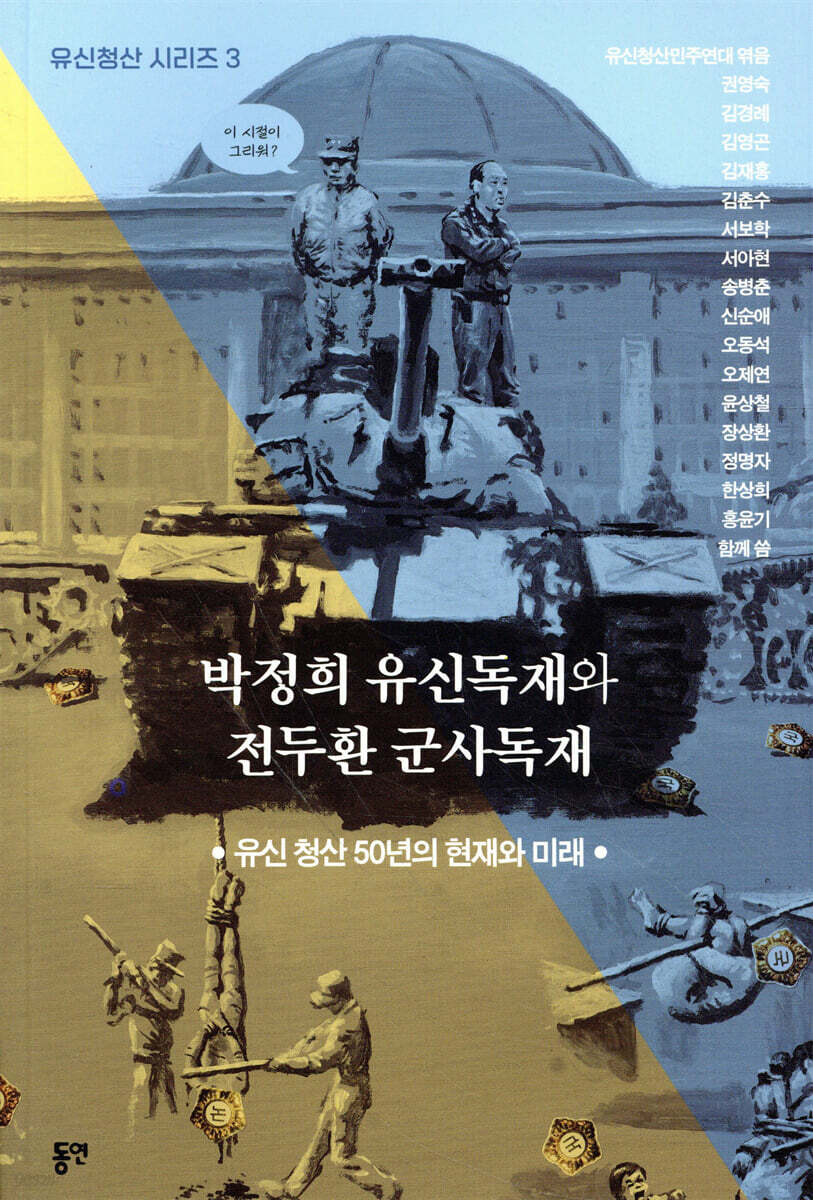 |
Description
Book Introduction
The current inequality and irrational social structure of our society are the product of the Yushin dictatorship and the military dictatorship of the Fifth Republic that followed.
Korea's global economic power rankings, including per capita GDP and gross national income, are among the top 10 OECD countries (Korea ranked 9th in 2021), placing it among the highest.
However, at the same time, the income inequality index and social benefits are among the lowest among OECD countries, and the birth rate and suicide rate are the lowest.
Even though the housing supply rate exceeds 100% (103.6%), we are still witnessing the despair of households without homes and young people who have given up on the dream of home ownership.
Taxes, social security, and welfare are still trapped in the communist-socialist, or so-called 'red', frame and are far behind economic indicators.
When and where did this ongoing, unreasonable social structure in Korean society originate? Many social economists trace it to the shackles of modern Korean history, the so-called "developmental dictatorship."
The chaebol-centered economic growth policies of Park Chung-hee's Yushin dictatorship and Chun Doo-hwan's military dictatorship that followed distorted not only our economic structure but also our social structure in an irrational way.
Despite this, the ‘Park Chung-hee ghost’ still runs rampant in our society.
After the Korean War, when it was difficult to make a living, the country achieved miraculous economic growth in the 1960s and 1970s, making it a prosperous country and laying the foundation for the formation of today's first-class nation.
The misguided historical consciousness that dictatorship was an inevitable or necessary evil for economic development still pervades this land, hindering the future of Korean society, including democratization and the resolution of inequality.
When we think of President Park Chung-hee, the image that often comes to mind in the media is of him drinking makgeolli and talking with farmers on the ridge of a rice paddy, but we know very well that in reality, he was a man who enjoyed entertainment every night at his house in Gungjeong-dong, drinking Chivas Regal, with Jungjeong as his assistant.
It is also an open secret that the soldiers who were dispatched to Vietnam embezzled their hard-earned war allowances and kept a huge amount of slush funds in Swiss banks.
Moreover, the secret history of fabricating spy ring cases through torture to maintain power and coercing members of the National Assembly and judges with absolute power is now widely known.
Yet, the specter of this brilliant image-washing through mass manipulation still lingers throughout our society.
This book is a call to historical awareness from the public who are in a state of delusion.
This is a collection of articles that do not simply reveal the simple damage suffered by the Park Chung-hee Yushin regime, but rather sharply expose why it is destroying our history and how the evil cartel was formed and operated.
This is a powerful message that we hope will awaken us to the reality of our country, which is still stuck in a vicious cycle of unequal structures where the rich get richer and the poor get poorer, unreasonable social structures such as "kick the ladder away" and "tilted playing field," as well as judicial corruption, the tyranny of the prosecutorial republic, and the continued winner-take-all economic system.
Although I regret that the paper is not enough to contain all the content, I have tried to cover at least the derived phenomena that resulted from the dictatorships of Park Chung-hee and Chun Doo-hwan by field.
For those who directly experienced the physical and mental suffering of the military dictatorship of Chun Doo-hwan, also known as the Yushin regime of Park Chung-hee and the Yushin period 2, and for those who have a conscious civic consciousness that sees through history rather than taking things at face value, the Park Chung-hee-Chun Doo-hwan dictatorship is a modern history that must be liquidated.
This is why we are trying to pull this era, which is like a terrible nightmare, out of the abyss of oblivion and look back on it.
I hope this book will help us, who are living in a new era, to properly reflect on the past, open up the future, and write the modern history of the future.
Korea's global economic power rankings, including per capita GDP and gross national income, are among the top 10 OECD countries (Korea ranked 9th in 2021), placing it among the highest.
However, at the same time, the income inequality index and social benefits are among the lowest among OECD countries, and the birth rate and suicide rate are the lowest.
Even though the housing supply rate exceeds 100% (103.6%), we are still witnessing the despair of households without homes and young people who have given up on the dream of home ownership.
Taxes, social security, and welfare are still trapped in the communist-socialist, or so-called 'red', frame and are far behind economic indicators.
When and where did this ongoing, unreasonable social structure in Korean society originate? Many social economists trace it to the shackles of modern Korean history, the so-called "developmental dictatorship."
The chaebol-centered economic growth policies of Park Chung-hee's Yushin dictatorship and Chun Doo-hwan's military dictatorship that followed distorted not only our economic structure but also our social structure in an irrational way.
Despite this, the ‘Park Chung-hee ghost’ still runs rampant in our society.
After the Korean War, when it was difficult to make a living, the country achieved miraculous economic growth in the 1960s and 1970s, making it a prosperous country and laying the foundation for the formation of today's first-class nation.
The misguided historical consciousness that dictatorship was an inevitable or necessary evil for economic development still pervades this land, hindering the future of Korean society, including democratization and the resolution of inequality.
When we think of President Park Chung-hee, the image that often comes to mind in the media is of him drinking makgeolli and talking with farmers on the ridge of a rice paddy, but we know very well that in reality, he was a man who enjoyed entertainment every night at his house in Gungjeong-dong, drinking Chivas Regal, with Jungjeong as his assistant.
It is also an open secret that the soldiers who were dispatched to Vietnam embezzled their hard-earned war allowances and kept a huge amount of slush funds in Swiss banks.
Moreover, the secret history of fabricating spy ring cases through torture to maintain power and coercing members of the National Assembly and judges with absolute power is now widely known.
Yet, the specter of this brilliant image-washing through mass manipulation still lingers throughout our society.
This book is a call to historical awareness from the public who are in a state of delusion.
This is a collection of articles that do not simply reveal the simple damage suffered by the Park Chung-hee Yushin regime, but rather sharply expose why it is destroying our history and how the evil cartel was formed and operated.
This is a powerful message that we hope will awaken us to the reality of our country, which is still stuck in a vicious cycle of unequal structures where the rich get richer and the poor get poorer, unreasonable social structures such as "kick the ladder away" and "tilted playing field," as well as judicial corruption, the tyranny of the prosecutorial republic, and the continued winner-take-all economic system.
Although I regret that the paper is not enough to contain all the content, I have tried to cover at least the derived phenomena that resulted from the dictatorships of Park Chung-hee and Chun Doo-hwan by field.
For those who directly experienced the physical and mental suffering of the military dictatorship of Chun Doo-hwan, also known as the Yushin regime of Park Chung-hee and the Yushin period 2, and for those who have a conscious civic consciousness that sees through history rather than taking things at face value, the Park Chung-hee-Chun Doo-hwan dictatorship is a modern history that must be liquidated.
This is why we are trying to pull this era, which is like a terrible nightmare, out of the abyss of oblivion and look back on it.
I hope this book will help us, who are living in a new era, to properly reflect on the past, open up the future, and write the modern history of the future.
index
Recommendation _ Lee Bu-young
Preface _ Kim Jae-hong
Part 1 | Prospects for the Yushin and Fifth Republic
Kim Jae-hong│Chun Doo-hwan's Second Yushin Period of Dictatorship - The political warlords, the Hanahoe, usurped sovereignty through the December 12 military coup.
Oh Dong-seok│The Constitutional Continuity and Illegalities of Park Chung-hee's 'Fourth Republic' and Chun Doo-hwan's 'Fifth Republic' 40
Hong Yun-gi│Structural Liquidation of the Yushin Dictatorship and the Prospects for K-Democracy - Comparative Evaluation with Foreign Liquidation Cases and the Completion of "Transitional Justice in the Republic of Korea" 71
Kwon Young-sook│The Developmentalist Legacy of Authoritarian Regimes and the Possibility of a Labor-Respecting Democracy (96)
Part 2 | From the Buma Uprising to the Gwangju Uprising
Kim Jae-hong│The Frustration of the 1980 "Seoul Spring" and the Usurpation of Power by the Political Clique Hanahoe 133
Oh Je-yeon│Spring in Seoul and the Frustration of Democratization - Grassroots Discontent and the Limits of Democratic Political Forces 152
Kim Jae-hong│An Anatomy of the Yushin Military Dictatorship of Park Chung-hee and Chun Doo-hwan (1971–1987) - Empirical Considerations for Clearing Its Remnants 175
Kim Kyung-rye│May 18th Gwangju Citizens' Resistance, Women, and the Reality Aftermath 228
Yoon Sang-cheol│Beyond Gwangju: The Reality and Future Path of Democracy in South Korea: Achieving Citizen Sovereignty 246
Part 3 | The Physical Power of the Yushin Dictatorship - The Judiciary (Prosecutors and Courts) and the Military (Martial Law)
Han Sang-hee│The Role of Courts in Authoritarian Regimes - Judicial Judgment as a Technique of Governance 269
Servohak│The Yushin Dictatorship and the Role of the Prosecution Service - What Did the Prosecution Service Do During the Yushin Era (1971-1987)? 295
Song Byeong-chun│The Court's Assistance with the Yushin Dictatorship During the Emergency Measures Era 322
Kim Chun-soo│Modern Korean History and Martial Law 334
Oh Dong-seok│The Illegality of Martial Law and the Garrison Decree During the Yushin Dictatorship 382
Part 4 | The Two Axis of Maintaining and Overcoming the Yushin Regime: The Chaebol Economy and the Labor Movement
Jang Sang-hwan│Park Chung-hee's Myth of Economic Growth and the Light and Dark Side of the Chaebol Republic 399
Seo Ah-hyun│Labor Control and the Women's Labor Movement in the Yushin Era - Focusing on the 1979 YH Incident 458
Kim Young-gon│Workers' Task of Eradicating the Yushin Dictatorship - Focusing on the Activities of the Wonpung Mibang Union and Cheonggye Garment Union in the 1970s 494
Case 1: Jeong Myeong-ja│The Peak of Extreme Repression and Fierce Resistance: Dongil Textile Workers' Union 532
Case 2: Shin Sun-ae│Jeon Tae-il's immediate successors, Cheonggye Garment Workers' Union 543
supplement
Progress of activities of the Yushin Sanmin Democratic Solidarity (2019.
5 ~ 2022.
6) 553
Declaration of the Launch of the Yushin San Democratic Alliance No. 559
Proposal for Participation in the Yushin 50-Year Military Dictatorship Liquidation Committee (Preparatory Committee) 563
Declaration 567: Ending 50 Years of Military Dictatorship
List of officers of the Yushin Sanminjuyeon Association (573)
Preface _ Kim Jae-hong
Part 1 | Prospects for the Yushin and Fifth Republic
Kim Jae-hong│Chun Doo-hwan's Second Yushin Period of Dictatorship - The political warlords, the Hanahoe, usurped sovereignty through the December 12 military coup.
Oh Dong-seok│The Constitutional Continuity and Illegalities of Park Chung-hee's 'Fourth Republic' and Chun Doo-hwan's 'Fifth Republic' 40
Hong Yun-gi│Structural Liquidation of the Yushin Dictatorship and the Prospects for K-Democracy - Comparative Evaluation with Foreign Liquidation Cases and the Completion of "Transitional Justice in the Republic of Korea" 71
Kwon Young-sook│The Developmentalist Legacy of Authoritarian Regimes and the Possibility of a Labor-Respecting Democracy (96)
Part 2 | From the Buma Uprising to the Gwangju Uprising
Kim Jae-hong│The Frustration of the 1980 "Seoul Spring" and the Usurpation of Power by the Political Clique Hanahoe 133
Oh Je-yeon│Spring in Seoul and the Frustration of Democratization - Grassroots Discontent and the Limits of Democratic Political Forces 152
Kim Jae-hong│An Anatomy of the Yushin Military Dictatorship of Park Chung-hee and Chun Doo-hwan (1971–1987) - Empirical Considerations for Clearing Its Remnants 175
Kim Kyung-rye│May 18th Gwangju Citizens' Resistance, Women, and the Reality Aftermath 228
Yoon Sang-cheol│Beyond Gwangju: The Reality and Future Path of Democracy in South Korea: Achieving Citizen Sovereignty 246
Part 3 | The Physical Power of the Yushin Dictatorship - The Judiciary (Prosecutors and Courts) and the Military (Martial Law)
Han Sang-hee│The Role of Courts in Authoritarian Regimes - Judicial Judgment as a Technique of Governance 269
Servohak│The Yushin Dictatorship and the Role of the Prosecution Service - What Did the Prosecution Service Do During the Yushin Era (1971-1987)? 295
Song Byeong-chun│The Court's Assistance with the Yushin Dictatorship During the Emergency Measures Era 322
Kim Chun-soo│Modern Korean History and Martial Law 334
Oh Dong-seok│The Illegality of Martial Law and the Garrison Decree During the Yushin Dictatorship 382
Part 4 | The Two Axis of Maintaining and Overcoming the Yushin Regime: The Chaebol Economy and the Labor Movement
Jang Sang-hwan│Park Chung-hee's Myth of Economic Growth and the Light and Dark Side of the Chaebol Republic 399
Seo Ah-hyun│Labor Control and the Women's Labor Movement in the Yushin Era - Focusing on the 1979 YH Incident 458
Kim Young-gon│Workers' Task of Eradicating the Yushin Dictatorship - Focusing on the Activities of the Wonpung Mibang Union and Cheonggye Garment Union in the 1970s 494
Case 1: Jeong Myeong-ja│The Peak of Extreme Repression and Fierce Resistance: Dongil Textile Workers' Union 532
Case 2: Shin Sun-ae│Jeon Tae-il's immediate successors, Cheonggye Garment Workers' Union 543
supplement
Progress of activities of the Yushin Sanmin Democratic Solidarity (2019.
5 ~ 2022.
6) 553
Declaration of the Launch of the Yushin San Democratic Alliance No. 559
Proposal for Participation in the Yushin 50-Year Military Dictatorship Liquidation Committee (Preparatory Committee) 563
Declaration 567: Ending 50 Years of Military Dictatorship
List of officers of the Yushin Sanminjuyeon Association (573)
Into the book
The Yushin Constitution made the president an all-powerful dictator, completely losing its constitutional meaning as a norm for controlling power.
The President could exercise absolute power, including the right to dissolve the National Assembly, as well as the right to take emergency measures prior to and after the fact that did not require the consent or approval of the National Assembly.
The independence of the judiciary could not be expected as the president could appoint, appoint, or dismiss all judges, including the Chief Justice of the Supreme Court.
The National Assembly lacked the means to properly check the president, as its sessions were shortened and its right to audit state affairs was denied.
The 'Yushin Constitution' system was not a constitutional democratic constitutional system at all, but rather an absolute new monarchy that surpassed Syngman Rhee's new presidential system.
The 1980 Constitution had some differences in its provisions, but there were no essential differences.
…
The Supreme Court presented constitutional evaluation criteria for the military rebellions of Chun Doo-hwan, Roh Tae-woo, and others.
First, there is the issue of seizing power.
Even if the government seized power by making the exercise of constitutional state power virtually impossible through military rebellion and civil war, then revised the constitution through a national referendum and governed the country according to the revised constitution, it cannot be said that a new legal order was established through that military rebellion and civil war.
Under the constitutional order, any act of making it impossible for constitutional institutions to exercise their powers or seizing power through violence without following the democratic procedures stipulated in the constitution is unacceptable under any circumstances.
Military rebellion and acts of rebellion are punishable.
---From "Oh Dong-seok│Constitutional continuity and illegality of Park Chung-hee's 'Fourth Republic' and Chun Doo-hwan's 'Fifth Republic'"
Thus, the first Park Chung-hee Yushin and the second military Yushin came to an end with the June Struggle of 1987, but the institutional framework of the power organizations that wielded anti-democratic privileges and ruled over the people as the Yushin ruling apparatus at the time, as well as the habitual behavior of the social forces, were formed during the Yushin dictatorship and continued to remain latent until they routinely resurfaced when a certain opportunity arises.
In particular, while the National Assembly was dissolved and all political activities were banned, the evil laws enacted and revised through pseudo-legislative bodies still remain, acting as a shackle to the development of democracy and a fair market economy, thus hindering the substantive development of democracy.
It is a well-known fact that the behavior of conglomerates, which take speculative profits from various national projects and government development projects and illegally seize control of corporate groups to monopolize corporate profits while excluding workers and shareholders, stems from the collusion between politics and business that developed during the military dictatorship.
The privileged media's practices of manipulating public opinion, manipulating politics, and ignoring various vested interests also stemmed from the media consolidation that guaranteed a monopoly to a small number of media outlets and provided privileged access to various development and policy information only to reporters from major media outlets.
The bias of prosecutors and judicial officials, who are harsh on the socially disadvantaged and lenient on the privileged, has become vested in the dictatorship, as they have suppressed the labor movement and fabricated countless public security cases in return for securing a privileged and closed position outside of democratic control. Now, intertwined with the judicialization of politics, it has reached a level that raises concerns about a dictatorship of the legal profession.
Politicians who are unable to take responsibility for running the country and are instead manipulated by bureaucrats also stem from the relationship between the president, the National Assembly, and political parties that functioned as auxiliary organs of the past imperial president.
The military dictatorship prohibited grassroots political activities centered on party members and solidified a top-down, undemocratic party structure centered on the central party.
---From "Hong Yun-gi│Structural Liquidation of the Yushin Dictatorship and the Prospects for K-Democracy"
Korea's industrialization and economic growth cannot be explained solely by the world's longest working hours, minimum wage, highest number of industrial accidents, high inflation rate, and negative trade deficit, but also by the blood and sweat of its citizens who put into practice the will to ensure the well-being of women and child laborers.
This is also proven by official statistical data from the objective and authoritative World Databank.
In other words, it was two years after the Kim Young-sam administration took office that Korea's per capita national income exceeded $10,000, and it was after 2007, the fifth year of the Roh Moo-hyun administration, that it exceeded $20,000.
The Kim Dae-jung administration's economic achievement, recognized both domestically and internationally, was that it overcame the sudden IMF crisis within a five-year term, the shortest in the world.
Looking at inflation and the price index, which are economic indicators related to the people's real lives, the rates during the military dictatorship were significantly higher than during the democratic government.
This is an indicator that economic growth under the developmental dictatorship was nothing more than a facade.
This economic situation was also reflected in the unemployment rate and the international trade deficit.
A high inflation rate and price index means that the real income of wage earners and salaried workers decreases accordingly.
Furthermore, if the unemployment rate is high, no matter how good the national economic macro indicators are, there are many unemployed people who have no connection to them and have to live a miserable life in isolation.
The military dictatorship's propaganda about economic growth is largely a fabrication, and this is why we must be mindful of their media manipulation and distortion of public opinion.
---From "Kim Jae-hong│Anatomy of the Yushin Military Dictatorship of Park Chung-hee and Chun Doo-hwan (1971-1987)"
In short, under an authoritarian system, our judiciary was itself an organ exercising state power.
In other words, rather than operating within the same checks and balances that appear in the theory of separation of powers between the legislative, executive, and judicial branches, the focus is on the phenomenon-confirming function of justifying the exercise of power by one party and thereby gaining the support of the people.
In the Korean state, the judiciary has established itself as a means of final arbitration to block or exclude demands from society—especially political demands or demands on the system—and has thus performed a comprehensive function as a means of forming and maintaining the state.
In this process, the judiciary solidified its position as an agent of power for the superior state and as an exerciser of power for civil society, which had been excluded from all power processes.
…
The judiciary under the authoritarian regime, especially the Yushin regime, was a power that thoroughly carried out its plan for permanent rule by abandoning the constitution and the rule of law and resorting to power and violence.
And its remnants still haunt our present as a precedent in our courts.
---From "Han Sang-hee│The Role of the Court in an Authoritarian System"
The remnants of the Yushin prosecution have not yet been liquidated.
In order to liquidate the Yushin Prosecution Service, the omnipotent power of the prosecution must be dismantled.
The most important core task is to achieve complete separation of investigation and prosecution.
The Moon Jae-in administration's establishment of the Corruption Investigation Office for High-ranking Officials and adjustment of investigative authority remained an incomplete reform that failed to completely dismantle the exclusive power of the prosecution.
Even after the reform, the prosecutorial power remains excessive and the possibility of abuse remains.
The prosecution's investigative powers remain strong.
It possesses the authority and human resources to virtually exclusively investigate six major incidents.
Because the prosecution has the exclusive right to request warrants for compulsory investigations and has its own 7,000 investigators, it is able to conduct exclusive investigations into serious cases.
Here, the prosecution has exclusive power to indict and also exercises discretion in prosecution.
The mini-air force is insufficient to check the power of the prosecution.
The abuse of power and corruption by the prosecution, which has monopolized the right to investigate and prosecute for the past 67 years, has been at a serious level.
There were countless cases of abuse of investigative power, including targeted investigations, dust-off investigations, biased investigations, preferential investigations, and investigations that protect one's own family. In addition, unfair and biased exercise of the right to prosecute was also witnessed in numerous cases.
Here, corrupt transactions with former officials were involved, and numerous corruption cases such as the so-called rice cake inspection, sponsor inspection, and Granger inspection occurred.
It can be said that after the democratization era, the prosecution has developed into something even more corrupt than the prosecution during the Yushin era.
These abuses of power and corrupt practices, which primarily occurred in the special investigation field, remain unresolved despite the first prosecution reform.
Unless the investigative power is completely separated from the prosecution, which is the prosecution agency, abuse of prosecutorial power and corruption will continue.
---From "Seobohak│Yushin Dictatorship and the Role of the Prosecution"
How should we evaluate the merits and demerits of Park Chung-hee's long-term dictatorship?
The media and many citizens generally have a positive view of Park Chung-hee's developmental dictatorship, arguing that while President Park Chung-hee's dictatorship and human rights suppression were wrong, the developmental dictatorship of that era enabled high economic growth, and that this economic development served as the foundation for democratization since the late 1980s.
However, developmental dictatorship was not an inevitable alternative for economic growth even in the early stages of industrialization, and the argument that developmental dictatorship is inevitable is nothing more than a logic to justify dictatorship.
…
In short, the common factor that allowed Korea and Taiwan to become leaders among the newly industrialized nations, if we set aside the international economic conditions faced by all developing countries, lies in their internal structural transformation.
The abolition of the semi-feudal landlord system, which significantly reduced parasitic elements, was a major factor, and the class dynamics between labor and management that became unilaterally favorable to the capitalist class after the war worked as a factor favorable to the capitalist class and rapid capitalization.
These internal and external conditions were created by specific historical circumstances.
Therefore, the Korean industrialization model, which was established under these special conditions and achieved significant results, cannot be defined as a typical model of industrialization in developing countries.
Korea's economic miracle can be explained not by the dictatorship of political military leaders led by Park Chung-hee, but by the sweat and blood of the majority of the people who directly produced the goods.
…
What was Park Chung-hee's core mistake?
He is the person who provided the starting point for the current structural contradictions in Korean society.
The developmental dictatorship system blocked the people's ability to resist capitalist contradictions and enforced the absolute rule of power and private property to the extreme.
The result is a high-cost structure, with corruption and slush fund-raising practices that sent former presidents and the current president's son to prison, and the world's highest land prices.
The chaebol system at its peak is an economic dictatorship, and the main factors behind the economic crisis are the excessive debt and poor management of the chaebols, which lead to insolvency and bankruptcy.
Park Chung-hee's mistake was that he was so focused on short-term economic development that he created a flawed political and economic structure that continued to distort the Korean economy and society.
If Park Chung-hee had not been in power for 18 years, the Korean economy would have developed much more substantially than it does now.
The President could exercise absolute power, including the right to dissolve the National Assembly, as well as the right to take emergency measures prior to and after the fact that did not require the consent or approval of the National Assembly.
The independence of the judiciary could not be expected as the president could appoint, appoint, or dismiss all judges, including the Chief Justice of the Supreme Court.
The National Assembly lacked the means to properly check the president, as its sessions were shortened and its right to audit state affairs was denied.
The 'Yushin Constitution' system was not a constitutional democratic constitutional system at all, but rather an absolute new monarchy that surpassed Syngman Rhee's new presidential system.
The 1980 Constitution had some differences in its provisions, but there were no essential differences.
…
The Supreme Court presented constitutional evaluation criteria for the military rebellions of Chun Doo-hwan, Roh Tae-woo, and others.
First, there is the issue of seizing power.
Even if the government seized power by making the exercise of constitutional state power virtually impossible through military rebellion and civil war, then revised the constitution through a national referendum and governed the country according to the revised constitution, it cannot be said that a new legal order was established through that military rebellion and civil war.
Under the constitutional order, any act of making it impossible for constitutional institutions to exercise their powers or seizing power through violence without following the democratic procedures stipulated in the constitution is unacceptable under any circumstances.
Military rebellion and acts of rebellion are punishable.
---From "Oh Dong-seok│Constitutional continuity and illegality of Park Chung-hee's 'Fourth Republic' and Chun Doo-hwan's 'Fifth Republic'"
Thus, the first Park Chung-hee Yushin and the second military Yushin came to an end with the June Struggle of 1987, but the institutional framework of the power organizations that wielded anti-democratic privileges and ruled over the people as the Yushin ruling apparatus at the time, as well as the habitual behavior of the social forces, were formed during the Yushin dictatorship and continued to remain latent until they routinely resurfaced when a certain opportunity arises.
In particular, while the National Assembly was dissolved and all political activities were banned, the evil laws enacted and revised through pseudo-legislative bodies still remain, acting as a shackle to the development of democracy and a fair market economy, thus hindering the substantive development of democracy.
It is a well-known fact that the behavior of conglomerates, which take speculative profits from various national projects and government development projects and illegally seize control of corporate groups to monopolize corporate profits while excluding workers and shareholders, stems from the collusion between politics and business that developed during the military dictatorship.
The privileged media's practices of manipulating public opinion, manipulating politics, and ignoring various vested interests also stemmed from the media consolidation that guaranteed a monopoly to a small number of media outlets and provided privileged access to various development and policy information only to reporters from major media outlets.
The bias of prosecutors and judicial officials, who are harsh on the socially disadvantaged and lenient on the privileged, has become vested in the dictatorship, as they have suppressed the labor movement and fabricated countless public security cases in return for securing a privileged and closed position outside of democratic control. Now, intertwined with the judicialization of politics, it has reached a level that raises concerns about a dictatorship of the legal profession.
Politicians who are unable to take responsibility for running the country and are instead manipulated by bureaucrats also stem from the relationship between the president, the National Assembly, and political parties that functioned as auxiliary organs of the past imperial president.
The military dictatorship prohibited grassroots political activities centered on party members and solidified a top-down, undemocratic party structure centered on the central party.
---From "Hong Yun-gi│Structural Liquidation of the Yushin Dictatorship and the Prospects for K-Democracy"
Korea's industrialization and economic growth cannot be explained solely by the world's longest working hours, minimum wage, highest number of industrial accidents, high inflation rate, and negative trade deficit, but also by the blood and sweat of its citizens who put into practice the will to ensure the well-being of women and child laborers.
This is also proven by official statistical data from the objective and authoritative World Databank.
In other words, it was two years after the Kim Young-sam administration took office that Korea's per capita national income exceeded $10,000, and it was after 2007, the fifth year of the Roh Moo-hyun administration, that it exceeded $20,000.
The Kim Dae-jung administration's economic achievement, recognized both domestically and internationally, was that it overcame the sudden IMF crisis within a five-year term, the shortest in the world.
Looking at inflation and the price index, which are economic indicators related to the people's real lives, the rates during the military dictatorship were significantly higher than during the democratic government.
This is an indicator that economic growth under the developmental dictatorship was nothing more than a facade.
This economic situation was also reflected in the unemployment rate and the international trade deficit.
A high inflation rate and price index means that the real income of wage earners and salaried workers decreases accordingly.
Furthermore, if the unemployment rate is high, no matter how good the national economic macro indicators are, there are many unemployed people who have no connection to them and have to live a miserable life in isolation.
The military dictatorship's propaganda about economic growth is largely a fabrication, and this is why we must be mindful of their media manipulation and distortion of public opinion.
---From "Kim Jae-hong│Anatomy of the Yushin Military Dictatorship of Park Chung-hee and Chun Doo-hwan (1971-1987)"
In short, under an authoritarian system, our judiciary was itself an organ exercising state power.
In other words, rather than operating within the same checks and balances that appear in the theory of separation of powers between the legislative, executive, and judicial branches, the focus is on the phenomenon-confirming function of justifying the exercise of power by one party and thereby gaining the support of the people.
In the Korean state, the judiciary has established itself as a means of final arbitration to block or exclude demands from society—especially political demands or demands on the system—and has thus performed a comprehensive function as a means of forming and maintaining the state.
In this process, the judiciary solidified its position as an agent of power for the superior state and as an exerciser of power for civil society, which had been excluded from all power processes.
…
The judiciary under the authoritarian regime, especially the Yushin regime, was a power that thoroughly carried out its plan for permanent rule by abandoning the constitution and the rule of law and resorting to power and violence.
And its remnants still haunt our present as a precedent in our courts.
---From "Han Sang-hee│The Role of the Court in an Authoritarian System"
The remnants of the Yushin prosecution have not yet been liquidated.
In order to liquidate the Yushin Prosecution Service, the omnipotent power of the prosecution must be dismantled.
The most important core task is to achieve complete separation of investigation and prosecution.
The Moon Jae-in administration's establishment of the Corruption Investigation Office for High-ranking Officials and adjustment of investigative authority remained an incomplete reform that failed to completely dismantle the exclusive power of the prosecution.
Even after the reform, the prosecutorial power remains excessive and the possibility of abuse remains.
The prosecution's investigative powers remain strong.
It possesses the authority and human resources to virtually exclusively investigate six major incidents.
Because the prosecution has the exclusive right to request warrants for compulsory investigations and has its own 7,000 investigators, it is able to conduct exclusive investigations into serious cases.
Here, the prosecution has exclusive power to indict and also exercises discretion in prosecution.
The mini-air force is insufficient to check the power of the prosecution.
The abuse of power and corruption by the prosecution, which has monopolized the right to investigate and prosecute for the past 67 years, has been at a serious level.
There were countless cases of abuse of investigative power, including targeted investigations, dust-off investigations, biased investigations, preferential investigations, and investigations that protect one's own family. In addition, unfair and biased exercise of the right to prosecute was also witnessed in numerous cases.
Here, corrupt transactions with former officials were involved, and numerous corruption cases such as the so-called rice cake inspection, sponsor inspection, and Granger inspection occurred.
It can be said that after the democratization era, the prosecution has developed into something even more corrupt than the prosecution during the Yushin era.
These abuses of power and corrupt practices, which primarily occurred in the special investigation field, remain unresolved despite the first prosecution reform.
Unless the investigative power is completely separated from the prosecution, which is the prosecution agency, abuse of prosecutorial power and corruption will continue.
---From "Seobohak│Yushin Dictatorship and the Role of the Prosecution"
How should we evaluate the merits and demerits of Park Chung-hee's long-term dictatorship?
The media and many citizens generally have a positive view of Park Chung-hee's developmental dictatorship, arguing that while President Park Chung-hee's dictatorship and human rights suppression were wrong, the developmental dictatorship of that era enabled high economic growth, and that this economic development served as the foundation for democratization since the late 1980s.
However, developmental dictatorship was not an inevitable alternative for economic growth even in the early stages of industrialization, and the argument that developmental dictatorship is inevitable is nothing more than a logic to justify dictatorship.
…
In short, the common factor that allowed Korea and Taiwan to become leaders among the newly industrialized nations, if we set aside the international economic conditions faced by all developing countries, lies in their internal structural transformation.
The abolition of the semi-feudal landlord system, which significantly reduced parasitic elements, was a major factor, and the class dynamics between labor and management that became unilaterally favorable to the capitalist class after the war worked as a factor favorable to the capitalist class and rapid capitalization.
These internal and external conditions were created by specific historical circumstances.
Therefore, the Korean industrialization model, which was established under these special conditions and achieved significant results, cannot be defined as a typical model of industrialization in developing countries.
Korea's economic miracle can be explained not by the dictatorship of political military leaders led by Park Chung-hee, but by the sweat and blood of the majority of the people who directly produced the goods.
…
What was Park Chung-hee's core mistake?
He is the person who provided the starting point for the current structural contradictions in Korean society.
The developmental dictatorship system blocked the people's ability to resist capitalist contradictions and enforced the absolute rule of power and private property to the extreme.
The result is a high-cost structure, with corruption and slush fund-raising practices that sent former presidents and the current president's son to prison, and the world's highest land prices.
The chaebol system at its peak is an economic dictatorship, and the main factors behind the economic crisis are the excessive debt and poor management of the chaebols, which lead to insolvency and bankruptcy.
Park Chung-hee's mistake was that he was so focused on short-term economic development that he created a flawed political and economic structure that continued to distort the Korean economy and society.
If Park Chung-hee had not been in power for 18 years, the Korean economy would have developed much more substantially than it does now.
---From "Jang Sang-hwan│Park Chung-hee's Myth of Economic Growth and the Light and Darkness of the Republic of Chaebols"
Publisher's Review
… It wasn’t just a small rice cake factory that fired one or two temporary workers. The Dong-A Ilbo, Korea’s leading media outlet, fired over 130 elite intellectuals and never even offered an apology.
But he told me to stay still.
Such things happened as often as eating rice during the Yushin and Fifth Republics.
They killed, tortured and imprisoned people.
Now, a generation after the June 1987 Democracy Movement, the children of those who committed such acts have inherited vested rights, have laundered their status, and are now trying to do the same thing again.
The international order in which the new Cold War era is unfolding is also giving them wings.
The National Security Act also remains in place.
It seems that the Serious Disasters Act will be abolished without even being properly implemented.
Jo Jung-dong, which was like that half a century ago, is back in full swing.
_ Lee Bu-yeong, from “Recommendation” “Yushin and the Fifth Republic: Are We Free from Monsters?”
The first Yushin period, Park Chung-hee's regime, and the second Yushin period, Chun Doo-hwan's Fifth Republic regime, were homogeneous political systems with no significant differences, although the person in power at the top changed.
… This year, 2022, marks the 50th anniversary of Park Chung-hee's official declaration of the Yushin military dictatorship, and also the 35th anniversary of the June 1987 Civil Uprising, which brought an end to the second term of Chun Doo-hwan's Yushin regime.
However, the remnants of the Yushin regime still remain in many places and have not been eliminated.
The laws enacted by quasi-legislative bodies under military authoritarianism and the Yushin regime, the unbalanced growth between large corporations and small and medium-sized enterprises, and the gap between the privileged class and the common people are all products of long-term dictatorship.
_ Kim Jae-hong, from “Preface”
But he told me to stay still.
Such things happened as often as eating rice during the Yushin and Fifth Republics.
They killed, tortured and imprisoned people.
Now, a generation after the June 1987 Democracy Movement, the children of those who committed such acts have inherited vested rights, have laundered their status, and are now trying to do the same thing again.
The international order in which the new Cold War era is unfolding is also giving them wings.
The National Security Act also remains in place.
It seems that the Serious Disasters Act will be abolished without even being properly implemented.
Jo Jung-dong, which was like that half a century ago, is back in full swing.
_ Lee Bu-yeong, from “Recommendation” “Yushin and the Fifth Republic: Are We Free from Monsters?”
The first Yushin period, Park Chung-hee's regime, and the second Yushin period, Chun Doo-hwan's Fifth Republic regime, were homogeneous political systems with no significant differences, although the person in power at the top changed.
… This year, 2022, marks the 50th anniversary of Park Chung-hee's official declaration of the Yushin military dictatorship, and also the 35th anniversary of the June 1987 Civil Uprising, which brought an end to the second term of Chun Doo-hwan's Yushin regime.
However, the remnants of the Yushin regime still remain in many places and have not been eliminated.
The laws enacted by quasi-legislative bodies under military authoritarianism and the Yushin regime, the unbalanced growth between large corporations and small and medium-sized enterprises, and the gap between the privileged class and the common people are all products of long-term dictatorship.
_ Kim Jae-hong, from “Preface”
GOODS SPECIFICS
- Publication date: June 22, 2022
- Page count, weight, size: 576 pages | 852g | 152*224*35mm
- ISBN13: 9788964478189
- ISBN10: 8964478185
You may also like
카테고리
korean


korean

![GQ KOREA Mark (Monthly): December [2025]](http://librairie.coreenne.fr/cdn/shop/files/8ef265dbbfbf186523ed75ba7319009d.jpg?v=1765340328&width=3840)


